MANAGERIAL DECISION MAKING
Presented By : Ankit Kumar
Uni. Roll.: 12500319018
Branch : ECE
Content
s
• Introduction
• Types of Decision Making
•The Decision Making Process
• Characteristic Of Managerial
Decision Making
•Psychological Parameters In
Decision Making
• The Interdisciplinary Framework
of Decision Making
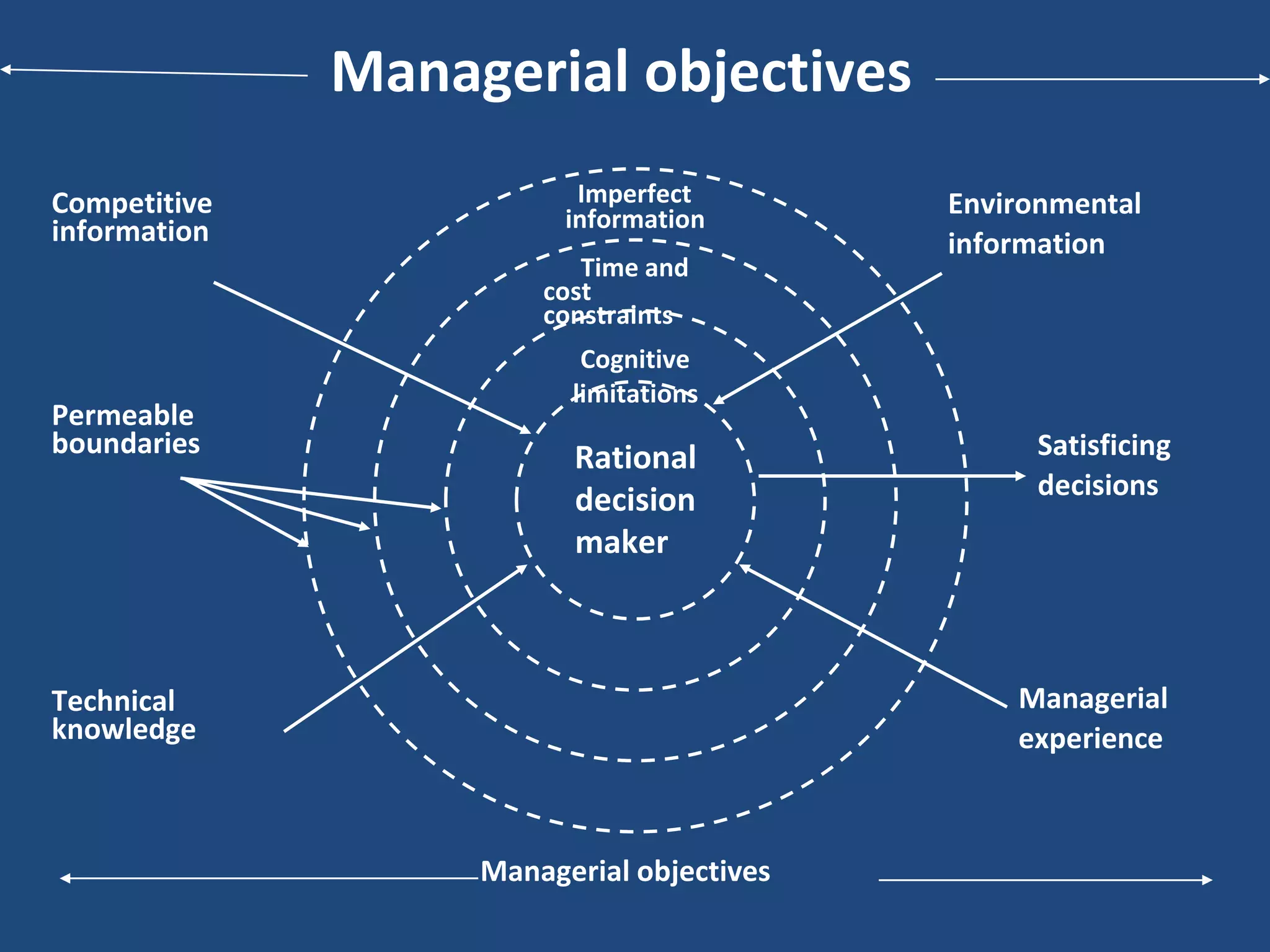
• Managerial objectives
• Conclusion
Introductio
n
⮚Management decision making is choosing a course of
action after considering different options to
accomplish an organization’s goals. Management
involves problem- solving, budgeting, coaching,
planning, organizing, staffing, controlling.
⮚Therefore, the process that goes into management
decision making serves as a continuous, dynamic
check and balance system to steer an organization to
sustained success.
Types Of Decision
Making
⮚Programmed Decision:A Decision made in
response to a situation which has occurred often
enough decision rules to be developed and applied
in the future.
⮚ Non Programmed Decision: a decision
made in response to a situation that is unique is
the poorly defined and largely unstructured
and has important consequences for the
organization.
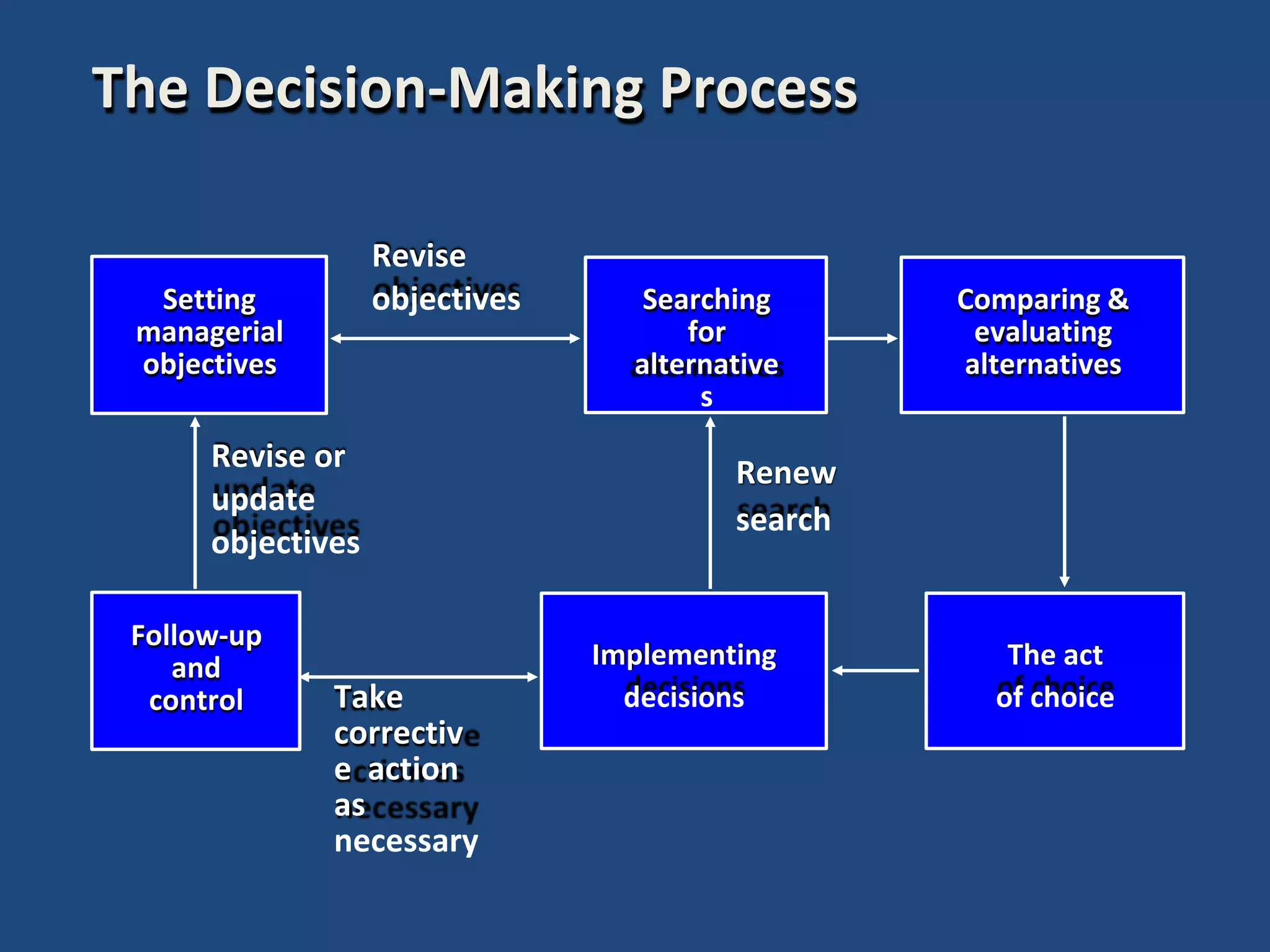
The Decision-Making Process
Searching
for
alternative
s
Implementing
decisions
Follow-up
and
control
Setting
managerial
objectives
Comparing &
evaluating
alternatives
The act
of choice
Take
correctiv
e action
as
necessary
Renew
search
Revise
objectives
Revise or
update
objectives
Characteristics of Managerial
Decisions
❖Long-range organizational objectives
❖Best choice from among a set of
alternatives
❖Decision involves organizational change
❖Decision requires a commitment of
resources
Psychological Parameters in Decision
Making
⮚Personality influences decision making.
⮚There is a human tendency to avoid
uncertainty and highly risky
situations.
⮚Perception pervades the entire process
of decision making.
⮚Preconscious and subconscious thoughts
invariably influence the decision
parameters.
The Interdisciplinary Framework of
Decision Making
The decision-
making
process
• Philosophy
• Psychology
• Mathematics
• Sociology
• Social
psychology
• Economics
• Statistics
Values and
ethics Utility and
probability
Individual
behavior
Group
behavior
Models and
simulation Environment
• Law
• Anthropology
• Political science
Rational
decision
maker
Managerial
experience
Competitive
information
Permeable
boundaries
Environmental
information
Managerial objectives
Imperfect
information
Time and
cost
constraints
Cognitive
limitations
Satisficing
decisions
Technical
knowledge
Conclusion
should make decisions to create value for all
stakeholders and society as a whole, and to achieve the
organizational goals that the team members share.
Thus, leaders should have a decision-making framework
that can be communicated to all members and practiced
by all members.
Managerial decision making.pptx

Managerial decision making.pptx