PRESENTATION: GROUP 4
Organizational Control & Evaluation
Presented
By:
Aleen Zahara (MBA 112)
Muhammad Ehsan Riaz (EMBA 129)
Irfan Aslam (MBA-118)
Sawera Saeed (EMBA 128)
Hassan Raza (EMBA126)
M Sameer Bhutta (MBA 104)
Qaiser Abass ( MBA 106)
Muhammad Rashid (MBA 123)
Mahnoor (EMBA 127)
Habib (
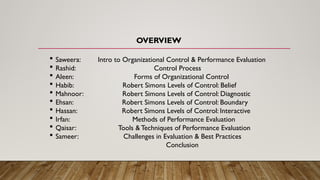
OVERVIEW
 Saweera: Intro to Organizational Control & Performance Evaluation
 Rashid: Control Process
 Aleen: Forms of Organizational Control
 Habib: Robert Simons Levels of Control: Belief
 Mahnoor: Robert Simons Levels of Control: Diagnostic
 Ehsan: Robert Simons Levels of Control: Boundary
 Hassan: Robert Simons Levels of Control: Interactive
 Irfan: Methods of Performance Evaluation
 Qaisar: Tools & Techniques of Performance Evaluation
 Sameer: Challenges in Evaluation & Best Practices
Conclusion
ORGANIZATIONAL CONTROL
Organizational control refers to the systematic processes,
mechanisms, and systems implemented by an organization to
regulate, monitor, direct, and coordinate its internal and
external activities, resources, and members. The primary
purpose of organizational control is to ensure that the
organization achieves its strategic objectives, mission, and
vision while maintaining efficiency, effectiveness, and
accountability.
•Henri Fayol in 1916, in his book, “Administration
Industrielle et Generale” gave the concept of “Control” in
5 Functions of Management.
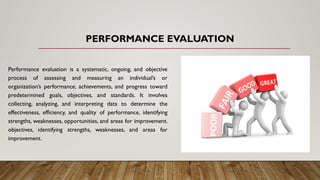
PERFORMANCE EVALUATION
Performance evaluation is a systematic, ongoing, and objective
process of assessing and measuring an individual’s or
organization’s performance, achievements, and progress toward
predetermined goals, objectives, and standards. It involves
collecting, analyzing, and interpreting data to determine the
effectiveness, efficiency, and quality of performance, identifying
strengths, weaknesses, opportunities, and areas for improvement.
objectives, identifying strengths, weaknesses, and areas for
improvement.
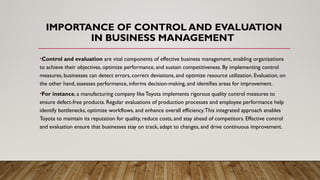
IMPORTANCE OF CONTROL AND EVALUATION
IN BUSINESS MANAGEMENT
•Control and evaluation are vital components of effective business management, enabling organizations
to achieve their objectives, optimize performance, and sustain competitiveness. By implementing control
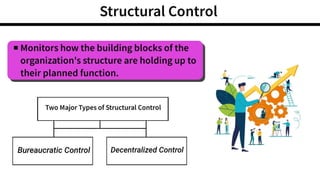
measures, businesses can detect errors, correct deviations, and optimize resource utilization. Evaluation, on
the other hand, assesses performance, informs decision-making, and identifies areas for improvement.
•For instance, a manufacturing company like Toyota implements rigorous quality control measures to
ensure defect-free products. Regular evaluations of production processes and employee performance help
identify bottlenecks, optimize workflows, and enhance overall efficiency.This integrated approach enables
Toyota to maintain its reputation for quality, reduce costs, and stay ahead of competitors. Effective control
and evaluation ensure that businesses stay on track, adapt to changes, and drive continuous improvement.
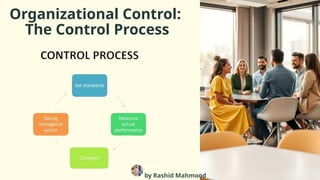
Organizational Control:
The Control Process
by Rashid Mahmood
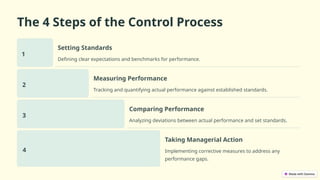
The 4 Steps of the Control Process
1
Setting Standards
Defining clear expectations and benchmarks for performance.
2
Measuring Performance
Tracking and quantifying actual performance against established standards.
3
Comparing Performance
Analyzing deviations between actual performance and set standards.
4
Taking Managerial Action
Implementing corrective measures to address any
performance gaps.
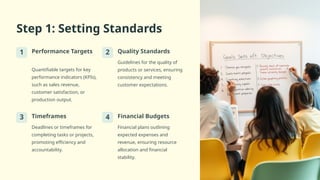
Step 1: Setting Standards
1 Performance Targets
Quantifiable targets for key
performance indicators (KPIs),
such as sales revenue,
customer satisfaction, or
production output.
2 Quality Standards
Guidelines for the quality of
products or services, ensuring
consistency and meeting
customer expectations.
3 Timeframes
Deadlines or timeframes for
completing tasks or projects,
promoting efficiency and
accountability.
4 Financial Budgets
Financial plans outlining
expected expenses and
revenue, ensuring resource
allocation and financial
stability.
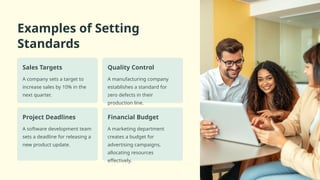
Examples of Setting
Standards
Sales Targets
A company sets a target to
increase sales by 10% in the
next quarter.
Quality Control
A manufacturing company
establishes a standard for
zero defects in their
production line.
Project Deadlines
A software development team
sets a deadline for releasing a
new product update.
Financial Budget
A marketing department
creates a budget for
advertising campaigns,
allocating resources
effectively.
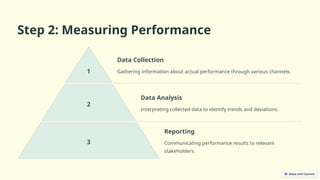
Step 2: Measuring Performance
1
Data Collection
Gathering information about actual performance through various channels.
2
Data Analysis
Interpreting collected data to identify trends and deviations.
3
Reporting
Communicating performance results to relevant
stakeholders.
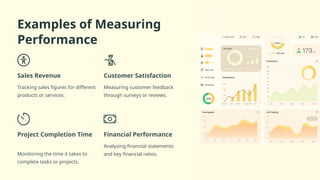
Examples of Measuring
Performance
Sales Revenue
Tracking sales figures for different
products or services.
Customer Satisfaction
Measuring customer feedback
through surveys or reviews.
Project Completion Time
Monitoring the time it takes to
complete tasks or projects.
Financial Performance
Analyzing financial statements
and key financial ratios.
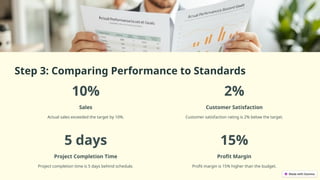
Step 3: Comparing Performance to Standards
10%
Sales
Actual sales exceeded the target by 10%.
2%
Customer Satisfaction
Customer satisfaction rating is 2% below the target.
5 days
Project Completion Time
Project completion time is 5 days behind schedule.
15%
Profit Margin
Profit margin is 15% higher than the budget.
Step 4: Taking Managerial
Action
Corrective Actions
Implementing measures to improve performance and close
the gap.
Preventive Actions
Taking steps to anticipate and prevent future deviations
from standards.
Performance Evaluation
Evaluating the effectiveness of corrective and preventive
actions.
MBA-112
Robert Simon’s Level of Control:
Belief “Values & Purposes”
by Habib-ur-Rasool
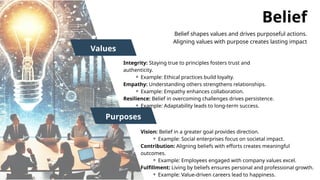
Integrity: Staying true to principles fosters trust and
authenticity.
⚬ Example: Ethical practices build loyalty.
Empathy: Understanding others strengthens relationships.
⚬ Example: Empathy enhances collaboration.
Resilience: Belief in overcoming challenges drives persistence.
⚬ Example: Adaptability leads to long-term success.
Values
Purposes
Vision: Belief in a greater goal provides direction.
⚬ Example: Social enterprises focus on societal impact.
Contribution: Aligning beliefs with efforts creates meaningful
outcomes.
⚬ Example: Employees engaged with company values excel.
Fulfillment: Living by beliefs ensures personal and professional growth.
⚬ Example: Value-driven careers lead to happiness.
Belief
Belief shapes values and drives purposeful actions.
Aligning values with purpose creates lasting impact
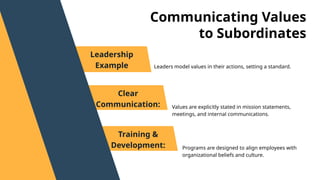
Values are explicitly stated in mission statements,
meetings, and internal communications.
Leadership
Example
Clear
Communication:
Training &
Development:
Communicating Values
to Subordinates
Programs are designed to align employees with
organizational beliefs and culture.
Leaders model values in their actions, setting a standard.
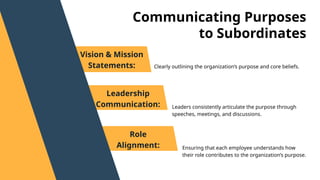
Leaders consistently articulate the purpose through
speeches, meetings, and discussions.
Vision & Mission
Statements:
Leadership
Communication:
Role
Alignment:
Communicating Purposes
to Subordinates
Ensuring that each employee understands how
their role contributes to the organization’s purpose.
Clearly outlining the organization’s purpose and core beliefs.
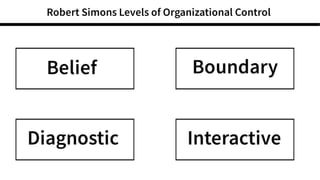
ROBERT SIMONS’ LEVELS OF CONTROL:
DIAGNOSTICS
MAHNOOR AAMIR
EMBA-27
Robert Simons’ Levels of Control framework focuses on how managers can
use different control systems to balance innovation and efficiency, while also
aligning employees’ actions with organizational goals.
OVERVIEW
DIAGNOSTIC CONTROL SYSTEMS
Diagnostic Control Systems are formal systems used by managers to track
key performance indicators (KPIs), monitor progress toward strategic goals,
and address deviations from expected results. These systems help ensure that
employees and departments remain aligned with the organization's goals.
KEY FEATURES
Monitoring and Measurement: Regularly track performance against
predefined standards or benchmarks (e.g., sales targets, production quotas,
customer satisfaction scores).
Focus on Efficiency: Emphasis on achieving targets with minimal resource
wastage.
Corrective Actions: Identify and address variances through corrective
measures to stay aligned with goals.
Feedback Loops: Provide managers with performance data to inform
decision-making and future planning.
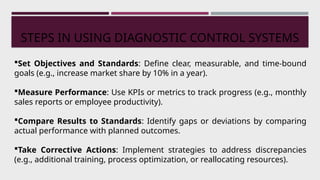
STEPS IN USING DIAGNOSTIC CONTROL SYSTEMS
Set Objectives and Standards: Define clear, measurable, and time-bound
goals (e.g., increase market share by 10% in a year).
Measure Performance: Use KPIs or metrics to track progress (e.g., monthly
sales reports or employee productivity).
Compare Results to Standards: Identify gaps or deviations by comparing
actual performance with planned outcomes.
Take Corrective Actions: Implement strategies to address discrepancies
(e.g., additional training, process optimization, or reallocating resources).
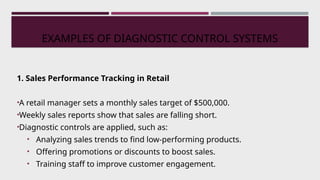
EXAMPLES OF DIAGNOSTIC CONTROL SYSTEMS
1. Sales Performance Tracking in Retail
•A retail manager sets a monthly sales target of $500,000.
•Weekly sales reports show that sales are falling short.
•Diagnostic controls are applied, such as:
• Analyzing sales trends to find low-performing products.
• Offering promotions or discounts to boost sales.
• Training staff to improve customer engagement.
EXAMPLE
2. Quality Control in Manufacturing
•A factory has a goal of producing 10,000 units per week with less than 1%
defect rate.
•Quality checks reveal a defect rate of 3%.
•Managers use diagnostic systems to:
• Identify faulty machinery or processes causing defects.
• Implement stricter quality checks or equipment maintenance.
• Adjust workflows to reduce errors.
STRENGTHS OF DIAGNOSTIC CONTROL SYSTEMS
Goal Alignment: Keeps employees and departments focused on achieving
strategic objectives.
Efficiency: Ensures resources are used optimally.
Accountability: Provides clear performance metrics to hold individuals
accountable.
Risk Mitigation: Quickly identifies and addresses performance issues.
LIMITATIONS
•Overemphasis on Metrics: Can lead to neglect of non-measurable aspects
like creativity and employee morale.
•Lagging Indicators: Focuses on past performance, which may delay
responses to real-time issues.
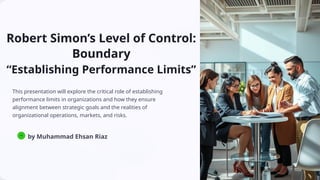
Robert Simon’s Level of Control:
Boundary
“Establishing Performance Limits”
This presentation will explore the critical role of establishing
performance limits in organizations and how they ensure
alignment between strategic goals and the realities of
organizational operations, markets, and risks.
MR
by Muhammad Ehsan Riaz
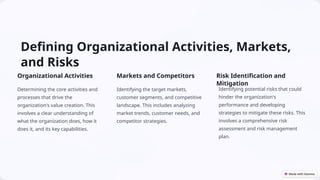
Defining Organizational Activities, Markets,
and Risks
Organizational Activities
Determining the core activities and
processes that drive the
organization's value creation. This
involves a clear understanding of
what the organization does, how it
does it, and its key capabilities.
Markets and Competitors
Identifying the target markets,
customer segments, and competitive
landscape. This includes analyzing
market trends, customer needs, and
competitor strategies.
Risk Identification and
Mitigation
Identifying potential risks that could
hinder the organization's
performance and developing
strategies to mitigate these risks. This
involves a comprehensive risk
assessment and risk management
plan.
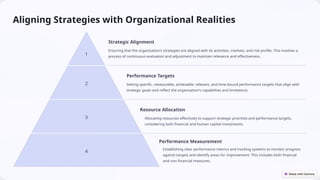
Aligning Strategies with Organizational Realities
1
Strategic Alignment
Ensuring that the organization's strategies are aligned with its activities, markets, and risk profile. This involves a
process of continuous evaluation and adjustment to maintain relevance and effectiveness.
2
Performance Targets
Setting specific, measurable, achievable, relevant, and time-bound performance targets that align with
strategic goals and reflect the organization's capabilities and limitations.
3
Resource Allocation
Allocating resources effectively to support strategic priorities and performance targets,
considering both financial and human capital investments.
4
Performance Measurement
Establishing clear performance metrics and tracking systems to monitor progress
against targets and identify areas for improvement. This includes both financial
and non-financial measures.
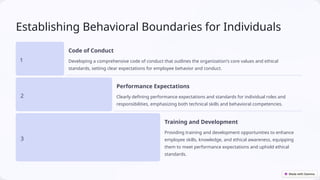
Establishing Behavioral Boundaries for Individuals
1
Code of Conduct
Developing a comprehensive code of conduct that outlines the organization's core values and ethical
standards, setting clear expectations for employee behavior and conduct.
2
Performance Expectations
Clearly defining performance expectations and standards for individual roles and
responsibilities, emphasizing both technical skills and behavioral competencies.
3
Training and Development
Providing training and development opportunities to enhance
employee skills, knowledge, and ethical awareness, equipping
them to meet performance expectations and uphold ethical
standards.
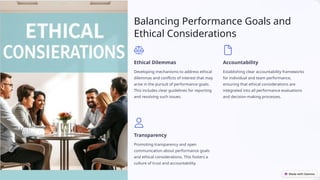
Balancing Performance Goals and
Ethical Considerations
Ethical Dilemmas
Developing mechanisms to address ethical
dilemmas and conflicts of interest that may
arise in the pursuit of performance goals.
This includes clear guidelines for reporting
and resolving such issues.
Accountability
Establishing clear accountability frameworks
for individual and team performance,
ensuring that ethical considerations are
integrated into all performance evaluations
and decision-making processes.
Transparency
Promoting transparency and open
communication about performance goals
and ethical considerations. This fosters a
culture of trust and accountability.
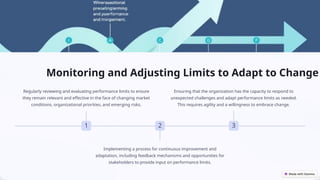
Monitoring and Adjusting Limits to Adapt to Change
1
Regularly reviewing and evaluating performance limits to ensure
they remain relevant and effective in the face of changing market
conditions, organizational priorities, and emerging risks.
2
Implementing a process for continuous improvement and
adaptation, including feedback mechanisms and opportunities for
stakeholders to provide input on performance limits.
3
Ensuring that the organization has the capacity to respond to
unexpected challenges and adapt performance limits as needed.
This requires agility and a willingness to embrace change.
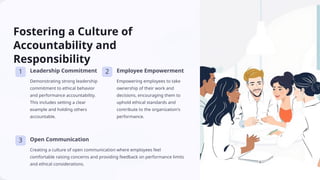
Fostering a Culture of
Accountability and
Responsibility
1 Leadership Commitment
Demonstrating strong leadership
commitment to ethical behavior
and performance accountability.
This includes setting a clear
example and holding others
accountable.
2 Employee Empowerment
Empowering employees to take
ownership of their work and
decisions, encouraging them to
uphold ethical standards and
contribute to the organization's
performance.
3 Open Communication
Creating a culture of open communication where employees feel
comfortable raising concerns and providing feedback on performance limits
and ethical considerations.
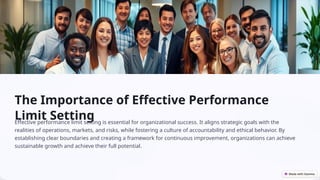
The Importance of Effective Performance
Limit Setting
Effective performance limit setting is essential for organizational success. It aligns strategic goals with the
realities of operations, markets, and risks, while fostering a culture of accountability and ethical behavior. By
establishing clear boundaries and creating a framework for continuous improvement, organizations can achieve
sustainable growth and achieve their full potential.
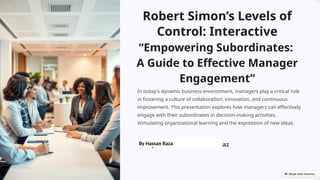
Robert Simon’s Levels of
Control: Interactive
“Empowering Subordinates:
A Guide to Effective Manager
Engagement”
In today's dynamic business environment, managers play a critical role
in fostering a culture of collaboration, innovation, and continuous
improvement. This presentation explores how managers can effectively
engage with their subordinates in decision-making activities,
stimulating organizational learning and the expression of new ideas.
MR
by Muhammad Ehsan Riaz
By Hassan Raza
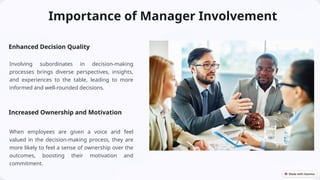
Importance of Manager Involvement
Enhanced Decision Quality
Involving subordinates in decision-making
processes brings diverse perspectives, insights,
and experiences to the table, leading to more
informed and well-rounded decisions.
Increased Ownership and Motivation
When employees are given a voice and feel
valued in the decision-making process, they are
more likely to feel a sense of ownership over the
outcomes, boosting their motivation and
commitment.
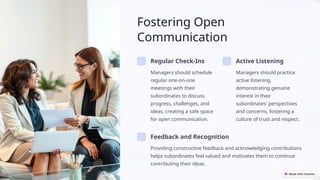
Fostering Open
Communication
Regular Check-Ins
Managers should schedule
regular one-on-one
meetings with their
subordinates to discuss
progress, challenges, and
ideas, creating a safe space
for open communication.
Active Listening
Managers should practice
active listening,
demonstrating genuine
interest in their
subordinates' perspectives
and concerns, fostering a
culture of trust and respect.
Feedback and Recognition
Providing constructive feedback and acknowledging contributions
helps subordinates feel valued and motivates them to continue
contributing their ideas.
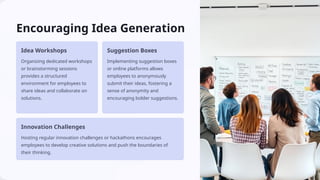
Encouraging Idea Generation
Idea Workshops
Organizing dedicated workshops
or brainstorming sessions
provides a structured
environment for employees to
share ideas and collaborate on
solutions.
Suggestion Boxes
Implementing suggestion boxes
or online platforms allows
employees to anonymously
submit their ideas, fostering a
sense of anonymity and
encouraging bolder suggestions.
Innovation Challenges
Hosting regular innovation challenges or hackathons encourages
employees to develop creative solutions and push the boundaries of
their thinking.
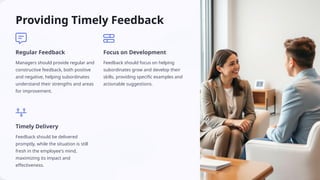
Providing Timely Feedback
Regular Feedback
Managers should provide regular and
constructive feedback, both positive
and negative, helping subordinates
understand their strengths and areas
for improvement.
Focus on Development
Feedback should focus on helping
subordinates grow and develop their
skills, providing specific examples and
actionable suggestions.
Timely Delivery
Feedback should be delivered
promptly, while the situation is still
fresh in the employee's mind,
maximizing its impact and
effectiveness.
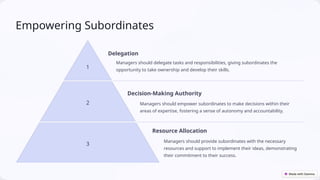
Empowering Subordinates
1
Delegation
Managers should delegate tasks and responsibilities, giving subordinates the
opportunity to take ownership and develop their skills.
2
Decision-Making Authority
Managers should empower subordinates to make decisions within their
areas of expertise, fostering a sense of autonomy and accountability.
3
Resource Allocation
Managers should provide subordinates with the necessary
resources and support to implement their ideas, demonstrating
their commitment to their success.
Cultivating a Culture of Learning
1 Continuous Learning
Managers should encourage continuous learning by providing
opportunities for professional development, mentorship, and
knowledge sharing.
2 Mentoring and Coaching
Managers should act as mentors and coaches, guiding and supporting
their subordinates in their professional growth and development.
3 Open Communication and Feedback
Managers should foster an open and transparent communication
culture where feedback is encouraged and used for learning and
improvement.
Measuring and Improving Engagement
Surveys
Conduct regular surveys to gauge
employee satisfaction,
engagement, and perception of
their decision-making influence.
Feedback
Collect feedback from employees
on their experiences with decision-
making processes and identify
areas for improvement.
Data Analysis
Analyze data from surveys and
feedback to identify trends,
patterns, and opportunities for
enhancing engagement and
decision-making.
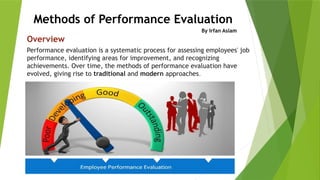
Overview
Performance evaluation is a systematic process for assessing employees' job
performance, identifying areas for improvement, and recognizing
achievements. Over time, the methods of performance evaluation have
evolved, giving rise to traditional and modern approaches.
Methods of Performance Evaluation
By Irfan Aslam
1. Traditional Methods of Performance Evaluation
Traditional methods are more structured, quantitative, and often focus on
individual performance. These methods are simple and have been widely used
in organizations for decades.
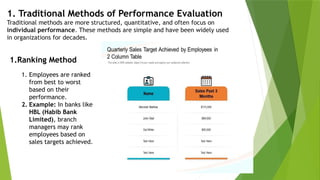
1.Ranking Method
1. Employees are ranked
from best to worst
based on their
performance.
2. Example: In banks like
HBL (Habib Bank
Limited), branch
managers may rank
employees based on
sales targets achieved.
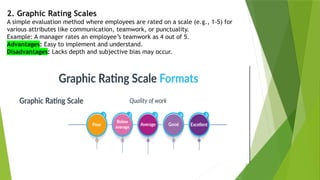
2. Graphic Rating Scales
A simple evaluation method where employees are rated on a scale (e.g., 1-5) for
various attributes like communication, teamwork, or punctuality.
Example: A manager rates an employee’s teamwork as 4 out of 5.
Advantages: Easy to implement and understand.
Disadvantages: Lacks depth and subjective bias may occur.
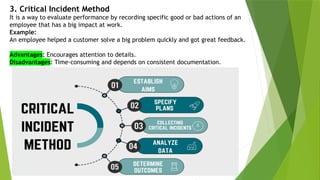
3. Critical Incident Method
It is a way to evaluate performance by recording specific good or bad actions of an
employee that has a big impact at work.
Example:
An employee helped a customer solve a big problem quickly and got great feedback.
Advantages: Encourages attention to details.
Disadvantages: Time-consuming and depends on consistent documentation.
Modern Methods
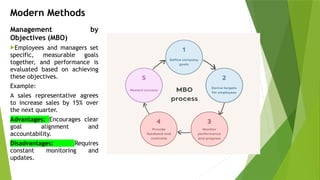
Management by
Objectives (MBO)
Employees and managers set
specific, measurable goals
together, and performance is
evaluated based on achieving
these objectives.
Example:
A sales representative agrees
to increase sales by 15% over
the next quarter.
Advantages: Encourages clear
goal alignment and
accountability.
Disadvantages: Requires
constant monitoring and
updates.
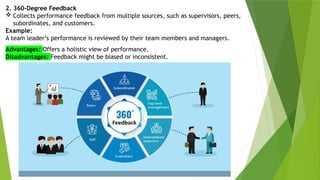
2. 360-Degree Feedback
 Collects performance feedback from multiple sources, such as supervisors, peers,
subordinates, and customers.
Example:
A team leader’s performance is reviewed by their team members and managers.
Advantages: Offers a holistic view of performance.
Disadvantages: Feedback might be biased or inconsistent.
Behavioral Assessment Techniques
Evaluates an employee’s behavior in specific situations using
structured frameworks or simulations.
Example:
Observing how a manager resolves conflicts in a training simulation.
Advantages: Focuses on actionable behaviors rather than subjective
traits.
Disadvantages: Can be resource-intensive.
Selecting the right performance evaluation method
depends on organizational needs, the complexity of roles,
and desired outcomes. Combining traditional and modern
methods often provides the most comprehensive results.
Tools and Techniques of Performance Evaluation
Data Collection
Surveys, interviews, observations, and document reviews
are crucial for gathering data to inform decisions. You can
also use data analytics software to collect information and
analyze data trends.
Data Analysis
Use statistical methods and visualization tools to identify
patterns, trends, and key insights. Excel, Tableau, and R can
be used to analyze data and present results in a clear and
concise format.
By Qaiser Khan
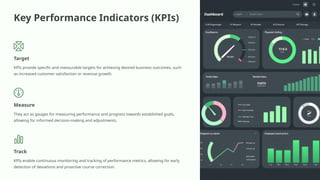
Key Performance Indicators (KPIs)
Target
KPIs provide specific and measurable targets for achieving desired business outcomes, such
as increased customer satisfaction or revenue growth.
Measure
They act as gauges for measuring performance and progress towards established goals,
allowing for informed decision-making and adjustments.
Track
KPIs enable continuous monitoring and tracking of performance metrics, allowing for early
detection of deviations and proactive course correction.
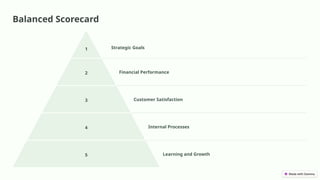
Balanced Scorecard
1 Strategic Goals
2 Financial Performance
3 Customer Satisfaction
4 Internal Processes
5 Learning and Growth
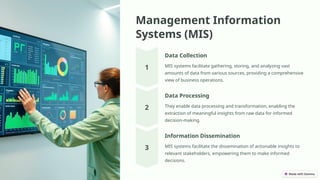
Management Information
Systems (MIS)
Data Collection
MIS systems facilitate gathering, storing, and analyzing vast
amounts of data from various sources, providing a comprehensive
view of business operations.
Data Processing
They enable data processing and transformation, enabling the
extraction of meaningful insights from raw data for informed
decision-making.
Information Dissemination
MIS systems facilitate the dissemination of actionable insights to
relevant stakeholders, empowering them to make informed
decisions.
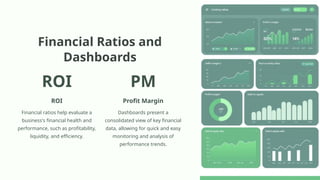
Financial Ratios and
Dashboards
ROI
ROI
Financial ratios help evaluate a
business's financial health and
performance, such as profitability,
liquidity, and efficiency.
PM
Profit Margin
Dashboards present a
consolidated view of key financial
data, allowing for quick and easy
monitoring and analysis of
performance trends.
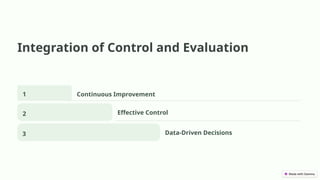
Integration of Control and Evaluation
1 Continuous Improvement
2 Effective Control
3 Data-Driven Decisions
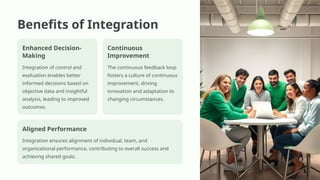
Benefits of Integration
Enhanced Decision-
Making
Integration of control and
evaluation enables better
informed decisions based on
objective data and insightful
analysis, leading to improved
outcomes.
Continuous
Improvement
The continuous feedback loop
fosters a culture of continuous
improvement, driving
innovation and adaptation to
changing circumstances.
Aligned Performance
Integration ensures alignment of individual, team, and
organizational performance, contributing to overall success and
achieving shared goals.
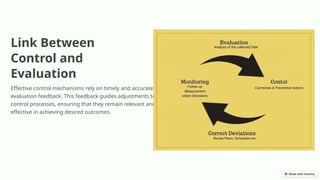
Link Between
Control and
Evaluation
Effective control mechanisms rely on timely and accurate
evaluation feedback. This feedback guides adjustments to
control processes, ensuring that they remain relevant and
effective in achieving desired outcomes.
Challenges in Performance
Evaluation
Performance evaluation is essential for effective business
management. However, companies face numerous challenges in
accurately assessing employee performance, leading to
suboptimal outcomes. This presentation explores key challenges
and outlines best practices to overcome them. It will also cover
the importance of effective performance management and how
to implement a successful strategy.
by Sameer Bhutta
Key Challenges in Performance Evaluation
Subjectivity and Bias
Personal opinions and biases can
influence evaluations, leading to
unfair assessments. It's crucial to
establish objective criteria to
mitigate bias and ensure fairness.
Lack of Clear Goals and
Expectations
Without well-defined goals,
employees may struggle to
understand what's expected of
them. This can result in
misaligned efforts and inaccurate
performance evaluations.
Limited Feedback and
Development Opportunities
Regular feedback is vital for
employee growth. Insufficient
feedback can hinder development
and limit performance
improvement.
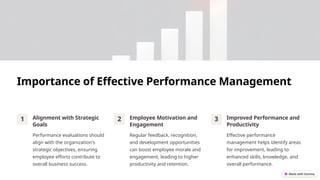
Importance of Effective Performance Management
1 Alignment with Strategic
Goals
Performance evaluations should
align with the organization's
strategic objectives, ensuring
employee efforts contribute to
overall business success.
2 Employee Motivation and
Engagement
Regular feedback, recognition,
and development opportunities
can boost employee morale and
engagement, leading to higher
productivity and retention.
3 Improved Performance and
Productivity
Effective performance
management helps identify areas
for improvement, leading to
enhanced skills, knowledge, and
overall performance.
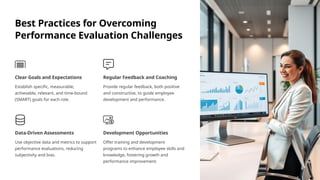
Best Practices for Overcoming
Performance Evaluation Challenges
Clear Goals and Expectations
Establish specific, measurable,
achievable, relevant, and time-bound
(SMART) goals for each role.
Regular Feedback and Coaching
Provide regular feedback, both positive
and constructive, to guide employee
development and performance.
Data-Driven Assessments
Use objective data and metrics to support
performance evaluations, reducing
subjectivity and bias.
Development Opportunities
Offer training and development
programs to enhance employee skills and
knowledge, fostering growth and
performance improvement.
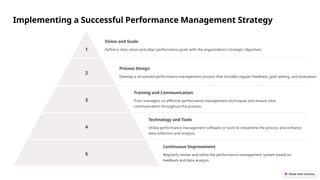
Implementing a Successful Performance Management Strategy
1
Vision and Goals
Define a clear vision and align performance goals with the organization's strategic objectives.
2
Process Design
Develop a structured performance management process that includes regular feedback, goal setting, and evaluation.
3
Training and Communication
Train managers on effective performance management techniques and ensure clear
communication throughout the process.
4
Technology and Tools
Utilize performance management software or tools to streamline the process and enhance
data collection and analysis.
5
Continuous Improvement
Regularly review and refine the performance management system based on
feedback and data analysis.
Conclusion
Effective performance evaluation is crucial for organizational
control and achieving business success. By addressing key
challenges, embracing best practices, and implementing a robust
performance management strategy, companies can foster
employee growth, improve productivity, and achieve their
strategic goals. Consistent, transparent, and fair performance
evaluation is essential for building a thriving and successful
organization.

Managemnt Presenation.pptxhhhhhhhhhĥhhhhhh

  • 1.
    PRESENTATION: GROUP 4 OrganizationalControl & Evaluation Presented By: Aleen Zahara (MBA 112) Muhammad Ehsan Riaz (EMBA 129) Irfan Aslam (MBA-118) Sawera Saeed (EMBA 128) Hassan Raza (EMBA126) M Sameer Bhutta (MBA 104) Qaiser Abass ( MBA 106) Muhammad Rashid (MBA 123) Mahnoor (EMBA 127) Habib (
  • 2.
    OVERVIEW  Saweera: Introto Organizational Control & Performance Evaluation  Rashid: Control Process  Aleen: Forms of Organizational Control  Habib: Robert Simons Levels of Control: Belief  Mahnoor: Robert Simons Levels of Control: Diagnostic  Ehsan: Robert Simons Levels of Control: Boundary  Hassan: Robert Simons Levels of Control: Interactive  Irfan: Methods of Performance Evaluation  Qaisar: Tools & Techniques of Performance Evaluation  Sameer: Challenges in Evaluation & Best Practices Conclusion
  • 3.
    ORGANIZATIONAL CONTROL Organizational controlrefers to the systematic processes, mechanisms, and systems implemented by an organization to regulate, monitor, direct, and coordinate its internal and external activities, resources, and members. The primary purpose of organizational control is to ensure that the organization achieves its strategic objectives, mission, and vision while maintaining efficiency, effectiveness, and accountability. •Henri Fayol in 1916, in his book, “Administration Industrielle et Generale” gave the concept of “Control” in 5 Functions of Management.
  • 4.
    PERFORMANCE EVALUATION Performance evaluationis a systematic, ongoing, and objective process of assessing and measuring an individual’s or organization’s performance, achievements, and progress toward predetermined goals, objectives, and standards. It involves collecting, analyzing, and interpreting data to determine the effectiveness, efficiency, and quality of performance, identifying strengths, weaknesses, opportunities, and areas for improvement. objectives, identifying strengths, weaknesses, and areas for improvement.
  • 5.
    IMPORTANCE OF CONTROLAND EVALUATION IN BUSINESS MANAGEMENT •Control and evaluation are vital components of effective business management, enabling organizations to achieve their objectives, optimize performance, and sustain competitiveness. By implementing control measures, businesses can detect errors, correct deviations, and optimize resource utilization. Evaluation, on the other hand, assesses performance, informs decision-making, and identifies areas for improvement. •For instance, a manufacturing company like Toyota implements rigorous quality control measures to ensure defect-free products. Regular evaluations of production processes and employee performance help identify bottlenecks, optimize workflows, and enhance overall efficiency.This integrated approach enables Toyota to maintain its reputation for quality, reduce costs, and stay ahead of competitors. Effective control and evaluation ensure that businesses stay on track, adapt to changes, and drive continuous improvement.
  • 6.
    Organizational Control: The ControlProcess by Rashid Mahmood
  • 7.
    The 4 Stepsof the Control Process 1 Setting Standards Defining clear expectations and benchmarks for performance. 2 Measuring Performance Tracking and quantifying actual performance against established standards. 3 Comparing Performance Analyzing deviations between actual performance and set standards. 4 Taking Managerial Action Implementing corrective measures to address any performance gaps.
  • 8.
    Step 1: SettingStandards 1 Performance Targets Quantifiable targets for key performance indicators (KPIs), such as sales revenue, customer satisfaction, or production output. 2 Quality Standards Guidelines for the quality of products or services, ensuring consistency and meeting customer expectations. 3 Timeframes Deadlines or timeframes for completing tasks or projects, promoting efficiency and accountability. 4 Financial Budgets Financial plans outlining expected expenses and revenue, ensuring resource allocation and financial stability.
  • 9.
    Examples of Setting Standards SalesTargets A company sets a target to increase sales by 10% in the next quarter. Quality Control A manufacturing company establishes a standard for zero defects in their production line. Project Deadlines A software development team sets a deadline for releasing a new product update. Financial Budget A marketing department creates a budget for advertising campaigns, allocating resources effectively.
  • 10.
    Step 2: MeasuringPerformance 1 Data Collection Gathering information about actual performance through various channels. 2 Data Analysis Interpreting collected data to identify trends and deviations. 3 Reporting Communicating performance results to relevant stakeholders.
  • 11.
    Examples of Measuring Performance SalesRevenue Tracking sales figures for different products or services. Customer Satisfaction Measuring customer feedback through surveys or reviews. Project Completion Time Monitoring the time it takes to complete tasks or projects. Financial Performance Analyzing financial statements and key financial ratios.
  • 12.
    Step 3: ComparingPerformance to Standards 10% Sales Actual sales exceeded the target by 10%. 2% Customer Satisfaction Customer satisfaction rating is 2% below the target. 5 days Project Completion Time Project completion time is 5 days behind schedule. 15% Profit Margin Profit margin is 15% higher than the budget.
  • 13.
    Step 4: TakingManagerial Action Corrective Actions Implementing measures to improve performance and close the gap. Preventive Actions Taking steps to anticipate and prevent future deviations from standards. Performance Evaluation Evaluating the effectiveness of corrective and preventive actions.
  • 14.
  • 24.
    Robert Simon’s Levelof Control: Belief “Values & Purposes” by Habib-ur-Rasool
  • 25.
    Integrity: Staying trueto principles fosters trust and authenticity. ⚬ Example: Ethical practices build loyalty. Empathy: Understanding others strengthens relationships. ⚬ Example: Empathy enhances collaboration. Resilience: Belief in overcoming challenges drives persistence. ⚬ Example: Adaptability leads to long-term success. Values Purposes Vision: Belief in a greater goal provides direction. ⚬ Example: Social enterprises focus on societal impact. Contribution: Aligning beliefs with efforts creates meaningful outcomes. ⚬ Example: Employees engaged with company values excel. Fulfillment: Living by beliefs ensures personal and professional growth. ⚬ Example: Value-driven careers lead to happiness. Belief Belief shapes values and drives purposeful actions. Aligning values with purpose creates lasting impact
  • 26.
    Values are explicitlystated in mission statements, meetings, and internal communications. Leadership Example Clear Communication: Training & Development: Communicating Values to Subordinates Programs are designed to align employees with organizational beliefs and culture. Leaders model values in their actions, setting a standard.
  • 27.
    Leaders consistently articulatethe purpose through speeches, meetings, and discussions. Vision & Mission Statements: Leadership Communication: Role Alignment: Communicating Purposes to Subordinates Ensuring that each employee understands how their role contributes to the organization’s purpose. Clearly outlining the organization’s purpose and core beliefs.
  • 28.
    ROBERT SIMONS’ LEVELSOF CONTROL: DIAGNOSTICS MAHNOOR AAMIR EMBA-27
  • 29.
    Robert Simons’ Levelsof Control framework focuses on how managers can use different control systems to balance innovation and efficiency, while also aligning employees’ actions with organizational goals. OVERVIEW
  • 30.
    DIAGNOSTIC CONTROL SYSTEMS DiagnosticControl Systems are formal systems used by managers to track key performance indicators (KPIs), monitor progress toward strategic goals, and address deviations from expected results. These systems help ensure that employees and departments remain aligned with the organization's goals.
  • 31.
    KEY FEATURES Monitoring andMeasurement: Regularly track performance against predefined standards or benchmarks (e.g., sales targets, production quotas, customer satisfaction scores). Focus on Efficiency: Emphasis on achieving targets with minimal resource wastage. Corrective Actions: Identify and address variances through corrective measures to stay aligned with goals. Feedback Loops: Provide managers with performance data to inform decision-making and future planning.
  • 32.
    STEPS IN USINGDIAGNOSTIC CONTROL SYSTEMS Set Objectives and Standards: Define clear, measurable, and time-bound goals (e.g., increase market share by 10% in a year). Measure Performance: Use KPIs or metrics to track progress (e.g., monthly sales reports or employee productivity). Compare Results to Standards: Identify gaps or deviations by comparing actual performance with planned outcomes. Take Corrective Actions: Implement strategies to address discrepancies (e.g., additional training, process optimization, or reallocating resources).
  • 33.
    EXAMPLES OF DIAGNOSTICCONTROL SYSTEMS 1. Sales Performance Tracking in Retail •A retail manager sets a monthly sales target of $500,000. •Weekly sales reports show that sales are falling short. •Diagnostic controls are applied, such as: • Analyzing sales trends to find low-performing products. • Offering promotions or discounts to boost sales. • Training staff to improve customer engagement.
  • 34.
    EXAMPLE 2. Quality Controlin Manufacturing •A factory has a goal of producing 10,000 units per week with less than 1% defect rate. •Quality checks reveal a defect rate of 3%. •Managers use diagnostic systems to: • Identify faulty machinery or processes causing defects. • Implement stricter quality checks or equipment maintenance. • Adjust workflows to reduce errors.
  • 35.
    STRENGTHS OF DIAGNOSTICCONTROL SYSTEMS Goal Alignment: Keeps employees and departments focused on achieving strategic objectives. Efficiency: Ensures resources are used optimally. Accountability: Provides clear performance metrics to hold individuals accountable. Risk Mitigation: Quickly identifies and addresses performance issues.
  • 36.
    LIMITATIONS •Overemphasis on Metrics:Can lead to neglect of non-measurable aspects like creativity and employee morale. •Lagging Indicators: Focuses on past performance, which may delay responses to real-time issues.
  • 37.
    Robert Simon’s Levelof Control: Boundary “Establishing Performance Limits” This presentation will explore the critical role of establishing performance limits in organizations and how they ensure alignment between strategic goals and the realities of organizational operations, markets, and risks. MR by Muhammad Ehsan Riaz
  • 38.
    Defining Organizational Activities,Markets, and Risks Organizational Activities Determining the core activities and processes that drive the organization's value creation. This involves a clear understanding of what the organization does, how it does it, and its key capabilities. Markets and Competitors Identifying the target markets, customer segments, and competitive landscape. This includes analyzing market trends, customer needs, and competitor strategies. Risk Identification and Mitigation Identifying potential risks that could hinder the organization's performance and developing strategies to mitigate these risks. This involves a comprehensive risk assessment and risk management plan.
  • 39.
    Aligning Strategies withOrganizational Realities 1 Strategic Alignment Ensuring that the organization's strategies are aligned with its activities, markets, and risk profile. This involves a process of continuous evaluation and adjustment to maintain relevance and effectiveness. 2 Performance Targets Setting specific, measurable, achievable, relevant, and time-bound performance targets that align with strategic goals and reflect the organization's capabilities and limitations. 3 Resource Allocation Allocating resources effectively to support strategic priorities and performance targets, considering both financial and human capital investments. 4 Performance Measurement Establishing clear performance metrics and tracking systems to monitor progress against targets and identify areas for improvement. This includes both financial and non-financial measures.
  • 40.
    Establishing Behavioral Boundariesfor Individuals 1 Code of Conduct Developing a comprehensive code of conduct that outlines the organization's core values and ethical standards, setting clear expectations for employee behavior and conduct. 2 Performance Expectations Clearly defining performance expectations and standards for individual roles and responsibilities, emphasizing both technical skills and behavioral competencies. 3 Training and Development Providing training and development opportunities to enhance employee skills, knowledge, and ethical awareness, equipping them to meet performance expectations and uphold ethical standards.
  • 41.
    Balancing Performance Goalsand Ethical Considerations Ethical Dilemmas Developing mechanisms to address ethical dilemmas and conflicts of interest that may arise in the pursuit of performance goals. This includes clear guidelines for reporting and resolving such issues. Accountability Establishing clear accountability frameworks for individual and team performance, ensuring that ethical considerations are integrated into all performance evaluations and decision-making processes. Transparency Promoting transparency and open communication about performance goals and ethical considerations. This fosters a culture of trust and accountability.
  • 42.
    Monitoring and AdjustingLimits to Adapt to Change 1 Regularly reviewing and evaluating performance limits to ensure they remain relevant and effective in the face of changing market conditions, organizational priorities, and emerging risks. 2 Implementing a process for continuous improvement and adaptation, including feedback mechanisms and opportunities for stakeholders to provide input on performance limits. 3 Ensuring that the organization has the capacity to respond to unexpected challenges and adapt performance limits as needed. This requires agility and a willingness to embrace change.
  • 43.
    Fostering a Cultureof Accountability and Responsibility 1 Leadership Commitment Demonstrating strong leadership commitment to ethical behavior and performance accountability. This includes setting a clear example and holding others accountable. 2 Employee Empowerment Empowering employees to take ownership of their work and decisions, encouraging them to uphold ethical standards and contribute to the organization's performance. 3 Open Communication Creating a culture of open communication where employees feel comfortable raising concerns and providing feedback on performance limits and ethical considerations.
  • 44.
    The Importance ofEffective Performance Limit Setting Effective performance limit setting is essential for organizational success. It aligns strategic goals with the realities of operations, markets, and risks, while fostering a culture of accountability and ethical behavior. By establishing clear boundaries and creating a framework for continuous improvement, organizations can achieve sustainable growth and achieve their full potential.
  • 45.
    Robert Simon’s Levelsof Control: Interactive “Empowering Subordinates: A Guide to Effective Manager Engagement” In today's dynamic business environment, managers play a critical role in fostering a culture of collaboration, innovation, and continuous improvement. This presentation explores how managers can effectively engage with their subordinates in decision-making activities, stimulating organizational learning and the expression of new ideas. MR by Muhammad Ehsan Riaz By Hassan Raza
  • 46.
    Importance of ManagerInvolvement Enhanced Decision Quality Involving subordinates in decision-making processes brings diverse perspectives, insights, and experiences to the table, leading to more informed and well-rounded decisions. Increased Ownership and Motivation When employees are given a voice and feel valued in the decision-making process, they are more likely to feel a sense of ownership over the outcomes, boosting their motivation and commitment.
  • 47.
    Fostering Open Communication Regular Check-Ins Managersshould schedule regular one-on-one meetings with their subordinates to discuss progress, challenges, and ideas, creating a safe space for open communication. Active Listening Managers should practice active listening, demonstrating genuine interest in their subordinates' perspectives and concerns, fostering a culture of trust and respect. Feedback and Recognition Providing constructive feedback and acknowledging contributions helps subordinates feel valued and motivates them to continue contributing their ideas.
  • 48.
    Encouraging Idea Generation IdeaWorkshops Organizing dedicated workshops or brainstorming sessions provides a structured environment for employees to share ideas and collaborate on solutions. Suggestion Boxes Implementing suggestion boxes or online platforms allows employees to anonymously submit their ideas, fostering a sense of anonymity and encouraging bolder suggestions. Innovation Challenges Hosting regular innovation challenges or hackathons encourages employees to develop creative solutions and push the boundaries of their thinking.
  • 49.
    Providing Timely Feedback RegularFeedback Managers should provide regular and constructive feedback, both positive and negative, helping subordinates understand their strengths and areas for improvement. Focus on Development Feedback should focus on helping subordinates grow and develop their skills, providing specific examples and actionable suggestions. Timely Delivery Feedback should be delivered promptly, while the situation is still fresh in the employee's mind, maximizing its impact and effectiveness.
  • 50.
    Empowering Subordinates 1 Delegation Managers shoulddelegate tasks and responsibilities, giving subordinates the opportunity to take ownership and develop their skills. 2 Decision-Making Authority Managers should empower subordinates to make decisions within their areas of expertise, fostering a sense of autonomy and accountability. 3 Resource Allocation Managers should provide subordinates with the necessary resources and support to implement their ideas, demonstrating their commitment to their success.
  • 51.
    Cultivating a Cultureof Learning 1 Continuous Learning Managers should encourage continuous learning by providing opportunities for professional development, mentorship, and knowledge sharing. 2 Mentoring and Coaching Managers should act as mentors and coaches, guiding and supporting their subordinates in their professional growth and development. 3 Open Communication and Feedback Managers should foster an open and transparent communication culture where feedback is encouraged and used for learning and improvement.
  • 52.
    Measuring and ImprovingEngagement Surveys Conduct regular surveys to gauge employee satisfaction, engagement, and perception of their decision-making influence. Feedback Collect feedback from employees on their experiences with decision- making processes and identify areas for improvement. Data Analysis Analyze data from surveys and feedback to identify trends, patterns, and opportunities for enhancing engagement and decision-making.
  • 53.
    Overview Performance evaluation isa systematic process for assessing employees' job performance, identifying areas for improvement, and recognizing achievements. Over time, the methods of performance evaluation have evolved, giving rise to traditional and modern approaches. Methods of Performance Evaluation By Irfan Aslam
  • 54.
    1. Traditional Methodsof Performance Evaluation Traditional methods are more structured, quantitative, and often focus on individual performance. These methods are simple and have been widely used in organizations for decades. 1.Ranking Method 1. Employees are ranked from best to worst based on their performance. 2. Example: In banks like HBL (Habib Bank Limited), branch managers may rank employees based on sales targets achieved.
  • 55.
    2. Graphic RatingScales A simple evaluation method where employees are rated on a scale (e.g., 1-5) for various attributes like communication, teamwork, or punctuality. Example: A manager rates an employee’s teamwork as 4 out of 5. Advantages: Easy to implement and understand. Disadvantages: Lacks depth and subjective bias may occur.
  • 56.
    3. Critical IncidentMethod It is a way to evaluate performance by recording specific good or bad actions of an employee that has a big impact at work. Example: An employee helped a customer solve a big problem quickly and got great feedback. Advantages: Encourages attention to details. Disadvantages: Time-consuming and depends on consistent documentation.
  • 57.
    Modern Methods Management by Objectives(MBO) Employees and managers set specific, measurable goals together, and performance is evaluated based on achieving these objectives. Example: A sales representative agrees to increase sales by 15% over the next quarter. Advantages: Encourages clear goal alignment and accountability. Disadvantages: Requires constant monitoring and updates.
  • 58.
    2. 360-Degree Feedback Collects performance feedback from multiple sources, such as supervisors, peers, subordinates, and customers. Example: A team leader’s performance is reviewed by their team members and managers. Advantages: Offers a holistic view of performance. Disadvantages: Feedback might be biased or inconsistent.
  • 59.
    Behavioral Assessment Techniques Evaluatesan employee’s behavior in specific situations using structured frameworks or simulations. Example: Observing how a manager resolves conflicts in a training simulation. Advantages: Focuses on actionable behaviors rather than subjective traits. Disadvantages: Can be resource-intensive. Selecting the right performance evaluation method depends on organizational needs, the complexity of roles, and desired outcomes. Combining traditional and modern methods often provides the most comprehensive results.
  • 60.
    Tools and Techniquesof Performance Evaluation Data Collection Surveys, interviews, observations, and document reviews are crucial for gathering data to inform decisions. You can also use data analytics software to collect information and analyze data trends. Data Analysis Use statistical methods and visualization tools to identify patterns, trends, and key insights. Excel, Tableau, and R can be used to analyze data and present results in a clear and concise format. By Qaiser Khan
  • 61.
    Key Performance Indicators(KPIs) Target KPIs provide specific and measurable targets for achieving desired business outcomes, such as increased customer satisfaction or revenue growth. Measure They act as gauges for measuring performance and progress towards established goals, allowing for informed decision-making and adjustments. Track KPIs enable continuous monitoring and tracking of performance metrics, allowing for early detection of deviations and proactive course correction.
  • 62.
    Balanced Scorecard 1 StrategicGoals 2 Financial Performance 3 Customer Satisfaction 4 Internal Processes 5 Learning and Growth
  • 63.
    Management Information Systems (MIS) DataCollection MIS systems facilitate gathering, storing, and analyzing vast amounts of data from various sources, providing a comprehensive view of business operations. Data Processing They enable data processing and transformation, enabling the extraction of meaningful insights from raw data for informed decision-making. Information Dissemination MIS systems facilitate the dissemination of actionable insights to relevant stakeholders, empowering them to make informed decisions.
  • 64.
    Financial Ratios and Dashboards ROI ROI Financialratios help evaluate a business's financial health and performance, such as profitability, liquidity, and efficiency. PM Profit Margin Dashboards present a consolidated view of key financial data, allowing for quick and easy monitoring and analysis of performance trends.
  • 65.
    Integration of Controland Evaluation 1 Continuous Improvement 2 Effective Control 3 Data-Driven Decisions
  • 66.
    Benefits of Integration EnhancedDecision- Making Integration of control and evaluation enables better informed decisions based on objective data and insightful analysis, leading to improved outcomes. Continuous Improvement The continuous feedback loop fosters a culture of continuous improvement, driving innovation and adaptation to changing circumstances. Aligned Performance Integration ensures alignment of individual, team, and organizational performance, contributing to overall success and achieving shared goals.
  • 67.
    Link Between Control and Evaluation Effectivecontrol mechanisms rely on timely and accurate evaluation feedback. This feedback guides adjustments to control processes, ensuring that they remain relevant and effective in achieving desired outcomes.
  • 69.
    Challenges in Performance Evaluation Performanceevaluation is essential for effective business management. However, companies face numerous challenges in accurately assessing employee performance, leading to suboptimal outcomes. This presentation explores key challenges and outlines best practices to overcome them. It will also cover the importance of effective performance management and how to implement a successful strategy. by Sameer Bhutta
  • 70.
    Key Challenges inPerformance Evaluation Subjectivity and Bias Personal opinions and biases can influence evaluations, leading to unfair assessments. It's crucial to establish objective criteria to mitigate bias and ensure fairness. Lack of Clear Goals and Expectations Without well-defined goals, employees may struggle to understand what's expected of them. This can result in misaligned efforts and inaccurate performance evaluations. Limited Feedback and Development Opportunities Regular feedback is vital for employee growth. Insufficient feedback can hinder development and limit performance improvement.
  • 71.
    Importance of EffectivePerformance Management 1 Alignment with Strategic Goals Performance evaluations should align with the organization's strategic objectives, ensuring employee efforts contribute to overall business success. 2 Employee Motivation and Engagement Regular feedback, recognition, and development opportunities can boost employee morale and engagement, leading to higher productivity and retention. 3 Improved Performance and Productivity Effective performance management helps identify areas for improvement, leading to enhanced skills, knowledge, and overall performance.
  • 72.
    Best Practices forOvercoming Performance Evaluation Challenges Clear Goals and Expectations Establish specific, measurable, achievable, relevant, and time-bound (SMART) goals for each role. Regular Feedback and Coaching Provide regular feedback, both positive and constructive, to guide employee development and performance. Data-Driven Assessments Use objective data and metrics to support performance evaluations, reducing subjectivity and bias. Development Opportunities Offer training and development programs to enhance employee skills and knowledge, fostering growth and performance improvement.
  • 73.
    Implementing a SuccessfulPerformance Management Strategy 1 Vision and Goals Define a clear vision and align performance goals with the organization's strategic objectives. 2 Process Design Develop a structured performance management process that includes regular feedback, goal setting, and evaluation. 3 Training and Communication Train managers on effective performance management techniques and ensure clear communication throughout the process. 4 Technology and Tools Utilize performance management software or tools to streamline the process and enhance data collection and analysis. 5 Continuous Improvement Regularly review and refine the performance management system based on feedback and data analysis.
  • 74.
    Conclusion Effective performance evaluationis crucial for organizational control and achieving business success. By addressing key challenges, embracing best practices, and implementing a robust performance management strategy, companies can foster employee growth, improve productivity, and achieve their strategic goals. Consistent, transparent, and fair performance evaluation is essential for building a thriving and successful organization.