Managerial Function
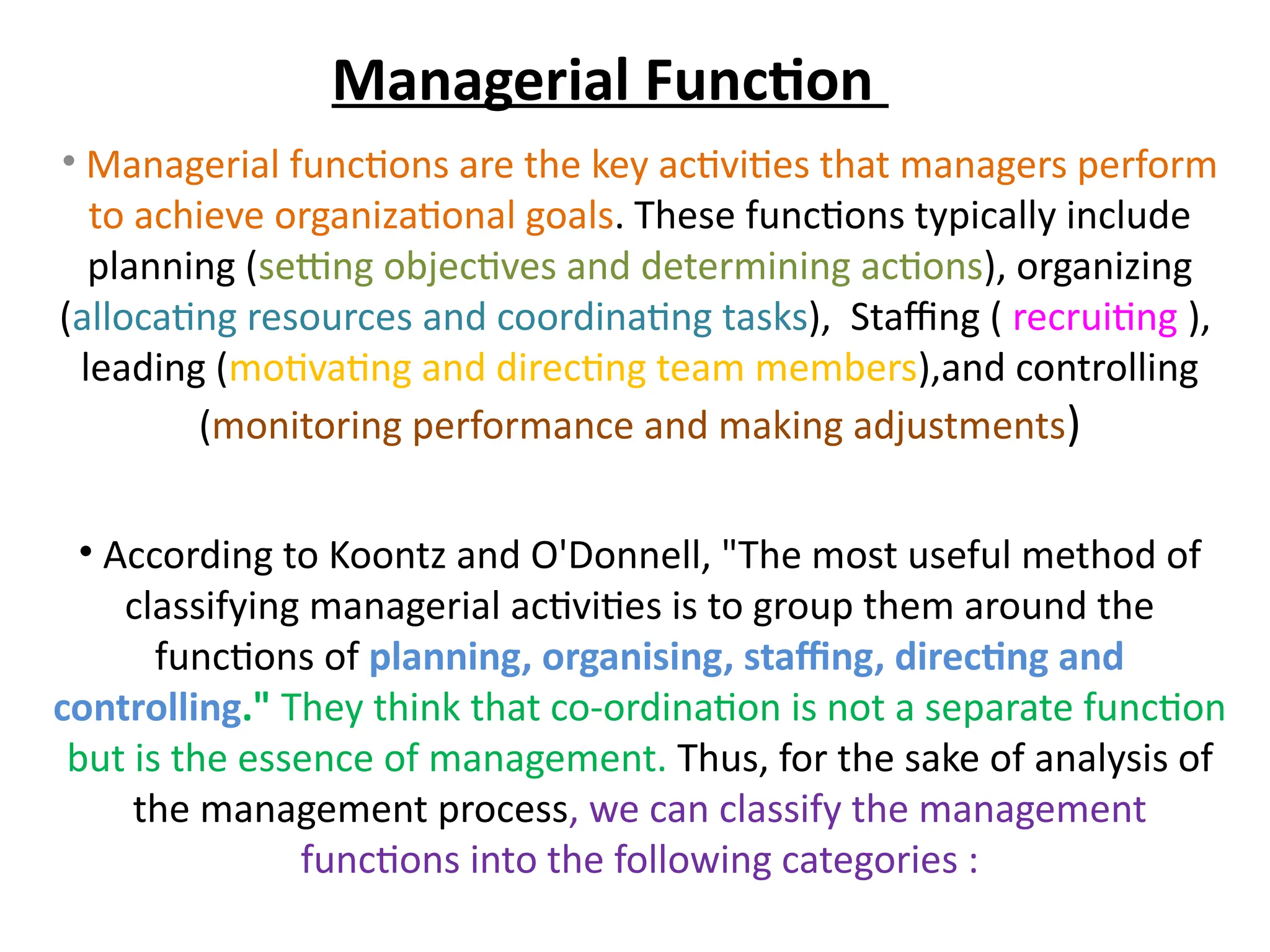
• Managerial functions are the key activities that managers perform
to achieve organizational goals. These functions typically include
planning (setting objectives and determining actions), organizing
(allocating resources and coordinating tasks), Staffing ( recruiting ),
leading (motivating and directing team members),and controlling
(monitoring performance and making adjustments)
• According to Koontz and O'Donnell, "The most useful method of
classifying managerial activities is to group them around the
functions of planning, organising, staffing, directing and
controlling." They think that co-ordination is not a separate function
but is the essence of management. Thus, for the sake of analysis of
the management process, we can classify the management
functions into the following categories :
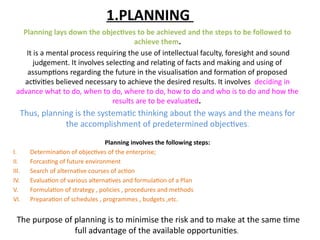
1.PLANNING
Planning lays down the objectives to be achieved and the steps to be followed to
achieve them.
It is a mental process requiring the use of intellectual faculty, foresight and sound
judgement. It involves selecting and relating of facts and making and using of
assumptions regarding the future in the visualisation and formation of proposed
activities believed necessary to achieve the desired results. It involves deciding in
advance what to do, when to do, where to do, how to do and who is to do and how the
results are to be evaluated.
Thus, planning is the systematic thinking about the ways and the means for
the accomplishment of predetermined objectives.
Planning involves the following steps:
I. Determination of objectives of the enterprise;
II. Forcasting of future environment
III. Search of alternative courses of action
IV. Evaluation of various alternatives and formulation of a Plan
V. Formulation of strategy , policies , procedures and methods
VI. Preparation of schedules , programmes , budgets ,etc.
The purpose of planning is to minimise the risk and to make at the same time
full advantage of the available opportunities.
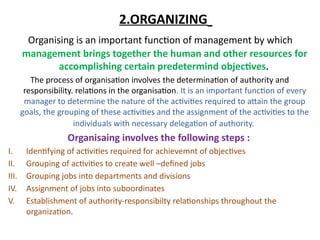
2.ORGANIZING
Organising is an important function of management by which
management brings together the human and other resources for
accomplishing certain predetermind objectives.
The process of organisation involves the determination of authority and
responsibility. relations in the organisation. It is an important function of every
manager to determine the nature of the activities required to attain the group
goals, the grouping of these activities and the assignment of the activities to the
individuals with necessary delegation of authority.
Organisaing involves the following steps :
I. Identifying of activities required for achievemnt of objectives
II. Grouping of activities to create well –defined jobs
III. Grouping jobs into departments and divisions
IV. Assignment of jobs into suboordinates
V. Establishment of authority-responsibilty relationships throughout the
organization.
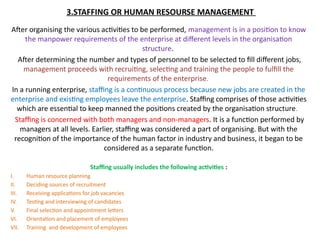
3.STAFFING OR HUMAN RESOURSE MANAGEMENT
After organising the various activities to be performed, management is in a position to know
the manpower requirements of the enterprise at different levels in the organisation
structure.
After determining the number and types of personnel to be selected to fill different jobs,
management proceeds with recruiting, selecting and training the people to fulfill the
requirements of the enterprise.
In a running enterprise, staffing is a continuous process because new jobs are created in the
enterprise and existing employees leave the enterprise. Staffing comprises of those activities
which are essential to keep manned the positions created by the organisation structure.
Staffing is concerned with both managers and non-managers. It is a function performed by
managers at all levels. Earlier, staffing was considered a part of organising. But with the
recognition of the importance of the human factor in industry and business, it began to be
considered as a separate function.
Staffing usually includes the following activities :
I. Human resource planning
II. Deciding sources of recruitment
III. Receiving applications for job vacancies
IV. Testing and interviewing of candidates
V. Final selection and appointment letters
VI. Orientation and placement of employees
VII. Training and development of employees

management ppt gurvinder.pptx for busine

  • 1.
    Managerial Function • Managerialfunctions are the key activities that managers perform to achieve organizational goals. These functions typically include planning (setting objectives and determining actions), organizing (allocating resources and coordinating tasks), Staffing ( recruiting ), leading (motivating and directing team members),and controlling (monitoring performance and making adjustments) • According to Koontz and O'Donnell, "The most useful method of classifying managerial activities is to group them around the functions of planning, organising, staffing, directing and controlling." They think that co-ordination is not a separate function but is the essence of management. Thus, for the sake of analysis of the management process, we can classify the management functions into the following categories :
  • 2.
    1.PLANNING Planning lays downthe objectives to be achieved and the steps to be followed to achieve them. It is a mental process requiring the use of intellectual faculty, foresight and sound judgement. It involves selecting and relating of facts and making and using of assumptions regarding the future in the visualisation and formation of proposed activities believed necessary to achieve the desired results. It involves deciding in advance what to do, when to do, where to do, how to do and who is to do and how the results are to be evaluated. Thus, planning is the systematic thinking about the ways and the means for the accomplishment of predetermined objectives. Planning involves the following steps: I. Determination of objectives of the enterprise; II. Forcasting of future environment III. Search of alternative courses of action IV. Evaluation of various alternatives and formulation of a Plan V. Formulation of strategy , policies , procedures and methods VI. Preparation of schedules , programmes , budgets ,etc. The purpose of planning is to minimise the risk and to make at the same time full advantage of the available opportunities.
  • 3.
    2.ORGANIZING Organising is animportant function of management by which management brings together the human and other resources for accomplishing certain predetermind objectives. The process of organisation involves the determination of authority and responsibility. relations in the organisation. It is an important function of every manager to determine the nature of the activities required to attain the group goals, the grouping of these activities and the assignment of the activities to the individuals with necessary delegation of authority. Organisaing involves the following steps : I. Identifying of activities required for achievemnt of objectives II. Grouping of activities to create well –defined jobs III. Grouping jobs into departments and divisions IV. Assignment of jobs into suboordinates V. Establishment of authority-responsibilty relationships throughout the organization.
  • 4.
    3.STAFFING OR HUMANRESOURSE MANAGEMENT After organising the various activities to be performed, management is in a position to know the manpower requirements of the enterprise at different levels in the organisation structure. After determining the number and types of personnel to be selected to fill different jobs, management proceeds with recruiting, selecting and training the people to fulfill the requirements of the enterprise. In a running enterprise, staffing is a continuous process because new jobs are created in the enterprise and existing employees leave the enterprise. Staffing comprises of those activities which are essential to keep manned the positions created by the organisation structure. Staffing is concerned with both managers and non-managers. It is a function performed by managers at all levels. Earlier, staffing was considered a part of organising. But with the recognition of the importance of the human factor in industry and business, it began to be considered as a separate function. Staffing usually includes the following activities : I. Human resource planning II. Deciding sources of recruitment III. Receiving applications for job vacancies IV. Testing and interviewing of candidates V. Final selection and appointment letters VI. Orientation and placement of employees VII. Training and development of employees