MANAGEMENT CHAPTER O1 SLIDES NOTES ZAINABSHAFIQADTHM03
MANAGEMENT CHAPTER 01
MANAGEMENT CHAPTER O1 SLIDES NOTES ZAINABSHAFIQADTHM03
Management
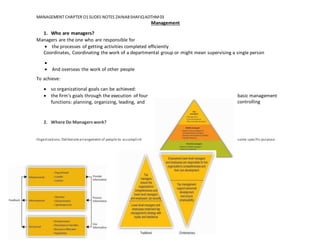
1. Who are managers?
Managers are the one who are responsible for
 the processes of getting activities completed efficiently
Coordinates, Coordinating the work of a departmental group or might mean supervising a single person

 And overseas the work of other people
To achieve:
 so organizational goals can be achieved:
 the firm's goals through the execution of four basic management
functions: planning, organizing, leading, and controlling
2. Where Do Managers work?
Organizations:Deliberatearrangement of people to accomplish some specific purpose
MANAGEMENT CHAPTER O1 SLIDES NOTES ZAINABSHAFIQADTHM03
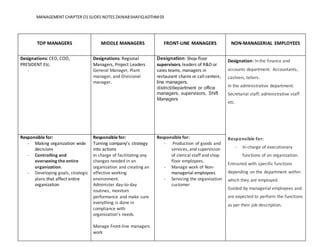
TOP MANAGERS MIDDLE MANAGERS FRONT-LINE MANAGERS NON-MANAGERIAL EMPLOYEES
Designations: CEO, COO,
PRESIDENT Etc.
-
Designations: Regional
Managers, Project Leaders
General Manager, Plant
manager, and Divisional
manager.
Designation: Shop-floor
supervisors, leaders of R&D or
sales teams, managers in
restaurant chains or call centers,
line managers,
district/department or office
managers, supervisors, Shift
Managers
 Designation: In the finance and
accounts department: Accountants,
cashiers, tellers.
 In the administrative department:
Secretarial staff, administrative staff
etc.
Responsible for:
- Making organization wide
decisions
- Controlling and
overseeing the entire
organization.
- Developing goals, strategic
plans that affect entire
organization
Responsible for:
Turning company’s strategy
into actions
In charge of facilitating any
changes needed in an
organization and creating an
effective working
environment.
Administer day-to-day
routines, monitors
performance and make sure
everything is done in
compliance with
organization's needs.
Manage Front-line managers
work
Responsible for:
- Production of goods and
services, and supervision
of clerical staff and shop
floor employees.
- Manage work of Non-
managerial employees
- Servicing the organization
customer
Responsible for:
- In-charge of executionary
functions of an organization.
Entrusted with specific functions
depending on the department within
which they are employed.
Guided by managerial employees and
are expected to perform the functions
as per their job description.
MANAGEMENT CHAPTER O1 SLIDES NOTES ZAINABSHAFIQADTHM03
QUES 01_
What are 3 main roles performed by a manager?
Management, Efficiency, Effectiveness
Management functions
Planning
Organizing
Leading
Controlling
Mintzberg Managerial roles
3 roles, Management skills
MANAGEMENT CHAPTER O1 SLIDES NOTES ZAINABSHAFIQADTHM03
QUESTION NO 02: WHY ARE MANAGERS IMPORTANT TO ORGANIZATIONS, WHAT ARE THEIR
KEY RESPONSIBILITES IN AN ORGANIZATION?
1. ORGANIZATIONS NEED THEIR MANAGERIAL SKILLS AND ABILITIES
As organizations deal with today’s challenges as changing workforce dynamics, the worldwide
economic climate, changing technology and ever increasing globalization hence they play an
important role in identifying critical issues and crafting responses
2. MANAGERS ARE CRITICAL TO GETTING THINGS DONE
These managers deal with all kinds of issues as the company’s myriad tasks are carried out. They
create and coordinate the workplace environment and work systems so that others can perform
those tasks. They find reasons and bring work and tasks on track back if there is an issue.
3. Matter
Single most important variable in an employee productivity and loyalty isn’t pay/benefits or
environment it’s the quality of relationship between employee and other direct supervisors
And. study states that managerial ability was important in creating organizational value.
Managers can provide leadership to their teams, providing a purpose and direction that
employees can trust. They help employees reach their goals and handle the daily production and
processes of a business. They also plan the next steps for managing projects and potential hires
What are the five key responsibilitiesof a manager?
At the most fundamental level, management is a discipline that consists of a set of five general
functions: planning,organizing,staffing,leading and controlling
MANAGEMENT CHAPTER O1 SLIDES NOTES ZAINABSHAFIQADTHM03
COMPETITIVE EDGE
COMPETITION OF FOOD, SERVICE AND CONCEPT
FOCUS ON CUSTOMER:
2 Strategies – Create what is demanded or Market it in a way to make a demand of it
FOCUS ON TECHNOLOGY:
Better service (Updated room service)
Food technology as food processing or order taking by robotic technology
FOCUS ON SOCIAL MEDIA
 FOCUS ON CUSTOMER
 FOCUS ON SOCIALMEDIA
 FOCUS ON TECHNOLOGY
 FOCUS ON INNOVATION
 FOCUS ON SUSTAINAILITY
 FOCUS ON EMPLOYEE
MANAGEMENT CHAPTER O1 SLIDES NOTES ZAINABSHAFIQADTHM03
FOCUS ON INNOVATION:
Business growth by marketing, Operations and HR by Training and development
And surveys to make it even better
FOCUS ON SUSTAINABILITY:
Sustainability: To perform a task without any harm to the environment
FOCUS ON EMPLOYEE:
Customer oriented organization as balance between work and social life to achieve goals
Employee focused as observe and identify their weak points for training sessions.
“SATISFY THOSE WHO SATISY YOUR CUSTOMERS”
INTRODRTUCTION:
Management has long been associated with the five basic functions: planning, organizing, staffing, directing, and
controlling. These default dimensions are sufficient when pursuing a fixed target in a stable landscape. But take away
the stability of the landscape, and one needs to start thinking about the fluidity of the target. This is what’s happening
today, and managers must move away from the friendly confines of these five tasks. To help organizations meet today’s
challenges, managers must move from: directive to instructive, restrictive to expansive, exclusive to inclusive, repetitive
to innovative, problem solving to challenging, and employer to entrepreneur
MANAGEMENT CHAPTER O1 SLIDES NOTES ZAINABSHAFIQADTHM03
Directive to instructive: When robots driven by artificial intelligence (AI) do more tasks like finish construction or help
legal professionals more efficiently manage invoices, there will be no need for a supervisor to direct people doing such
work. This is already happening in many industries — workers are being replaced with robots, especially for work that is
more manual than mental, more repetitive than creative.
What will be needed from managers is to think differently about the future in order to shape the impact AI will have on
their industry. This means spending more time exploring the implications of AI, helping others extend their own frontiers
of knowledge, and learning through experimentation to develop new practices. Learning, not knowledge, will power
organizations into the future; and the central champion of learning should be the manager.
Restrictive to expansive: Too many managers micromanage. They don’t delegate or let direct reports make decisions,
and they needlessly monitor other people’s work. This tendency restricts employees’ ability to develop their thinking
and decision making — exactly what is needed to help organizations remain competitive.
Managers today need to draw out everyone’s best thinking. This means encouraging people to learn about competitors
old and new, and to think about the ways in which the marketplace is unfolding.
Exclusive to inclusive: Too many managers believe they are smart enough to make all the decisions without the aid of
anyone else. To them, the proverbial buck always stops at their desks. Yet, it has been our experience that when facing
new situations, the best managers create leadership circles, or groups of peers from across the firm, to gain more
perspective about problems and solutions.
Managers need to be bringing a diverse set of thinking styles to bear on the challenges they face. Truly breakaway
thinking gets its spark from the playful experimentation of many people exchanging their views, integrating their
experiences, and imagining different futures.
Repetitive to innovative: Managers often encourage predictability — they want things nailed down, systems in place,
and existing performance measures high. That way, the operation can be fully justifiable, one that runs the same way
year in and out. The problem with this mode is it leads managers to focus only on what they know — on perpetuating
the status quo — at the expense of what is possible.
MANAGEMENT CHAPTER O1 SLIDES NOTES ZAINABSHAFIQADTHM03
Organizations need managers to think much more about innovating beyond the status quo – and not just in the face of
challenges. Idris Mootee, CEO of Idea Couture Inc., could not have said it better: “When a company is expanding, when a
manager starts saying ‘our firm is doing great’, or when a business is featured on the cover of a national magazine –
that’s when it’s time to start thinking. When companies are under the gun and things are falling apart, it is not hard to
find compelling reasons to change. Companies need to learn that their successes should not distract them from
innovation. The best time to innovate is all the time.”
Problem solver to challenger: Solving problems is never a substitute for growing a business. Many managers have told
us that their number one job is “putting out fires,” fixing the problems that have naturally arisen from operating the
business. We don’t think that should be the only job of today’s manager. Rather, the role calls for finding better ways to
operate the firm — by challenging people to discover new and better ways to grow, and by reimagining the best of
what’s been done before. This requires practicing more reflection — to understand what challenges to pursue, and how
one tends to think about and respond to those challenges.
Employer to entrepreneur: Many jobs devolve into trying to please one’s supervisor. The emphasis on customers,
competitors, innovations, marketplace trends, and organizational performance morphs too easily into what the manager
wants done today — and how he or she wants it done. Anyone who has worked for “a boss” probably knows the feeling.
The job of a manager must be permanently recast from an employer to an entrepreneur. Being entrepreneurial is a
mode of thinking, one that can help us see things we normally overlook and do things we normally avoid. Thinking like
an entrepreneur simply means to expand your perception and increase your action — both of which are important for
finding new gateways for development. And this would make organizations more future facing — more vibrant, alert,
playful — and open to the perpetual novelty it brings
.
MANAGEMENT CHAPTER O1 SLIDES NOTES ZAINABSHAFIQADTHM03

MANAGEMENT 01.docx

  • 1.
    MANAGEMENT CHAPTER O1SLIDES NOTES ZAINABSHAFIQADTHM03 MANAGEMENT CHAPTER 01
  • 2.
    MANAGEMENT CHAPTER O1SLIDES NOTES ZAINABSHAFIQADTHM03 Management 1. Who are managers? Managers are the one who are responsible for  the processes of getting activities completed efficiently Coordinates, Coordinating the work of a departmental group or might mean supervising a single person   And overseas the work of other people To achieve:  so organizational goals can be achieved:  the firm's goals through the execution of four basic management functions: planning, organizing, leading, and controlling 2. Where Do Managers work? Organizations:Deliberatearrangement of people to accomplish some specific purpose
  • 3.
    MANAGEMENT CHAPTER O1SLIDES NOTES ZAINABSHAFIQADTHM03 TOP MANAGERS MIDDLE MANAGERS FRONT-LINE MANAGERS NON-MANAGERIAL EMPLOYEES Designations: CEO, COO, PRESIDENT Etc. - Designations: Regional Managers, Project Leaders General Manager, Plant manager, and Divisional manager. Designation: Shop-floor supervisors, leaders of R&D or sales teams, managers in restaurant chains or call centers, line managers, district/department or office managers, supervisors, Shift Managers  Designation: In the finance and accounts department: Accountants, cashiers, tellers.  In the administrative department: Secretarial staff, administrative staff etc. Responsible for: - Making organization wide decisions - Controlling and overseeing the entire organization. - Developing goals, strategic plans that affect entire organization Responsible for: Turning company’s strategy into actions In charge of facilitating any changes needed in an organization and creating an effective working environment. Administer day-to-day routines, monitors performance and make sure everything is done in compliance with organization's needs. Manage Front-line managers work Responsible for: - Production of goods and services, and supervision of clerical staff and shop floor employees. - Manage work of Non- managerial employees - Servicing the organization customer Responsible for: - In-charge of executionary functions of an organization. Entrusted with specific functions depending on the department within which they are employed. Guided by managerial employees and are expected to perform the functions as per their job description.
  • 4.
    MANAGEMENT CHAPTER O1SLIDES NOTES ZAINABSHAFIQADTHM03
  • 5.
    MANAGEMENT CHAPTER O1SLIDES NOTES ZAINABSHAFIQADTHM03 QUES 01_ What are 3 main roles performed by a manager? Management, Efficiency, Effectiveness Management functions Planning Organizing Leading Controlling Mintzberg Managerial roles 3 roles, Management skills
  • 6.
    MANAGEMENT CHAPTER O1SLIDES NOTES ZAINABSHAFIQADTHM03
  • 7.
    MANAGEMENT CHAPTER O1SLIDES NOTES ZAINABSHAFIQADTHM03
  • 8.
    MANAGEMENT CHAPTER O1SLIDES NOTES ZAINABSHAFIQADTHM03
  • 9.
    MANAGEMENT CHAPTER O1SLIDES NOTES ZAINABSHAFIQADTHM03
  • 10.
    MANAGEMENT CHAPTER O1SLIDES NOTES ZAINABSHAFIQADTHM03
  • 11.
    MANAGEMENT CHAPTER O1SLIDES NOTES ZAINABSHAFIQADTHM03 QUESTION NO 02: WHY ARE MANAGERS IMPORTANT TO ORGANIZATIONS, WHAT ARE THEIR KEY RESPONSIBILITES IN AN ORGANIZATION? 1. ORGANIZATIONS NEED THEIR MANAGERIAL SKILLS AND ABILITIES As organizations deal with today’s challenges as changing workforce dynamics, the worldwide economic climate, changing technology and ever increasing globalization hence they play an important role in identifying critical issues and crafting responses 2. MANAGERS ARE CRITICAL TO GETTING THINGS DONE These managers deal with all kinds of issues as the company’s myriad tasks are carried out. They create and coordinate the workplace environment and work systems so that others can perform those tasks. They find reasons and bring work and tasks on track back if there is an issue. 3. Matter Single most important variable in an employee productivity and loyalty isn’t pay/benefits or environment it’s the quality of relationship between employee and other direct supervisors And. study states that managerial ability was important in creating organizational value. Managers can provide leadership to their teams, providing a purpose and direction that employees can trust. They help employees reach their goals and handle the daily production and processes of a business. They also plan the next steps for managing projects and potential hires What are the five key responsibilitiesof a manager? At the most fundamental level, management is a discipline that consists of a set of five general functions: planning,organizing,staffing,leading and controlling
  • 12.
    MANAGEMENT CHAPTER O1SLIDES NOTES ZAINABSHAFIQADTHM03
  • 13.
    MANAGEMENT CHAPTER O1SLIDES NOTES ZAINABSHAFIQADTHM03 COMPETITIVE EDGE COMPETITION OF FOOD, SERVICE AND CONCEPT FOCUS ON CUSTOMER: 2 Strategies – Create what is demanded or Market it in a way to make a demand of it FOCUS ON TECHNOLOGY: Better service (Updated room service) Food technology as food processing or order taking by robotic technology FOCUS ON SOCIAL MEDIA  FOCUS ON CUSTOMER  FOCUS ON SOCIALMEDIA  FOCUS ON TECHNOLOGY  FOCUS ON INNOVATION  FOCUS ON SUSTAINAILITY  FOCUS ON EMPLOYEE
  • 14.
    MANAGEMENT CHAPTER O1SLIDES NOTES ZAINABSHAFIQADTHM03 FOCUS ON INNOVATION: Business growth by marketing, Operations and HR by Training and development And surveys to make it even better FOCUS ON SUSTAINABILITY: Sustainability: To perform a task without any harm to the environment FOCUS ON EMPLOYEE: Customer oriented organization as balance between work and social life to achieve goals Employee focused as observe and identify their weak points for training sessions. “SATISFY THOSE WHO SATISY YOUR CUSTOMERS” INTRODRTUCTION: Management has long been associated with the five basic functions: planning, organizing, staffing, directing, and controlling. These default dimensions are sufficient when pursuing a fixed target in a stable landscape. But take away the stability of the landscape, and one needs to start thinking about the fluidity of the target. This is what’s happening today, and managers must move away from the friendly confines of these five tasks. To help organizations meet today’s challenges, managers must move from: directive to instructive, restrictive to expansive, exclusive to inclusive, repetitive to innovative, problem solving to challenging, and employer to entrepreneur
  • 15.
    MANAGEMENT CHAPTER O1SLIDES NOTES ZAINABSHAFIQADTHM03 Directive to instructive: When robots driven by artificial intelligence (AI) do more tasks like finish construction or help legal professionals more efficiently manage invoices, there will be no need for a supervisor to direct people doing such work. This is already happening in many industries — workers are being replaced with robots, especially for work that is more manual than mental, more repetitive than creative. What will be needed from managers is to think differently about the future in order to shape the impact AI will have on their industry. This means spending more time exploring the implications of AI, helping others extend their own frontiers of knowledge, and learning through experimentation to develop new practices. Learning, not knowledge, will power organizations into the future; and the central champion of learning should be the manager. Restrictive to expansive: Too many managers micromanage. They don’t delegate or let direct reports make decisions, and they needlessly monitor other people’s work. This tendency restricts employees’ ability to develop their thinking and decision making — exactly what is needed to help organizations remain competitive. Managers today need to draw out everyone’s best thinking. This means encouraging people to learn about competitors old and new, and to think about the ways in which the marketplace is unfolding. Exclusive to inclusive: Too many managers believe they are smart enough to make all the decisions without the aid of anyone else. To them, the proverbial buck always stops at their desks. Yet, it has been our experience that when facing new situations, the best managers create leadership circles, or groups of peers from across the firm, to gain more perspective about problems and solutions. Managers need to be bringing a diverse set of thinking styles to bear on the challenges they face. Truly breakaway thinking gets its spark from the playful experimentation of many people exchanging their views, integrating their experiences, and imagining different futures. Repetitive to innovative: Managers often encourage predictability — they want things nailed down, systems in place, and existing performance measures high. That way, the operation can be fully justifiable, one that runs the same way year in and out. The problem with this mode is it leads managers to focus only on what they know — on perpetuating the status quo — at the expense of what is possible.
  • 16.
    MANAGEMENT CHAPTER O1SLIDES NOTES ZAINABSHAFIQADTHM03 Organizations need managers to think much more about innovating beyond the status quo – and not just in the face of challenges. Idris Mootee, CEO of Idea Couture Inc., could not have said it better: “When a company is expanding, when a manager starts saying ‘our firm is doing great’, or when a business is featured on the cover of a national magazine – that’s when it’s time to start thinking. When companies are under the gun and things are falling apart, it is not hard to find compelling reasons to change. Companies need to learn that their successes should not distract them from innovation. The best time to innovate is all the time.” Problem solver to challenger: Solving problems is never a substitute for growing a business. Many managers have told us that their number one job is “putting out fires,” fixing the problems that have naturally arisen from operating the business. We don’t think that should be the only job of today’s manager. Rather, the role calls for finding better ways to operate the firm — by challenging people to discover new and better ways to grow, and by reimagining the best of what’s been done before. This requires practicing more reflection — to understand what challenges to pursue, and how one tends to think about and respond to those challenges. Employer to entrepreneur: Many jobs devolve into trying to please one’s supervisor. The emphasis on customers, competitors, innovations, marketplace trends, and organizational performance morphs too easily into what the manager wants done today — and how he or she wants it done. Anyone who has worked for “a boss” probably knows the feeling. The job of a manager must be permanently recast from an employer to an entrepreneur. Being entrepreneurial is a mode of thinking, one that can help us see things we normally overlook and do things we normally avoid. Thinking like an entrepreneur simply means to expand your perception and increase your action — both of which are important for finding new gateways for development. And this would make organizations more future facing — more vibrant, alert, playful — and open to the perpetual novelty it brings .
  • 17.
    MANAGEMENT CHAPTER O1SLIDES NOTES ZAINABSHAFIQADTHM03
  • 18.
    MANAGEMENT CHAPTER O1SLIDES NOTES ZAINABSHAFIQADTHM03
  • 19.
    MANAGEMENT CHAPTER O1SLIDES NOTES ZAINABSHAFIQADTHM03