Managed Care Practice and Progress 1st Edition
Michael Drury download
https://textbookfull.com/product/managed-care-practice-and-
progress-1st-edition-michael-drury/
Download more ebook from https://textbookfull.com
We believe these products will be a great fit for you. Click
the link to download now, or visit textbookfull.com
to discover even more!
The Practice Manager Third Edition Drury
https://textbookfull.com/product/the-practice-manager-third-
edition-drury/
Leading Medicaid Managed Care Plans: A State
Relationship Perspective 1st Edition Arlene Davidson
https://textbookfull.com/product/leading-medicaid-managed-care-
plans-a-state-relationship-perspective-1st-edition-arlene-
davidson/
Palliative Care Within Mental Health Care and Practice
1st Edition David Cooper
https://textbookfull.com/product/palliative-care-within-mental-
health-care-and-practice-1st-edition-david-cooper/
Electrical Inspection Testing and Certification A Guide
to Passing the City and Guilds 2391 Exams Second
Edition Michael Drury
https://textbookfull.com/product/electrical-inspection-testing-
and-certification-a-guide-to-passing-the-city-and-
guilds-2391-exams-second-edition-michael-drury/
Practice and Progress British Sociology 1950 1980
Philip Abrams (Editor)
https://textbookfull.com/product/practice-and-progress-british-
sociology-1950-1980-philip-abrams-editor/
Primary Care for Older Adults: Models and Challenges
1st Edition Michael Wasserman
https://textbookfull.com/product/primary-care-for-older-adults-
models-and-challenges-1st-edition-michael-wasserman/
Veterinary Nursing Care Plans: Theory and Practice 1st
Edition Helen Ballantyne
https://textbookfull.com/product/veterinary-nursing-care-plans-
theory-and-practice-1st-edition-helen-ballantyne/
Strategic Management and Economics in Health Care
Michael Chletsos
https://textbookfull.com/product/strategic-management-and-
economics-in-health-care-michael-chletsos/
Care in Healthcare: Reflections on Theory and Practice
1st Edition Franziska Krause
https://textbookfull.com/product/care-in-healthcare-reflections-
on-theory-and-practice-1st-edition-franziska-krause/
Managed Care
practice and progress
Robert Royce
Head of Policy/Secretary
Dyfed Powys Health Authority
First published 1997 by Radcliffe Publishing
Published 2016 by CRC Press
Taylor & Francis Group
6000 Broken Sound Parkway NW, Suite 300
Boca Raron, FL 33487-2742
© 1997 Robert Royce
CRC Press is an imprint ofTaylor & Francis Group, an Informa business
No claim to original U.S. Government works
ISBN-l3: 978-1-85775-280-9 (pbk)
This book contains information obtained from authentic and highly regarded sources. While all
reasonable efforts have been made ro publish reliable data and information, neither the author[sl nor
the publisher can accept any legal responsibility or liability for any errors or omissions that may be
made. The publishers wish to make clear that any views or opinions expressed in this book by
individual editors, authors or contributors are personal to them and do not necessarily reflect the
views/opinions ofthe publishers. The information or guidance contained in this book is intended for
use by medical, scientific or health-care professionals and is provided strictly as a supplement to the
medical or other professional's own judgement, their knowledge of the patient's medical history,
relevant manufacturer's instructions and the appropriate best practice guidelines. Because ofthe rapid
advances in medical science, any information or advice on dosages, procedures or diagnoses should be
independently verified. The reader is strongly urged to consult the relevant national drug formulary
and the drug companies' and device or material manufacturers' printed instructions, and their
websites, before administering or utilizing any of the drugs, devices or materials mentioned in this
book. This book does not indicate whether a particular treatment is appropriate or suitable for a
particular individual. Ultimately it is the sole responsibility ofthe medical professional to make his or
her own professional judgements, so as to advise and treat patients appropriately. The authors and
publishers have also attempted to trace the copyright holders of all material reproduced in this
publication and apologize to copyright holders if permission to publish in this form has not been
obtained. If any copyright material has not been acknowledged please write and let us know so we
may rectifY in any future reprint.
Except as permitted under u.S. Copyright Law, no part of this book may be reprinted, reproduced,
transmitted, or utilized in any form by any electronic, mechanical, or other means, now known or
hereafter invented, including photocopying, microfilming, and recording, or in any information
storage or retrieval system, without written permission from the publishers.
Trademark Notice: Product or corporate names may be trademarks or registered trademarks, and are
used only for identification and explanation without intent to infringe.
Visit the Taylor & Francis Web site at
http://www.taylorandfrancis.com
and the CRC Press Web site at
http://www.crcpress.com
British Library Cataloguing in Publication Data
A catalogue record for this book is available from the British Library.
Library of Congress Cataloging-in-Publication Data is available.
Typeset by Advance Typesetting Ltd, Oxon
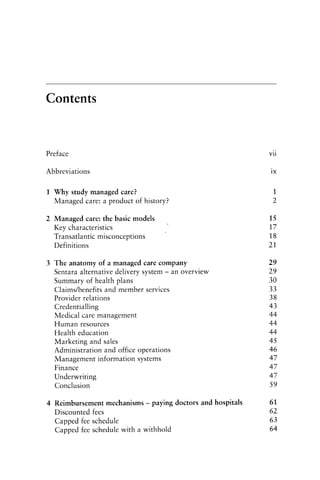
Contents
Preface Vll
Abbreviations lX
1 Why study managed care? 1
Managed care: a product of history? 2
2 Managed care: the basic models 15
Key characteristics 17
Transatlantic misconceptions 18
Definitions 21
3 The anatomy of a managed care company 29
Sentara alternative delivery system - an overview 29
Summary of health plans 30
Claims/benefits and member services 33
Provider relations 38
Credentialling 43
Medical care management 44
Human resources 44
Health education 44
Marketing and sales 45
Administration and office operations 46
Management information systems 47
Finance 47
Underwriting 47
Conclusion 59
4 Reimbursement mechanisms - paying doctors and hospitals 61
Discounted fees 62
Capped fee schedule 63
Capped fee schedule with a withhold 64
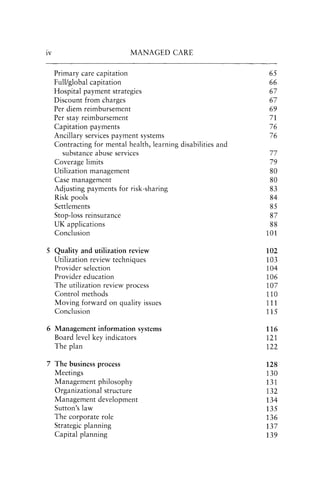
lV MANAGED CARE
Primary care capitation
FulVglobal capitation
Hospital payment strategies
Discount from charges
Per diem reimbursement
Per stay reimbursement
Capitation -payments
Ancillary services payment systems
Contracting for mental health, learning disabilities and
substance abuse services
Coverage limits
Utilization management
Case management
Adjusting payments for risk-sharing
Risk pools
Settlements
Stop-loss reinsurance
UK applications
Conclusion
5 Quality and utilization review
Utilization review techniques
Provider selection
Provider education
The utilization review process
Control methods
Moving forward on quality issues
Conclusion·
6 Manageme~t information systems
Board level key indicators
The plan
7 The business process
Meetings
Management philosophy
Organizational structure
Management development .
Sutton's law
The corporate role
Strategic planning
Capital planning
65
66
67
67
69
71
76
76
77
79
80
80
83
84
85
87
88
101
102
103
104
106
107
110
111
115
116
121
122
128
130
131
132
134
135
136
137
139
Economies of scale
Is current practice relevant?
Some simple lessons
CONTENTS
8 Strategic issues in cost-containment
Overcapacity
Salary costs
Medical practice variation
Introduction of new drugs and technologies
The drive to improve quality of life and defeat death
The drowned and the saved
Conclusion
Appendix I: US hospital contract
Appendix II: US physician contract
Appendix III: NHS contracts
Appendix IV: HMO benefit packages
Appendix V: Examples of Sentara's treatment
authorization protocols
Appendix VI: Reengineering Sentara
Appendix VII: Glossary
Appendix VIII: Refining current contracts - illustrations
References
Index
v
141
142
143
144
146
150
152
153
154
155
157
158
164
166
188
198
203
210
224
227
231
Preface
I wrote this book initially with the sole intention of giving readers an
in-depth appreciation of managed care in the USA and a balanced assess-
ment of its applicability to the UK. As time passed it became obvious that,
in addition to the above, I was being drawn to comment about the current
state of the NHS reforms, and that this would give greater focus to observa-
tions about US health care, management and techniques. My consistent aim
has been to produce a work that would add to most readers' knowledge
and will contribute to the development of health care management regard-
less of which party occupies government, and which path reform takes.
I was able to write this book from first-hand experience of the managed
care industry, via a six-month secondment to Sentara Health System in
Virginia, USA - one of the leading health care companies on the East
Coast. I am extremely grateful to Sentara for the unparalleled access to
meetings, documents and personnel afforded to me during my time there.
The secondment was made possible by the support of the then chief execu-
tive of Dyfed Health Authority - Mike Ponton - and formed part of the
leadership development programme for NHS Wales. I strongly believe that
it is extremely important that the NHS encourages external placements as
a way of developing its staff, and encouraging access to new ideas. Insularity
is one of the public sector's most enduring and least attractive characteristics.
Amongst the many individuals I wish to thank for their assistance in
getting this book written and making my time in the USA so productive
are Richard Hill, Ted Willie, Tommy Lee, Bert Reese, Bob Rash, and Anne
Marie and John Cochrane (in the USA), and Mike Ponton, Sue Brown and
David Evans (in the UK). Finally, I wish to thank my wife - Jill- for her
unrelenting understanding and support. The views in this book are the
author's and should not be seen as representing that of his employer -
Dyfed Powys Health Authority - or NHS Wales. In the course of this book
the terms 'physician' and 'doctor' are used interchangeably as are the terms
'HMO' and 'managed care'. A glossary is provided on pages 210-223.
Robert Royce
December 1996
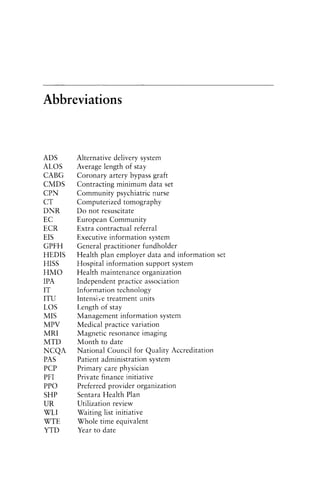
Abbreviations
ADS
ALOS
CABG
CMDS
CPN
CT
DNR
EC
ECR
EIS
GPFH
HEDIS
HISS
HMO
IPA
IT
ITU
LOS
MIS
MPV
MRI
MTD
NCQA
PAS
PCP
PFI
PPO
SHP
UR
WLI
WTE
YTD
Alternative delivery system
Average length of stay
Coronary artery bypass graft
Contracting minimum data set
Community psychiatric nurse
Computerized tomography
Do not resuscitate
European Community
Extra contractual referral
Executive information system
General practitioner fundholder
Health plan employer data and information set
Hospital information support system
Health maintenance organization
Independent practice association
Information technology
Intensive treatment units
Length of stay
Management information system
Medical practice variation
Magnetic resonance imaging
Month to date
National Council for Quality Accreditation
Patient administration system
Primary care physician
Private finance initiative
Preferred provider organization
Sentara Health Plan
Utilization review
Waiting list initiative
Whole time equivalent
Year to date
Why study managed care?
Most countries are dealing with health care reform as if each was on Mars.
Few have tried to learn from others. This indifference to the international
face of doctoring is a mistake.
The Economist - July 1991
1
Any writer on health care in the USA has to overcome the natural inclina-
tion to concentrate on the differences with the British National Health
Service (NHS), which can quickly lead to the erroneous conclusion that we
can learn nothing of value from this complex, fragmented and expensive
industry. The use of the term 'industry' is deliberate and is meant to con-
vey both the financial sums involved, and the management techniques and
operating philosophies displayed by those working within it. It remains
unfashionable to think of the NHS in such terms, but this book sets out to
demonstrate that both systems share certain common concerns - and that
this is particularly true when looking at the role and methodologies used
by managed care companies in general, and health maintenance organ-
izations (HMOs) in particular. It should also be borne in mind that the US
health care system has operated in a market environment for many years. As
a result it has developed some advanced micro-management techniques and
an operating philosophy dominated by the knowledge that patients can -
and often will - move company/provider if they are dissatisfied with the
service they receive and/or consider it too expensive. Only those married
to the most rigid of preconceptions as to what constitutes 'good health care'
would consider such experience irrelevant to the UK.
Notwithstanding the above, the US health care system exhibits a curious
mixture of sophisticated clinical/management techniques and rudimentary
omissions. The production and use of information demonstrates a similar
inconsistency - but as one might suspect there is a certain internal logic.
Systems, reports, ways of managing - and particularly the manner in
which health care is delivered (or not delivered in certain circumstances) -
are direct responses to the way the US system is structured (sic) and oper-
ates. To the outside observer this represents a potentially rich, but also
confusing environment from which to learn: particularly when the objective
2 MANAGED CARE
is to utilize that which is innovative and transferable and reject the
less desirable features of what is widely (and rightly) seen as a flawed
system.
With this in mind this book examines the principal methods by which
managed care in the USA operates and considers its relevance to the
embryonic NHS 'internal market'. Strengths and weaknesses are identified
in each health care system and areas are highlighted where adoption of
new techniques and methods would enhance services in the UK without
unduly undermining the basis on which the NHS operates. It is the under-
lying premise of this book (and indeed of the author's secondment from
the NHS which provided much of the reference material and allowed this
book to be written) that there are elements of 'foreign' health care systems
which can usefully be applied to the UK without the abandonment or
undermining of the operating principles of the NHS.
The book also looks at the way one US health care company - Sentara
Health System - has developed its managed care business and the dir-
ection in which its products are moving, as a means of illustrating models
and ideas in circulation. The opportunity is also taken to make some ob-
servations about management cultures, and the question is posed as to
whether the NHS can hope to obtain the leverage of an effective market
(which by no means presupposes an unbridled market system) with its
existing management culture, regulations and mindsets.
Managed care: a product of history?
The brief historical overview provided below attempts to show that differ-
ent systems, with very distinctive features, can end up facing similar issues.
Historically, the insurance market in the USA had been relatively indif-
ferent to the manner by which care was provided. Whilst premiums more
than covered costs, it kept itself at arm's length from health care delivery
- a relationship encouraged by bodies such as the American Medical
Association (AMA), which remains fiercely protective of the medical
community's professional autonomy.
Although the USA has had the unenviable lead in medical cost inflation
for some time, the UK has not escaped from the cost implications of third-
party reimbursement for health services (primarily through general taxation)
and the enthusiasm with which providers offer, and patients consume,
expensive health care. However, payers in both countries are today de-
manding more control over costs, better quality care, accountability from
providers, and fiscally sound and efficient management. In the USA man-
aged care has grown in response to this environment. Part of the UK's
WHY STUDY MANAGED CARE? 3
response was the creation of the 'internal market'1,2 in the late 1980s
(which is examined later in this chapter).
One subtle difference between the UK and the USA lies in the relative
influence of the bodies shaping health care. Unsurprisingly, in both
countries government has a significant role to play, but it has been much
more central to UK developments than has been the case with its US counter-
part. Although the federal government is the largest single purchaser of
health services in the USA, many assert that it is the large employers who
are the most important influence in shaping health care today (particularly
given the failure of the Clinton administration to get its health reforms
through Congress). Thus the Health Insurance Association of America3
can state that:
Employers as a group constitute an extremely influential element in the
evolution of health policy because they are the nation's major purchasers of
health benefits. Their preferences will continue to determine developments in
managed care.
Although the employer's influence may be in danger of being overstated,
it helps to explain the diversity of systems being experimented with in the
USA - and their associated strengths and weaknesses.
Notwithstanding the above, there is a continuing debate over the ability
of 'market forces' to reform adequately the US health care system (and the
UK's for that matter). Reform in this context is usually taken to mean a
process which will lead to reduced costs and improved access with no sig-
nificant reduction in quality of care. Some observers are confident that a
dynamic combination of large managed care organizations, employers and
politicians harnessing the 'market' will bring about such reform in America.
Others - the author included - are more sceptical, believing that the cur-
rent 'structure' of the US health care system mitigates against fundamental
reform and has a natural bias to fragmented and costly service provision.
In such an environment a wholesale reliance on the application of market
principles to bring about the desired changes is likely to disappoint, not
least because markets in health care are so distorted even at the theoretical
level- inadequate information, natural monopolies, poor principles of sub-
stitution, etc. - as to be inadequate for the desired purpose even before the
power of special interest groups, and the particular priorities a society
places on the way health care is provided are taken into account.
The author believes that fundamental change ofthe US health care system
- universal coverage, dramatic reductions in administrative and medical
costs - will require some form of government (or at the very least state)
legislation. The prospects for this are not necessarily encouraging. An oft-
heard observation is that there is simply too much money to be made out
4 MANAGED CARE
of the current system, with too many powerful groups benefiting, to allow
meaningful reform to take place. Moreover, extending the role of gov-
ernment is always acontroversial area for Americans - particularly when
the existing regulatory framework and proposed reform packages have a
justified reputation both for hypertrophied and impenetrable bureaucracy.
This scepticism was expressed in the following passage in the New York
Times:4
I see people acting like retroviruses. Government regulators, for example,
subvert the country's 'immune system' with their excessive diligence. You
might think of the regulatory system as being overly protective and becoming
the equivalent of an autoimmune disease.
There is another dynamic at work which transcends national borders and
is likely to frustrate the cost-containment ambitions of all governments:
the current emphasis within western culture on research and development,
and improving technology to improve quality of life. A greater reliance on
a competitive market may restrict the rate of total spending (although a
good case can also be made for such a model accelerating expenditure in
this regard) but it will be unable to reverse this trend, whilst there remains
a desire and commitment to extend the frontiers of knowledge literally to
'cheat death'. This area is further explored in Chapter 8.
In the meantime the competition currently taking place in the USA is
enough to satisfy many employers that they are getting a reasonable deal
whilst retaining the choice so many employees see as important. It is in this
environment that managed care companies operate, and which is a signifi-
cant factor towards explaining a structure which to the average UK reader
looks bloated, expensive and inherently wasteful in parts. Yet significant
inroads could be made to reduce transaction costs and profit margins if
some of the major employer groups and health care companies formed
strong strategic alliances. One initiative would be to enforce de facto in-
dustrial standards for uniform billing and use of compatible information
systems, and the case for such initiatives should become apparent when
these topics are discussed later in the book. The industry needs to make
inroads in these areas if it seriously wishes to self-regulate itself and avoid
change by government decree.
In the UK, on the other hand, government-initiated concerns have taken
centre stage - although from an initial mindset not too dissimilar from
that of the insurers. The net result has been the desire to develop systems
aimed at controlling costs and assuring quality, enhancing account-
ability etc., whilst promoting choice - without it seems much awareness
that in health care the latter sits in some tension to the cost-control
objective.
WHY STUDY MANAGED CARE? 5
However, it would seem reasonable to conclude that the NHS has
significant in-built advantages and a considerable lead in tackling most of
these issues by virtue of its public funding base, history of relative
frugality, and unitary structure (compared with the USA). Yet both countries
are not short of critics declaring their respective health care systems as
being in crisis. If anything, the NHS is the object of the most concern with
predictions of financial meltdown,s and professional despair being com-
monplace. Meanwhile, the average American, whilst perhaps prepared to
concede the intellectual case for a national health service, would consider
its restraints on freedom of choice to be unacceptable - and at odds with
both economic and social conventional wisdom in the USA.
From what has been written above, it is clear that the UK cannot afford
to be complacent about its system of health care. History shows that
organizations need to retain flexibility so as to be able to respond to a
changing society'S demands, enhance their value and progress - or risk
eventual extinction. The NHS and its political masters are currently strug-
gling to reconcile its philosophical roots with the challenges and advant-
ages derived from the introduction of a market forces dynamic. Moreover,
in a number of critical areas there remains an ever-widening gap between
the objectives management are set and the methods they are allowed to
employ to reach them. The techniques and ideas described in this book
will not of themselves ease that contradiction but it may help to break
down the cultural isolationism which helps limit our possible responses to
the challenges we set ourselves.
What then is of value in the managed care experience to the UK? When
authors describe developments in managed care, phrases such as 'varied',
'innovative' and 'encouraging' are used, as are terms like 'emerging', 'in-
complete' and 'fragmented'. It is in the inherently dynamic and innovative
nature of HMO operations (set within a tradition of operating in a market
environment) that we may be able to find ideas and techniques to build on
to the NHS's inherent strengths and fragile purchaser-provider relation-
ship. The history behind the NHS's current organizational structures is
outlined below, so that the likely value and impact of the managed care
movement will become apparent.
In 1991 the Conservative government, headed by Margaret Thatcher,
launched the NHS into an era of upheaval paralleled only at the time of
its creation in 1946. There is precious little sense that this era of sustained
turbulence is drawing to a close. Outlined initially in the White Paper
Working for PatientsI and subsequently passed into legislation2 was a
series of ideas and reforms which set out to establish an 'internal market'
- a formal separation between purchasers and providers..
6 MANAGED CARE
The contrast with the abortive Clinton Health Plan could not be more
stark in terms of process, content and outcome. As the satirist PJ O'Rourke6
noted: 'The plan is 1400 pages long, detailed specifics to come ... and says
the President, this might not be the real or final plan because he's an open-
minded guy and wants to be bipartisan and hasn't had a chance to get
everybody's input'.
In contrast, Working for Patients was pithy to the point of raising
(justified) concern that what was being set out was less a blueprint than a
haphazard collection of sketches. This was partly confirmed in the diaries?
of Alan Clark, ex-Conservative minister of defence, in a passage about
John Moore, who had been dropped from the government in 1989 after
three years as social security secretary:
During the high months of his status as her [Thatcher's] chosen successor, he
framed the Health Service reforms exactly on the basis of what he thought
she wanted. But she kept changing her mind. One minute she wanted to go
further, the next she got an attack of the doubts, wanted to trim a bit. Each
time the unfortunate John agreed, made the adjustments, came back for
approval. The result was a total hotchpotch and she ended up thinking he
was a wanker, and got rid of him.
Thatcher had announced a review of the NHS in the late 1980s in response
to a now-familiar set of problems besetting the service - funding difficulties,
too few intensive treatment unit (ITU) beds, adverse media reports - and
whatever the dynamics of the internal review process, the end result had
two characteristics lacking in its American counterpart:
• it was short, punchy and worked on the principle of setting a direction
- details to come later
• it was implemented quickly with no consideration given to establishing
pilots and little attention or concession made to its many critics.
The more cynical observer would say that what it did have in common
with Clinton's plan was a distinct ambivalence on funding issues (which
nevertheless could be said to be at the root of both reform programmes),
and a predilection to believe in solutions generated by politicians rather
than those actually working in health care.
Chris Ham, writing in the British Medical Journal, summed up the gov-
ernment's approach as follows:8
Unlike previous reorganisations, the changes introduced by Working for
Patients were sketched in broad outline only, with many of the most im-
portant details missing. This reflected the tight timescale against which the
WHY STUDY MANAGED CARE?
white paper was prepared and the fact that most of the central ideas in the
reforms had been only partially thought through. There has therefore been
no overall plan guiding the implementation of the reforms and little sense of
where this will ultimately lead. In business school parlance, Working for
Patients is best described as an emergent strategy. Expressed in more simple
language, Ministers have been making it up as they have been going along
... Where these changes will take the NHS is unclear, even (or perhaps
especially) to those at the heart of government.
7
It is not the purpose of this book to detail the history of the reforms, but
an attempt is made to highlight what its principal characteristics were and
where they might be leading. Certainly, it is possible to trace an evolution
to 'managed care' similar to the term which Americans understand it to
be. Other directions are also possible, and some would argue more likely.
At the time of writing (autumn 1996), a general election is due and the
question needs to be asked if a Labour victory would spell the end of the
reform process in general and the internal market in particular.
We can try and answer this by examining the current state of the Con-
servative government's reforms. Coincidentally, this should highlight key
differences with the USA and what opportunities there might be for
managed care techniques to make inroads within the NHS.
The first point to be made is that the 1991 act made no changes to the
principles by which UK residents had access to NHS services, nor how the
service is funded in toto. The basis of health care provision in the UK since
1946 has been for universal access, largely free at the point of use. These
services are principally funded through general taxation. The NHS encom-
passes primary and secondary care, community care and ambulance ser-
vices. There are a number of 'grey areas', principally the interface with
social services (which is part of local government), which has responsibil-
ity for 'social care', and dentistry, which ostensibly remains part of the
NHS but is drifting towards private practice as large numbers of dentists
are refusing to treat NHS cases, complaining that the level of remuneration
is too low.
Whilst these 'anomalies' frustrate those seeking to present the NHS as
a coherent, universal and logical set of services and give ammunition for
those suspecting a programme of privatization by stealth, the fact remains
that since its inception both Conservative and Labour governments have
retained a public commitment to the principles of NHS provision.
If the Conservative government's reforms did not change the essentials
of state provision, they certainly had an impact on the way services were
delivered. Prior to 1991 there was no formal distinction between purchasers
and providers within the NHS. Health services were organized via geo-
graphically based capitation-funded health authorities typically comprising
8 MANAGED CARE
a number of acute hospitals and peripheral community services with
primary care operating under parallel but administratively distinct bodies
known as family health services authorities (FHSAs). The 1991 act created
a formal purchaser-provider system whereby the health authorities relin-
quished control of hospitals and community services (which were organized
as 'self-governing bodies' known as NHS trusts). Health authorities con-
tinued to receive capitation-based funding from government which it used
to purchase services via 'contracts' or 'service agreements' from providers
- thus the 'internal market' was created. FHSAs remained until April 1996
when a further act of parliament9 led to the creation of unified authorities.
From the outset it was clear that a key challenge for government would
be to strike the right balance between competition and regulation. In the
first couple of years there was a particular emphasis on ensuring any
change was gradual and controlled, with watchwords such as 'steady state'
and 'smooth take-off' much in evidence. What all parties were 'taking off'
to appeared to be a managed market, where the aim was to obtain the
efficiencies of market systems (by creating incentives) whilst still regu-
lating proceedings to prevent market failures.
As every government which has attempted this balancing act has found
out, this is no easy task. The problem, simply put, is that central interven-
tion threatens to weaken incentives and dilute market signals, rendering
redundant the reform process itself. However, unregulated competition
carries its own dangers, particularly in such an unusual 'market' as health
care. It is highly prone to anticompetitive behaviour and 'market failure'
may be considered socially unacceptable. The danger was always that the
UK would end up with the worst of both worlds: 'a mixture of old style
bureaucratic controls coupled with the additional transaction costs of
the market and without the benefits of either approach'.!O
There is little question that some five years into the reform process the
Conservative government feels vulnerable on this issue. As far as the
author is concerned, effective purchasing is dependent on at least three
conditions being present:
• a reasonable degree of autonomy and/or a central mandate to take deci-
sions on issues of clinical effectiveness, provider capacity and provision
of services
• access to decent information concerning the quality and cost of services
being purchased and the financial and human resources to make use of
this
• a mechanism for understanding the services being purchased and
establishing a reward system based on their value. It presupposes the
WHY STUDY MANAGED CARE? 9
existence of - but is greater than - a coherent set of contracting
methodologies.
Health authorities were disadvantaged in all three areas from the begin-
ning. The Achilles' heel of NHS commissioning is its dependence on polit-
ical will to effect change. When this is lacking (which has been the norm
beyond the 'steady state' years) health authorities in particular are effect-
ively neutered.
The purchasing function had to be developed in the UK as there was
little relevant experience of the necessary skills to be found within the
NHS. Likewise, contracting, costing and information systems needed
developing - in some cases from scratch. The relevance of this book is
testimony to the work still required in these fields. It would not be stretch-
ing a set of similes too far to compare the learning curve to that en-
countered by would-be eastern bloc capitalists making the transition from
the Soviet central planning system.
By contrast, the American health care system seems much better
equipped by reference to these criteria (something of a paradox given the
assessment earlier in this chapter that the NHS was better equipped to
tackle the 'macro-issues' of health care). This is not to say that American
health care companies are by definition effective purchasers nor that there
is no room for improvement. However, health authorities continue to
struggle to make significant progress in all three areas and there remains
a significant body of opinion that sees contracting and health authorities
as irrelevant 'on costs' to the NHS. WilpI spoke for many when he wrote
that 'The plain truth is that contracting is irrelevant to the healthcare that
most patients receive'.
However, the government did not provide health authorities with a
monopoly on purchasing, as Working for Patients established two models
of purchasing - one centred on health authorities and the other on general
practitioners (GPs). The latter, known as fundholding, is discussed in some
detail in Chapter 4, but for the present it should be noted .that this self-
styled 'wild card' has been the subject of considerable controversy.
Whatever its merits, it represents a policy development which threatens to
bring the organizational structures of US style managed care and the NHS
much closer together and, as will be explained, much of this is likely to
survive a change of government (albeit renamed and repackaged for
public consumption).
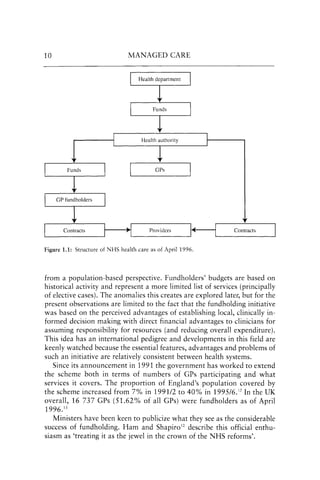
Figure 1.1 outlines the structure of NHS health care as of April 1996.
One of the most controversial features of fundholding has been its
method of funding. Health authorities are funded through a capitation
formula and are expected to purchase a comprehensive set of services
10 MANAGED CARE
Health authority
GPs
Providers Contracts
Figure 1.1: Structure of NHS health care as of April 1996.
from a population-based perspective. Fundholders' budgets are based on
historical activity and represent a more limited list of services (principally
of elective cases). The anomalies this creates are explored later, but for the
present observations are limited to the fact that the fundholding initiative
was based on the perceived advantages of establishing local, clinically in-
formed decision making with direct financial advantages to clinicians for
assuming responsibility for resources (and reducing overall expenditure).
This idea has an international pedigree and developments in this field are
keenly watched because the essential features, advantages and problems of
such an initiative are relatively consistent between health systems.
Since its announcement in 1991 the government has worked to extend
the scheme both in terms of numbers of GPs participating and what
services it covers. The proportion of England's population covered by
the scheme increased from 7% in 1991/2 to 40% in 199516.12 In the UK
overall, 16 737 GPs (51.62% of all GPs) were fundholders as of April
1996.13
Ministers have been keen to publicize what they see as the considerable
success of fundholding. Ham and Shapiro12 describe this official enthu-
siasm as 'treating it as the jewel in the crown of the NHS reforms'.
WHY STUDY MANAGED CARE? 11
However, a review of fundholding by the Audit Commission14 was
less than complimentary about many aspects of the scheme's mechanism
(inequitable funding formulae, high transition costs, etc.) and sceptical
about its impact on purchasing. This has been seized upon by the scheme's
many critics, including the Labour party.
The Labour party's policy on the two central tenets of Conservative
health reform - the internal market and fundholding - is, on face value,
simple. They have spent over half a decade attacking it as fundamentally
misconceived. They are publicly committed (as far as the term has mean-
ing for a party which has been in opposition since 1979 and has made
many changes to its policies in that time) to abolishing both the internal
market and fundholding. Yet when one examines Labour's proposed alter-
natives, it is less than clear to what degree these differ from Conservative
policy - in substance if not in style.
The first point to make is that the confrontational nature of parlia-
mentary politics tends to mask the significant areas of broad agreement
between government and opposition on the NHS. Despite each party's
systematic and ritualistic attacks on each other's policy, the substance of
their antagonism is often more imagined than real. The same might be said
for US Congress, where the Republicans spent a considerable amount of
time and money demolishing the Clinton Health Plan, only to put forward
a series of measures on Medicare (a federally funded insurance policy for
US citizens aged 65 years and over) which to the outside observer looked
suspiciously similar to that proposed by Democrats only two years previ-
ously. These proposals in turn have been the subject of sustained opposi-
tion by the Clinton administration!
Both in America and the UK the principal parties believe they have sub-
stantive philosophical differences in the way their respective health systems
should be operated, but such claims often look less secure when subjected
to a thorough analysis. Margaret Beckett, the shadow health secretary,
reflected this (although there are doubts that she would readily accept
the inference) when she said in 1995 that 'the Conservatives are divided
on whether to accuse us of accepting what they have done or wanting to
destroy it'.15
As noted, the key difference of opinion between Labour and Con-
servatives has been on the costs and benefits of the 'internal market' and
fundholding. Labour's hostility to both can be summarized as regarding
the former as having no role to play in health care, but merely introducing
useless transaction costs - trusts, contracts, bureaucracy - and on the
latter, that fundholding threatens the equity principle of the NHS and also
has high transaction costs. Labour wrap their criticisms in a general
'bureau-scepticism'. Money for service development is to be found from
12 MANAGED CARE
cutting management and transaction costs as Harriet Harman (Beckett's
successor) reaffirmed in a letter to the Health Service Journal: 16
Our pledge can be financed from redirecting resources within the health ser-
vice because we are committed to reducing market-related transaction costs.
There is clear evidence that there has been a substantial increase in spending
on management and administration since the introduction of the internal
market ... We will replace GP fundholding with GP commissioning. That will
end one source of increased administration immediately ... We will end the
annual contracting round and replace it with our longer term comprehensive
healthcare agreements between planners and providers based on cooperation,
not competition. The money released will be permanently transferred to
reducing waiting lists on a recurrent basis.
Labour policy on the NHS might be summarized as follows:
• abolish the internal market but retain the purchaser-provider split.
Replace contracts with 'strategic agreements' of a collaborative nature.
Trusts will lose their self-governing status but retain responsibility for
the day to day provision of care
• replace fundholding with GP commissioning (described by Klein1? as
'a nebulous concept which may turn out to be a euphemism for collect-
ive fundholding')
• continue trying to reduce waiting lists
• fund developments by efficiency savings within the service
• place greater emphasis on pay within a national framework, put an
end to compulsive competitive tendering, and place more emphasis on
'democratizing' the membership of health bodies
• give continued support for clinical effectiveness programmes, research
and development (R & D), audit etc.
Despite the ideological breast-beating that has accompanied this, a highly
plausible case can be made for considering that this amounts to little more
than a renaming of the existing structure. Admittedly, on a continuum of
cooperation-contestability-competition, Labour proposes to push the NHS
towards the cooperation end whilst the Conservatives are thought to favour
a competitive model but the substantive differences may be marginal.
First, .both parties remain immune from financial logic. The initial re-
forms were sparked by a funding crisis. The reforms themselves took no
note of the issue, and hence every year since then the media carry a plethora
WHY STUDY MANAGED CARE? 13
of stories on funding problems for authorities and trusts. Labour looks set
to continue this tradition. This will seriously undermine any hope of creat-
ing collaborative relationships between purchasers and providers, there being
nothing like substantial deficits to sour relations between organizations.
Second, any system which purports to be delivering efficient and effect-
ive services requires a demonstrable system for mediating the relationship
between those things customers want and the services being delivered. For
sensible decisions to be made it has to be known who is providing good
quality, cost-effective care, and who is not. This, coupled with Labour's
ostensible objective of providing greater accountability and the common
need for cost control, naturally implies strong systems of management and
an infrastructure currently being attacked as needless bureaucracy. The
author is confident that practical reductions in this area will prove marg-
inal, particularly when it becomes clear that this will only serve to under-
mine objectives which already have a reasonable degree of consensus - the
need for R&D, promotion of clinical audit, and the drive for greater use
of evidence-based practices and clinical effectiveness.
Third, Labour shares the cross-party obsession with waiting times, and
as a result will probably continue to promote the Patient's Charter and
league tables. These imply an infrastructure capable of:
• monitoring standards
• accounting for any expenditure earmarked to tackle charter objectives
• reporting waiting-lists and activity.
Finally, Labour accepts the value of GP participation in purchasing and will
wish to retain and strengthen current involvement. There are legitimate
concerns about high transaction costs, the sustainability of the current
fundholding scheme (Chapter 4) and equity issues, but any likely altern-
atives will not be without their problems. Labour is keen to eliminate
direct financial incentives from GP-based purchasing but its problem in
essence is that if it removes too many incentives it is not clear on which
basis doctors can be persuaded to participate in what is increasingly seen
as a daunting set of responsibilities.
Furthermore, whilst a Labour government may be able to reduce costs
through the economies offered by multipractice agreements (although this
often occurs via fundholding agencies at present), it will need to provide
both management and information support to GPs. The means and organ-
izational structures for achieving this would look something like the HMOs
examined in subsequent chapters.
14 MANAGED CARE
At the time of writing a win for the Conservatives would constitute a
major upset (based on opinion poll ratings for the two parties). The chances
are that a victory for the Conservatives would only result in a small
majority in the House of Commons, so it is considered likely that the
Tories would be content to let the reforms continue to develop into a more
contestable and visible market. Deffenbaugh18 predicts that:
Fundholding would become the norm and GPs would take the lead in
purchasing healthcare .., GPs would develop further into community-based
integrated providers of healthcare services, leading US style health
maintenance organisations,
It is possible that a re-elected Conservative government could be more rad-
ical than its predecessors and push forward the separation of public sector
purchasing from its provision, allowing the private sector to take over the
running of increasing amounts of what is currently NHS operations. With
the structure moving towards a mixed economy model, there might well
be an attempt to define NHS 'core' services provision with vouchers or
private insurance schemes being introduced for 'elective' health care. This
is the thrust of Labour's briefing document Road to the Manifesto19 which
states:
The future of the NHS under the Tories is clear. If the Tories are elected again,
they will strip the NHS down to the basic emergency services. For everything
else, people will have to pay.
The pace of change may depend on who occupies 10 Downing Street in
the UK, and the White House in the USA, but the underlying dynamics of
health care provision make a return to the 'good old days' unrealistic.
Both countries' health care systems are set objectives at odds with the
means available to them and both could usefully learn some lessons from
the other in terms of the techniques and trade-offs on offer.
In the next chapter the focus is on understanding what comprises
managed care in the USA. This will provide a foundation from which to
explore possible UK applications.
2
Managed care: the basic models
When you've seen one HMO you've seen one HMO.
Anon.
There are many different types of managed care organization, although
the foundations from which they operate begin within a number of common
assumptions or observations concerning the delivery of modern health
care. They might be summarized as follows:
• the methodology used to reimburse providers has a significant impact
on the efficiency of medical practice patterns. Therefore it is a primary
objective of managed care programmes to create meaningful incentives
for providers to practise cost effectively
• the service needs of large population groups are essentially predictable.
As a result a wide range of services can be provided at a predetermined
premium through defining appropriate clinical practice criteria, enforc-
ing their application through effective utilization controls, and elimin-
ating inappropriate financial incentives
• effective health care is also cost-efficient health care. Within this, that it
makes economic sense - as well as being better for the individual- to try
and prevent illness. As a result managed care companies and particu-
larly HMOs have a strong primary care focus (by US standards)
• there is an overmedicalization of the population which results both in
inappropriate treatments being performed and an undue dependence
on medical services. Managed care attempts to influence this through a
mixture of patient education, empowerment, and the aforementioned
use of financial incentives which are directed both at the physician and
the patient
• physicians playa key role in the delivery of services and hence in the
expenditure incurred. Unless means are devised to influence their deliv-
ery of services the organization's financial viability is compromised
16 MANAGED CARE
• a company cannot be successful unless it has a certain critical mass of
financial, information and management resources.
All of the above could reasonably be described as characteristics of - or
belief systems typically found within - NHS health authorities. Moreover,
both organizations could fairly be described as having a concern for the
health of their respective 'customer' base. Both wish to predict utilization
of services, avoid unnecessary cost and inappropriate treatment, and
promote the role of primary care and 'wellness' as a means of improving
individuals' lifestyles as well as containing costs. As a result both countries'
'purchasers' are showing a particular interest in evidence-based treatment
and the use of outcomes - and are likely to remain doing so whilst the
efficacy of so much - relatively expensive - treatment remains unproven.
In the USA, this initiative is being pioneered by the managed care movement.
As previously stated, the organizational structure of a managed care
company will show many variations on a theme. There is no national
model although certain shared characteristics (as above) are discernible.
Managed care's (oots lie in the insurance sector and in one sense HMOs
and their derivatives are just the latest response to the perennial problem
of how to provide affordable coverage and make a 'profit'. They have
grown (in part) from traditional indemnity insurance companies' failure to
constrain costs, and the propensity of health care providers to subject the
population to medical practice variation (MPV).
To just examine a staff model (HMO, for example) would fail to illus-
trate the somewhat Byzantine complexity of the managed care product
and organizations typically seen in the USA. Most of the models described
in this book are drawn from the coverage options Sentara currently oper-
ates. This is by no means an exhaustive list. Moreover these 'models' are
likely to change in response to market conditions. New coverage options
may be added and existing products dropped. The organizational models
which will be reviewed are:
• The HMO, of which one can find examples of:
- staff models
individual or independent practice association (IPA) models
- direct contract models
• The preferred provider organization (PPO).
The number of variations on a theme mirrors the predisposition of
Americans to avoid plans which offer limited or no choice - of provider,
benefits, hospital, etc. - and the varied ability and capacity of managed
BASIC MODELS 17
care companies to corral physicians into particular organizational and
contractual relationships. HMOs are passed over in favour of more 'lib-
eral' insurance schemes by many Americans because they believe managed
care will restrict their choice, and this assumes an importance which may
be lost on UK readers. Moreover, what by many in the UK would be
regarded as a major advantage - uniformity of care - is likely to be viewed
with suspicion by members of the American public, on the basis that it
represents a means of driving the quality of health care downwards.
There is a continuous tension here between the desire to offer different
models and products so as to satisfy and capture all potential members and
the resulting dilution of managed care principles to the point where the
term almost loses its meaning and plans cannot be effectively distinguished
from conventional indemnity insurance products. It is common for a
managed care company to put forward a portfolio of 'products', to a
would-be customer (typically a company), hoping that in doing so they
have the ability to satisfy the different (perceived) needs for coverage of
the company chairman through to the shop-floor worker. Moreover,
many employers will not consider a proposal unless such a portfolio is
available - despite such variation increasing the costs of health care to all
concerned.
Key characteristics
Before losing sight of the fundamentals of managed care via a plethora of
brand names and abbreviations, its key characteristics and how it differs
from ordinary health insurance are reviewed. Some of managed care's core
operating assumptions have previously been outlined. The result should
be an organization that aims to provide comprehensive health care to
members in exchange for a regular (usually monthly) fee. Conceptually a
managed care programme should be concerned not merely with providing
care when a member becomes ill, but should be structured in a manner
conducive to keeping the member healthy. In contrast, traditional insur-
ance systems act simply as conduits between the providers of health care
and the patient through the processing and payment of bills. However, this
is a characterization of both organizations - managed care companies can
compromise their preventative aims through their general cost-containment
policies and contractual arrangements, whilst insurance companies are
increasingly taking on board managed care philosophies and techniques.
Continuing the characterization, the 'typical' managed care member
enjoys a 'complete' range of health care services within a defined network
in return for a standardized fee. There will be few additional charges.
18 MANAGED CARE
Traditional health insurance in contrast (which is still the predominant
form of coverage in the USA) typically has a more restricted range of bene-
fits, e.g. hospital only, which will leave a more significant amount to be
paid by the patient, but allows much greater choice of provider and will
not typically require either patient or doctor to undertake external auth-
orization checks prior to a proposed treatment or procedure.
Transatlantic misconceptions
Two common misconceptions in the UK are that the premium (or cost to
the member) for an HMO will be lower than that available via traditional
health insurance and that employers naturally prefer to get their em-
ployees' health insurance from managed care companies.
In reality, a basic indemnity package (for a healthy individual) is likely
to cost considerably less per month than an HMO premium. However, the
two 'products' are not the same. Indemnity insurance will not be com-
prehensive, in either the services provided - for example, mammography
examinations as part of well-women screening will probably not be
covered - or the costs of care, typically through the application of deduct-
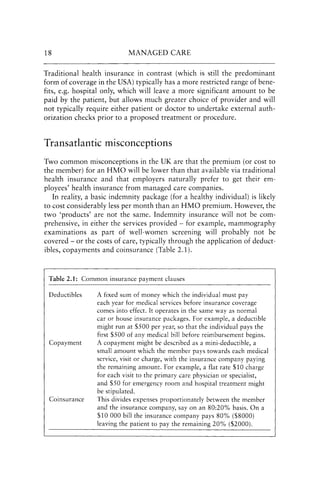
ibles, copayments and coinsurance(Table 2.1).
Table 2.1: Common insurance payment clauses
Deductibles
Copayment
Coinsurance
A fixed sum of money which the individual must pay
each year for medical services before insurance coverage
comes into effect. It operates in the same way as normal
car or house insurance packages. For example, a deductible
might run at $500 per year, so that the individual pays the
first $500 of any medical bill before reimbursement begins.
A copayment might be described as a mini-deductible, a
small amount which the member pays towards each medical
service, visit or charge, with the insurance company paying
the remaining amount. For example, a flat rate $10 charge
for each visit to the primary care physician or specialist,
and $50 for emergency room and hospital treatment might
be stipulated.
This divides expenses proportionately between the member
and the insurance company, say on an 80:20% basis. On a
$10000 bill the insurance company pays 80% ($8000)
leaving the patient to pay the remaining 20% ($2000).
Exploring the Variety of Random
Documents with Different Content
altogether. Since he has been sick scarcely one has come to enquire
for him.'
'Aweel, Miss Mary, an' it's no juist that has brocht me, ill doin' ye
ken maun bring ill feelin'. Whan folk sees the abomination o'
desolation sittin' in the holy place, as the Scripter micht word it, an
the steward o' the Kirk's mysteries gien ower to the lusts o' the
flesh, the douce Christi'n folk beut to hand awa. Touch not, taste
not, haunel not, ye ken what the word says. An' I hae been thinkin',
seein' hoo things hae come round, ye'll be best to tak tent o' yer bits
o' dishes yersel', gin Eppie there can gar it gree wi' her walk an'
conversation as a Christi'n wumman to mind that ill-faured scart o' a
bairn, I see na at she may na keep yer teapat as weel!' So saying
she lifted the cover of her basket, and proceeded to lay out the cups
and saucers on the dresser.
Mary was too much astonished to say anything. She was glad to
see the ware once more brought within reach of use, seeing that
hitherto it had been a mere embellishment to the glass cupboard in
the corner of Luckie Howden's cabin, a testimony to her piety and
helpfulness to the church; but the cause and the manner of the
restitution were beyond her comprehension. She glanced at Eppie
for some explanation, but Eppie sat with lips compressed in
determined silence, a flame of scarlet indignation burning on either
cheek.
Luckie Howden went on arranging and counting the pieces of
crockery. 'Twall cups an' twall sacers, four bread plates, an' twa
bowls. Ye'll find that a' richt, Miss Brown. An' here's the bits o' siller
things,' producing the teapot, over which she passed her hand with
a regretful stroking motion, 'It's gotten neither clure nor dint i' my
haunds. A' siller say ye? An' weel I wat it's bonny. Aiblins it's no sae
bricht an' glintin' as it ance was. "Yer goold an' yer siller are become
dim, yer garments are moth-eaten," that's what the Prophet Ezekil
said til back-slidin' Isril lang syne, an' it's true yet! Wae's me, Miss
Brown! 'at the white raiment o' yer puir wanderin' brither, 'at we
ance thocht sae clean an' white, suld be spotted wi' the flesh after
a'! But what's been dune i' the secret chaumer sall be proclaimed on
the house heads afore lang. My certie! but he's been the lad to draw
iniquity wi' cart ropes! an' to sin wi' the high haund! But it's a' fand
out at last, he'll be peuten til open shame, an' be nae mair a steward
o' the gospel mysteries in Glen Effick!'
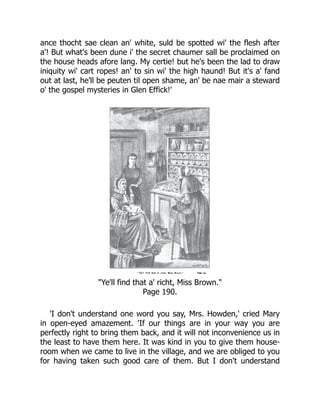
"Ye'll find that a' richt, Miss Brown."
Page 190.
'I don't understand one word you say, Mrs. Howden,' cried Mary
in open-eyed amazement. 'If our things are in your way you are
perfectly right to bring them back, and it will not inconvenience us in
the least to have them here. It was kind in you to give them house-
room when we came to live in the village, and we are obliged to you
for having taken such good care of them. But I don't understand
what ground of offence my brother can have given you, or why you
should speak of him in such extraordinary language.'
'I'm thinkin' ye'll hae to thole waur langidge nor that afore a's o'er,
Miss Brown. An' aiblins ye ken mair nor ye wad like to let-on. I'm no
yer judge, but we hae scripter for't, 'at refuges o' lees winna stand.'
'Think shame, woman!' cried Eppie, unable altogether to keep
silence, though she still restrained herself, fearful of provoking a
tempest and disturbing the sick man.
'An' what wad I think shame for? It's the ill doer 'at fears the ill
word. I hae cleared my skirts this day. I shack the stour frae my very
feet, an' I'm dune wi' the De'il an' a' his warks!' And shaking out the
folds of her red cloak, with a stamp of either foot, she hobbled away.
'What does she mean, Eppie? And whatever it is, the rest of the
people must think it too--Don't deny it, Eppie! you know all about it.
I have seen so much as that in your face for several days. What is
it?'
'It's naething ony sensible body wad heed. Just a wheen
senseless havers. Ne'er fash yer thoomb, Miss Mary! It'll a' blaw
ower.'
Miss Mary was resolute, however, and would be told. She sat
herself down on a stool beside Eppie, and between coaxing and
sheer pertinacity she at last prevailed on the old woman to speak.
They sat together for some time with their heads very close,
conversing in whispers.
'Oh how could any one believe so monstrous an invention?' she
cried at last, her face suffused with crimson, while she kissed the
sleeping baby, the innocent cause of so much confusion, and
returned to her brother's room.
CHAPTER XXV.
SOPHIA'S ANSWER.
Thursday morning was the opening of a great day in Glen Effick.
The foundation stone of the new Church was to be laid, and from
the most distant corners of Kilrundle parish the people came
streaming in across the braes, more numerously even than for the
Sunday meeting. The Session had at last come to an agreement with
Widow Forester for half of her kaleyard on which to build their
Church. The foundation was already dug, and every owner of a
horse and cart had agreed to contribute so many days' labour
towards delivering the materials on the ground. And now the work
was to be inaugurated with preaching and prayer, that it might be
brought to a speedy and prosperous issue. The good people having
neither oil nor wine to bestow in cementing the stones, had resolved
to pour forth a copious oblation of words devout and stirring, and to
celebrate their triumph over Laird and Law in true democratic
fashion, by a general gathering and unstinted speechification.
The hot stillness of September days had passed away, and the
fresh cool brightness of October had succeeded. In low-lying hollows
the first hoar-frost of the season was melting into dew before the
approaching noon, and straggling flecks of cloud swam merrily
overhead in the breezy sky. The crimson of the moors was withering
somewhat into rusty brown, but the birch along the watercourses
had ripened into sprays of gold, while the distant hills stood out
against the sky in violet and blue. The trooping worshippers
displayed all their Sunday bravery of apparel, but the solemnity of
their Sabbath demeanour they had felt at liberty to leave behind.
The children ran hither and thither shouting their loudest, while the
seniors chatted cheerily as they went, carrying their dinners in heavy
baskets between them, and resolved to make the most of the day's
'ploy.'
Along the village street the people trickled in a continuous stream,
and by and by Ebenezer Prittie and Peter Malloch put up the shutters
on their respective shops. Donald Maclachlan shut up the smithy,
and Angus Eldrecht, the wheel-wright, closed his yard, and stepped
off with their wives to the meeting place on the brae-side, where Mr.
Dowlas and a reverend brother of the presbytery were already in the
tent waiting to conduct the exercises.
Mrs. Sangster, with her daughter, was on the ground betimes,
discussing with unwonted affability the terrible scandal to the elders
and more prominent people near her. She occupied, of course, the
beadle's special chairs, and as the time to commence the service
drew near, she beckoned to her Stephen Boague and his wife, and
seated them beside herself and daughter. It was a public recognition
of their exemplary character she considered, which would fully
reward the woman for her hospitality the day she was lost in the
mist, and was quite inexpensive besides. When Mary Brown
presently appeared, the good woman would fain have yielded up to
her her accustomed seat under the matronly wing of the
congregation's only lady; but Mrs. Sangster requested that she
would not move. 'I could not countenance Mr. Brown or his family,'
she said, 'under the circumstances.' So the poor woman had to
remain; but she no longer felt promotion in her place of honour, and
all her acquaintances looked askance, and wondered at her 'upsettin'
impidence.' Mrs. Sangster was too busy with her 'spy-glass' and
psalm-book to see the approach of Mary, who coloured with
resentment at what, since Eppie's explanation, she now perfectly
understood, and looked about for another seat. The Laird had been
watching his wife's proceedings with cynical amusement, he now
came forward and removed his daughter to the elder's bench,
setting the chair she had been occupying beside her, and seating
Mary upon it, while he took his own stand beside them.
Mrs. Sangster's spy-glass dropped upon her book; amazement
and indignation paralyzed her, which was fortunate, or she might
have exhibited a tantrum, even in that sacred assembly. She! that
congregation's Deborah without a Barak, as a fawning preacher had
once described her at family prayers, to be thus flouted before them
all! And the wholesome discipline she had meant to exercise in
support of the public morals to be turned round upon herself! and
this, too, by her own husband! the man bound to protect, honour,
and obey her! For of course he was bound so to do, whatever Saint
Paul, or any other old bachelor who knew nothing about it, might
say. Was she not the more advanced Christian? and in right of her
higher standing in 'The Kingdom' entitled to instruct, advise, and
reprove those on a lower level. Oh! how should she punish him and
bring him to book? There was the difficulty. Scolding would not do.
She had tried that before, and it did not succeed. He was apt to
laugh in her face, and sometimes even to scold back in return, in an
altogether dreadful and appalling way--for an elder--if she persisted;
and then nothing, not even her unfailing Christian meekness could
secure her the last word, which was her due as a lady. She thought
of putting him on low diet for a while.--'And it would serve that
monkey Sophia right, too, for sympathising with her father. See how
contentedly she cottons up to Mary Brown!' thought she. But she did
not like bad dinners herself, and it would come out if she had a
sweetbread quietly in her own room. Besides, she had attempted a
penitential regimen of cold mutton once before, and it had not
ministered to his spiritual needs; on the contrary, he had broken out
in a way that was simply dreadful, and had threatened her with a
housekeeper if she could not keep a better table. Her crosses were
indeed many and grievous, and she might have grown weak and
hysterical in reviewing them, but that other cares and anxieties
demanded her present attention. Surely there was something
rubbing up against her in a familiar and unbecoming way. She
turned, looked, and almost leaped into Mrs. Boague's lap. Stephen's
largest collie was titillating his spine by pushing it up and down
against her new plum-coloured silk gown.
'Haud steady, mem! The folk 'ull see ye, an' ye're nae licht wecht
forby!' whispered Mrs. Boague. 'Ne'er mind the dugs, an' they winna
fash wi' you. An' de'il a yelp or snap wull they gie, sae lang as ye
dinna staund on their tails.'
Touseler, finding his scratching-post withdrawn, stretched himself
on the ground to sleep out the sermon, and Mrs. Sangster resumed
her chair. Her tranquility was of short duration. First would come a
tug at her parasol, accompanied by a strangled yelp, as a puppy
having swallowed the tassel would struggle to escape, like a trout on
a fish-hook; and next it would be her shawl. A dirty little finger
would be found tracing the flowing lines of its elegant embroidery, or
the corner would be pulled down, that the critics squatting on the
sward might more conveniently scrutinize the elaborate design.
When Sophia's chair was removed it had left an open spot in the
crowd, to Mrs. Sangster's left, and as nature abhors a vacuum, the
unplaced material of her party had flowed in to fill it. She looked
down on a confused knot of dog and child life, heads and tails, legs
and arms swaying and kicking to and fro in silent happiness. Had a
quadruped or a biped given tongue in the 'House of God,' there
would have been whipping behind the first big boulder-stone on the
home-going, and they had all felt the weight of Stephen's hand at
sometime, so were wary; but so long as silence was kept, and they
remained beside the shepherd and his wife, they might kick, roll,
and be happy as they pleased.
Poor Mrs. Sangster's attention was fully occupied in protecting her
dress from the busy fingers of the little boys and girls, and in seeing
that the dogs did not make a coverlet of her skirts; and she vowed
never again to 'take notice' of people from the 'lower orders,' who so
little appreciated the honour she did them, and made themselves so
utterly abominable with their ill-reared dogs and children. She lost all
the good of their sermons as she told the reverend orators that
evening at supper, and was far too concerned for what might befall
her own draperies, to give much heed to the Rev. Æmelius Geddie's
description of the curtains of fine linen and badger skins, blue and
scarlet, prepared for the Tabernacle in the wilderness, and his tender
appeal to the women of Glen Effick to go and do likewise. Mr.
Dowlas described the building of Solomon's Temple, its joists of
cedar covered with plates of pure gold, the chapiters, the
pomegranates, and the wreathen-work, the brazen pillars and the
vessels of pure gold. He interspersed these with spiritual
interpretations and mystical images drawn from the Prophets, till the
hearers were brought under a general vague impression of
splendour and solemnity, they could not have explained wherefore;
but they all agreed that it was a 'graund discoorse,' and 'very
refreshing,' and that they had entered on a high, noble and arduous
work, in proposing to build themselves a little meeting house; and
that, though propriety forbade their saying so, the Divine Head of
the Church was greatly beholden to them, and that they might look,
as their certain due, for large amounts of blessing, spiritual and
temporal, to requite their exertions in church-building, as well as
that heroic penny-a-week to the Sustentation Fund.
Like other fine things, the sermon came to an end at last, and
after psalms and benediction, it was announced that they would
proceed in procession to the site of their future church, where
reports of the different committees would be received, and
addresses given, after which the foundation stone would be laid with
prayer and praise.
The congregation then broke up, and in the confusion Sophia got
the opportunity she had been desiring of a quiet word with Mary.
Circumstances had befriended her wonderfully she thought, when
her father had brought her away from her mother, and placed her
beside Mary Brown. She had always been fond of Mary, but now she
felt a sisterly drawing towards her which she had not known before.
Mary was her junior by about a year, but was quicker and earlier to
mature, and this had sometimes made Sophia feel a rawness in
herself, and a general slowness and obtuseness by comparison, in a
way approaching as near to jealousy as her somewhat stolid and
easy-going disposition was capable of experiencing. But as Mary
neither assumed nor probably was aware of any advantage, this
feeling in great measure slept; and now, when Sophia's development
had advanced as with a bound, under the stirrings of awakening
emotion, the latent grudge was altogether overborne. She sat up
very close to her and pressed her softly. Mary was surprised.
Demonstration of the faintest kind was something new in Sophia,
and altogether unexpected. Her heart was sore at the unkindness of
the parishioners to her brother, and their haste to adopt
unwarrantable and improbable suspicion against him; and that Mrs.
Sangster; who had assumed to play the rôle of mother to her in her
lonely position, should turn and publicly visit the imaginary misdeeds
of her brother on her head, had been very grievous. She assumed
that Sophia meant to signify her disbelief in the idle rumours afloat,
and, accepting the proffered sympathy, she returned the friendly
pressure with grateful warmth. The two read from the same bible
and psalm-book, and sat so close that the Laird was able to find
room on the bench beside his daughter, just as he was beginning to
think a two hours' stand rather a heavy penalty for interfering with
his wife's absurdity.
'Mary!' whispered Sophia, when the assemblage was breaking up,
'I want you to tell your brother that I received his letter. Whoever
told him that I am engaged is altogether mistaken. Nobody ever
asked me to--be engaged, and there is no one who could have any
right to do so. I would have answered his letter, but mamma forbade
me; she even says I must not come and see you, while some report
or other, I don't know what it is, is going about. So I have been
waiting for an opportunity to speak to you. Mamma says papa does
not believe the report, so--' here the words died away and the colour
deepened on her cheeks--'but papa does not know of his letter to
me.' Mary leant forward to bestow a kiss, but Sophia started back
under a sharp prod from the parasol of her mother, who was eagerly
reaching over the shoulders of the intervening crowd.
'Sophia Sangster! what are you lingering there for? Don't you see
everybody is on the move? Come to your mother's side, your proper
place, this moment.'
It was not a happy half-hour for Sophia that followed. The
maternal plumage was sadly ruffled, and in the 'preening' that
ensued to readjust the feathers mental as well as physical (for the
silk gown was rumpled as much as the self-complacency was
disturbed), not a few stray pecks fell to her portion. That her
husband should have carried away her own girl from her side was
almost intolerable; only, till she could devise a way to punish him
which she had not yet discovered, she must bear that; but the girl
had acquiesced without sign of reluctance or remonstrance, had
consented to be separated from her own mother with perfect
equanimity, and in spite of all that had passed, had seemed entirely
comfortable beside Mary Brown, notwithstanding the maternal
taboo. She had had little leisure for observation. Her gown, her
shawl, the children, the sheep-dogs had made constant demands on
her attention, and when she looked for succour to the shepherd and
his wife, they were drinking in the sumptuous splendours of
Solomon's temple, and had no thought for the turbulent little Bethel
at their feet. Once however she had found time to glance across and
was disgusted to see Sophia and Mary singing amicably from one
book and evidently on the best of terms.
'You're a saft feckless tawpie, Sophia Sangster!' she enunciated
with much emphasis, as she and her daughter were carried along in
the stream of the procession. 'It seems to me sometimes that you
have no more sense than a sookin' turkey!' Mrs. Sangster rather
prided herself on her English, which she considered equal to that of
any body on her side of London or Inverness. These were the two
seats of perfect speech she considered; but failing them Auchlippie
could hold its own against Edinburgh, St. Andrews, or anywhere
else, and was decidedly a better model than her son Peter since he
had adopted a Lancashire brogue. Nevertheless when she became
'excited' (i.e. angry), she admitted that she had to fall back on the
pith and vigour of her native Doric with its unlimited capacity for
picturesque vituperation.
'It's not from me you take your fushionless gates! That comes o'
the donnart Sangster bluid in you, I'm thinking. But what possessed
you to take up publicly like yon with Mary Brown, when you know I
want you to steer clear of her just now? When the Presbytery has
taken the matter up, it will be proper enough to bestow patronage
and show sympathy for the poor girl; but meanwhile we have a
testimony to bear, and it will not do to countenance evil doers or
their families.'
'Mamma, I don't know what you are talking about.'
'Of course not. It's no subject for a young girl to know anything
about; but you must not think in your ignorance to set yourself
above the advice and opinion of your mother, who knows all about
it.'
Sophia said no more. To speak was but to stir the fire of her
mother's wrath. She held her peace, and left the flame to burn itself
out, or smother in its own smoke and ashes. She simply did not
attend, and when her mother, stopping for breath, turned to survey,
as it were, the field of battle, or at least to view the result of her
onslaught as depicted in the girl's face, she was smiling to a bare-
footed urchin who trotted by her side, Stephen Boague's youngest,
who had taken a fancy to the gay apparel of Mrs. Sangster, and still
kept it in view.
'Let that de'il's buckie alone, Sophia Sangster, and attend to me!
It has been pulling the fringes of my shawl for the past two hours,
and made it smell of peat-reek and moss-water so that I shall never
be able to put it on again.'
The meeting was held in the field adjoining the excavation made
for the church's foundation. Mr. Sangster was in the chair and
supported on either hand by a minister, and there were chairs in
front for Mrs. Sangster, her daughter, and Miss Brown, to which the
matron, somewhat mollified by this observance, was ushered, when
she very quickly appropriated the remaining seat for her shawl, so
that there might be no vacant place for any one else. She might
have spared herself the trouble. Mary was not in the crowd, and if
she had been, would not have desired to sit beside her.
At the close of the religious exercises, Mary had hastened home
to her brother, from whom she had already been longer away than
at any previous time since he was taken ill. She would not have
attended the meeting at all, but for his desire that she should; and
she was glad to return home at the earliest moment, for since she
had learned its proneness to think evil without cause, she loathed
Glen Effick utterly and all its affairs. Her brother had been drowsing,
but he woke up at her entrance, and asked to hear what had been
done.
'Just the usual thing. Mr. Geddes preached about the Tabernacle,
and Mr. Dowlas about Solomon's Temple.'
'Ah! I can imagine it; very pretty and flowery, no doubt. But I
think when so many were collected they might have had something
more useful and more likely to do good to the poor people. "A dish
of metaphor," as my good father used to say, "is light feeding for
hungry souls."'
'They did not think so, I assure you; they seemed quite delighted;
though I confess I rather wearied over the inventory of the golden
vessels, and I saw Sophia Sangster yawn once at any rate.'
'Was Sophia there?'
'Oh yes. And by the way she sent a most particular message to
you; or at least she seemed particularly anxious that you should
receive it.'
'Ah!' said Roderick, raising himself, 'tell me quick.'
'I declare, Roddie, you look quite excited! She asked me to tell
you she had received your letter--You rogue! What have you been
writing to her? I remember now how restless you were one morning
till you had got Joseph sent off to Auchlippie! But I, simple soul,
supposed it was Session business with the Laird. To think I should
be so obtuse with a little comedy going on under my very nose! But,
ah me! It has been more like tragedy of late, you have been so ill,
and we have both been so lonely.'
'But, to return to your comedy, or at least to Sophia, what more?'
'She said she had got your letter! Was not that enough? She did
not say it was a sonnet to her eyebrows--but I suspect, she blushed
so prettily--yet, now I think of it, it was not a sonnet you sent, for I
was to tell you that she is not engaged--that there is no one who
has a right to ask her to be engaged. You must have been jealous,
Roddie! Who was it? And she said she would have written, but her
mother forbade her.'
'Oh that tiresome Duchess! What ridiculous fancy has she got in
her head now, I wonder? I feel quite ashamed when I recall the
black thoughts I have been nourishing against that poor harmless
cockney or whatever he is, Mr. Wallowby; all along of some absurd
scheme of hers, which rushed to her lips in her agitation that day on
the hill. Poor Duchess! She must have a bee in her bonnet; but she
is a sad worry.'
'She is far worse that that!--hard, evil-minded, worldly.'
'Hush, Mary! "Judge not," et cetera. But proceed!'
'Sophia told me that her mother says there is some rumour afloat
which must be cleared up before she can have communication with
us; and, in fact, the tiresome old thing did her best, not only to cut
me to-day, but to keep Soph away too; but the Laird, honest man,
was too many for her.'
'You do not mean to say that that abominable Duchess was
publicly rude to you? I could not stand that! Though she may do or
say to me as she likes (and she generally does;) for I do not
suppose any sensible man could seriously mind her.'
'Oh no! The Laird came to the rescue like a man and a
gentleman, as he always does; and, in fact, if the Duchess had
behaved herself, and Soph and I had been under her wing, I do not
believe the poor oppressed child would have had courage or
opportunity to send you your message, sir, so do not be harbouring
bad thoughts of the poor Duchess! Ah! ah! And by the way, there is
more message yet! Sophia says her father does not believe the
rumours which her mother has been so ready to accept; and--but
she blushed and stammered and I could not make sense of it, for
you see I was not in your confidence, Mr. Prudence--but, if I were an
old woman and understood about those sort of things, it sounded
suspiciously like bidding you carry your tale to 'Papa!' Ha! Have I
found you out, old gentleman? I suppose I may go for a governess
now; I may be losing my place as house-keeper any day!' And she
laughed merrily while Roderick coloured and looked confused, but
intensely happy.
When the Doctor came to visit his patient that afternoon, he was
astonished at the improvement in his condition, and quite confirmed
in his belief as to the wisdom of his own prescriptions, and general
course of treatment.
CHAPTER XXVI.
FAMA CLAMOSA.
The meeting was an undeniable success. The chairman called on
his reverend supporters for addresses, which they made in their
warmest and most florid style. They recalled the rebuilding of
Jerusalem and the Temple, when each man laboured with his sword
by his side, and worked, and watched, and fought by turns; till every
hearer present believed that he might emulate Nehemiah and
Zerubbabel by contributing to the collection, and began to finger his
loose change with a view to doing it. There were stirring references,
too, to John Knox, (especially to the scene at Holyrood, when he
spoke back to the Queen,) to George Wishart and Andrew
Rutherford, Margaret Wilson, John Brown of Priesthill, martyred by
'Clavers,' Jenny Geddes with her creepie attacking the Dean of
Edinburgh, and other Scots Worthies.
Then followed reports, statements of funds and calculations of
expenses from the Deacons, and finally speeches from all who chose
to address the meeting. This last feature in the proceedings was
especially popular. Every greybeard in the crowd was in turn urged
and goaded by his admiring family and neighbours to step forward,
and when, after much shame-faced trepidation, he had hummed and
stuttered through a few sentences and would finally come to a dead
stop and return to his friends, he had earned the self-satisfied
consciousness that he was a potential orator, and that 'gin the Lord
had but granted him schulin' in his youth, he might have wagged his
pow in a poopit wi' the best.'
At length the hoary grandsires had all spoken, the fathers, the
sons, even the 'halflin callants,' began to feel the stirrings of
ambitious eloquence. Luckie Howden, too, felt movings to rehearse
her testimony in favour of good morals, and Brother Dowlas saw it
was time to draw the line. In a whisper he called attention to the
practice of Saint Paul, who suffered not a woman to teach--a
sentiment which was overheard by Mrs. Sangster, and elicited from
her a look of most contemptuous wonder, but nevertheless received
the adhesion of the Laird. They therefore proceeded to lay the
foundation stone, with appropriate prayer and praise, and the
proceedings came to an end.
At this moment, Mr. Dowlas came forward and stated in a loud
voice that he had been requested to intimate 'that the Session and
Deacons' Court were requested to assemble for special and
important business at the Post Office, immediately after the close of
the present meeting.' Mr. Sangster was taken by surprise. He asked
on whose authority the intimation had been made, but the reverend
announcer replied that a written notice had been placed in his hand,
and that he and Mr. Geddie had been requested to be present.
The elders and deacons were already assembled when Mr.
Sangster and the ministers entered the place of meeting, Joseph
bringing up the rear in his most official manner, yet diffidently,--as if
uncertain whether he were wanted,--but still desirous to know what
was going forward, and willing to give weight to it by the presence
of the beadle. He stood by the door with his hand meekly before his
mouth, and surveyed the silent assemblage, whom he afterwards
described to Jean Macaulay as resembling 'a curran hoolets wi' their
muckle blinkin' een, lookin' terrible wise an' sayin' naething.' Perhaps
it was in their silence that their wisdom lay.
Ebenezer Prittie, being host, or at least the party in occupation of
the premises, rose to his feet, and after clearing his voice, proposed
that the ruling elder, Mr. Sangster of Auchlippie, now take the chair,
and that the clerk of session take the desk and minute the
proceedings.
Mr. Sangster rose in reply, saying that before he did so, he desired
to understand the nature of the meeting over which he was asked to
preside, as he knew nothing about it but the intimation which had
been read after the meeting just closed and while it was dispersing.
Ebenezer replied that it was the meeting adjourned from Monday,
as agreed on, that they might consult with the two reverend
members of Presbytery, who were now kind enough to be present.
The Laird answered that the joint meeting of Session and
Deacons' Court on the Monday, had concluded its business and been
adjourned sine die by their acting minister who presided, and that
when he (the speaker) subsequently conversed on the same evening
with his friends, whom he had been happy once more to meet in
that place, he had dwelt strongly and without being gainsaid, on the
fact that their meeting as a Church Court having been dissolved by
the presiding officer, that which they were then holding was merely
a friendly conversation, and without authority. And he begged to
inform the person, whoever he might be, at whose instance they
had now come together, that it was altogether 'ultra vires' (his voice
hung emphatically on the Latin words, and they greatly impressed
his auditors) for the Session to assemble itself at the pleasure of any
of its members, and to act as a court. Mr. Brown as acting minister
was 'ex officio' (more emphasis and deep impression) the proper
caller and president of such courts; and failing him, it was the ruling
elder on whom it devolved to summon and preside over the Court.
But the minister had no knowledge of,--far less had he called or
sanctioned their meeting,--and for himself he could not, as a
constituted authority in the Church, be party to a proceeding so
irregular and subversive of all Church government, as the course
proposed.
'But Mester Sangster,' put in Ebenezer, 'ye canna but say that we
met here on Monday nicht, and gin ye dinna ken that we agreed to
come thegither again the day, to consult wi' the twa ministers here
present, it's yer ain faut. Ye gaed awa at yer ain wull, an' naebody
cud tak on him to bid ye bide.'
'Brethren,' interposed Peter Malloch, with an elated but solemn
smile, 'what say ye to ca't a' a meetin' o' the Deacons' Coort? An' we
could meenit it a' in our books,--I'm thinkin' that's our plan. I'm the
convener, an' I hae a richt to convene my ain coort!'
'Certainly, Mr. Convener,' responded the Laird, 'you may call a
Deacons' Court; but on what point is it that you want the advice of
the Eldership here present? Will the treasurer's books not balance?
Have some of the collectors failed to make their returns? Or what is
it?'
'Hoot, Laird! ye ken just fine! The treasurer's a' richt, an' sae are
the collectors. It's the minister an' his bairn we're after, as ye ken
brawly.'
'I regret then, Mr. Convener, to have to remind you that your
court has no jurisdiction. Faith, morals, and discipline, are the
exclusive province of the Session; and I for one protest against the
Deacons' Court presuming to touch such matters.'
'Presumin'! quotha!' interjected Andrew Semple. 'An' hasna ilka
auld wife e'y Glen been presumin', as ye ca' 't, for twa week back an'
mair?'
Here Mr. Geddie felt compelled to intervene, and pour the oil of
evangelical sweetness on the troubled waters. He was to dine and
spend the night along with Mr. Dowlas at Auchlippie, therefore he
would fain have agreed with his host; at the same time he had no
intention of being balked of a sensation, and what promised to be a
most interesting hunt after recent iniquity, at the very outset.
'It appears to me, my friends,' he said in his smoothest accents,
'that the points of order raised by our excellent brother have great
weight, and are taken with that clear and perspicuous wisdom which
have made his opinions a tower of strength to the church in turning
back the army of the aliens; and therefore while the Deacons' Court
are manifestly moved by a holy zeal for righteousness, such as we
might have expected at their hands, it will be best that they do not
take action officially in this matter.'
'I defy them to do it!' interjected the Laird, little mollified by the
unctuous adjectives.
'It is also not to be expected,' continued this reverend Achitophel,
'that our erring brother'----
'Prove the error,' muttered the Laird.
'That our brother who has wandered from the paths of holy living,
but whom we all love (and brethren, I may add that he is still but
young, and the flesh is weak)! It is not to be expected that he
should call a Court to investigate into his own shortcomings; or that
until he has been brought to see and admit the heinousness of his
offences, and that they have all been found out (for that, brethren, I
have always observed is a powerful lever in awakening a slumbering
conscience)--It is when the poor sinner has discovered that his
refuges of lies will not stand, that they are all swept away like mists
before the winds of indignation, and that the clear light of truth is
shining down on his nakedness, and wretchedness, and moral
wounds; it is then that the poor sinner comes forth with tears in his
eyes and sackcloth on his loins, and cries aloud, "I have sinned."'
Here the orator stopped for breath. He was moved by his own
pathetic elocution, and his picture of the returning prodigal. Also, he
had got entangled among his parts of speech, and lost his way
among the parentheses; and now he scarcely knew where he was,
or what he had intended to say next.
'Are you not condemning a man before you have even heard the
accusation brought against him?' inquired the Laird; but without
gaining much attention from any one. The audience, in fact, was just
then uttering a sigh of satisfaction over the moving words of the
previous speaker, which were as impressive as a doleful sing-song
could make them, besides being in accordance with their own
opinion; and nothing is more interesting and weighty than our own
sentiments uttered by another, with a fluency and copiousness which
we could not have lent them. It is like looking at ourselves through a
glorifying medium, contemplating our own portrait from the brush of
a distinguished court painter; which, judged by the walls of Royal
Academy Exhibitions, is the highest, as well as the best paid form of
art. The golden bowls and pomegranates of the morning were
nothing to this! it was as good as a sermon, and 'so practical,' as
some one whispered. Nothing like a practical sermon! my friend; and
much tilting at sin. Always premising that the sin is not yours nor
mine (which would be personal and rude), it makes one feel virtuous
by proxy.
Mr. Geddie looked over for a suggestion how to proceed, to
brother Dowlas, who was quietly enjoying the scene. He knew what
it was to be flown away with by Pegasus, and then dropped helpless
in a swamp. It had happened to himself; but he was older now, and
it was not disagreeable to see his young friend meet the reward of
his overforwardness in this miscarriage.
Mr. Dowlas suggested that the present was properly to be
considered a meeting of members and office-bearers of the
congregation, to investigate certain rumours affecting the character
of their acting minister, and to decide what action, either by way of
petition to the Presbytery or otherwise, as might seem most
expedient was to be taken thereanent.
'Ay! Thereanent, Elluck! Hear ye that?' whispered a neighbour to
Alec Lamont, 'That's juist what they say e'y Presbytery. I ken, for I
hae heard them mysel'! A graund head for business he's gotten, that
Mester Dowlas. We's gang the richt gate to wark noo, I'm thinkin'.
An' hear till him noo, Elluck!' he continued. 'Hear til him noo!' while
poor Alec was straining his ears to listen, and was only prevented by
the chatter of his talkative neighbour.
Mr. Dowlas went on to propose that the postmaster, Mr. Prittie, act
as secretary to the meeting, which was carried with general
applause; and Ebenezer took a new quill pen from his drawer,
examined the nib critically on his nail, and then placed it thoughtfully
between his teeth, while he took his stand at the little shop desk.
Observing the tall stool he bethought him that a chairman was
wanted, and forthwith reciprocated the holy man's politeness by
proposing that he take the chair. Mr. Dowlas bearing in mind his own
bulk, and surveying the tall and slender legs of the stool, demurred,
suggesting that the chair should be filled by one of themselves--the
Laird in fact. The Laird declined with emphasis. He said that it would
not be long till they would not only regret, but be heartily ashamed
of what they were doing, that he would not compromise himself in
their proceedings, even so far as to be present, but that he thought
it well that a friend of both sides, who had not yet committed
himself to a judgment without evidence, should be present, to
prevent mischief as far as possible.
No one ventured to retort. The majesty of wealth and prosperity
forbade that; but it may be safely said that for the moment the
kindness and goodwill of a lifetime did little to mitigate the
indignation begotten of that rebuke.
With some trepidation and much care, Mr. Dowlas clambered up
to his lofty perch, from which he looked giddily down. He could not
now rise to speak, and there was nothing so abstruse going forward
that he need come down to the level of his hearers, wherefore he
remained where he was, and like the Queen addressing her
Parliament, he spoke seated.
He looked down over Ebenezer and his clean sheet of paper and
directed him how he should begin the minutes of the meeting, and
then informed his auditors that they might now consider the meeting
as constituted, and that it would be in order for some one to bring
before it a categorical statement of the business which had brought
them together.
All eyes were turned on Ebenezer, but that terrible word
'categorical' had proved a stumbler to him. Looks, winks and nods
were in vain, because he had resolved not to see them, and was
busy remaking his pen, and flicking the point with his thumb that the
hair split might come straight. Next they looked to Peter Malloch, but
he was persistently looking to some one else, so that the electric
influence, if there was any, was simply passed along further by him
as a conductor, and nothing came of it.
'Is there no one,' said Mr. Dowlas at length, 'who will state the
purpose of this meeting? We have nothing before us which we can
consider or come to a decision upon, surely some one present could
repeat the charges and statements on which Mr. Geddie and myself
were induced to attend here.'
His eye had fallen on that of Andrew Semple, who was looking up
and listening with all attention, and there, unwittingly fixed, it had
remained, till Andrew feeling himself singled out and addressed
individually, stood up as by special command, and after some
introductory stammering, found voice.
'It's little I can say 'at I ken, Mester Dowlas, an' I see na what for
ye suld look to me to mak yer statement; but seein' ye're a minister
'at kens what's richt, an' wad na be for leadin' simple folk 'at lippens
to ye, intil harm, I'm no mindin' gin I say what I can. A weel, sir, ye
see it was just the very day our Davie was ta'en down wi' the
jandies. It may hae been on a Tuesday? Na, it was Wadnesday, I'm
gye an' sure it was a Wadnesday. I had gotten thegither a score o'
yows, an' I was just gaun to herd them down by til Elluc Powie's; an'
the gudewife she comes to me an' she says, "Andra," says she, "I'm
sair misdoubtin' but our Davie"--or na! It was "that puir bairn Davie"
she ca'd him. Ay! thae was her very words, "that he's gotten the
jandies, an', gin yer road's through Glen Effick, I wuss ye wad just
rin in as ye gang by, an' tell my Auntie Lillie, she's just graund on the
jandies." An', says I, "gudewife, I'll do yer biddin'." An' sae, me an'
my yows, an' my dug Bawtie--ay it was--Bawtie, I'm thinkin'--
Mustard had gotten a lang jag in's forepaw, sae he bed at hame.
Aweel, as I was sayin'--'
'Hurry up! Andra,' whispered the Laird, 'or it will be supper time
before you get through! I want to get home.'
'The truith's better nor rubies, Laird! speer the minister there gin
it's no! I wull no lee, for a' the lairds atween here an' Fruchie! an' it's
a sair job to be mindin' byganes. But, as I was sayin', minister, we
was just fornent the smiddie, (me, an' the yows, ye ken, an' Bawtie)
whan wha suld I see but Auntie Lillie hersel, an' says I to her, "Hoo's
a' wi' ye, Auntie?" says I--Na! that's no hit. It was her 'at says to me,
"Andra Semple," says she, "but the sicht o' you's gude for sair eyen,"
says she, an' syne she speered for the gudewife. An' I up an' telled
her hoo our Davie was down wi' the jandies, an' her, she was sair
afflicket to hear tell o't, for she's a rael kindly auld body. An' says she
to me, "It's just trouble an' affliction a' round," says she, "I'm
thinkin' it's the days of the end 'at's comin' to pass," says she. "An'
there's nane to lippen til. We're just born til evil as the sparks flee
up. An' there's non that doeth gude, no not wan," for she's weel
grundet e'y scripter, our Auntie Lillie. "An' ye'll no hae been hearin'
what's come o'er our minister," says she, "Him we a' tuk for sic a
sonsie honest laad, an' a gude!--aweel gin a' the folk says," says
she, "be true, he's gaen clean wrang a' thegither." An' sae she up an'
telled me a' 'at a'body kens a'ready; an' ye a' ken't, an' that's just
hoo I cam to hear tell o't at the first. An' sae I hae telled ye a' I ken.'
'But you have told us nothing at all,' said the Laird, 'except that
your Auntie Lillie has skill with the "Jandies," and it was not that we
assembled to hear about, though it is a far more useful thing to
know than the other stuff. I think we had better go home!'
'Patience! brethren,' said the chairman, 'let us cultivate a calm
and judicious frame of mind. What was it, Andrew, that your aunt
told you about the minister?'
'Hear-say evidence!' interjected the Laird.
'Not at all! It is not evidence in the legal sense we are after at
present, simply a beginning of some kind,--an allegation, a
statement to be afterwards sifted. Now, Andrew Semple, what was it
your aunt told you about Mr. Brown?'
'Aweel, sir, she telled me o' the bairn 'at auld Eppie Ness was
takin' tent on; an' I says, ne'er misdoubtin' wrang, ye ken, says I,
"It's juist like him; it's him 'at's aye doin' gude." An' Auntie Lillie she
just leugh, an' gae a kin' o' glint o' the e'e, an' syne she gae the
ither nicker, an' says she, "Andra," she says, "Semple's yer name, an'
simple's yer natur! It's his ain bairn, bless ye!--the pawkie young
sneckdrawer 'at we a' thocht was sae blate an' sae douce. I canna
but laugh whiles, to think sic fules as he has made o' us, for a' it's
sae wrang." "But it's no true," says I. "That's just the fash o't," quo'
she; "it's ower true! There's no a wife e'y hale glen 'at disna ken a'
about it."'
'You affirm, then, that it is commonly reported, Andrew,' said the
chairman, 'that the infant adopted by Mr. Brown is his own child?
Here is an allegation which the ecclesiastical authorities cannot
possibly let pass unsifted. On what authority is the assertion made?'
'Just a' body tells the same tale. An' I hae telled ye a' 'at I ken,
an' that's naething!'
The ice being broken, every one was now willing to contribute a
surmise or a circumstance, till in the end they had worked up the
narrative to the full strength at which it was circulating out of doors.
'And now,' said the chairman, 'we have the accusation before us;
and yet, strange to say, there is no accuser. We have here a public
scandal, a case which would give the enemy ground to blaspheme.
We must do our duty to the Church by taking steps for the removal
of its withered branch. Now, who will undertake the Christian duty of
libelling Mr. Brown before the Presbytery? Will the Session do it? or
will the members of Session do it? It is a thing that must be done!
You are all guilty of connivance, and are in fact accessories to the
sin. Will the Session undertake to present the libel?'
'I won't for one,' said the Laird. 'I believe it to be all idle tattle.
You have not a thread of evidence to support your libel, whatever.'
'Is there no one whom we could examine, so as to get at the
facts?'
'Here's Joseph the bederal,' said Peter Malloch. 'The minister's
man sees mair o' him nor ither folk!'
'I ken naething!' said Joseph, coming forward with a troubled
look, 'naething ava! I'm ower weel kenned for a douce an' peacefu'
Christian, for ony body to let on to me, gin their walk and
conversation wasna what they suld be.'
Mr. Geddie appeared touched, and began to observe more
attentively this excellent person.
'Did you see Mr. Brown bring home this infant?'
'No sir; but I saw the bairn in Miss Brown's arms, no lang after.'
'Where was the child brought from?'
'Naebody kens.'
'The child was brought from the seashore,' interposed the Laird,
'where it had been cast by the waves after a shipwreck. Mr. Brown
never made any mystery about that!'
'Ah yes!' broke forth Mr. Geddie in his most dulcet cadence,
'charity never faileth! It is good for us to be here! This simple
undoubting credence in our beloved and highly esteemed brother, is
refreshing to the soul, as the grapes of Eshcol in a thirsty land! We
know, my brethren, that we must all become as little children,
trustful and believing in the gospel message. And here is one who
has been nourished on the slopes of Carmel, in the footsteps of the
flock, on whom the heaven has dropped her fatness, and the
wisdom of the word has been his abundant nourishment. He is as a
prince among us, and dwells in his own land among his flocks and
herds, with none to make him afraid. Lo! my brethren, behold the
simple and confiding innocency of our well-beloved brother, and his
charity that never faileth, and his voice that is as the voice of a dove.
But ah! my brethren, this is not the primeval Eden of our earliest
progenitors! Alas! the trail of the serpent can be traced among the
flowers! Sin has entered on our goodly land, and though we should
still seek to be harmless as the dove, the wisdom of the serpent is
also required, and we are cautioned to arm ourselves with that
wisdom, even before we show the lovely gentleness of the bird of
beauty, whose wings are sprinkled with silver, and its feathers with
yellow gold. It is a wicked world, my friends, and while we may well
envy our brother his beautiful charity of soul, we are clearly called
upon to take heed to our steps, and not to be deceived by the
cunning craftiness of evil men.'
An angry flush suffused the forehead of the Laird. I sadly fear he
was not the heavenly-minded person depicted by the gushing
preacher. He certainly would have resented and repudiated the
portrait himself, and would have liked to detect some palpable sign
of ironical intent, that he might quarrel with the man on the spot.
But the preacher continued to regard him with his most lambent and
seraphic smile, and in perfect good faith, without the smallest tinge
of mockery. The audience, too, bore the outpouring in the best
possible spirit. It struck them as very pretty language, and no doubt
the Laird deserved it, though that was scarcely the view of his
excellences which had hitherto presented itself to their minds;
however, no doubt, the minister being a learned man knew best.
Joseph was the only person present whose sense of humour was
in any way disturbed. When he heard the Laird likened to a bird of
beauty, his wandering eyes alighted on his honour's bald and
blushing poll. He felt tempted to grin, but checked himself in time,
raised his eyes to the ceiling and sighed long and softly, like one
recovering breath after a protracted draught of sweetness. Mr.
Dowlas bore the effusion with entire composure. Such bearing is a
necessary gift in the eloquent professions. He had often had to
practise it for the behoof of his fellows, and he suspected that they
too had had reason to use it for his. He took up the examination.
'How was this infant brought home? he asked of Joseph.
'On Patey Soutar's pownie, sir. The minister cam hame ridin'.'
'Patey Soutar!' ejaculated Ebenezer, 'Patey Soutar the cadger? The
maist ill doin' drucken vagabond e'y parish. Ye may tak yer aith the
minister was after nae gude whan he gaed ridin' Patey Soutar's
pownie!'
'Did you see him riding it then?' asked the Laird.
'No sir, but I heard tell o't.'
'Who told you?'
'I'm sure I canna say, sir.'
'Then we must question Soutar himself.'
'He's the warst leear e'y glen!' cried Joseph, who had no desire
that it should be found out that it was himself who had procured
Patey's pony for the minister. Had that come out, and the object of
the minister's journey, all the suspicion and mystery would have
fallen to pieces; and while he had no deliberate wish to injure the
minister (whom indeed he liked as well as any one, except Joseph
Smiley), yet if somebody else did it, and if Tibbie could be induced
to join, why then his suit to Jean Macaulay might come to
something. His attitude, therefore, may be described as 'expectant,'
and his policy, to use his own words, was 'to haud a man on his ain
gate.'
'And what do you think about this yourself, Joseph?' asked Mr.
Geddie.
'A weel sir! I dinna weel ken just what to think; but my granny
had an auld sayin' 'at there was "aye water whaur the stirk was
drowned," an' I'm feared it's a true ane, for the heart of man rins on
evil continual, we hae Scripter for that, an' the flesh is waik ye ken,
sir, for, after a', ministers are but men, though wi' a hantle grace
they may come to great things, as in yer ain case,' said this polite
Joseph.
Mr. Geddie was visibly touched,--the tribute was as unexpected as
it was gratifying. 'Evidently a very superior man,' he thought, 'and
one who has the root of the matter in him. He seems to know his
Bible well too.'
'And now,' said Mr. Dowlas, 'what is to be the result of our
deliberations? We dare not let this matter drop. Of all here present,
who will sustain before the Presbytery the libel that must be drawn?'
'Who can sustain it?' said the Laird, 'that is what I want to know.'
'There is clearly a fama clamosa in this parish, against the acting
minister, destroying his usefulness, and injurious to the church. If
some of the office-bearers here present will frame a libel, it will be
the best and most expeditious mode of proceeding; if not, Mr.
Geddie and I must bring this fama clamosa before the Presbytery,
that it may deal with it as in its wisdom may appear best, and I call
on you all here present to assist us in the work! Further, it seems to
me that we should appoint a committee to visit and deal with the
suspected transgressors, in all faithfulness and love. Who knows but
they may be brought to a due sense of their offences, and may
make confession (which would simplify proceedings)? Or at any rate
such admissions as they may make, will be of assistance in framing
our libel.'
'Wha's that he's gaun tae gar confess?' asked Alec Lamont. 'I
ne'er heard the name afore. Phemie wha? I'm thinkin' ye hae her
name wrang, minister!' he continued in a louder voice. 'Her name's
no Phemie ava, it's juist Tibbie Tirpie!'
Alec was speedily reduced to silence by his neighbours, and Mr.
Dowlas went on.
'I have important duties at home which will call me away to-
morrow, but I propose that the committee to call on and deal with
the parties under suspicion, be as follows:--To represent the
Presbytery, Brother Geddie, who, I feel sure, will see it his duty to
remain over, Mr. Sangster and Mr. Prittie to represent the Eldership,
Mr. Peter Malloch the Deacons and congregation.'
'For myself,' said the Laird, 'I will accompany your deputation to
wait on Mr. Brown, if it were only to show him that there are some
who believe in him still; but as for visiting the young woman who
has had the ill luck to fall under the suspicion of this meeting, I must
crave to be excused. How any man can think of going on such an
errand to a lonely old woman and her daughter is beyond my
comprehension. For myself, I could not do it.'
'Duty, brother! duty!' cried Mr. Geddie. 'That should be the
watchword of every true soldier of the cross! Likings and dislikes will
go for nothing in the eyes of true wisdom when duty calls, and her
ways are ways of pleasantness and all her paths are peace!'
Welcome to our website – the ideal destination for book lovers and
knowledge seekers. With a mission to inspire endlessly, we offer a
vast collection of books, ranging from classic literary works to
specialized publications, self-development books, and children's
literature. Each book is a new journey of discovery, expanding
knowledge and enriching the soul of the reade
Our website is not just a platform for buying books, but a bridge
connecting readers to the timeless values of culture and wisdom. With
an elegant, user-friendly interface and an intelligent search system,
we are committed to providing a quick and convenient shopping
experience. Additionally, our special promotions and home delivery
services ensure that you save time and fully enjoy the joy of reading.
Let us accompany you on the journey of exploring knowledge and
personal growth!
textbookfull.com

Managed Care Practice and Progress 1st Edition Michael Drury

  • 1.
    Managed Care Practiceand Progress 1st Edition Michael Drury download https://textbookfull.com/product/managed-care-practice-and- progress-1st-edition-michael-drury/ Download more ebook from https://textbookfull.com
  • 2.
    We believe theseproducts will be a great fit for you. Click the link to download now, or visit textbookfull.com to discover even more! The Practice Manager Third Edition Drury https://textbookfull.com/product/the-practice-manager-third- edition-drury/ Leading Medicaid Managed Care Plans: A State Relationship Perspective 1st Edition Arlene Davidson https://textbookfull.com/product/leading-medicaid-managed-care- plans-a-state-relationship-perspective-1st-edition-arlene- davidson/ Palliative Care Within Mental Health Care and Practice 1st Edition David Cooper https://textbookfull.com/product/palliative-care-within-mental- health-care-and-practice-1st-edition-david-cooper/ Electrical Inspection Testing and Certification A Guide to Passing the City and Guilds 2391 Exams Second Edition Michael Drury https://textbookfull.com/product/electrical-inspection-testing- and-certification-a-guide-to-passing-the-city-and- guilds-2391-exams-second-edition-michael-drury/
  • 3.
    Practice and ProgressBritish Sociology 1950 1980 Philip Abrams (Editor) https://textbookfull.com/product/practice-and-progress-british- sociology-1950-1980-philip-abrams-editor/ Primary Care for Older Adults: Models and Challenges 1st Edition Michael Wasserman https://textbookfull.com/product/primary-care-for-older-adults- models-and-challenges-1st-edition-michael-wasserman/ Veterinary Nursing Care Plans: Theory and Practice 1st Edition Helen Ballantyne https://textbookfull.com/product/veterinary-nursing-care-plans- theory-and-practice-1st-edition-helen-ballantyne/ Strategic Management and Economics in Health Care Michael Chletsos https://textbookfull.com/product/strategic-management-and- economics-in-health-care-michael-chletsos/ Care in Healthcare: Reflections on Theory and Practice 1st Edition Franziska Krause https://textbookfull.com/product/care-in-healthcare-reflections- on-theory-and-practice-1st-edition-franziska-krause/
  • 5.
    Managed Care practice andprogress Robert Royce Head of Policy/Secretary Dyfed Powys Health Authority
  • 6.
    First published 1997by Radcliffe Publishing Published 2016 by CRC Press Taylor & Francis Group 6000 Broken Sound Parkway NW, Suite 300 Boca Raron, FL 33487-2742 © 1997 Robert Royce CRC Press is an imprint ofTaylor & Francis Group, an Informa business No claim to original U.S. Government works ISBN-l3: 978-1-85775-280-9 (pbk) This book contains information obtained from authentic and highly regarded sources. While all reasonable efforts have been made ro publish reliable data and information, neither the author[sl nor the publisher can accept any legal responsibility or liability for any errors or omissions that may be made. The publishers wish to make clear that any views or opinions expressed in this book by individual editors, authors or contributors are personal to them and do not necessarily reflect the views/opinions ofthe publishers. The information or guidance contained in this book is intended for use by medical, scientific or health-care professionals and is provided strictly as a supplement to the medical or other professional's own judgement, their knowledge of the patient's medical history, relevant manufacturer's instructions and the appropriate best practice guidelines. Because ofthe rapid advances in medical science, any information or advice on dosages, procedures or diagnoses should be independently verified. The reader is strongly urged to consult the relevant national drug formulary and the drug companies' and device or material manufacturers' printed instructions, and their websites, before administering or utilizing any of the drugs, devices or materials mentioned in this book. This book does not indicate whether a particular treatment is appropriate or suitable for a particular individual. Ultimately it is the sole responsibility ofthe medical professional to make his or her own professional judgements, so as to advise and treat patients appropriately. The authors and publishers have also attempted to trace the copyright holders of all material reproduced in this publication and apologize to copyright holders if permission to publish in this form has not been obtained. If any copyright material has not been acknowledged please write and let us know so we may rectifY in any future reprint. Except as permitted under u.S. Copyright Law, no part of this book may be reprinted, reproduced, transmitted, or utilized in any form by any electronic, mechanical, or other means, now known or hereafter invented, including photocopying, microfilming, and recording, or in any information storage or retrieval system, without written permission from the publishers. Trademark Notice: Product or corporate names may be trademarks or registered trademarks, and are used only for identification and explanation without intent to infringe. Visit the Taylor & Francis Web site at http://www.taylorandfrancis.com and the CRC Press Web site at http://www.crcpress.com British Library Cataloguing in Publication Data A catalogue record for this book is available from the British Library. Library of Congress Cataloging-in-Publication Data is available. Typeset by Advance Typesetting Ltd, Oxon
  • 7.
    Contents Preface Vll Abbreviations lX 1Why study managed care? 1 Managed care: a product of history? 2 2 Managed care: the basic models 15 Key characteristics 17 Transatlantic misconceptions 18 Definitions 21 3 The anatomy of a managed care company 29 Sentara alternative delivery system - an overview 29 Summary of health plans 30 Claims/benefits and member services 33 Provider relations 38 Credentialling 43 Medical care management 44 Human resources 44 Health education 44 Marketing and sales 45 Administration and office operations 46 Management information systems 47 Finance 47 Underwriting 47 Conclusion 59 4 Reimbursement mechanisms - paying doctors and hospitals 61 Discounted fees 62 Capped fee schedule 63 Capped fee schedule with a withhold 64
  • 8.
    lV MANAGED CARE Primarycare capitation FulVglobal capitation Hospital payment strategies Discount from charges Per diem reimbursement Per stay reimbursement Capitation -payments Ancillary services payment systems Contracting for mental health, learning disabilities and substance abuse services Coverage limits Utilization management Case management Adjusting payments for risk-sharing Risk pools Settlements Stop-loss reinsurance UK applications Conclusion 5 Quality and utilization review Utilization review techniques Provider selection Provider education The utilization review process Control methods Moving forward on quality issues Conclusion· 6 Manageme~t information systems Board level key indicators The plan 7 The business process Meetings Management philosophy Organizational structure Management development . Sutton's law The corporate role Strategic planning Capital planning 65 66 67 67 69 71 76 76 77 79 80 80 83 84 85 87 88 101 102 103 104 106 107 110 111 115 116 121 122 128 130 131 132 134 135 136 137 139
  • 9.
    Economies of scale Iscurrent practice relevant? Some simple lessons CONTENTS 8 Strategic issues in cost-containment Overcapacity Salary costs Medical practice variation Introduction of new drugs and technologies The drive to improve quality of life and defeat death The drowned and the saved Conclusion Appendix I: US hospital contract Appendix II: US physician contract Appendix III: NHS contracts Appendix IV: HMO benefit packages Appendix V: Examples of Sentara's treatment authorization protocols Appendix VI: Reengineering Sentara Appendix VII: Glossary Appendix VIII: Refining current contracts - illustrations References Index v 141 142 143 144 146 150 152 153 154 155 157 158 164 166 188 198 203 210 224 227 231
  • 11.
    Preface I wrote thisbook initially with the sole intention of giving readers an in-depth appreciation of managed care in the USA and a balanced assess- ment of its applicability to the UK. As time passed it became obvious that, in addition to the above, I was being drawn to comment about the current state of the NHS reforms, and that this would give greater focus to observa- tions about US health care, management and techniques. My consistent aim has been to produce a work that would add to most readers' knowledge and will contribute to the development of health care management regard- less of which party occupies government, and which path reform takes. I was able to write this book from first-hand experience of the managed care industry, via a six-month secondment to Sentara Health System in Virginia, USA - one of the leading health care companies on the East Coast. I am extremely grateful to Sentara for the unparalleled access to meetings, documents and personnel afforded to me during my time there. The secondment was made possible by the support of the then chief execu- tive of Dyfed Health Authority - Mike Ponton - and formed part of the leadership development programme for NHS Wales. I strongly believe that it is extremely important that the NHS encourages external placements as a way of developing its staff, and encouraging access to new ideas. Insularity is one of the public sector's most enduring and least attractive characteristics. Amongst the many individuals I wish to thank for their assistance in getting this book written and making my time in the USA so productive are Richard Hill, Ted Willie, Tommy Lee, Bert Reese, Bob Rash, and Anne Marie and John Cochrane (in the USA), and Mike Ponton, Sue Brown and David Evans (in the UK). Finally, I wish to thank my wife - Jill- for her unrelenting understanding and support. The views in this book are the author's and should not be seen as representing that of his employer - Dyfed Powys Health Authority - or NHS Wales. In the course of this book the terms 'physician' and 'doctor' are used interchangeably as are the terms 'HMO' and 'managed care'. A glossary is provided on pages 210-223. Robert Royce December 1996
  • 13.
    Abbreviations ADS ALOS CABG CMDS CPN CT DNR EC ECR EIS GPFH HEDIS HISS HMO IPA IT ITU LOS MIS MPV MRI MTD NCQA PAS PCP PFI PPO SHP UR WLI WTE YTD Alternative delivery system Averagelength of stay Coronary artery bypass graft Contracting minimum data set Community psychiatric nurse Computerized tomography Do not resuscitate European Community Extra contractual referral Executive information system General practitioner fundholder Health plan employer data and information set Hospital information support system Health maintenance organization Independent practice association Information technology Intensive treatment units Length of stay Management information system Medical practice variation Magnetic resonance imaging Month to date National Council for Quality Accreditation Patient administration system Primary care physician Private finance initiative Preferred provider organization Sentara Health Plan Utilization review Waiting list initiative Whole time equivalent Year to date
  • 15.
    Why study managedcare? Most countries are dealing with health care reform as if each was on Mars. Few have tried to learn from others. This indifference to the international face of doctoring is a mistake. The Economist - July 1991 1 Any writer on health care in the USA has to overcome the natural inclina- tion to concentrate on the differences with the British National Health Service (NHS), which can quickly lead to the erroneous conclusion that we can learn nothing of value from this complex, fragmented and expensive industry. The use of the term 'industry' is deliberate and is meant to con- vey both the financial sums involved, and the management techniques and operating philosophies displayed by those working within it. It remains unfashionable to think of the NHS in such terms, but this book sets out to demonstrate that both systems share certain common concerns - and that this is particularly true when looking at the role and methodologies used by managed care companies in general, and health maintenance organ- izations (HMOs) in particular. It should also be borne in mind that the US health care system has operated in a market environment for many years. As a result it has developed some advanced micro-management techniques and an operating philosophy dominated by the knowledge that patients can - and often will - move company/provider if they are dissatisfied with the service they receive and/or consider it too expensive. Only those married to the most rigid of preconceptions as to what constitutes 'good health care' would consider such experience irrelevant to the UK. Notwithstanding the above, the US health care system exhibits a curious mixture of sophisticated clinical/management techniques and rudimentary omissions. The production and use of information demonstrates a similar inconsistency - but as one might suspect there is a certain internal logic. Systems, reports, ways of managing - and particularly the manner in which health care is delivered (or not delivered in certain circumstances) - are direct responses to the way the US system is structured (sic) and oper- ates. To the outside observer this represents a potentially rich, but also confusing environment from which to learn: particularly when the objective
  • 16.
    2 MANAGED CARE isto utilize that which is innovative and transferable and reject the less desirable features of what is widely (and rightly) seen as a flawed system. With this in mind this book examines the principal methods by which managed care in the USA operates and considers its relevance to the embryonic NHS 'internal market'. Strengths and weaknesses are identified in each health care system and areas are highlighted where adoption of new techniques and methods would enhance services in the UK without unduly undermining the basis on which the NHS operates. It is the under- lying premise of this book (and indeed of the author's secondment from the NHS which provided much of the reference material and allowed this book to be written) that there are elements of 'foreign' health care systems which can usefully be applied to the UK without the abandonment or undermining of the operating principles of the NHS. The book also looks at the way one US health care company - Sentara Health System - has developed its managed care business and the dir- ection in which its products are moving, as a means of illustrating models and ideas in circulation. The opportunity is also taken to make some ob- servations about management cultures, and the question is posed as to whether the NHS can hope to obtain the leverage of an effective market (which by no means presupposes an unbridled market system) with its existing management culture, regulations and mindsets. Managed care: a product of history? The brief historical overview provided below attempts to show that differ- ent systems, with very distinctive features, can end up facing similar issues. Historically, the insurance market in the USA had been relatively indif- ferent to the manner by which care was provided. Whilst premiums more than covered costs, it kept itself at arm's length from health care delivery - a relationship encouraged by bodies such as the American Medical Association (AMA), which remains fiercely protective of the medical community's professional autonomy. Although the USA has had the unenviable lead in medical cost inflation for some time, the UK has not escaped from the cost implications of third- party reimbursement for health services (primarily through general taxation) and the enthusiasm with which providers offer, and patients consume, expensive health care. However, payers in both countries are today de- manding more control over costs, better quality care, accountability from providers, and fiscally sound and efficient management. In the USA man- aged care has grown in response to this environment. Part of the UK's
  • 17.
    WHY STUDY MANAGEDCARE? 3 response was the creation of the 'internal market'1,2 in the late 1980s (which is examined later in this chapter). One subtle difference between the UK and the USA lies in the relative influence of the bodies shaping health care. Unsurprisingly, in both countries government has a significant role to play, but it has been much more central to UK developments than has been the case with its US counter- part. Although the federal government is the largest single purchaser of health services in the USA, many assert that it is the large employers who are the most important influence in shaping health care today (particularly given the failure of the Clinton administration to get its health reforms through Congress). Thus the Health Insurance Association of America3 can state that: Employers as a group constitute an extremely influential element in the evolution of health policy because they are the nation's major purchasers of health benefits. Their preferences will continue to determine developments in managed care. Although the employer's influence may be in danger of being overstated, it helps to explain the diversity of systems being experimented with in the USA - and their associated strengths and weaknesses. Notwithstanding the above, there is a continuing debate over the ability of 'market forces' to reform adequately the US health care system (and the UK's for that matter). Reform in this context is usually taken to mean a process which will lead to reduced costs and improved access with no sig- nificant reduction in quality of care. Some observers are confident that a dynamic combination of large managed care organizations, employers and politicians harnessing the 'market' will bring about such reform in America. Others - the author included - are more sceptical, believing that the cur- rent 'structure' of the US health care system mitigates against fundamental reform and has a natural bias to fragmented and costly service provision. In such an environment a wholesale reliance on the application of market principles to bring about the desired changes is likely to disappoint, not least because markets in health care are so distorted even at the theoretical level- inadequate information, natural monopolies, poor principles of sub- stitution, etc. - as to be inadequate for the desired purpose even before the power of special interest groups, and the particular priorities a society places on the way health care is provided are taken into account. The author believes that fundamental change ofthe US health care system - universal coverage, dramatic reductions in administrative and medical costs - will require some form of government (or at the very least state) legislation. The prospects for this are not necessarily encouraging. An oft- heard observation is that there is simply too much money to be made out
  • 18.
    4 MANAGED CARE ofthe current system, with too many powerful groups benefiting, to allow meaningful reform to take place. Moreover, extending the role of gov- ernment is always acontroversial area for Americans - particularly when the existing regulatory framework and proposed reform packages have a justified reputation both for hypertrophied and impenetrable bureaucracy. This scepticism was expressed in the following passage in the New York Times:4 I see people acting like retroviruses. Government regulators, for example, subvert the country's 'immune system' with their excessive diligence. You might think of the regulatory system as being overly protective and becoming the equivalent of an autoimmune disease. There is another dynamic at work which transcends national borders and is likely to frustrate the cost-containment ambitions of all governments: the current emphasis within western culture on research and development, and improving technology to improve quality of life. A greater reliance on a competitive market may restrict the rate of total spending (although a good case can also be made for such a model accelerating expenditure in this regard) but it will be unable to reverse this trend, whilst there remains a desire and commitment to extend the frontiers of knowledge literally to 'cheat death'. This area is further explored in Chapter 8. In the meantime the competition currently taking place in the USA is enough to satisfy many employers that they are getting a reasonable deal whilst retaining the choice so many employees see as important. It is in this environment that managed care companies operate, and which is a signifi- cant factor towards explaining a structure which to the average UK reader looks bloated, expensive and inherently wasteful in parts. Yet significant inroads could be made to reduce transaction costs and profit margins if some of the major employer groups and health care companies formed strong strategic alliances. One initiative would be to enforce de facto in- dustrial standards for uniform billing and use of compatible information systems, and the case for such initiatives should become apparent when these topics are discussed later in the book. The industry needs to make inroads in these areas if it seriously wishes to self-regulate itself and avoid change by government decree. In the UK, on the other hand, government-initiated concerns have taken centre stage - although from an initial mindset not too dissimilar from that of the insurers. The net result has been the desire to develop systems aimed at controlling costs and assuring quality, enhancing account- ability etc., whilst promoting choice - without it seems much awareness that in health care the latter sits in some tension to the cost-control objective.
  • 19.
    WHY STUDY MANAGEDCARE? 5 However, it would seem reasonable to conclude that the NHS has significant in-built advantages and a considerable lead in tackling most of these issues by virtue of its public funding base, history of relative frugality, and unitary structure (compared with the USA). Yet both countries are not short of critics declaring their respective health care systems as being in crisis. If anything, the NHS is the object of the most concern with predictions of financial meltdown,s and professional despair being com- monplace. Meanwhile, the average American, whilst perhaps prepared to concede the intellectual case for a national health service, would consider its restraints on freedom of choice to be unacceptable - and at odds with both economic and social conventional wisdom in the USA. From what has been written above, it is clear that the UK cannot afford to be complacent about its system of health care. History shows that organizations need to retain flexibility so as to be able to respond to a changing society'S demands, enhance their value and progress - or risk eventual extinction. The NHS and its political masters are currently strug- gling to reconcile its philosophical roots with the challenges and advant- ages derived from the introduction of a market forces dynamic. Moreover, in a number of critical areas there remains an ever-widening gap between the objectives management are set and the methods they are allowed to employ to reach them. The techniques and ideas described in this book will not of themselves ease that contradiction but it may help to break down the cultural isolationism which helps limit our possible responses to the challenges we set ourselves. What then is of value in the managed care experience to the UK? When authors describe developments in managed care, phrases such as 'varied', 'innovative' and 'encouraging' are used, as are terms like 'emerging', 'in- complete' and 'fragmented'. It is in the inherently dynamic and innovative nature of HMO operations (set within a tradition of operating in a market environment) that we may be able to find ideas and techniques to build on to the NHS's inherent strengths and fragile purchaser-provider relation- ship. The history behind the NHS's current organizational structures is outlined below, so that the likely value and impact of the managed care movement will become apparent. In 1991 the Conservative government, headed by Margaret Thatcher, launched the NHS into an era of upheaval paralleled only at the time of its creation in 1946. There is precious little sense that this era of sustained turbulence is drawing to a close. Outlined initially in the White Paper Working for PatientsI and subsequently passed into legislation2 was a series of ideas and reforms which set out to establish an 'internal market' - a formal separation between purchasers and providers..
  • 20.
    6 MANAGED CARE Thecontrast with the abortive Clinton Health Plan could not be more stark in terms of process, content and outcome. As the satirist PJ O'Rourke6 noted: 'The plan is 1400 pages long, detailed specifics to come ... and says the President, this might not be the real or final plan because he's an open- minded guy and wants to be bipartisan and hasn't had a chance to get everybody's input'. In contrast, Working for Patients was pithy to the point of raising (justified) concern that what was being set out was less a blueprint than a haphazard collection of sketches. This was partly confirmed in the diaries? of Alan Clark, ex-Conservative minister of defence, in a passage about John Moore, who had been dropped from the government in 1989 after three years as social security secretary: During the high months of his status as her [Thatcher's] chosen successor, he framed the Health Service reforms exactly on the basis of what he thought she wanted. But she kept changing her mind. One minute she wanted to go further, the next she got an attack of the doubts, wanted to trim a bit. Each time the unfortunate John agreed, made the adjustments, came back for approval. The result was a total hotchpotch and she ended up thinking he was a wanker, and got rid of him. Thatcher had announced a review of the NHS in the late 1980s in response to a now-familiar set of problems besetting the service - funding difficulties, too few intensive treatment unit (ITU) beds, adverse media reports - and whatever the dynamics of the internal review process, the end result had two characteristics lacking in its American counterpart: • it was short, punchy and worked on the principle of setting a direction - details to come later • it was implemented quickly with no consideration given to establishing pilots and little attention or concession made to its many critics. The more cynical observer would say that what it did have in common with Clinton's plan was a distinct ambivalence on funding issues (which nevertheless could be said to be at the root of both reform programmes), and a predilection to believe in solutions generated by politicians rather than those actually working in health care. Chris Ham, writing in the British Medical Journal, summed up the gov- ernment's approach as follows:8 Unlike previous reorganisations, the changes introduced by Working for Patients were sketched in broad outline only, with many of the most im- portant details missing. This reflected the tight timescale against which the
  • 21.
    WHY STUDY MANAGEDCARE? white paper was prepared and the fact that most of the central ideas in the reforms had been only partially thought through. There has therefore been no overall plan guiding the implementation of the reforms and little sense of where this will ultimately lead. In business school parlance, Working for Patients is best described as an emergent strategy. Expressed in more simple language, Ministers have been making it up as they have been going along ... Where these changes will take the NHS is unclear, even (or perhaps especially) to those at the heart of government. 7 It is not the purpose of this book to detail the history of the reforms, but an attempt is made to highlight what its principal characteristics were and where they might be leading. Certainly, it is possible to trace an evolution to 'managed care' similar to the term which Americans understand it to be. Other directions are also possible, and some would argue more likely. At the time of writing (autumn 1996), a general election is due and the question needs to be asked if a Labour victory would spell the end of the reform process in general and the internal market in particular. We can try and answer this by examining the current state of the Con- servative government's reforms. Coincidentally, this should highlight key differences with the USA and what opportunities there might be for managed care techniques to make inroads within the NHS. The first point to be made is that the 1991 act made no changes to the principles by which UK residents had access to NHS services, nor how the service is funded in toto. The basis of health care provision in the UK since 1946 has been for universal access, largely free at the point of use. These services are principally funded through general taxation. The NHS encom- passes primary and secondary care, community care and ambulance ser- vices. There are a number of 'grey areas', principally the interface with social services (which is part of local government), which has responsibil- ity for 'social care', and dentistry, which ostensibly remains part of the NHS but is drifting towards private practice as large numbers of dentists are refusing to treat NHS cases, complaining that the level of remuneration is too low. Whilst these 'anomalies' frustrate those seeking to present the NHS as a coherent, universal and logical set of services and give ammunition for those suspecting a programme of privatization by stealth, the fact remains that since its inception both Conservative and Labour governments have retained a public commitment to the principles of NHS provision. If the Conservative government's reforms did not change the essentials of state provision, they certainly had an impact on the way services were delivered. Prior to 1991 there was no formal distinction between purchasers and providers within the NHS. Health services were organized via geo- graphically based capitation-funded health authorities typically comprising
  • 22.
    8 MANAGED CARE anumber of acute hospitals and peripheral community services with primary care operating under parallel but administratively distinct bodies known as family health services authorities (FHSAs). The 1991 act created a formal purchaser-provider system whereby the health authorities relin- quished control of hospitals and community services (which were organized as 'self-governing bodies' known as NHS trusts). Health authorities con- tinued to receive capitation-based funding from government which it used to purchase services via 'contracts' or 'service agreements' from providers - thus the 'internal market' was created. FHSAs remained until April 1996 when a further act of parliament9 led to the creation of unified authorities. From the outset it was clear that a key challenge for government would be to strike the right balance between competition and regulation. In the first couple of years there was a particular emphasis on ensuring any change was gradual and controlled, with watchwords such as 'steady state' and 'smooth take-off' much in evidence. What all parties were 'taking off' to appeared to be a managed market, where the aim was to obtain the efficiencies of market systems (by creating incentives) whilst still regu- lating proceedings to prevent market failures. As every government which has attempted this balancing act has found out, this is no easy task. The problem, simply put, is that central interven- tion threatens to weaken incentives and dilute market signals, rendering redundant the reform process itself. However, unregulated competition carries its own dangers, particularly in such an unusual 'market' as health care. It is highly prone to anticompetitive behaviour and 'market failure' may be considered socially unacceptable. The danger was always that the UK would end up with the worst of both worlds: 'a mixture of old style bureaucratic controls coupled with the additional transaction costs of the market and without the benefits of either approach'.!O There is little question that some five years into the reform process the Conservative government feels vulnerable on this issue. As far as the author is concerned, effective purchasing is dependent on at least three conditions being present: • a reasonable degree of autonomy and/or a central mandate to take deci- sions on issues of clinical effectiveness, provider capacity and provision of services • access to decent information concerning the quality and cost of services being purchased and the financial and human resources to make use of this • a mechanism for understanding the services being purchased and establishing a reward system based on their value. It presupposes the
  • 23.
    WHY STUDY MANAGEDCARE? 9 existence of - but is greater than - a coherent set of contracting methodologies. Health authorities were disadvantaged in all three areas from the begin- ning. The Achilles' heel of NHS commissioning is its dependence on polit- ical will to effect change. When this is lacking (which has been the norm beyond the 'steady state' years) health authorities in particular are effect- ively neutered. The purchasing function had to be developed in the UK as there was little relevant experience of the necessary skills to be found within the NHS. Likewise, contracting, costing and information systems needed developing - in some cases from scratch. The relevance of this book is testimony to the work still required in these fields. It would not be stretch- ing a set of similes too far to compare the learning curve to that en- countered by would-be eastern bloc capitalists making the transition from the Soviet central planning system. By contrast, the American health care system seems much better equipped by reference to these criteria (something of a paradox given the assessment earlier in this chapter that the NHS was better equipped to tackle the 'macro-issues' of health care). This is not to say that American health care companies are by definition effective purchasers nor that there is no room for improvement. However, health authorities continue to struggle to make significant progress in all three areas and there remains a significant body of opinion that sees contracting and health authorities as irrelevant 'on costs' to the NHS. WilpI spoke for many when he wrote that 'The plain truth is that contracting is irrelevant to the healthcare that most patients receive'. However, the government did not provide health authorities with a monopoly on purchasing, as Working for Patients established two models of purchasing - one centred on health authorities and the other on general practitioners (GPs). The latter, known as fundholding, is discussed in some detail in Chapter 4, but for the present it should be noted .that this self- styled 'wild card' has been the subject of considerable controversy. Whatever its merits, it represents a policy development which threatens to bring the organizational structures of US style managed care and the NHS much closer together and, as will be explained, much of this is likely to survive a change of government (albeit renamed and repackaged for public consumption). Figure 1.1 outlines the structure of NHS health care as of April 1996. One of the most controversial features of fundholding has been its method of funding. Health authorities are funded through a capitation formula and are expected to purchase a comprehensive set of services
  • 24.
    10 MANAGED CARE Healthauthority GPs Providers Contracts Figure 1.1: Structure of NHS health care as of April 1996. from a population-based perspective. Fundholders' budgets are based on historical activity and represent a more limited list of services (principally of elective cases). The anomalies this creates are explored later, but for the present observations are limited to the fact that the fundholding initiative was based on the perceived advantages of establishing local, clinically in- formed decision making with direct financial advantages to clinicians for assuming responsibility for resources (and reducing overall expenditure). This idea has an international pedigree and developments in this field are keenly watched because the essential features, advantages and problems of such an initiative are relatively consistent between health systems. Since its announcement in 1991 the government has worked to extend the scheme both in terms of numbers of GPs participating and what services it covers. The proportion of England's population covered by the scheme increased from 7% in 1991/2 to 40% in 199516.12 In the UK overall, 16 737 GPs (51.62% of all GPs) were fundholders as of April 1996.13 Ministers have been keen to publicize what they see as the considerable success of fundholding. Ham and Shapiro12 describe this official enthu- siasm as 'treating it as the jewel in the crown of the NHS reforms'.
  • 25.
    WHY STUDY MANAGEDCARE? 11 However, a review of fundholding by the Audit Commission14 was less than complimentary about many aspects of the scheme's mechanism (inequitable funding formulae, high transition costs, etc.) and sceptical about its impact on purchasing. This has been seized upon by the scheme's many critics, including the Labour party. The Labour party's policy on the two central tenets of Conservative health reform - the internal market and fundholding - is, on face value, simple. They have spent over half a decade attacking it as fundamentally misconceived. They are publicly committed (as far as the term has mean- ing for a party which has been in opposition since 1979 and has made many changes to its policies in that time) to abolishing both the internal market and fundholding. Yet when one examines Labour's proposed alter- natives, it is less than clear to what degree these differ from Conservative policy - in substance if not in style. The first point to make is that the confrontational nature of parlia- mentary politics tends to mask the significant areas of broad agreement between government and opposition on the NHS. Despite each party's systematic and ritualistic attacks on each other's policy, the substance of their antagonism is often more imagined than real. The same might be said for US Congress, where the Republicans spent a considerable amount of time and money demolishing the Clinton Health Plan, only to put forward a series of measures on Medicare (a federally funded insurance policy for US citizens aged 65 years and over) which to the outside observer looked suspiciously similar to that proposed by Democrats only two years previ- ously. These proposals in turn have been the subject of sustained opposi- tion by the Clinton administration! Both in America and the UK the principal parties believe they have sub- stantive philosophical differences in the way their respective health systems should be operated, but such claims often look less secure when subjected to a thorough analysis. Margaret Beckett, the shadow health secretary, reflected this (although there are doubts that she would readily accept the inference) when she said in 1995 that 'the Conservatives are divided on whether to accuse us of accepting what they have done or wanting to destroy it'.15 As noted, the key difference of opinion between Labour and Con- servatives has been on the costs and benefits of the 'internal market' and fundholding. Labour's hostility to both can be summarized as regarding the former as having no role to play in health care, but merely introducing useless transaction costs - trusts, contracts, bureaucracy - and on the latter, that fundholding threatens the equity principle of the NHS and also has high transaction costs. Labour wrap their criticisms in a general 'bureau-scepticism'. Money for service development is to be found from
  • 26.
    12 MANAGED CARE cuttingmanagement and transaction costs as Harriet Harman (Beckett's successor) reaffirmed in a letter to the Health Service Journal: 16 Our pledge can be financed from redirecting resources within the health ser- vice because we are committed to reducing market-related transaction costs. There is clear evidence that there has been a substantial increase in spending on management and administration since the introduction of the internal market ... We will replace GP fundholding with GP commissioning. That will end one source of increased administration immediately ... We will end the annual contracting round and replace it with our longer term comprehensive healthcare agreements between planners and providers based on cooperation, not competition. The money released will be permanently transferred to reducing waiting lists on a recurrent basis. Labour policy on the NHS might be summarized as follows: • abolish the internal market but retain the purchaser-provider split. Replace contracts with 'strategic agreements' of a collaborative nature. Trusts will lose their self-governing status but retain responsibility for the day to day provision of care • replace fundholding with GP commissioning (described by Klein1? as 'a nebulous concept which may turn out to be a euphemism for collect- ive fundholding') • continue trying to reduce waiting lists • fund developments by efficiency savings within the service • place greater emphasis on pay within a national framework, put an end to compulsive competitive tendering, and place more emphasis on 'democratizing' the membership of health bodies • give continued support for clinical effectiveness programmes, research and development (R & D), audit etc. Despite the ideological breast-beating that has accompanied this, a highly plausible case can be made for considering that this amounts to little more than a renaming of the existing structure. Admittedly, on a continuum of cooperation-contestability-competition, Labour proposes to push the NHS towards the cooperation end whilst the Conservatives are thought to favour a competitive model but the substantive differences may be marginal. First, .both parties remain immune from financial logic. The initial re- forms were sparked by a funding crisis. The reforms themselves took no note of the issue, and hence every year since then the media carry a plethora
  • 27.
    WHY STUDY MANAGEDCARE? 13 of stories on funding problems for authorities and trusts. Labour looks set to continue this tradition. This will seriously undermine any hope of creat- ing collaborative relationships between purchasers and providers, there being nothing like substantial deficits to sour relations between organizations. Second, any system which purports to be delivering efficient and effect- ive services requires a demonstrable system for mediating the relationship between those things customers want and the services being delivered. For sensible decisions to be made it has to be known who is providing good quality, cost-effective care, and who is not. This, coupled with Labour's ostensible objective of providing greater accountability and the common need for cost control, naturally implies strong systems of management and an infrastructure currently being attacked as needless bureaucracy. The author is confident that practical reductions in this area will prove marg- inal, particularly when it becomes clear that this will only serve to under- mine objectives which already have a reasonable degree of consensus - the need for R&D, promotion of clinical audit, and the drive for greater use of evidence-based practices and clinical effectiveness. Third, Labour shares the cross-party obsession with waiting times, and as a result will probably continue to promote the Patient's Charter and league tables. These imply an infrastructure capable of: • monitoring standards • accounting for any expenditure earmarked to tackle charter objectives • reporting waiting-lists and activity. Finally, Labour accepts the value of GP participation in purchasing and will wish to retain and strengthen current involvement. There are legitimate concerns about high transaction costs, the sustainability of the current fundholding scheme (Chapter 4) and equity issues, but any likely altern- atives will not be without their problems. Labour is keen to eliminate direct financial incentives from GP-based purchasing but its problem in essence is that if it removes too many incentives it is not clear on which basis doctors can be persuaded to participate in what is increasingly seen as a daunting set of responsibilities. Furthermore, whilst a Labour government may be able to reduce costs through the economies offered by multipractice agreements (although this often occurs via fundholding agencies at present), it will need to provide both management and information support to GPs. The means and organ- izational structures for achieving this would look something like the HMOs examined in subsequent chapters.
  • 28.
    14 MANAGED CARE Atthe time of writing a win for the Conservatives would constitute a major upset (based on opinion poll ratings for the two parties). The chances are that a victory for the Conservatives would only result in a small majority in the House of Commons, so it is considered likely that the Tories would be content to let the reforms continue to develop into a more contestable and visible market. Deffenbaugh18 predicts that: Fundholding would become the norm and GPs would take the lead in purchasing healthcare .., GPs would develop further into community-based integrated providers of healthcare services, leading US style health maintenance organisations, It is possible that a re-elected Conservative government could be more rad- ical than its predecessors and push forward the separation of public sector purchasing from its provision, allowing the private sector to take over the running of increasing amounts of what is currently NHS operations. With the structure moving towards a mixed economy model, there might well be an attempt to define NHS 'core' services provision with vouchers or private insurance schemes being introduced for 'elective' health care. This is the thrust of Labour's briefing document Road to the Manifesto19 which states: The future of the NHS under the Tories is clear. If the Tories are elected again, they will strip the NHS down to the basic emergency services. For everything else, people will have to pay. The pace of change may depend on who occupies 10 Downing Street in the UK, and the White House in the USA, but the underlying dynamics of health care provision make a return to the 'good old days' unrealistic. Both countries' health care systems are set objectives at odds with the means available to them and both could usefully learn some lessons from the other in terms of the techniques and trade-offs on offer. In the next chapter the focus is on understanding what comprises managed care in the USA. This will provide a foundation from which to explore possible UK applications.
  • 29.
    2 Managed care: thebasic models When you've seen one HMO you've seen one HMO. Anon. There are many different types of managed care organization, although the foundations from which they operate begin within a number of common assumptions or observations concerning the delivery of modern health care. They might be summarized as follows: • the methodology used to reimburse providers has a significant impact on the efficiency of medical practice patterns. Therefore it is a primary objective of managed care programmes to create meaningful incentives for providers to practise cost effectively • the service needs of large population groups are essentially predictable. As a result a wide range of services can be provided at a predetermined premium through defining appropriate clinical practice criteria, enforc- ing their application through effective utilization controls, and elimin- ating inappropriate financial incentives • effective health care is also cost-efficient health care. Within this, that it makes economic sense - as well as being better for the individual- to try and prevent illness. As a result managed care companies and particu- larly HMOs have a strong primary care focus (by US standards) • there is an overmedicalization of the population which results both in inappropriate treatments being performed and an undue dependence on medical services. Managed care attempts to influence this through a mixture of patient education, empowerment, and the aforementioned use of financial incentives which are directed both at the physician and the patient • physicians playa key role in the delivery of services and hence in the expenditure incurred. Unless means are devised to influence their deliv- ery of services the organization's financial viability is compromised
  • 30.
    16 MANAGED CARE •a company cannot be successful unless it has a certain critical mass of financial, information and management resources. All of the above could reasonably be described as characteristics of - or belief systems typically found within - NHS health authorities. Moreover, both organizations could fairly be described as having a concern for the health of their respective 'customer' base. Both wish to predict utilization of services, avoid unnecessary cost and inappropriate treatment, and promote the role of primary care and 'wellness' as a means of improving individuals' lifestyles as well as containing costs. As a result both countries' 'purchasers' are showing a particular interest in evidence-based treatment and the use of outcomes - and are likely to remain doing so whilst the efficacy of so much - relatively expensive - treatment remains unproven. In the USA, this initiative is being pioneered by the managed care movement. As previously stated, the organizational structure of a managed care company will show many variations on a theme. There is no national model although certain shared characteristics (as above) are discernible. Managed care's (oots lie in the insurance sector and in one sense HMOs and their derivatives are just the latest response to the perennial problem of how to provide affordable coverage and make a 'profit'. They have grown (in part) from traditional indemnity insurance companies' failure to constrain costs, and the propensity of health care providers to subject the population to medical practice variation (MPV). To just examine a staff model (HMO, for example) would fail to illus- trate the somewhat Byzantine complexity of the managed care product and organizations typically seen in the USA. Most of the models described in this book are drawn from the coverage options Sentara currently oper- ates. This is by no means an exhaustive list. Moreover these 'models' are likely to change in response to market conditions. New coverage options may be added and existing products dropped. The organizational models which will be reviewed are: • The HMO, of which one can find examples of: - staff models individual or independent practice association (IPA) models - direct contract models • The preferred provider organization (PPO). The number of variations on a theme mirrors the predisposition of Americans to avoid plans which offer limited or no choice - of provider, benefits, hospital, etc. - and the varied ability and capacity of managed
  • 31.
    BASIC MODELS 17 carecompanies to corral physicians into particular organizational and contractual relationships. HMOs are passed over in favour of more 'lib- eral' insurance schemes by many Americans because they believe managed care will restrict their choice, and this assumes an importance which may be lost on UK readers. Moreover, what by many in the UK would be regarded as a major advantage - uniformity of care - is likely to be viewed with suspicion by members of the American public, on the basis that it represents a means of driving the quality of health care downwards. There is a continuous tension here between the desire to offer different models and products so as to satisfy and capture all potential members and the resulting dilution of managed care principles to the point where the term almost loses its meaning and plans cannot be effectively distinguished from conventional indemnity insurance products. It is common for a managed care company to put forward a portfolio of 'products', to a would-be customer (typically a company), hoping that in doing so they have the ability to satisfy the different (perceived) needs for coverage of the company chairman through to the shop-floor worker. Moreover, many employers will not consider a proposal unless such a portfolio is available - despite such variation increasing the costs of health care to all concerned. Key characteristics Before losing sight of the fundamentals of managed care via a plethora of brand names and abbreviations, its key characteristics and how it differs from ordinary health insurance are reviewed. Some of managed care's core operating assumptions have previously been outlined. The result should be an organization that aims to provide comprehensive health care to members in exchange for a regular (usually monthly) fee. Conceptually a managed care programme should be concerned not merely with providing care when a member becomes ill, but should be structured in a manner conducive to keeping the member healthy. In contrast, traditional insur- ance systems act simply as conduits between the providers of health care and the patient through the processing and payment of bills. However, this is a characterization of both organizations - managed care companies can compromise their preventative aims through their general cost-containment policies and contractual arrangements, whilst insurance companies are increasingly taking on board managed care philosophies and techniques. Continuing the characterization, the 'typical' managed care member enjoys a 'complete' range of health care services within a defined network in return for a standardized fee. There will be few additional charges.
  • 32.
    18 MANAGED CARE Traditionalhealth insurance in contrast (which is still the predominant form of coverage in the USA) typically has a more restricted range of bene- fits, e.g. hospital only, which will leave a more significant amount to be paid by the patient, but allows much greater choice of provider and will not typically require either patient or doctor to undertake external auth- orization checks prior to a proposed treatment or procedure. Transatlantic misconceptions Two common misconceptions in the UK are that the premium (or cost to the member) for an HMO will be lower than that available via traditional health insurance and that employers naturally prefer to get their em- ployees' health insurance from managed care companies. In reality, a basic indemnity package (for a healthy individual) is likely to cost considerably less per month than an HMO premium. However, the two 'products' are not the same. Indemnity insurance will not be com- prehensive, in either the services provided - for example, mammography examinations as part of well-women screening will probably not be covered - or the costs of care, typically through the application of deduct- ibles, copayments and coinsurance(Table 2.1). Table 2.1: Common insurance payment clauses Deductibles Copayment Coinsurance A fixed sum of money which the individual must pay each year for medical services before insurance coverage comes into effect. It operates in the same way as normal car or house insurance packages. For example, a deductible might run at $500 per year, so that the individual pays the first $500 of any medical bill before reimbursement begins. A copayment might be described as a mini-deductible, a small amount which the member pays towards each medical service, visit or charge, with the insurance company paying the remaining amount. For example, a flat rate $10 charge for each visit to the primary care physician or specialist, and $50 for emergency room and hospital treatment might be stipulated. This divides expenses proportionately between the member and the insurance company, say on an 80:20% basis. On a $10000 bill the insurance company pays 80% ($8000) leaving the patient to pay the remaining 20% ($2000).
  • 33.
    Exploring the Varietyof Random Documents with Different Content
  • 34.
    altogether. Since hehas been sick scarcely one has come to enquire for him.' 'Aweel, Miss Mary, an' it's no juist that has brocht me, ill doin' ye ken maun bring ill feelin'. Whan folk sees the abomination o' desolation sittin' in the holy place, as the Scripter micht word it, an the steward o' the Kirk's mysteries gien ower to the lusts o' the flesh, the douce Christi'n folk beut to hand awa. Touch not, taste not, haunel not, ye ken what the word says. An' I hae been thinkin', seein' hoo things hae come round, ye'll be best to tak tent o' yer bits o' dishes yersel', gin Eppie there can gar it gree wi' her walk an' conversation as a Christi'n wumman to mind that ill-faured scart o' a bairn, I see na at she may na keep yer teapat as weel!' So saying she lifted the cover of her basket, and proceeded to lay out the cups and saucers on the dresser. Mary was too much astonished to say anything. She was glad to see the ware once more brought within reach of use, seeing that hitherto it had been a mere embellishment to the glass cupboard in the corner of Luckie Howden's cabin, a testimony to her piety and helpfulness to the church; but the cause and the manner of the restitution were beyond her comprehension. She glanced at Eppie for some explanation, but Eppie sat with lips compressed in determined silence, a flame of scarlet indignation burning on either cheek. Luckie Howden went on arranging and counting the pieces of crockery. 'Twall cups an' twall sacers, four bread plates, an' twa bowls. Ye'll find that a' richt, Miss Brown. An' here's the bits o' siller things,' producing the teapot, over which she passed her hand with a regretful stroking motion, 'It's gotten neither clure nor dint i' my haunds. A' siller say ye? An' weel I wat it's bonny. Aiblins it's no sae bricht an' glintin' as it ance was. "Yer goold an' yer siller are become dim, yer garments are moth-eaten," that's what the Prophet Ezekil said til back-slidin' Isril lang syne, an' it's true yet! Wae's me, Miss Brown! 'at the white raiment o' yer puir wanderin' brither, 'at we
  • 35.
    ance thocht saeclean an' white, suld be spotted wi' the flesh after a'! But what's been dune i' the secret chaumer sall be proclaimed on the house heads afore lang. My certie! but he's been the lad to draw iniquity wi' cart ropes! an' to sin wi' the high haund! But it's a' fand out at last, he'll be peuten til open shame, an' be nae mair a steward o' the gospel mysteries in Glen Effick!' "Ye'll find that a' richt, Miss Brown." Page 190. 'I don't understand one word you say, Mrs. Howden,' cried Mary in open-eyed amazement. 'If our things are in your way you are perfectly right to bring them back, and it will not inconvenience us in the least to have them here. It was kind in you to give them house- room when we came to live in the village, and we are obliged to you for having taken such good care of them. But I don't understand
  • 36.
    what ground ofoffence my brother can have given you, or why you should speak of him in such extraordinary language.' 'I'm thinkin' ye'll hae to thole waur langidge nor that afore a's o'er, Miss Brown. An' aiblins ye ken mair nor ye wad like to let-on. I'm no yer judge, but we hae scripter for't, 'at refuges o' lees winna stand.' 'Think shame, woman!' cried Eppie, unable altogether to keep silence, though she still restrained herself, fearful of provoking a tempest and disturbing the sick man. 'An' what wad I think shame for? It's the ill doer 'at fears the ill word. I hae cleared my skirts this day. I shack the stour frae my very feet, an' I'm dune wi' the De'il an' a' his warks!' And shaking out the folds of her red cloak, with a stamp of either foot, she hobbled away. 'What does she mean, Eppie? And whatever it is, the rest of the people must think it too--Don't deny it, Eppie! you know all about it. I have seen so much as that in your face for several days. What is it?' 'It's naething ony sensible body wad heed. Just a wheen senseless havers. Ne'er fash yer thoomb, Miss Mary! It'll a' blaw ower.' Miss Mary was resolute, however, and would be told. She sat herself down on a stool beside Eppie, and between coaxing and sheer pertinacity she at last prevailed on the old woman to speak. They sat together for some time with their heads very close, conversing in whispers. 'Oh how could any one believe so monstrous an invention?' she cried at last, her face suffused with crimson, while she kissed the sleeping baby, the innocent cause of so much confusion, and returned to her brother's room.
  • 38.
    CHAPTER XXV. SOPHIA'S ANSWER. Thursdaymorning was the opening of a great day in Glen Effick. The foundation stone of the new Church was to be laid, and from the most distant corners of Kilrundle parish the people came streaming in across the braes, more numerously even than for the Sunday meeting. The Session had at last come to an agreement with Widow Forester for half of her kaleyard on which to build their Church. The foundation was already dug, and every owner of a horse and cart had agreed to contribute so many days' labour towards delivering the materials on the ground. And now the work was to be inaugurated with preaching and prayer, that it might be brought to a speedy and prosperous issue. The good people having neither oil nor wine to bestow in cementing the stones, had resolved to pour forth a copious oblation of words devout and stirring, and to celebrate their triumph over Laird and Law in true democratic fashion, by a general gathering and unstinted speechification. The hot stillness of September days had passed away, and the fresh cool brightness of October had succeeded. In low-lying hollows the first hoar-frost of the season was melting into dew before the approaching noon, and straggling flecks of cloud swam merrily overhead in the breezy sky. The crimson of the moors was withering somewhat into rusty brown, but the birch along the watercourses had ripened into sprays of gold, while the distant hills stood out against the sky in violet and blue. The trooping worshippers displayed all their Sunday bravery of apparel, but the solemnity of their Sabbath demeanour they had felt at liberty to leave behind.
  • 39.
    The children ranhither and thither shouting their loudest, while the seniors chatted cheerily as they went, carrying their dinners in heavy baskets between them, and resolved to make the most of the day's 'ploy.' Along the village street the people trickled in a continuous stream, and by and by Ebenezer Prittie and Peter Malloch put up the shutters on their respective shops. Donald Maclachlan shut up the smithy, and Angus Eldrecht, the wheel-wright, closed his yard, and stepped off with their wives to the meeting place on the brae-side, where Mr. Dowlas and a reverend brother of the presbytery were already in the tent waiting to conduct the exercises. Mrs. Sangster, with her daughter, was on the ground betimes, discussing with unwonted affability the terrible scandal to the elders and more prominent people near her. She occupied, of course, the beadle's special chairs, and as the time to commence the service drew near, she beckoned to her Stephen Boague and his wife, and seated them beside herself and daughter. It was a public recognition of their exemplary character she considered, which would fully reward the woman for her hospitality the day she was lost in the mist, and was quite inexpensive besides. When Mary Brown presently appeared, the good woman would fain have yielded up to her her accustomed seat under the matronly wing of the congregation's only lady; but Mrs. Sangster requested that she would not move. 'I could not countenance Mr. Brown or his family,' she said, 'under the circumstances.' So the poor woman had to remain; but she no longer felt promotion in her place of honour, and all her acquaintances looked askance, and wondered at her 'upsettin' impidence.' Mrs. Sangster was too busy with her 'spy-glass' and psalm-book to see the approach of Mary, who coloured with resentment at what, since Eppie's explanation, she now perfectly understood, and looked about for another seat. The Laird had been watching his wife's proceedings with cynical amusement, he now came forward and removed his daughter to the elder's bench,
  • 40.
    setting the chairshe had been occupying beside her, and seating Mary upon it, while he took his own stand beside them. Mrs. Sangster's spy-glass dropped upon her book; amazement and indignation paralyzed her, which was fortunate, or she might have exhibited a tantrum, even in that sacred assembly. She! that congregation's Deborah without a Barak, as a fawning preacher had once described her at family prayers, to be thus flouted before them all! And the wholesome discipline she had meant to exercise in support of the public morals to be turned round upon herself! and this, too, by her own husband! the man bound to protect, honour, and obey her! For of course he was bound so to do, whatever Saint Paul, or any other old bachelor who knew nothing about it, might say. Was she not the more advanced Christian? and in right of her higher standing in 'The Kingdom' entitled to instruct, advise, and reprove those on a lower level. Oh! how should she punish him and bring him to book? There was the difficulty. Scolding would not do. She had tried that before, and it did not succeed. He was apt to laugh in her face, and sometimes even to scold back in return, in an altogether dreadful and appalling way--for an elder--if she persisted; and then nothing, not even her unfailing Christian meekness could secure her the last word, which was her due as a lady. She thought of putting him on low diet for a while.--'And it would serve that monkey Sophia right, too, for sympathising with her father. See how contentedly she cottons up to Mary Brown!' thought she. But she did not like bad dinners herself, and it would come out if she had a sweetbread quietly in her own room. Besides, she had attempted a penitential regimen of cold mutton once before, and it had not ministered to his spiritual needs; on the contrary, he had broken out in a way that was simply dreadful, and had threatened her with a housekeeper if she could not keep a better table. Her crosses were indeed many and grievous, and she might have grown weak and hysterical in reviewing them, but that other cares and anxieties demanded her present attention. Surely there was something rubbing up against her in a familiar and unbecoming way. She turned, looked, and almost leaped into Mrs. Boague's lap. Stephen's
  • 41.
    largest collie wastitillating his spine by pushing it up and down against her new plum-coloured silk gown. 'Haud steady, mem! The folk 'ull see ye, an' ye're nae licht wecht forby!' whispered Mrs. Boague. 'Ne'er mind the dugs, an' they winna fash wi' you. An' de'il a yelp or snap wull they gie, sae lang as ye dinna staund on their tails.' Touseler, finding his scratching-post withdrawn, stretched himself on the ground to sleep out the sermon, and Mrs. Sangster resumed her chair. Her tranquility was of short duration. First would come a tug at her parasol, accompanied by a strangled yelp, as a puppy having swallowed the tassel would struggle to escape, like a trout on a fish-hook; and next it would be her shawl. A dirty little finger would be found tracing the flowing lines of its elegant embroidery, or the corner would be pulled down, that the critics squatting on the sward might more conveniently scrutinize the elaborate design. When Sophia's chair was removed it had left an open spot in the crowd, to Mrs. Sangster's left, and as nature abhors a vacuum, the unplaced material of her party had flowed in to fill it. She looked down on a confused knot of dog and child life, heads and tails, legs and arms swaying and kicking to and fro in silent happiness. Had a quadruped or a biped given tongue in the 'House of God,' there would have been whipping behind the first big boulder-stone on the home-going, and they had all felt the weight of Stephen's hand at sometime, so were wary; but so long as silence was kept, and they remained beside the shepherd and his wife, they might kick, roll, and be happy as they pleased. Poor Mrs. Sangster's attention was fully occupied in protecting her dress from the busy fingers of the little boys and girls, and in seeing that the dogs did not make a coverlet of her skirts; and she vowed never again to 'take notice' of people from the 'lower orders,' who so little appreciated the honour she did them, and made themselves so utterly abominable with their ill-reared dogs and children. She lost all
  • 42.
    the good oftheir sermons as she told the reverend orators that evening at supper, and was far too concerned for what might befall her own draperies, to give much heed to the Rev. Æmelius Geddie's description of the curtains of fine linen and badger skins, blue and scarlet, prepared for the Tabernacle in the wilderness, and his tender appeal to the women of Glen Effick to go and do likewise. Mr. Dowlas described the building of Solomon's Temple, its joists of cedar covered with plates of pure gold, the chapiters, the pomegranates, and the wreathen-work, the brazen pillars and the vessels of pure gold. He interspersed these with spiritual interpretations and mystical images drawn from the Prophets, till the hearers were brought under a general vague impression of splendour and solemnity, they could not have explained wherefore; but they all agreed that it was a 'graund discoorse,' and 'very refreshing,' and that they had entered on a high, noble and arduous work, in proposing to build themselves a little meeting house; and that, though propriety forbade their saying so, the Divine Head of the Church was greatly beholden to them, and that they might look, as their certain due, for large amounts of blessing, spiritual and temporal, to requite their exertions in church-building, as well as that heroic penny-a-week to the Sustentation Fund. Like other fine things, the sermon came to an end at last, and after psalms and benediction, it was announced that they would proceed in procession to the site of their future church, where reports of the different committees would be received, and addresses given, after which the foundation stone would be laid with prayer and praise. The congregation then broke up, and in the confusion Sophia got the opportunity she had been desiring of a quiet word with Mary. Circumstances had befriended her wonderfully she thought, when her father had brought her away from her mother, and placed her beside Mary Brown. She had always been fond of Mary, but now she felt a sisterly drawing towards her which she had not known before. Mary was her junior by about a year, but was quicker and earlier to
  • 43.
    mature, and thishad sometimes made Sophia feel a rawness in herself, and a general slowness and obtuseness by comparison, in a way approaching as near to jealousy as her somewhat stolid and easy-going disposition was capable of experiencing. But as Mary neither assumed nor probably was aware of any advantage, this feeling in great measure slept; and now, when Sophia's development had advanced as with a bound, under the stirrings of awakening emotion, the latent grudge was altogether overborne. She sat up very close to her and pressed her softly. Mary was surprised. Demonstration of the faintest kind was something new in Sophia, and altogether unexpected. Her heart was sore at the unkindness of the parishioners to her brother, and their haste to adopt unwarrantable and improbable suspicion against him; and that Mrs. Sangster; who had assumed to play the rôle of mother to her in her lonely position, should turn and publicly visit the imaginary misdeeds of her brother on her head, had been very grievous. She assumed that Sophia meant to signify her disbelief in the idle rumours afloat, and, accepting the proffered sympathy, she returned the friendly pressure with grateful warmth. The two read from the same bible and psalm-book, and sat so close that the Laird was able to find room on the bench beside his daughter, just as he was beginning to think a two hours' stand rather a heavy penalty for interfering with his wife's absurdity. 'Mary!' whispered Sophia, when the assemblage was breaking up, 'I want you to tell your brother that I received his letter. Whoever told him that I am engaged is altogether mistaken. Nobody ever asked me to--be engaged, and there is no one who could have any right to do so. I would have answered his letter, but mamma forbade me; she even says I must not come and see you, while some report or other, I don't know what it is, is going about. So I have been waiting for an opportunity to speak to you. Mamma says papa does not believe the report, so--' here the words died away and the colour deepened on her cheeks--'but papa does not know of his letter to me.' Mary leant forward to bestow a kiss, but Sophia started back
  • 44.
    under a sharpprod from the parasol of her mother, who was eagerly reaching over the shoulders of the intervening crowd. 'Sophia Sangster! what are you lingering there for? Don't you see everybody is on the move? Come to your mother's side, your proper place, this moment.' It was not a happy half-hour for Sophia that followed. The maternal plumage was sadly ruffled, and in the 'preening' that ensued to readjust the feathers mental as well as physical (for the silk gown was rumpled as much as the self-complacency was disturbed), not a few stray pecks fell to her portion. That her husband should have carried away her own girl from her side was almost intolerable; only, till she could devise a way to punish him which she had not yet discovered, she must bear that; but the girl had acquiesced without sign of reluctance or remonstrance, had consented to be separated from her own mother with perfect equanimity, and in spite of all that had passed, had seemed entirely comfortable beside Mary Brown, notwithstanding the maternal taboo. She had had little leisure for observation. Her gown, her shawl, the children, the sheep-dogs had made constant demands on her attention, and when she looked for succour to the shepherd and his wife, they were drinking in the sumptuous splendours of Solomon's temple, and had no thought for the turbulent little Bethel at their feet. Once however she had found time to glance across and was disgusted to see Sophia and Mary singing amicably from one book and evidently on the best of terms. 'You're a saft feckless tawpie, Sophia Sangster!' she enunciated with much emphasis, as she and her daughter were carried along in the stream of the procession. 'It seems to me sometimes that you have no more sense than a sookin' turkey!' Mrs. Sangster rather prided herself on her English, which she considered equal to that of any body on her side of London or Inverness. These were the two seats of perfect speech she considered; but failing them Auchlippie could hold its own against Edinburgh, St. Andrews, or anywhere
  • 45.
    else, and wasdecidedly a better model than her son Peter since he had adopted a Lancashire brogue. Nevertheless when she became 'excited' (i.e. angry), she admitted that she had to fall back on the pith and vigour of her native Doric with its unlimited capacity for picturesque vituperation. 'It's not from me you take your fushionless gates! That comes o' the donnart Sangster bluid in you, I'm thinking. But what possessed you to take up publicly like yon with Mary Brown, when you know I want you to steer clear of her just now? When the Presbytery has taken the matter up, it will be proper enough to bestow patronage and show sympathy for the poor girl; but meanwhile we have a testimony to bear, and it will not do to countenance evil doers or their families.' 'Mamma, I don't know what you are talking about.' 'Of course not. It's no subject for a young girl to know anything about; but you must not think in your ignorance to set yourself above the advice and opinion of your mother, who knows all about it.' Sophia said no more. To speak was but to stir the fire of her mother's wrath. She held her peace, and left the flame to burn itself out, or smother in its own smoke and ashes. She simply did not attend, and when her mother, stopping for breath, turned to survey, as it were, the field of battle, or at least to view the result of her onslaught as depicted in the girl's face, she was smiling to a bare- footed urchin who trotted by her side, Stephen Boague's youngest, who had taken a fancy to the gay apparel of Mrs. Sangster, and still kept it in view. 'Let that de'il's buckie alone, Sophia Sangster, and attend to me! It has been pulling the fringes of my shawl for the past two hours, and made it smell of peat-reek and moss-water so that I shall never be able to put it on again.'
  • 46.
    The meeting washeld in the field adjoining the excavation made for the church's foundation. Mr. Sangster was in the chair and supported on either hand by a minister, and there were chairs in front for Mrs. Sangster, her daughter, and Miss Brown, to which the matron, somewhat mollified by this observance, was ushered, when she very quickly appropriated the remaining seat for her shawl, so that there might be no vacant place for any one else. She might have spared herself the trouble. Mary was not in the crowd, and if she had been, would not have desired to sit beside her. At the close of the religious exercises, Mary had hastened home to her brother, from whom she had already been longer away than at any previous time since he was taken ill. She would not have attended the meeting at all, but for his desire that she should; and she was glad to return home at the earliest moment, for since she had learned its proneness to think evil without cause, she loathed Glen Effick utterly and all its affairs. Her brother had been drowsing, but he woke up at her entrance, and asked to hear what had been done. 'Just the usual thing. Mr. Geddes preached about the Tabernacle, and Mr. Dowlas about Solomon's Temple.' 'Ah! I can imagine it; very pretty and flowery, no doubt. But I think when so many were collected they might have had something more useful and more likely to do good to the poor people. "A dish of metaphor," as my good father used to say, "is light feeding for hungry souls."' 'They did not think so, I assure you; they seemed quite delighted; though I confess I rather wearied over the inventory of the golden vessels, and I saw Sophia Sangster yawn once at any rate.' 'Was Sophia there?' 'Oh yes. And by the way she sent a most particular message to you; or at least she seemed particularly anxious that you should
  • 47.
    receive it.' 'Ah!' saidRoderick, raising himself, 'tell me quick.' 'I declare, Roddie, you look quite excited! She asked me to tell you she had received your letter--You rogue! What have you been writing to her? I remember now how restless you were one morning till you had got Joseph sent off to Auchlippie! But I, simple soul, supposed it was Session business with the Laird. To think I should be so obtuse with a little comedy going on under my very nose! But, ah me! It has been more like tragedy of late, you have been so ill, and we have both been so lonely.' 'But, to return to your comedy, or at least to Sophia, what more?' 'She said she had got your letter! Was not that enough? She did not say it was a sonnet to her eyebrows--but I suspect, she blushed so prettily--yet, now I think of it, it was not a sonnet you sent, for I was to tell you that she is not engaged--that there is no one who has a right to ask her to be engaged. You must have been jealous, Roddie! Who was it? And she said she would have written, but her mother forbade her.' 'Oh that tiresome Duchess! What ridiculous fancy has she got in her head now, I wonder? I feel quite ashamed when I recall the black thoughts I have been nourishing against that poor harmless cockney or whatever he is, Mr. Wallowby; all along of some absurd scheme of hers, which rushed to her lips in her agitation that day on the hill. Poor Duchess! She must have a bee in her bonnet; but she is a sad worry.' 'She is far worse that that!--hard, evil-minded, worldly.' 'Hush, Mary! "Judge not," et cetera. But proceed!' 'Sophia told me that her mother says there is some rumour afloat which must be cleared up before she can have communication with
  • 48.
    us; and, infact, the tiresome old thing did her best, not only to cut me to-day, but to keep Soph away too; but the Laird, honest man, was too many for her.' 'You do not mean to say that that abominable Duchess was publicly rude to you? I could not stand that! Though she may do or say to me as she likes (and she generally does;) for I do not suppose any sensible man could seriously mind her.' 'Oh no! The Laird came to the rescue like a man and a gentleman, as he always does; and, in fact, if the Duchess had behaved herself, and Soph and I had been under her wing, I do not believe the poor oppressed child would have had courage or opportunity to send you your message, sir, so do not be harbouring bad thoughts of the poor Duchess! Ah! ah! And by the way, there is more message yet! Sophia says her father does not believe the rumours which her mother has been so ready to accept; and--but she blushed and stammered and I could not make sense of it, for you see I was not in your confidence, Mr. Prudence--but, if I were an old woman and understood about those sort of things, it sounded suspiciously like bidding you carry your tale to 'Papa!' Ha! Have I found you out, old gentleman? I suppose I may go for a governess now; I may be losing my place as house-keeper any day!' And she laughed merrily while Roderick coloured and looked confused, but intensely happy. When the Doctor came to visit his patient that afternoon, he was astonished at the improvement in his condition, and quite confirmed in his belief as to the wisdom of his own prescriptions, and general course of treatment.
  • 50.
    CHAPTER XXVI. FAMA CLAMOSA. Themeeting was an undeniable success. The chairman called on his reverend supporters for addresses, which they made in their warmest and most florid style. They recalled the rebuilding of Jerusalem and the Temple, when each man laboured with his sword by his side, and worked, and watched, and fought by turns; till every hearer present believed that he might emulate Nehemiah and Zerubbabel by contributing to the collection, and began to finger his loose change with a view to doing it. There were stirring references, too, to John Knox, (especially to the scene at Holyrood, when he spoke back to the Queen,) to George Wishart and Andrew Rutherford, Margaret Wilson, John Brown of Priesthill, martyred by 'Clavers,' Jenny Geddes with her creepie attacking the Dean of Edinburgh, and other Scots Worthies. Then followed reports, statements of funds and calculations of expenses from the Deacons, and finally speeches from all who chose to address the meeting. This last feature in the proceedings was especially popular. Every greybeard in the crowd was in turn urged and goaded by his admiring family and neighbours to step forward, and when, after much shame-faced trepidation, he had hummed and stuttered through a few sentences and would finally come to a dead stop and return to his friends, he had earned the self-satisfied consciousness that he was a potential orator, and that 'gin the Lord had but granted him schulin' in his youth, he might have wagged his pow in a poopit wi' the best.'
  • 51.
    At length thehoary grandsires had all spoken, the fathers, the sons, even the 'halflin callants,' began to feel the stirrings of ambitious eloquence. Luckie Howden, too, felt movings to rehearse her testimony in favour of good morals, and Brother Dowlas saw it was time to draw the line. In a whisper he called attention to the practice of Saint Paul, who suffered not a woman to teach--a sentiment which was overheard by Mrs. Sangster, and elicited from her a look of most contemptuous wonder, but nevertheless received the adhesion of the Laird. They therefore proceeded to lay the foundation stone, with appropriate prayer and praise, and the proceedings came to an end. At this moment, Mr. Dowlas came forward and stated in a loud voice that he had been requested to intimate 'that the Session and Deacons' Court were requested to assemble for special and important business at the Post Office, immediately after the close of the present meeting.' Mr. Sangster was taken by surprise. He asked on whose authority the intimation had been made, but the reverend announcer replied that a written notice had been placed in his hand, and that he and Mr. Geddie had been requested to be present. The elders and deacons were already assembled when Mr. Sangster and the ministers entered the place of meeting, Joseph bringing up the rear in his most official manner, yet diffidently,--as if uncertain whether he were wanted,--but still desirous to know what was going forward, and willing to give weight to it by the presence of the beadle. He stood by the door with his hand meekly before his mouth, and surveyed the silent assemblage, whom he afterwards described to Jean Macaulay as resembling 'a curran hoolets wi' their muckle blinkin' een, lookin' terrible wise an' sayin' naething.' Perhaps it was in their silence that their wisdom lay. Ebenezer Prittie, being host, or at least the party in occupation of the premises, rose to his feet, and after clearing his voice, proposed that the ruling elder, Mr. Sangster of Auchlippie, now take the chair,
  • 52.
    and that theclerk of session take the desk and minute the proceedings. Mr. Sangster rose in reply, saying that before he did so, he desired to understand the nature of the meeting over which he was asked to preside, as he knew nothing about it but the intimation which had been read after the meeting just closed and while it was dispersing. Ebenezer replied that it was the meeting adjourned from Monday, as agreed on, that they might consult with the two reverend members of Presbytery, who were now kind enough to be present. The Laird answered that the joint meeting of Session and Deacons' Court on the Monday, had concluded its business and been adjourned sine die by their acting minister who presided, and that when he (the speaker) subsequently conversed on the same evening with his friends, whom he had been happy once more to meet in that place, he had dwelt strongly and without being gainsaid, on the fact that their meeting as a Church Court having been dissolved by the presiding officer, that which they were then holding was merely a friendly conversation, and without authority. And he begged to inform the person, whoever he might be, at whose instance they had now come together, that it was altogether 'ultra vires' (his voice hung emphatically on the Latin words, and they greatly impressed his auditors) for the Session to assemble itself at the pleasure of any of its members, and to act as a court. Mr. Brown as acting minister was 'ex officio' (more emphasis and deep impression) the proper caller and president of such courts; and failing him, it was the ruling elder on whom it devolved to summon and preside over the Court. But the minister had no knowledge of,--far less had he called or sanctioned their meeting,--and for himself he could not, as a constituted authority in the Church, be party to a proceeding so irregular and subversive of all Church government, as the course proposed.
  • 53.
    'But Mester Sangster,'put in Ebenezer, 'ye canna but say that we met here on Monday nicht, and gin ye dinna ken that we agreed to come thegither again the day, to consult wi' the twa ministers here present, it's yer ain faut. Ye gaed awa at yer ain wull, an' naebody cud tak on him to bid ye bide.' 'Brethren,' interposed Peter Malloch, with an elated but solemn smile, 'what say ye to ca't a' a meetin' o' the Deacons' Coort? An' we could meenit it a' in our books,--I'm thinkin' that's our plan. I'm the convener, an' I hae a richt to convene my ain coort!' 'Certainly, Mr. Convener,' responded the Laird, 'you may call a Deacons' Court; but on what point is it that you want the advice of the Eldership here present? Will the treasurer's books not balance? Have some of the collectors failed to make their returns? Or what is it?' 'Hoot, Laird! ye ken just fine! The treasurer's a' richt, an' sae are the collectors. It's the minister an' his bairn we're after, as ye ken brawly.' 'I regret then, Mr. Convener, to have to remind you that your court has no jurisdiction. Faith, morals, and discipline, are the exclusive province of the Session; and I for one protest against the Deacons' Court presuming to touch such matters.' 'Presumin'! quotha!' interjected Andrew Semple. 'An' hasna ilka auld wife e'y Glen been presumin', as ye ca' 't, for twa week back an' mair?' Here Mr. Geddie felt compelled to intervene, and pour the oil of evangelical sweetness on the troubled waters. He was to dine and spend the night along with Mr. Dowlas at Auchlippie, therefore he would fain have agreed with his host; at the same time he had no intention of being balked of a sensation, and what promised to be a most interesting hunt after recent iniquity, at the very outset.
  • 54.
    'It appears tome, my friends,' he said in his smoothest accents, 'that the points of order raised by our excellent brother have great weight, and are taken with that clear and perspicuous wisdom which have made his opinions a tower of strength to the church in turning back the army of the aliens; and therefore while the Deacons' Court are manifestly moved by a holy zeal for righteousness, such as we might have expected at their hands, it will be best that they do not take action officially in this matter.' 'I defy them to do it!' interjected the Laird, little mollified by the unctuous adjectives. 'It is also not to be expected,' continued this reverend Achitophel, 'that our erring brother'---- 'Prove the error,' muttered the Laird. 'That our brother who has wandered from the paths of holy living, but whom we all love (and brethren, I may add that he is still but young, and the flesh is weak)! It is not to be expected that he should call a Court to investigate into his own shortcomings; or that until he has been brought to see and admit the heinousness of his offences, and that they have all been found out (for that, brethren, I have always observed is a powerful lever in awakening a slumbering conscience)--It is when the poor sinner has discovered that his refuges of lies will not stand, that they are all swept away like mists before the winds of indignation, and that the clear light of truth is shining down on his nakedness, and wretchedness, and moral wounds; it is then that the poor sinner comes forth with tears in his eyes and sackcloth on his loins, and cries aloud, "I have sinned."' Here the orator stopped for breath. He was moved by his own pathetic elocution, and his picture of the returning prodigal. Also, he had got entangled among his parts of speech, and lost his way among the parentheses; and now he scarcely knew where he was, or what he had intended to say next.
  • 55.
    'Are you notcondemning a man before you have even heard the accusation brought against him?' inquired the Laird; but without gaining much attention from any one. The audience, in fact, was just then uttering a sigh of satisfaction over the moving words of the previous speaker, which were as impressive as a doleful sing-song could make them, besides being in accordance with their own opinion; and nothing is more interesting and weighty than our own sentiments uttered by another, with a fluency and copiousness which we could not have lent them. It is like looking at ourselves through a glorifying medium, contemplating our own portrait from the brush of a distinguished court painter; which, judged by the walls of Royal Academy Exhibitions, is the highest, as well as the best paid form of art. The golden bowls and pomegranates of the morning were nothing to this! it was as good as a sermon, and 'so practical,' as some one whispered. Nothing like a practical sermon! my friend; and much tilting at sin. Always premising that the sin is not yours nor mine (which would be personal and rude), it makes one feel virtuous by proxy. Mr. Geddie looked over for a suggestion how to proceed, to brother Dowlas, who was quietly enjoying the scene. He knew what it was to be flown away with by Pegasus, and then dropped helpless in a swamp. It had happened to himself; but he was older now, and it was not disagreeable to see his young friend meet the reward of his overforwardness in this miscarriage. Mr. Dowlas suggested that the present was properly to be considered a meeting of members and office-bearers of the congregation, to investigate certain rumours affecting the character of their acting minister, and to decide what action, either by way of petition to the Presbytery or otherwise, as might seem most expedient was to be taken thereanent. 'Ay! Thereanent, Elluck! Hear ye that?' whispered a neighbour to Alec Lamont, 'That's juist what they say e'y Presbytery. I ken, for I hae heard them mysel'! A graund head for business he's gotten, that
  • 56.
    Mester Dowlas. We'sgang the richt gate to wark noo, I'm thinkin'. An' hear till him noo, Elluck!' he continued. 'Hear til him noo!' while poor Alec was straining his ears to listen, and was only prevented by the chatter of his talkative neighbour. Mr. Dowlas went on to propose that the postmaster, Mr. Prittie, act as secretary to the meeting, which was carried with general applause; and Ebenezer took a new quill pen from his drawer, examined the nib critically on his nail, and then placed it thoughtfully between his teeth, while he took his stand at the little shop desk. Observing the tall stool he bethought him that a chairman was wanted, and forthwith reciprocated the holy man's politeness by proposing that he take the chair. Mr. Dowlas bearing in mind his own bulk, and surveying the tall and slender legs of the stool, demurred, suggesting that the chair should be filled by one of themselves--the Laird in fact. The Laird declined with emphasis. He said that it would not be long till they would not only regret, but be heartily ashamed of what they were doing, that he would not compromise himself in their proceedings, even so far as to be present, but that he thought it well that a friend of both sides, who had not yet committed himself to a judgment without evidence, should be present, to prevent mischief as far as possible. No one ventured to retort. The majesty of wealth and prosperity forbade that; but it may be safely said that for the moment the kindness and goodwill of a lifetime did little to mitigate the indignation begotten of that rebuke. With some trepidation and much care, Mr. Dowlas clambered up to his lofty perch, from which he looked giddily down. He could not now rise to speak, and there was nothing so abstruse going forward that he need come down to the level of his hearers, wherefore he remained where he was, and like the Queen addressing her Parliament, he spoke seated.
  • 57.
    He looked downover Ebenezer and his clean sheet of paper and directed him how he should begin the minutes of the meeting, and then informed his auditors that they might now consider the meeting as constituted, and that it would be in order for some one to bring before it a categorical statement of the business which had brought them together. All eyes were turned on Ebenezer, but that terrible word 'categorical' had proved a stumbler to him. Looks, winks and nods were in vain, because he had resolved not to see them, and was busy remaking his pen, and flicking the point with his thumb that the hair split might come straight. Next they looked to Peter Malloch, but he was persistently looking to some one else, so that the electric influence, if there was any, was simply passed along further by him as a conductor, and nothing came of it. 'Is there no one,' said Mr. Dowlas at length, 'who will state the purpose of this meeting? We have nothing before us which we can consider or come to a decision upon, surely some one present could repeat the charges and statements on which Mr. Geddie and myself were induced to attend here.' His eye had fallen on that of Andrew Semple, who was looking up and listening with all attention, and there, unwittingly fixed, it had remained, till Andrew feeling himself singled out and addressed individually, stood up as by special command, and after some introductory stammering, found voice. 'It's little I can say 'at I ken, Mester Dowlas, an' I see na what for ye suld look to me to mak yer statement; but seein' ye're a minister 'at kens what's richt, an' wad na be for leadin' simple folk 'at lippens to ye, intil harm, I'm no mindin' gin I say what I can. A weel, sir, ye see it was just the very day our Davie was ta'en down wi' the jandies. It may hae been on a Tuesday? Na, it was Wadnesday, I'm gye an' sure it was a Wadnesday. I had gotten thegither a score o' yows, an' I was just gaun to herd them down by til Elluc Powie's; an'
  • 58.
    the gudewife shecomes to me an' she says, "Andra," says she, "I'm sair misdoubtin' but our Davie"--or na! It was "that puir bairn Davie" she ca'd him. Ay! thae was her very words, "that he's gotten the jandies, an', gin yer road's through Glen Effick, I wuss ye wad just rin in as ye gang by, an' tell my Auntie Lillie, she's just graund on the jandies." An', says I, "gudewife, I'll do yer biddin'." An' sae, me an' my yows, an' my dug Bawtie--ay it was--Bawtie, I'm thinkin'-- Mustard had gotten a lang jag in's forepaw, sae he bed at hame. Aweel, as I was sayin'--' 'Hurry up! Andra,' whispered the Laird, 'or it will be supper time before you get through! I want to get home.' 'The truith's better nor rubies, Laird! speer the minister there gin it's no! I wull no lee, for a' the lairds atween here an' Fruchie! an' it's a sair job to be mindin' byganes. But, as I was sayin', minister, we was just fornent the smiddie, (me, an' the yows, ye ken, an' Bawtie) whan wha suld I see but Auntie Lillie hersel, an' says I to her, "Hoo's a' wi' ye, Auntie?" says I--Na! that's no hit. It was her 'at says to me, "Andra Semple," says she, "but the sicht o' you's gude for sair eyen," says she, an' syne she speered for the gudewife. An' I up an' telled her hoo our Davie was down wi' the jandies, an' her, she was sair afflicket to hear tell o't, for she's a rael kindly auld body. An' says she to me, "It's just trouble an' affliction a' round," says she, "I'm thinkin' it's the days of the end 'at's comin' to pass," says she. "An' there's nane to lippen til. We're just born til evil as the sparks flee up. An' there's non that doeth gude, no not wan," for she's weel grundet e'y scripter, our Auntie Lillie. "An' ye'll no hae been hearin' what's come o'er our minister," says she, "Him we a' tuk for sic a sonsie honest laad, an' a gude!--aweel gin a' the folk says," says she, "be true, he's gaen clean wrang a' thegither." An' sae she up an' telled me a' 'at a'body kens a'ready; an' ye a' ken't, an' that's just hoo I cam to hear tell o't at the first. An' sae I hae telled ye a' I ken.' 'But you have told us nothing at all,' said the Laird, 'except that your Auntie Lillie has skill with the "Jandies," and it was not that we
  • 59.
    assembled to hearabout, though it is a far more useful thing to know than the other stuff. I think we had better go home!' 'Patience! brethren,' said the chairman, 'let us cultivate a calm and judicious frame of mind. What was it, Andrew, that your aunt told you about the minister?' 'Hear-say evidence!' interjected the Laird. 'Not at all! It is not evidence in the legal sense we are after at present, simply a beginning of some kind,--an allegation, a statement to be afterwards sifted. Now, Andrew Semple, what was it your aunt told you about Mr. Brown?' 'Aweel, sir, she telled me o' the bairn 'at auld Eppie Ness was takin' tent on; an' I says, ne'er misdoubtin' wrang, ye ken, says I, "It's juist like him; it's him 'at's aye doin' gude." An' Auntie Lillie she just leugh, an' gae a kin' o' glint o' the e'e, an' syne she gae the ither nicker, an' says she, "Andra," she says, "Semple's yer name, an' simple's yer natur! It's his ain bairn, bless ye!--the pawkie young sneckdrawer 'at we a' thocht was sae blate an' sae douce. I canna but laugh whiles, to think sic fules as he has made o' us, for a' it's sae wrang." "But it's no true," says I. "That's just the fash o't," quo' she; "it's ower true! There's no a wife e'y hale glen 'at disna ken a' about it."' 'You affirm, then, that it is commonly reported, Andrew,' said the chairman, 'that the infant adopted by Mr. Brown is his own child? Here is an allegation which the ecclesiastical authorities cannot possibly let pass unsifted. On what authority is the assertion made?' 'Just a' body tells the same tale. An' I hae telled ye a' 'at I ken, an' that's naething!' The ice being broken, every one was now willing to contribute a surmise or a circumstance, till in the end they had worked up the narrative to the full strength at which it was circulating out of doors.
  • 60.
    'And now,' saidthe chairman, 'we have the accusation before us; and yet, strange to say, there is no accuser. We have here a public scandal, a case which would give the enemy ground to blaspheme. We must do our duty to the Church by taking steps for the removal of its withered branch. Now, who will undertake the Christian duty of libelling Mr. Brown before the Presbytery? Will the Session do it? or will the members of Session do it? It is a thing that must be done! You are all guilty of connivance, and are in fact accessories to the sin. Will the Session undertake to present the libel?' 'I won't for one,' said the Laird. 'I believe it to be all idle tattle. You have not a thread of evidence to support your libel, whatever.' 'Is there no one whom we could examine, so as to get at the facts?' 'Here's Joseph the bederal,' said Peter Malloch. 'The minister's man sees mair o' him nor ither folk!' 'I ken naething!' said Joseph, coming forward with a troubled look, 'naething ava! I'm ower weel kenned for a douce an' peacefu' Christian, for ony body to let on to me, gin their walk and conversation wasna what they suld be.' Mr. Geddie appeared touched, and began to observe more attentively this excellent person. 'Did you see Mr. Brown bring home this infant?' 'No sir; but I saw the bairn in Miss Brown's arms, no lang after.' 'Where was the child brought from?' 'Naebody kens.' 'The child was brought from the seashore,' interposed the Laird, 'where it had been cast by the waves after a shipwreck. Mr. Brown
  • 61.
    never made anymystery about that!' 'Ah yes!' broke forth Mr. Geddie in his most dulcet cadence, 'charity never faileth! It is good for us to be here! This simple undoubting credence in our beloved and highly esteemed brother, is refreshing to the soul, as the grapes of Eshcol in a thirsty land! We know, my brethren, that we must all become as little children, trustful and believing in the gospel message. And here is one who has been nourished on the slopes of Carmel, in the footsteps of the flock, on whom the heaven has dropped her fatness, and the wisdom of the word has been his abundant nourishment. He is as a prince among us, and dwells in his own land among his flocks and herds, with none to make him afraid. Lo! my brethren, behold the simple and confiding innocency of our well-beloved brother, and his charity that never faileth, and his voice that is as the voice of a dove. But ah! my brethren, this is not the primeval Eden of our earliest progenitors! Alas! the trail of the serpent can be traced among the flowers! Sin has entered on our goodly land, and though we should still seek to be harmless as the dove, the wisdom of the serpent is also required, and we are cautioned to arm ourselves with that wisdom, even before we show the lovely gentleness of the bird of beauty, whose wings are sprinkled with silver, and its feathers with yellow gold. It is a wicked world, my friends, and while we may well envy our brother his beautiful charity of soul, we are clearly called upon to take heed to our steps, and not to be deceived by the cunning craftiness of evil men.' An angry flush suffused the forehead of the Laird. I sadly fear he was not the heavenly-minded person depicted by the gushing preacher. He certainly would have resented and repudiated the portrait himself, and would have liked to detect some palpable sign of ironical intent, that he might quarrel with the man on the spot. But the preacher continued to regard him with his most lambent and seraphic smile, and in perfect good faith, without the smallest tinge of mockery. The audience, too, bore the outpouring in the best possible spirit. It struck them as very pretty language, and no doubt
  • 62.
    the Laird deservedit, though that was scarcely the view of his excellences which had hitherto presented itself to their minds; however, no doubt, the minister being a learned man knew best. Joseph was the only person present whose sense of humour was in any way disturbed. When he heard the Laird likened to a bird of beauty, his wandering eyes alighted on his honour's bald and blushing poll. He felt tempted to grin, but checked himself in time, raised his eyes to the ceiling and sighed long and softly, like one recovering breath after a protracted draught of sweetness. Mr. Dowlas bore the effusion with entire composure. Such bearing is a necessary gift in the eloquent professions. He had often had to practise it for the behoof of his fellows, and he suspected that they too had had reason to use it for his. He took up the examination. 'How was this infant brought home? he asked of Joseph. 'On Patey Soutar's pownie, sir. The minister cam hame ridin'.' 'Patey Soutar!' ejaculated Ebenezer, 'Patey Soutar the cadger? The maist ill doin' drucken vagabond e'y parish. Ye may tak yer aith the minister was after nae gude whan he gaed ridin' Patey Soutar's pownie!' 'Did you see him riding it then?' asked the Laird. 'No sir, but I heard tell o't.' 'Who told you?' 'I'm sure I canna say, sir.' 'Then we must question Soutar himself.' 'He's the warst leear e'y glen!' cried Joseph, who had no desire that it should be found out that it was himself who had procured Patey's pony for the minister. Had that come out, and the object of
  • 63.
    the minister's journey,all the suspicion and mystery would have fallen to pieces; and while he had no deliberate wish to injure the minister (whom indeed he liked as well as any one, except Joseph Smiley), yet if somebody else did it, and if Tibbie could be induced to join, why then his suit to Jean Macaulay might come to something. His attitude, therefore, may be described as 'expectant,' and his policy, to use his own words, was 'to haud a man on his ain gate.' 'And what do you think about this yourself, Joseph?' asked Mr. Geddie. 'A weel sir! I dinna weel ken just what to think; but my granny had an auld sayin' 'at there was "aye water whaur the stirk was drowned," an' I'm feared it's a true ane, for the heart of man rins on evil continual, we hae Scripter for that, an' the flesh is waik ye ken, sir, for, after a', ministers are but men, though wi' a hantle grace they may come to great things, as in yer ain case,' said this polite Joseph. Mr. Geddie was visibly touched,--the tribute was as unexpected as it was gratifying. 'Evidently a very superior man,' he thought, 'and one who has the root of the matter in him. He seems to know his Bible well too.' 'And now,' said Mr. Dowlas, 'what is to be the result of our deliberations? We dare not let this matter drop. Of all here present, who will sustain before the Presbytery the libel that must be drawn?' 'Who can sustain it?' said the Laird, 'that is what I want to know.' 'There is clearly a fama clamosa in this parish, against the acting minister, destroying his usefulness, and injurious to the church. If some of the office-bearers here present will frame a libel, it will be the best and most expeditious mode of proceeding; if not, Mr. Geddie and I must bring this fama clamosa before the Presbytery, that it may deal with it as in its wisdom may appear best, and I call
  • 64.
    on you allhere present to assist us in the work! Further, it seems to me that we should appoint a committee to visit and deal with the suspected transgressors, in all faithfulness and love. Who knows but they may be brought to a due sense of their offences, and may make confession (which would simplify proceedings)? Or at any rate such admissions as they may make, will be of assistance in framing our libel.' 'Wha's that he's gaun tae gar confess?' asked Alec Lamont. 'I ne'er heard the name afore. Phemie wha? I'm thinkin' ye hae her name wrang, minister!' he continued in a louder voice. 'Her name's no Phemie ava, it's juist Tibbie Tirpie!' Alec was speedily reduced to silence by his neighbours, and Mr. Dowlas went on. 'I have important duties at home which will call me away to- morrow, but I propose that the committee to call on and deal with the parties under suspicion, be as follows:--To represent the Presbytery, Brother Geddie, who, I feel sure, will see it his duty to remain over, Mr. Sangster and Mr. Prittie to represent the Eldership, Mr. Peter Malloch the Deacons and congregation.' 'For myself,' said the Laird, 'I will accompany your deputation to wait on Mr. Brown, if it were only to show him that there are some who believe in him still; but as for visiting the young woman who has had the ill luck to fall under the suspicion of this meeting, I must crave to be excused. How any man can think of going on such an errand to a lonely old woman and her daughter is beyond my comprehension. For myself, I could not do it.' 'Duty, brother! duty!' cried Mr. Geddie. 'That should be the watchword of every true soldier of the cross! Likings and dislikes will go for nothing in the eyes of true wisdom when duty calls, and her ways are ways of pleasantness and all her paths are peace!'
  • 65.
    Welcome to ourwebsite – the ideal destination for book lovers and knowledge seekers. With a mission to inspire endlessly, we offer a vast collection of books, ranging from classic literary works to specialized publications, self-development books, and children's literature. Each book is a new journey of discovery, expanding knowledge and enriching the soul of the reade Our website is not just a platform for buying books, but a bridge connecting readers to the timeless values of culture and wisdom. With an elegant, user-friendly interface and an intelligent search system, we are committed to providing a quick and convenient shopping experience. Additionally, our special promotions and home delivery services ensure that you save time and fully enjoy the joy of reading. Let us accompany you on the journey of exploring knowledge and personal growth! textbookfull.com