Welcome and thank you for joining us for
What you need to know about
Managed Care & PDPM:
Ask The Experts
The webinar will begin soon
What to Expect
•Listen-only mode during
the presentation
•Questions can be submitted
via the Q & A panel
•Copy of the presentation is
located via the handout panel
•The webinar will be recorded
and emailed to all registrants
What you need to know about
Managed Care & PDPM: Ask the
experts
Presenters
John Harned
Director, BKD
Julie Bilyeu
Managing Director, BKD
Lisa Chambers
Chief Quality and Operations Officer
Overview of Managed Care Program
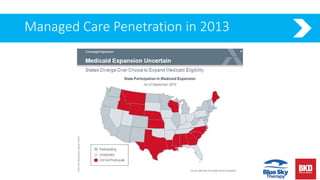
Managed Care Penetration in 2013
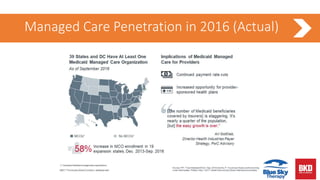
Managed Care Penetration in 2016 (Actual)
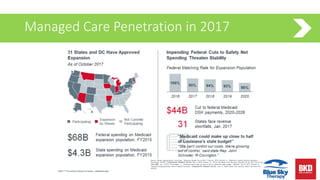
Managed Care Penetration in 2017
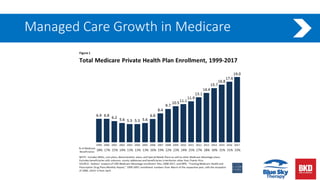
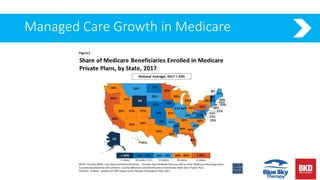
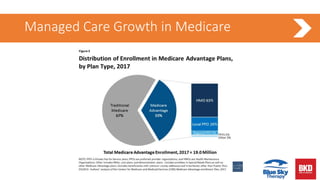
Managed Care Growth in Medicare
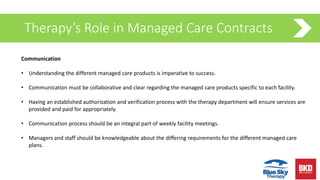
Therapy’s Role in Managed Care Contracts
Communication
• Understanding the different managed care products is imperative to success.
• Communication must be collaborative and clear regarding the managed care products specific to each facility.
• Having an established authorization and verification process with the therapy department will ensure services are
provided and paid for appropriately.
• Communication process should be an integral part of weekly facility meetings.
• Managers and staff should be knowledgeable about the differing requirements for the different managed care
plans.
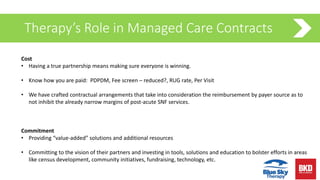
Therapy’s Role in Managed Care Contracts
Cost
• Having a true partnership means making sure everyone is winning.
• Know how you are paid: PDPDM, Fee screen – reduced?, RUG rate, Per Visit
• We have crafted contractual arrangements that take into consideration the reimbursement by payer source as to
not inhibit the already narrow margins of post-acute SNF services.
Commitment
• Providing “value-added” solutions and additional resources
• Committing to the vision of their partners and investing in tools, solutions and education to bolster efforts in areas
like census development, community initiatives, fundraising, technology, etc.
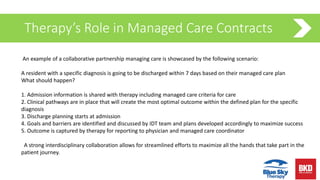
Therapy’s Role in Managed Care Contracts
An example of a collaborative partnership managing care is showcased by the following scenario:
A resident with a specific diagnosis is going to be discharged within 7 days based on their managed care plan
What should happen?
1. Admission information is shared with therapy including managed care criteria for care
2. Clinical pathways are in place that will create the most optimal outcome within the defined plan for the specific
diagnosis
3. Discharge planning starts at admission
4. Goals and barriers are identified and discussed by IDT team and plans developed accordingly to maximize success
5. Outcome is captured by therapy for reporting to physician and managed care coordinator
A strong interdisciplinary collaboration allows for streamlined efforts to maximize all the hands that take part in the
patient journey.
Medicare Managed Care: Contracting
What tips do you have for contracting with Medicare
Managed Care organizations, and how do you start
accepting patients who are in bundles?
Medicare Managed Care: Screening
With most hospitals requiring a decision in 30
minutes or less, what is a SNF to do to make
the right decision?
Medicare Managed Care: Admission
Since the most critical window seems to be the first 72
hours, what do you recommend organizations do to
prevent readmissions to the hospital?
Medicare Managed Care: Care Plan & IDT
What are things you discuss during your daily
and weekly interdisciplinary team meetings to
prevent readmissions and achieve the best
outcome in the shortest period of time?
Medicare Managed Care: Treatment
Are managed care/insurance companies following the
Medicare coverage and documentation criteria or using their
own criteria?
Medicare Managed Care: Treatment,
continued
What tips do you have for creating care pathways?
Medicare Managed Care: Requalification
• How can we use our EHR software to help track
subsequent authorizations or extended
authorizations?
• What other tips do you have on extending stays
beyond the Managed Care company’s
expectations?
Medicare Managed Care: Discharge
What advice do you have on preparing for a
successful discharge for a Managed Care patient?
Medicare Managed Care: Billing
When a managed Medicare PDPM
assessment has a late ARD and the default
HIPPS is generated under the PPS update
screen, does the default HIPPS or the actual
HIPPS score from the MDS need to be put on
the claim since the reimbursement is paid at
the LOC, not PDPM, and the assessment isn't
transmitted to the state?
Medicare Managed Care: Billing, continued
What are the advantages of using a
clearinghouse?
We seem to get surprised by Managed Care timely
filing - what advice do you have?
PDPM Billing
How do we know if we are being reimbursed
correctly due to the hundreds of case mix groupings
(CMG) possibilities?
Medicare Managed Care
Do you recommend post-discharge follow up and if so
what does that look like?
Summary
 Know your numbers
 Set goals
 Dashboard your goals to actual
 Meet regularly to discuss
 Advocate for your numbers
Q & A
John Harned
Director, BKD
Julie Bilyeu
Managing Director, BKD
Lisa Chambers
Chief Quality and Operations Officer

Managed Care of PDPM

  • 1.
    Welcome and thankyou for joining us for What you need to know about Managed Care & PDPM: Ask The Experts The webinar will begin soon What to Expect •Listen-only mode during the presentation •Questions can be submitted via the Q & A panel •Copy of the presentation is located via the handout panel •The webinar will be recorded and emailed to all registrants
  • 2.
    What you needto know about Managed Care & PDPM: Ask the experts
  • 3.
    Presenters John Harned Director, BKD JulieBilyeu Managing Director, BKD Lisa Chambers Chief Quality and Operations Officer
  • 4.
    Overview of ManagedCare Program
  • 5.
  • 6.
    Managed Care Penetrationin 2016 (Actual)
  • 7.
  • 8.
  • 9.
  • 10.
  • 11.
    Therapy’s Role inManaged Care Contracts Communication • Understanding the different managed care products is imperative to success. • Communication must be collaborative and clear regarding the managed care products specific to each facility. • Having an established authorization and verification process with the therapy department will ensure services are provided and paid for appropriately. • Communication process should be an integral part of weekly facility meetings. • Managers and staff should be knowledgeable about the differing requirements for the different managed care plans.
  • 12.
    Therapy’s Role inManaged Care Contracts Cost • Having a true partnership means making sure everyone is winning. • Know how you are paid: PDPDM, Fee screen – reduced?, RUG rate, Per Visit • We have crafted contractual arrangements that take into consideration the reimbursement by payer source as to not inhibit the already narrow margins of post-acute SNF services. Commitment • Providing “value-added” solutions and additional resources • Committing to the vision of their partners and investing in tools, solutions and education to bolster efforts in areas like census development, community initiatives, fundraising, technology, etc.
  • 13.
    Therapy’s Role inManaged Care Contracts An example of a collaborative partnership managing care is showcased by the following scenario: A resident with a specific diagnosis is going to be discharged within 7 days based on their managed care plan What should happen? 1. Admission information is shared with therapy including managed care criteria for care 2. Clinical pathways are in place that will create the most optimal outcome within the defined plan for the specific diagnosis 3. Discharge planning starts at admission 4. Goals and barriers are identified and discussed by IDT team and plans developed accordingly to maximize success 5. Outcome is captured by therapy for reporting to physician and managed care coordinator A strong interdisciplinary collaboration allows for streamlined efforts to maximize all the hands that take part in the patient journey.
  • 14.
    Medicare Managed Care:Contracting What tips do you have for contracting with Medicare Managed Care organizations, and how do you start accepting patients who are in bundles?
  • 15.
    Medicare Managed Care:Screening With most hospitals requiring a decision in 30 minutes or less, what is a SNF to do to make the right decision?
  • 16.
    Medicare Managed Care:Admission Since the most critical window seems to be the first 72 hours, what do you recommend organizations do to prevent readmissions to the hospital?
  • 17.
    Medicare Managed Care:Care Plan & IDT What are things you discuss during your daily and weekly interdisciplinary team meetings to prevent readmissions and achieve the best outcome in the shortest period of time?
  • 18.
    Medicare Managed Care:Treatment Are managed care/insurance companies following the Medicare coverage and documentation criteria or using their own criteria?
  • 19.
    Medicare Managed Care:Treatment, continued What tips do you have for creating care pathways?
  • 20.
    Medicare Managed Care:Requalification • How can we use our EHR software to help track subsequent authorizations or extended authorizations? • What other tips do you have on extending stays beyond the Managed Care company’s expectations?
  • 21.
    Medicare Managed Care:Discharge What advice do you have on preparing for a successful discharge for a Managed Care patient?
  • 22.
    Medicare Managed Care:Billing When a managed Medicare PDPM assessment has a late ARD and the default HIPPS is generated under the PPS update screen, does the default HIPPS or the actual HIPPS score from the MDS need to be put on the claim since the reimbursement is paid at the LOC, not PDPM, and the assessment isn't transmitted to the state?
  • 23.
    Medicare Managed Care:Billing, continued What are the advantages of using a clearinghouse? We seem to get surprised by Managed Care timely filing - what advice do you have?
  • 24.
    PDPM Billing How dowe know if we are being reimbursed correctly due to the hundreds of case mix groupings (CMG) possibilities?
  • 25.
    Medicare Managed Care Doyou recommend post-discharge follow up and if so what does that look like?
  • 26.
    Summary  Know yournumbers  Set goals  Dashboard your goals to actual  Meet regularly to discuss  Advocate for your numbers
  • 27.
    Q & A JohnHarned Director, BKD Julie Bilyeu Managing Director, BKD Lisa Chambers Chief Quality and Operations Officer

Editor's Notes

  • #6 John There has been a lot of attention spent on Fee for Service Medicare and the transition from RUGs – IV to PDPM However while we are hearing more and more about I-SNPs there is not a lot of people talking about Medicare Managed Care, Bundles and Medicare Advantage Yet in some portions of the country these payor sources account for more than 50% of a Skilled Nursing Facilities Medicare Patient Population – but not necessarily revenue So what has caused this land shift in payor sources? I would attribute it to Medicaid Expansion And one might ask – wait – what does Medicaid have to do with Medicare Managed Care The answer is a lot So in 2013 this is the map of Medicaid expansion in the US
  • #7 John Note in 2016 39 states and Washington DC had at least one Medicaid Managed Care Organization There was a 58% increase in Managed Care enrollment in the 19 expansion states from the previous slide to this slide in just 3 years
  • #8 Joh Note the federal participation of the Medicaid expansion is declining from 100% in 2016 to 90% in 2020
  • #9 John So as states move into Medicaid Expansion it creates a platform for the insurance companies who are required to set up all the infrastructure to administer the Medicaid plans This infrastructure and capital are necessary to launch a Medicare Managed Care Insurance program in those states So note from 2004 to 2017 the continued increase in the Medicare Managed Care enrollees and what percentage of the total Medicare Beneficiaries that equates to Now over 30% And this will continue to grow even though number of Medicare Beneficiaries are growing They are looking for convenience they want one plan to cover their Medicare Part A, Part B, Part D (Pharmacy) and their coinsurance as well as looking for other non-traditional benefits
  • #10 John So if you were to cross match the Medicare Expansion states in 2017 to the above percentage of Medicare Beneficiaries enrolled in Managed Care you would find a high correlation For example Oklahoma has not pursued Medicaid Expansion and the number of Medicare Beneficiaries enrolled in Medicare Managed Care is below 20%
  • #11 John So of the Medicare Advantage plans you can see the splits between HMO, Local PPOs and Regional PPOs You can also see the total Medicare Advantage Enrollment in 2017 was 19 million individuals Thus the Genesis for our discussion today Medicare Managed Care is not something you dabble in Rather is something you have to master or the Managed Care Organizations will take advantage of you and you will wind up with little or worse yet zero margin
  • #12 1. This is first and foremost one of the most critical elements of therapy’s role. 2. Many different types if of plans with different criteria, knowing the specifics of each plan: type of reimbursement, criteria for reimbursement. 3. This process should identify plan name, authorization requirements, restrictions, type of reimbursement, co-pay information
  • #13 . When partnering, we know that certain managed care products are significantly lower in reimbursement than others or pay differently, so we can tailor a contract to be specific by payer source
  • #14 . When partnering, we know that certain managed care products are significantly lower in reimbursement than others or pay differently, so we can tailor a contract to be specific by payer source
  • #15 Julie Bilyeu Comments from Juli Pascoe Not having copies of their contracts Not knowing who they have contracts with John Harned Take your C-Suite to the meetings with the Managed Care Companies to show how important this is to your organization Utilize CMS Website for managed care enrollment Medicare enrollment has most market share in my market Rather than going to one with 100 members Prioritize where to start your efforts Almost have to have systems in place before they will talk with you Chicken / egg need pathways before you have patients Start with developing pathways for hips and knees Then work your way up to Congestive heart failure pathways Most only work with 3 stars and greater In major metro want to have 5 stars Must have data to take to companies How does the rate they are presenting you compare to your Medicare Fee for Service rate – may start at 80% You can get increases; however, you must keep data on outcomes For example: What is discharge rate to home Length of stay Number of admissions by insurer Discharges to home health, hospice and home Readmission rate What differentiates you from others Performance tied to results It takes years to build a relationship with the MCO One thing to do is join case management associations in your area and get to know people Anything to get face-time with discharge planners Show discharge planners the same data Hospitals now have preferred provider networks (PPN) If not in PPN you won’t the work Bundles – even different than Managed Care Prove self with doctors or hospitals controlling bundles Had to provide numbers and clinical pathways Meet with regularly - quarterly Biggest metric for bundles: return to hospital and length of stay Have to live with some ambiguity some better than average some worse Hardest part for therapist is 100% is not the goal for discharge Want us to get them to a point they can make it to the next level of care safely Takes lots of education Build your own sharing group in your region and gather the Directors of contracting from competitors I call this coopatition (even though they are competitors you can cooperate, because the managed care organization is really the 800 lb. gorilla in the room Work together as a sharing group / support group Work on global issues with a payor Email exchange Gather monthly for lunch Work group / support group STOP! Know NPI, Medicare number, Star rating, tax id number, provider license They will know your star Credentialing is a big part (sometimes a big hurdle) Plans have different requirements Application process Submit information Supporting documentation 30 – 60 day Plans may meet monthly or quarterly Thanks, but no thanks Some use 3rd party firms to do the work Then negotiations actually begin Could take up to 6 months First step to first admission Management networks system (MNS) Third party vendor Credentialing and contracting for SNFs Customer is SNF for a fee Like a hired gun Post-acute side pay them a management fee Wellcare contract Humana uses them to manage Value Based Contracting TPA hired for managed care / bundled – navahealth services Authorization / continued stay / discharge go through – navahealth Rather than work with Humana, work with Navahealth Carecentric similar to Navahealth (maybe Wellcare) for the payor Navahealth – prior to PDPM – provide post acute facility they would set RUG level for Humana With PDPM they coordinate they set the HIPPS score Without an MDS Town hall with payor Don’t want an MDS Do an OBRA assessment and manually enter HIPPS on the claim Don’t submit the MDS Completing Don’t want section GG Want all the supporting documentation Put their own Adding stringent NTA and Nursing and less reimbursement Post-acute facility only negotiate change in reimbursement only while patient in facility No post discharge rate appeal Health plan side Still reimbursing on levels Some on PDPM Expand contracting Few still on RUGs
  • #16 Jeremy do you want to talk about data and John Harned can talk about operations? John Screening Referrals come into a SNF admission office staffed 7 days a week What is your plan for weekends? All agree on paperwork to send to SNF Most hospitals agree on what they are going to send Many come in electronically Get access to the hospital EMR Allscripts / Carespan???? Create a stop light process Green – immediate yes (for example if your admission liaison is not a nurse) Yellow – pause (push up to DON/ADON) Red – get more info send to management for review Administrator / CFO (i.e. wounds) Track your metric from Hospital on referral time Track your metric on declines – must go to the administrator Hospital wants to know how many taken, how many decline Metric on authorization from Managed Care – many times the patient stays in the hospital until the SNF stay is authorized Keep admission liaison in the hospital – go see patient and family and build a relationship before someone else does Pre-admission Watch medication list Use pre-admission checklist that BKD uses  
  • #17 John: INTERACT 2 Physicians and NP expected to be there 7 days a week Need coverage on weekend All admissions must be seen by NP in 24 hours All admissions must be seen by Doctor in 72 hours Helps with readmissions If cardiac, neurology (Parkinson / stroke) and wounds, rehab (DR) – need an NP weekly Need RNs around the clock – always Make sure you have Standing orders for care pathways Interact is a must – answer these questions before sending the patient out!!! Using INTERACT call NP with your plan before you call 911
  • #18 John Harned Care Plan Mini IDT Meeting in 24 hours for: All admissions All clinical changes Within the first 24 hours: Diagnosis decided, regardless of Bundle / Managed Care / PDPM Decide potential discharge date within 24 hours This is how we get everyone together In your standups look at: All discharges in next 24 hours Look at discharges in next 72 hours From these lists move people up or back Working discussion Only 30-minute meeting Typically driven by ADON or DON If charge nurse can attend it is great, if not make sure they get the information immediately! Tried to pull charge nurse but they are trying to get discharges out the door Also included are Social Worker, MDS, Therapy, DON, (Admin in and out) IDT meeting weekly: Nurse Practitioner (NP) or Doctor come to weekly meeting – you may even ask them to run the meeting Remember this is managed care Especially if this is a physician group bundle They have skin in the game Sometimes even the managed care case manager to see your process and gain trust in your organization they usually come in first for their patients and leave Maybe they even phone in Sometimes the home health representative Similarly, they come into the meeting for their patients only Make sure we are using the pathways for the best results Make sure everyone knows in advance what their responsibilities are to bring to the meeting Higher clinical skills of the entire team  
  • #19 Julie Bilyeu Question posed by Richard Many tell providers to treat everyone like a Medicare patient, But if you are a high volume MA provider and your contracts don’t require PPS assessments why are they doing them? It is understandable to be safe rather than sorry but in this day and age the SNF should know if they need PPS or just OBRA (READ THE CONTRACT) so they can appropriately spend time where needed rather than wasting time on assessments which are not required
  • #20 John Harned Have a family meeting in first 48 hours Know what the discharge location looks like in terms of support systems and barriers to success Know within first 24 to 72 hours is discharge location optimal Standing orders for pathways May times the night nurse could be working on this If not make it home in 21 days, then a real care plan Create Email groups with MDS, Therapy, ADON & Social Worker IF in doubt and problems arise remind to go back to care pathway Pathways created – adoption Interact 2 Involve specialty groups for example for CHF patients get Cardiologist group to be in building For example, everyone educated on signs and symptoms of fluid overload Teach everyone, patient and family Bought home scales, given blank calendar, do BP & Pulse Don’t do special diets Put symbols on menu Give people choice Adjust to lasics while there If making bad choices at facility use meds to adjust Develop Pain protocols – red light / yellow light / green light Every four hours Know what the goal is from the physician Education to resident Bundles may have protocols of their own For example: Hip / knees Create one which includes physician and hospital protocols Get everyone to agree To the extent possible keep them simple Work with Home Health early in the process
  • #21 Julie Bilyeu Missing out on subsequent authorizations or extended authorizations which they should be able to setup a process/tracking for in MyUnity John Harned Each bundle company has different expectation Update 24/48/72 hours At 72 want discharge Want 7 days Explain why past 7 days Add speech must get permission first Not afraid of asking for AL respite stay If you don’t abuse it You will get support Don’t wait till the discharge date to get approval Do they have familial support systems? All go through social worker / case manager What are barriers from discharge to home Humana will give quarterly data – in a 90-day window 5% may have over 5% under as well Remidi partner check live time less than 5% They will call you on train wrecks Tell me up front not after Extend a knee with pain Comes down to trust
  • #22 John Harned Planning from day one Teach wound vacs Don’t wait Nursing just important as rehab on the discharge Make sure transition is smooth from SNF to HHA Data on return to hospital is 30 to 45 Do satisfaction survey Mailed back to administrator Compiled by Info goes to the quality assurance team
  • #23 Julie Bilyeu Question posed by Letricia Other things to point our: Not understanding the carve outs (items that can be billed separate) and leaving money on the table.  For example some allow for additional revenue for high cost meds however they may have rules about these things needing authorized before hospital discharge. Not having the software setup to create the claim correctly per contract guidelines (i.e. is it a LOC or PPS- what revenue codes etc.) and not having A/R set up correctly- not having payers split out so they can easily tell who owes the money.. i.e. having a generic Medicare Advantage payer is a bad idea for hundreds of reasons. Not finding out and billing the cost share in advance and then not ever getting those classified over to private- or not understanding the rules for a dual eligible for their state if it’s billable/reimbursable to Medicaid Not getting the authorization number(s) on the claim= poor communication not knowing where to input in MyUnity, etc.
  • #24 Julie Bilyeu Not billing the required compliance claim to Medicare Not getting copies of cards to have the correct policy number Not having a clearinghouse and trying to bill paper is a bad idea on the opposite end we see where people send claims and never follow up and realize later the claim never made it to the correct payer so follow up is key Not knowing the rules for timely filing
  • #25 Julie Bilyeu Question came in from Carolyn
  • #26 John Harned Must educate home health team they can readmit to SNF Bring back to SNF Rather do this than send to the hospital Needs to be more training Many bundles (Remidi) go to home with RN and Social Worker They have the knowledge to return to SNF Ortho bundles don’t want RN on Home Health See if you can get a nurse Show hospitals data on benefit of readmit to SNF rather than hospital Start calls after they leave How are they doing Buildings are implementing Give them a script on what to ask Make it a goal for 2020 Work with home health companies Health plans evaluating home health networks on quality / stars / outcomes Post-acute facilities monitor network Check the star rating Evaluate the network Look at DME when is delivery / where is delivery / planning in advance Must use the health plan network of DME Pilot program of 30 day re-admit Concerned about feedback – they will ask questions Reach out to home care providers Mitigate returns to the hospital Most likely in first 7 days Gather this data!!!! Greater coordination is a must! Who is placing the calls? Ask the health plan Definitely fee for service