By Maria Pia and Amy Saliba
Ġbejna (plural ġbejniet) are cheeselets
made in the Maltese Islands from goat’s
or sheep milk, salt and rennet. In both
Malta and the neighbouring island of
Gozo virtually all sheep milk and most
goat milk is used for production of these
cheeselets, much of it through family-
owned cottage industries. They are
prepared and served in a variety of
forms: pickled, salted, peppered,
covered in herbs, dried, or as a plain,
fresh cheeselet. Legend has it that
earlier generations used sea water,
rather than rennet, as a curdling agent.
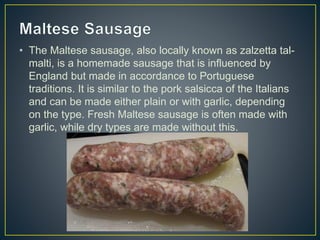
• The Maltese sausage, also locally known as zalzetta tal-
malti, is a homemade sausage that is influenced by
England but made in accordance to Portuguese
traditions. It is similar to the pork salsicca of the Italians
and can be made either plain or with garlic, depending
on the type. Fresh Maltese sausage is often made with
garlic, while dry types are made without this.
The production of Maltese sausage begins with ground
pork and fat. This is seasoned with sea salt, crushed
black peppercorns, crushed coriander seeds, parsley,
garlic and other spices then stuffed into sausage
casings.
For dried varieties, the links are pricked to let air out
and left to dry for about 2 to 4 days. The result is a
short and thick sausage with a pinkish color when raw.
Once cooked, this becomes brown and is full of flavor.
The amount of sea salt used also makes for a slightly
salty sausage that has bit of crunch and texture thanks
to the peppercorn and coriander.
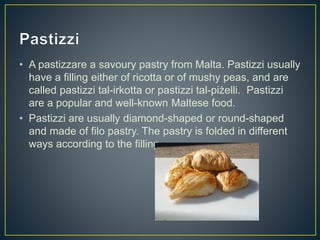
• A pastizzare a savoury pastry from Malta. Pastizzi usually
have a filling either of ricotta or of mushy peas, and are
called pastizzi tal-irkotta or pastizzi tal-piżelli. Pastizzi
are a popular and well-known Maltese food.
• Pastizzi are usually diamond-shaped or round-shaped
and made of filo pastry. The pastry is folded in different
ways according to the filling.
A pastizzare a savoury pastry from Malta. Pastizzi usually
have a filling either of ricotta or of mushy peas, and are
called pastizzi tal-irkotta or pastizzi tal-piżelli. Pastizzi are
a popular and well-known Maltese food.
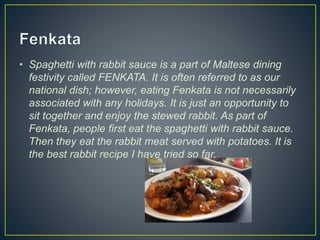
• Spaghetti with rabbit sauce is a part of Maltese dining
festivity called FENKATA. It is often referred to as our
national dish; however, eating Fenkata is not necessarily
associated with any holidays. It is just an opportunity to
sit together and enjoy the stewed rabbit. As part of
Fenkata, people first eat the spaghetti with rabbit sauce.
Then they eat the rabbit meat served with potatoes. It is
the best rabbit recipe I have tried so far.
Qagħaq tal-għasel are sweet pastry rings filled with a
treacle mixture. Literally translated they are ‘honey
rings’; but there is absolutely no honey in the
recipe. The main ingredient in the filling is treacle. In
Maltese treacle is known as għasel iswed; so
probably that is why they are known as honey
rings. Years ago village people used qastanija, and
not treacle, for theirqagħaq tal-għasel. This was
made by melting down honey-combs after the honey
had been extracted from them. In all
probability qastanija is a corruption of the
Italian castagna, which means chestnut. It might be
that it was so called because the mixture was the
colour of chestnuts. But there are absolutely no
chestnuts in the mixture. Through the
years qastanija was substituted by black treacle. For
those who have a very sweet tooth, sugar is added to
the filling mixture.
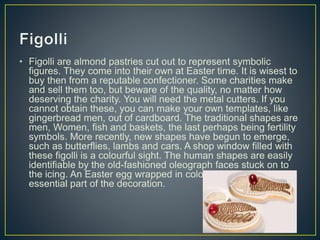
• Figolli are almond pastries cut out to represent symbolic
figures. They come into their own at Easter time. It is wisest to
buy then from a reputable confectioner. Some charities make
and sell them too, but beware of the quality, no matter how
deserving the charity. You will need the metal cutters. If you
cannot obtain these, you can make your own templates, like
gingerbread men, out of cardboard. The traditional shapes are
men, Women, fish and baskets, the last perhaps being fertility
symbols. More recently, new shapes have begun to emerge,
such as butterflies, lambs and cars. A shop window filled with
these figolli is a colourful sight. The human shapes are easily
identifiable by the old-fashioned oleograph faces stuck on to
the icing. An Easter egg wrapped in coloured paper is an
essential part of the decoration.
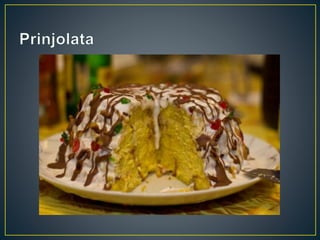
• This is a cake designed to appeal to kids in general.
While Christmas cakes are ice-rink smooth perfection,
the prinjolata, which starts appearing in cafés and
confectioners in late January and therefore well before
carnival, is a mound of mess. Splattered with melted
chocolate, pine nuts and glacé cherries glowing neon
artificial green and red, the prinjolata is like a kids’ art
session. Its name comes from prinjol, pine nut, which is
similar to the Italian word, pinoli. But pine nuts seem to
be just a bit of decoration. The cake itself, which can be a
cafe’ counter-top mountain, is made of cream, sponge,
citrus peel and biscuits. It has a substantial calorie count
with its condensed milk and a bit of a boozy bite to it with
its Vermouth content.
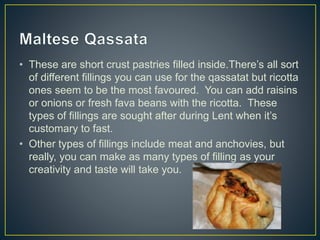
• These are short crust pastries filled inside.There’s all sort
of different fillings you can use for the qassatat but ricotta
ones seem to be the most favoured. You can add raisins
or onions or fresh fava beans with the ricotta. These
types of fillings are sought after during Lent when it’s
customary to fast.
• Other types of fillings include meat and anchovies, but
really, you can make as many types of filling as your
creativity and taste will take you.
Maltese original foods

Maltese original foods

  • 1.
    By Maria Piaand Amy Saliba
  • 2.
    Ġbejna (plural ġbejniet)are cheeselets made in the Maltese Islands from goat’s or sheep milk, salt and rennet. In both Malta and the neighbouring island of Gozo virtually all sheep milk and most goat milk is used for production of these cheeselets, much of it through family- owned cottage industries. They are prepared and served in a variety of forms: pickled, salted, peppered, covered in herbs, dried, or as a plain, fresh cheeselet. Legend has it that earlier generations used sea water, rather than rennet, as a curdling agent.
  • 3.
    • The Maltesesausage, also locally known as zalzetta tal- malti, is a homemade sausage that is influenced by England but made in accordance to Portuguese traditions. It is similar to the pork salsicca of the Italians and can be made either plain or with garlic, depending on the type. Fresh Maltese sausage is often made with garlic, while dry types are made without this.
  • 4.
    The production ofMaltese sausage begins with ground pork and fat. This is seasoned with sea salt, crushed black peppercorns, crushed coriander seeds, parsley, garlic and other spices then stuffed into sausage casings. For dried varieties, the links are pricked to let air out and left to dry for about 2 to 4 days. The result is a short and thick sausage with a pinkish color when raw. Once cooked, this becomes brown and is full of flavor. The amount of sea salt used also makes for a slightly salty sausage that has bit of crunch and texture thanks to the peppercorn and coriander.
  • 5.
    • A pastizzarea savoury pastry from Malta. Pastizzi usually have a filling either of ricotta or of mushy peas, and are called pastizzi tal-irkotta or pastizzi tal-piżelli. Pastizzi are a popular and well-known Maltese food. • Pastizzi are usually diamond-shaped or round-shaped and made of filo pastry. The pastry is folded in different ways according to the filling.
  • 6.
    A pastizzare asavoury pastry from Malta. Pastizzi usually have a filling either of ricotta or of mushy peas, and are called pastizzi tal-irkotta or pastizzi tal-piżelli. Pastizzi are a popular and well-known Maltese food.
  • 7.
    • Spaghetti withrabbit sauce is a part of Maltese dining festivity called FENKATA. It is often referred to as our national dish; however, eating Fenkata is not necessarily associated with any holidays. It is just an opportunity to sit together and enjoy the stewed rabbit. As part of Fenkata, people first eat the spaghetti with rabbit sauce. Then they eat the rabbit meat served with potatoes. It is the best rabbit recipe I have tried so far.
  • 8.
    Qagħaq tal-għasel aresweet pastry rings filled with a treacle mixture. Literally translated they are ‘honey rings’; but there is absolutely no honey in the recipe. The main ingredient in the filling is treacle. In Maltese treacle is known as għasel iswed; so probably that is why they are known as honey rings. Years ago village people used qastanija, and not treacle, for theirqagħaq tal-għasel. This was made by melting down honey-combs after the honey had been extracted from them. In all probability qastanija is a corruption of the Italian castagna, which means chestnut. It might be that it was so called because the mixture was the colour of chestnuts. But there are absolutely no chestnuts in the mixture. Through the years qastanija was substituted by black treacle. For those who have a very sweet tooth, sugar is added to the filling mixture.
  • 9.
    • Figolli arealmond pastries cut out to represent symbolic figures. They come into their own at Easter time. It is wisest to buy then from a reputable confectioner. Some charities make and sell them too, but beware of the quality, no matter how deserving the charity. You will need the metal cutters. If you cannot obtain these, you can make your own templates, like gingerbread men, out of cardboard. The traditional shapes are men, Women, fish and baskets, the last perhaps being fertility symbols. More recently, new shapes have begun to emerge, such as butterflies, lambs and cars. A shop window filled with these figolli is a colourful sight. The human shapes are easily identifiable by the old-fashioned oleograph faces stuck on to the icing. An Easter egg wrapped in coloured paper is an essential part of the decoration.
  • 10.
    • This isa cake designed to appeal to kids in general. While Christmas cakes are ice-rink smooth perfection, the prinjolata, which starts appearing in cafés and confectioners in late January and therefore well before carnival, is a mound of mess. Splattered with melted chocolate, pine nuts and glacé cherries glowing neon artificial green and red, the prinjolata is like a kids’ art session. Its name comes from prinjol, pine nut, which is similar to the Italian word, pinoli. But pine nuts seem to be just a bit of decoration. The cake itself, which can be a cafe’ counter-top mountain, is made of cream, sponge, citrus peel and biscuits. It has a substantial calorie count with its condensed milk and a bit of a boozy bite to it with its Vermouth content.
  • 12.
    • These areshort crust pastries filled inside.There’s all sort of different fillings you can use for the qassatat but ricotta ones seem to be the most favoured. You can add raisins or onions or fresh fava beans with the ricotta. These types of fillings are sought after during Lent when it’s customary to fast. • Other types of fillings include meat and anchovies, but really, you can make as many types of filling as your creativity and taste will take you.