ADNAN AKHTAR
Bachelor of Engineering
(civil)
CONTENTS
 Introduction
 Definition
 Types Of Malnutrition
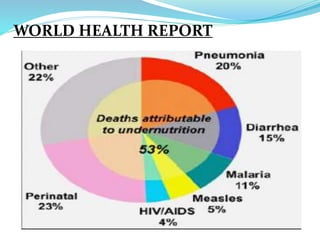
 World Health Report
 Difference Between under
and over nutrition
 Cause Of Malnutrition
 Symptom Of Malnutrition
 Treatment Of Malnutrition
 Conclusion
 References
DEFINITION OF MALNUTRITION
WHO defines malnutrition as “the cellular imbalance
between the supply of nutrients and energy and the body’s
demand for them to ensure growth, maintains , and
specific function .”
Malnutrition is a condition that develops when the body
does not get the right amount of vitamins , minerals , and
other nutrients it needs to maintain healthy tissues and
organ function .
TYPE OF MALNUTRITION
UNDER NUTRITION- insufficient food is eaten.
OVER NUTRITION- consumption of excessive quantity
of food.
IMBALANCE – disproportion amount essential
nutrients.
SPECIFIC DEFICIENCY- relative or absolute lack of
nutrients .
WORLD HEALTH REPORT
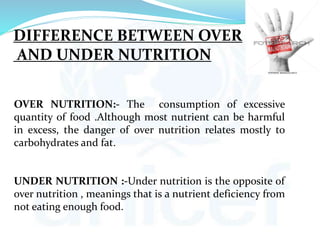
DIFFERENCE BETWEEN OVER
AND UNDER NUTRITION
OVER NUTRITION:- The consumption of excessive
quantity of food .Although most nutrient can be harmful
in excess, the danger of over nutrition relates mostly to
carbohydrates and fat.
UNDER NUTRITION :-Under nutrition is the opposite of
over nutrition , meanings that is a nutrient deficiency from
not eating enough food.
CAUSES OF MALNUTRITION
There are many causes for malnutrition . These causes
can be divided in two main categories.
(A) Causes related to food.
(B) General causes.
(A) Causes related to food: a lot causes related to food
are responsible for malnutrition.
1. Lack of nutritious and balanced diet.
2. Indigestive and Harmful diet.
3. Lack of regulated diet.
(B) General causes
1. Dirty Environment.
2. Lack of sound sleep and rest.
3. Negligence of children.
4. Bodily diseases.
5. Heavy work.
6. lack of exercise and games.
1. Lack of nutritious and Balanced Diet:
Lack of nutritious and balanced diet is responsible to a
great extent for malnutrition in children. In our
country, because of poverty.
Causes of malnutrition (cont..)
2 . Indigestive and Harmful diet:
Intake of indigestive and harmful diet is one of the main
causes of malnutrition. Children belonging to the rich families
do have expensive food items but in general these food items
are indigestive and harmful.
3. Lack of Regulated Diet:
Irregular intake of food is one of the main causes leading
to malnutrition. The timings for breakfast, lunch and dinner
must more or less be fixed. Indiscipline in this matter is very
bad.
Causes of malnutrition (cont..)
(B) General Causes
1. Dirty Environment:
Dirty environment of home and school also causes malnutrition.
In Indian cities the home and school environment becomes
dirty due to lack of fresh and pure air, lack of sunlight, non-
availability of playground, dirty lanes, which hampers right
nutrition of children .
.
2. Negligence of Children:
Negligence of children at home and in school causes anxiety in
children. This also results in malnutrition.
Causes of malnutrition (cont..)
3. Lack of Sound Sleep and Rest:
Lack of space and suffocated bedroom causes lack of
sleep. Besides this excess of homework and Television
watching in late hours causes lack of sleep. Lack of sleep
results in indigestion, which leads to malnutrition. Lack of
proper and sufficient rest also leads to malnutrition
4. Bodily diseases:
Many children being infected from the diseases are neither
able to have balanced diet nor their bodily functions take
place properly resulting in malnutrition.
Causes of malnutrition (cont..)
5. Heavy work:
The digestive process of children gets affected because of
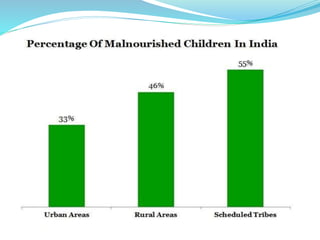
continuous hard work. Nearly forty percent of total children in
India suffer from malnutrition.
6. Lack of Exercise and Games:
The lack of exercise and games also leads to malnutrition. This
also causes physical deficiencies.
Causes of malnutrition (cont..)
Symptoms of malnutrition
in Adult
Change in skin pigment.
Decreased muscle mass
Diarrhea
Failure to gain weight and grow
Hair change (change in colour or texture)
Loss of muscle mass.
Rash (dermatitis).
Shock (late stage).
Swelling(edema).
Symptoms of malnutrition
in children
failure to grow at the expected rate, both in terms of weight
and height
changes in behavior , such as being unusually irritable.
changes in hair and skin color
 skin problems or rashes
swelling of your tongue
poor vision at night or in dim light
feeling out of breath and tired all the time
 bone and joint pain
TREATMENT
Treatment strategy can be divided into three stages.
( 1) Resolving life threatening conditions.
(2) Restoring nutritional status.
(3) Ensuring nutritional rehabilitation.
There are three stages of treatment.
1. Hospital treatment
Hypothermia ,infection ,dehydration ,electrolyte imbalance,
Anemia and other vitamin and mineral deficiencies.
2 . Dietary management
The diet should be from locally available staple food –
inexpensive, easily digestible, evenly distributed
throughout the day and increased number of feedings to
increase the quantity of food.
3. Rehabilitation
The concept of nutritional rehabilitation is based on
practical nutritional training .Fo r mothers in which they
learn by feeding their children back to health under
Supervision and using local foods.
Treatment (cont..)
CONCLUSION
 Malnutrition in India can be improved dramatically with
the active participation and prioritization of this issue by
the government and international organizations
 The government needs to spend more money on quality
nutritional programs.
 I believe that spreading the word about overpopulation and
its effects on the planet is important to help decrease
malnutrition.
 Improving political commitment and public awareness.
 Raising the level of community participation.
REFRENCES
 Progress For Children: A Report
Card On Nutrition“
 Essentials of International
Health
 WHO Drug Information Vol.
16, No. 2, 2002.
 "Classification and Definition
of Protein-Calorie
Malnutrition”
 “ World Food programme ,
Cash and Vouchers For food”
SUBMITTED TO :
DR- KISHWAR ZAFIR
SUBMITTED TO :
DR- KISHWAR ZAFIR
SUBMITTED TO :
DR- KISHWAR ZAFIR

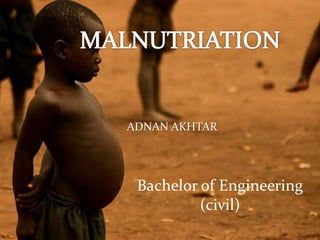
MALNUTRIATION

  • 1.
    ADNAN AKHTAR Bachelor ofEngineering (civil)
  • 2.
    CONTENTS  Introduction  Definition Types Of Malnutrition  World Health Report  Difference Between under and over nutrition  Cause Of Malnutrition  Symptom Of Malnutrition  Treatment Of Malnutrition  Conclusion  References
  • 3.
    DEFINITION OF MALNUTRITION WHOdefines malnutrition as “the cellular imbalance between the supply of nutrients and energy and the body’s demand for them to ensure growth, maintains , and specific function .” Malnutrition is a condition that develops when the body does not get the right amount of vitamins , minerals , and other nutrients it needs to maintain healthy tissues and organ function .
  • 4.
    TYPE OF MALNUTRITION UNDERNUTRITION- insufficient food is eaten. OVER NUTRITION- consumption of excessive quantity of food. IMBALANCE – disproportion amount essential nutrients. SPECIFIC DEFICIENCY- relative or absolute lack of nutrients .
  • 5.
  • 6.
    DIFFERENCE BETWEEN OVER ANDUNDER NUTRITION OVER NUTRITION:- The consumption of excessive quantity of food .Although most nutrient can be harmful in excess, the danger of over nutrition relates mostly to carbohydrates and fat. UNDER NUTRITION :-Under nutrition is the opposite of over nutrition , meanings that is a nutrient deficiency from not eating enough food.
  • 8.
    CAUSES OF MALNUTRITION Thereare many causes for malnutrition . These causes can be divided in two main categories. (A) Causes related to food. (B) General causes. (A) Causes related to food: a lot causes related to food are responsible for malnutrition. 1. Lack of nutritious and balanced diet. 2. Indigestive and Harmful diet. 3. Lack of regulated diet.
  • 9.
    (B) General causes 1.Dirty Environment. 2. Lack of sound sleep and rest. 3. Negligence of children. 4. Bodily diseases. 5. Heavy work. 6. lack of exercise and games. 1. Lack of nutritious and Balanced Diet: Lack of nutritious and balanced diet is responsible to a great extent for malnutrition in children. In our country, because of poverty. Causes of malnutrition (cont..)
  • 10.
    2 . Indigestiveand Harmful diet: Intake of indigestive and harmful diet is one of the main causes of malnutrition. Children belonging to the rich families do have expensive food items but in general these food items are indigestive and harmful. 3. Lack of Regulated Diet: Irregular intake of food is one of the main causes leading to malnutrition. The timings for breakfast, lunch and dinner must more or less be fixed. Indiscipline in this matter is very bad. Causes of malnutrition (cont..)
  • 11.
    (B) General Causes 1.Dirty Environment: Dirty environment of home and school also causes malnutrition. In Indian cities the home and school environment becomes dirty due to lack of fresh and pure air, lack of sunlight, non- availability of playground, dirty lanes, which hampers right nutrition of children . . 2. Negligence of Children: Negligence of children at home and in school causes anxiety in children. This also results in malnutrition. Causes of malnutrition (cont..)
  • 12.
    3. Lack ofSound Sleep and Rest: Lack of space and suffocated bedroom causes lack of sleep. Besides this excess of homework and Television watching in late hours causes lack of sleep. Lack of sleep results in indigestion, which leads to malnutrition. Lack of proper and sufficient rest also leads to malnutrition 4. Bodily diseases: Many children being infected from the diseases are neither able to have balanced diet nor their bodily functions take place properly resulting in malnutrition. Causes of malnutrition (cont..)
  • 13.
    5. Heavy work: Thedigestive process of children gets affected because of continuous hard work. Nearly forty percent of total children in India suffer from malnutrition. 6. Lack of Exercise and Games: The lack of exercise and games also leads to malnutrition. This also causes physical deficiencies. Causes of malnutrition (cont..)
  • 14.
    Symptoms of malnutrition inAdult Change in skin pigment. Decreased muscle mass Diarrhea Failure to gain weight and grow Hair change (change in colour or texture) Loss of muscle mass. Rash (dermatitis). Shock (late stage). Swelling(edema).
  • 15.
    Symptoms of malnutrition inchildren failure to grow at the expected rate, both in terms of weight and height changes in behavior , such as being unusually irritable. changes in hair and skin color  skin problems or rashes swelling of your tongue poor vision at night or in dim light feeling out of breath and tired all the time  bone and joint pain
  • 16.
    TREATMENT Treatment strategy canbe divided into three stages. ( 1) Resolving life threatening conditions. (2) Restoring nutritional status. (3) Ensuring nutritional rehabilitation. There are three stages of treatment. 1. Hospital treatment Hypothermia ,infection ,dehydration ,electrolyte imbalance, Anemia and other vitamin and mineral deficiencies.
  • 17.
    2 . Dietarymanagement The diet should be from locally available staple food – inexpensive, easily digestible, evenly distributed throughout the day and increased number of feedings to increase the quantity of food. 3. Rehabilitation The concept of nutritional rehabilitation is based on practical nutritional training .Fo r mothers in which they learn by feeding their children back to health under Supervision and using local foods. Treatment (cont..)
  • 18.
    CONCLUSION  Malnutrition inIndia can be improved dramatically with the active participation and prioritization of this issue by the government and international organizations  The government needs to spend more money on quality nutritional programs.  I believe that spreading the word about overpopulation and its effects on the planet is important to help decrease malnutrition.  Improving political commitment and public awareness.  Raising the level of community participation.
  • 19.
    REFRENCES  Progress ForChildren: A Report Card On Nutrition“  Essentials of International Health  WHO Drug Information Vol. 16, No. 2, 2002.  "Classification and Definition of Protein-Calorie Malnutrition”  “ World Food programme , Cash and Vouchers For food”
  • 20.
    SUBMITTED TO : DR-KISHWAR ZAFIR SUBMITTED TO : DR- KISHWAR ZAFIR SUBMITTED TO : DR- KISHWAR ZAFIR