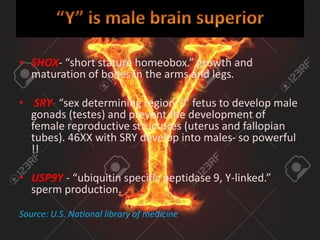
• SHOX- “short stature homeobox.” growth and
maturation of bones in the arms and legs.
• SRY- “sex determining region Y.” fetus to develop male
gonads (testes) and prevent the development of
female reproductive structures (uterus and fallopian
tubes). 46XX with SRY develop into males- so powerful
!!
• USP9Y - “ubiquitin specific peptidase 9, Y-linked.”
sperm production.
Source: U.S. National library of medicine
• Differences appear as early as 3 years of age!
• Connectivity patterns in children were
indistinguishable between males and females!
• 3rd interstitial nucleus of thalamus- Sexual
orientation
Personality Traits
• Schmitt, David P.; Realo, Anu; Voracek, Martin; Allik, Jüri (2008). "Why can't a man be more like a woman? Sex
differences in Big Five personality traits across 55 cultures". Journal of Personality and Social Psychology 94(1):
168–82. doi:10.1037/0022-3514.94.1.168.PMID 18179326
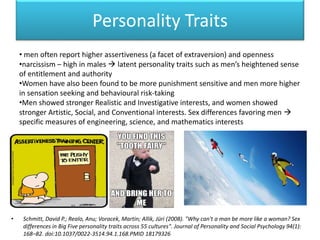
• men often report higher assertiveness (a facet of extraversion) and openness
•narcissism – high in males  latent personality traits such as men’s heightened sense
of entitlement and authority
•Women have also been found to be more punishment sensitive and men more higher
in sensation seeking and behavioural risk-taking
•Men showed stronger Realistic and Investigative interests, and women showed
stronger Artistic, Social, and Conventional interests. Sex differences favoring men 
specific measures of engineering, science, and mathematics interests
Mood disorders
• 2 fold greater prevalence in females
• Manic episodes more in men.
• Suicides – “Paradox”
Psychosis and Substance use
• Brief psychotic disorder- twice as common
in females as male
• Schizophrenia – Chronic negative symptoms
Vs Mood+brief episodes
• Schizo affective – more common in females
•SUD is more in males
•SUD with mood disorder twice
more common in females than
males
•Intoxication
•Withdrawal
Autism and Schizophrenia
 The extreme male brain hypothesis
• People with autism tend to perform poorly on tests of empathizing, or the ability to
put oneself in somebody else's shoes, but do well on tests of systematizing, or
finding repeating patterns.
• The hypothesis states that autism is an extreme form of the normal male cognitive
profile, which occurs as a result of high testosterone levels in the womb.
considered as 'hyper-systematisers' who focus more on patterns and fine details
than on other people's thoughts and actions.
 Imprinted brain theory:
• the risk of autism is increased by disruption of maternal interests and the
uninhibited expression of paternal interests, and that the risk of schizophrenia is
increased by the disruption of paternal interests and the uninhibited expression of
maternal interests
Source:
1. Baron-Cohen S (2002). "The extreme male brain theory of autism". Trends Cogn Sci 6 (6): 248–254. doi:10.1016/S1364-6613(02)01904-
6. PMID 12039606.
2. Crespi, B. (2008). "Genomic imprinting in the development and evolution of psychotic spectrum conditions". Biological
Reviews. doi:10.1111/j.1469-185X.2008.00050.
1. Lynn, Richard (1999). "Sex differences in intelligence and brain size: A developmental
theory". Intelligence 27: 1–12.doi:10.1016/S0160-2896(99)00009-4.
2. ^ Jump up to:a b c Irwing, Paul; Lynn, Richard (2005). "Sex differences in means and variability
on the progressive matrices in university students: A meta-analysis". British Journal of
Psychology96 (4): 505–24.doi:10.1348/000712605X53542.PMID 16248939.
3. Jump up^ Lynn, Richard (1994). "Sex differences in intelligence and brain size: A paradox
resolved". Personality and Individual Differences 17 (2): 257–71. doi:10.1016/0191-
8869(94)90030-2.
4. ^ Jump up to:a b c d Blinkhorn, Steve (2005). "Intelligence: A gender
bender" (PDF). Nature 438 (7064): 31–
2. Bibcode:2005Natur.438...31B.doi:10.1038/438031a. PMID 16267535
5. Irwing, Paul; Lynn, Richard (2006). "Intelligence: Is there a sex difference in IQ
scores?". Nature 442 (7098): E1; discussion E1–
2. Bibcode:2006Natur.442E...1I.doi:10.1038/nature04966. PMID 16823409.
6. ^ Jump up to:a b Jackson, Douglas N.; Rushton, J. Philippe (2006). "Males have greater g: Sex
differences in general mental ability from 100,000 17- to 18-year-olds on the Scholastic
Assessment Test". Intelligence 34 (5): 479–486.doi:10.1016/j.intell.2006.03.005.
7. Jump up^ Nyborg, Helmuth (2005). "Sex-related differences in general intelligence g, brain
size, and social status". Personality and Individual Differences 39 (3): 497–
509.doi:10.1016/j.paid.2004.12.011.
Author Test
Richard Lynn and Paul
Irwing (2005)
RPM
Jackson and Philipe Rushton Scholastic assessment test
Irwing (2013) WAIS III
Jianghong Liu WISC
Richard Lynn (2015) RPM
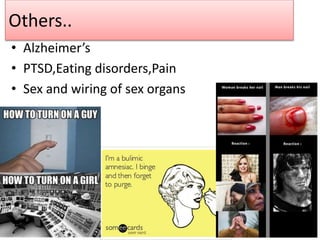
Others..
• Alzheimer’s
• PTSD,Eating disorders,Pain
• Sex and wiring of sex organs
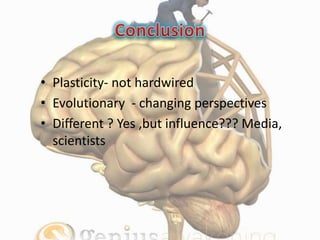
• Plasticity- not hardwired
• Evolutionary - changing perspectives
• Different ? Yes ,but influence??? Media,
scientists
• “no scientific basis for all of our stereotypes and
prejudices about what certain sexes
should/shouldn’t do and they all stem from
irrational or unpleasant cultural influences that
haven’t gone away yet, forcing us to admit to
ourselves that our preconceived notions about
certain sexes or genders are just self-fulfilling
clichés with no logical basis, potentially
threatening our beliefs, our positions and even
our identity. And we can’t have that, can we?”
Male brain

Male brain

  • 2.
    • SHOX- “shortstature homeobox.” growth and maturation of bones in the arms and legs. • SRY- “sex determining region Y.” fetus to develop male gonads (testes) and prevent the development of female reproductive structures (uterus and fallopian tubes). 46XX with SRY develop into males- so powerful !! • USP9Y - “ubiquitin specific peptidase 9, Y-linked.” sperm production. Source: U.S. National library of medicine
  • 3.
    • Differences appearas early as 3 years of age! • Connectivity patterns in children were indistinguishable between males and females! • 3rd interstitial nucleus of thalamus- Sexual orientation
  • 4.
    Personality Traits • Schmitt,David P.; Realo, Anu; Voracek, Martin; Allik, Jüri (2008). "Why can't a man be more like a woman? Sex differences in Big Five personality traits across 55 cultures". Journal of Personality and Social Psychology 94(1): 168–82. doi:10.1037/0022-3514.94.1.168.PMID 18179326 • men often report higher assertiveness (a facet of extraversion) and openness •narcissism – high in males  latent personality traits such as men’s heightened sense of entitlement and authority •Women have also been found to be more punishment sensitive and men more higher in sensation seeking and behavioural risk-taking •Men showed stronger Realistic and Investigative interests, and women showed stronger Artistic, Social, and Conventional interests. Sex differences favoring men  specific measures of engineering, science, and mathematics interests
  • 5.
    Mood disorders • 2fold greater prevalence in females • Manic episodes more in men. • Suicides – “Paradox”
  • 6.
    Psychosis and Substanceuse • Brief psychotic disorder- twice as common in females as male • Schizophrenia – Chronic negative symptoms Vs Mood+brief episodes • Schizo affective – more common in females •SUD is more in males •SUD with mood disorder twice more common in females than males •Intoxication •Withdrawal
  • 7.
    Autism and Schizophrenia The extreme male brain hypothesis • People with autism tend to perform poorly on tests of empathizing, or the ability to put oneself in somebody else's shoes, but do well on tests of systematizing, or finding repeating patterns. • The hypothesis states that autism is an extreme form of the normal male cognitive profile, which occurs as a result of high testosterone levels in the womb. considered as 'hyper-systematisers' who focus more on patterns and fine details than on other people's thoughts and actions.  Imprinted brain theory: • the risk of autism is increased by disruption of maternal interests and the uninhibited expression of paternal interests, and that the risk of schizophrenia is increased by the disruption of paternal interests and the uninhibited expression of maternal interests Source: 1. Baron-Cohen S (2002). "The extreme male brain theory of autism". Trends Cogn Sci 6 (6): 248–254. doi:10.1016/S1364-6613(02)01904- 6. PMID 12039606. 2. Crespi, B. (2008). "Genomic imprinting in the development and evolution of psychotic spectrum conditions". Biological Reviews. doi:10.1111/j.1469-185X.2008.00050.
  • 8.
    1. Lynn, Richard(1999). "Sex differences in intelligence and brain size: A developmental theory". Intelligence 27: 1–12.doi:10.1016/S0160-2896(99)00009-4. 2. ^ Jump up to:a b c Irwing, Paul; Lynn, Richard (2005). "Sex differences in means and variability on the progressive matrices in university students: A meta-analysis". British Journal of Psychology96 (4): 505–24.doi:10.1348/000712605X53542.PMID 16248939. 3. Jump up^ Lynn, Richard (1994). "Sex differences in intelligence and brain size: A paradox resolved". Personality and Individual Differences 17 (2): 257–71. doi:10.1016/0191- 8869(94)90030-2. 4. ^ Jump up to:a b c d Blinkhorn, Steve (2005). "Intelligence: A gender bender" (PDF). Nature 438 (7064): 31– 2. Bibcode:2005Natur.438...31B.doi:10.1038/438031a. PMID 16267535 5. Irwing, Paul; Lynn, Richard (2006). "Intelligence: Is there a sex difference in IQ scores?". Nature 442 (7098): E1; discussion E1– 2. Bibcode:2006Natur.442E...1I.doi:10.1038/nature04966. PMID 16823409. 6. ^ Jump up to:a b Jackson, Douglas N.; Rushton, J. Philippe (2006). "Males have greater g: Sex differences in general mental ability from 100,000 17- to 18-year-olds on the Scholastic Assessment Test". Intelligence 34 (5): 479–486.doi:10.1016/j.intell.2006.03.005. 7. Jump up^ Nyborg, Helmuth (2005). "Sex-related differences in general intelligence g, brain size, and social status". Personality and Individual Differences 39 (3): 497– 509.doi:10.1016/j.paid.2004.12.011. Author Test Richard Lynn and Paul Irwing (2005) RPM Jackson and Philipe Rushton Scholastic assessment test Irwing (2013) WAIS III Jianghong Liu WISC Richard Lynn (2015) RPM
  • 9.
    Others.. • Alzheimer’s • PTSD,Eatingdisorders,Pain • Sex and wiring of sex organs
  • 10.
    • Plasticity- nothardwired • Evolutionary - changing perspectives • Different ? Yes ,but influence??? Media, scientists
  • 11.
    • “no scientificbasis for all of our stereotypes and prejudices about what certain sexes should/shouldn’t do and they all stem from irrational or unpleasant cultural influences that haven’t gone away yet, forcing us to admit to ourselves that our preconceived notions about certain sexes or genders are just self-fulfilling clichés with no logical basis, potentially threatening our beliefs, our positions and even our identity. And we can’t have that, can we?”