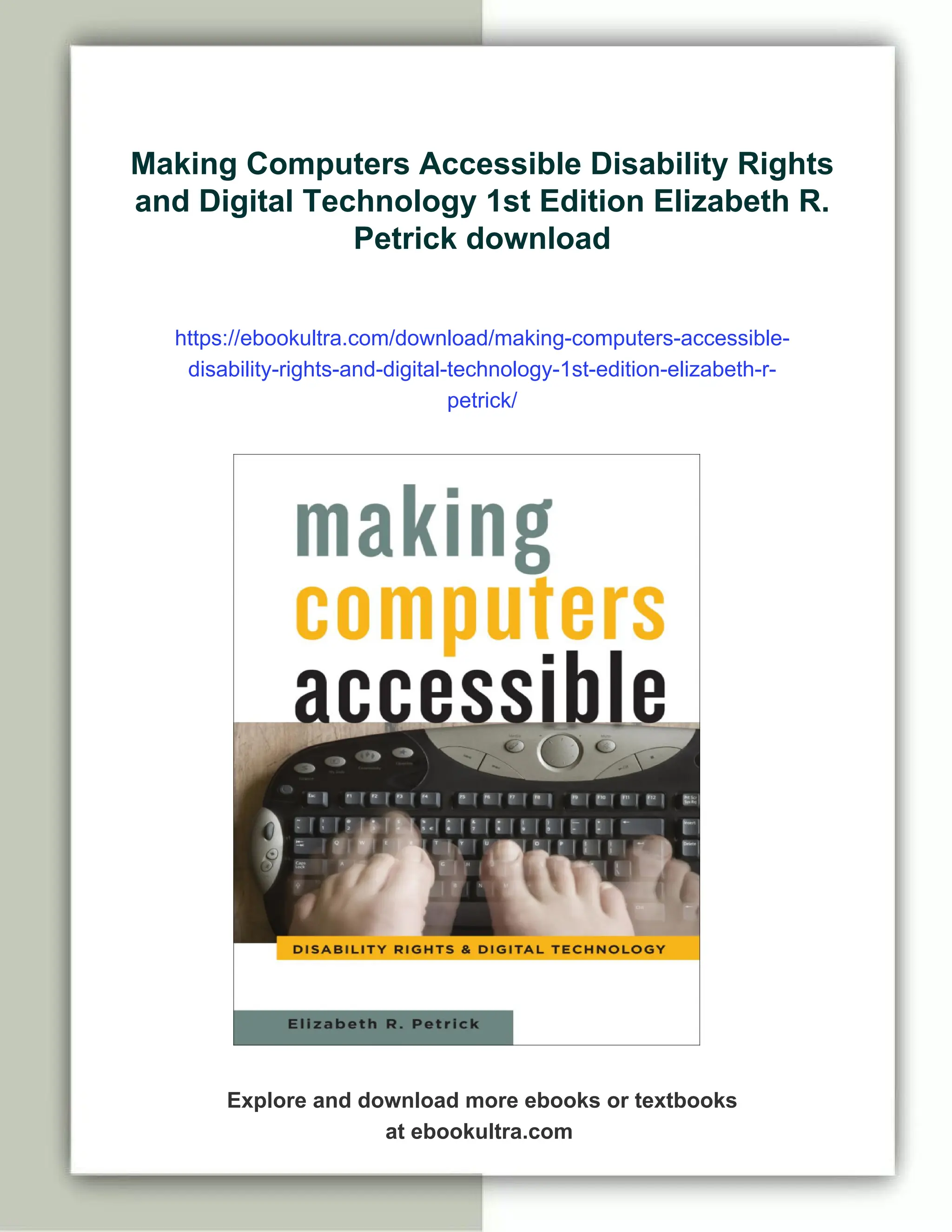
Making Computers Accessible Disability Rights
and Digital Technology 1st Edition Elizabeth R.
Petrick download
https://ebookultra.com/download/making-computers-accessible-
disability-rights-and-digital-technology-1st-edition-elizabeth-r-
petrick/
Explore and download more ebooks or textbooks
at ebookultra.com
Here are some recommended products for you. Click the link to
download, or explore more at ebookultra.com
Disability Rights and Wrongs 1st Edition Tom Shakespeare
https://ebookultra.com/download/disability-rights-and-wrongs-1st-
edition-tom-shakespeare/
Studying Disability Multiple Theories and Responses 1st
Edition Elizabeth G. Depoy
https://ebookultra.com/download/studying-disability-multiple-theories-
and-responses-1st-edition-elizabeth-g-depoy/
Digital Research Inventing With Computers The Digital
World 1st Edition Ananda Mitra
https://ebookultra.com/download/digital-research-inventing-with-
computers-the-digital-world-1st-edition-ananda-mitra/
Computers Software Engineering and Digital Devices Richard
C. Dorf
https://ebookultra.com/download/computers-software-engineering-and-
digital-devices-richard-c-dorf/
Digital Music Computers That Make Music The Digital World
1st Edition Ananda Mitra
https://ebookultra.com/download/digital-music-computers-that-make-
music-the-digital-world-1st-edition-ananda-mitra/
The Minority Body A Theory of Disability 1st Edition
Elizabeth Barnes
https://ebookultra.com/download/the-minority-body-a-theory-of-
disability-1st-edition-elizabeth-barnes/
Disability Rights and the American Social Safety Net 1st
Edition Jennifer L. Erkulwater
https://ebookultra.com/download/disability-rights-and-the-american-
social-safety-net-1st-edition-jennifer-l-erkulwater/
Computers phones and the Internet domesticating
information technology 1st Edition Robert Kraut
https://ebookultra.com/download/computers-phones-and-the-internet-
domesticating-information-technology-1st-edition-robert-kraut/
Disability Citizenship and Community Care A Case for
Welfare Rights 1st Edition Kirstein Rummery
https://ebookultra.com/download/disability-citizenship-and-community-
care-a-case-for-welfare-rights-1st-edition-kirstein-rummery/
Making Computers Accessible Disability Rights and
Digital Technology 1st Edition Elizabeth R. Petrick
Digital Instant Download
Author(s): Elizabeth R. Petrick
ISBN(s): 9781421416472, 1421416476
Edition: 1
File Details: PDF, 27.02 MB
Year: 2015
Language: english
Making Computers Accessible
This page intentionally left blank
Making Computers Accessible
Disability Rights and Digital Technology
Elizabeth R. Petrick
Johns Hopkins University Press
Baltimore
© 2015 Johns Hopkins University Press
All rights reserved. Published 2015
Printed in the United States of America on acid-­
free paper
9 8 7 6 5 4 3 2 1
Johns Hopkins University Press
2715 North Charles Street
Baltimore, Maryland 21218-4363
www.press.jhu.edu
Library of Congress Cataloging-­
in-Publication Data
Petrick, Elizabeth, 1978–
Making computers accessible : disability rights and digital technology /
Elizabeth Petrick.
    pages cm. — (History of science, technology, and medicine)
Includes bibliographical references and index.
ISBN 978-1-4214-1646-5 (hardcover : alk. paper) — ISBN 978-1-4214-1647-2
(electronic) —­ISBN 1-4214-1646-8 (hardcover : alk. paper) —­
ISBN 1-4214-1647-6 (electronic) 1. Computers and people with
disabilities—­
United States. 2. Assistive computer technology—­
United States. 3. Microcomputers—­
Social aspects—
­United States. I. Title.
HV1569.5.P47 2015
004.16087—­
dc23   2014033485
A cata­
log record for this book is available from the British Library.
Special discounts are available for bulk purchases of this book. For more
information, please contact Special Sales at 410-516-6936 or
specialsales@press.jhu.edu.
Johns Hopkins University Press uses environmentally friendly book materials,
including recycled text paper that is composed of at least 30 percent
post-­
consumer waste, whenever possible.
Contents
Ac­know­ledg­ments vii
		 Introduction. The Development of Accessible Personal
Computer Technologies 1
1 Disability Rights and Technology before the Personal Computer 9
2 Early Personal Computer Accessibility, 1980–1987 35
3 Corporate Philanthropy and the National Special
Education Alliance 73
4 The Growth of Disability Rights and Accessible
Computer Technologies 98
5 Accessibility and Software Applications in the 1990s 120
		 Conclusion. The Promises of Personal Computers 152
Notes 161
A Note on Theory, Method, and Sources 179
Index 191
This page intentionally left blank
Ac­know­ledg­ments
This book would not have been possible without the help and guidance of many
people. I began this project as a PhD student in History and Science Studies at
the University of California, San Diego. I would like to thank my graduate advisor,
Cathy Gere, who did her best to make me a better writer, and I will always appreci-
ate it. I also want to thank Charles Thorpe for making the time to run a disserta-
tion workshop group with all of his students; his and their feedback was invalu-
able, particularly in helping me to consider interdisciplinary views. I am grateful
to Tal Golan, Robert Westman, and Kelly Gates for their encouragement and
feedback along the way. The graduate students also helped me, throughout my
time there, by letting me bounce ideas off of them and providing necessary critique,
in par­
tic­
u­
lar: Kevin Walsh, Emily Lee, Monica Hoffman, Katrina Petersen, Krystal
Tribbett-McCants, Bob Long, Leah Cluff, and Jon Stern.
I would also like to thank some of the people this book is about, whose history
I have told, especially the Brand family and Alan Brightman. Their work to pro-
mote accessible computer technologies for people with disabilities made this book
possible and also gave me an often intimate look at the role of individual people
in the technology development pro­
cess. The materials on their work and that of
others mostly came from oral history interviews they conducted and from the
archive at the Bancroft Library of the University of California, Berkeley. In addi-
tion, Alan met and talked with me, offering me much-­
needed insights into the
accessibility work done at Apple Computer. Jackie Brand provided me with signifi-
cant materials from her personal collection, both photographs and documents,
and encouraged my telling of this history. I thank her daughter, Shoshana Brand,
for allowing me to share images of her own use of accessible personal computer
technology and thus put a face to the significance of this technology.
I also appreciate Robert J. Brugger at Johns Hopkins University Press for his
patience and assistance in guiding me through this publication pro­
cess. I am grate-
ful as well for the feedback in the review done by Howard Segal from the University
of Maine.
viii  Acknowledgments
I cannot thank my friends and family enough for their support in getting me
­
here and enabling me to complete this book. In par­
tic­
u­
lar, I want to thank Holly
Zynda for her copyediting expertise, Kristofer Lee for endless conversations in
which I mulled over problems, and Matt McGuire for providing me with operat-
ing system images. Finally, I never could have done this without the support of my
parents, who encouraged me to change disciplines entirely, from computer science
to history, and work toward a goal that seemed a very long way off when I started.
Making Computers Accessible
This page intentionally left blank
Introduction
The Development of Accessible
Personal Computer Technologies
With regard to the major physical and sensory disabilities, I believe that in
a couple of de­
cades we will come to herald the effective end of handicaps.
As amplifiers of human thought, computers have great potential to assist
human expression and to expand creativity for all of us.
raymond kurzweil, the age of spiritual machines:
when computers exceed human intelligence
In 1974, not long after developing the first optical character recognition technol-
ogy that could recognize any printed text, Raymond Kurzweil sat next to a blind
man on a plane flight. Kurzweil was searching for a use for his new software—­
looking for a problem to which the software might provide the solution. At this
time, no computer program existed which could translate text of any font into
speech for blind people to understand. The man on the flight described this limi-
tation as “the only real handicap” his blindness presented. Kurzweil, a computer
technology developer and later futurist phi­
los­
o­
pher, decided that this would be the
use to which he would put his new innovation, to “overcome this principal hand-
icap of blindness,” as he saw it—­that is, the inability to read printed texts.1
By 1976,
the Kurzweil Reading Machine existed as a working prototype that could scan
printed texts and translate them into speech. People expressed immediate inter-
est in the technology; after seeing it featured on the Today Show, Stevie Wonder
contacted Kurzweil’s company and was given their second-­ever version of the ma-
chine.2
The Kurzweil Reading Machine would set the bar for other text-­to-­speech
software in terms of accuracy and vocabulary. The Reading Machine was not Kurz-
weil’s only accessible technology innovation. In 1982, his company created the
Kurzweil Voice, general purpose dictation software that was the descendent of spe-
cialized medical dictation technology. Kurzweil found that this software was par-
ticularly useful for people whose disability affected the use of their hands; it allowed
them to compose text in word-­
processing software by speaking.3
These early
2   Making Computers Accessible
accessible computer technologies placed Kurzweil at the forefront of innovations
for people with disabilities and demonstrated the possibilities of computers to im-
prove people’s lives.
Looking toward the future, Kurzweil predicted that one day advanced computer
technologies would eradicate disability itself, first by accommodating all the needs
of people with disabilities and later by fixing their bodies. In Kurzweil’s vision of
the future, computer technology created for people with disabilities acted as the
first step in people transcending the limitations of their bodies, thus altering what
it means to be human. This transhumanist utopian vision descends from utopian
ideals dating back to Plato and defined by Thomas More’s 1516 novel, Utopia. Kurz-
weil’s utopia follows from Enlightenment dreams that flowed into the Industrial
Revolution and looked not to an ideal society hidden away, waiting to be found,
but to the future, when science and technology would inevitably improve society
to a point where utopia might be attainable.4
For most utopianists, the Christian
belief in original sin prevented the full realization of any true utopian society for
human beings; they could only be improved upon, not made perfect. Unlike this
idea of an inherently limited utopia, Kurzweil’s vision of a better future is one where
all problems with the human body are fixed by technology, and, ultimately, the
body itself is left behind. Technology is capable of solving all human physical prob-
lems, eliminating the barriers that prevent certain people from fully participating
in society but also offering the potential to transform human existence itself. Tech-
nologists, Kurzweil believed, could aid the creation of this future by working on
innovations that aided people in the present.
Disability and technology activists also looked at developing computer technol-
ogy and saw its potential to overcome barriers and improve the lives of people with
disabilities, taking a celebratory perspective toward the use of computers. Unlike
Kurzweil, however, these activists did not reach toward a utopia in some distant
future. Instead they focused on the daily reality of people with disabilities strug-
gling for fuller participation in society. Theirs was a more pragmatic vision of tech-
nological potential, promoting the development of computer technologies, such as
those Kurzweil himself created, but with an emphasis on the unique needs of in-
dividuals and the often messy realities of using technology to augment their abil-
ities. Disability activists focused on people with disabilities as technology users,
as people who might incorporate technology into their lives in order to meet their
individual needs and desires.
Throughout the history of accessible computer technologies, people with dis-
abilities acted as the paradigmatic computer users. Technology created for their
Introduction  3
use was the foundation for technologies intended to augment all humans, a goal
in line with Kurzweil’s arguments for technology benefiting people. Developers
had to design specifically for people with disabilities in mind—­making their needs
primary—­
before they could expand the scope of computer technology to include
everyone. This was not a one-­
way relationship between developers and users,
however; people with disabilities and nondisabled activists pushed for changes to
personal computers that would make them more inclusive of different needs. This
history of the creation of accessible personal computer technologies did not play
out in a futurist vision of ever-­
accelerating technological progress toward a state
of bodilessness but rather in the actual development of personal computer tech-
nologies for people with disabilities. Innovators, users, activists, and policy mak-
ers worked to build an inclusive technology instead of one developed according
to ideas of normalcy that excluded people with disabilities, to put their needs at
the forefront of the development pro­
cess.
The role of everyday users, and people with disabilities in par­tic­u­lar, lies mostly
unexplored within the history of computers. This history tells us about the influ-
ences of the military and counterculture in creating computers and embedding
them with values that influenced the place of the technology in society, as well as
about the importance of innovators, companies, and computer professionals. Hack-
ers or people who blur the line between users and developers, such as hobbyists
or computer professionals, generally define the “user.” We know less about how
everyday consumers play a part in the development of computers or how the de-
sign of technology affects people’s use of it. From the perspective of people with
disabilities, various rich histories detail the civil rights struggle and the use of
assistive technologies, but fewer studies examine everyday technologies. The
history of accessible personal computer technologies for people with disabilities
combines the history of computers and the history of people with disabilities in
order to understand the role of users in the development of computers and the
significance of computers in the lives of users.
By accommodating physical needs, personal computer technology played a po­
liti­
cal role in the historical enactment of civil rights for people with disabilities.
The development of accessible technologies intersected with the history of civil
rights and the emergence of identity politics; as disability became an identity that
people could claim and as their consciousness as a marginalized population within
society grew, people with disabilities increasingly advocated for changes to the so-
cial environment that would address concerns about equity. Technological accom-
modation, in the form of personal technology and in the public built environment,
4   Making Computers Accessible
is necessary for people with disabilities to experience full participation in a soci-
ety that has not been built with their needs in mind. Technology alone, however,
does not change anyone’s lives for the better; people must be aware of it, and it must
be available to them for its benefits to be realized. This element of technological
development and use does not appear in Kurzweil’s account of technology and so-
ciety. Activists created social technologies, in the form of networked advocacy
groups, to share information and disseminate knowledge to consumers. In some
instances, federal antidiscrimination legislation was necessary to mandate access
to computer technologies.
Accessible personal computer technology took three forms during this history:
a po­liti­cal technology, which made equity possible; a legal technology, which was
required and funded by the federal government; and a social technology, which
created new forms of information sharing and communication. For its potential
as a po­liti­cal technology to be realized, developers needed to build these technolo-
gies into the personal computer, and corporate philanthropy played an essential
role in creating accessible computer technologies and supplying them to users. First
though, developers had to rethink who counted as a user in order for these tech-
nologies to work for a variety of uses. By embracing the values behind what
would become universal design, developers met the needs of different people by
creating technologies that ­
were flexible enough to accommodate bodily varia-
tions. This approach started with hardware and the physical input and output
devices people use to interact with the computer, then it was applied to creating
software that allowed people to experience the same computer functions in dif-
ferent ways. The federal government mandated some of these accessibility devel-
opments in order for the civil rights potential of the technology to be realized. As
a social technology, the personal computer was a part of its own network of
technological dissemination—­
informing people of what was available and what
was possible. On a more personal level, the technology also enabled new forms
of communication for users. These three aspects of the development of accessible
personal computer technology fit in well with Kurzweil’s philosophy of technol-
ogy changing individual lives, but beyond the personal lay a social level absent
from his view, where technology was built within companies, promoted and dis-
seminated by activists, talked about and requested by users, and legislated by the
government.
All three aspects of the technology—­
political, legal, and social—­
came together
in the form of technological accommodations to enact civil rights. For these rights
to be realized, access had to be built into the technology. The hard, messy pro­cess
Random documents with unrelated
content Scribd suggests to you:
Poetry.
Edited By Ernest Hartley Coleridge
CONTENTS OF VOL. IV.
Preface to Vol. IV. of the Poems v
The Prisoner of Chillon.
Introduction to The Prisoner of Chillon 3
Sonnet on Chillon 7
Advertisement 9
The Prisoner of Chillon 13
Poems of July-September, 1816. The Dream.
Introduction to The Dream 31
The Dream. First published, Prisoner of Chillon, etc.,
1816 33
Darkness. First published, Prisoner of Chillon, etc.,
1816 42
Churchill's Grave. First published, Prisoner of Chillon,
etc., 1816 45
Prometheus. First published, Prisoner of Chillon, etc.,
1816 48
A Fragment. First published, Letters and Journals,
1830, ii. 36 51
Sonnet to Lake Leman, First published, Prisoner of
Chillon, etc., 1816 53
Stanzas to Augusta. First published, Prisoner of
Chillon, etc., 1816 54
Epistle to Augusta. First published, Letters and
Journals, 1830, ii. 38-41 57
Lines on hearing that Lady Byron was Ill. First
published, 1831 63
Monody on the Death of the Right Hon. R. B. Sheridan.
Introduction to Monody, etc. 69
Monody on the Death of the Right Hon. R. B.
Sheridan, Spoken at Drury Lane Theatre, London 71
Manfred: A Dramatic Poem.
Introduction to Manfred 79
Manfred 85
The Lament of Tasso.
Introduction to The Lament of Tasso 139
Advertisement 141
The Lament of Tasso 143
Beppo: A Venetian Story.
Introduction to Beppo 155
Beppo 159
Ode on Venice.
Ode on Venice 193
Mazeppa.
Introduction to Mazeppa 201
Advertisement 205
Mazeppa 207
The Prophecy of Dante.
Introduction to The Prophecy of Dante 237
Dedication 241
Preface 243
The Prophecy of Dante. Canto the First 247
Canto the Second 255
Canto the Third 261
Canto the Fourth 269
The Morgante Maggiore of Pulci.
Introduction to The Morgante Maggiore 279
Advertisement 283
The Morgante Maggiore. Canto the First 285
Francesca Of Rimini.
Introduction to Francesca of Rimini 313
Francesco of Rimini 317
Marino Faliero, Doge of Venice: an Historical Tragedy.
Introduction to Marino Faliero 325
Preface 331
Marino Faliero 345
Appendix 462
The Vision Of Judgment.
Introduction to The Vision of Judgment 475
Preface 481
The Vision of Judgment 487
Poems 1816-1823.
A very Mournful Ballad on the Siege and Conquest of
Alhama. First published, Childe Harold, Canto IV.,
1818 529
Sonetto di Vittorelli. Per Monaca 535
Translation from Vittorelli. On a Nun. First published,
Childe Harold, Canto IV., 1818 535
On the Bust of Helen by Canova. First published,
Letters and Journals, 1830, ii. 61 536
[Venice. A Fragment.] MS. M 537
So we'll go no more a-roving. First published, Letters
and Journals, 1830, ii. 79 538
[Lord Byron's Verses on Sam Rogers.] Question and
Answer. First published, Fraser's Magazine, January,
1833, vol. vii. pp. 82-84 538
The Duel. MS. M 542
Stanzas to the Po. First published, Conversations of
Lord Byron, 1824 545
Sonnet on the Nuptials of the Marquis Antonio Cavalli
with the Countess Clelia Rasponi of Ravenna. MS. M 547
Sonnet to the Prince Regent. On the Repeal of Lord
Edward Fitzgerald's Forfeiture. First published, Letters
and Journals, ii. 234, 235 548
Stanzas. First published, New Monthly Magazine,
1832 549
Ode to a Lady whose Lover was killed by a Ball,
which at the same time shivered a portrait next his
heart. MS. M. 552
The Irish Avatar. First published, Conversations of
Lord Byron, 1824 555
Stanzas written on the Road between Florence and
Pisa. First published, Letters and Journals, 1830, ii.
566, not 562
Stanzas to a Hindoo Air. First published, Works of
Lord Byron 563
To —— First published, New Monthly Magazine, 1833 564
To the Countess of Blessington. First published,
Letters and Journals, 1830 565
Aristomanes. Canto First. MS. D. 566
The Blues: A Literary Eclogue.
Introduction to The Blues 569
The Blues. Eclogue the First 573
Eclogue the Second 580
THE WORKS OF LORD BYRON.
Vol. V.
Poetry
CONTENTS OF VOL. V
Preface to Vol. V. of the Poems v
Sardanapalus: A Tragedy.
Introduction to Sardanapalus 3
Dedication 7
Preface 9
Sardanapalus 13
The Two Foscari: An Historical Tragedy.
Introduction to The Two Foscari 115
The Two Foscari 121
Cain: A Mystery.
Introduction to Cain 199
Dedication 205
Preface 207
Cain 213
Heaven and Earth; A Mystery.
Introduction to Heaven and Earth 279
Heaven and Earth 285
Werner; or, The Inheritance: A Tragedy.
Introduction to Werner 325
Note to the Introduction to Werner 329
Dedication 335
Preface 337
Werner 341
Werner. [First Draft.] 453
The Deformed Transformed: A Drama.
Introduction to The Deformed Transformed 469
Advertisement 473
The Deformed Transformed 477
Fragment of the Third Part of The Deformed
Transformed
531
The Age of Bronze; or, Carmen Seculare et Annus haud
Mirabilis.
Introduction to The Age of Bronze 537
The Age of Bronze 541
The Island; or, Christian and his Comrades.
Introduction to The Island 581
Advertisement 585
The Island. Canto the First 587
Canto the Second 598
Canto the Third 618
Canto the Fourth 626
THE WORKS OF LORD BYRON,
Vol. VI.
Poetry
Edited By Ernest Hartley Coleridge
CONTENTS OF VOL. VI.
Dedication v
Preface to Vol. VI. of the Poems vii
Introduction to DON JUAN xv
Dedication to Robert Southey, Esq. 3
DON JUAN—
Canto I 11
Canto II 81
Canto III 143
Canto IV 183
Canto V 218
Preface to Cantos VI., VII., and VIII 264
Canto VI 268
Canto VII 302
Canto VIII 330
Canto IX 373
Canto X 400
Canto XI 427
Canto XII 455
Canto XIII 481
Canto XIV 516
Canto XV 544
Canto XVI 572
Canto XVII 608
THE WORKS OF LORD BYRON,
Vol. VII.
Poetry
Edited By Ernest Hartley Coleridge
CONTENTS OF VOL. VII.
Preface to Vol. VII. of the Poems. v Jeux d'Esprit and Minor Poems,
1798-1824. Epigram on an Old Lady who had some Curious
Notions respecting the Soul. First published, Letters and Journals,
1830, i. 28. 1 Epitaph on John Adams, of Southwell. First
published, Letters and Journals, 1830, i. 106. 1 A Version of
Ossian's Address to the Sun. First published, Atlantic Monthly,
December, 1898. 2 Lines to Mr. Hodgson. Written on board the
Lisbon Packet. First published, Letters and Journals, 1830, i. 230-
232. 4 [To Dives. A Fragment.] First published, Lord Byron's Works,
1833, xvii. 241. 7 Farewell Petition to J. C. H., Esqre
. First
published, Murray's Magazine, 1887, vol. i. pp. 290, 291. 7
Translation of the Nurse's Dole in the Medea of Euripides. First
published, Letters and Journals, 1830, i. 227. 10 My Epitaph. First
published, Letters and Journals, 1830, i. 240. 10 Substitute for an
Epitaph. First published, Lord Byron's Works, 1832, ix. 4. 11
Epitaph for Joseph Blacket, late Poet and Shoemaker. First
published, Lord Byron's Works, 1832, ix. 10. 11 On Moore's Last
Operatic Farce, or Farcical Opera. First published, Letters and
Journals, 1830, i. 295 (note). 12 [S. M. Dallas.] First published,
Life, Writings, Opinions, etc., 1825, ii. 192. 12
An Ode to the Framers of the Frame Bill. First
published, Morning Chronicle, March 2, 1812. 13
To the Honorable Mr. George Lamb. First published, The
Two Duchesses, by Vere Foster, 1898, p. 374. 15
[La Revanche.] MS.M. 15
To Thomas Moore. Written the Evening before his Visit
to Mr. Leigh Hunt in Horsemonger Lane Gaol, May 19,
1813. First published, Letters and Journals, 1830, i.
401. 16
On Lord Thurlow's Poems. First published, Letters and
Journals, 1830, i. 396. 17
To Lord Thurlow. First published, Letters and Journals,
1830, i. 397. 19
The Devil's Drive. First published (stanzas 1-5, 8, 10-12,
17, 18), Letters and Journals, 1830, i. 471-474; and
(stanzas 6, 7, 9, 13-16, 19-27) from a MS. in the
possession of the Earl of Ilchester. 21
Windsor Poetics. First published, Poetical Works, Paris,
1819, vi. 125. 35
[Another Version.] On a Royal Visit to the Vaults. From
an autograph MS. in the possession of the Hon. Mrs.
Norbury, now for the first time printed. 36
Ich Dien. From an autograph MS. in the possession of
Mr. A. H. Hallam Murray, now for the first time printed.
36
Condolatory Address, To Sarah Countess of Jersey. First
published, The Champion, July 31, 1814. 37
Fragment of an Epistle to Thomas Moore. First
published, Letters and Journals, 1830, i. 561, 562
(note). 39
Answer to——'s Professions of Affection. MS. 40
On Napoleon's Escape from Elba. First published,
Letters and Journals, 1830, i. 611. 41
Endorsement to the Deed of Separation, in the April of
1816. First published, Poetical Works, 1831, vi. 454. 41
[To George Anson Byron (?).] First published, Nicnac,
March 25, 1823. 41
Song for the Luddites. First published, Letters and
Journals, 1830, ii. 58. 42
To Thomas Moore ("What are you doing now?"). First
published, Letters and Journals, 1830, ii. 58, 59. 23
To Mr. Murray ("To hook the Reader," etc.). First
published, Letters and Journals, 1830, ii. 91. 44
Versicles. First published, Letters and Journals, 1830, ii.
87. 45
Quem Deus vult perdere prius dementat. First
published, Letters, 1900, iv. 93. 45
To Thomas Moore ("My boat is on the shore"). First
published, Waltz, London, 1821, p. 29. 46
Epistle from Mr. Murray to Dr. Polidori. First published,
Letters and Journals, 1830, ii. 139-141. 47
Epistle to Mr. Murray. First published (stanzas 1, 2, 4, 7-
9), Letters and Journals, 1830, ii. 156, 157; and
(stanzas 3, 5, 6, 10, 11) Letters, 1900, iv. 191-193. 51
On the Birth of John William Rizzo Hoppner. First
published, Letters and Journals, 1830, ii. 134. 54
[E Nihilo Nihil; or, An Epigram Bewitched.] MS.M. 55
To Mr. Murray. First published, Letters and Journals,
1830, ii. 171. 56
Ballad. To the Tune of "Sally in our Alley." MS.M. 58
Another Simple Ballat. MS.M. 61
Epigram. From the French of Rulhiéres. First published,
Letters and Journals, 1830, ii. 235. 62
Epilogue. First published, Philadelphia Record,
December 28, 1891. 63
On my Wedding-Day. First published, Letters and
Journals, 1830, ii. 294. 64
Epitaph for William Pitt. First published, Letters and
Journals, 1830, ii. 295. 64
Epigram ("In digging up your bones, Tom Paine"). First
published, Letters and Journals, 1830, ii. 295. 65
Epitaph ("Posterity will ne'er survey"). First published,
Lord Byron's Works, 1833, xvii. 246. 65
Epigram ("The world is a bundle of hay"). First
published, Letters and Journals, 1830, ii. 494. 65
My Boy Hobbie O. First published, Murray's Magazine,
March, 1887, vol. i. pp. 292, 293. 66
Lines, Addressed by Lord Byron to Mr. Hobhouse on his
Election for Westminster. First published, Miscellaneous
Poems, 1824. 69
A Volume of Nonsense. First published, Letters, 1900, v.
83.70
Stanzas. First published, Letters and Journals, 1830, ii.
377. 70
To Penelope. First published, Medwin's Conversations,
1824 p. 106. 71
The Charity Ball. First published, Letters and Journals,
1830, ii. 540. 71
Epigram, On the Braziers' Address, etc. First published,
Letters and Journals, 1830, ii. 442. 72
On my Thirty-third Birthday. First published, Letters and
Journals, 1830, ii. 414. 73
Martial, Lib. I. Epig. I. First published, Lord Byron's
Works, 1833, xvii. 245. 74
Bowles and Campbell. First published, The Liberal,
1823, No. II. p. 398. 74
Elegy. First published, Medwin's Conversations, 1824, p.
121. 75
John Keats. First published, Letters and Journals, 1830,
ii. 506. 76
From the French ("Ægle, beauty and poet," etc.). First
published, The Liberal, 1823, No. II. p. 396. 76
To Mr. Murray ("For Orford," etc.). First published,
Letters and Journals, 1830, ii. 517. 76
[Napoleon's Snuff-box.] First published, Conversations
of Lord Byron, 1824, p. 235. 77
The New Vicar of Bray. First published, Works
(Galignani), 1831, p. 116. 78
Lucietta. A Fragment. MS.M. 81
Epigrams. First published, The Liberal, No. I. October
18, 1822, p. 164. 81
The Conquest. First published, Lord Byron's Works,
1833, xvii. 246. 82
Impromptu ("Beneath Blessington's eyes"). First
published, Letters and Journals, 1830, ii. 635. 82
Journal in Cephalonia. First published, Letters, 1901, vi.
238.83
Song to the Suliotes. MS.M. 83
[Love and Death.] First published, Murray's Magazine,
February, 1887, vol. i. pp. 145, 146. 84
Last Words on Greece. First published, Murray's
Magazine, February, 1887, vol. i. p. 146. 85
On this Day I complete my Thirty-sixth Year. First
published, Morning Chronicle, October 29, 1824. 86
A Bibliography Of The Successive Editions And
Translations Of Lord Byron's poetical Works. 89
Notes—
Note (1).—On Genuine and Spurious Issues of English
Bards, and Scotch Reviewers. 305
Note (2).—Correspondence between the First Edition as
numbered and the Present Issue as numbered. 307
Note (3).—The Annotated Copies of the Fourth Edition
of 1811 310
Appendix to Bibliography 314
Contents of Bibliography 317
Summary of Bibliography 319
Index 349
Index to First Lines 449
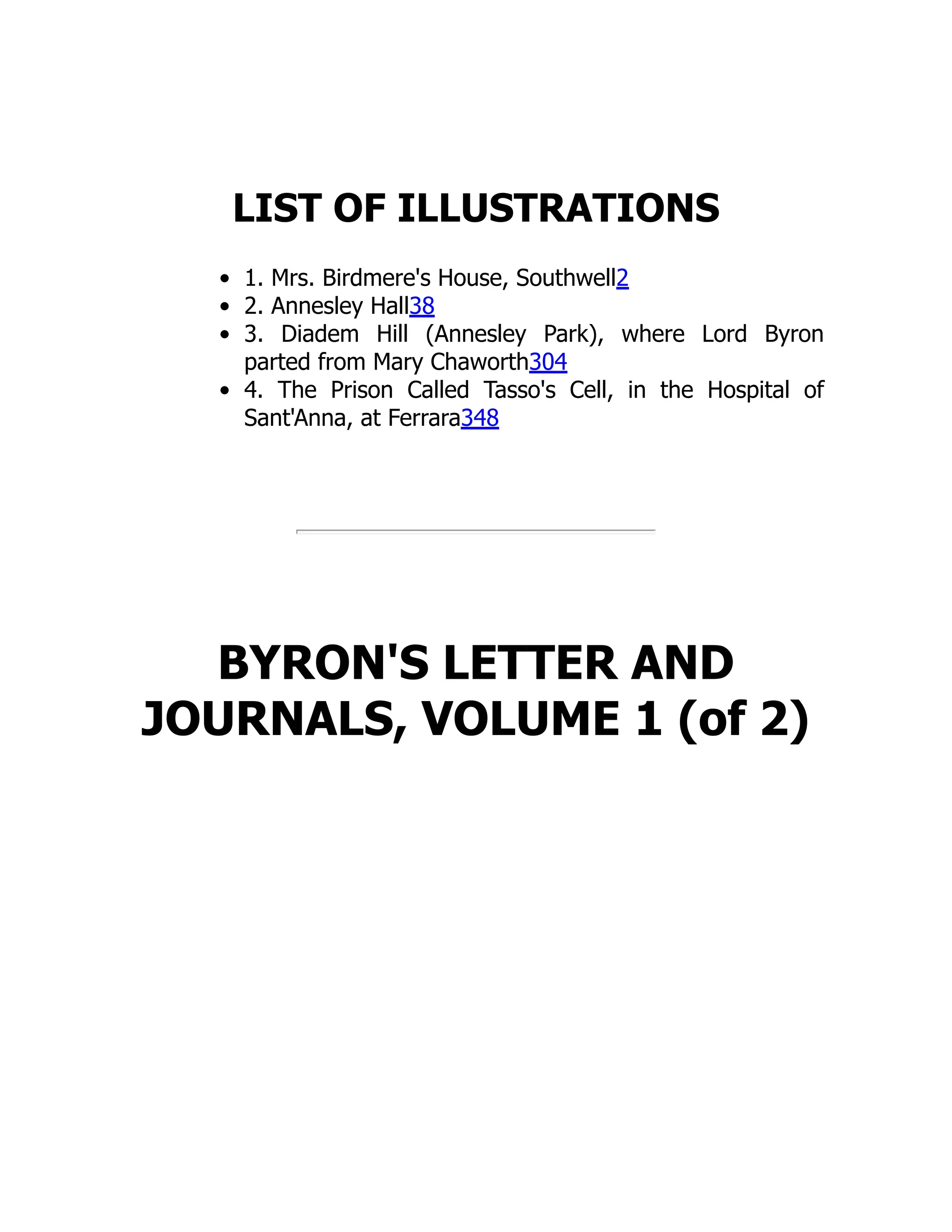
LIST OF ILLUSTRATIONS
1. Mrs. Birdmere's House, Southwell2
2. Annesley Hall38
3. Diadem Hill (Annesley Park), where Lord Byron
parted from Mary Chaworth304
4. The Prison Called Tasso's Cell, in the Hospital of
Sant'Anna, at Ferrara348
BYRON'S LETTER AND
JOURNALS, VOLUME 1 (of 2)
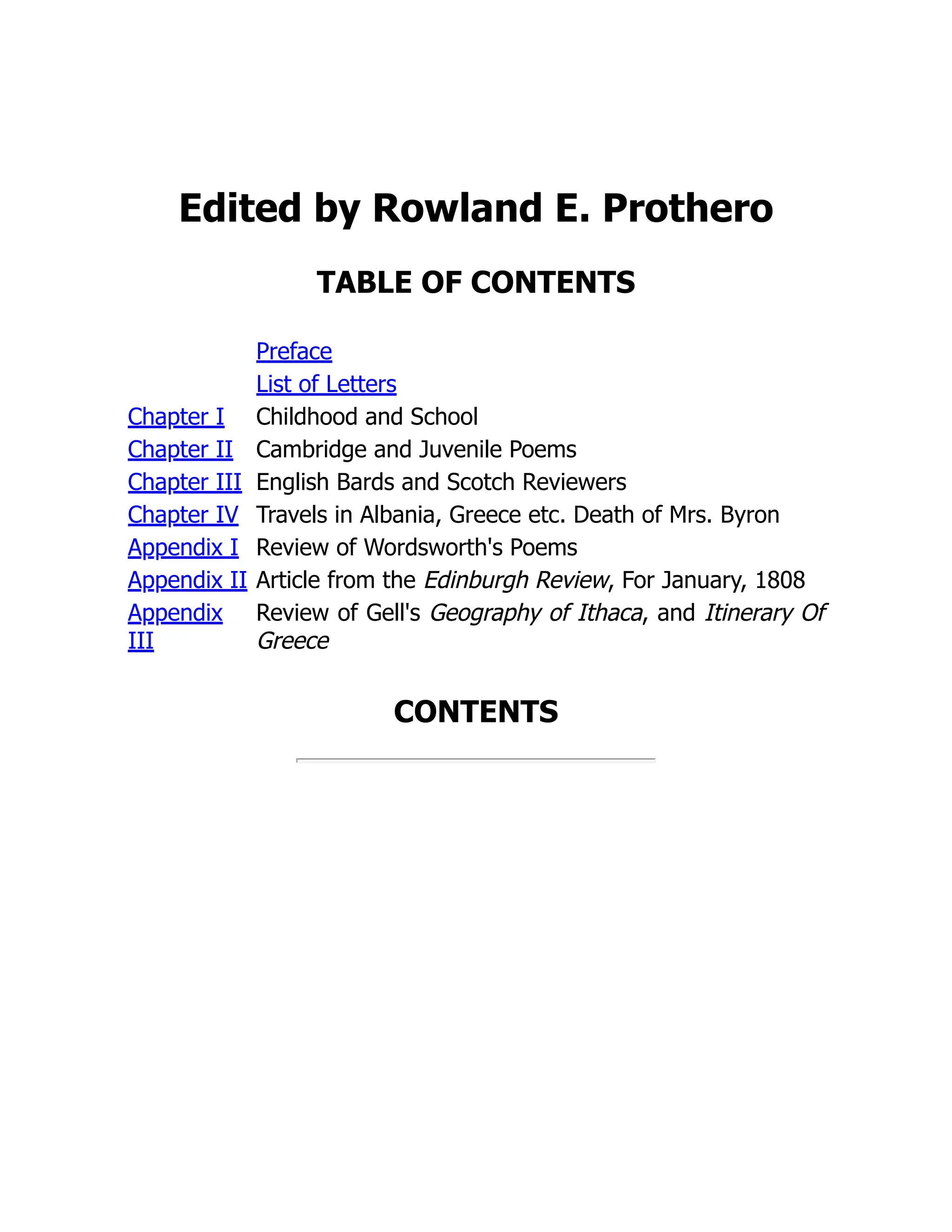
Edited by Rowland E. Prothero
TABLE OF CONTENTS
Preface
List of Letters
Chapter I Childhood and School
Chapter II Cambridge and Juvenile Poems
Chapter III English Bards and Scotch Reviewers
Chapter IV Travels in Albania, Greece etc. Death of Mrs. Byron
Appendix I Review of Wordsworth's Poems
Appendix II Article from the Edinburgh Review, For January, 1808
Appendix
III
Review of Gell's Geography of Ithaca, and Itinerary Of
Greece
CONTENTS
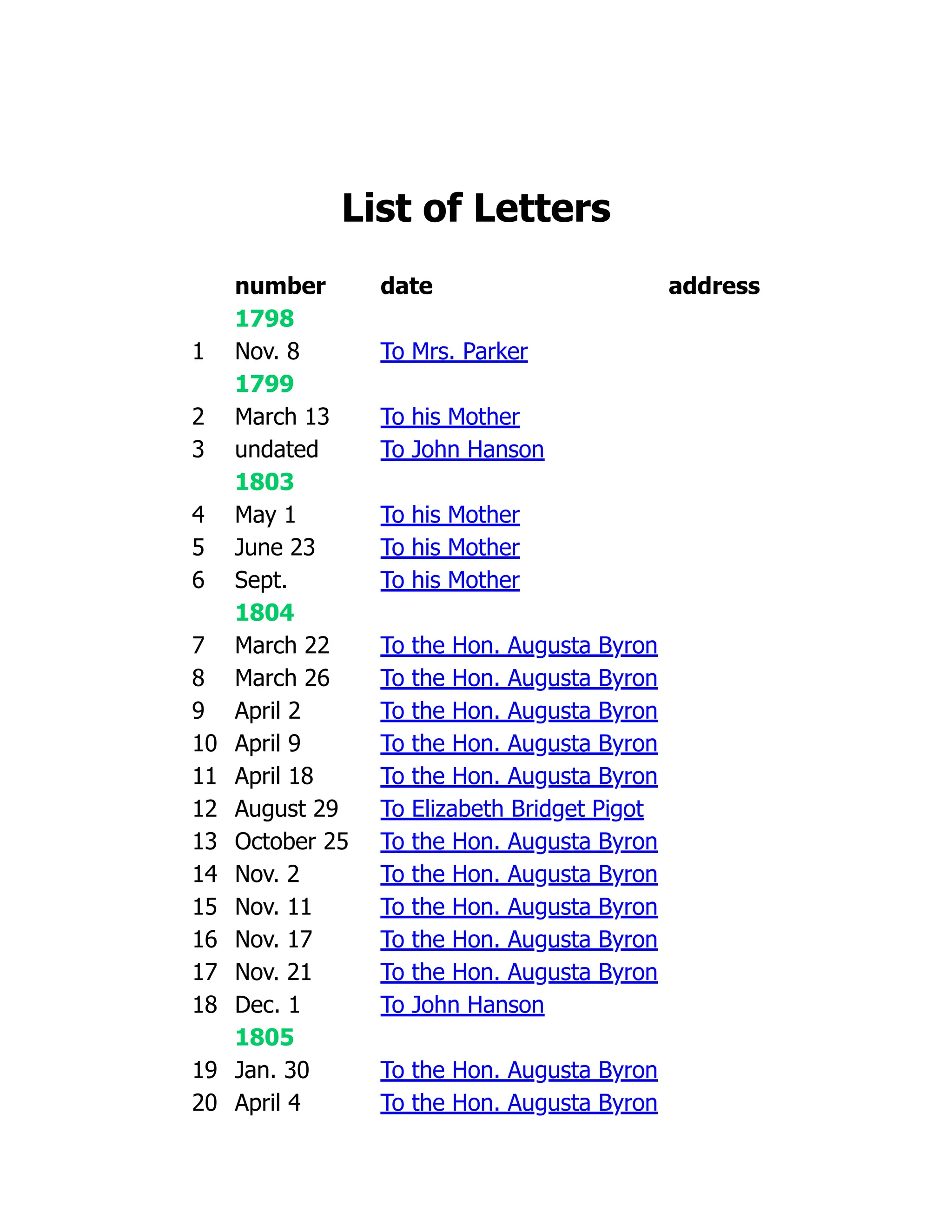
List of Letters
number date address
1798
1 Nov. 8 To Mrs. Parker
1799
2 March 13 To his Mother
3 undated To John Hanson
1803
4 May 1 To his Mother
5 June 23 To his Mother
6 Sept. To his Mother
1804
7 March 22 To the Hon. Augusta Byron
8 March 26 To the Hon. Augusta Byron
9 April 2 To the Hon. Augusta Byron
10 April 9 To the Hon. Augusta Byron
11 April 18 To the Hon. Augusta Byron
12 August 29 To Elizabeth Bridget Pigot
13 October 25 To the Hon. Augusta Byron
14 Nov. 2 To the Hon. Augusta Byron
15 Nov. 11 To the Hon. Augusta Byron
16 Nov. 17 To the Hon. Augusta Byron
17 Nov. 21 To the Hon. Augusta Byron
18 Dec. 1 To John Hanson
1805
19 Jan. 30 To the Hon. Augusta Byron
20 April 4 To the Hon. Augusta Byron
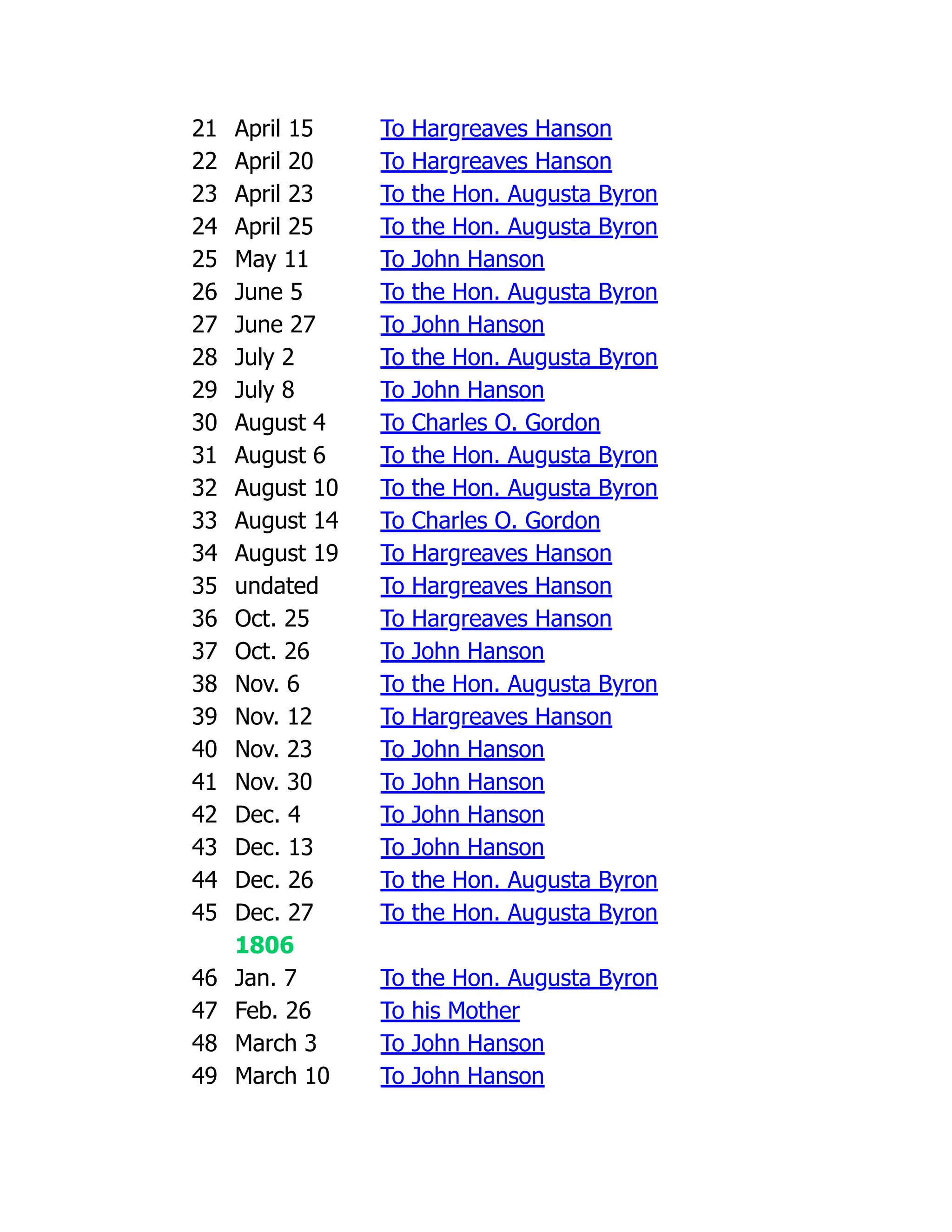
21 April 15 To Hargreaves Hanson
22 April 20 To Hargreaves Hanson
23 April 23 To the Hon. Augusta Byron
24 April 25 To the Hon. Augusta Byron
25 May 11 To John Hanson
26 June 5 To the Hon. Augusta Byron
27 June 27 To John Hanson
28 July 2 To the Hon. Augusta Byron
29 July 8 To John Hanson
30 August 4 To Charles O. Gordon
31 August 6 To the Hon. Augusta Byron
32 August 10 To the Hon. Augusta Byron
33 August 14 To Charles O. Gordon
34 August 19 To Hargreaves Hanson
35 undated To Hargreaves Hanson
36 Oct. 25 To Hargreaves Hanson
37 Oct. 26 To John Hanson
38 Nov. 6 To the Hon. Augusta Byron
39 Nov. 12 To Hargreaves Hanson
40 Nov. 23 To John Hanson
41 Nov. 30 To John Hanson
42 Dec. 4 To John Hanson
43 Dec. 13 To John Hanson
44 Dec. 26 To the Hon. Augusta Byron
45 Dec. 27 To the Hon. Augusta Byron
1806
46 Jan. 7 To the Hon. Augusta Byron
47 Feb. 26 To his Mother
48 March 3 To John Hanson
49 March 10 To John Hanson
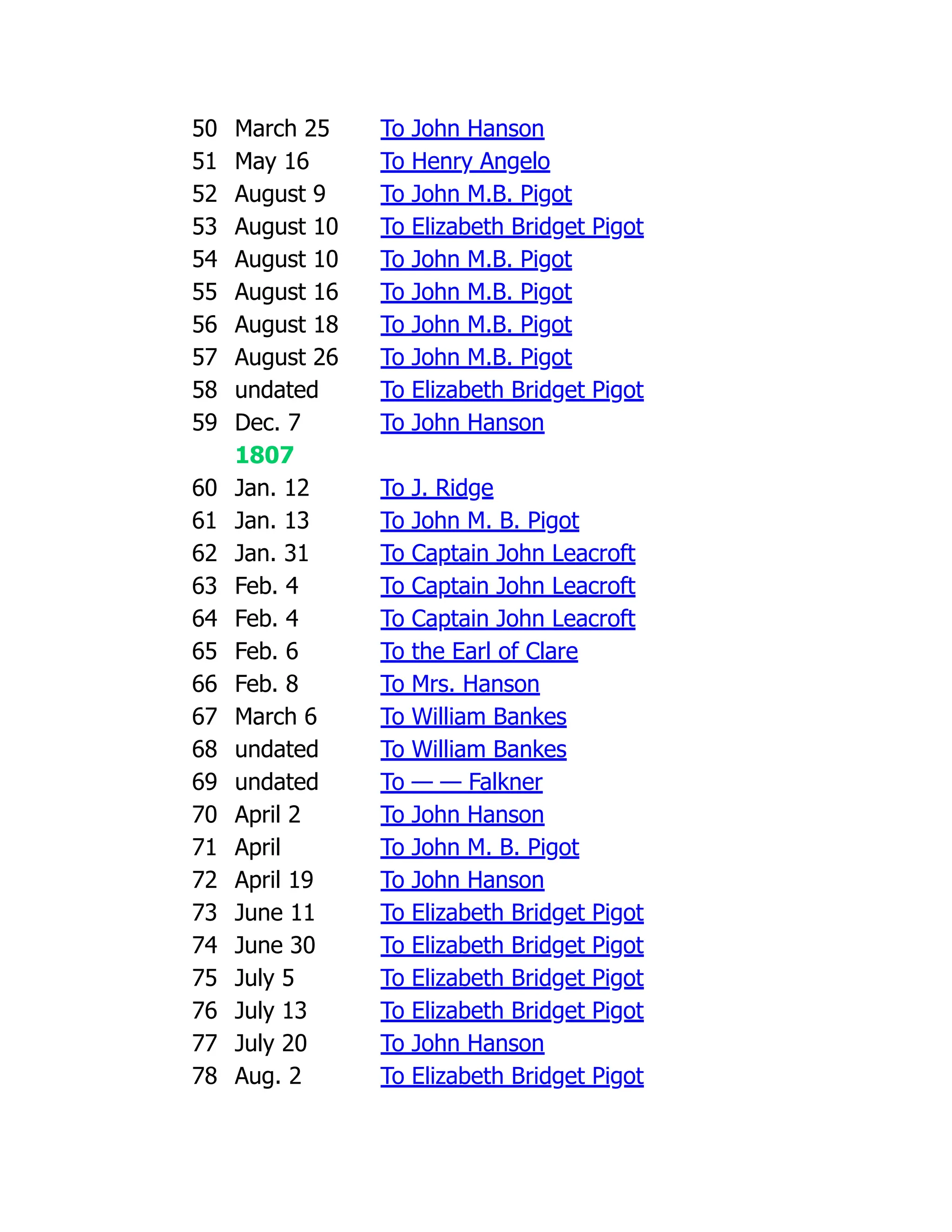
50 March 25 To John Hanson
51 May 16 To Henry Angelo
52 August 9 To John M.B. Pigot
53 August 10 To Elizabeth Bridget Pigot
54 August 10 To John M.B. Pigot
55 August 16 To John M.B. Pigot
56 August 18 To John M.B. Pigot
57 August 26 To John M.B. Pigot
58 undated To Elizabeth Bridget Pigot
59 Dec. 7 To John Hanson
1807
60 Jan. 12 To J. Ridge
61 Jan. 13 To John M. B. Pigot
62 Jan. 31 To Captain John Leacroft
63 Feb. 4 To Captain John Leacroft
64 Feb. 4 To Captain John Leacroft
65 Feb. 6 To the Earl of Clare
66 Feb. 8 To Mrs. Hanson
67 March 6 To William Bankes
68 undated To William Bankes
69 undated To — — Falkner
70 April 2 To John Hanson
71 April To John M. B. Pigot
72 April 19 To John Hanson
73 June 11 To Elizabeth Bridget Pigot
74 June 30 To Elizabeth Bridget Pigot
75 July 5 To Elizabeth Bridget Pigot
76 July 13 To Elizabeth Bridget Pigot
77 July 20 To John Hanson
78 Aug. 2 To Elizabeth Bridget Pigot
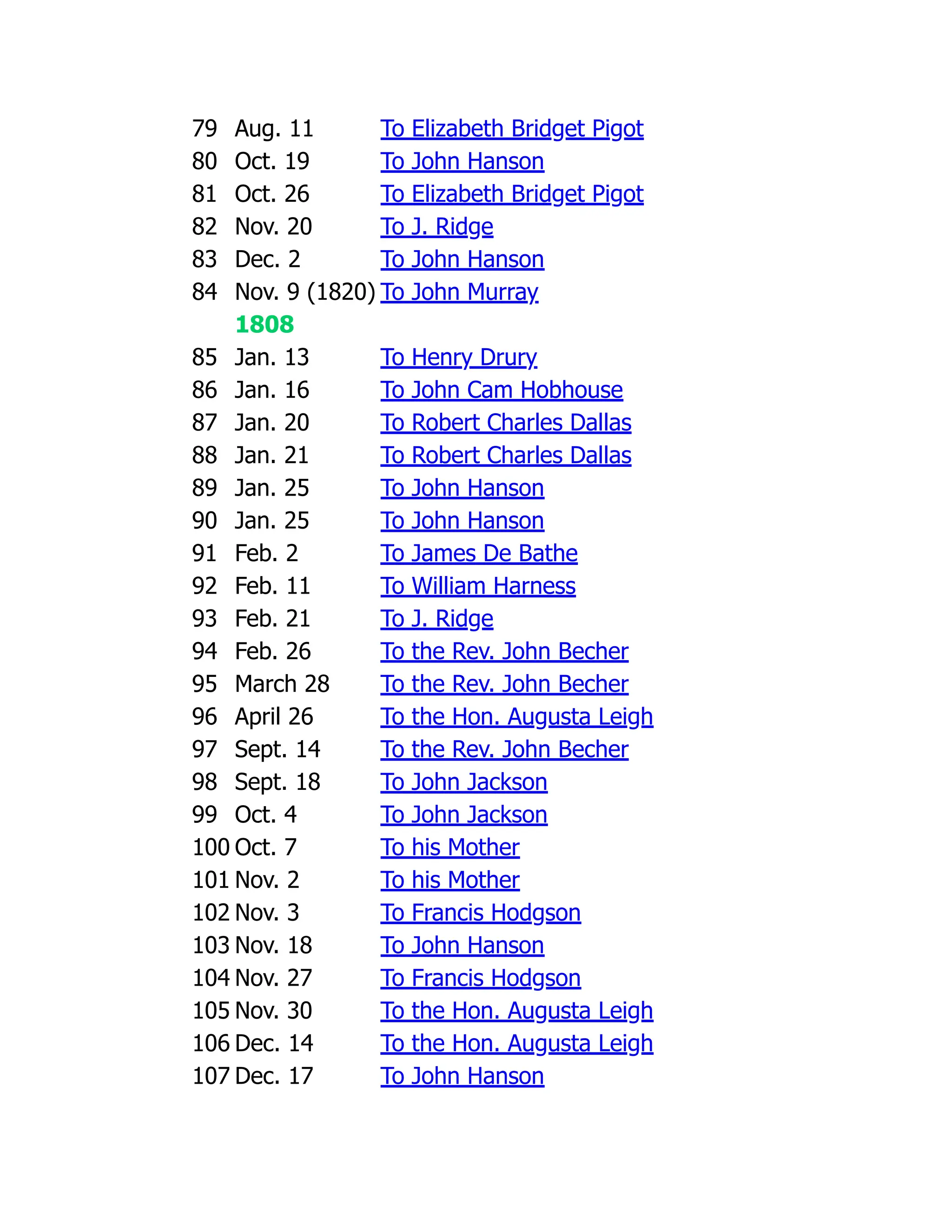
79 Aug. 11 To Elizabeth Bridget Pigot
80 Oct. 19 To John Hanson
81 Oct. 26 To Elizabeth Bridget Pigot
82 Nov. 20 To J. Ridge
83 Dec. 2 To John Hanson
84 Nov. 9 (1820) To John Murray
1808
85 Jan. 13 To Henry Drury
86 Jan. 16 To John Cam Hobhouse
87 Jan. 20 To Robert Charles Dallas
88 Jan. 21 To Robert Charles Dallas
89 Jan. 25 To John Hanson
90 Jan. 25 To John Hanson
91 Feb. 2 To James De Bathe
92 Feb. 11 To William Harness
93 Feb. 21 To J. Ridge
94 Feb. 26 To the Rev. John Becher
95 March 28 To the Rev. John Becher
96 April 26 To the Hon. Augusta Leigh
97 Sept. 14 To the Rev. John Becher
98 Sept. 18 To John Jackson
99 Oct. 4 To John Jackson
100 Oct. 7 To his Mother
101 Nov. 2 To his Mother
102 Nov. 3 To Francis Hodgson
103 Nov. 18 To John Hanson
104 Nov. 27 To Francis Hodgson
105 Nov. 30 To the Hon. Augusta Leigh
106 Dec. 14 To the Hon. Augusta Leigh
107 Dec. 17 To John Hanson
108 Dec. 17 To Francis Hodgson
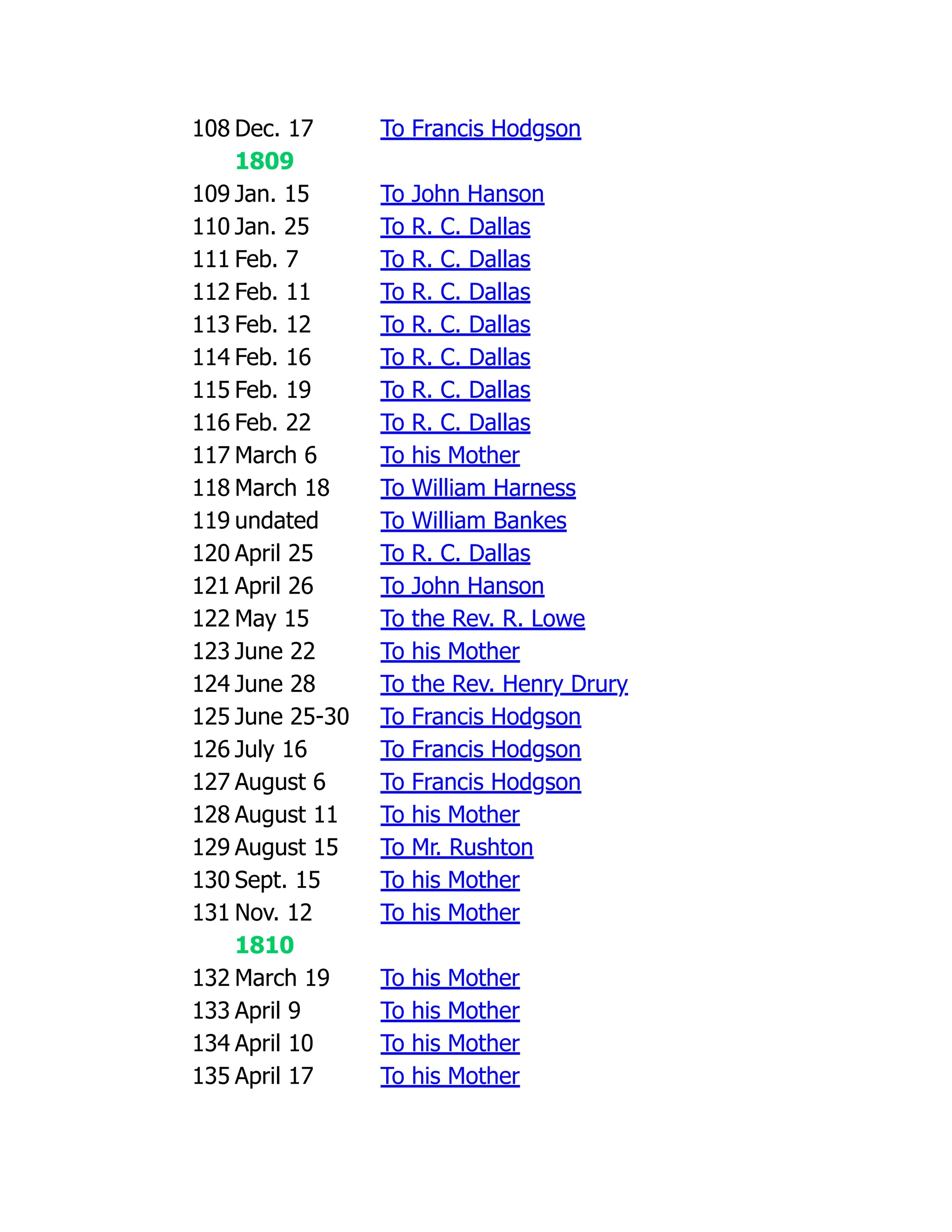
1809
109 Jan. 15 To John Hanson
110 Jan. 25 To R. C. Dallas
111 Feb. 7 To R. C. Dallas
112 Feb. 11 To R. C. Dallas
113 Feb. 12 To R. C. Dallas
114 Feb. 16 To R. C. Dallas
115 Feb. 19 To R. C. Dallas
116 Feb. 22 To R. C. Dallas
117 March 6 To his Mother
118 March 18 To William Harness
119 undated To William Bankes
120 April 25 To R. C. Dallas
121 April 26 To John Hanson
122 May 15 To the Rev. R. Lowe
123 June 22 To his Mother
124 June 28 To the Rev. Henry Drury
125 June 25-30 To Francis Hodgson
126 July 16 To Francis Hodgson
127 August 6 To Francis Hodgson
128 August 11 To his Mother
129 August 15 To Mr. Rushton
130 Sept. 15 To his Mother
131 Nov. 12 To his Mother
1810
132 March 19 To his Mother
133 April 9 To his Mother
134 April 10 To his Mother
135 April 17 To his Mother
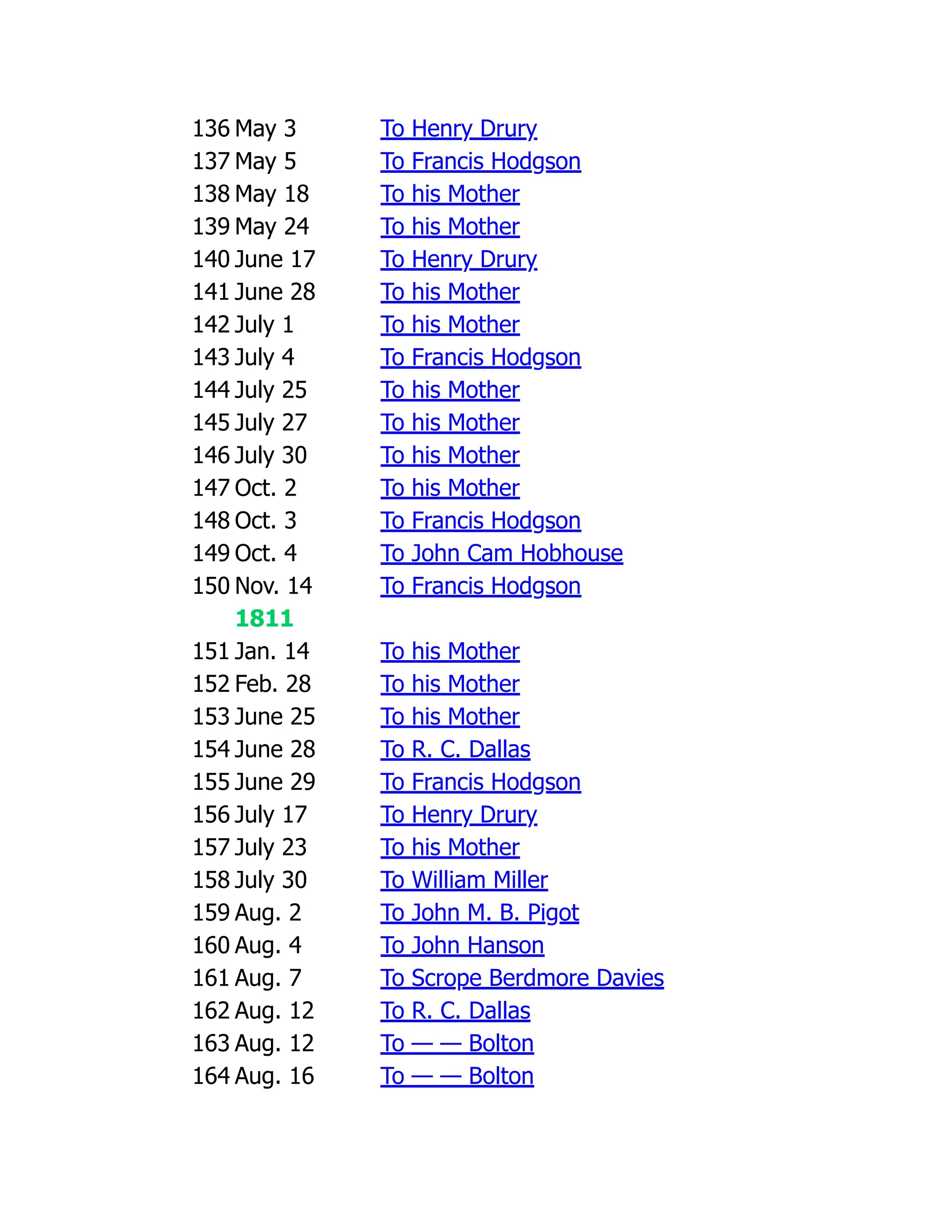
136 May 3 To Henry Drury
137 May 5 To Francis Hodgson
138 May 18 To his Mother
139 May 24 To his Mother
140 June 17 To Henry Drury
141 June 28 To his Mother
142 July 1 To his Mother
143 July 4 To Francis Hodgson
144 July 25 To his Mother
145 July 27 To his Mother
146 July 30 To his Mother
147 Oct. 2 To his Mother
148 Oct. 3 To Francis Hodgson
149 Oct. 4 To John Cam Hobhouse
150 Nov. 14 To Francis Hodgson
1811
151 Jan. 14 To his Mother
152 Feb. 28 To his Mother
153 June 25 To his Mother
154 June 28 To R. C. Dallas
155 June 29 To Francis Hodgson
156 July 17 To Henry Drury
157 July 23 To his Mother
158 July 30 To William Miller
159 Aug. 2 To John M. B. Pigot
160 Aug. 4 To John Hanson
161 Aug. 7 To Scrope Berdmore Davies
162 Aug. 12 To R. C. Dallas
163 Aug. 12 To — — Bolton
164 Aug. 16 To — — Bolton
165 Aug. 20 To — — Bolton
166 Aug. 21 To the Hon. Augusta Leigh
167 Aug. 21 To R. C. Dallas
168 Aug. 22 To Francis Hodgson
BYRON'S LETTERS AND
JOURNALS, Volume 2
(August 1811-April 1814)
Edited by Rowland E. Prothero
TABLE OF CONTENTS
Preface
List of Letters
List of Journal Entries
Detailed Contents of Appendices
Chapter V—Childe Harold, Cantos I, II
Chapter VI—The Idol of Society—The Drury Lane Address—Second
Speech in Parliament
Chapter VII—The Giaour and Bride of Abydos
Chapter VIII—Journal: November 14, 1813-April 19, 1814
Appendix I—Articles from The Monthly Review
Appendix II—Parliamentary Speeches
Appendix III—Lady Caroline Lamb and Byron
Appendix IV—Letters of Bernard Barton
Appendix V—Correspondence with Walter Scott
Appendix VI—"The Giant and the Dwarf"
Appendix VII—Attacks upon Byron in the Newspapers for February
and March, 1814
CONTENTS
List of Letters
number date address
1811
169 Aug. 23 To John Murray
170 Aug. 24 To James Wedderburn Webster
171 Aug. 25 To R.C. Dallas
172 Aug. 27 To R.C. Dallas
173 Aug. 30 To the Hon. Augusta Leigh
174 Aug. 30 To the Hon. Augusta Leigh
175 Aug. 31 To James Wedderburn Webster
176 Sept. 2 To the Hon. Augusta Leigh
177 Sept. 3 To Francis Hodgson
178 Sept. 4 To R.C. Dallas
179 Sept. 5 To John Murray
180 Sept. 7 To R.C. Dallas
181 Sept. 9 To the Hon. Augusta Leigh
182 Sept. 9 To Francis Hodgson
183 Sept. 10 To R.C. Dallas
184 Sept. 13 To Francis Hodgson
185 Sept. 14 To John Murray
186 Sept. 15 To R.C. Dallas
187 Sept. 16 To John Murray
188 Sept. 16 To R.C. Dallas
189 Sept. 17 To R.C. Dallas
190 Sept. 17 To R.C. Dallas
191 Sept. 21 To R.C. Dallas
192 Sept. 23 To R.C. Dallas
193 Sept. 25 To Francis Hodgson
194 Sept. 26 To R.C. Dallas
195 Oct. 10 To James Wedderburn Webster
196 Oct. 10 To R.C. Dallas
197 Oct. 11 To R.C. Dallas
198 Oct. 13 To Francis Hodgson
Welcome to our website – the ideal destination for book lovers and
knowledge seekers. With a mission to inspire endlessly, we offer a
vast collection of books, ranging from classic literary works to
specialized publications, self-development books, and children's
literature. Each book is a new journey of discovery, expanding
knowledge and enriching the soul of the reade
Our website is not just a platform for buying books, but a bridge
connecting readers to the timeless values of culture and wisdom. With
an elegant, user-friendly interface and an intelligent search system,
we are committed to providing a quick and convenient shopping
experience. Additionally, our special promotions and home delivery
services ensure that you save time and fully enjoy the joy of reading.
Let us accompany you on the journey of exploring knowledge and
personal growth!
ebookultra.com

Making Computers Accessible Disability Rights and Digital Technology 1st Edition Elizabeth R. Petrick

  • 1.
    Making Computers AccessibleDisability Rights and Digital Technology 1st Edition Elizabeth R. Petrick download https://ebookultra.com/download/making-computers-accessible- disability-rights-and-digital-technology-1st-edition-elizabeth-r- petrick/ Explore and download more ebooks or textbooks at ebookultra.com
  • 2.
    Here are somerecommended products for you. Click the link to download, or explore more at ebookultra.com Disability Rights and Wrongs 1st Edition Tom Shakespeare https://ebookultra.com/download/disability-rights-and-wrongs-1st- edition-tom-shakespeare/ Studying Disability Multiple Theories and Responses 1st Edition Elizabeth G. Depoy https://ebookultra.com/download/studying-disability-multiple-theories- and-responses-1st-edition-elizabeth-g-depoy/ Digital Research Inventing With Computers The Digital World 1st Edition Ananda Mitra https://ebookultra.com/download/digital-research-inventing-with- computers-the-digital-world-1st-edition-ananda-mitra/ Computers Software Engineering and Digital Devices Richard C. Dorf https://ebookultra.com/download/computers-software-engineering-and- digital-devices-richard-c-dorf/
  • 3.
    Digital Music ComputersThat Make Music The Digital World 1st Edition Ananda Mitra https://ebookultra.com/download/digital-music-computers-that-make- music-the-digital-world-1st-edition-ananda-mitra/ The Minority Body A Theory of Disability 1st Edition Elizabeth Barnes https://ebookultra.com/download/the-minority-body-a-theory-of- disability-1st-edition-elizabeth-barnes/ Disability Rights and the American Social Safety Net 1st Edition Jennifer L. Erkulwater https://ebookultra.com/download/disability-rights-and-the-american- social-safety-net-1st-edition-jennifer-l-erkulwater/ Computers phones and the Internet domesticating information technology 1st Edition Robert Kraut https://ebookultra.com/download/computers-phones-and-the-internet- domesticating-information-technology-1st-edition-robert-kraut/ Disability Citizenship and Community Care A Case for Welfare Rights 1st Edition Kirstein Rummery https://ebookultra.com/download/disability-citizenship-and-community- care-a-case-for-welfare-rights-1st-edition-kirstein-rummery/
  • 5.
    Making Computers AccessibleDisability Rights and Digital Technology 1st Edition Elizabeth R. Petrick Digital Instant Download Author(s): Elizabeth R. Petrick ISBN(s): 9781421416472, 1421416476 Edition: 1 File Details: PDF, 27.02 MB Year: 2015 Language: english

  • 7.
  • 8.
  • 9.
    Making Computers Accessible DisabilityRights and Digital Technology Elizabeth R. Petrick Johns Hopkins University Press Baltimore
  • 10.
    © 2015 JohnsHopkins University Press All rights reserved. Published 2015 Printed in the United States of America on acid-­ free paper 9 8 7 6 5 4 3 2 1 Johns Hopkins University Press 2715 North Charles Street Baltimore, Maryland 21218-4363 www.press.jhu.edu Library of Congress Cataloging-­ in-Publication Data Petrick, Elizabeth, 1978– Making computers accessible : disability rights and digital technology / Elizabeth Petrick.     pages cm. — (History of science, technology, and medicine) Includes bibliographical references and index. ISBN 978-1-4214-1646-5 (hardcover : alk. paper) — ISBN 978-1-4214-1647-2 (electronic) —­ISBN 1-4214-1646-8 (hardcover : alk. paper) —­ ISBN 1-4214-1647-6 (electronic) 1. Computers and people with disabilities—­ United States. 2. Assistive computer technology—­ United States. 3. Microcomputers—­ Social aspects— ­United States. I. Title. HV1569.5.P47 2015 004.16087—­ dc23   2014033485 A cata­ log record for this book is available from the British Library. Special discounts are available for bulk purchases of this book. For more information, please contact Special Sales at 410-516-6936 or specialsales@press.jhu.edu. Johns Hopkins University Press uses environmentally friendly book materials, including recycled text paper that is composed of at least 30 percent post-­ consumer waste, whenever possible.
  • 11.
    Contents Ac­know­ledg­ments vii Introduction.The Development of Accessible Personal Computer Technologies 1 1 Disability Rights and Technology before the Personal Computer 9 2 Early Personal Computer Accessibility, 1980–1987 35 3 Corporate Philanthropy and the National Special Education Alliance 73 4 The Growth of Disability Rights and Accessible Computer Technologies 98 5 Accessibility and Software Applications in the 1990s 120 Conclusion. The Promises of Personal Computers 152 Notes 161 A Note on Theory, Method, and Sources 179 Index 191
  • 12.
  • 13.
    Ac­know­ledg­ments This book wouldnot have been possible without the help and guidance of many people. I began this project as a PhD student in History and Science Studies at the University of California, San Diego. I would like to thank my graduate advisor, Cathy Gere, who did her best to make me a better writer, and I will always appreci- ate it. I also want to thank Charles Thorpe for making the time to run a disserta- tion workshop group with all of his students; his and their feedback was invalu- able, particularly in helping me to consider interdisciplinary views. I am grateful to Tal Golan, Robert Westman, and Kelly Gates for their encouragement and feedback along the way. The graduate students also helped me, throughout my time there, by letting me bounce ideas off of them and providing necessary critique, in par­ tic­ u­ lar: Kevin Walsh, Emily Lee, Monica Hoffman, Katrina Petersen, Krystal Tribbett-McCants, Bob Long, Leah Cluff, and Jon Stern. I would also like to thank some of the people this book is about, whose history I have told, especially the Brand family and Alan Brightman. Their work to pro- mote accessible computer technologies for people with disabilities made this book possible and also gave me an often intimate look at the role of individual people in the technology development pro­ cess. The materials on their work and that of others mostly came from oral history interviews they conducted and from the archive at the Bancroft Library of the University of California, Berkeley. In addi- tion, Alan met and talked with me, offering me much-­ needed insights into the accessibility work done at Apple Computer. Jackie Brand provided me with signifi- cant materials from her personal collection, both photographs and documents, and encouraged my telling of this history. I thank her daughter, Shoshana Brand, for allowing me to share images of her own use of accessible personal computer technology and thus put a face to the significance of this technology. I also appreciate Robert J. Brugger at Johns Hopkins University Press for his patience and assistance in guiding me through this publication pro­ cess. I am grate- ful as well for the feedback in the review done by Howard Segal from the University of Maine.
  • 14.
    viii  Acknowledgments I cannot thankmy friends and family enough for their support in getting me ­ here and enabling me to complete this book. In par­ tic­ u­ lar, I want to thank Holly Zynda for her copyediting expertise, Kristofer Lee for endless conversations in which I mulled over problems, and Matt McGuire for providing me with operat- ing system images. Finally, I never could have done this without the support of my parents, who encouraged me to change disciplines entirely, from computer science to history, and work toward a goal that seemed a very long way off when I started.
  • 15.
  • 16.
  • 17.
    Introduction The Development ofAccessible Personal Computer Technologies With regard to the major physical and sensory disabilities, I believe that in a couple of de­ cades we will come to herald the effective end of handicaps. As amplifiers of human thought, computers have great potential to assist human expression and to expand creativity for all of us. raymond kurzweil, the age of spiritual machines: when computers exceed human intelligence In 1974, not long after developing the first optical character recognition technol- ogy that could recognize any printed text, Raymond Kurzweil sat next to a blind man on a plane flight. Kurzweil was searching for a use for his new software—­ looking for a problem to which the software might provide the solution. At this time, no computer program existed which could translate text of any font into speech for blind people to understand. The man on the flight described this limi- tation as “the only real handicap” his blindness presented. Kurzweil, a computer technology developer and later futurist phi­ los­ o­ pher, decided that this would be the use to which he would put his new innovation, to “overcome this principal hand- icap of blindness,” as he saw it—­that is, the inability to read printed texts.1 By 1976, the Kurzweil Reading Machine existed as a working prototype that could scan printed texts and translate them into speech. People expressed immediate inter- est in the technology; after seeing it featured on the Today Show, Stevie Wonder contacted Kurzweil’s company and was given their second-­ever version of the ma- chine.2 The Kurzweil Reading Machine would set the bar for other text-­to-­speech software in terms of accuracy and vocabulary. The Reading Machine was not Kurz- weil’s only accessible technology innovation. In 1982, his company created the Kurzweil Voice, general purpose dictation software that was the descendent of spe- cialized medical dictation technology. Kurzweil found that this software was par- ticularly useful for people whose disability affected the use of their hands; it allowed them to compose text in word-­ processing software by speaking.3 These early
  • 18.
    2   Making ComputersAccessible accessible computer technologies placed Kurzweil at the forefront of innovations for people with disabilities and demonstrated the possibilities of computers to im- prove people’s lives. Looking toward the future, Kurzweil predicted that one day advanced computer technologies would eradicate disability itself, first by accommodating all the needs of people with disabilities and later by fixing their bodies. In Kurzweil’s vision of the future, computer technology created for people with disabilities acted as the first step in people transcending the limitations of their bodies, thus altering what it means to be human. This transhumanist utopian vision descends from utopian ideals dating back to Plato and defined by Thomas More’s 1516 novel, Utopia. Kurz- weil’s utopia follows from Enlightenment dreams that flowed into the Industrial Revolution and looked not to an ideal society hidden away, waiting to be found, but to the future, when science and technology would inevitably improve society to a point where utopia might be attainable.4 For most utopianists, the Christian belief in original sin prevented the full realization of any true utopian society for human beings; they could only be improved upon, not made perfect. Unlike this idea of an inherently limited utopia, Kurzweil’s vision of a better future is one where all problems with the human body are fixed by technology, and, ultimately, the body itself is left behind. Technology is capable of solving all human physical prob- lems, eliminating the barriers that prevent certain people from fully participating in society but also offering the potential to transform human existence itself. Tech- nologists, Kurzweil believed, could aid the creation of this future by working on innovations that aided people in the present. Disability and technology activists also looked at developing computer technol- ogy and saw its potential to overcome barriers and improve the lives of people with disabilities, taking a celebratory perspective toward the use of computers. Unlike Kurzweil, however, these activists did not reach toward a utopia in some distant future. Instead they focused on the daily reality of people with disabilities strug- gling for fuller participation in society. Theirs was a more pragmatic vision of tech- nological potential, promoting the development of computer technologies, such as those Kurzweil himself created, but with an emphasis on the unique needs of in- dividuals and the often messy realities of using technology to augment their abil- ities. Disability activists focused on people with disabilities as technology users, as people who might incorporate technology into their lives in order to meet their individual needs and desires. Throughout the history of accessible computer technologies, people with dis- abilities acted as the paradigmatic computer users. Technology created for their
  • 19.
    Introduction  3 use was thefoundation for technologies intended to augment all humans, a goal in line with Kurzweil’s arguments for technology benefiting people. Developers had to design specifically for people with disabilities in mind—­making their needs primary—­ before they could expand the scope of computer technology to include everyone. This was not a one-­ way relationship between developers and users, however; people with disabilities and nondisabled activists pushed for changes to personal computers that would make them more inclusive of different needs. This history of the creation of accessible personal computer technologies did not play out in a futurist vision of ever-­ accelerating technological progress toward a state of bodilessness but rather in the actual development of personal computer tech- nologies for people with disabilities. Innovators, users, activists, and policy mak- ers worked to build an inclusive technology instead of one developed according to ideas of normalcy that excluded people with disabilities, to put their needs at the forefront of the development pro­ cess. The role of everyday users, and people with disabilities in par­tic­u­lar, lies mostly unexplored within the history of computers. This history tells us about the influ- ences of the military and counterculture in creating computers and embedding them with values that influenced the place of the technology in society, as well as about the importance of innovators, companies, and computer professionals. Hack- ers or people who blur the line between users and developers, such as hobbyists or computer professionals, generally define the “user.” We know less about how everyday consumers play a part in the development of computers or how the de- sign of technology affects people’s use of it. From the perspective of people with disabilities, various rich histories detail the civil rights struggle and the use of assistive technologies, but fewer studies examine everyday technologies. The history of accessible personal computer technologies for people with disabilities combines the history of computers and the history of people with disabilities in order to understand the role of users in the development of computers and the significance of computers in the lives of users. By accommodating physical needs, personal computer technology played a po­ liti­ cal role in the historical enactment of civil rights for people with disabilities. The development of accessible technologies intersected with the history of civil rights and the emergence of identity politics; as disability became an identity that people could claim and as their consciousness as a marginalized population within society grew, people with disabilities increasingly advocated for changes to the so- cial environment that would address concerns about equity. Technological accom- modation, in the form of personal technology and in the public built environment,
  • 20.
    4   Making ComputersAccessible is necessary for people with disabilities to experience full participation in a soci- ety that has not been built with their needs in mind. Technology alone, however, does not change anyone’s lives for the better; people must be aware of it, and it must be available to them for its benefits to be realized. This element of technological development and use does not appear in Kurzweil’s account of technology and so- ciety. Activists created social technologies, in the form of networked advocacy groups, to share information and disseminate knowledge to consumers. In some instances, federal antidiscrimination legislation was necessary to mandate access to computer technologies. Accessible personal computer technology took three forms during this history: a po­liti­cal technology, which made equity possible; a legal technology, which was required and funded by the federal government; and a social technology, which created new forms of information sharing and communication. For its potential as a po­liti­cal technology to be realized, developers needed to build these technolo- gies into the personal computer, and corporate philanthropy played an essential role in creating accessible computer technologies and supplying them to users. First though, developers had to rethink who counted as a user in order for these tech- nologies to work for a variety of uses. By embracing the values behind what would become universal design, developers met the needs of different people by creating technologies that ­ were flexible enough to accommodate bodily varia- tions. This approach started with hardware and the physical input and output devices people use to interact with the computer, then it was applied to creating software that allowed people to experience the same computer functions in dif- ferent ways. The federal government mandated some of these accessibility devel- opments in order for the civil rights potential of the technology to be realized. As a social technology, the personal computer was a part of its own network of technological dissemination—­ informing people of what was available and what was possible. On a more personal level, the technology also enabled new forms of communication for users. These three aspects of the development of accessible personal computer technology fit in well with Kurzweil’s philosophy of technol- ogy changing individual lives, but beyond the personal lay a social level absent from his view, where technology was built within companies, promoted and dis- seminated by activists, talked about and requested by users, and legislated by the government. All three aspects of the technology—­ political, legal, and social—­ came together in the form of technological accommodations to enact civil rights. For these rights to be realized, access had to be built into the technology. The hard, messy pro­cess
  • 21.
    Random documents withunrelated content Scribd suggests to you:
  • 22.
  • 23.
    Edited By ErnestHartley Coleridge CONTENTS OF VOL. IV. Preface to Vol. IV. of the Poems v The Prisoner of Chillon. Introduction to The Prisoner of Chillon 3 Sonnet on Chillon 7 Advertisement 9 The Prisoner of Chillon 13 Poems of July-September, 1816. The Dream. Introduction to The Dream 31 The Dream. First published, Prisoner of Chillon, etc., 1816 33 Darkness. First published, Prisoner of Chillon, etc., 1816 42 Churchill's Grave. First published, Prisoner of Chillon, etc., 1816 45 Prometheus. First published, Prisoner of Chillon, etc., 1816 48 A Fragment. First published, Letters and Journals, 1830, ii. 36 51 Sonnet to Lake Leman, First published, Prisoner of Chillon, etc., 1816 53 Stanzas to Augusta. First published, Prisoner of Chillon, etc., 1816 54 Epistle to Augusta. First published, Letters and Journals, 1830, ii. 38-41 57
  • 24.
    Lines on hearingthat Lady Byron was Ill. First published, 1831 63 Monody on the Death of the Right Hon. R. B. Sheridan. Introduction to Monody, etc. 69 Monody on the Death of the Right Hon. R. B. Sheridan, Spoken at Drury Lane Theatre, London 71 Manfred: A Dramatic Poem. Introduction to Manfred 79 Manfred 85 The Lament of Tasso. Introduction to The Lament of Tasso 139 Advertisement 141 The Lament of Tasso 143 Beppo: A Venetian Story. Introduction to Beppo 155 Beppo 159 Ode on Venice. Ode on Venice 193 Mazeppa. Introduction to Mazeppa 201 Advertisement 205 Mazeppa 207 The Prophecy of Dante. Introduction to The Prophecy of Dante 237 Dedication 241 Preface 243 The Prophecy of Dante. Canto the First 247 Canto the Second 255 Canto the Third 261 Canto the Fourth 269 The Morgante Maggiore of Pulci.
  • 25.
    Introduction to TheMorgante Maggiore 279 Advertisement 283 The Morgante Maggiore. Canto the First 285 Francesca Of Rimini. Introduction to Francesca of Rimini 313 Francesco of Rimini 317 Marino Faliero, Doge of Venice: an Historical Tragedy. Introduction to Marino Faliero 325 Preface 331 Marino Faliero 345 Appendix 462 The Vision Of Judgment. Introduction to The Vision of Judgment 475 Preface 481 The Vision of Judgment 487 Poems 1816-1823. A very Mournful Ballad on the Siege and Conquest of Alhama. First published, Childe Harold, Canto IV., 1818 529 Sonetto di Vittorelli. Per Monaca 535 Translation from Vittorelli. On a Nun. First published, Childe Harold, Canto IV., 1818 535 On the Bust of Helen by Canova. First published, Letters and Journals, 1830, ii. 61 536 [Venice. A Fragment.] MS. M 537 So we'll go no more a-roving. First published, Letters and Journals, 1830, ii. 79 538 [Lord Byron's Verses on Sam Rogers.] Question and Answer. First published, Fraser's Magazine, January, 1833, vol. vii. pp. 82-84 538 The Duel. MS. M 542
  • 26.
    Stanzas to thePo. First published, Conversations of Lord Byron, 1824 545 Sonnet on the Nuptials of the Marquis Antonio Cavalli with the Countess Clelia Rasponi of Ravenna. MS. M 547 Sonnet to the Prince Regent. On the Repeal of Lord Edward Fitzgerald's Forfeiture. First published, Letters and Journals, ii. 234, 235 548 Stanzas. First published, New Monthly Magazine, 1832 549 Ode to a Lady whose Lover was killed by a Ball, which at the same time shivered a portrait next his heart. MS. M. 552 The Irish Avatar. First published, Conversations of Lord Byron, 1824 555 Stanzas written on the Road between Florence and Pisa. First published, Letters and Journals, 1830, ii. 566, not 562 Stanzas to a Hindoo Air. First published, Works of Lord Byron 563 To —— First published, New Monthly Magazine, 1833 564 To the Countess of Blessington. First published, Letters and Journals, 1830 565 Aristomanes. Canto First. MS. D. 566 The Blues: A Literary Eclogue. Introduction to The Blues 569 The Blues. Eclogue the First 573 Eclogue the Second 580
  • 27.
    THE WORKS OFLORD BYRON. Vol. V.
  • 28.
    Poetry CONTENTS OF VOL.V Preface to Vol. V. of the Poems v Sardanapalus: A Tragedy. Introduction to Sardanapalus 3 Dedication 7 Preface 9 Sardanapalus 13 The Two Foscari: An Historical Tragedy. Introduction to The Two Foscari 115 The Two Foscari 121 Cain: A Mystery. Introduction to Cain 199 Dedication 205 Preface 207 Cain 213 Heaven and Earth; A Mystery. Introduction to Heaven and Earth 279 Heaven and Earth 285
  • 29.
    Werner; or, TheInheritance: A Tragedy. Introduction to Werner 325 Note to the Introduction to Werner 329 Dedication 335 Preface 337 Werner 341 Werner. [First Draft.] 453 The Deformed Transformed: A Drama. Introduction to The Deformed Transformed 469 Advertisement 473 The Deformed Transformed 477 Fragment of the Third Part of The Deformed Transformed 531 The Age of Bronze; or, Carmen Seculare et Annus haud Mirabilis. Introduction to The Age of Bronze 537 The Age of Bronze 541 The Island; or, Christian and his Comrades. Introduction to The Island 581 Advertisement 585 The Island. Canto the First 587 Canto the Second 598 Canto the Third 618 Canto the Fourth 626
  • 30.
    THE WORKS OFLORD BYRON, Vol. VI.
  • 31.
  • 32.
    Edited By ErnestHartley Coleridge CONTENTS OF VOL. VI. Dedication v Preface to Vol. VI. of the Poems vii Introduction to DON JUAN xv Dedication to Robert Southey, Esq. 3 DON JUAN— Canto I 11 Canto II 81 Canto III 143 Canto IV 183 Canto V 218 Preface to Cantos VI., VII., and VIII 264 Canto VI 268 Canto VII 302 Canto VIII 330 Canto IX 373 Canto X 400 Canto XI 427 Canto XII 455 Canto XIII 481 Canto XIV 516 Canto XV 544
  • 33.
    Canto XVI 572 CantoXVII 608 THE WORKS OF LORD BYRON, Vol. VII.
  • 34.
  • 35.
    Edited By ErnestHartley Coleridge CONTENTS OF VOL. VII. Preface to Vol. VII. of the Poems. v Jeux d'Esprit and Minor Poems, 1798-1824. Epigram on an Old Lady who had some Curious Notions respecting the Soul. First published, Letters and Journals, 1830, i. 28. 1 Epitaph on John Adams, of Southwell. First published, Letters and Journals, 1830, i. 106. 1 A Version of Ossian's Address to the Sun. First published, Atlantic Monthly, December, 1898. 2 Lines to Mr. Hodgson. Written on board the Lisbon Packet. First published, Letters and Journals, 1830, i. 230- 232. 4 [To Dives. A Fragment.] First published, Lord Byron's Works, 1833, xvii. 241. 7 Farewell Petition to J. C. H., Esqre . First published, Murray's Magazine, 1887, vol. i. pp. 290, 291. 7 Translation of the Nurse's Dole in the Medea of Euripides. First published, Letters and Journals, 1830, i. 227. 10 My Epitaph. First published, Letters and Journals, 1830, i. 240. 10 Substitute for an Epitaph. First published, Lord Byron's Works, 1832, ix. 4. 11 Epitaph for Joseph Blacket, late Poet and Shoemaker. First published, Lord Byron's Works, 1832, ix. 10. 11 On Moore's Last Operatic Farce, or Farcical Opera. First published, Letters and Journals, 1830, i. 295 (note). 12 [S. M. Dallas.] First published, Life, Writings, Opinions, etc., 1825, ii. 192. 12 An Ode to the Framers of the Frame Bill. First published, Morning Chronicle, March 2, 1812. 13 To the Honorable Mr. George Lamb. First published, The Two Duchesses, by Vere Foster, 1898, p. 374. 15 [La Revanche.] MS.M. 15 To Thomas Moore. Written the Evening before his Visit to Mr. Leigh Hunt in Horsemonger Lane Gaol, May 19,
  • 36.
    1813. First published,Letters and Journals, 1830, i. 401. 16 On Lord Thurlow's Poems. First published, Letters and Journals, 1830, i. 396. 17 To Lord Thurlow. First published, Letters and Journals, 1830, i. 397. 19 The Devil's Drive. First published (stanzas 1-5, 8, 10-12, 17, 18), Letters and Journals, 1830, i. 471-474; and (stanzas 6, 7, 9, 13-16, 19-27) from a MS. in the possession of the Earl of Ilchester. 21 Windsor Poetics. First published, Poetical Works, Paris, 1819, vi. 125. 35 [Another Version.] On a Royal Visit to the Vaults. From an autograph MS. in the possession of the Hon. Mrs. Norbury, now for the first time printed. 36 Ich Dien. From an autograph MS. in the possession of Mr. A. H. Hallam Murray, now for the first time printed. 36 Condolatory Address, To Sarah Countess of Jersey. First published, The Champion, July 31, 1814. 37 Fragment of an Epistle to Thomas Moore. First published, Letters and Journals, 1830, i. 561, 562 (note). 39 Answer to——'s Professions of Affection. MS. 40 On Napoleon's Escape from Elba. First published, Letters and Journals, 1830, i. 611. 41 Endorsement to the Deed of Separation, in the April of 1816. First published, Poetical Works, 1831, vi. 454. 41 [To George Anson Byron (?).] First published, Nicnac, March 25, 1823. 41 Song for the Luddites. First published, Letters and Journals, 1830, ii. 58. 42 To Thomas Moore ("What are you doing now?"). First published, Letters and Journals, 1830, ii. 58, 59. 23 To Mr. Murray ("To hook the Reader," etc.). First published, Letters and Journals, 1830, ii. 91. 44
  • 37.
    Versicles. First published,Letters and Journals, 1830, ii. 87. 45 Quem Deus vult perdere prius dementat. First published, Letters, 1900, iv. 93. 45 To Thomas Moore ("My boat is on the shore"). First published, Waltz, London, 1821, p. 29. 46 Epistle from Mr. Murray to Dr. Polidori. First published, Letters and Journals, 1830, ii. 139-141. 47 Epistle to Mr. Murray. First published (stanzas 1, 2, 4, 7- 9), Letters and Journals, 1830, ii. 156, 157; and (stanzas 3, 5, 6, 10, 11) Letters, 1900, iv. 191-193. 51 On the Birth of John William Rizzo Hoppner. First published, Letters and Journals, 1830, ii. 134. 54 [E Nihilo Nihil; or, An Epigram Bewitched.] MS.M. 55 To Mr. Murray. First published, Letters and Journals, 1830, ii. 171. 56 Ballad. To the Tune of "Sally in our Alley." MS.M. 58 Another Simple Ballat. MS.M. 61 Epigram. From the French of Rulhiéres. First published, Letters and Journals, 1830, ii. 235. 62 Epilogue. First published, Philadelphia Record, December 28, 1891. 63 On my Wedding-Day. First published, Letters and Journals, 1830, ii. 294. 64 Epitaph for William Pitt. First published, Letters and Journals, 1830, ii. 295. 64 Epigram ("In digging up your bones, Tom Paine"). First published, Letters and Journals, 1830, ii. 295. 65 Epitaph ("Posterity will ne'er survey"). First published, Lord Byron's Works, 1833, xvii. 246. 65 Epigram ("The world is a bundle of hay"). First published, Letters and Journals, 1830, ii. 494. 65 My Boy Hobbie O. First published, Murray's Magazine, March, 1887, vol. i. pp. 292, 293. 66
  • 38.
    Lines, Addressed byLord Byron to Mr. Hobhouse on his Election for Westminster. First published, Miscellaneous Poems, 1824. 69 A Volume of Nonsense. First published, Letters, 1900, v. 83.70 Stanzas. First published, Letters and Journals, 1830, ii. 377. 70 To Penelope. First published, Medwin's Conversations, 1824 p. 106. 71 The Charity Ball. First published, Letters and Journals, 1830, ii. 540. 71 Epigram, On the Braziers' Address, etc. First published, Letters and Journals, 1830, ii. 442. 72 On my Thirty-third Birthday. First published, Letters and Journals, 1830, ii. 414. 73 Martial, Lib. I. Epig. I. First published, Lord Byron's Works, 1833, xvii. 245. 74 Bowles and Campbell. First published, The Liberal, 1823, No. II. p. 398. 74 Elegy. First published, Medwin's Conversations, 1824, p. 121. 75 John Keats. First published, Letters and Journals, 1830, ii. 506. 76 From the French ("Ægle, beauty and poet," etc.). First published, The Liberal, 1823, No. II. p. 396. 76 To Mr. Murray ("For Orford," etc.). First published, Letters and Journals, 1830, ii. 517. 76 [Napoleon's Snuff-box.] First published, Conversations of Lord Byron, 1824, p. 235. 77 The New Vicar of Bray. First published, Works (Galignani), 1831, p. 116. 78 Lucietta. A Fragment. MS.M. 81 Epigrams. First published, The Liberal, No. I. October 18, 1822, p. 164. 81
  • 39.
    The Conquest. Firstpublished, Lord Byron's Works, 1833, xvii. 246. 82 Impromptu ("Beneath Blessington's eyes"). First published, Letters and Journals, 1830, ii. 635. 82 Journal in Cephalonia. First published, Letters, 1901, vi. 238.83 Song to the Suliotes. MS.M. 83 [Love and Death.] First published, Murray's Magazine, February, 1887, vol. i. pp. 145, 146. 84 Last Words on Greece. First published, Murray's Magazine, February, 1887, vol. i. p. 146. 85 On this Day I complete my Thirty-sixth Year. First published, Morning Chronicle, October 29, 1824. 86 A Bibliography Of The Successive Editions And Translations Of Lord Byron's poetical Works. 89 Notes— Note (1).—On Genuine and Spurious Issues of English Bards, and Scotch Reviewers. 305 Note (2).—Correspondence between the First Edition as numbered and the Present Issue as numbered. 307 Note (3).—The Annotated Copies of the Fourth Edition of 1811 310 Appendix to Bibliography 314 Contents of Bibliography 317 Summary of Bibliography 319 Index 349 Index to First Lines 449
  • 40.
    LIST OF ILLUSTRATIONS 1.Mrs. Birdmere's House, Southwell2 2. Annesley Hall38 3. Diadem Hill (Annesley Park), where Lord Byron parted from Mary Chaworth304 4. The Prison Called Tasso's Cell, in the Hospital of Sant'Anna, at Ferrara348 BYRON'S LETTER AND JOURNALS, VOLUME 1 (of 2)
  • 41.
    Edited by RowlandE. Prothero TABLE OF CONTENTS Preface List of Letters Chapter I Childhood and School Chapter II Cambridge and Juvenile Poems Chapter III English Bards and Scotch Reviewers Chapter IV Travels in Albania, Greece etc. Death of Mrs. Byron Appendix I Review of Wordsworth's Poems Appendix II Article from the Edinburgh Review, For January, 1808 Appendix III Review of Gell's Geography of Ithaca, and Itinerary Of Greece CONTENTS
  • 42.
    List of Letters numberdate address 1798 1 Nov. 8 To Mrs. Parker 1799 2 March 13 To his Mother 3 undated To John Hanson 1803 4 May 1 To his Mother 5 June 23 To his Mother 6 Sept. To his Mother 1804 7 March 22 To the Hon. Augusta Byron 8 March 26 To the Hon. Augusta Byron 9 April 2 To the Hon. Augusta Byron 10 April 9 To the Hon. Augusta Byron 11 April 18 To the Hon. Augusta Byron 12 August 29 To Elizabeth Bridget Pigot 13 October 25 To the Hon. Augusta Byron 14 Nov. 2 To the Hon. Augusta Byron 15 Nov. 11 To the Hon. Augusta Byron 16 Nov. 17 To the Hon. Augusta Byron 17 Nov. 21 To the Hon. Augusta Byron 18 Dec. 1 To John Hanson 1805 19 Jan. 30 To the Hon. Augusta Byron 20 April 4 To the Hon. Augusta Byron
  • 43.
    21 April 15To Hargreaves Hanson 22 April 20 To Hargreaves Hanson 23 April 23 To the Hon. Augusta Byron 24 April 25 To the Hon. Augusta Byron 25 May 11 To John Hanson 26 June 5 To the Hon. Augusta Byron 27 June 27 To John Hanson 28 July 2 To the Hon. Augusta Byron 29 July 8 To John Hanson 30 August 4 To Charles O. Gordon 31 August 6 To the Hon. Augusta Byron 32 August 10 To the Hon. Augusta Byron 33 August 14 To Charles O. Gordon 34 August 19 To Hargreaves Hanson 35 undated To Hargreaves Hanson 36 Oct. 25 To Hargreaves Hanson 37 Oct. 26 To John Hanson 38 Nov. 6 To the Hon. Augusta Byron 39 Nov. 12 To Hargreaves Hanson 40 Nov. 23 To John Hanson 41 Nov. 30 To John Hanson 42 Dec. 4 To John Hanson 43 Dec. 13 To John Hanson 44 Dec. 26 To the Hon. Augusta Byron 45 Dec. 27 To the Hon. Augusta Byron 1806 46 Jan. 7 To the Hon. Augusta Byron 47 Feb. 26 To his Mother 48 March 3 To John Hanson 49 March 10 To John Hanson
  • 44.
    50 March 25To John Hanson 51 May 16 To Henry Angelo 52 August 9 To John M.B. Pigot 53 August 10 To Elizabeth Bridget Pigot 54 August 10 To John M.B. Pigot 55 August 16 To John M.B. Pigot 56 August 18 To John M.B. Pigot 57 August 26 To John M.B. Pigot 58 undated To Elizabeth Bridget Pigot 59 Dec. 7 To John Hanson 1807 60 Jan. 12 To J. Ridge 61 Jan. 13 To John M. B. Pigot 62 Jan. 31 To Captain John Leacroft 63 Feb. 4 To Captain John Leacroft 64 Feb. 4 To Captain John Leacroft 65 Feb. 6 To the Earl of Clare 66 Feb. 8 To Mrs. Hanson 67 March 6 To William Bankes 68 undated To William Bankes 69 undated To — — Falkner 70 April 2 To John Hanson 71 April To John M. B. Pigot 72 April 19 To John Hanson 73 June 11 To Elizabeth Bridget Pigot 74 June 30 To Elizabeth Bridget Pigot 75 July 5 To Elizabeth Bridget Pigot 76 July 13 To Elizabeth Bridget Pigot 77 July 20 To John Hanson 78 Aug. 2 To Elizabeth Bridget Pigot
  • 45.
    79 Aug. 11To Elizabeth Bridget Pigot 80 Oct. 19 To John Hanson 81 Oct. 26 To Elizabeth Bridget Pigot 82 Nov. 20 To J. Ridge 83 Dec. 2 To John Hanson 84 Nov. 9 (1820) To John Murray 1808 85 Jan. 13 To Henry Drury 86 Jan. 16 To John Cam Hobhouse 87 Jan. 20 To Robert Charles Dallas 88 Jan. 21 To Robert Charles Dallas 89 Jan. 25 To John Hanson 90 Jan. 25 To John Hanson 91 Feb. 2 To James De Bathe 92 Feb. 11 To William Harness 93 Feb. 21 To J. Ridge 94 Feb. 26 To the Rev. John Becher 95 March 28 To the Rev. John Becher 96 April 26 To the Hon. Augusta Leigh 97 Sept. 14 To the Rev. John Becher 98 Sept. 18 To John Jackson 99 Oct. 4 To John Jackson 100 Oct. 7 To his Mother 101 Nov. 2 To his Mother 102 Nov. 3 To Francis Hodgson 103 Nov. 18 To John Hanson 104 Nov. 27 To Francis Hodgson 105 Nov. 30 To the Hon. Augusta Leigh 106 Dec. 14 To the Hon. Augusta Leigh 107 Dec. 17 To John Hanson
  • 46.
    108 Dec. 17To Francis Hodgson 1809 109 Jan. 15 To John Hanson 110 Jan. 25 To R. C. Dallas 111 Feb. 7 To R. C. Dallas 112 Feb. 11 To R. C. Dallas 113 Feb. 12 To R. C. Dallas 114 Feb. 16 To R. C. Dallas 115 Feb. 19 To R. C. Dallas 116 Feb. 22 To R. C. Dallas 117 March 6 To his Mother 118 March 18 To William Harness 119 undated To William Bankes 120 April 25 To R. C. Dallas 121 April 26 To John Hanson 122 May 15 To the Rev. R. Lowe 123 June 22 To his Mother 124 June 28 To the Rev. Henry Drury 125 June 25-30 To Francis Hodgson 126 July 16 To Francis Hodgson 127 August 6 To Francis Hodgson 128 August 11 To his Mother 129 August 15 To Mr. Rushton 130 Sept. 15 To his Mother 131 Nov. 12 To his Mother 1810 132 March 19 To his Mother 133 April 9 To his Mother 134 April 10 To his Mother 135 April 17 To his Mother
  • 47.
    136 May 3To Henry Drury 137 May 5 To Francis Hodgson 138 May 18 To his Mother 139 May 24 To his Mother 140 June 17 To Henry Drury 141 June 28 To his Mother 142 July 1 To his Mother 143 July 4 To Francis Hodgson 144 July 25 To his Mother 145 July 27 To his Mother 146 July 30 To his Mother 147 Oct. 2 To his Mother 148 Oct. 3 To Francis Hodgson 149 Oct. 4 To John Cam Hobhouse 150 Nov. 14 To Francis Hodgson 1811 151 Jan. 14 To his Mother 152 Feb. 28 To his Mother 153 June 25 To his Mother 154 June 28 To R. C. Dallas 155 June 29 To Francis Hodgson 156 July 17 To Henry Drury 157 July 23 To his Mother 158 July 30 To William Miller 159 Aug. 2 To John M. B. Pigot 160 Aug. 4 To John Hanson 161 Aug. 7 To Scrope Berdmore Davies 162 Aug. 12 To R. C. Dallas 163 Aug. 12 To — — Bolton 164 Aug. 16 To — — Bolton
  • 48.
    165 Aug. 20To — — Bolton 166 Aug. 21 To the Hon. Augusta Leigh 167 Aug. 21 To R. C. Dallas 168 Aug. 22 To Francis Hodgson
  • 49.
  • 50.
  • 51.
    Edited by RowlandE. Prothero TABLE OF CONTENTS Preface List of Letters List of Journal Entries Detailed Contents of Appendices Chapter V—Childe Harold, Cantos I, II Chapter VI—The Idol of Society—The Drury Lane Address—Second Speech in Parliament Chapter VII—The Giaour and Bride of Abydos Chapter VIII—Journal: November 14, 1813-April 19, 1814 Appendix I—Articles from The Monthly Review Appendix II—Parliamentary Speeches Appendix III—Lady Caroline Lamb and Byron Appendix IV—Letters of Bernard Barton Appendix V—Correspondence with Walter Scott Appendix VI—"The Giant and the Dwarf" Appendix VII—Attacks upon Byron in the Newspapers for February and March, 1814 CONTENTS List of Letters number date address 1811
  • 52.
    169 Aug. 23To John Murray 170 Aug. 24 To James Wedderburn Webster 171 Aug. 25 To R.C. Dallas 172 Aug. 27 To R.C. Dallas 173 Aug. 30 To the Hon. Augusta Leigh 174 Aug. 30 To the Hon. Augusta Leigh 175 Aug. 31 To James Wedderburn Webster 176 Sept. 2 To the Hon. Augusta Leigh 177 Sept. 3 To Francis Hodgson 178 Sept. 4 To R.C. Dallas 179 Sept. 5 To John Murray 180 Sept. 7 To R.C. Dallas 181 Sept. 9 To the Hon. Augusta Leigh 182 Sept. 9 To Francis Hodgson 183 Sept. 10 To R.C. Dallas 184 Sept. 13 To Francis Hodgson 185 Sept. 14 To John Murray 186 Sept. 15 To R.C. Dallas 187 Sept. 16 To John Murray 188 Sept. 16 To R.C. Dallas 189 Sept. 17 To R.C. Dallas 190 Sept. 17 To R.C. Dallas 191 Sept. 21 To R.C. Dallas 192 Sept. 23 To R.C. Dallas 193 Sept. 25 To Francis Hodgson 194 Sept. 26 To R.C. Dallas 195 Oct. 10 To James Wedderburn Webster 196 Oct. 10 To R.C. Dallas 197 Oct. 11 To R.C. Dallas 198 Oct. 13 To Francis Hodgson
  • 53.
    Welcome to ourwebsite – the ideal destination for book lovers and knowledge seekers. With a mission to inspire endlessly, we offer a vast collection of books, ranging from classic literary works to specialized publications, self-development books, and children's literature. Each book is a new journey of discovery, expanding knowledge and enriching the soul of the reade Our website is not just a platform for buying books, but a bridge connecting readers to the timeless values of culture and wisdom. With an elegant, user-friendly interface and an intelligent search system, we are committed to providing a quick and convenient shopping experience. Additionally, our special promotions and home delivery services ensure that you save time and fully enjoy the joy of reading. Let us accompany you on the journey of exploring knowledge and personal growth! ebookultra.com