Silly
                                               the Seed
                                               MAKE YOUR OWN BOOK

                           OBJECTIVE
                           To write and illustrate one’s own story.

                           SKILLS
                           Write narratives in which they recount a short sequence of events, including details to describe
                           actions, thoughts, and feelings, and provide an sense of closure; develop and strengthen writing
                           as needed by planning, revising, editing, rewriting, or trying a new approach.

                           MATERIALS
                           Plain white paper (8 1/2 x11), stapler, pens, pencils, crayons, markers.

                           PROCEDURE
                           (Optional introduction: write PLOT, CONFLICT, CLIMAX, and THEME on the board and then
                           ask students to define each term. If necessary, explain that PLOT is simply what happens in
                           the story from beginning to end. CONFLICT is the struggle, i.e. the problem or problems the
                           main character or characters face. CLIMAX is the point of highest emotion, the turning point,
                           or when the conflict is resolved. THEME is the story’s main idea. Discuss the four concepts,
                           relating them to a book the students have recently read, for example, Silly the Seed.)

                           Remind students how Silly helped the worm and the bug in the story and then tell them to
                           imagine other creatures Silly could help, for example, a butterfly, a frog, a mouse, a cat,
                           a lion, a giraffe, an elephant, even an alien, dinosaur, monster, or a creature of their own
                           creation.

                           Write some animal names on the board and ask students to imagine what types of problems
                           such creatures might have and how Silly could help them. (For example, a butterfly might have
                           trouble breaking out of its cocoon, a frog might need to find water, a mouse might be hiding
                           from a cat or searching for food, a lion could have a thorn in its foot, etc.)

                           Students then choose any two creatures and invent a story in which Silly helps them.

                           Remember to ask students how their stories end. Does Silly go to a party with all his new
                           animal friends? Does he go home to his garden to find his flower friends waiting to celebrate
                           his birthday? Does he win the Nobel Peace Prize?

                           Finally, give students four or five pieces of paper to be folded in half lengthwise, and then
                           stapled along the folded edge (three staples is enough, one at each end and one in the middle)
                           to form a “book. They must count the pages they will be writing and illustrating, plan each
                           page (i.e. what illustration they will draw and what words they will write, and then, using pens,
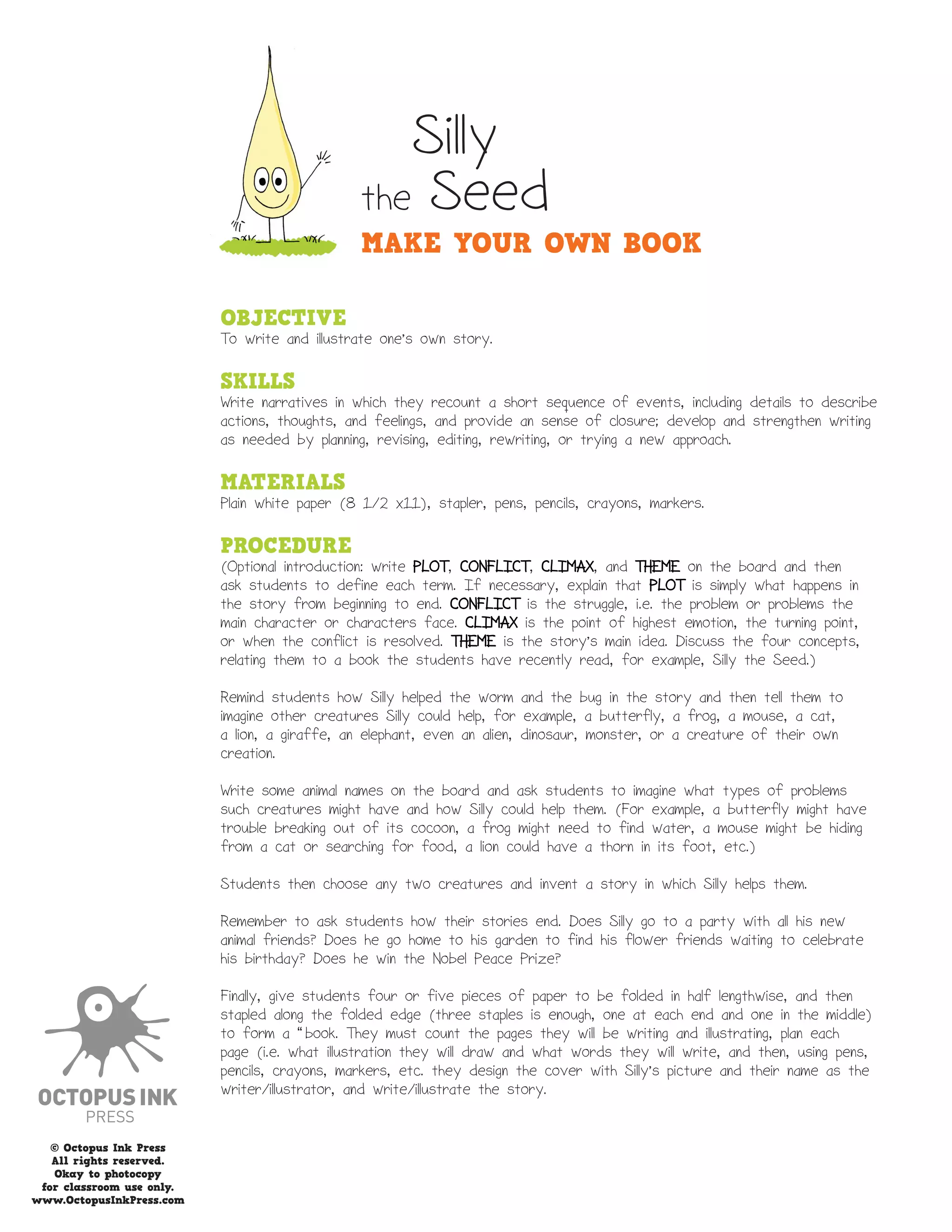
                           pencils, crayons, markers, etc. they design the cover with Silly’s picture and their name as the
                           writer/illustrator, and write/illustrate the story.


   © Octopus Ink Press
   All rights reserved.
   Okay to photocopy
 for classroom use only.
www.OctopusInkPress.com

Make your own_book

  • 1.
    Silly the Seed MAKE YOUR OWN BOOK OBJECTIVE To write and illustrate one’s own story. SKILLS Write narratives in which they recount a short sequence of events, including details to describe actions, thoughts, and feelings, and provide an sense of closure; develop and strengthen writing as needed by planning, revising, editing, rewriting, or trying a new approach. MATERIALS Plain white paper (8 1/2 x11), stapler, pens, pencils, crayons, markers. PROCEDURE (Optional introduction: write PLOT, CONFLICT, CLIMAX, and THEME on the board and then ask students to define each term. If necessary, explain that PLOT is simply what happens in the story from beginning to end. CONFLICT is the struggle, i.e. the problem or problems the main character or characters face. CLIMAX is the point of highest emotion, the turning point, or when the conflict is resolved. THEME is the story’s main idea. Discuss the four concepts, relating them to a book the students have recently read, for example, Silly the Seed.) Remind students how Silly helped the worm and the bug in the story and then tell them to imagine other creatures Silly could help, for example, a butterfly, a frog, a mouse, a cat, a lion, a giraffe, an elephant, even an alien, dinosaur, monster, or a creature of their own creation. Write some animal names on the board and ask students to imagine what types of problems such creatures might have and how Silly could help them. (For example, a butterfly might have trouble breaking out of its cocoon, a frog might need to find water, a mouse might be hiding from a cat or searching for food, a lion could have a thorn in its foot, etc.) Students then choose any two creatures and invent a story in which Silly helps them. Remember to ask students how their stories end. Does Silly go to a party with all his new animal friends? Does he go home to his garden to find his flower friends waiting to celebrate his birthday? Does he win the Nobel Peace Prize? Finally, give students four or five pieces of paper to be folded in half lengthwise, and then stapled along the folded edge (three staples is enough, one at each end and one in the middle) to form a “book. They must count the pages they will be writing and illustrating, plan each page (i.e. what illustration they will draw and what words they will write, and then, using pens, pencils, crayons, markers, etc. they design the cover with Silly’s picture and their name as the writer/illustrator, and write/illustrate the story. © Octopus Ink Press All rights reserved. Okay to photocopy for classroom use only. www.OctopusInkPress.com