Make Your Everyday Teaching a Masterpiece1
Let’s Begin…What are the most pressing issues on your mind as you begin the school year?2
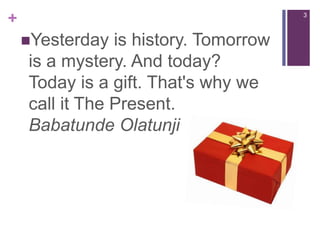
3Yesterday is history. Tomorrow is a mystery. And today?Today is a gift. That's why we call it The Present.BabatundeOlatunji
Let’sstartbythinkingaboutyourownlife …4IF your life were a painting, what would it look like? Sit back, close your eyes and imagine your life on a canvas. What colors are most dominant? Tell me about the figures you see, the shapes and lines that are forming. Is it abstract? Is it defined by still life? Is it set in a meadow with red poppies? Tell me what you see. "LIFE is a great big canvas and you should throw all the paint on it you can." -- Danny Kaye
Designing And Creating The Masterpiece Called Your LifeYou are a creator, designing and creating the masterpiece called your life. Each one of us is a potent being orchestrating our life down to the finest details. All we have to do is recognize this and utilize our power to create what we want in our lives.5
MakeEachDay a MasterpieceIf this day were a painting, would it be a masterpiece when it's done? Embrace life as it happens. Seize the day. Make each day your masterpiece!6
Today is really the only day that matters. . .You can’t make your past self do anything. You can’t make your future self do anything, either. Your only freedom of choice is right now, and thus today is your one chance to paint your masterpiece.What are you going to do today to make it your masterpiece?7
Make each day your masterpieceIn other words, how would you spend today if it were the one day by which your entire life would be judged?This is something I make a genuine effort to keep in mind every single day of my life.What would I write if I knew I only had one shot at making a difference in someone’s life?How would I spend the next hour with my four year old son if I knew it was the only hour he’d remember from his childhood when he was an adult?8
Make each day your masterpiece How would I spend this evening with my wife if it were the last evening we would spend together?How would I spend my money today if I knew that today spoke financially for the rest of my days?Would I hold my temper? Would I stop being such a slob? Would I set a good example? Would I not worry what the neighbors thought and just run through the sprinkler in my clothes, laughing with my children? Would I make a perfectly delicious, tasty meal and smile at my daughter across the dinner table – or would I just throw a box of Tuna Helper out there?9
Make each day your masterpiece Every single day, we’re making an impact on the people around us. The people we love. The people we merely like. The people we will never directly know. Even on ourselves – our future health and happiness and relationships and skills and finances.Every single day, we have a chance to really make all of those things shine – or we can buy a sack full of double cheeseburgers and sit in the basement all evening watching Seinfeld reruns.10
Let’sStartWith a Joke . . .A burglar broke into a house one night. He shined his flashlight around, looking for valuables when a voice in the dark said, 'Jesus knows you're here.'  He nearly jumped out of his skin, clicked his flashlight off, and froze.  When he heard nothing more, after a bit, he shook his head and continued.  Just as he pulled the stereo out so he could disconnect the wires, clear as a bell he heard  'Jesus is watching you.‘ Freaked out, he shined his light around frantically, looking for the source of the voice.Finally, in the corner of the room, his flashlight beam came to rest on a parrot.  'Did you say that?' he hissed at the parrot. 'Yep', the parrot confessed, then squawked, 'I'm just trying to warn you that he is watching you. 'The burglar relaxed. 'Warn me, huh? Who in the world are you ?'  'Moses,' replied the bird. 'Moses?' the burglar laughed. 'What kind of people would name a bird  Moses?' 'The kind of people that would name a  Rottweiler Jesus.' 11
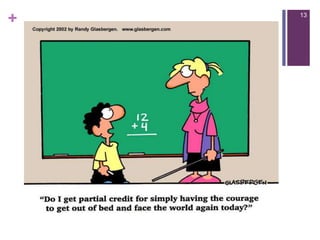
13
14
15
Innovating The Future So You Don't Have To”16
17
TOWARD A GLOBAL PARADIGM SHIFT 18
19The Mission of EducationTo develop or to encourage in young peoplea desire to learn and to continue learning over a lifetime
20If you always do what you always did, you will always get what you always got. J. “Moms” Mabley
So then, shallweinnovate ?“Themainproblemisnotanabsence of innovation in schools, butratherthepresence of toomanydisconnected, episodic, fragmented, superficiallyadornedprojects.”21
It's as simple as choosing what you want, claiming it as yours, and owning it. Every aspect of your life is your creation; you get to do what you want with it. Once you own the power within you, you can be a magnificent creator!22
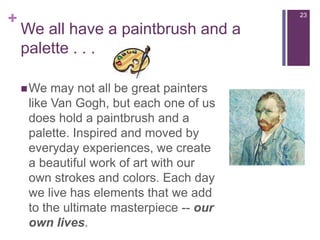
Weallhave a paintbrush and a palette . . .We may not all be great painters like Van Gogh, but each one of us does hold a paintbrush and a palette. Inspired and moved by everyday experiences, we create a beautiful work of art with our own strokes and colors. Each day we live has elements that we add to the ultimate masterpiece -- our own lives.23
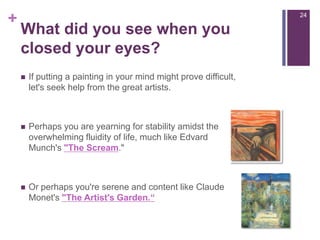
What did you see when you closed your eyes?If putting a painting in your mind might prove difficult, let's seek help from the great artists.Perhaps you are yearning for stability amidst the overwhelming fluidity of life, much like Edvard Munch's "The Scream." Or perhaps you're serene and content like Claude Monet's "The Artist's Garden.“24
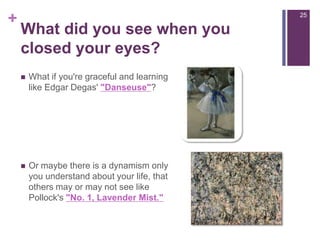
What did you see when you closed your eyes?What if you're graceful and learning like Edgar Degas' "Danseuse"?Or maybe there is a dynamism only you understand about your life, that others may or may not see like Pollock's "No. 1, Lavender Mist."25
Or what if you're feeling like you're in the autumn of your life, but known deep inside there is still something within you that is still blooming, similar to Georgia O'Keeffe's "Dark and Lavender Leaf"26What did you see when you closed your eyes?
Haveyoualreadyvisualizedyourlifeon a canvas ???Which one is most like your life? Now that you've visualized your life on a canvas, do you like what you see? If you do, pat yourself on the back and celebrate that happiness.And do remember that you still continue to paint for as long as you're breathing, so take care of that masterpiece you are creating. If you don't like what is on your canvas, no worries. You have a palette of unlimited colors and you are in control of what colors and strokes to use. Maybe you'd like to spice it up with amber and red, or tone it down with sea green.27
CreatingYourMasterpieceWhat activities, hobbies or other experiences will lead you towards the masterpiece you want to create? In knowing this, your canvas will fill with more elements that will give you much happiness. Sometimes we don't have that end in mind, or we get frustrated when the colors don't turn out right. It's alright. Enjoy the act of painting. Enjoy the different hues and tones. Relish each action you contribute to your canvas everyday, and before you know it, a masterpiece will be right before your eyes. You wield the paintbrush and the palette of your life's canvas. Your life is a masterpiece, a work of art. Color it in as much as you can, and enjoy every moment of your painting.28
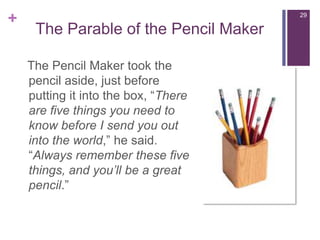
The Parable of the Pencil Maker29  The Pencil Maker took the pencil aside, just before putting it into the box, “There are five things you need to know before I send you out into the world,” he said.  “Always remember these five things, and you’ll be a great pencil.”
The Parable of the Pencil MakerYou are capable of many great things, but only if you allow yourself to be guided by someone’s handYou will experience a painful sharpening from time to time, but you’ll need it to become a better pencilYou have the ability to correct the mistakes you makeThe most important part of you will always be what’s insideOn every surface where you are used, regardless of its condition, you must leave your mark.30
Isteaching a callingoranoccupation?CALLING AND OCCUPATIONI define calling as follows: "The most important thing you can do in which you would be most difficult to replace."I define occupation conventionally: the work you perform that supports you financially.Your calling should be your legacy.  Your job probably won't be.A few occupations lend themselves toward callings. Teaching is one. Preaching is another. Writing, too. Being a star anything is a calling. But stars are mostly shooting stars. Fame fades.31
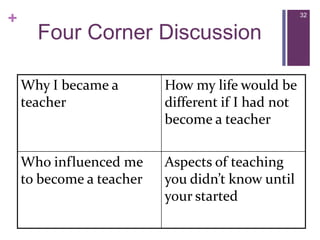
32Four Corner Discussion
Today’sInspiration comes from . . .33
Developing my personal masterpiece . . .“Although I wouldliketoconsidermyself as a painter, creating a masterpiecefromnothing more than a blankcanvas, somepaint, and thevision in my artist’smind, the time has come toadmitthat I am more of a collage artist. I takescraps of thingsotherpeoplehavecreated and putthemtogether, hopingthatthe total sumwillbegreaterthanit’sparts. And so, thisbookis a collage of allthegiftsgivento me bytheverybrilliantpeople in my life.”Robyn R. Jackson , “NeverWorkHarderThanYourStudents”34
“Never Work Harder…” IntroIndividually, get acquainted with the book by reading pp.1-5 of the Introduction.Personalize your reading: write notes in the margin, underline key points, etc.
36The Mastery PrinciplesLocate the mastery principles on pg.4Rank order the 7 mastery principles and justify your top choiceWhat does your top choice look  like in the classroom?
37The Mastery PrinciplesStart Where Your Students AreKnow Where Your Students Are GoingExpect to Get Your Students ThereSupport Your StudentsUse Effective FeedbackFocus on Quality, Not QuantityNever Work Harder Than Your Students
Are you a MasterTeacher, Practitioner, ApprenticeorNovice?Individually, read through and complete the mastery self-assessment on pp.7-21.Calculate your scores on the scoring sheet on p.22 and identify your overall score and teaching level.Give yourself a score for each principle. Total the number of points in each column of the scoring sheet. Then, divide the number by 7 for your average score. Record your average score for each principle.Based on your assessment, what principle will you work on first?   38
Small Group Reflection39Regarding the self-assessment:Where are you overall?  Did this surprise you?What was your weakest principle?  Is this something you were aware of?Which principle do you consider an area of strength?
40"I wake up every morning determined both to change the world and have one hell of a good time.  Sometimes this makes planning the day a little difficult.“			--E. B. White
Think of a successful learning experience. Identify three characteristics that made it successful:1.2.3.
Priscilla Ruiz de Vergara, M.Ed.  42The Lighthouse: All Together NowThree lighthouses on three nearby islands flash their lights every evening. On one island, the light flashes every 45 seconds. The lighthouse on the second island has a light that flashes every 2 minutes. The third lighthouse flashes a light every 1 ¼ minutes. Suppose all the lights flash together at 8:35 p.m. At what time will all three lights flash together again? Justify and explain your answer.
43The Lighthouse: All Together NowThe AnswerThe lights will flash together every 30 minutes, so the next time will be 9:05 p.m. The ExplanationIf you start by converting all the times to seconds, then the time intervals for the lights are 45 seconds, 120 seconds, and 75 seconds, respectively. The least common multiple of 45, 120, and 75 is 1800. So, all the lights will flash together every 1800 seconds, or 30 minutes.
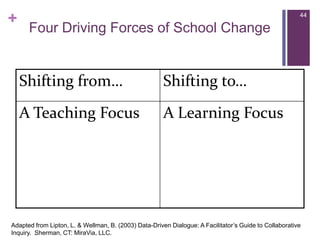
44Four Driving Forces of School ChangeAdapted from Lipton, L. & Wellman, B. (2003) Data-Driven Dialogue: A Facilitator’s Guide to Collaborative Inquiry.  Sherman, CT: MiraVia, LLC.
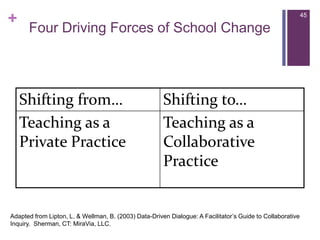
45Four Driving Forces of School ChangeAdapted from Lipton, L. & Wellman, B. (2003) Data-Driven Dialogue: A Facilitator’s Guide to Collaborative Inquiry.  Sherman, CT: MiraVia, LLC.
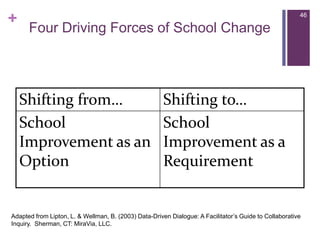
46Four Driving Forces of School ChangeAdapted from Lipton, L. & Wellman, B. (2003) Data-Driven Dialogue: A Facilitator’s Guide to Collaborative Inquiry.  Sherman, CT: MiraVia, LLC.
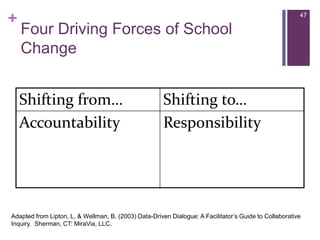
Four Driving Forces of School Change47Adapted from Lipton, L. & Wellman, B. (2003) Data-Driven Dialogue: A Facilitator’s Guide to Collaborative Inquiry.  Sherman, CT: MiraVia, LLC.
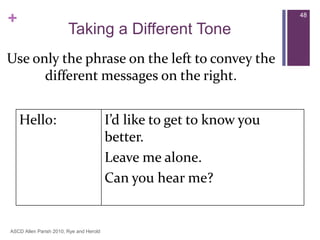
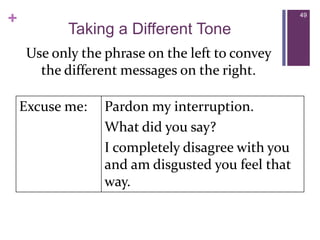
ASCD Allen Parish 2010; Rye and Herold48Taking a Different ToneUse only the phrase on the left to convey the different messages on the right.
49Taking a Different ToneUse only the phrase on the left to convey the different messages on the right.
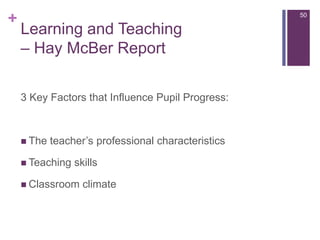
Learning and Teaching – Hay McBer Report503 Key Factors that Influence Pupil Progress:The teacher’s professional characteristicsTeaching skillsClassroom climate
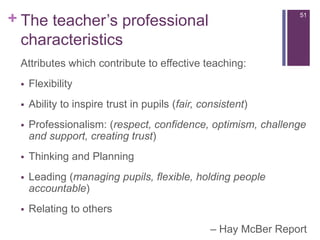
The teacher’s professional characteristics51Attributes which contribute to effective teaching:Flexibility
Ability to inspire trust in pupils (fair, consistent)
Professionalism: (respect, confidence, optimism, challenge and support, creating trust)
Thinking and Planning
Leading (managing pupils, flexible, holding people accountable)
Relating to others  – Hay McBer Report
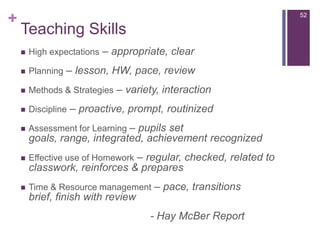
Teaching Skills52High expectations – appropriate, clearPlanning – lesson, HW, pace, reviewMethods & Strategies – variety, interactionDiscipline – proactive, prompt, routinizedAssessment for Learning – pupils set goals, range, integrated, achievement recognizedEffective use of Homework – regular, checked, related to classwork, reinforces & preparesTime & Resource management – pace, transitions brief, finish with review                                            - Hay McBer Report
Good Classroom Climate53Claritypurpose & context of each lessonOrderdiscipline & civilized behaviourStandardshigh, explicit & consistentFairnessno favourites, affirmation earnedParticipationvariety of discussion & activitySupportconfidence to risk, err and learnSafety                absence of bullying & fearInterestinteresting & stimulating lessonsEnvironmentattractive, organised & clean                                       - Hay McBer Report
Teaching skills … not random54Effective teaching requires planning:Attention to detailA focus on individual pupilsEffective use of information from pupil assessment to inform future teaching and learningClarity about standards and expectations– Hay McBer Report

Make your everyday teaching a masterpiece

  • 1.
    MakeYour Everyday Teaching a Masterpiece1
  • 2.
    Let’s Begin…What arethe most pressing issues on your mind as you begin the school year?2
  • 3.
    3Yesterday is history.Tomorrow is a mystery. And today?Today is a gift. That's why we call it The Present.BabatundeOlatunji
  • 4.
    Let’sstartbythinkingaboutyourownlife …4IF yourlife were a painting, what would it look like? Sit back, close your eyes and imagine your life on a canvas. What colors are most dominant? Tell me about the figures you see, the shapes and lines that are forming. Is it abstract? Is it defined by still life? Is it set in a meadow with red poppies? Tell me what you see. "LIFE is a great big canvas and you should throw all the paint on it you can." -- Danny Kaye
  • 5.
    Designing And CreatingThe Masterpiece Called Your LifeYou are a creator, designing and creating the masterpiece called your life. Each one of us is a potent being orchestrating our life down to the finest details. All we have to do is recognize this and utilize our power to create what we want in our lives.5
  • 6.
    MakeEachDay a MasterpieceIfthis day were a painting, would it be a masterpiece when it's done? Embrace life as it happens. Seize the day. Make each day your masterpiece!6
  • 7.
    Today is reallythe only day that matters. . .You can’t make your past self do anything. You can’t make your future self do anything, either. Your only freedom of choice is right now, and thus today is your one chance to paint your masterpiece.What are you going to do today to make it your masterpiece?7
  • 8.
    Make each dayyour masterpieceIn other words, how would you spend today if it were the one day by which your entire life would be judged?This is something I make a genuine effort to keep in mind every single day of my life.What would I write if I knew I only had one shot at making a difference in someone’s life?How would I spend the next hour with my four year old son if I knew it was the only hour he’d remember from his childhood when he was an adult?8
  • 9.
    Make each dayyour masterpiece How would I spend this evening with my wife if it were the last evening we would spend together?How would I spend my money today if I knew that today spoke financially for the rest of my days?Would I hold my temper? Would I stop being such a slob? Would I set a good example? Would I not worry what the neighbors thought and just run through the sprinkler in my clothes, laughing with my children? Would I make a perfectly delicious, tasty meal and smile at my daughter across the dinner table – or would I just throw a box of Tuna Helper out there?9
  • 10.
    Make each dayyour masterpiece Every single day, we’re making an impact on the people around us. The people we love. The people we merely like. The people we will never directly know. Even on ourselves – our future health and happiness and relationships and skills and finances.Every single day, we have a chance to really make all of those things shine – or we can buy a sack full of double cheeseburgers and sit in the basement all evening watching Seinfeld reruns.10
  • 11.
    Let’sStartWith a Joke. . .A burglar broke into a house one night. He shined his flashlight around, looking for valuables when a voice in the dark said, 'Jesus knows you're here.'  He nearly jumped out of his skin, clicked his flashlight off, and froze.  When he heard nothing more, after a bit, he shook his head and continued.  Just as he pulled the stereo out so he could disconnect the wires, clear as a bell he heard 'Jesus is watching you.‘ Freaked out, he shined his light around frantically, looking for the source of the voice.Finally, in the corner of the room, his flashlight beam came to rest on a parrot.  'Did you say that?' he hissed at the parrot. 'Yep', the parrot confessed, then squawked, 'I'm just trying to warn you that he is watching you. 'The burglar relaxed. 'Warn me, huh? Who in the world are you ?'  'Moses,' replied the bird. 'Moses?' the burglar laughed. 'What kind of people would name a bird  Moses?' 'The kind of people that would name a  Rottweiler Jesus.' 11
  • 13.
  • 14.
  • 15.
  • 16.
    Innovating The FutureSo You Don't Have To”16
  • 17.
  • 18.
    TOWARD A GLOBALPARADIGM SHIFT 18
  • 19.
    19The Mission ofEducationTo develop or to encourage in young peoplea desire to learn and to continue learning over a lifetime
  • 20.
    20If you alwaysdo what you always did, you will always get what you always got. J. “Moms” Mabley
  • 21.
    So then, shallweinnovate?“Themainproblemisnotanabsence of innovation in schools, butratherthepresence of toomanydisconnected, episodic, fragmented, superficiallyadornedprojects.”21
  • 22.
    It's as simpleas choosing what you want, claiming it as yours, and owning it. Every aspect of your life is your creation; you get to do what you want with it. Once you own the power within you, you can be a magnificent creator!22
  • 23.
    Weallhave a paintbrushand a palette . . .We may not all be great painters like Van Gogh, but each one of us does hold a paintbrush and a palette. Inspired and moved by everyday experiences, we create a beautiful work of art with our own strokes and colors. Each day we live has elements that we add to the ultimate masterpiece -- our own lives.23
  • 24.
    What did yousee when you closed your eyes?If putting a painting in your mind might prove difficult, let's seek help from the great artists.Perhaps you are yearning for stability amidst the overwhelming fluidity of life, much like Edvard Munch's "The Scream." Or perhaps you're serene and content like Claude Monet's "The Artist's Garden.“24
  • 25.
    What did yousee when you closed your eyes?What if you're graceful and learning like Edgar Degas' "Danseuse"?Or maybe there is a dynamism only you understand about your life, that others may or may not see like Pollock's "No. 1, Lavender Mist."25
  • 26.
    Or what ifyou're feeling like you're in the autumn of your life, but known deep inside there is still something within you that is still blooming, similar to Georgia O'Keeffe's "Dark and Lavender Leaf"26What did you see when you closed your eyes?
  • 27.
    Haveyoualreadyvisualizedyourlifeon a canvas???Which one is most like your life? Now that you've visualized your life on a canvas, do you like what you see? If you do, pat yourself on the back and celebrate that happiness.And do remember that you still continue to paint for as long as you're breathing, so take care of that masterpiece you are creating. If you don't like what is on your canvas, no worries. You have a palette of unlimited colors and you are in control of what colors and strokes to use. Maybe you'd like to spice it up with amber and red, or tone it down with sea green.27
  • 28.
    CreatingYourMasterpieceWhat activities, hobbiesor other experiences will lead you towards the masterpiece you want to create? In knowing this, your canvas will fill with more elements that will give you much happiness. Sometimes we don't have that end in mind, or we get frustrated when the colors don't turn out right. It's alright. Enjoy the act of painting. Enjoy the different hues and tones. Relish each action you contribute to your canvas everyday, and before you know it, a masterpiece will be right before your eyes. You wield the paintbrush and the palette of your life's canvas. Your life is a masterpiece, a work of art. Color it in as much as you can, and enjoy every moment of your painting.28
  • 29.
    The Parable ofthe Pencil Maker29 The Pencil Maker took the pencil aside, just before putting it into the box, “There are five things you need to know before I send you out into the world,” he said. “Always remember these five things, and you’ll be a great pencil.”
  • 30.
    The Parable ofthe Pencil MakerYou are capable of many great things, but only if you allow yourself to be guided by someone’s handYou will experience a painful sharpening from time to time, but you’ll need it to become a better pencilYou have the ability to correct the mistakes you makeThe most important part of you will always be what’s insideOn every surface where you are used, regardless of its condition, you must leave your mark.30
  • 31.
    Isteaching a callingoranoccupation?CALLINGAND OCCUPATIONI define calling as follows: "The most important thing you can do in which you would be most difficult to replace."I define occupation conventionally: the work you perform that supports you financially.Your calling should be your legacy. Your job probably won't be.A few occupations lend themselves toward callings. Teaching is one. Preaching is another. Writing, too. Being a star anything is a calling. But stars are mostly shooting stars. Fame fades.31
  • 32.
  • 33.
  • 34.
    Developing my personalmasterpiece . . .“Although I wouldliketoconsidermyself as a painter, creating a masterpiecefromnothing more than a blankcanvas, somepaint, and thevision in my artist’smind, the time has come toadmitthat I am more of a collage artist. I takescraps of thingsotherpeoplehavecreated and putthemtogether, hopingthatthe total sumwillbegreaterthanit’sparts. And so, thisbookis a collage of allthegiftsgivento me bytheverybrilliantpeople in my life.”Robyn R. Jackson , “NeverWorkHarderThanYourStudents”34
  • 35.
    “Never Work Harder…”IntroIndividually, get acquainted with the book by reading pp.1-5 of the Introduction.Personalize your reading: write notes in the margin, underline key points, etc.
  • 36.
    36The Mastery PrinciplesLocatethe mastery principles on pg.4Rank order the 7 mastery principles and justify your top choiceWhat does your top choice look like in the classroom?
  • 37.
    37The Mastery PrinciplesStartWhere Your Students AreKnow Where Your Students Are GoingExpect to Get Your Students ThereSupport Your StudentsUse Effective FeedbackFocus on Quality, Not QuantityNever Work Harder Than Your Students
  • 38.
    Are you aMasterTeacher, Practitioner, ApprenticeorNovice?Individually, read through and complete the mastery self-assessment on pp.7-21.Calculate your scores on the scoring sheet on p.22 and identify your overall score and teaching level.Give yourself a score for each principle. Total the number of points in each column of the scoring sheet. Then, divide the number by 7 for your average score. Record your average score for each principle.Based on your assessment, what principle will you work on first? 38
  • 39.
    Small Group Reflection39Regardingthe self-assessment:Where are you overall? Did this surprise you?What was your weakest principle? Is this something you were aware of?Which principle do you consider an area of strength?
  • 40.
    40"I wake upevery morning determined both to change the world and have one hell of a good time. Sometimes this makes planning the day a little difficult.“ --E. B. White
  • 41.
    Think of asuccessful learning experience. Identify three characteristics that made it successful:1.2.3.
  • 42.
    Priscilla Ruiz deVergara, M.Ed. 42The Lighthouse: All Together NowThree lighthouses on three nearby islands flash their lights every evening. On one island, the light flashes every 45 seconds. The lighthouse on the second island has a light that flashes every 2 minutes. The third lighthouse flashes a light every 1 ¼ minutes. Suppose all the lights flash together at 8:35 p.m. At what time will all three lights flash together again? Justify and explain your answer.
  • 43.
    43The Lighthouse: AllTogether NowThe AnswerThe lights will flash together every 30 minutes, so the next time will be 9:05 p.m. The ExplanationIf you start by converting all the times to seconds, then the time intervals for the lights are 45 seconds, 120 seconds, and 75 seconds, respectively. The least common multiple of 45, 120, and 75 is 1800. So, all the lights will flash together every 1800 seconds, or 30 minutes.
  • 44.
    44Four Driving Forcesof School ChangeAdapted from Lipton, L. & Wellman, B. (2003) Data-Driven Dialogue: A Facilitator’s Guide to Collaborative Inquiry. Sherman, CT: MiraVia, LLC.
  • 45.
    45Four Driving Forcesof School ChangeAdapted from Lipton, L. & Wellman, B. (2003) Data-Driven Dialogue: A Facilitator’s Guide to Collaborative Inquiry. Sherman, CT: MiraVia, LLC.
  • 46.
    46Four Driving Forcesof School ChangeAdapted from Lipton, L. & Wellman, B. (2003) Data-Driven Dialogue: A Facilitator’s Guide to Collaborative Inquiry. Sherman, CT: MiraVia, LLC.
  • 47.
    Four Driving Forcesof School Change47Adapted from Lipton, L. & Wellman, B. (2003) Data-Driven Dialogue: A Facilitator’s Guide to Collaborative Inquiry. Sherman, CT: MiraVia, LLC.
  • 48.
    ASCD Allen Parish2010; Rye and Herold48Taking a Different ToneUse only the phrase on the left to convey the different messages on the right.
  • 49.
    49Taking a DifferentToneUse only the phrase on the left to convey the different messages on the right.
  • 50.
    Learning and Teaching– Hay McBer Report503 Key Factors that Influence Pupil Progress:The teacher’s professional characteristicsTeaching skillsClassroom climate
  • 51.
    The teacher’s professionalcharacteristics51Attributes which contribute to effective teaching:Flexibility
  • 52.
    Ability to inspiretrust in pupils (fair, consistent)
  • 53.
    Professionalism: (respect, confidence,optimism, challenge and support, creating trust)
  • 54.
  • 55.
    Leading (managing pupils,flexible, holding people accountable)
  • 56.
    Relating to others – Hay McBer Report
  • 57.
    Teaching Skills52High expectations– appropriate, clearPlanning – lesson, HW, pace, reviewMethods & Strategies – variety, interactionDiscipline – proactive, prompt, routinizedAssessment for Learning – pupils set goals, range, integrated, achievement recognizedEffective use of Homework – regular, checked, related to classwork, reinforces & preparesTime & Resource management – pace, transitions brief, finish with review - Hay McBer Report
  • 58.
    Good Classroom Climate53Claritypurpose& context of each lessonOrderdiscipline & civilized behaviourStandardshigh, explicit & consistentFairnessno favourites, affirmation earnedParticipationvariety of discussion & activitySupportconfidence to risk, err and learnSafety absence of bullying & fearInterestinteresting & stimulating lessonsEnvironmentattractive, organised & clean - Hay McBer Report
  • 59.
    Teaching skills …not random54Effective teaching requires planning:Attention to detailA focus on individual pupilsEffective use of information from pupil assessment to inform future teaching and learningClarity about standards and expectations– Hay McBer Report