18 March 2019 S3905-P-694 v1.0COMMERCIALLY CONFIDENTIAL
Chris Roberts
AgriTech East: Innovating for CEA
MAKE OR BUY? COMMERCIAL AND
TECHNICAL DRIVERS FOR VERTICAL FARMING
18 March 2019 S3905-P-694 v1.0COMMERCIALLY CONFIDENTIAL 2
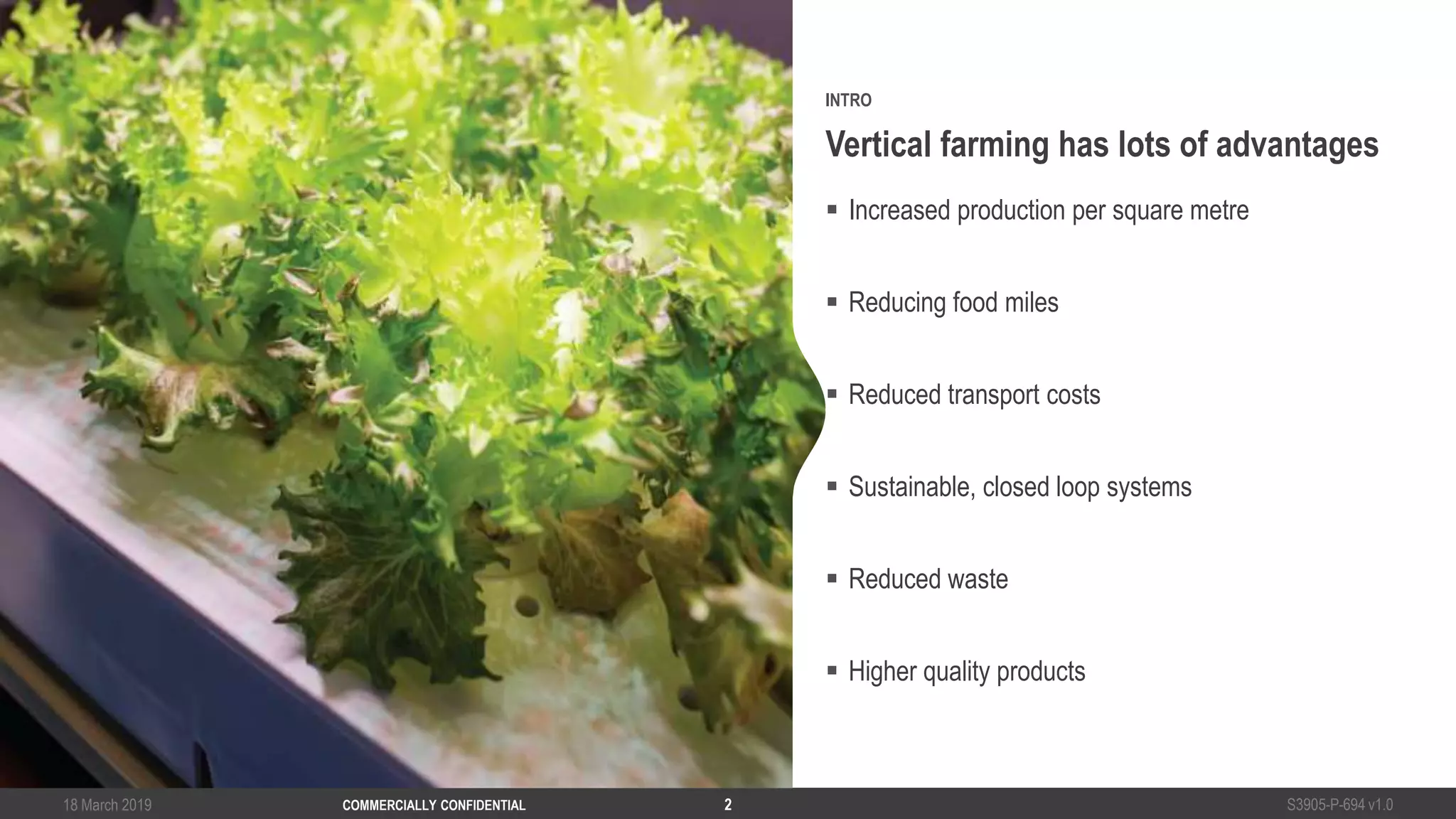
 Increased production per square metre
 Reducing food miles
 Reduced transport costs
 Sustainable, closed loop systems
 Reduced waste
 Higher quality products
Vertical farming has lots of advantages
INTRO
18 March 2019 S3905-P-694 v1.0COMMERCIALLY CONFIDENTIAL 3
 Costs can be broken down into three buckets:
Costs associated with vertical farming are still higher than traditional farming
COSTS
Development Costs
• Paid once per type of machine
or installation
• Pays for engineering time to
invent or tailor a technology to
match the specific needs of the
project
• Paying for development
generally results in owning IP
Installation Costs
• Paid once per installation / farm
at the start of running
• Includes buying land, racking for
crops, lighting and HVAC
hardware
Running Costs
• Paid every day the farm is
running
• Human labour
• Water rates
• Fertiliser, pesticides, seeds and
other agri consumables
• Energy costs for lighting,
heating, cooling, moving things
around within the farm
18 March 2019 S3905-P-694 v1.0COMMERCIALLY CONFIDENTIAL 4
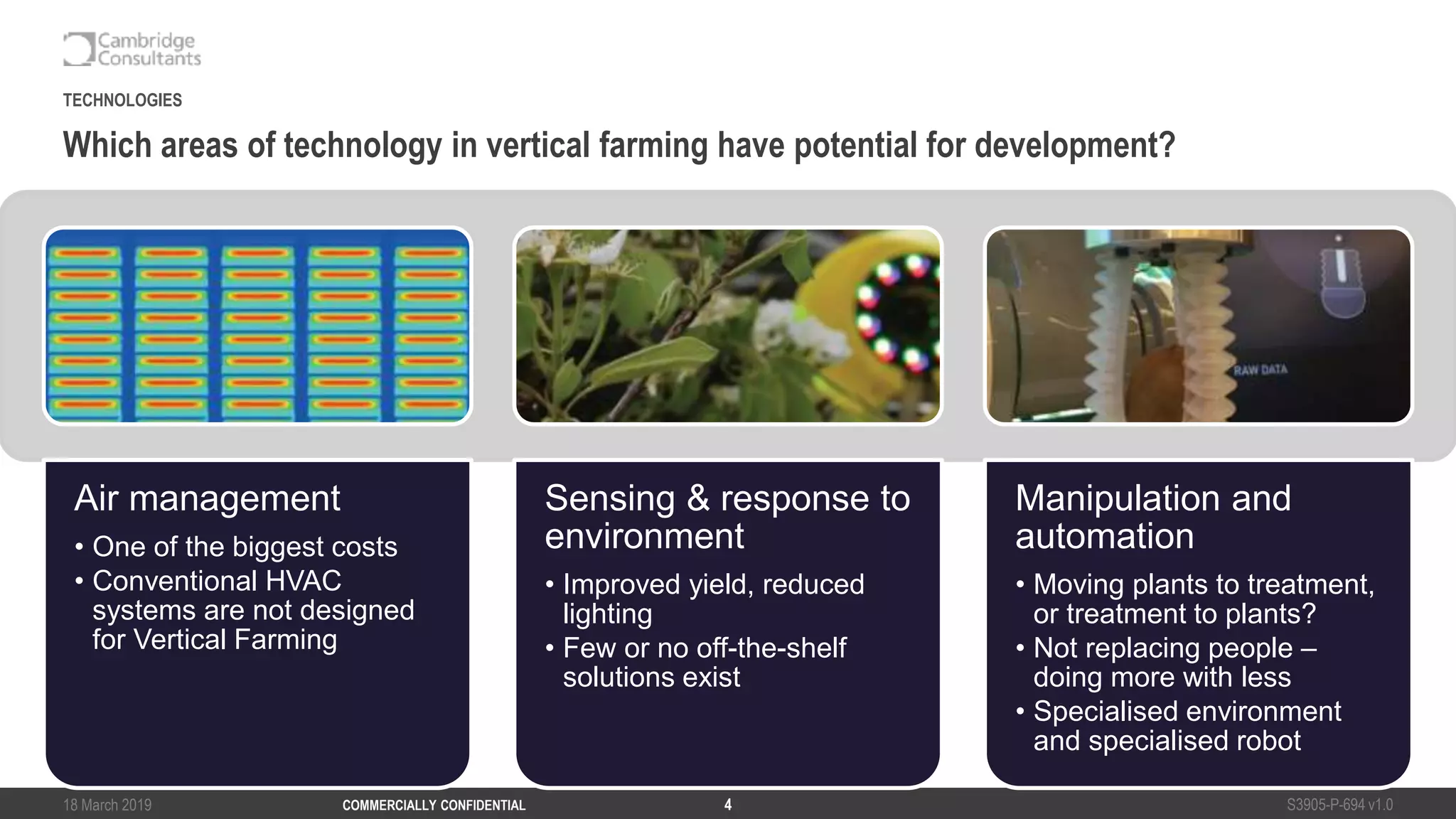
Which areas of technology in vertical farming have potential for development?
TECHNOLOGIES
Air management
• One of the biggest costs
• Conventional HVAC
systems are not designed
for Vertical Farming
Sensing & response to
environment
• Improved yield, reduced
lighting
• Few or no off-the-shelf
solutions exist
Manipulation and
automation
• Moving plants to treatment,
or treatment to plants?
• Not replacing people –
doing more with less
• Specialised environment
and specialised robot
18 March 2019 S3905-P-694 v1.0COMMERCIALLY CONFIDENTIAL 5
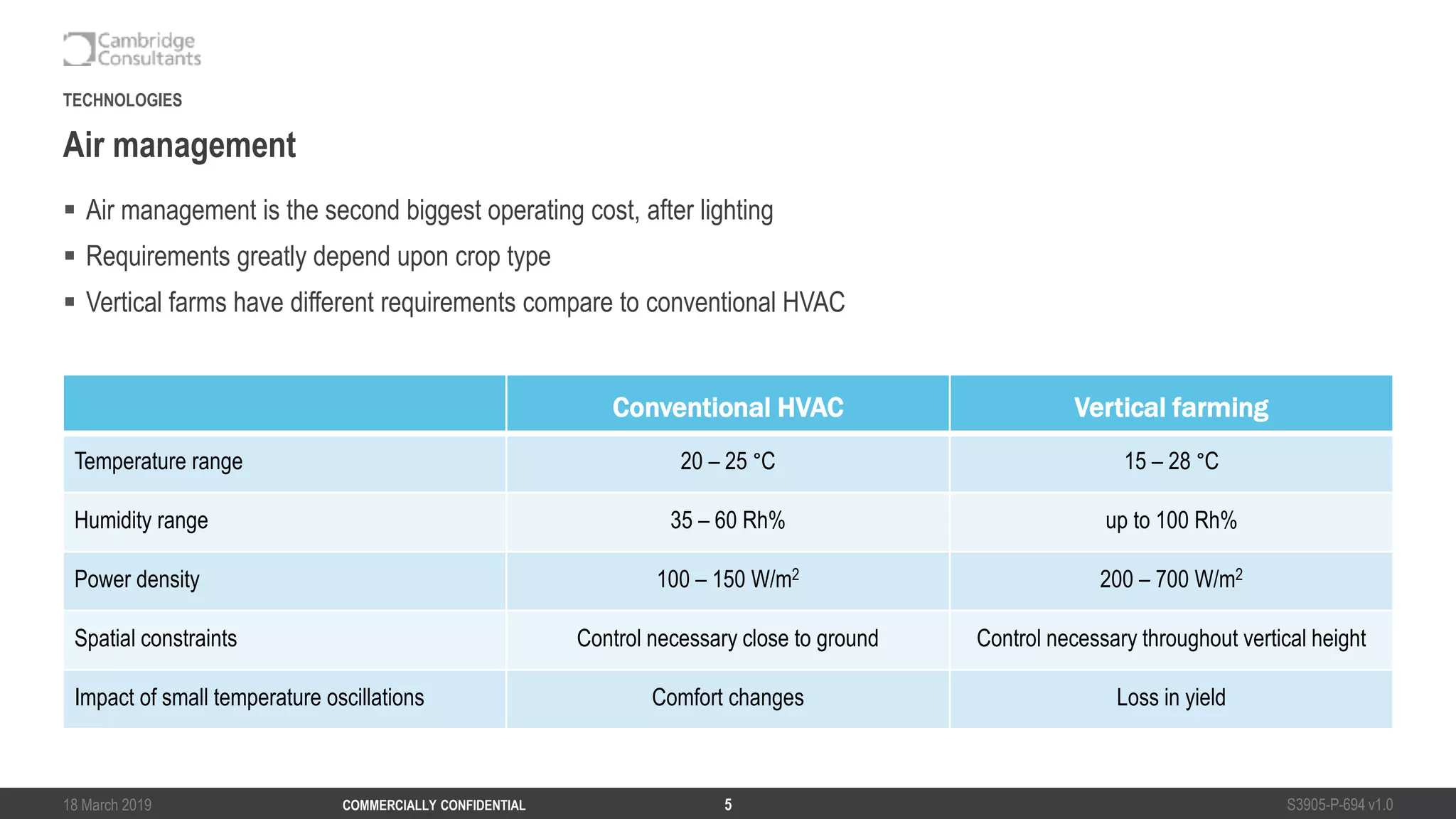
 Air management is the second biggest operating cost, after lighting
 Requirements greatly depend upon crop type
 Vertical farms have different requirements compare to conventional HVAC
Air management
TECHNOLOGIES
Conventional HVAC Vertical farming
Temperature range 20 – 25 °C 15 – 28 °C
Humidity range 35 – 60 Rh% up to 100 Rh%
Power density 100 – 150 W/m2 200 – 700 W/m2
Spatial constraints Control necessary close to ground Control necessary throughout vertical height
Impact of small temperature oscillations Comfort changes Loss in yield
18 March 2019 S3905-P-694 v1.0COMMERCIALLY CONFIDENTIAL 6
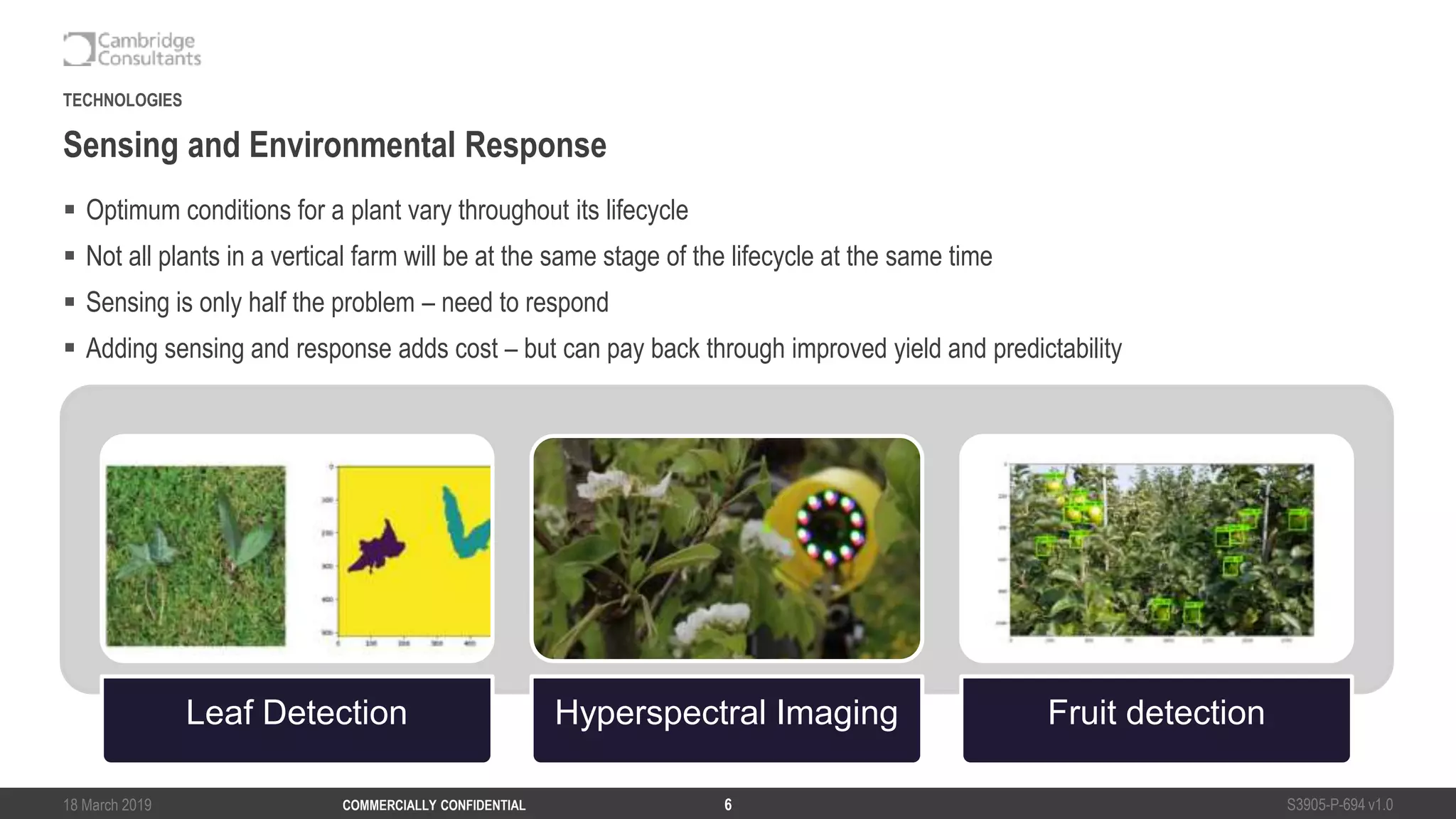
 Optimum conditions for a plant vary throughout its lifecycle
 Not all plants in a vertical farm will be at the same stage of the lifecycle at the same time
 Sensing is only half the problem – need to respond
 Adding sensing and response adds cost – but can pay back through improved yield and predictability
Sensing and Environmental Response
TECHNOLOGIES
Leaf Detection Hyperspectral Imaging Fruit detection
18 March 2019 S3905-P-694 v1.0COMMERCIALLY CONFIDENTIAL 7
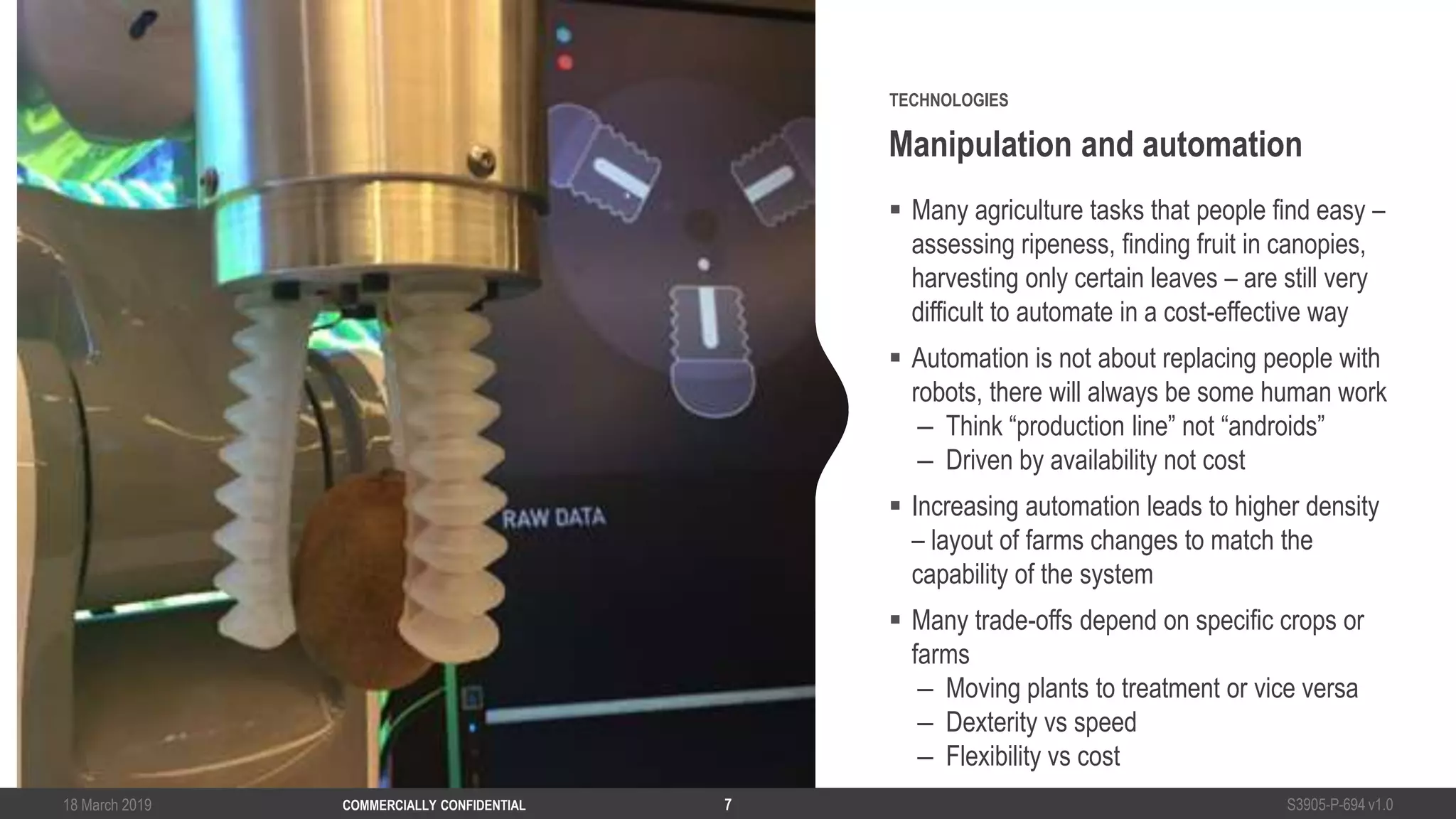
 Many agriculture tasks that people find easy –
assessing ripeness, finding fruit in canopies,
harvesting only certain leaves – are still very
difficult to automate in a cost-effective way
 Automation is not about replacing people with
robots, there will always be some human work
– Think “production line” not “androids”
– Driven by availability not cost
 Increasing automation leads to higher density
– layout of farms changes to match the
capability of the system
 Many trade-offs depend on specific crops or
farms
– Moving plants to treatment or vice versa
– Dexterity vs speed
– Flexibility vs cost
Manipulation and automation
TECHNOLOGIES
18 March 2019 S3905-P-694 v1.0COMMERCIALLY CONFIDENTIAL 8
 Developing specialised, more efficient
technologies is the only way to get the costs of
vertical farming down in the long run
 But developing more tech is expensive
 Spreading this cost over a large scale is the
only way it can make sense…
 …either through innovative sharing of tech, or
just larger ambition
Conclusions
18 March 2019 S3905-P-694 v1.0
The contents of this presentation are commercially confidential and the proprietary information
of Cambridge Consultants © 2019 Cambridge Consultants Ltd. All rights reserved.
UK
Cambridge Consultants is part of the Altran group, a global leader
in Innovation. www.Altran.com
www.CambridgeConsultants.com
USA SINGAPORE JAPAN. . .
Registered no. 01036298 England and Wales

Make or buy? Commercial and technical drivers for vertical farming

  • 1.
    18 March 2019S3905-P-694 v1.0COMMERCIALLY CONFIDENTIAL Chris Roberts AgriTech East: Innovating for CEA MAKE OR BUY? COMMERCIAL AND TECHNICAL DRIVERS FOR VERTICAL FARMING
  • 2.
    18 March 2019S3905-P-694 v1.0COMMERCIALLY CONFIDENTIAL 2  Increased production per square metre  Reducing food miles  Reduced transport costs  Sustainable, closed loop systems  Reduced waste  Higher quality products Vertical farming has lots of advantages INTRO
  • 3.
    18 March 2019S3905-P-694 v1.0COMMERCIALLY CONFIDENTIAL 3  Costs can be broken down into three buckets: Costs associated with vertical farming are still higher than traditional farming COSTS Development Costs • Paid once per type of machine or installation • Pays for engineering time to invent or tailor a technology to match the specific needs of the project • Paying for development generally results in owning IP Installation Costs • Paid once per installation / farm at the start of running • Includes buying land, racking for crops, lighting and HVAC hardware Running Costs • Paid every day the farm is running • Human labour • Water rates • Fertiliser, pesticides, seeds and other agri consumables • Energy costs for lighting, heating, cooling, moving things around within the farm
  • 4.
    18 March 2019S3905-P-694 v1.0COMMERCIALLY CONFIDENTIAL 4 Which areas of technology in vertical farming have potential for development? TECHNOLOGIES Air management • One of the biggest costs • Conventional HVAC systems are not designed for Vertical Farming Sensing & response to environment • Improved yield, reduced lighting • Few or no off-the-shelf solutions exist Manipulation and automation • Moving plants to treatment, or treatment to plants? • Not replacing people – doing more with less • Specialised environment and specialised robot
  • 5.
    18 March 2019S3905-P-694 v1.0COMMERCIALLY CONFIDENTIAL 5  Air management is the second biggest operating cost, after lighting  Requirements greatly depend upon crop type  Vertical farms have different requirements compare to conventional HVAC Air management TECHNOLOGIES Conventional HVAC Vertical farming Temperature range 20 – 25 °C 15 – 28 °C Humidity range 35 – 60 Rh% up to 100 Rh% Power density 100 – 150 W/m2 200 – 700 W/m2 Spatial constraints Control necessary close to ground Control necessary throughout vertical height Impact of small temperature oscillations Comfort changes Loss in yield
  • 6.
    18 March 2019S3905-P-694 v1.0COMMERCIALLY CONFIDENTIAL 6  Optimum conditions for a plant vary throughout its lifecycle  Not all plants in a vertical farm will be at the same stage of the lifecycle at the same time  Sensing is only half the problem – need to respond  Adding sensing and response adds cost – but can pay back through improved yield and predictability Sensing and Environmental Response TECHNOLOGIES Leaf Detection Hyperspectral Imaging Fruit detection
  • 7.
    18 March 2019S3905-P-694 v1.0COMMERCIALLY CONFIDENTIAL 7  Many agriculture tasks that people find easy – assessing ripeness, finding fruit in canopies, harvesting only certain leaves – are still very difficult to automate in a cost-effective way  Automation is not about replacing people with robots, there will always be some human work – Think “production line” not “androids” – Driven by availability not cost  Increasing automation leads to higher density – layout of farms changes to match the capability of the system  Many trade-offs depend on specific crops or farms – Moving plants to treatment or vice versa – Dexterity vs speed – Flexibility vs cost Manipulation and automation TECHNOLOGIES
  • 8.
    18 March 2019S3905-P-694 v1.0COMMERCIALLY CONFIDENTIAL 8  Developing specialised, more efficient technologies is the only way to get the costs of vertical farming down in the long run  But developing more tech is expensive  Spreading this cost over a large scale is the only way it can make sense…  …either through innovative sharing of tech, or just larger ambition Conclusions
  • 9.
    18 March 2019S3905-P-694 v1.0 The contents of this presentation are commercially confidential and the proprietary information of Cambridge Consultants © 2019 Cambridge Consultants Ltd. All rights reserved. UK Cambridge Consultants is part of the Altran group, a global leader in Innovation. www.Altran.com www.CambridgeConsultants.com USA SINGAPORE JAPAN. . . Registered no. 01036298 England and Wales

Editor's Notes

  • #2 Example using black CC logo
  • #4 So why would you add to this by developing some new technology? Counter-intuitively, the high running costs are precisely the reason it is worth considering Make vs Buy in this case However – scale is important Development costs are spread over the installations Spending £500k on technology to save 10% of your running costs probably only starts to make sense when those costs are £1M+ per year…