Benoît Majerus (University of Luxembourg)


Why the Holocaust does not matter?
Explaining the (non-)participation of policemen in the arrest of
           Jews in Belgium during World War Two
Structure of the presentation
  Introduction
  Arresting Jews in Brussels
  Arresting Jews in Antwerpen
  Arresting people in Belgium
  Conclusion
Introduction
  Making lists of British and American citizens in
   Brussels
     Summer 1940
  Arresting Belgian officers in Brussels
     Summer 1942
     As auxiliary forces
  Hypothesis
     History of Jewish persecution and history of police
      cooperation : crossed story
Arresting Jews in Brussels
  Two major requests during the summer 1942
     July 1942
        Oberfeldkommandantur
        Refusal is argumented on a general level
     September 1942
        Sipo-SD
        Refusal is argumented on a general level
  Individual transfer of Jews to the German police till
    autumn 1943
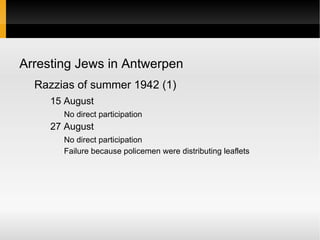
Arresting Jews in Antwerpen
  Razzias of summer 1942 (1)
     15 August
       No direct participation
     27 August
       No direct participation
       Failure because policemen were distributing leaflets
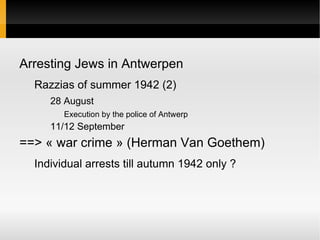
Arresting Jews in Antwerpen
  Razzias of summer 1942 (2)
     28 August
        Execution by the police of Antwerp
     11/12 September
==> « war crime » (Herman Van Goethem)
  Individual arrests till autumn 1942 only ?
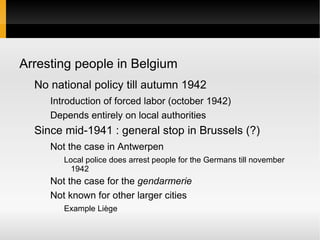
Arresting people in Belgium
  No national policy till autumn 1942
     Introduction of forced labor (october 1942)
     Depends entirely on local authorities
  Since mid-1941 : general stop in Brussels (?)
     Not the case in Antwerpen
        Local police does arrest people for the Germans till november
          1942
     Not the case for the gendarmerie
     Not known for other larger cities
        Example Liège
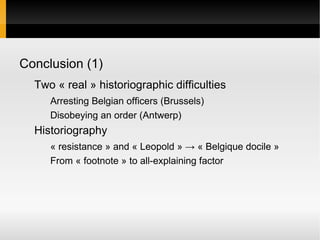
Conclusion (1)
  Two « real » historiographic difficulties
     Arresting Belgian officers (Brussels)
     Disobeying an order (Antwerp)
  Historiography
     « resistance » and « Leopold » → « Belgique docile »
     From « footnote » to all-explaining factor
Conclusion (2)
  « Decentralise » anti-Jewish policy
     Stop telling a linear story : making lists → arrests
  Sociology is more interesting than law
     Stop proving it was legally wrong
  Integrate in larger narrative on occupation and war
     Has been fruitful for Eastern Europe
     Or is there a Western European specificity ?
        Occupation but no war
Selectif bibliography
   Doorslaer Rudi (éd.), La Belgique docile: les autorités belges et la
     persécution des Juifs en Belgique, Bruxelles, Luc Pire, 2007, vol.2.
   Majerus Benoit, Occupations et logiques policières. La police bruxelloise en
     1914-1918 et 1940-1945, Bruxelles, Académie royale de Belgique, 2007.
   Meinen Insa, De Shoah in België, Antwerpen, De Bezige Bij Antwerpen, 2011.
   Monjardet Dominique, Ce que fait la police  : sociologie de la force publique,
     Paris, La Découverte, coll. « Textes à l’appui. Série Sociologie », 1996.
   Saerens Lieven, Vreemdelingen in een wereldstad : een geschiedenis van
     Antwerpen en zijn joodse bevolking (1880-1944), Tielt, Lannoo, 2000.
   Goethem Herman van, « La convention de La Haye, la collaboration
     administrative en Belgique et la persécution des Juifs à Anvers,
     1940-1942 », Bijdragen tot de eigentijdse geschiedenis, 2006, p. 117–197.

Majerus holocaust

  • 1.
    Benoît Majerus (Universityof Luxembourg) Why the Holocaust does not matter? Explaining the (non-)participation of policemen in the arrest of Jews in Belgium during World War Two
  • 2.
    Structure of thepresentation Introduction Arresting Jews in Brussels Arresting Jews in Antwerpen Arresting people in Belgium Conclusion
  • 3.
    Introduction Makinglists of British and American citizens in Brussels Summer 1940 Arresting Belgian officers in Brussels Summer 1942 As auxiliary forces Hypothesis History of Jewish persecution and history of police cooperation : crossed story
  • 4.
    Arresting Jews inBrussels Two major requests during the summer 1942 July 1942 Oberfeldkommandantur Refusal is argumented on a general level September 1942 Sipo-SD Refusal is argumented on a general level Individual transfer of Jews to the German police till autumn 1943
  • 5.
    Arresting Jews inAntwerpen Razzias of summer 1942 (1) 15 August No direct participation 27 August No direct participation Failure because policemen were distributing leaflets
  • 6.
    Arresting Jews inAntwerpen Razzias of summer 1942 (2) 28 August Execution by the police of Antwerp 11/12 September ==> « war crime » (Herman Van Goethem) Individual arrests till autumn 1942 only ?
  • 7.
    Arresting people inBelgium No national policy till autumn 1942 Introduction of forced labor (october 1942) Depends entirely on local authorities Since mid-1941 : general stop in Brussels (?) Not the case in Antwerpen Local police does arrest people for the Germans till november 1942 Not the case for the gendarmerie Not known for other larger cities Example Liège
  • 8.
    Conclusion (1) Two « real » historiographic difficulties Arresting Belgian officers (Brussels) Disobeying an order (Antwerp) Historiography « resistance » and « Leopold » → « Belgique docile » From « footnote » to all-explaining factor
  • 9.
    Conclusion (2) « Decentralise » anti-Jewish policy Stop telling a linear story : making lists → arrests Sociology is more interesting than law Stop proving it was legally wrong Integrate in larger narrative on occupation and war Has been fruitful for Eastern Europe Or is there a Western European specificity ? Occupation but no war
  • 10.
    Selectif bibliography Doorslaer Rudi (éd.), La Belgique docile: les autorités belges et la persécution des Juifs en Belgique, Bruxelles, Luc Pire, 2007, vol.2. Majerus Benoit, Occupations et logiques policières. La police bruxelloise en 1914-1918 et 1940-1945, Bruxelles, Académie royale de Belgique, 2007. Meinen Insa, De Shoah in België, Antwerpen, De Bezige Bij Antwerpen, 2011. Monjardet Dominique, Ce que fait la police  : sociologie de la force publique, Paris, La Découverte, coll. « Textes à l’appui. Série Sociologie », 1996. Saerens Lieven, Vreemdelingen in een wereldstad : een geschiedenis van Antwerpen en zijn joodse bevolking (1880-1944), Tielt, Lannoo, 2000. Goethem Herman van, « La convention de La Haye, la collaboration administrative en Belgique et la persécution des Juifs à Anvers, 1940-1942 », Bijdragen tot de eigentijdse geschiedenis, 2006, p. 117–197.