Introduction
Introduction to Life Cycle Cost
Objectives of Maintenance and Maintenance Cost
Maintenance Definition
How to get unplanned repair jobs planned
Maintenance Procedures
Failure Development
Total Productivity Maintenance
Maintenance Management Systems
Maintenance Management
Objectives
Introduction
Industry today is in a fight to survive. Competition is
found not only on a domestic level, but also on international
levels. In an effort to survive, all forms of production analysis,
product reviews, and material reviews are made and
periodically checked. Statistical process control is only one of
the new methods used to reduce operational costs. However,
one area many industries are now turning their attention
toward is the maintenance function.
Introduction (Cont.)
Cost reduction in maintenance does not necessarily
mean a reduction in service or in the quality of service. It
means a better control of the maintenance organization and the
related areas. To properly control the maintenance of any
facility, information is required to analyze what is occurring.
Manually, this requires a tremendous amount of effort
and time. In recognition of this, many of the progressive
companies are developing and using computer programs
geared toward control of the maintenance organization. These
systems are often referred to as computerized maintenance
management systems (CMMS).
What is Maintenance?
• Maintenance - any activity carried out on
an asset in order to ensure that the asset
continues to perform its intended functions,
or to repair the equipment. Note that
modifications are not maintenance, even
though they may be carried out by
maintenance personnel.
What is Maintenance?
“Maintenance is war.
Your enemies are the triumvirate of
breakdown, deterioration, and all types of
unplanned events.
Your soldiers are the maintenance
department and as many civilians as you
can recruit.
The civilians you protect are production
workers, office workers, drivers, and all the
other users of your organization’s assets”.
- Joel Levitt
What is Maintenance?
• Keeping equipment available, reliable and
cost optimized.
Asset ?
• Asset - unlike in the accounting definition,
in maintenance this is commonly taken to
be any item of physical plant or equipment
• It is the basic unit of maintenance.
Asset Management ?
• Asset Management - the systematic
planning and control of a physical
resource throughout its life. This may
include the specification, design, and
construction of the asset, its operation,
maintenance and modification while in
use, and its disposal when no longer
required.
Maintenance Function ?
• The maintenance department has a more
involved list of functions or responsibilities.
These can be grouped into five main areas:-
1. Maintenance of existing equipment.
2. Equipment inspection and services.
3. Equipment installation.
4. Maintenance storekeeping.
5. Craft administration.
Maintenance Function ?

1. Maintenance of Existing Equipment
Maintaining existing equipment is the basic reason for the
department.
The maintenance group will make repairs to the production
equipment as quickly and economically as possible. They should
be able to anticipate repairs, based on previous experi-ence with
the equipment.
To prevent rapid wear of the equip-ment, the group should utilize
cost-effective preventive maintenance programs.
To perform these tasks as efficiently and cost effectively as
possible requires the utilization of a trained workforce and the use
of modern tools and maintenance methods that are available.
However, performing all of the above tasks depends on one im-
portant item accurate record keeping. Without accurate re-cords, it
will not be possible to complete the assigned tasks in a timely and
cost-effective manner.




Maintenance Function ?

2. Equipment Inspections and Service
This task will require the engineer or manufacturer to
determine the proper lubricant for the equipment. In
addition to the type of lubricant, the proper amount and
time intervals of application of the lubricant are necessary.
The inspections are required to ensure that the equipment
is in safe operating condition and is being serviced in a
timely manner.
Some installations will require that the operational
personnel do some routine lubrication and servicing. Even
where this is a common practice, the maintenance
department should oversee the completion of the tasks.

Maintenance Function ?
 This responsibility varies from industry to
industry and depends on the size of the installation
and the maintenance workforce.
Some industrial facilities that require constant
equipment changeover may have an installation
department.
When large installation projects occur in some
industries without the necessary workforce,
outside contractors are used to supply the needed
manpower.


3. Equipment Installation
Maintenance Function ?

4. Maintenance Storekeeping
This responsibility of the maintenance group involves the
receiving and distribution of the spares necessary for the
repair and upkeep of the plant equipment.
There are several important tasks involved in this
responsibility. The first is recording the necessary spares for
each piece of equipment.
With all of the spares recorded, the maintenance group has
the responsibility of setting the inventory level for each part.
As the spares are used, the replacements will have to be
ordered.
The ordering process is important to prevent material
outages in the stores. Material outages could result in
production delays, if equipment breakdowns occur and no
replacement parts are available. Keeping the stores inventory
level as low as possible will prevent tying up capital
investments in spares.


Maintenance Function ?

5. Craft Administration
This is the responsibility of controlling the manpower used
by the maintenance department.
The most cost-effective way of determining the size of the
workforce is the work in the maintenance backlog. By
looking in the backlog, the number of employees for each
craft area can easily be determined. As programs are

changed and equipment is added or deleted from a
department, the workforce can be adjusted as necessary.
The responsibility for providing the necessary tools
and supplies for the crafts is also included in this area.

Maintenance Objectives
1. To keep the maintenance cost per production
item produced as low as possible.
2. To keep the quality of the product very high.
3. To keep the downtime for critical equipment as
low as possible.
4. To keep maintenance cost as low as possible for
non-critical equipment.
5. To provide and maintain adequate facilities.
6. To provide effective and trained supervision.
What is Management?
• Art of doing what is possible out of what is
available
• Sharing in overheads that leads to unity of
goal
• Coordination of different tones in a
harmony
• Guaranty of never being caught in a
surprise condition
Maintenance Management
• Maintenance Management is defined as the
organization of maintenance within an
agreed policy.
• Maintenance Policy is a statement of
principle used to achieve maintenance
objectives and guide Maintenance
Management decision making.
Maintenance Philosophy (Policy)
• Maintenance organization i.e., centralized versus decentralized
maintenance.
In-house versus outside contracting maintenance.
Preventive versus predictive maintenance. Repair versus
replacement.
•
•
•
In general the following items represent the main aspects
of maintenance philosophy or policy:
Maintenance Policies
This chapter covers basic policies for the operation of a
maintenance-engineering department.
While many of these policies overlap and are interdependent,
they may be grouped in four general categories:
Policies with respect to work allocation
Policies with respect to workforce
Policies with respect to interplant relations
Policies with respect to control
Maintenance Policies
Policies with respect to work allocation
?To Schedule or Not to Schedule
It is generally accepted that, in any maintenance department
where there are more than 10 men and more than two or three
crafts, some planning, other than day-to-day allocation of work
by foremen, can result in improved efficiency.
As the size of the maintenance organization increases, the
extent to which
amount of time
work planning can be formalized and the
that should be spent on this activity are
increased. There should be only as much planning as necessary
for maximum overall efficiency so long as the system costs less
than the cost of operating without it.
Maintenance Policies
Policies with respect to work allocation
How Much Scheduling ?
There are practical limitations to any scheduling system. A very detailed
schedule that becomes obsolete after the first hour or two of use because of
emergencies is of little value.
If, however, actual performance indicates from 60 to 80 percent adherence
during normal operation, the value of the schedule is real.
Justification of any scheduling system requires proof of its effectiveness in
cost saved. Where some form of incentive system or work measurement
exists, such proof is readily available. But in most maintenance departments
no such definitive method is available and the only criteria of measurement
are overall trends in maintenance costs and quality of service.
Maintenance Policies
Policies with respect to work allocation
How Much Scheduling ?
Some aspects to be considered in arriving at a sound
work- scheduling procedure are:
Work Unit. Most detailed schedules are laid out in terms of
man-hours or, if standard times are used, fractions of hours.
Other scheduling systems use a half man-day as a minimum
work unit. Others may use a man-day or even a man-week as a
basis.
Maintenance Policies
Policies with respect to work allocation
How Much Scheduling ?
Some aspects to be considered in arriving at a sound
work- scheduling procedure are:
Size of Jobs Scheduled. Some work-scheduling systems handle
small jobs as well as large ones.
Others schedule only major work where the number of men and
the length of time involved are appreciable.
Maintenance Policies
Policies with respect to work allocation
How Much Scheduling ?
Some aspects to be considered in arriving at a sound
work- scheduling procedure are:
Percent of Total Work Load Scheduled. Although in some cases all work
may be scheduled, the most effective systems recognize the inability of
any maintenance-engineering department to anticipate all jobs, especially
those of an emergency nature, and do not attempt scheduling for the entire
work force. A portion of the available work force is left free for quick
assignment to emergency jobs or other priority work not anticipated
at the time of scheduling.
Maintenance Policies
Policies with respect to work allocation
How Much Scheduling ?
Some aspects to be considered in arriving at a sound
work- scheduling procedure are:
Lead Time for Scheduling. Some scheduling systems do
not attempt to cover breakdown repairs and are limited to the
routine preventive maintenance and to major work that
can be anticipated and scheduled well in advance. In these
cases a monthly or biweekly allocation of manpower
suffices. In most instances, however, a weekly schedule with
2 or 3 day lead-time results in good performance, yet is
sufficiently flexible to handle most unexpected work.
Maintenance Policies
Policies with respect to work allocation
Selection and Implementation of a Scheduling System
Flow-of-Work Requests.
Before any formalized scheduling program can be initiated, the method of
requesting work from the maintenance department should be
formalized.
This request may take the form of a work description or job ticket,
listing manpower or equipment requirement, or it can be in the form of a
work sheet on which the same type of information is accumulated by
either verbal or written communication.
It must be routed to one central point if a scheduling system is to
be used. In a small plant this can be the shop foreman, the
maintenance superintendent, or the plant engineer. In a larger maintenance
department it should be through a staff individual or group.
Maintenance Policies
Policies with respect to work allocation
Selection and Implementation of a Scheduling System
Determination of Priority
In any maintenance organization, which is efficiently
manned, the work load in terms of quantity or
timing, exceeds the availability of men and/or equipment.
For this reason the problem of defining the order in which
the work is to be carried out. or establishing priority,
exists and is an important factor in scheduling.
production.
However, as the plant grows and the maintenance department
is called upon to provide service to more than one production
department, the problem of equitable and efficient priority
assignment becomes more involved. One of the most
serious problems in maintaining good relations between
maintenance and production departments is in this sphereM.
Maintenance Policies
Policies with respect to work allocation
Selection and Implementation of a Scheduling System
Determination of Priority (Cont.)
In a small plant with one operating department and a small
maintenance organization, establishment of priorities may
and
amount to casual discussion between maintenance
Maintenance Policies
Policies with respect to work allocation
Preventive vs. Breakdown Maintenance
Preventive maintenance has long been recognized as
extremely important in the reduction of maintenance
costs and improvement of equipment reliability. In practice it
takes many forms.
Two major factors that should control the extent of a
of the program
preventive program are first, the cost
compared with the carefully measured reduction in
total repair costs and improved equipment performance;
second, the percent utilization of the equipment
Maintenance Policies
Policies with respect to work allocation
Preventive vs. Breakdown Maintenance (Cont.)
If the cost of preparation for a preventive-maintenance
inspection is essentially the same as the cost of repair after a
failure accompanied by preventive inspections,
the justification is small. If, on the other hand,
breakdown could result in severe damage to the
equipment and a far more costly, repair, the scheduled
inspection time should be considered.
Maintenance Policies
Material Collected By: A.H
Policies with respect to work allocation
Preventive vs. Breakdown Maintenance (Cont.)
plant preventive maintenance should be tailored to fit
the function of different items of equipment rather than
applied in the same manner to all equipment.
Indeed, a program of unit replacements can result in
considerably lower maintenance costs where complete
preventive maintenance is impractical.
In a plant using many pumps, for instance, a program
of standardization, coupled with an inventory of complete
units of pumps most widely used, may provide a
satisfactory program for this equipment.
Maintenance Policies
Policies with respect to work allocation
Preventive vs. Breakdown Maintenance (Cont.)
One of the most effective methods of tempering ideal
preventive maintenance with practical considerations of a
continuous operation is that of taking advantage of a
breakdown in some component of the line to perform
vital inspections and replacements which can be
accomplished in about the same time as the primary repair.
Production supervision usually can be sold the need
for a few more hours' time for additional work with repair
of a breakdown much more easily than they can be
convinced of its necessity when things are apparently running
smoothly.
Maintenance Policies
Policies with respect to work allocation
Preventive Engineering
One of the most important tools in minimizing
downtime, whether or not a conventional preventive-
maintenance program is possible, is called "preventive
engineering."
Too often maintenance engineers are so busy handling
emergency repairs or in other day-to-day activities that
they find no opportunity to analyze the causes for
breakdowns, which keep them so fully occupied.
Maintenance Policies
Policies with respect to work allocation
Preventive Engineering
While most engineers keep their eyes open to details such as
better packings, longer-wearing bearings, and improved lubrication
systems, true preventive engineering goes further than this and consists
of actually setting aside a specific amount of technical manpower
to analyze incidents of breakdown and determine where the real
effort is needed; then through redesign, substitution, changes, and
specifications, or other similar means, reducing the frequency of failure
and the cost of repair.
Effective preventive engineering can result only when it is
recognized as an independent activity of a research nature that cannot be
effectively sandwiched into the schedule of a man who is occupied with
putting out fires.
Maintenance Policies
Policies with respect to workforce
Own Work Force or Outside Contractors?
 The primary factor in deciding whether to use an outside contractor is
cost. Is it cheaper to staff internally for the performance of
2.The type of work involved,
3.The amount of work involved, and
4.The expediency with which this work must be accomplished?
 In studying these relative costs it is not sufficient to consider
the maintenance cost alone. The cost to the company,
including downtime and quality of performance, must also be
considered.
Material Collected By: A.H
Maintenance Policies
Policies with respect to workforce
Own Work Force or Outside Contractors?




Establishing an appropriate contract administration process and structure
Establishing an appropriate structure for the contract document Managing
the transition to the outsourced arrangement
Contract termination arrangements
There are a number of issues facing organizations
maintenance outsourcing as an improvement initiative :
that are considering



To outsource or not outsource - strategic decision making
Does a competitive outsourcing market exist?
How much maintenance to outsource



Establishing an appropriate tendering process Establishing an
appropriate specification of requirements Establishing an
appropriate contract payment structure
Maintenance Policies
Policies with respect to workforce
Own Work Force or Outside Contractors?
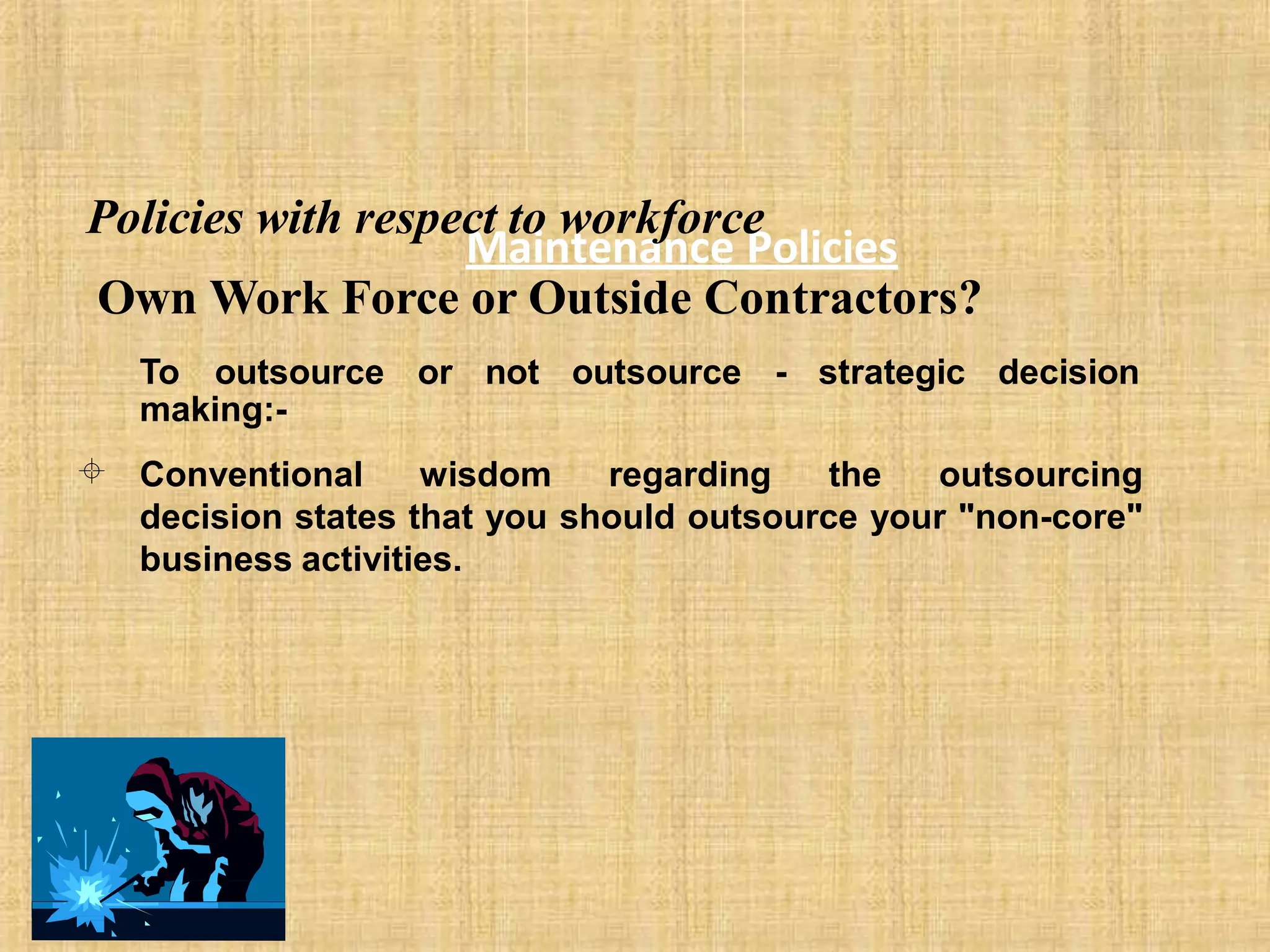
To outsource or not outsource - strategic decision
making:-
Conventional wisdom regarding the outsourcing
decision states that you should outsource your "non-core"
business activities.

Maintenance Policies
Policies with respect to workforce
Own Work Force or Outside Contractors?
Maintenance Policies
Policies with respect to workforce
Own Work Force or Outside Contractors?
In the last diagram, we consider the outsourcing decision
along two dimensions. The first, Strategic-Non Strategic,
considers how important the activity proposed for
outsourcing is to the organization in achieving long term
strategic competitive advantage in its chosen marketplace.
The second dimension, Competitive-Non Competitive,
relates to how competitively the function being considered
for outsourcing is currently being performed compared to the
external competitive marketplace.
Maintenance Policies
Policies with respect to workforce
Own Work Force or Outside Contractors?
Putting the two elements together gives four possible outcomes.
2.Those functions that are of Strategic importance to the firm,
and which are currently being performed competitively require
no further action - the status quo should be retained.
3.Those functions that are of Strategic importance to the firm,
but which are not currently being performed competitively with
the external marketplace should not (in the long run) be
outsourced. Instead, a better long-term option is to re- engineer
them to ensure that they are performed at a competitive cost.
Maintenance Policies
Policies with respect to workforce
Own Work Force or Outside Contractors?
1. Those functions that are not of Strategic
importance to the firm, and which are not currently being
performed competitively with the external marketplace
should be outsourced. There is little value in investing in
improving this function.
Material Collected By: A.H
Maintenance Policies
Policies with respect to workforce
Own Work Force or Outside Contractors?
1. The final combination, those functions that are not of
Strategic importance to the firm, but which are being performed
competitively with the external marketplace is more interesting. A
number of options exist :


selling the function as a going concern,
extending the function to provide services to external
customers,
outsourcing the function, or
raise the profile of the function to turn it into a source of


strategic competitive advantage.
Maintenance Policies
Policies with respect to workforce
Own Work Force or Outside Contractors?
Does a competitive outsourcing market exist?
 A second consideration for outsourcing, is to decide
whether a competitive market for the outsourced
services actually exists.
By adopting an appropriate outsourcing strategy (such
as letting work to two or more contractors, rather than
to one exclusively), awareness of this possible
outcome prior to establishing the outsourcing strategy
is vital if the outsourcing organization is not to find
itself "locked in" to a sole provider.

Maintenance Policies
Policies with respect to workforce
Own Work Force or Outside Contractors?
How much maintenance to outsource?
An important consideration in making the maintenance outsourcing decision
is what aspects of maintenance to outsource. If we consider the maintenance
management process as consisting of six major steps, as shown below, then a
number of options exist.
Material Collected By: A.H
Maintenance Policies
Policies with respect to workforce
Own Work Force or Outside Contractors?
How much maintenance to outsource?
In the first instance, organizations may choose simply to outsource the work
execution step, while retaining the remaining steps in-house. This is often done
on a limited basis, for example, when employing contractors to supplement an
in-house work force during times of high workload, during major shutdowns,
for example. This is the minimalist approach to outsourcing.
An alternative approach is to outsource all of the above activities with the
exception of the analysis and work identification steps. In this approach, the
contractor is permitted to plan and schedule his own work, and decide how and
when work is to be done, but the outsourcing organization retains
control over what is to be done.
Maintenance Policies
Policies with respect to workforce
Own Work Force or Outside Contractors?
How much maintenance to outsource?
A third approach is to outsource all of the above steps, thus
giving control over the development of equipment maintenance
strategies (ie Preventive and Predictive Maintenance programs) to
the contractor. In this instance, the contract must be structured
around the achievement of desired outcomes in terms of
equipment performance, with the contractor being given latitude
to achieve this to the best of his ability.
There are advantages and disadvantages to each approach, and
the most appropriate approach will depend on the client’s
particular situation.
.
Maintenance Policies
Policies with respect to workforce
Own Work Force or Outside Contractors?
How much maintenance to outsource?
Many organizations today are adopting Total Productive
Maintenance principles, which encourage Production operators
to take a higher level of responsibility for equipment
performance, and also encourage them to perform many minor
maintenance tasks. There is also a growing realization that the
manner in which equipment is operated can have a huge bearing
on maintenance costs and the maintenance activities required to
be performed if equipment performance targets are to be met.
Maintenance Policies
Policies with respect to workforce
Own Work Force or Outside Contractors?
How much maintenance to outsource?
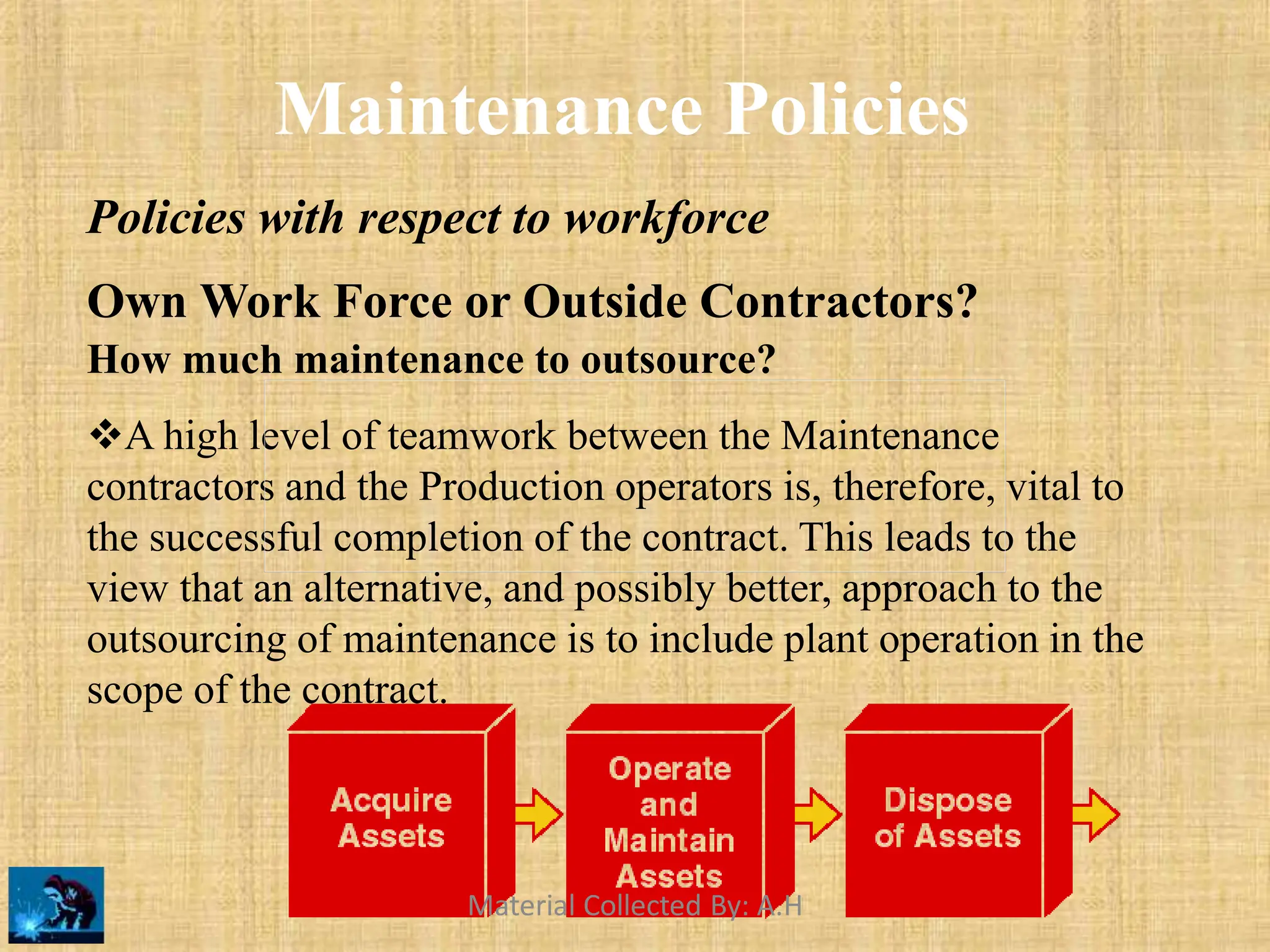
A high level of teamwork between the Maintenance
contractors and the Production operators is, therefore, vital to
the successful completion of the contract. This leads to the
view that an alternative, and possibly better, approach to the
outsourcing of maintenance is to include plant operation in the
scope of the contract.
Material Collected By: A.H
Maintenance Policies
Policies with respect to workforce
Own Work Force or Outside Contractors?
How much maintenance to outsource?
Finally, taking things one step further again, there is also a growing
realization that maintenance is limited in achieving higher equipment
performance by the fundamental design of the equipment being maintained.
There is, therefore, a school of thought that says that the best way to
overcome this limitation, in an outsourcing environment, is to also give the
contractor responsibility for the design of the equipment. This can be done
either by giving him responsibility for ongoing equipment modifications, or
by giving him responsibility for the initial design of the equipment, as in a
BOOM (Build, Own, Operate and Maintain) contract, which is gaining favour
in many infrastructure projects.
Maintenance Policies
Policies with respect to workforce
Own Work Force or Outside Contractors?
Establishing an appropriate tendering process
The tendering process for a major outsourcing contract is likely to be
different to the contracting process for major capital works in a few key
aspects.
Of particular importance will be the explicit consideration of risk at various
key points in the contracting process, and the identification of appropriate
strategies for managing those risks. These could take the form of either
shaping or hedging actions. Shaping actions are those action undertaken to
minimize the likelihood of the risk factor occurring. Hedging actions are
those actions undertaken to minimize the impact of the risk factor, should it
occur.
Maintenance Policies
Policies with respect to workforce
Own Work Force or Outside Contractors?
Establishing an appropriate tendering process
In addition, the evaluation criteria for the selection of an appropriate
maintenance contractor are likely to be quite different from those for a major
capital project. It is likely that significant work will be required to develop
appropriate criteria, and to ensure that sufficient information is obtained from
tenderers to be able to make an informed decision.
Maintenance Policies
Policies with respect to workforce
Own Work Force or Outside Contractors?
Establishing an appropriate specification of requirements:
The specification of requirement during the tendering process will need to
be carefully considered.
Ensure that the requirements specification is outcome-based, rather than
input-based. In other words, the specification will need to detail what is to
be achieved from the contract, not how it is to be achieved, or what inputs will
be required for its achievement.
Ensuring that all the required outcomes are specified is a major undertaking.
Agreeing how the achievement of all of these outcomes will be measured is
also, potentially, a huge undertaking. Deciding how to measure that was a
difficult process.
Material Collected By: A.H
Maintenance Policies
Policies with respect to workforce
Own Work Force or Outside Contractors?
Establishing an appropriate contract payment
structure
There are a number of alternative contract payment
structures. These include but not limited to:




Fixed or Firm price
Variable Price
Price ceiling incentive
Cost plus incentive fee
 Each of these price structures represents a different level of
risk sharing between the contractor and the outsourcing
organization.
Material Collected By: A.H
Maintenance Policies
Policies with respect to workforce
Own Work Force or Outside Contractors?
Establishing an appropriate contract payment structure
A number of considerations will need to be made in
determining the most appropriate payment structure. These
include:
 The extent to which objective assessment of contract performance is
possible
The ease with which realistic targets can be set for contractor
performance
The administrative effort involved with each payment option
The degree of certainty with which the desired contract outcomes can



be specified.
Material Collected By: A.H
Maintenance Policies
Policies with respect to workforce
Own Work Force or Outside Contractors?
Establishing an appropriate contract payment structure
Transition arrangement may be put in place to gradually transfer
the payment structure from one method to another over time, as a
greater degree of certainty over the requirements of the contract,
and more accurate knowledge of target levels of performance is
established.
Material Collected By: A.H
Maintenance Policies
Policies with respect to workforce
Own Work Force or Outside Contractors?
Establishing an appropriate contract administration process
and structure
Before the contract is let, the client will need to have decided
on the appropriate contract administration process, and the roles
and responsibilities of his own staff in managing the contract.
He will also need to establish the structures, processes and
equip his people with the skills to perform the required duties.
We have seen many potentially successful outsourcing
contracts fail, simply because the client did not manage those
contracts effectively.
Maintenance Policies
Policies with respect to workforce
Own Work Force or Outside Contractors?
Establishing an appropriate structure for the contract
document
Most standard contracts in place at most organizations, are
not appropriate for large outsourcing contracts. Many Standard
Terms and Conditions are inappropriate for large, long-term
service-related contracts .
It is best to combine Special Conditions of Contract with
revised Standard Conditions of Contract to develop a new
contract structure that is appropriate for the particular contract
being let. Material Collected By: A.H
Maintenance Policies
Policies with respect to workforce
Own Work Force or Outside Contractors?
Managing the transition to the outsourced arrangement
 There are many issues to be addressed by the outsourcing organization in the
transition to the new arrangements. Among these are matters such as:
Staff - which will be retained by the organization, which will be employed by
the contractor, which will be let go?
 Drawings - who has responsibility for ensuring that drawings are kept up to
date, who will be the custodian of site drawings?
Computer systems - will the contractor have access to the client’s
Computerized Maintenance Management system? Will they maintain their
own computerized Maintenance records? Who is responsible for ensuring
that all data in the Computerized Maintenance Management systems are

accurate?
Material Collected By: A.H
Maintenance Policies
Policies with respect to workforce
Own Work Force or Outside Contractors?
Managing the transition to the outsourced arrangement
There are many issues to be addressed by the outsourcing organization in
the transition to the new arrangements. Among these are matters such as:
 Materials Management - will the contractor provide his own
materials, or will the client provide these?
Workshop facilities and tools - who owns and maintains these?

Material Collected By: A.H
Maintenance Policies
Policies with respect to workforce
Own Work Force or Outside Contractors?
Contract termination arrangements
Another critical issue that needs to be addressed before the
contract is let, is how the situation will be managed if the
decision is made to terminate the existing contract.
In particular, agreement needs to be reached regarding the
duties and obligations of the outgoing contractor in handing
over to the incoming contractor (or the client organization,
should they decide to bring maintenance back in-house).
Material Collected By: A.H
Maintenance Policies
Policies with respect to workforce
Own Work Force or Outside Contractors?
Conclusion
While these are some of the major considerations for
organizations considering outsourcing maintenance, there are
many others.
Needless to say, the decision to outsource any major function,
such as maintenance, is not one that should be taken lightly, and
careful consideration of all major issues is vital, if the transition
to contracted maintenance is to be smooth and satisfactory to both
parties.
Maintenance Policies
Policies with respect to workforce
Shift Coverage
The two extremes in providing maintenance for continuous
operation are to provide full coverage during all hours that
the plant is in operation or to maintain day coverage only,
letting the plant shift for itself during other periods or to
accept minimum essential service on call-in, overtime basis.
The optimum arrangement is something in between,
depending a great deal upon circumstances in an individual
plant.
Maintenance Policies
Policies with respect to workforce
Shift Coverage
In considering the staffing of a maintenance department
to cover more than one-shift operation, many factors are
involved:


Efficiency of the Worker.
Location of the plant.
Maintenance Policies
Policies with respect to workforce
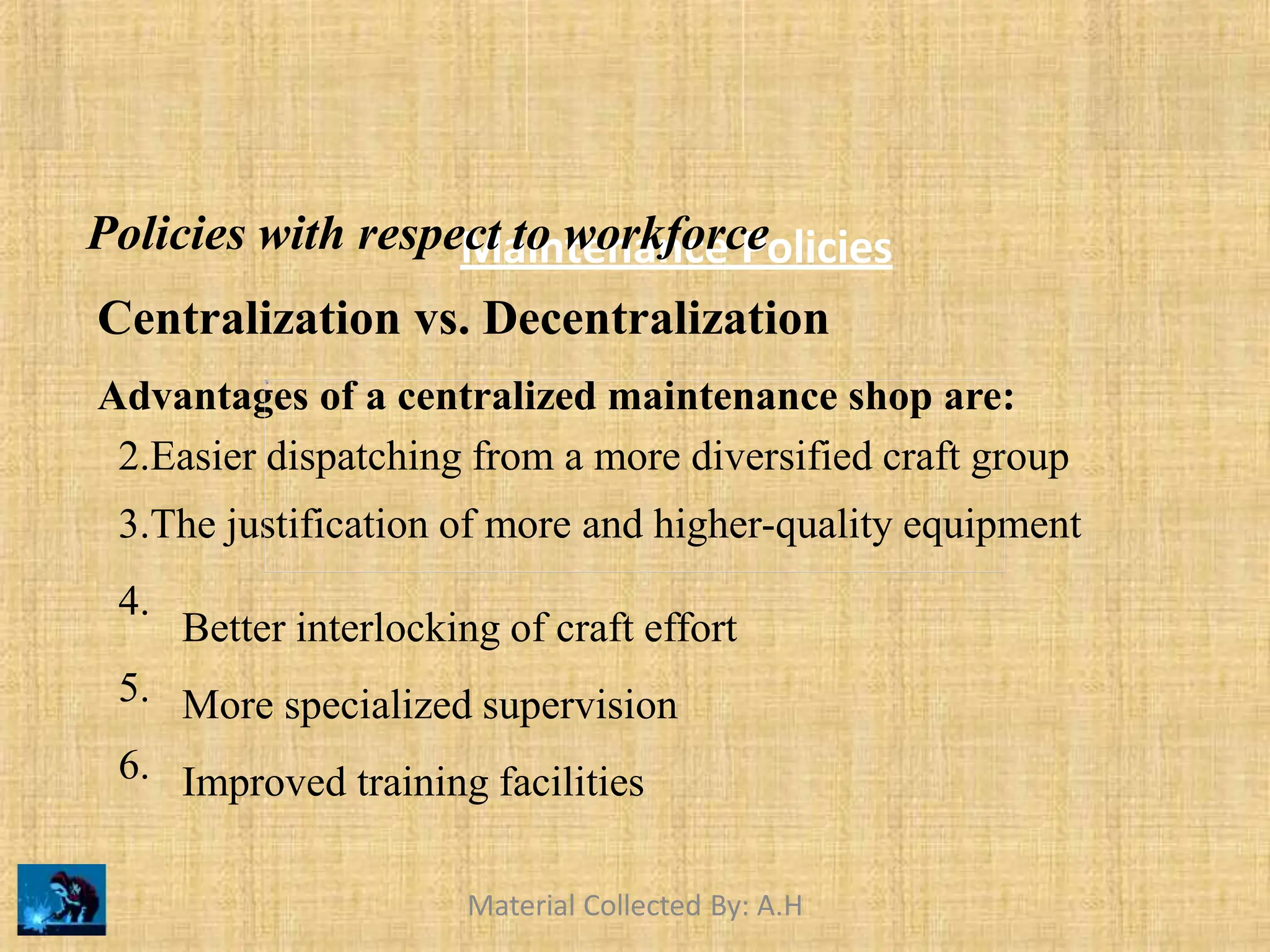
Centralization vs. Decentralization
Advantages of a centralized maintenance shop are:
2.Easier dispatching from a more diversified craft group
3.The justification of more and higher-quality equipment
4.
5.
6.
Better interlocking of craft effort
More specialized supervision
Improved training facilities
Material Collected By: A.H
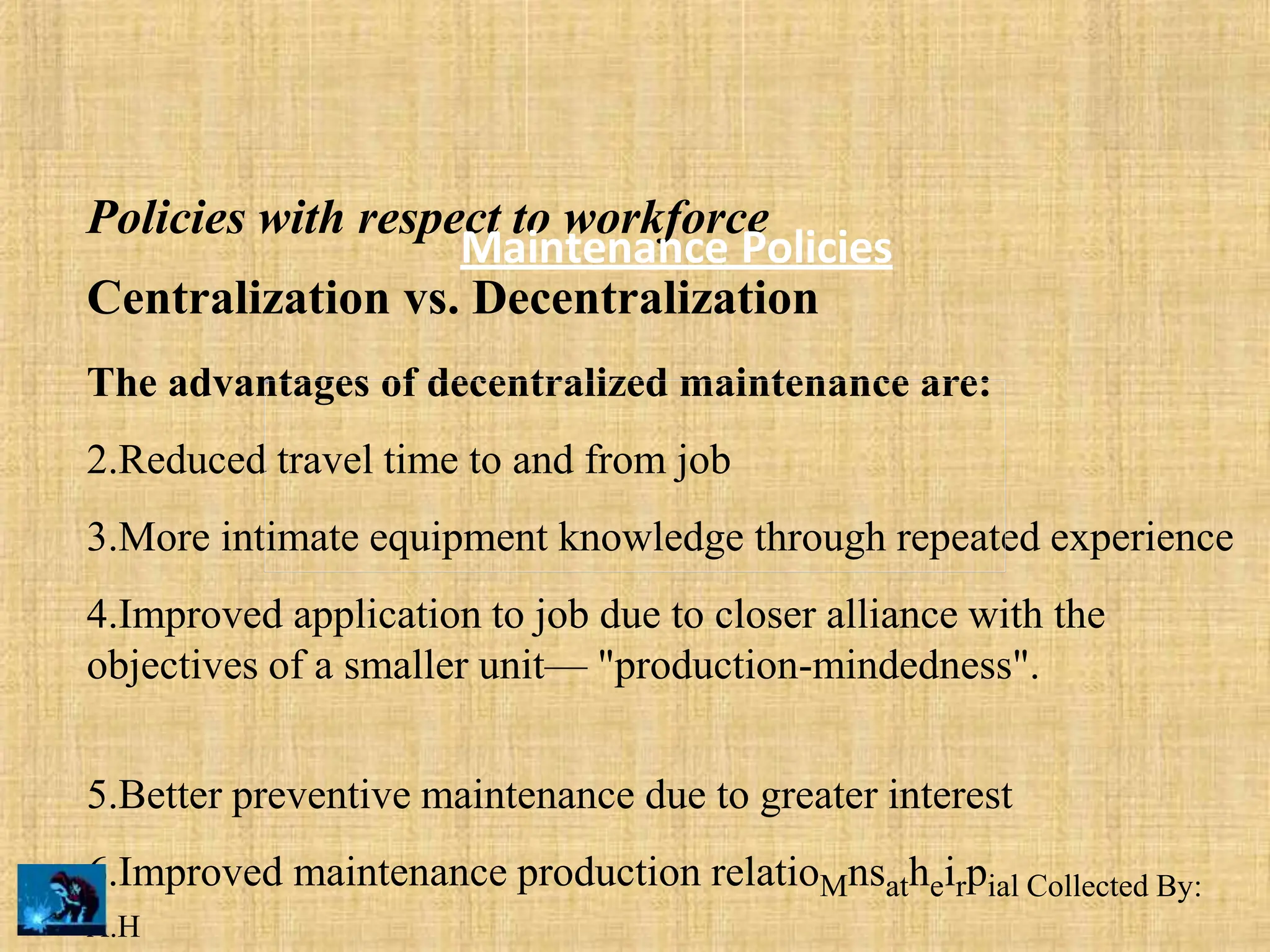
Policies with respect to workforce
Centralization vs. Decentralization
The advantages of decentralized maintenance are:
2.Reduced travel time to and from job
3.More intimate equipment knowledge through repeated experience
4.Improved application to job due to closer alliance with the
objectives of a smaller unit— "production-mindedness".
5.Better preventive maintenance due to greater interest
6.Improved maintenance production relatioMnsatheirpial Collected By:
A.H
Maintenance Policies
Policies with respect to workforce
Centralization vs. Decentralization
 In practice, however, it has been found that neither one
alone is the panacea for difficulties in work distribution.
Often a compromise system in which both centralized
and decentralized maintenance coexist has proved most

effective.
Material Collected By: A.H
Modern maintenance management is not to repair
broken equipment rapidly. Modern maintenance
management is to keep the equipment running at
high capacity and produce quality products at
lowest cost possible.
Maintenance, then and now
Many years ago, the manufacturing and production work was
done with relatively simple technical equipment and the
involvement of more manpower.
Maintenance was of course simple and impact to certain extent
to the function of machines.
During the industrialization, production equipment has been
more developed. In connection with the high technical
development the impact of productivity and quality has moved
from man to machine.
The importance of maintenance has considerably increased.
There are many reasons why maintenance is becoming more and
more important. In developing countries , where many old machines
are operating, the spare part problem are arising. Some times it is
difficult to find spare parts for equipment and if it is possible to find
them, they are usually very expensive and must be paid on foreign
currency.
Due to long lead times of supply of spares, it is common that the
spare part inventory is growing bigger than necessary. A very essential
part in maintenance management is developing countries to reduce
the need of spare parts, as well as to maintain the minimum level of
shock to save foreign currency, but still keeping the productivity high.
Maintenance has to be taken into consideration in very early stage of work of
procuring new equipment to ensure a good and cheap operation.
High quality equipment will give high reliability and maintainability which
secure high productivity and equipment efficiency.
The lifetime of the equipment can be spilt up in six phases 4.Idea
5.Specification 6.Design
7.Procurement(Manufacturing) 8.Operation
9.Windup
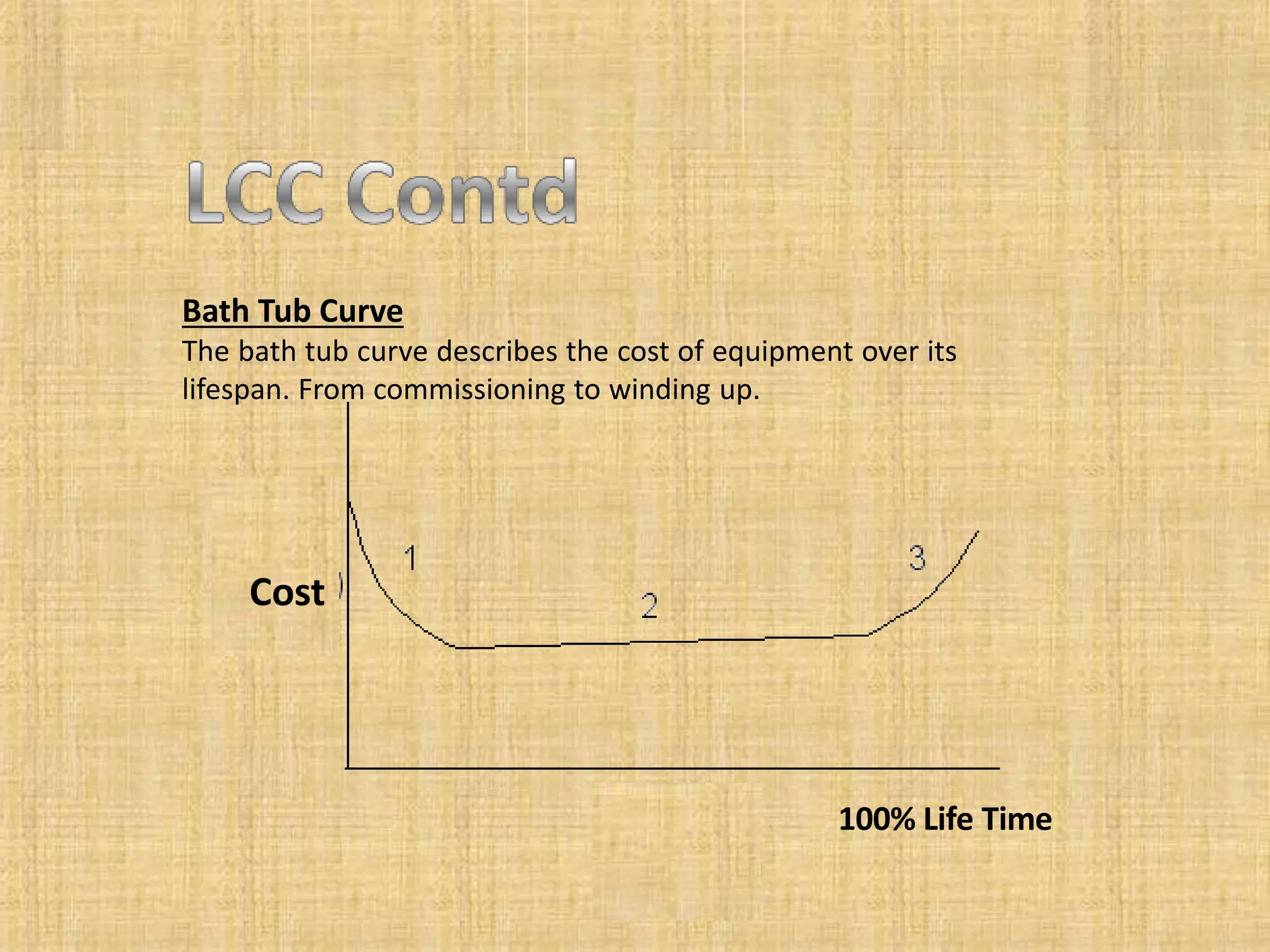
Bath Tub Curve
The bath tub curve describes the cost of equipment over its
lifespan. From commissioning to winding up.
Cost
100% Life Time
LCC – Life Cycle Cost – is commonly
understood to be the customer’s total cost
and other sacrifice during the actual life time
of the product. Hence LCC includes the
acquisition cost as well as all future costs for
operation and support of the product until it
is finally discard.
Comparison of alternative products.
 Improvements of products.
Adaptation of the maintenance and support organization.
Objectives of Maintenance
During the years the maintenance function has not been seen as a
condition for production output. The previous approach has been that
maintenance is the necessary evil, one among the cost generators in the
organization. Very often the maintenance strategy in plants has been to
reduce the
maintenance cost as much as possible without thinking of the
consequences.
Objective of the maintenance is , as priority one , to create an availability
performance which is suitable for production demands in the
organization. No mechanized/atomized company has yet succeeded to
produce with stopped equipment. Production buy availability
performance from maintenance.
1.
Keep up the planned availability performance
2.
At the lowest cost
Above all
Within the safety prescriptions
All enterprises and organizations are interested in
lowering maintenance costs. A very common delusion is
that
MAINTENANCE WICH IS NOT CARRIED OUT ,WILL COST
EVEN MORE THAN MONEY !!!!!!
There are two ways of managing the maintenance costs
Cost or
Result
Controlled
Maintenance
The cost controlled maintenance is not considered as modern maintenance
management, The reason why maintenance has been treated as a cost controlled
activity, Is often that engineers and technical staff have had some dilemma to
measure the results of investments in maintenance in total economical terms. It
is simple to find the direct cost for maintenance but it could be difficult to see the
results.
The upper priority in the objectives of maintenance is to “keep up planned
availability performance at the lowest cost possible” . This means that the long
term results are important. The maintenance cost must be put in relationship
with overall results achieved by maintenance in production facility.
PRODUCTIO
N LOSSES
LOST
MARKET
WORK
ENVIORMEN
T
CAPACITY
LOSSES
ENERGY
LOSSES
QUALITY
LOSSES
CAPITAL
COSTS
INCREASED
INVESTMENT
MAINTENANCE
The maintenance cost can be split up in two different categories.
 Direct maintenance costs -
Indirect maintenance costs -
The costs are directly related to
the performance of the
maintenance works
Losses due to maintenance
Direct maintenance costs
•Wages & Salaries
• Material Costs
• Administration Costs
• Costs for training
• Spare parts costs
• Contracted work forces
• Modification Costs
Indirect Costs
•Loss of revenue or other losses as a result of interruption
to production as a result of maintenance.
Many times there are needs to measure the maintenance efficiency. However,
maintenance can not be measured by the cost it creates. There must be an
connection to the production out put some way. It is naturally impossible to
determine anything about the size of the direct costs. One method to control the
direct maintenance is to use the PM-factor.”P” stands for prime product produce
and “M” stands for maintenance cost. When using the PM-factor, the result of the
maintenance impact on the production is measured. How many products are
produced per a 1000 units of “maintenance money”.
Prime Production
PM – Factor = X
Maintenance Cost
1000
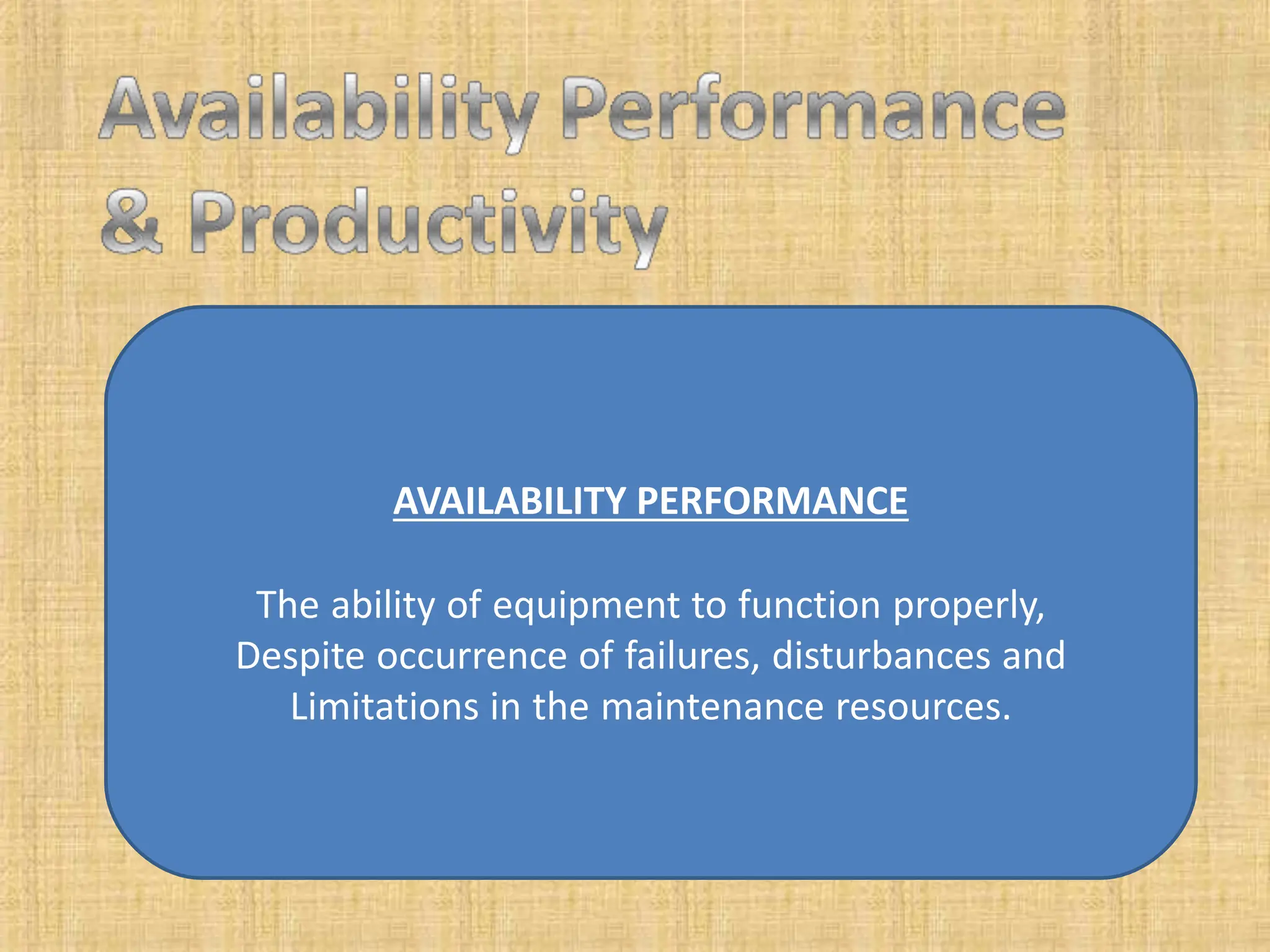
AVAILABILITY PERFORMANCE
The ability of equipment to function properly,
Despite occurrence of failures, disturbances and
Limitations in the maintenance resources.
Availability performance can be divided in to tree parts:
Reliability Performance
Maintenance Support Performance
Maintainability Performance
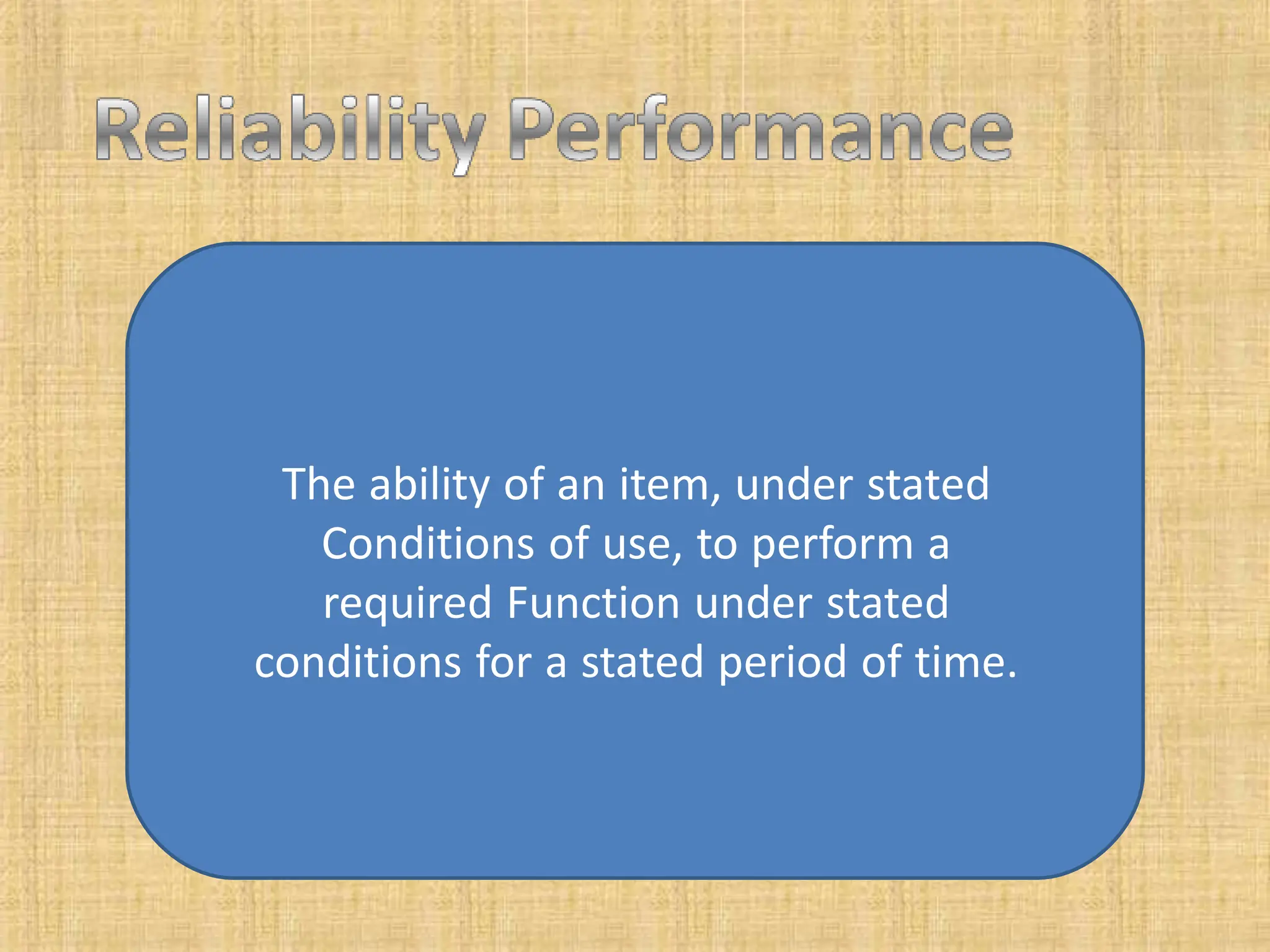
The ability of an item, under stated
Conditions of use, to perform a
required Function under stated
conditions for a stated period of time.
The ability of a maintenance
organization, Under stated condition, to
provide upon Demand the resources
required to Maintain an equipment.
The ability of an equipment, under started
conditions of use, To be retained or
restored to state in which it can perform a
required function, when maintenance is
performed under stated conditions and
using stated procedure and resources.
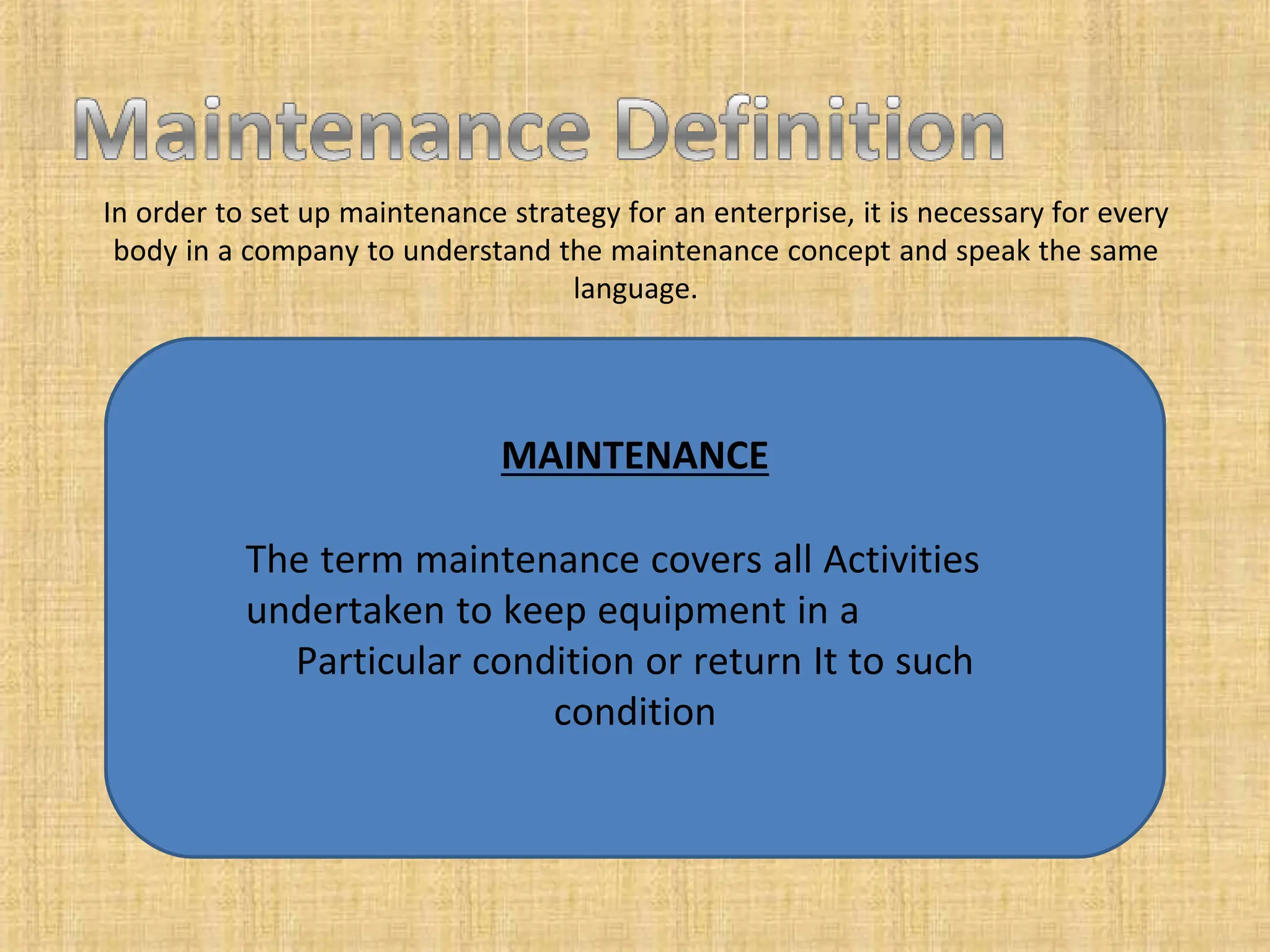
In order to set up maintenance strategy for an enterprise, it is necessary for every
body in a company to understand the maintenance concept and speak the same
language.
MAINTENANCE
The term maintenance covers all Activities
undertaken to keep equipment in a
Particular condition or return It to such
condition
The term maintenance consists of three
main parts
 Corrective maintenance
Preventive maintenance
Improvement maintenance
CORRECTIVE MAINTENANCE (CM)
Corrective maintenance covers all Maintenance which is
carried out in Order to correct (repair) a fault in
equipment
WHAT IS FALIURE ?
Digress of demands of a
certain quality
Planned & unplanned corrective maintenance
Corrective maintenance is divided in
Break Down
Emergency Repairs
Urgent
Not possible to Control
You are controlled by
the equipment
Planned
Maintenance
Prepared Properly
Possible to Control
You control the
Equipment
PREVENTIVE MAINTERANCE (PM)
Preventive maintenance covers all
Programmed maintenance which is carried
out in order to prevent the Occurrence of
failures before they Develop to a
breakdown or Interruption in production.
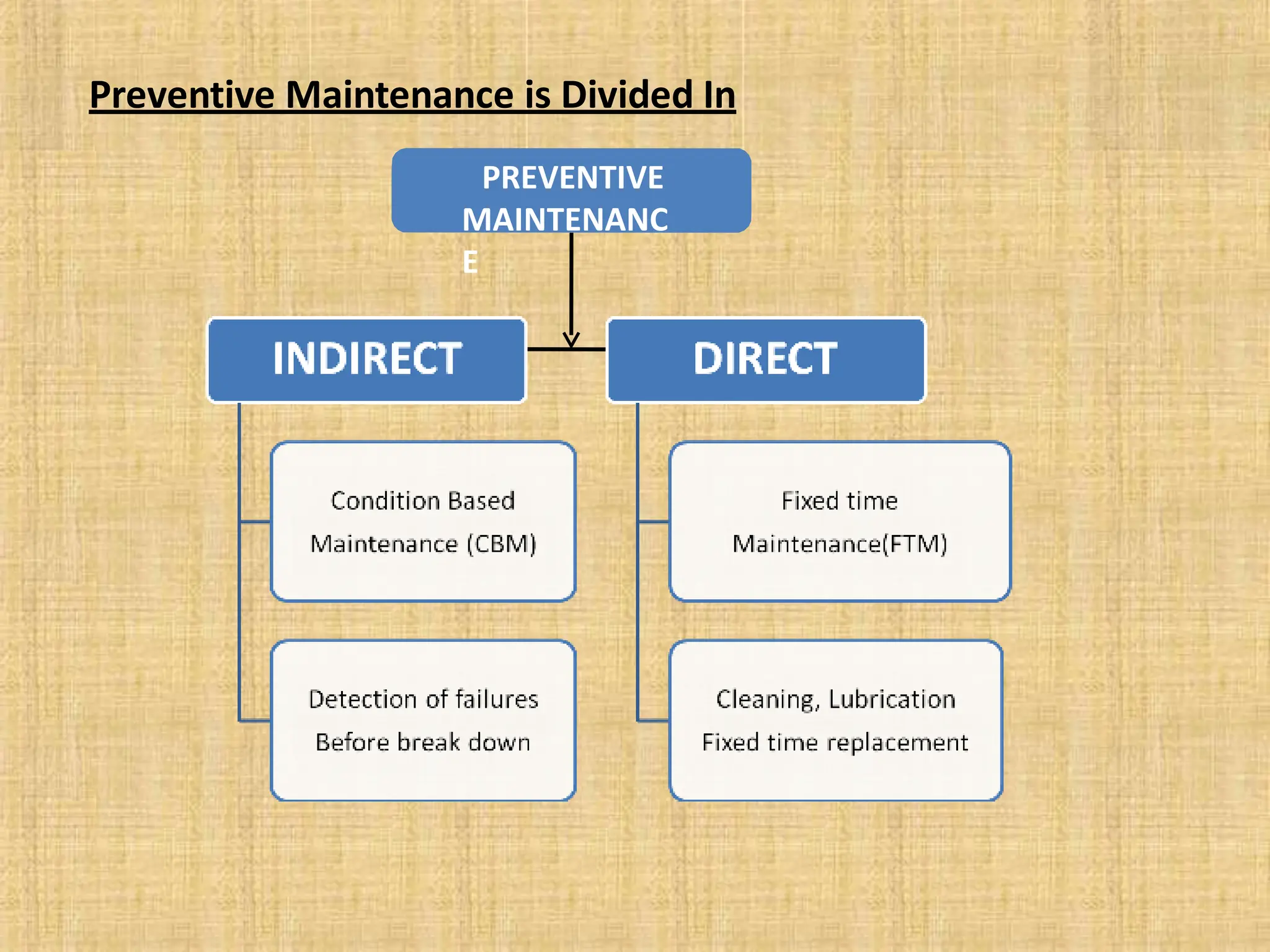
Preventive Maintenance is Divided In
PREVENTIVE
MAINTENANC
E
Indirect Maintenance
INDIRECT PM
IMPROVEMENT MAINTENANCE (IM)
Improvement maintenance is used
When to modify the equipment so the
Condition improves. Improvement
Maintenance includes activities which
are carried out once. The objectives of
improvement maintenance are to
Design out the failure i.e. the failure
Will never occur again or extend the
life time of parts.
One of the objectives of the maintenance job is to get them planned
This gives increased availability performance and lower direct maintenance
costs and a lot of other advantages. The load on the maintenance
department will for instance be lower and the quality of the jobs higher.
•Use of condition monitoring
Through condition monitoring the failure development and it is therefore
possible to plane the forthcoming jobs before a break down occurs. By
condition monitoring the unplanned jobs are transferred to planned
job.
•Planned maintenance resulting in lower costs for maintenance and
lesser down time.
Preventive Maintenance
-Reduce number of break downs & urgent repairs
-More planning and control of correctivemaintenance
Result
-Increased availability performance & efficiency
-Decreased cost of maintenance
Results in the correct maintenance work is carried out
 At the right time
 In the right way
 By the right professional
 With the right spare parts
“Real maintenance management is impossible
without condition based preventive
maintenance”
When a maintenance strategy is going to be formulated, there
are many maintenance procedures that could be chosen, From
sophisticated procedures to low level procedures.
Operate to break down (unplanned corrective
maintenance), O.T.B.D
Fixed-time maintenance, F.T.M
Condition-based maintenance, C.B.M
Design out maintenance, D.O.M
Life-time extension, L.T.E
Redundancy, RED
INDIVIDUAL LIFE TIME
Machines, spare parts, all types of equipment, have
their own individual lifetime. The individual life time is
different from part to part and is influenced by the
quality of the product but also by other outside factors
such as environment, handling etc.
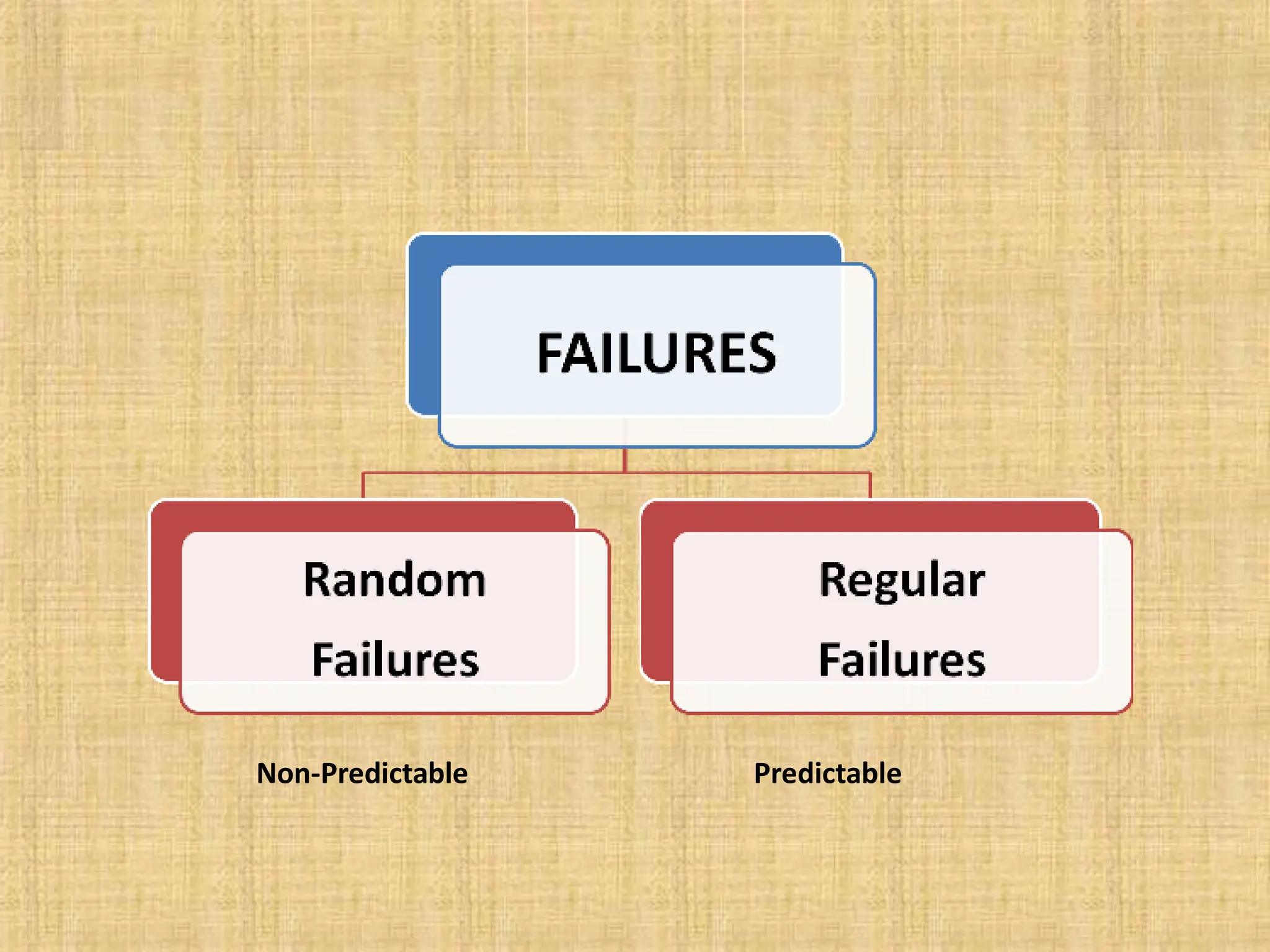
Some failures are occurring after a certain, expected
time, and can almost be predicted. Some failures are
occurring completely unexpected.
Non-Predictable Predictable
Failure Developing time(FDT)
Some failures either they are random or regular, have longer or
shorter failure development time. The failure development time is
the deterioration time from the moment condition departs from
the normal condition until the moment of break down occurs.
Failures with failure development time is easier to handle than
the failures without failure development time.
Shorter FDT – Continuous on line condition monitoring has to be
applied
Longer FDT – Off-line condition monitoring has to be applied
Total Productivity Maintenance (TPM)
TPM is a way of organizing maintenance to support
productivity & quality through increased equipment
efficiency and to reduce costs.
TPM concept means that all employees work in small
groups to maximize the improvement of equipment efficiency.
Operators are working independently with all maintenance
activities of their own equipment and have also the total
responsibility of operation and maintenance.
Fundamental Goals of TPM
Increased productivity and quality
Zero defects
Reduced cost of maintenance and production
Increased motivation among all employees
Zero accident
Shorter lead time
Zero unplanned stops
Development of staff through training
Improvement of work environment
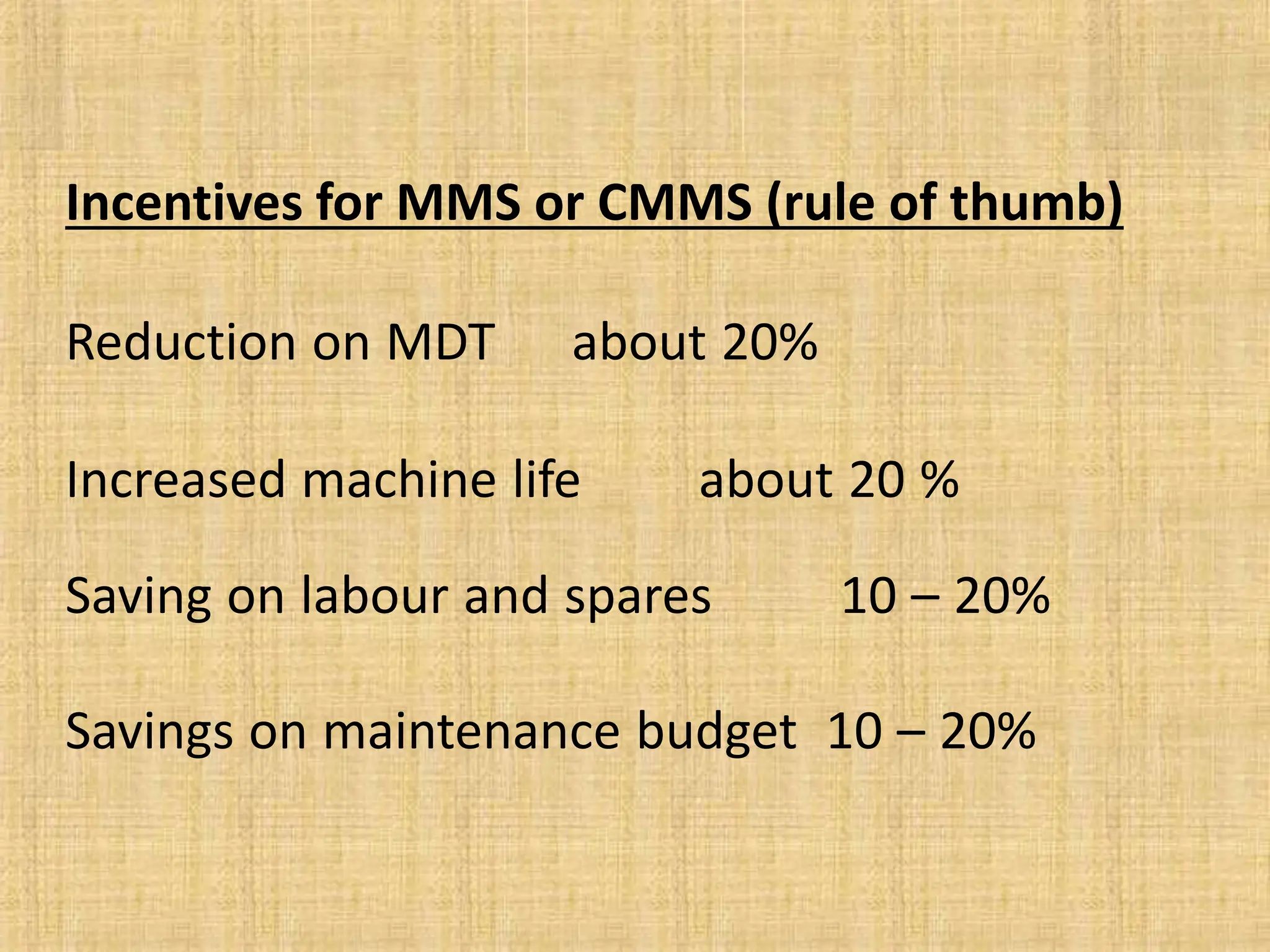
Incentives for MMS or CMMS (rule of thumb)
Reduction on MDT about 20%
Increased machine life about 20 %
Saving on labour and spares 10 – 20%
Savings on maintenance budget 10 – 20%
General of maintenance systems
The maintenance function must also have necessary aids to manage the maintenance
activities to coop up to the main target of the enterprise. Maintenance management
means a better control of the maintenance organization and the related area. To
properly control the maintenance of a facility, information is required to analyze what
is occurring.
To be able to manage the maintenance activities in the right way, a maintenance
management system is necessary. The system can be either manual or computerized.
The main purpose of a maintenance management system is in operation and works
properly.
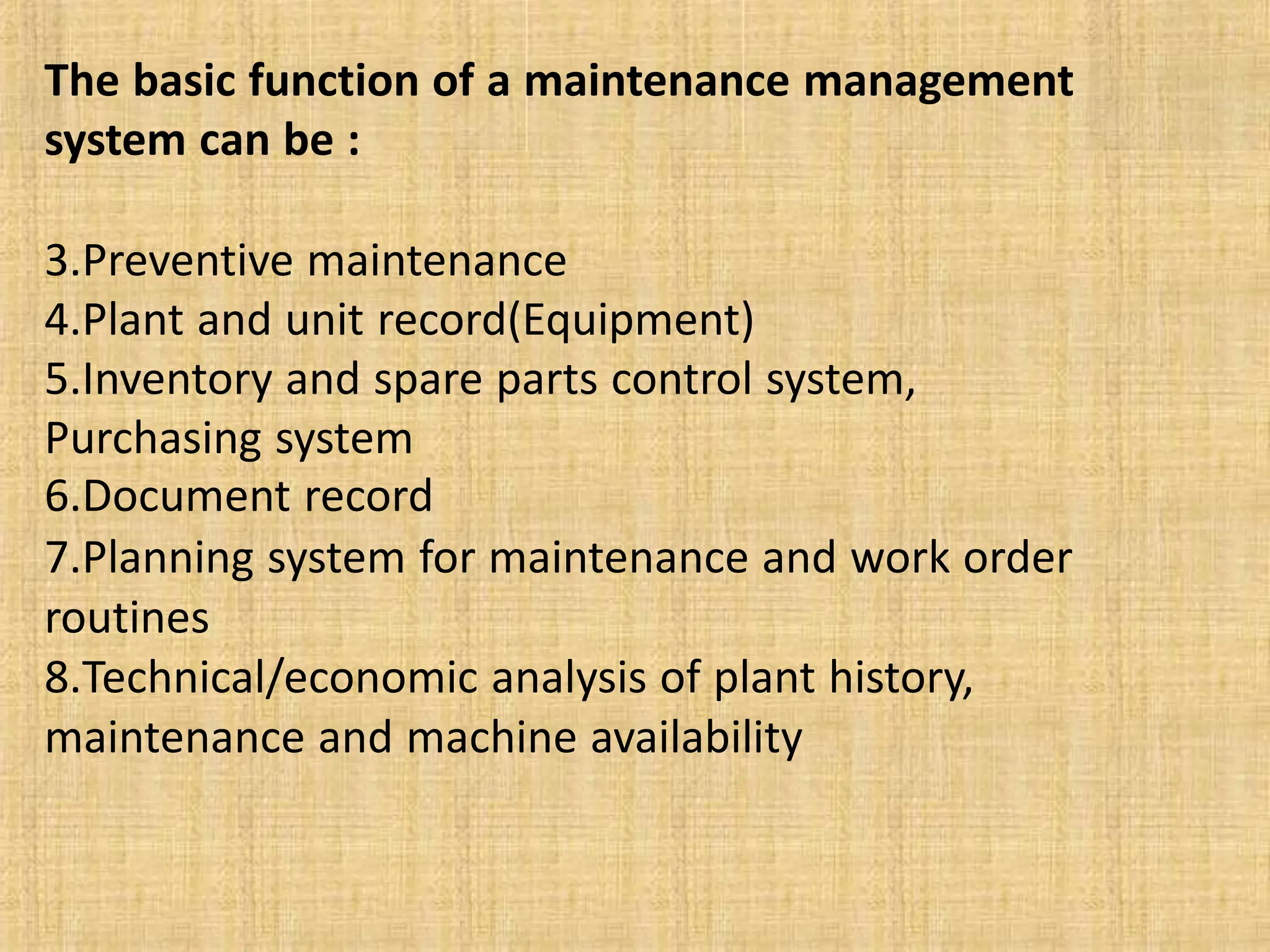
The basic function of a maintenance management
system can be :
3.Preventive maintenance
4.Plant and unit record(Equipment)
5.Inventory and spare parts control system,
Purchasing system
6.Document record
7.Planning system for maintenance and work order
routines
8.Technical/economic analysis of plant history,
maintenance and machine availability
Maintenance Management 1.2_Maintenance Philosophy.ppt

Maintenance Management 1.2_Maintenance Philosophy.ppt

  • 5.
    Introduction Introduction to LifeCycle Cost Objectives of Maintenance and Maintenance Cost Maintenance Definition How to get unplanned repair jobs planned Maintenance Procedures Failure Development Total Productivity Maintenance Maintenance Management Systems
  • 6.
  • 7.
    Introduction Industry today isin a fight to survive. Competition is found not only on a domestic level, but also on international levels. In an effort to survive, all forms of production analysis, product reviews, and material reviews are made and periodically checked. Statistical process control is only one of the new methods used to reduce operational costs. However, one area many industries are now turning their attention toward is the maintenance function.
  • 8.
    Introduction (Cont.) Cost reductionin maintenance does not necessarily mean a reduction in service or in the quality of service. It means a better control of the maintenance organization and the related areas. To properly control the maintenance of any facility, information is required to analyze what is occurring. Manually, this requires a tremendous amount of effort and time. In recognition of this, many of the progressive companies are developing and using computer programs geared toward control of the maintenance organization. These systems are often referred to as computerized maintenance management systems (CMMS).
  • 9.
    What is Maintenance? •Maintenance - any activity carried out on an asset in order to ensure that the asset continues to perform its intended functions, or to repair the equipment. Note that modifications are not maintenance, even though they may be carried out by maintenance personnel.
  • 10.
    What is Maintenance? “Maintenanceis war. Your enemies are the triumvirate of breakdown, deterioration, and all types of unplanned events. Your soldiers are the maintenance department and as many civilians as you can recruit. The civilians you protect are production workers, office workers, drivers, and all the other users of your organization’s assets”. - Joel Levitt
  • 11.
    What is Maintenance? •Keeping equipment available, reliable and cost optimized.
  • 12.
    Asset ? • Asset- unlike in the accounting definition, in maintenance this is commonly taken to be any item of physical plant or equipment • It is the basic unit of maintenance.
  • 13.
    Asset Management ? •Asset Management - the systematic planning and control of a physical resource throughout its life. This may include the specification, design, and construction of the asset, its operation, maintenance and modification while in use, and its disposal when no longer required.
  • 14.
    Maintenance Function ? •The maintenance department has a more involved list of functions or responsibilities. These can be grouped into five main areas:- 1. Maintenance of existing equipment. 2. Equipment inspection and services. 3. Equipment installation. 4. Maintenance storekeeping. 5. Craft administration.
  • 15.
    Maintenance Function ?  1.Maintenance of Existing Equipment Maintaining existing equipment is the basic reason for the department. The maintenance group will make repairs to the production equipment as quickly and economically as possible. They should be able to anticipate repairs, based on previous experi-ence with the equipment. To prevent rapid wear of the equip-ment, the group should utilize cost-effective preventive maintenance programs. To perform these tasks as efficiently and cost effectively as possible requires the utilization of a trained workforce and the use of modern tools and maintenance methods that are available. However, performing all of the above tasks depends on one im- portant item accurate record keeping. Without accurate re-cords, it will not be possible to complete the assigned tasks in a timely and cost-effective manner.    
  • 16.
    Maintenance Function ?  2.Equipment Inspections and Service This task will require the engineer or manufacturer to determine the proper lubricant for the equipment. In addition to the type of lubricant, the proper amount and time intervals of application of the lubricant are necessary. The inspections are required to ensure that the equipment is in safe operating condition and is being serviced in a timely manner. Some installations will require that the operational personnel do some routine lubrication and servicing. Even where this is a common practice, the maintenance department should oversee the completion of the tasks. 
  • 17.
    Maintenance Function ? This responsibility varies from industry to industry and depends on the size of the installation and the maintenance workforce. Some industrial facilities that require constant equipment changeover may have an installation department. When large installation projects occur in some industries without the necessary workforce, outside contractors are used to supply the needed manpower.   3. Equipment Installation
  • 18.
    Maintenance Function ?  4.Maintenance Storekeeping This responsibility of the maintenance group involves the receiving and distribution of the spares necessary for the repair and upkeep of the plant equipment. There are several important tasks involved in this responsibility. The first is recording the necessary spares for each piece of equipment. With all of the spares recorded, the maintenance group has the responsibility of setting the inventory level for each part. As the spares are used, the replacements will have to be ordered. The ordering process is important to prevent material outages in the stores. Material outages could result in production delays, if equipment breakdowns occur and no replacement parts are available. Keeping the stores inventory level as low as possible will prevent tying up capital investments in spares.  
  • 19.
    Maintenance Function ?  5.Craft Administration This is the responsibility of controlling the manpower used by the maintenance department. The most cost-effective way of determining the size of the workforce is the work in the maintenance backlog. By looking in the backlog, the number of employees for each craft area can easily be determined. As programs are  changed and equipment is added or deleted from a department, the workforce can be adjusted as necessary. The responsibility for providing the necessary tools and supplies for the crafts is also included in this area. 
  • 20.
    Maintenance Objectives 1. Tokeep the maintenance cost per production item produced as low as possible. 2. To keep the quality of the product very high. 3. To keep the downtime for critical equipment as low as possible. 4. To keep maintenance cost as low as possible for non-critical equipment. 5. To provide and maintain adequate facilities. 6. To provide effective and trained supervision.
  • 21.
    What is Management? •Art of doing what is possible out of what is available • Sharing in overheads that leads to unity of goal • Coordination of different tones in a harmony • Guaranty of never being caught in a surprise condition
  • 22.
    Maintenance Management • MaintenanceManagement is defined as the organization of maintenance within an agreed policy. • Maintenance Policy is a statement of principle used to achieve maintenance objectives and guide Maintenance Management decision making.
  • 23.
    Maintenance Philosophy (Policy) •Maintenance organization i.e., centralized versus decentralized maintenance. In-house versus outside contracting maintenance. Preventive versus predictive maintenance. Repair versus replacement. • • • In general the following items represent the main aspects of maintenance philosophy or policy:
  • 24.
  • 25.
    Maintenance Policies This chaptercovers basic policies for the operation of a maintenance-engineering department. While many of these policies overlap and are interdependent, they may be grouped in four general categories: Policies with respect to work allocation Policies with respect to workforce Policies with respect to interplant relations Policies with respect to control
  • 26.
    Maintenance Policies Policies withrespect to work allocation ?To Schedule or Not to Schedule It is generally accepted that, in any maintenance department where there are more than 10 men and more than two or three crafts, some planning, other than day-to-day allocation of work by foremen, can result in improved efficiency. As the size of the maintenance organization increases, the extent to which amount of time work planning can be formalized and the that should be spent on this activity are increased. There should be only as much planning as necessary for maximum overall efficiency so long as the system costs less than the cost of operating without it.
  • 27.
    Maintenance Policies Policies withrespect to work allocation How Much Scheduling ? There are practical limitations to any scheduling system. A very detailed schedule that becomes obsolete after the first hour or two of use because of emergencies is of little value. If, however, actual performance indicates from 60 to 80 percent adherence during normal operation, the value of the schedule is real. Justification of any scheduling system requires proof of its effectiveness in cost saved. Where some form of incentive system or work measurement exists, such proof is readily available. But in most maintenance departments no such definitive method is available and the only criteria of measurement are overall trends in maintenance costs and quality of service.
  • 28.
    Maintenance Policies Policies withrespect to work allocation How Much Scheduling ? Some aspects to be considered in arriving at a sound work- scheduling procedure are: Work Unit. Most detailed schedules are laid out in terms of man-hours or, if standard times are used, fractions of hours. Other scheduling systems use a half man-day as a minimum work unit. Others may use a man-day or even a man-week as a basis.
  • 29.
    Maintenance Policies Policies withrespect to work allocation How Much Scheduling ? Some aspects to be considered in arriving at a sound work- scheduling procedure are: Size of Jobs Scheduled. Some work-scheduling systems handle small jobs as well as large ones. Others schedule only major work where the number of men and the length of time involved are appreciable.
  • 30.
    Maintenance Policies Policies withrespect to work allocation How Much Scheduling ? Some aspects to be considered in arriving at a sound work- scheduling procedure are: Percent of Total Work Load Scheduled. Although in some cases all work may be scheduled, the most effective systems recognize the inability of any maintenance-engineering department to anticipate all jobs, especially those of an emergency nature, and do not attempt scheduling for the entire work force. A portion of the available work force is left free for quick assignment to emergency jobs or other priority work not anticipated at the time of scheduling.
  • 31.
    Maintenance Policies Policies withrespect to work allocation How Much Scheduling ? Some aspects to be considered in arriving at a sound work- scheduling procedure are: Lead Time for Scheduling. Some scheduling systems do not attempt to cover breakdown repairs and are limited to the routine preventive maintenance and to major work that can be anticipated and scheduled well in advance. In these cases a monthly or biweekly allocation of manpower suffices. In most instances, however, a weekly schedule with 2 or 3 day lead-time results in good performance, yet is sufficiently flexible to handle most unexpected work.
  • 32.
    Maintenance Policies Policies withrespect to work allocation Selection and Implementation of a Scheduling System Flow-of-Work Requests. Before any formalized scheduling program can be initiated, the method of requesting work from the maintenance department should be formalized. This request may take the form of a work description or job ticket, listing manpower or equipment requirement, or it can be in the form of a work sheet on which the same type of information is accumulated by either verbal or written communication. It must be routed to one central point if a scheduling system is to be used. In a small plant this can be the shop foreman, the maintenance superintendent, or the plant engineer. In a larger maintenance department it should be through a staff individual or group.
  • 33.
    Maintenance Policies Policies withrespect to work allocation Selection and Implementation of a Scheduling System Determination of Priority In any maintenance organization, which is efficiently manned, the work load in terms of quantity or timing, exceeds the availability of men and/or equipment. For this reason the problem of defining the order in which the work is to be carried out. or establishing priority, exists and is an important factor in scheduling.
  • 34.
    production. However, as theplant grows and the maintenance department is called upon to provide service to more than one production department, the problem of equitable and efficient priority assignment becomes more involved. One of the most serious problems in maintaining good relations between maintenance and production departments is in this sphereM. Maintenance Policies Policies with respect to work allocation Selection and Implementation of a Scheduling System Determination of Priority (Cont.) In a small plant with one operating department and a small maintenance organization, establishment of priorities may and amount to casual discussion between maintenance
  • 35.
    Maintenance Policies Policies withrespect to work allocation Preventive vs. Breakdown Maintenance Preventive maintenance has long been recognized as extremely important in the reduction of maintenance costs and improvement of equipment reliability. In practice it takes many forms. Two major factors that should control the extent of a of the program preventive program are first, the cost compared with the carefully measured reduction in total repair costs and improved equipment performance; second, the percent utilization of the equipment
  • 36.
    Maintenance Policies Policies withrespect to work allocation Preventive vs. Breakdown Maintenance (Cont.) If the cost of preparation for a preventive-maintenance inspection is essentially the same as the cost of repair after a failure accompanied by preventive inspections, the justification is small. If, on the other hand, breakdown could result in severe damage to the equipment and a far more costly, repair, the scheduled inspection time should be considered.
  • 37.
    Maintenance Policies Material CollectedBy: A.H Policies with respect to work allocation Preventive vs. Breakdown Maintenance (Cont.) plant preventive maintenance should be tailored to fit the function of different items of equipment rather than applied in the same manner to all equipment. Indeed, a program of unit replacements can result in considerably lower maintenance costs where complete preventive maintenance is impractical. In a plant using many pumps, for instance, a program of standardization, coupled with an inventory of complete units of pumps most widely used, may provide a satisfactory program for this equipment.
  • 38.
    Maintenance Policies Policies withrespect to work allocation Preventive vs. Breakdown Maintenance (Cont.) One of the most effective methods of tempering ideal preventive maintenance with practical considerations of a continuous operation is that of taking advantage of a breakdown in some component of the line to perform vital inspections and replacements which can be accomplished in about the same time as the primary repair. Production supervision usually can be sold the need for a few more hours' time for additional work with repair of a breakdown much more easily than they can be convinced of its necessity when things are apparently running smoothly.
  • 39.
    Maintenance Policies Policies withrespect to work allocation Preventive Engineering One of the most important tools in minimizing downtime, whether or not a conventional preventive- maintenance program is possible, is called "preventive engineering." Too often maintenance engineers are so busy handling emergency repairs or in other day-to-day activities that they find no opportunity to analyze the causes for breakdowns, which keep them so fully occupied.
  • 40.
    Maintenance Policies Policies withrespect to work allocation Preventive Engineering While most engineers keep their eyes open to details such as better packings, longer-wearing bearings, and improved lubrication systems, true preventive engineering goes further than this and consists of actually setting aside a specific amount of technical manpower to analyze incidents of breakdown and determine where the real effort is needed; then through redesign, substitution, changes, and specifications, or other similar means, reducing the frequency of failure and the cost of repair. Effective preventive engineering can result only when it is recognized as an independent activity of a research nature that cannot be effectively sandwiched into the schedule of a man who is occupied with putting out fires.
  • 41.
    Maintenance Policies Policies withrespect to workforce Own Work Force or Outside Contractors?  The primary factor in deciding whether to use an outside contractor is cost. Is it cheaper to staff internally for the performance of 2.The type of work involved, 3.The amount of work involved, and 4.The expediency with which this work must be accomplished?  In studying these relative costs it is not sufficient to consider the maintenance cost alone. The cost to the company, including downtime and quality of performance, must also be considered.
  • 42.
    Material Collected By:A.H Maintenance Policies Policies with respect to workforce Own Work Force or Outside Contractors?     Establishing an appropriate contract administration process and structure Establishing an appropriate structure for the contract document Managing the transition to the outsourced arrangement Contract termination arrangements There are a number of issues facing organizations maintenance outsourcing as an improvement initiative : that are considering    To outsource or not outsource - strategic decision making Does a competitive outsourcing market exist? How much maintenance to outsource    Establishing an appropriate tendering process Establishing an appropriate specification of requirements Establishing an appropriate contract payment structure
  • 43.
    Maintenance Policies Policies withrespect to workforce Own Work Force or Outside Contractors? To outsource or not outsource - strategic decision making:- Conventional wisdom regarding the outsourcing decision states that you should outsource your "non-core" business activities. 
  • 44.
    Maintenance Policies Policies withrespect to workforce Own Work Force or Outside Contractors?
  • 45.
    Maintenance Policies Policies withrespect to workforce Own Work Force or Outside Contractors? In the last diagram, we consider the outsourcing decision along two dimensions. The first, Strategic-Non Strategic, considers how important the activity proposed for outsourcing is to the organization in achieving long term strategic competitive advantage in its chosen marketplace. The second dimension, Competitive-Non Competitive, relates to how competitively the function being considered for outsourcing is currently being performed compared to the external competitive marketplace.
  • 46.
    Maintenance Policies Policies withrespect to workforce Own Work Force or Outside Contractors? Putting the two elements together gives four possible outcomes. 2.Those functions that are of Strategic importance to the firm, and which are currently being performed competitively require no further action - the status quo should be retained. 3.Those functions that are of Strategic importance to the firm, but which are not currently being performed competitively with the external marketplace should not (in the long run) be outsourced. Instead, a better long-term option is to re- engineer them to ensure that they are performed at a competitive cost.
  • 47.
    Maintenance Policies Policies withrespect to workforce Own Work Force or Outside Contractors? 1. Those functions that are not of Strategic importance to the firm, and which are not currently being performed competitively with the external marketplace should be outsourced. There is little value in investing in improving this function.
  • 48.
    Material Collected By:A.H Maintenance Policies Policies with respect to workforce Own Work Force or Outside Contractors? 1. The final combination, those functions that are not of Strategic importance to the firm, but which are being performed competitively with the external marketplace is more interesting. A number of options exist :   selling the function as a going concern, extending the function to provide services to external customers, outsourcing the function, or raise the profile of the function to turn it into a source of   strategic competitive advantage.
  • 49.
    Maintenance Policies Policies withrespect to workforce Own Work Force or Outside Contractors? Does a competitive outsourcing market exist?  A second consideration for outsourcing, is to decide whether a competitive market for the outsourced services actually exists. By adopting an appropriate outsourcing strategy (such as letting work to two or more contractors, rather than to one exclusively), awareness of this possible outcome prior to establishing the outsourcing strategy is vital if the outsourcing organization is not to find itself "locked in" to a sole provider. 
  • 50.
    Maintenance Policies Policies withrespect to workforce Own Work Force or Outside Contractors? How much maintenance to outsource? An important consideration in making the maintenance outsourcing decision is what aspects of maintenance to outsource. If we consider the maintenance management process as consisting of six major steps, as shown below, then a number of options exist. Material Collected By: A.H
  • 51.
    Maintenance Policies Policies withrespect to workforce Own Work Force or Outside Contractors? How much maintenance to outsource? In the first instance, organizations may choose simply to outsource the work execution step, while retaining the remaining steps in-house. This is often done on a limited basis, for example, when employing contractors to supplement an in-house work force during times of high workload, during major shutdowns, for example. This is the minimalist approach to outsourcing. An alternative approach is to outsource all of the above activities with the exception of the analysis and work identification steps. In this approach, the contractor is permitted to plan and schedule his own work, and decide how and when work is to be done, but the outsourcing organization retains control over what is to be done.
  • 52.
    Maintenance Policies Policies withrespect to workforce Own Work Force or Outside Contractors? How much maintenance to outsource? A third approach is to outsource all of the above steps, thus giving control over the development of equipment maintenance strategies (ie Preventive and Predictive Maintenance programs) to the contractor. In this instance, the contract must be structured around the achievement of desired outcomes in terms of equipment performance, with the contractor being given latitude to achieve this to the best of his ability. There are advantages and disadvantages to each approach, and the most appropriate approach will depend on the client’s particular situation. .
  • 53.
    Maintenance Policies Policies withrespect to workforce Own Work Force or Outside Contractors? How much maintenance to outsource? Many organizations today are adopting Total Productive Maintenance principles, which encourage Production operators to take a higher level of responsibility for equipment performance, and also encourage them to perform many minor maintenance tasks. There is also a growing realization that the manner in which equipment is operated can have a huge bearing on maintenance costs and the maintenance activities required to be performed if equipment performance targets are to be met.
  • 54.
    Maintenance Policies Policies withrespect to workforce Own Work Force or Outside Contractors? How much maintenance to outsource? A high level of teamwork between the Maintenance contractors and the Production operators is, therefore, vital to the successful completion of the contract. This leads to the view that an alternative, and possibly better, approach to the outsourcing of maintenance is to include plant operation in the scope of the contract. Material Collected By: A.H
  • 55.
    Maintenance Policies Policies withrespect to workforce Own Work Force or Outside Contractors? How much maintenance to outsource? Finally, taking things one step further again, there is also a growing realization that maintenance is limited in achieving higher equipment performance by the fundamental design of the equipment being maintained. There is, therefore, a school of thought that says that the best way to overcome this limitation, in an outsourcing environment, is to also give the contractor responsibility for the design of the equipment. This can be done either by giving him responsibility for ongoing equipment modifications, or by giving him responsibility for the initial design of the equipment, as in a BOOM (Build, Own, Operate and Maintain) contract, which is gaining favour in many infrastructure projects.
  • 56.
    Maintenance Policies Policies withrespect to workforce Own Work Force or Outside Contractors? Establishing an appropriate tendering process The tendering process for a major outsourcing contract is likely to be different to the contracting process for major capital works in a few key aspects. Of particular importance will be the explicit consideration of risk at various key points in the contracting process, and the identification of appropriate strategies for managing those risks. These could take the form of either shaping or hedging actions. Shaping actions are those action undertaken to minimize the likelihood of the risk factor occurring. Hedging actions are those actions undertaken to minimize the impact of the risk factor, should it occur.
  • 57.
    Maintenance Policies Policies withrespect to workforce Own Work Force or Outside Contractors? Establishing an appropriate tendering process In addition, the evaluation criteria for the selection of an appropriate maintenance contractor are likely to be quite different from those for a major capital project. It is likely that significant work will be required to develop appropriate criteria, and to ensure that sufficient information is obtained from tenderers to be able to make an informed decision.
  • 58.
    Maintenance Policies Policies withrespect to workforce Own Work Force or Outside Contractors? Establishing an appropriate specification of requirements: The specification of requirement during the tendering process will need to be carefully considered. Ensure that the requirements specification is outcome-based, rather than input-based. In other words, the specification will need to detail what is to be achieved from the contract, not how it is to be achieved, or what inputs will be required for its achievement. Ensuring that all the required outcomes are specified is a major undertaking. Agreeing how the achievement of all of these outcomes will be measured is also, potentially, a huge undertaking. Deciding how to measure that was a difficult process.
  • 59.
    Material Collected By:A.H Maintenance Policies Policies with respect to workforce Own Work Force or Outside Contractors? Establishing an appropriate contract payment structure There are a number of alternative contract payment structures. These include but not limited to:     Fixed or Firm price Variable Price Price ceiling incentive Cost plus incentive fee  Each of these price structures represents a different level of risk sharing between the contractor and the outsourcing organization.
  • 60.
    Material Collected By:A.H Maintenance Policies Policies with respect to workforce Own Work Force or Outside Contractors? Establishing an appropriate contract payment structure A number of considerations will need to be made in determining the most appropriate payment structure. These include:  The extent to which objective assessment of contract performance is possible The ease with which realistic targets can be set for contractor performance The administrative effort involved with each payment option The degree of certainty with which the desired contract outcomes can    be specified.
  • 61.
    Material Collected By:A.H Maintenance Policies Policies with respect to workforce Own Work Force or Outside Contractors? Establishing an appropriate contract payment structure Transition arrangement may be put in place to gradually transfer the payment structure from one method to another over time, as a greater degree of certainty over the requirements of the contract, and more accurate knowledge of target levels of performance is established.
  • 62.
    Material Collected By:A.H Maintenance Policies Policies with respect to workforce Own Work Force or Outside Contractors? Establishing an appropriate contract administration process and structure Before the contract is let, the client will need to have decided on the appropriate contract administration process, and the roles and responsibilities of his own staff in managing the contract. He will also need to establish the structures, processes and equip his people with the skills to perform the required duties. We have seen many potentially successful outsourcing contracts fail, simply because the client did not manage those contracts effectively.
  • 63.
    Maintenance Policies Policies withrespect to workforce Own Work Force or Outside Contractors? Establishing an appropriate structure for the contract document Most standard contracts in place at most organizations, are not appropriate for large outsourcing contracts. Many Standard Terms and Conditions are inappropriate for large, long-term service-related contracts . It is best to combine Special Conditions of Contract with revised Standard Conditions of Contract to develop a new contract structure that is appropriate for the particular contract being let. Material Collected By: A.H
  • 64.
    Maintenance Policies Policies withrespect to workforce Own Work Force or Outside Contractors? Managing the transition to the outsourced arrangement  There are many issues to be addressed by the outsourcing organization in the transition to the new arrangements. Among these are matters such as: Staff - which will be retained by the organization, which will be employed by the contractor, which will be let go?  Drawings - who has responsibility for ensuring that drawings are kept up to date, who will be the custodian of site drawings? Computer systems - will the contractor have access to the client’s Computerized Maintenance Management system? Will they maintain their own computerized Maintenance records? Who is responsible for ensuring that all data in the Computerized Maintenance Management systems are  accurate? Material Collected By: A.H
  • 65.
    Maintenance Policies Policies withrespect to workforce Own Work Force or Outside Contractors? Managing the transition to the outsourced arrangement There are many issues to be addressed by the outsourcing organization in the transition to the new arrangements. Among these are matters such as:  Materials Management - will the contractor provide his own materials, or will the client provide these? Workshop facilities and tools - who owns and maintains these?  Material Collected By: A.H
  • 66.
    Maintenance Policies Policies withrespect to workforce Own Work Force or Outside Contractors? Contract termination arrangements Another critical issue that needs to be addressed before the contract is let, is how the situation will be managed if the decision is made to terminate the existing contract. In particular, agreement needs to be reached regarding the duties and obligations of the outgoing contractor in handing over to the incoming contractor (or the client organization, should they decide to bring maintenance back in-house). Material Collected By: A.H
  • 67.
    Maintenance Policies Policies withrespect to workforce Own Work Force or Outside Contractors? Conclusion While these are some of the major considerations for organizations considering outsourcing maintenance, there are many others. Needless to say, the decision to outsource any major function, such as maintenance, is not one that should be taken lightly, and careful consideration of all major issues is vital, if the transition to contracted maintenance is to be smooth and satisfactory to both parties.
  • 68.
    Maintenance Policies Policies withrespect to workforce Shift Coverage The two extremes in providing maintenance for continuous operation are to provide full coverage during all hours that the plant is in operation or to maintain day coverage only, letting the plant shift for itself during other periods or to accept minimum essential service on call-in, overtime basis. The optimum arrangement is something in between, depending a great deal upon circumstances in an individual plant.
  • 69.
    Maintenance Policies Policies withrespect to workforce Shift Coverage In considering the staffing of a maintenance department to cover more than one-shift operation, many factors are involved:   Efficiency of the Worker. Location of the plant.
  • 70.
    Maintenance Policies Policies withrespect to workforce Centralization vs. Decentralization Advantages of a centralized maintenance shop are: 2.Easier dispatching from a more diversified craft group 3.The justification of more and higher-quality equipment 4. 5. 6. Better interlocking of craft effort More specialized supervision Improved training facilities Material Collected By: A.H
  • 71.
    Policies with respectto workforce Centralization vs. Decentralization The advantages of decentralized maintenance are: 2.Reduced travel time to and from job 3.More intimate equipment knowledge through repeated experience 4.Improved application to job due to closer alliance with the objectives of a smaller unit— "production-mindedness". 5.Better preventive maintenance due to greater interest 6.Improved maintenance production relatioMnsatheirpial Collected By: A.H Maintenance Policies
  • 72.
    Maintenance Policies Policies withrespect to workforce Centralization vs. Decentralization  In practice, however, it has been found that neither one alone is the panacea for difficulties in work distribution. Often a compromise system in which both centralized and decentralized maintenance coexist has proved most  effective. Material Collected By: A.H
  • 73.
    Modern maintenance managementis not to repair broken equipment rapidly. Modern maintenance management is to keep the equipment running at high capacity and produce quality products at lowest cost possible.
  • 74.
    Maintenance, then andnow Many years ago, the manufacturing and production work was done with relatively simple technical equipment and the involvement of more manpower. Maintenance was of course simple and impact to certain extent to the function of machines. During the industrialization, production equipment has been more developed. In connection with the high technical development the impact of productivity and quality has moved from man to machine. The importance of maintenance has considerably increased.
  • 75.
    There are manyreasons why maintenance is becoming more and more important. In developing countries , where many old machines are operating, the spare part problem are arising. Some times it is difficult to find spare parts for equipment and if it is possible to find them, they are usually very expensive and must be paid on foreign currency. Due to long lead times of supply of spares, it is common that the spare part inventory is growing bigger than necessary. A very essential part in maintenance management is developing countries to reduce the need of spare parts, as well as to maintain the minimum level of shock to save foreign currency, but still keeping the productivity high.
  • 76.
    Maintenance has tobe taken into consideration in very early stage of work of procuring new equipment to ensure a good and cheap operation. High quality equipment will give high reliability and maintainability which secure high productivity and equipment efficiency. The lifetime of the equipment can be spilt up in six phases 4.Idea 5.Specification 6.Design 7.Procurement(Manufacturing) 8.Operation 9.Windup
  • 77.
    Bath Tub Curve Thebath tub curve describes the cost of equipment over its lifespan. From commissioning to winding up. Cost 100% Life Time
  • 78.
    LCC – LifeCycle Cost – is commonly understood to be the customer’s total cost and other sacrifice during the actual life time of the product. Hence LCC includes the acquisition cost as well as all future costs for operation and support of the product until it is finally discard.
  • 79.
    Comparison of alternativeproducts.  Improvements of products. Adaptation of the maintenance and support organization.
  • 80.
    Objectives of Maintenance Duringthe years the maintenance function has not been seen as a condition for production output. The previous approach has been that maintenance is the necessary evil, one among the cost generators in the organization. Very often the maintenance strategy in plants has been to reduce the maintenance cost as much as possible without thinking of the consequences. Objective of the maintenance is , as priority one , to create an availability performance which is suitable for production demands in the organization. No mechanized/atomized company has yet succeeded to produce with stopped equipment. Production buy availability performance from maintenance.
  • 81.
    1. Keep up theplanned availability performance 2. At the lowest cost Above all Within the safety prescriptions
  • 82.
    All enterprises andorganizations are interested in lowering maintenance costs. A very common delusion is that
  • 83.
    MAINTENANCE WICH ISNOT CARRIED OUT ,WILL COST EVEN MORE THAN MONEY !!!!!!
  • 84.
    There are twoways of managing the maintenance costs Cost or Result Controlled Maintenance
  • 85.
    The cost controlledmaintenance is not considered as modern maintenance management, The reason why maintenance has been treated as a cost controlled activity, Is often that engineers and technical staff have had some dilemma to measure the results of investments in maintenance in total economical terms. It is simple to find the direct cost for maintenance but it could be difficult to see the results. The upper priority in the objectives of maintenance is to “keep up planned availability performance at the lowest cost possible” . This means that the long term results are important. The maintenance cost must be put in relationship with overall results achieved by maintenance in production facility.
  • 86.
  • 87.
    The maintenance costcan be split up in two different categories.  Direct maintenance costs - Indirect maintenance costs - The costs are directly related to the performance of the maintenance works Losses due to maintenance
  • 88.
    Direct maintenance costs •Wages& Salaries • Material Costs • Administration Costs • Costs for training • Spare parts costs • Contracted work forces • Modification Costs Indirect Costs •Loss of revenue or other losses as a result of interruption to production as a result of maintenance.
  • 89.
    Many times thereare needs to measure the maintenance efficiency. However, maintenance can not be measured by the cost it creates. There must be an connection to the production out put some way. It is naturally impossible to determine anything about the size of the direct costs. One method to control the direct maintenance is to use the PM-factor.”P” stands for prime product produce and “M” stands for maintenance cost. When using the PM-factor, the result of the maintenance impact on the production is measured. How many products are produced per a 1000 units of “maintenance money”. Prime Production PM – Factor = X Maintenance Cost 1000
  • 90.
    AVAILABILITY PERFORMANCE The abilityof equipment to function properly, Despite occurrence of failures, disturbances and Limitations in the maintenance resources.
  • 91.
    Availability performance canbe divided in to tree parts: Reliability Performance Maintenance Support Performance Maintainability Performance
  • 92.
    The ability ofan item, under stated Conditions of use, to perform a required Function under stated conditions for a stated period of time.
  • 93.
    The ability ofa maintenance organization, Under stated condition, to provide upon Demand the resources required to Maintain an equipment.
  • 94.
    The ability ofan equipment, under started conditions of use, To be retained or restored to state in which it can perform a required function, when maintenance is performed under stated conditions and using stated procedure and resources.
  • 95.
    In order toset up maintenance strategy for an enterprise, it is necessary for every body in a company to understand the maintenance concept and speak the same language. MAINTENANCE The term maintenance covers all Activities undertaken to keep equipment in a Particular condition or return It to such condition
  • 96.
    The term maintenanceconsists of three main parts  Corrective maintenance Preventive maintenance Improvement maintenance
  • 97.
    CORRECTIVE MAINTENANCE (CM) Correctivemaintenance covers all Maintenance which is carried out in Order to correct (repair) a fault in equipment
  • 98.
    WHAT IS FALIURE? Digress of demands of a certain quality
  • 99.
    Planned & unplannedcorrective maintenance Corrective maintenance is divided in Break Down Emergency Repairs Urgent Not possible to Control You are controlled by the equipment Planned Maintenance Prepared Properly Possible to Control You control the Equipment
  • 100.
    PREVENTIVE MAINTERANCE (PM) Preventivemaintenance covers all Programmed maintenance which is carried out in order to prevent the Occurrence of failures before they Develop to a breakdown or Interruption in production.
  • 101.
    Preventive Maintenance isDivided In PREVENTIVE MAINTENANC E
  • 102.
  • 103.
    IMPROVEMENT MAINTENANCE (IM) Improvementmaintenance is used When to modify the equipment so the Condition improves. Improvement Maintenance includes activities which are carried out once. The objectives of improvement maintenance are to Design out the failure i.e. the failure Will never occur again or extend the life time of parts.
  • 104.
    One of theobjectives of the maintenance job is to get them planned This gives increased availability performance and lower direct maintenance costs and a lot of other advantages. The load on the maintenance department will for instance be lower and the quality of the jobs higher. •Use of condition monitoring Through condition monitoring the failure development and it is therefore possible to plane the forthcoming jobs before a break down occurs. By condition monitoring the unplanned jobs are transferred to planned job. •Planned maintenance resulting in lower costs for maintenance and lesser down time.
  • 105.
    Preventive Maintenance -Reduce numberof break downs & urgent repairs -More planning and control of correctivemaintenance Result -Increased availability performance & efficiency -Decreased cost of maintenance
  • 106.
    Results in thecorrect maintenance work is carried out  At the right time  In the right way  By the right professional  With the right spare parts “Real maintenance management is impossible without condition based preventive maintenance”
  • 107.
    When a maintenancestrategy is going to be formulated, there are many maintenance procedures that could be chosen, From sophisticated procedures to low level procedures. Operate to break down (unplanned corrective maintenance), O.T.B.D Fixed-time maintenance, F.T.M Condition-based maintenance, C.B.M Design out maintenance, D.O.M Life-time extension, L.T.E Redundancy, RED
  • 108.
    INDIVIDUAL LIFE TIME Machines,spare parts, all types of equipment, have their own individual lifetime. The individual life time is different from part to part and is influenced by the quality of the product but also by other outside factors such as environment, handling etc. Some failures are occurring after a certain, expected time, and can almost be predicted. Some failures are occurring completely unexpected.
  • 109.
  • 110.
    Failure Developing time(FDT) Somefailures either they are random or regular, have longer or shorter failure development time. The failure development time is the deterioration time from the moment condition departs from the normal condition until the moment of break down occurs. Failures with failure development time is easier to handle than the failures without failure development time. Shorter FDT – Continuous on line condition monitoring has to be applied Longer FDT – Off-line condition monitoring has to be applied
  • 111.
    Total Productivity Maintenance(TPM) TPM is a way of organizing maintenance to support productivity & quality through increased equipment efficiency and to reduce costs. TPM concept means that all employees work in small groups to maximize the improvement of equipment efficiency. Operators are working independently with all maintenance activities of their own equipment and have also the total responsibility of operation and maintenance.
  • 112.
    Fundamental Goals ofTPM Increased productivity and quality Zero defects Reduced cost of maintenance and production Increased motivation among all employees Zero accident Shorter lead time Zero unplanned stops Development of staff through training Improvement of work environment
  • 113.
    Incentives for MMSor CMMS (rule of thumb) Reduction on MDT about 20% Increased machine life about 20 % Saving on labour and spares 10 – 20% Savings on maintenance budget 10 – 20%
  • 114.
    General of maintenancesystems The maintenance function must also have necessary aids to manage the maintenance activities to coop up to the main target of the enterprise. Maintenance management means a better control of the maintenance organization and the related area. To properly control the maintenance of a facility, information is required to analyze what is occurring. To be able to manage the maintenance activities in the right way, a maintenance management system is necessary. The system can be either manual or computerized. The main purpose of a maintenance management system is in operation and works properly.
  • 116.
    The basic functionof a maintenance management system can be : 3.Preventive maintenance 4.Plant and unit record(Equipment) 5.Inventory and spare parts control system, Purchasing system 6.Document record 7.Planning system for maintenance and work order routines 8.Technical/economic analysis of plant history, maintenance and machine availability