Genre Research
By Matthew Haddock
Our Genre: Drama
• We have chosen the genre of drama, and so
we have researched the introductions to three
films in the drama genre.
• These three films are Schindler’s List,
Schindler’s List: Narrative
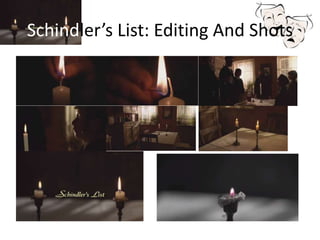
• The opening to Schindler’s List shows a Jewish
prayer ceremony, candles are lit and a Jewish
family recites a prayer, then the room is
empty, and the camera focuses on the candles
as they melt, the title “Schindler’s List”
appears between two candles, the scene
gradually loses colour and goes black and
white as the candles burn out.
Schindler’s List: Mise-En-Scene And
Props
Schindler’s List: Mise-En-Scene And
Props Analysis
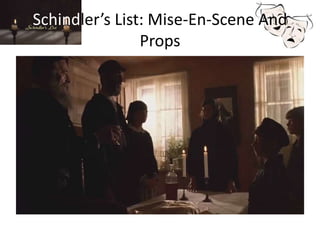
• The setting is a small kitchen in the house of a Jewish
family, the candles and drinks are part of a Jewish prayer
ceremony and make the film’s connection to Judaism and
the Holocaust immediately clear to the audience.
• The wooden simple furniture are Germanic and would be
popular in homes in the early 20th century, this is a clear
indicator of the film being set in Germany during World
War II.
• From this we can learn that it is important to convey the
time and setting with the furniture used, as our film is set
in modern day we will use contemporary furniture,
however we will not use modern features that could
become dated such as specific smartphones.
Schindler’s List: Editing And Shots
Analysis
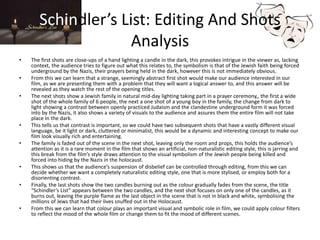
• The first shots are close-ups of a hand lighting a candle in the dark, this provokes intrigue in the viewer as, lacking
context, the audience tries to figure out what this relates to, the symbolism is that of the Jewish faith being forced
underground by the Nazis, their prayers being held in the dark, however this is not immediately obvious.
• From this we can learn that a strange, seemingly abstract first shot would make our audience interested in our
film, as we are presenting them with a problem that they will want a logical answer to, and this answer will be
revealed as they watch the rest of the opening titles.
• The next shots show a Jewish family in natural mid-day lighting taking part in a prayer ceremony,, the first a wide
shot of the whole family of 6 people, the next a one shot of a young boy in the family, the change from dark to
light showing a contrast between openly practiced Judaism and the clandestine underground form it was forced
into by the Nazis, it also shows a variety of visuals to the audience and assures them the entire film will not take
place in the dark.
• This tells us that contrast is important, so we could have two subsequent shots that have a vastly different visual
language, be it light or dark, cluttered or minimalist, this would be a dynamic and interesting concept to make our
film look visually rich and entertaining.
• The family is faded out of the scene in the next shot, leaving only the room and props, this holds the audience’s
attention as it is a rare moment in the film that shows an artificial, non-naturalistic editing style, this is jarring and
this break from the film’s style draws attention to the visual symbolism of the Jewish people being killed and
forced into hiding by the Nazis in the holocaust.
• This shows us that the audience’s suspension of disbelief can be controlled through editing, from this we can
decide whether we want a completely naturalistic editing style, one that is more stylised, or employ both for a
disorienting contrast.
• Finally, the last shots show the two candles burning out as the colour gradually fades from the scene, the title
“Schindler’s List” appears between the two candles, and the next shot focuses on only one of the candles, as it
burns out, leaving the purple flame as the last object in the scene that is not in black and white, symbolising the
millions of Jews that had their lives snuffed out in the Holocaust.
• From this we can learn that colour plays an important visual and symbolic role in film, we could apply colour filters
to reflect the mood of the whole film or change them to fit the mood of different scenes.
Schindler’s List: Sound Used And
Analysis
• The first sounds are that of a match being struck and candles burning,
these are normally not sounds that are given special attention in films,
rather fading into the background, however they are the focus here to
reflect the hushed nature of Judaism in Germany in the Second World
War.
• For these to be recorded a candle being lit would have had to be recorded
with a very close microphone, this tells us that we can employ very small,
usually ignored sounds to amplify an atmosphere of silence by recording
them with a close microphone and playing them in quiet, intense scenes.
• The next sound lasts throughout the rest of the opening titles, it is the
recitation of a traditional Jewish prayer by an old Orthodox Jewish man,
this exemplifies the traditional Jewish values that the Nazis aimed to
destroy.
• From this we can understand that by using speech in other languages and
accents we can symbolically represent cultural values and ideals, for
example an upper-class Received Pronunciation accent would be
associated with wealth and tradition, this is an example of Barthe’s
cultural code.
Researching Roland Barthes And The
Five Codes Of Narrative
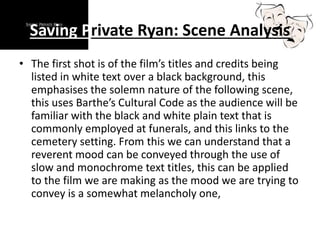
Roland Barthe’s 5 Codes Of Narrative
• Proairetic Code: This dictates that any action that is shown to begin
must be completed, and that suspense can be created by leaving
actions without a conclusion for an extended period of time or
indefinitely.
• Hermeneutic Code: This is a way to create suspense by leaving
questions unanswered for the audience to wonder about.
• Connotative Code: This dictates that the sequential thoughts of a
character build up to create a fleshed-out characterisation.
• Cultural Code: This is the use of plot elements that take advantage
of things that the audience already knows, communicating without
explaining, as the audience is aware of the connotations of what is
being shown.
• Symbolic Code: This is the use of binary opposites in reinforcing a
theme, comparing and contrasting images and ideas.
Saving Private Ryan: Scene Analysis
• The first shot is of the film’s titles and credits being
listed in white text over a black background, this
emphasises the solemn nature of the following scene,
this uses Barthe’s Cultural Code as the audience will be
familiar with the black and white plain text that is
commonly employed at funerals, and this links to the
cemetery setting. From this we can understand that a
reverent mood can be conveyed through the use of
slow and monochrome text titles, this can be applied
to the film we are making as the mood we are trying to
convey is a somewhat melancholy one,
• The next shot shows a United States Of America flag waving in the wind,
its colour washed out, this also uses Barthe’s Cultural Code, in that the
film is mainly about the events during the Second World War, the washed-
out colour symbolising the passage of time since the War, this would make
the audience understand that this film is exploring the events of the past
from an American perspective, this tells us that flags can be used to
communicate the national identity of a film, however our film will not be
set in a specific country, so this will not be used in ours.
• The following shot is a tracking shot of the back of the elderly man's legs
as he walks down the path towards the ceremony, the camera follows his
pace and pans up to show only his head and shoulders from behind, while
still keeping up with him. The effect on the audience here is one that first
communicates motion by showing the legs of the elderly man as he walks,
and then focuses primarily on his character by showing the back of his
head, this also reveals his grey hair, showing his age. This tells us that not
only can panning be used effectively in conjunction with tracking, but that
panning can be used to reveal aspects of a character, while our character
is the main focus of the film, his appearance is not something we intend to
withhold and reveal, so we will not use this aspect in our film.
• The next shot is a tracking shot, facing towards the elderly man's family, an adult
man and woman, an elderly woman and three young women, the camera moves
away from them at the same pace that they walk towards it, following the elderly
man. This makes it clear to the audience that the man has lived an eventful life
and raised a family, this also shows him as a respected man, as his family are going
with him to visit the military cemetery, a task that would not be very enjoyable,
but shows that they understand him and will provide him with support. This shot
teaches us that many things about a character can be inferred from their relation
to other characters, another example of Barthe's Cultural Code, we will employ
this in our film by showing the main character's loneliness through a photograph
of an absent love interest.
• The next two shots show the adult man of the family about to take a picture, the
camera facing towards his face and continuing the tracking pace, the next shot is
from behind the family and shows the adult woman, implied to be his wife,
shaking her head at him as if to say it would be disrespectful to take a picture,
notably the elderly man is kept in focus in the centre of the frame, however the
exchange between the presumed husband and wife is the main event of the shot,
this tells us that the focus of the shot and the main action in a shot do not always
have to be the same, we will employ this by focusing on a still tin of beans in one
shot, while a picture is turned face-down out of the shot's focus. The following
shot is faced towards the elderly woman, tracking away from her as she walks
towards the cemetery, revealing a small boy holding the adult woman's hand, this
shot does not provide anything new of note that we can learn from.
• The following shot is a long tracking shot, showing the elderly man
walking down the path to the cemetery, the camera following him
as he walks, slowly zooming in so his family are out of frame, until
he gets to the entrance of the cemetery, faces the towards the
camera, and his family gather behind him. This shows us that a long
shot can be rendered more dynamic with elements of a reveal by
using a combination of tracking and zooming. We could employ this
for some outdoor scenes in our film, however it may end up
betraying the staid atmosphere we are attempting.
• The next shot again shows the United States of America's flag
waving, however this time it is in full colour at the top of a pole and
shot from a low angle, a POV shot from the elderly man's
perspective. This is another reminder of the film's American setting
and perspective. This is followed by a shot of a French flag in the
exact same state, a Culturally Coded reference to the battle at
Omaha Beach that takes place in the film, an attempted American
invasion of Nazi-occupied France.
• There is a brief shot of the elderly man beginning to walk towards the graves, followed by a
long tracking shot of him walking amongst the graves that sees the camera move from facing
towards him, to facing towards his left side, and then behind him, pulling back to reveal the
hundreds of gravestones. this is to emphasise the loss of human life that comes as a result of
war, and from this we can learn a pull-back-and-reveal technique that means that the
audience has a different viewpoint from that of the characters, the elderly man would clearly
be able to see the gravestones for a long time before this shot, however it is the first time the
audience would see them, this is something we could employ for dramatic effect by having
an object relevant to the plot hinted at, and acknowledged by the main character, but not
looked at clearly until when it would be most dramatically effective, we will use this with a
photograph of a woman in our film.
• The elderly man then collapses in front of a gravestone and his family surround him to
support him. The next two shots clearly show the names of the gravestones in front of him,
focusing on nothing else, this tells the audience that the names of these men are relevant,
and probably have some emotional significance to the elderly man. From this we can learn
that the written word can be an effective tool for visual communication, and that by giving
the audience clear shots of text they can have a good vantage point to read them, however
as the film we are making focuses more on action than language, it is unlikely we will employ
this technique.
• The camera then zooms into the elderly man's
crying eyes in the next shot until they fill the
frame, concluding the opening sequence, this
conveys to the audience the emotional nature
of the film, and teaches us that intensity can
be generated by slowly zooming in on the face
of an emotional person, however our film will
be somewhat emotionally detached, so we
will most likely not use this technique.
Saving Private Ryan: Mise-En-Scene
• This setting is in modern day while the rest of
the film takes place during the Second World
War, the message here is that war results in a
catastrophic loss of human life, this teaches us
that changing the time of the mise-en-scene
can be used to powerful dramatic effect to
display change, however we will not employ
this technique as our film will be set in an
ambiguously modern time.
Saving Private Ryan: Audio Analysis
• The only audio in the scene besides low ambient noises such as birds chirping, footsteps and
wind is an original score, it starts off as solely mournful brass instrumentation, most likely a
cultural reference to military music such as Taps and The Last Post that are brass pieces,
linking with the film's story of the American military in the Second World War. As the elderly
man walks towards the graves cellos are added to the instrumentation, conveying movement
and dramatic progression,violins come in soon after, and the piece takes a more uplifting
turn, as the elderly man begins to cry the instrumentation becomes more quiet, mournful
and brass-focused, reflecting his sadness towards his fallen comrades, the last instrumental
phrase is an ominous brass tune that becomes overpowered by the sound of crashing waves
as the film switches to the Battle of Omaha Beach and the narrative is set in motion. The
score here works with the onscreen events to telegraph to the audience how they should be
feeling at different points of the film.
• This tells us that the mood and movement of an original instrumental piece can be used as a
fitting companion to onscreen action, however as we are likely going to use an existing song
as the soundtrack to our film, we will not follow this technique exactly but the editing will be
done in tandem with the song's movements.
• Only one word is spoken in this opening, as the elderly man collapses and cries the adult man
runs up to him and says "Dad!" an obvious exposition of the character's relation to the
elderly man, this makes the audience aware that the man is his son and that the people
behind the elderly man are almost certainly his family.
• From this we can learn that sparing words can be used to convey necessary plot information
without dialogue taking over the film, however we intend for our film to have no spoken
words besides those in an existing song used as a soundtrack, this also seems too obvious of
a method of exposition, we would prefer to show instead of tell where possible in our film
opening.
The Great Gatsby: Shots and editing
• The opening sequence of The Great Gatsby begins with a black and white, grainy rendition of the Warner Brothers
titles as well as those of other film companies, this conveys the 1920s setting of the film by also accompanying
them with Art Deco stylistic finishes. From this we can understand that if our film is set in the past we can alter the
titles to fit the styles of the time the film is set in, however as our film opening is set in a modern time, this style
will not be employed, and no contemporary trends will be showcases, as it is important that the film has a
timeless atmosphere.
• The shot however loses the grain and gains colour, zooming into the film sequence beyond the titles, this has an
effect on the audience of moving from a stylistic fantasy into a cinematic, narrative reality. This tells us that a
dynamic use of colour saturation can change the mood of a film, while we will not use colour saturation in a
dynamic manner, we will apply a filter to the colours in our film opening that lends the film a cold and detached
book.
• The following show is a slow zoom towards a light above what to be an ocean at night, this provokes intrigue in
the audience, relating to Barthe’s idea of suspense being generated by unexplained actions, the audience wants to
know what the light in the distance is. This tells us that obscured objects and distant lights can be used to
generate suspense, we will employ this with the use of a picture frame, whose subject will not be revealed until
the end of the film opening.
• The shot then become filled with snow and changes to a scene which is implied to be the previous shot under
different light, a small building stands on a snowy hill and has a larger building behind it, the buildings stand at a
coast snow is falling and the sea is filled with chunks of ice, slowly the camera zooms into the building, revealing
the words “The Perkins Sanitarium” above the door, from this point on the films narrative is set in motion, this last
ambiguous shot lends the audience a series of symbols and images that will be explained later, an example of
Barthes idea of suspense being generated from unresolved problems, the audience does not know the
significance of The Perkins Sanitarium, but they will consider it likely that the film will explain this later on.
However, as we are only creating a 2-minute opening to a film, it would not be a good idea for us to employ this
kid of long-form narrative device.
The Great Gatsby: Audio Analysis
• The film company logos are presented alongside 1920s instrumental music that
sounds like it is being played on a worn-out record, it is the type of music you
would expect to hear accompanying a silent film, the sound quality then changes
and the violins used in the soundtrack become more vivid and high-quality, this is
to convey a change in the visual style from grainy black and white to full colour,
and this tells us that audio degradation artifacts can be employed to make a
cultural connection with the era in which these audio crackles and pops would
take place, however we are going to use a clean modern digital file for our
soundtrack, and so will not be employing this technique.
• The words spoken during the introduction are a monologue, opening with “In my
younger and more vulnerable years”, this implies that the character is older and
has had to harden up due to events in his life, from this we can understand that
speech can be used to give away ideas without explicitly stating them, he could
have said “When I was younger and not yet hardened by the world” but his use of
“more vulnerable” renders the phrase obsolete, he shows without telling, however
as our film will have no words spoken by the only character we will not employ this
technique.
The Great Gatsby: Mise-En-Scene
• The mise-en-scene of the opening of The Great Gatsby is a small
building called The Perkins Sanitarium which is on a snowy coast
across from an ocean filled with chunks of ice, it is seen in two
ways, once from far away at night so that only the ocean and a
bright light can be seen, and secondly on a clear snowy day where
the entire building can be seen clearly, the use of CGI to create the
ocean and ice effects, as well as composite the entire scene tell us
that computer editing can be used to create very realistic looking
scenes, however as our film will be heavily naturalistic, computer
editing will not be used beyond cutting shots together, applying a
colour saturation filter, adding sound effects and possibly altering
the speed of shots, no images shall be inserted using a computer
that were not already there when filmed.

Main Task Genre Research And Textual Analysis

  • 1.
  • 2.
    Our Genre: Drama •We have chosen the genre of drama, and so we have researched the introductions to three films in the drama genre. • These three films are Schindler’s List,
  • 3.
    Schindler’s List: Narrative •The opening to Schindler’s List shows a Jewish prayer ceremony, candles are lit and a Jewish family recites a prayer, then the room is empty, and the camera focuses on the candles as they melt, the title “Schindler’s List” appears between two candles, the scene gradually loses colour and goes black and white as the candles burn out.
  • 4.
  • 5.
    Schindler’s List: Mise-En-SceneAnd Props Analysis • The setting is a small kitchen in the house of a Jewish family, the candles and drinks are part of a Jewish prayer ceremony and make the film’s connection to Judaism and the Holocaust immediately clear to the audience. • The wooden simple furniture are Germanic and would be popular in homes in the early 20th century, this is a clear indicator of the film being set in Germany during World War II. • From this we can learn that it is important to convey the time and setting with the furniture used, as our film is set in modern day we will use contemporary furniture, however we will not use modern features that could become dated such as specific smartphones.
  • 6.
  • 7.
    Schindler’s List: EditingAnd Shots Analysis • The first shots are close-ups of a hand lighting a candle in the dark, this provokes intrigue in the viewer as, lacking context, the audience tries to figure out what this relates to, the symbolism is that of the Jewish faith being forced underground by the Nazis, their prayers being held in the dark, however this is not immediately obvious. • From this we can learn that a strange, seemingly abstract first shot would make our audience interested in our film, as we are presenting them with a problem that they will want a logical answer to, and this answer will be revealed as they watch the rest of the opening titles. • The next shots show a Jewish family in natural mid-day lighting taking part in a prayer ceremony,, the first a wide shot of the whole family of 6 people, the next a one shot of a young boy in the family, the change from dark to light showing a contrast between openly practiced Judaism and the clandestine underground form it was forced into by the Nazis, it also shows a variety of visuals to the audience and assures them the entire film will not take place in the dark. • This tells us that contrast is important, so we could have two subsequent shots that have a vastly different visual language, be it light or dark, cluttered or minimalist, this would be a dynamic and interesting concept to make our film look visually rich and entertaining. • The family is faded out of the scene in the next shot, leaving only the room and props, this holds the audience’s attention as it is a rare moment in the film that shows an artificial, non-naturalistic editing style, this is jarring and this break from the film’s style draws attention to the visual symbolism of the Jewish people being killed and forced into hiding by the Nazis in the holocaust. • This shows us that the audience’s suspension of disbelief can be controlled through editing, from this we can decide whether we want a completely naturalistic editing style, one that is more stylised, or employ both for a disorienting contrast. • Finally, the last shots show the two candles burning out as the colour gradually fades from the scene, the title “Schindler’s List” appears between the two candles, and the next shot focuses on only one of the candles, as it burns out, leaving the purple flame as the last object in the scene that is not in black and white, symbolising the millions of Jews that had their lives snuffed out in the Holocaust. • From this we can learn that colour plays an important visual and symbolic role in film, we could apply colour filters to reflect the mood of the whole film or change them to fit the mood of different scenes.
  • 8.
    Schindler’s List: SoundUsed And Analysis • The first sounds are that of a match being struck and candles burning, these are normally not sounds that are given special attention in films, rather fading into the background, however they are the focus here to reflect the hushed nature of Judaism in Germany in the Second World War. • For these to be recorded a candle being lit would have had to be recorded with a very close microphone, this tells us that we can employ very small, usually ignored sounds to amplify an atmosphere of silence by recording them with a close microphone and playing them in quiet, intense scenes. • The next sound lasts throughout the rest of the opening titles, it is the recitation of a traditional Jewish prayer by an old Orthodox Jewish man, this exemplifies the traditional Jewish values that the Nazis aimed to destroy. • From this we can understand that by using speech in other languages and accents we can symbolically represent cultural values and ideals, for example an upper-class Received Pronunciation accent would be associated with wealth and tradition, this is an example of Barthe’s cultural code.
  • 9.
    Researching Roland BarthesAnd The Five Codes Of Narrative
  • 10.
    Roland Barthe’s 5Codes Of Narrative • Proairetic Code: This dictates that any action that is shown to begin must be completed, and that suspense can be created by leaving actions without a conclusion for an extended period of time or indefinitely. • Hermeneutic Code: This is a way to create suspense by leaving questions unanswered for the audience to wonder about. • Connotative Code: This dictates that the sequential thoughts of a character build up to create a fleshed-out characterisation. • Cultural Code: This is the use of plot elements that take advantage of things that the audience already knows, communicating without explaining, as the audience is aware of the connotations of what is being shown. • Symbolic Code: This is the use of binary opposites in reinforcing a theme, comparing and contrasting images and ideas.
  • 11.
    Saving Private Ryan:Scene Analysis • The first shot is of the film’s titles and credits being listed in white text over a black background, this emphasises the solemn nature of the following scene, this uses Barthe’s Cultural Code as the audience will be familiar with the black and white plain text that is commonly employed at funerals, and this links to the cemetery setting. From this we can understand that a reverent mood can be conveyed through the use of slow and monochrome text titles, this can be applied to the film we are making as the mood we are trying to convey is a somewhat melancholy one,
  • 12.
    • The nextshot shows a United States Of America flag waving in the wind, its colour washed out, this also uses Barthe’s Cultural Code, in that the film is mainly about the events during the Second World War, the washed- out colour symbolising the passage of time since the War, this would make the audience understand that this film is exploring the events of the past from an American perspective, this tells us that flags can be used to communicate the national identity of a film, however our film will not be set in a specific country, so this will not be used in ours. • The following shot is a tracking shot of the back of the elderly man's legs as he walks down the path towards the ceremony, the camera follows his pace and pans up to show only his head and shoulders from behind, while still keeping up with him. The effect on the audience here is one that first communicates motion by showing the legs of the elderly man as he walks, and then focuses primarily on his character by showing the back of his head, this also reveals his grey hair, showing his age. This tells us that not only can panning be used effectively in conjunction with tracking, but that panning can be used to reveal aspects of a character, while our character is the main focus of the film, his appearance is not something we intend to withhold and reveal, so we will not use this aspect in our film.
  • 13.
    • The nextshot is a tracking shot, facing towards the elderly man's family, an adult man and woman, an elderly woman and three young women, the camera moves away from them at the same pace that they walk towards it, following the elderly man. This makes it clear to the audience that the man has lived an eventful life and raised a family, this also shows him as a respected man, as his family are going with him to visit the military cemetery, a task that would not be very enjoyable, but shows that they understand him and will provide him with support. This shot teaches us that many things about a character can be inferred from their relation to other characters, another example of Barthe's Cultural Code, we will employ this in our film by showing the main character's loneliness through a photograph of an absent love interest. • The next two shots show the adult man of the family about to take a picture, the camera facing towards his face and continuing the tracking pace, the next shot is from behind the family and shows the adult woman, implied to be his wife, shaking her head at him as if to say it would be disrespectful to take a picture, notably the elderly man is kept in focus in the centre of the frame, however the exchange between the presumed husband and wife is the main event of the shot, this tells us that the focus of the shot and the main action in a shot do not always have to be the same, we will employ this by focusing on a still tin of beans in one shot, while a picture is turned face-down out of the shot's focus. The following shot is faced towards the elderly woman, tracking away from her as she walks towards the cemetery, revealing a small boy holding the adult woman's hand, this shot does not provide anything new of note that we can learn from.
  • 14.
    • The followingshot is a long tracking shot, showing the elderly man walking down the path to the cemetery, the camera following him as he walks, slowly zooming in so his family are out of frame, until he gets to the entrance of the cemetery, faces the towards the camera, and his family gather behind him. This shows us that a long shot can be rendered more dynamic with elements of a reveal by using a combination of tracking and zooming. We could employ this for some outdoor scenes in our film, however it may end up betraying the staid atmosphere we are attempting. • The next shot again shows the United States of America's flag waving, however this time it is in full colour at the top of a pole and shot from a low angle, a POV shot from the elderly man's perspective. This is another reminder of the film's American setting and perspective. This is followed by a shot of a French flag in the exact same state, a Culturally Coded reference to the battle at Omaha Beach that takes place in the film, an attempted American invasion of Nazi-occupied France.
  • 15.
    • There isa brief shot of the elderly man beginning to walk towards the graves, followed by a long tracking shot of him walking amongst the graves that sees the camera move from facing towards him, to facing towards his left side, and then behind him, pulling back to reveal the hundreds of gravestones. this is to emphasise the loss of human life that comes as a result of war, and from this we can learn a pull-back-and-reveal technique that means that the audience has a different viewpoint from that of the characters, the elderly man would clearly be able to see the gravestones for a long time before this shot, however it is the first time the audience would see them, this is something we could employ for dramatic effect by having an object relevant to the plot hinted at, and acknowledged by the main character, but not looked at clearly until when it would be most dramatically effective, we will use this with a photograph of a woman in our film. • The elderly man then collapses in front of a gravestone and his family surround him to support him. The next two shots clearly show the names of the gravestones in front of him, focusing on nothing else, this tells the audience that the names of these men are relevant, and probably have some emotional significance to the elderly man. From this we can learn that the written word can be an effective tool for visual communication, and that by giving the audience clear shots of text they can have a good vantage point to read them, however as the film we are making focuses more on action than language, it is unlikely we will employ this technique.
  • 16.
    • The camerathen zooms into the elderly man's crying eyes in the next shot until they fill the frame, concluding the opening sequence, this conveys to the audience the emotional nature of the film, and teaches us that intensity can be generated by slowly zooming in on the face of an emotional person, however our film will be somewhat emotionally detached, so we will most likely not use this technique.
  • 17.
    Saving Private Ryan:Mise-En-Scene • This setting is in modern day while the rest of the film takes place during the Second World War, the message here is that war results in a catastrophic loss of human life, this teaches us that changing the time of the mise-en-scene can be used to powerful dramatic effect to display change, however we will not employ this technique as our film will be set in an ambiguously modern time.
  • 18.
    Saving Private Ryan:Audio Analysis • The only audio in the scene besides low ambient noises such as birds chirping, footsteps and wind is an original score, it starts off as solely mournful brass instrumentation, most likely a cultural reference to military music such as Taps and The Last Post that are brass pieces, linking with the film's story of the American military in the Second World War. As the elderly man walks towards the graves cellos are added to the instrumentation, conveying movement and dramatic progression,violins come in soon after, and the piece takes a more uplifting turn, as the elderly man begins to cry the instrumentation becomes more quiet, mournful and brass-focused, reflecting his sadness towards his fallen comrades, the last instrumental phrase is an ominous brass tune that becomes overpowered by the sound of crashing waves as the film switches to the Battle of Omaha Beach and the narrative is set in motion. The score here works with the onscreen events to telegraph to the audience how they should be feeling at different points of the film. • This tells us that the mood and movement of an original instrumental piece can be used as a fitting companion to onscreen action, however as we are likely going to use an existing song as the soundtrack to our film, we will not follow this technique exactly but the editing will be done in tandem with the song's movements. • Only one word is spoken in this opening, as the elderly man collapses and cries the adult man runs up to him and says "Dad!" an obvious exposition of the character's relation to the elderly man, this makes the audience aware that the man is his son and that the people behind the elderly man are almost certainly his family. • From this we can learn that sparing words can be used to convey necessary plot information without dialogue taking over the film, however we intend for our film to have no spoken words besides those in an existing song used as a soundtrack, this also seems too obvious of a method of exposition, we would prefer to show instead of tell where possible in our film opening.
  • 19.
    The Great Gatsby:Shots and editing • The opening sequence of The Great Gatsby begins with a black and white, grainy rendition of the Warner Brothers titles as well as those of other film companies, this conveys the 1920s setting of the film by also accompanying them with Art Deco stylistic finishes. From this we can understand that if our film is set in the past we can alter the titles to fit the styles of the time the film is set in, however as our film opening is set in a modern time, this style will not be employed, and no contemporary trends will be showcases, as it is important that the film has a timeless atmosphere. • The shot however loses the grain and gains colour, zooming into the film sequence beyond the titles, this has an effect on the audience of moving from a stylistic fantasy into a cinematic, narrative reality. This tells us that a dynamic use of colour saturation can change the mood of a film, while we will not use colour saturation in a dynamic manner, we will apply a filter to the colours in our film opening that lends the film a cold and detached book. • The following show is a slow zoom towards a light above what to be an ocean at night, this provokes intrigue in the audience, relating to Barthe’s idea of suspense being generated by unexplained actions, the audience wants to know what the light in the distance is. This tells us that obscured objects and distant lights can be used to generate suspense, we will employ this with the use of a picture frame, whose subject will not be revealed until the end of the film opening. • The shot then become filled with snow and changes to a scene which is implied to be the previous shot under different light, a small building stands on a snowy hill and has a larger building behind it, the buildings stand at a coast snow is falling and the sea is filled with chunks of ice, slowly the camera zooms into the building, revealing the words “The Perkins Sanitarium” above the door, from this point on the films narrative is set in motion, this last ambiguous shot lends the audience a series of symbols and images that will be explained later, an example of Barthes idea of suspense being generated from unresolved problems, the audience does not know the significance of The Perkins Sanitarium, but they will consider it likely that the film will explain this later on. However, as we are only creating a 2-minute opening to a film, it would not be a good idea for us to employ this kid of long-form narrative device.
  • 20.
    The Great Gatsby:Audio Analysis • The film company logos are presented alongside 1920s instrumental music that sounds like it is being played on a worn-out record, it is the type of music you would expect to hear accompanying a silent film, the sound quality then changes and the violins used in the soundtrack become more vivid and high-quality, this is to convey a change in the visual style from grainy black and white to full colour, and this tells us that audio degradation artifacts can be employed to make a cultural connection with the era in which these audio crackles and pops would take place, however we are going to use a clean modern digital file for our soundtrack, and so will not be employing this technique. • The words spoken during the introduction are a monologue, opening with “In my younger and more vulnerable years”, this implies that the character is older and has had to harden up due to events in his life, from this we can understand that speech can be used to give away ideas without explicitly stating them, he could have said “When I was younger and not yet hardened by the world” but his use of “more vulnerable” renders the phrase obsolete, he shows without telling, however as our film will have no words spoken by the only character we will not employ this technique.
  • 21.
    The Great Gatsby:Mise-En-Scene • The mise-en-scene of the opening of The Great Gatsby is a small building called The Perkins Sanitarium which is on a snowy coast across from an ocean filled with chunks of ice, it is seen in two ways, once from far away at night so that only the ocean and a bright light can be seen, and secondly on a clear snowy day where the entire building can be seen clearly, the use of CGI to create the ocean and ice effects, as well as composite the entire scene tell us that computer editing can be used to create very realistic looking scenes, however as our film will be heavily naturalistic, computer editing will not be used beyond cutting shots together, applying a colour saturation filter, adding sound effects and possibly altering the speed of shots, no images shall be inserted using a computer that were not already there when filmed.