Magnifying
Glass
History of Magnifying Glass/Lens
 Roger Bacon, was a
philosopher who conducted a
wide range of experiments
with lenses and mirrors.
 it was built in the 1250s.
 Its use is first mentioned in
1268, when the magnifying
lens was adapted to be used
as primitive eyeglasses.
Magnifying Glass
 also known as a hand
lens
 a specially shaped piece
of glass that is attached
to a handle and is used
to make an object look
larger than it is.
Magnifying
Glass/Lens
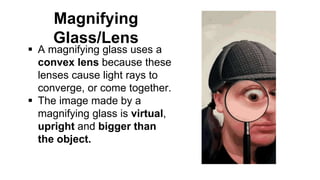
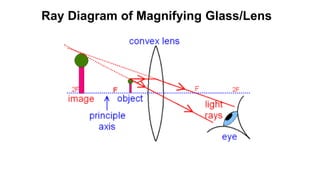
 A magnifying glass uses a
convex lens because these
lenses cause light rays to
converge, or come together.
 The image made by a
magnifying glass is virtual,
upright and bigger than
the object.
Ray Diagram of Magnifying Glass/Lens
Applications of Magnifying Glass/Lens
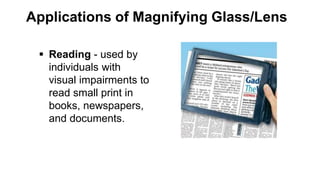
 Reading - used by
individuals with
visual impairments to
read small print in
books, newspapers,
and documents.
Applications of Magnifying Glass/Lens
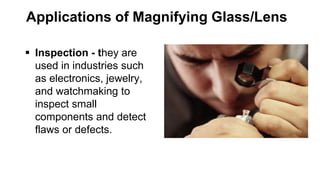
 Inspection - they are
used in industries such
as electronics, jewelry,
and watchmaking to
inspect small
components and detect
flaws or defects.
Applications of Magnifying Glass/Lens
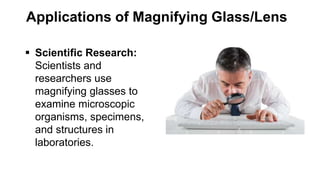
 Scientific Research:
Scientists and
researchers use
magnifying glasses to
examine microscopic
organisms, specimens,
and structures in
laboratories.
Conclusio
n
 The magnifying is a
versatile and essential
tool that has been used
for centuries to magnify
and examine objects
and images.
Thank you!

magnifying-glasses-infographics-and-uses

  • 1.
  • 2.
    History of MagnifyingGlass/Lens  Roger Bacon, was a philosopher who conducted a wide range of experiments with lenses and mirrors.  it was built in the 1250s.  Its use is first mentioned in 1268, when the magnifying lens was adapted to be used as primitive eyeglasses.
  • 3.
    Magnifying Glass  alsoknown as a hand lens  a specially shaped piece of glass that is attached to a handle and is used to make an object look larger than it is.
  • 4.
    Magnifying Glass/Lens  A magnifyingglass uses a convex lens because these lenses cause light rays to converge, or come together.  The image made by a magnifying glass is virtual, upright and bigger than the object.
  • 5.
    Ray Diagram ofMagnifying Glass/Lens
  • 6.
    Applications of MagnifyingGlass/Lens  Reading - used by individuals with visual impairments to read small print in books, newspapers, and documents.
  • 7.
    Applications of MagnifyingGlass/Lens  Inspection - they are used in industries such as electronics, jewelry, and watchmaking to inspect small components and detect flaws or defects.
  • 8.
    Applications of MagnifyingGlass/Lens  Scientific Research: Scientists and researchers use magnifying glasses to examine microscopic organisms, specimens, and structures in laboratories.
  • 9.
    Conclusio n  The magnifyingis a versatile and essential tool that has been used for centuries to magnify and examine objects and images.
  • 10.