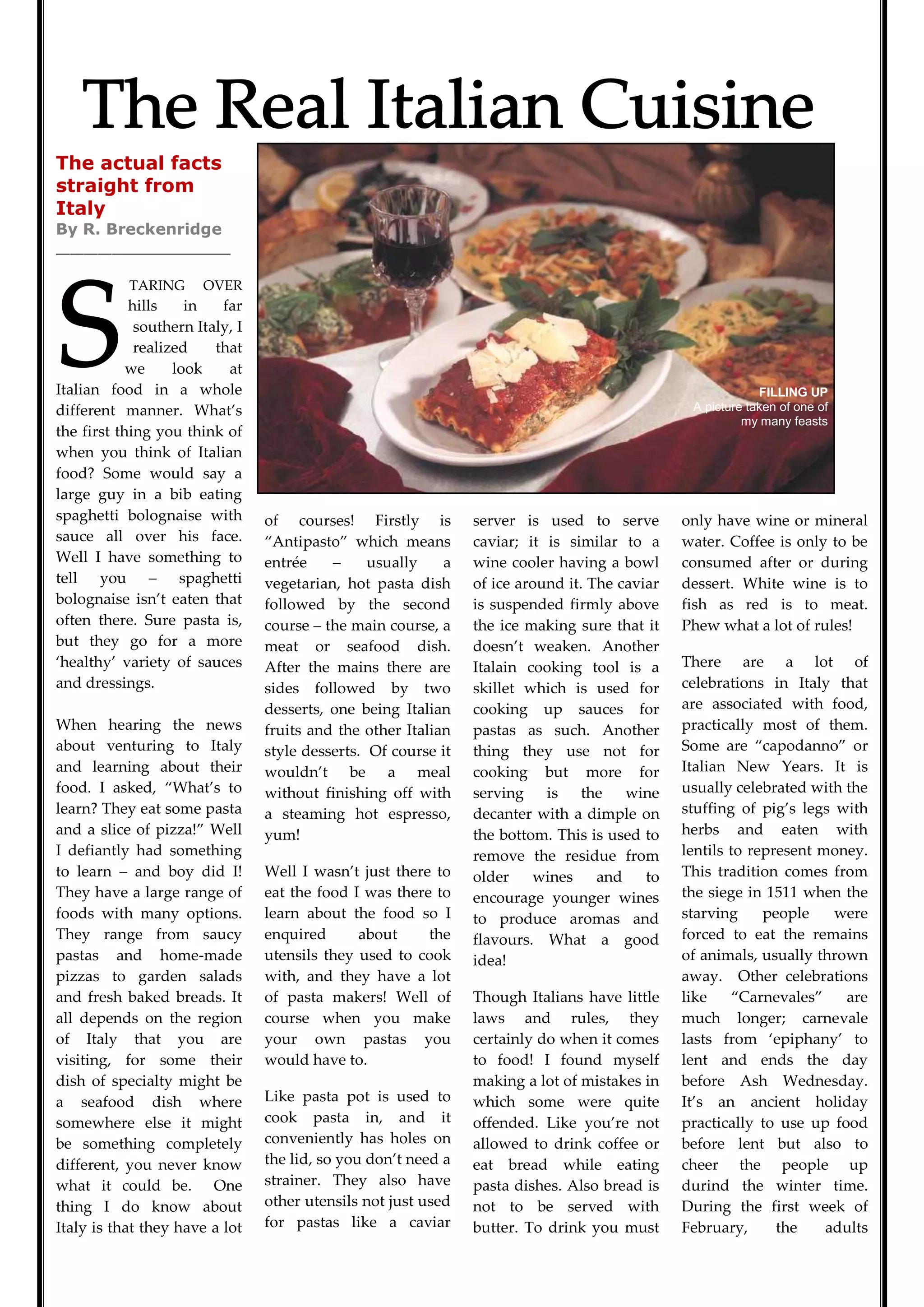
1657350100965<br />The actual facts straight from Italy <br />By R. Breckenridge<br />_________________________<br />FILLING UPA picture taken of one of my many feastsTARING OVER hills in far southern Italy, I realized that we look at Italian food in a whole different manner. What’s the first thing you think of when you think of Italian food? Some would say a large guy in a bib eating spaghetti bolognaise with sauce all over his face. Well I have something to tell you – spaghetti bolognaise isn’t eaten that often there. Sure pasta is, but they go for a more ‘healthy’ variety of sauces and dressings.<br />When hearing the news about venturing to Italy and learning about their food. I asked, “What’s to learn? They eat some pasta and a slice of pizza!” Well I defiantly had something to learn – and boy did I! They have a large range of foods with many options. They range from saucy pastas and home-made pizzas to garden salads and fresh baked breads. It all depends on the region of Italy that you are visiting, for some their dish of specialty might be a seafood dish where somewhere else it might be something completely different, you never know what it could be.  One thing I do know about Italy is that they have a lot of courses! Firstly is “Antipasto” which means entrée – usually a vegetarian, hot pasta dish followed by the second course – the main course, a meat or seafood dish. After the mains there are sides followed by two desserts, one being Italian fruits and the other Italian style desserts.  Of course it wouldn’t be a meal without finishing off with a steaming hot espresso, yum!<br />Well I wasn’t just there to eat the food I was there to learn about the food so I enquired about the utensils they used to cook with, and they have a lot of pasta makers! Well of course when you make your own pastas you would have to.<br />Like pasta pot is used to cook pasta in, and it conveniently has holes on the lid, so you don’t need a strainer. They also have other utensils not just used for pastas like a caviar server is used to serve caviar; it is similar to a wine cooler having a bowl of ice around it. The caviar is suspended firmly above the ice making sure that it doesn’t weaken. Another Italain cooking tool is a skillet which is used for cooking up sauces for pastas as such. Another thing they use not for cooking but more for serving is the wine decanter with a dimple on the bottom. This is used to remove the residue from older wines and to encourage younger wines to produce aromas and flavours. What a good idea!<br />Though Italians have little laws and rules, they certainly do when it comes to food! I found myself making a lot of mistakes in which some were quite offended. Like you’re not allowed to drink coffee or eat bread while eating pasta dishes. Also bread is not to be served with butter. To drink you must only have wine or mineral water. Coffee is only to be consumed after or during dessert. White wine is to fish as red is to meat. Phew what a lot of rules!<br />There are a lot of celebrations in Italy that are associated with food, practically most of them. Some are “capodanno” or Italian New Years. It is usually celebrated with the stuffing of pig’s legs with herbs and eaten with lentils to represent money. This tradition comes from the siege in 1511 when the starving people were forced to eat the remains of animals, usually thrown away.  Other celebrations like “Carnevales” are much longer; carnevale lasts from ‘epiphany’ to lent and ends the day before Ash Wednesday. It’s an ancient holiday practically to use up food before lent but also to cheer the people up durind the winter time. During the first week of February, the adults  <br />would dress up in costume and mask and attend a lot of parties and grand balls while the children wear disguises to school. Though this happens all over Italy, Venice, Viareggio and Cento is where the real fun is. The celebrations last a week in Venice and there are plenty of balls, masquerade and costumes. The main food sold is donut strips dusted in sugar. On the last day there is a huge fireworks display in the city. In Viareggio it is the celebration of love and peace, which huge mache paper floats and acrobats are paraded, along with the usual balls and masquerades. Cento claims to have the oldest carnevale of all Italy and boy do they take it seriously. Masters take up apprentices to master the skill of float making for the celebrations. Their celebrations end with the tossing of 30 000 sweets into the crowd. Carnevale is celebrated rather differently in Ivrea. They host massive orange throwing battles during the day, settling down to the burning of large wooden poles and the feasting of codfish and polenta. Now all celebrations must unfortunately come to an end, on the Fat Tuesday. I guess a whole month of celebrations is enough for one country.  <br />When my journey to Italy finally came to end, I can say that I put on some along the waistline but I enjoyed the experience, and doing so I would recommend to anyone a visit to the beautiful country, not just to eat the foods though! Italy also has a lot more to offer than a large menu, you know!<br />And of course I could not leave the country without finding my wonderful readers a quick ‘n’ easy recipe to make!<br />3164840251460Broccoli Rabe And Sausage Pizza<br />INGREDIENTS:<br />4 Balls Pizza Dough For Individual Sized Pizzas
1 Bunch Prepared Broccoli Rabe (See Below)
4 Large Sausage Links

Magazine article

  • 1.
    1657350100965<br />The actualfacts straight from Italy <br />By R. Breckenridge<br />_________________________<br />FILLING UPA picture taken of one of my many feastsTARING OVER hills in far southern Italy, I realized that we look at Italian food in a whole different manner. What’s the first thing you think of when you think of Italian food? Some would say a large guy in a bib eating spaghetti bolognaise with sauce all over his face. Well I have something to tell you – spaghetti bolognaise isn’t eaten that often there. Sure pasta is, but they go for a more ‘healthy’ variety of sauces and dressings.<br />When hearing the news about venturing to Italy and learning about their food. I asked, “What’s to learn? They eat some pasta and a slice of pizza!” Well I defiantly had something to learn – and boy did I! They have a large range of foods with many options. They range from saucy pastas and home-made pizzas to garden salads and fresh baked breads. It all depends on the region of Italy that you are visiting, for some their dish of specialty might be a seafood dish where somewhere else it might be something completely different, you never know what it could be. One thing I do know about Italy is that they have a lot of courses! Firstly is “Antipasto” which means entrée – usually a vegetarian, hot pasta dish followed by the second course – the main course, a meat or seafood dish. After the mains there are sides followed by two desserts, one being Italian fruits and the other Italian style desserts. Of course it wouldn’t be a meal without finishing off with a steaming hot espresso, yum!<br />Well I wasn’t just there to eat the food I was there to learn about the food so I enquired about the utensils they used to cook with, and they have a lot of pasta makers! Well of course when you make your own pastas you would have to.<br />Like pasta pot is used to cook pasta in, and it conveniently has holes on the lid, so you don’t need a strainer. They also have other utensils not just used for pastas like a caviar server is used to serve caviar; it is similar to a wine cooler having a bowl of ice around it. The caviar is suspended firmly above the ice making sure that it doesn’t weaken. Another Italain cooking tool is a skillet which is used for cooking up sauces for pastas as such. Another thing they use not for cooking but more for serving is the wine decanter with a dimple on the bottom. This is used to remove the residue from older wines and to encourage younger wines to produce aromas and flavours. What a good idea!<br />Though Italians have little laws and rules, they certainly do when it comes to food! I found myself making a lot of mistakes in which some were quite offended. Like you’re not allowed to drink coffee or eat bread while eating pasta dishes. Also bread is not to be served with butter. To drink you must only have wine or mineral water. Coffee is only to be consumed after or during dessert. White wine is to fish as red is to meat. Phew what a lot of rules!<br />There are a lot of celebrations in Italy that are associated with food, practically most of them. Some are “capodanno” or Italian New Years. It is usually celebrated with the stuffing of pig’s legs with herbs and eaten with lentils to represent money. This tradition comes from the siege in 1511 when the starving people were forced to eat the remains of animals, usually thrown away. Other celebrations like “Carnevales” are much longer; carnevale lasts from ‘epiphany’ to lent and ends the day before Ash Wednesday. It’s an ancient holiday practically to use up food before lent but also to cheer the people up durind the winter time. During the first week of February, the adults <br />would dress up in costume and mask and attend a lot of parties and grand balls while the children wear disguises to school. Though this happens all over Italy, Venice, Viareggio and Cento is where the real fun is. The celebrations last a week in Venice and there are plenty of balls, masquerade and costumes. The main food sold is donut strips dusted in sugar. On the last day there is a huge fireworks display in the city. In Viareggio it is the celebration of love and peace, which huge mache paper floats and acrobats are paraded, along with the usual balls and masquerades. Cento claims to have the oldest carnevale of all Italy and boy do they take it seriously. Masters take up apprentices to master the skill of float making for the celebrations. Their celebrations end with the tossing of 30 000 sweets into the crowd. Carnevale is celebrated rather differently in Ivrea. They host massive orange throwing battles during the day, settling down to the burning of large wooden poles and the feasting of codfish and polenta. Now all celebrations must unfortunately come to an end, on the Fat Tuesday. I guess a whole month of celebrations is enough for one country. <br />When my journey to Italy finally came to end, I can say that I put on some along the waistline but I enjoyed the experience, and doing so I would recommend to anyone a visit to the beautiful country, not just to eat the foods though! Italy also has a lot more to offer than a large menu, you know!<br />And of course I could not leave the country without finding my wonderful readers a quick ‘n’ easy recipe to make!<br />3164840251460Broccoli Rabe And Sausage Pizza<br />INGREDIENTS:<br />4 Balls Pizza Dough For Individual Sized Pizzas
  • 2.
    1 Bunch PreparedBroccoli Rabe (See Below)
  • 3.
  • 4.
  • 5.
    3 Cups PreparedTomato Sauce
  • 6.
    1 Block MozzarellaCheese, Thinly SlicedMETHOD:<br />To prepare the broccoli rabe, wash the stalks and cut the leafy parts into 1 to 2 inch lengths. Peel the stems and cut into 2 inch pieces. Bring a pot of salted water to a boil, and cook for about 3 minutes or until tender. Drain. Heat 2 tablespoons olive oil and cook two cloves of garlic peeled and minced until sizzling. Add salt, pepper, and a dash of red pepper flakes. Return the broccoli rabe to the pot and cook a minute or two more in the seasoned oil. Cool.<br />In a skillet, heat the oil. Remove the sausage meat from the casings and cook until lightly browned, breaking the meat up with a fork as it cooks.  Set aside.<br />Preheat oven to 500 degrees F. Roll out one ball of dough into a 12 to 14 inch circle and place on a cornmeal dusted pizza peel. Spoon some of the tomato sauce onto the pizza spreading it to within 1 inch of the edge. Place cheese slices over the sauce, then top with some of the broccoli rabe and sausages. Cook for about 12 to 15 minutes or until the crust is lightly browned and the cheese is bubbly. Serve immediately and continue to prepare and cook the rest of the pizzas.<br />Yum! Thanks to my good friend Deborah Mele for that recipe!<br />Have Fun Cooking!<br />BIBLIOGRAPHY<br />http://goitaly.about.com/od/festivalsandevents/a/carnevale_2.htm retrieved from the World Wide Web
  • 7.
  • 8.
  • 9.
  • 10.
  • 11.