POWERPOINT PRESENTATION ON


             GOVT. OF BIHAR
        DEPARTMENT OF INDUSTRIES
ORIGIN

     The origins fo Madhubani Painting are shrouded in
antiquity, and a tradition states that this style of painting
originated at the time of the Ramayana, when King Janak
commissioned artists to do paintings at the time of marriage
of his daughter SITA, to Hindu Lord Ram.
     Madhubani Painting has been done traditionally by the
women of villages around the present town Madhubani, the
literal meaning of which is forest of honey and the areas of
Mithila.
     W.G.Archer, I.C.S., then S.D.O., Madhubani brought these
paintings to the attention of outside world after the great
Bihar Earthquake in 1934.
ORIGIN


The All India Handicrafts Board, encouraged the
women of Madhubani to paint on paper instead of
Walls and Floor to facilitate the sale of paintings

Outstanding Artists such as Jagadamba Devi. Sita
Devi, Mahasundari Devi, Ookha Devi, Baua Devi and
Karpoori Devi and many more were discovered.

Credit goes to Puppul Jayakar, Bhaskar Kulkarni,
Upendra Maharathi and Lalit Narayan Mishra for
popularising the painting both in country and abroad.
STYLE

A style of Indian Paintings practised in Madhubani,
Darbhanga, Sitamarhi, Sheohar, Part of Samastipur,
Purnea and Muzaffarpur.
Depict Nature and Mythological events.
Themes generally revolve around Hindu Deities like
Krishna, Ram, Shiv, Durga, Laxmi, Kali and Saraswati.
Natural objects like Sun, Moon and Religious plants
like Tulsi and Social events like Wedding also painted.
Paintings done on walls during festivals and religious
events and other milestones of the life cycle such as
Birth, Upanayan (sacred thread ceremony) and
Marriage.
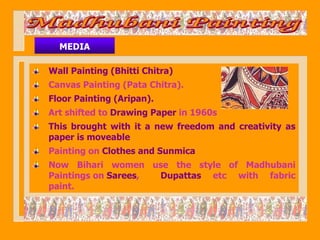
MEDIA

Wall Painting (Bhitti Chitra)
Canvas Painting (Pata Chitra).
Floor Painting (Aripan).
Art shifted to Drawing Paper in 1960s
This brought with it a new freedom and creativity as
paper is moveable
Painting on Clothes and Sunmica
Now Bihari women use the style of Madhubani
Paintings on Sarees, Dupattas etc with fabric
paint.
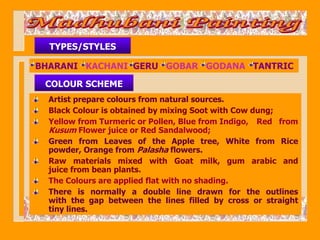
TYPES/STYLES

BHARANI KACHANI GERU GOBAR GODANA TANTRIC

 COLOUR SCHEME
  Artist prepare colours from natural sources.
  Black Colour is obtained by mixing Soot with Cow dung;
  Yellow from Turmeric or Pollen, Blue from Indigo, Red from
  Kusum Flower juice or Red Sandalwood;
  Green from Leaves of the Apple tree, White from Rice
  powder, Orange from Palasha flowers.
  Raw materials mixed with Goat milk, gum arabic and
  juice from bean plants.
  The Colours are applied flat with no shading.
  There is normally a double line drawn for the outlines
  with the gap between the lines filled by cross or straight
  tiny lines.
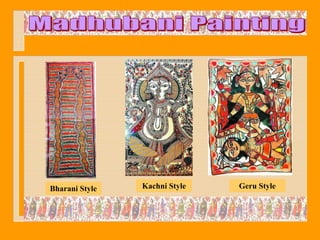
Bharani Style   Kachni Style   Geru Style
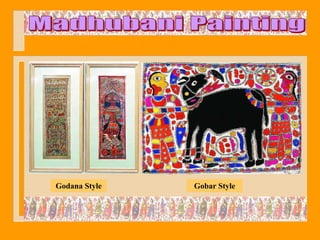
Godana Style   Gobar Style
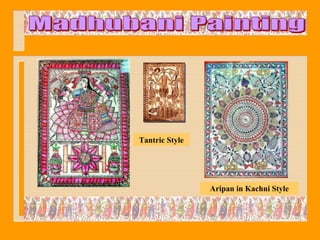
Tantric Style


                Aripan in Kachni Style
TOOLS

 NO sophisticated tools are needed in Madhubani
 Paintings. Artists are still unfamiliar with modern
 paintbrushes.
 One brush made from Bamboo Twigs
 Other used brush for filling in the space which is
 prepared from a small piece of cloth attached to a
 twig.
SOCIAL GROUPS
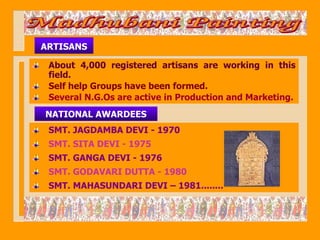
 Women of the Brahim Caste
 Women of Kayastha
 Women belonging to Scheduled Castes
 Women of Minority
ARTISANS

 About 4,000 registered artisans are working in this
 field.
 Self help Groups have been formed.
 Several N.G.Os are active in Production and Marketing.
NATIONAL AWARDEES
 SMT. JAGDAMBA DEVI - 1970
 SMT. SITA DEVI - 1975
 SMT. GANGA DEVI - 1976
 SMT. GODAVARI DUTTA - 1980
 SMT. MAHASUNDARI DEVI – 1981........
STATE AWARDEES

   SMT. MAHASUNDARI DEVI – 1978-79
   SMT. KARPOORI DEVI – 1980-81
   SMT. SHASHIKALA DEVI – 1980-81
   SMT. HIRA MISHRA – 1981-82 ..............

  CERTIFICATE OF EXCELLENCE BY THE STATE GOVT.
LATE RAUDI PASWAN, SRI SWAROOP LAL PASWAN, SMT. PATALI
DEVI, SMT. KAUSHLYA DEVI, SRI GANESH PASWAN, SMT.URMILA
DEVI, SMT.SHILA DEVI, SRI RAMJI RAM, SMT.RAMPARI DEVI,
SMT.CHANO DEVI, SRI SHIV NARAIN PASWAN, SRI UTTIM LAL,
SMT.URMILA DEVI, SMT.PAVITRI DEVI, SMT.TRIPURA DEVI,
SMT.SUMATI DAS, SMT. LALLI DEVI, SMT. VINA DEVI,
SMT.MAHANAMA DEVI, SMT.YOGMAYA DEVI, MS. NAMITA KUMARI,
SMT.VALESHWARI       DEVI,     SMT.DHARMSHILA      DEVI,
SMT.CHANDRAKALA DEVI, SMT.MUDRIKA DEVI.
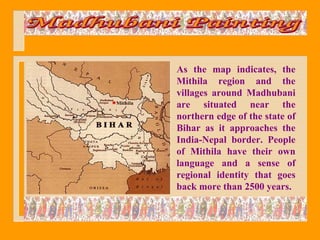
As the map indicates, the
Mithila region and the
villages around Madhubani
are situated near the
northern edge of the state of
Bihar as it approaches the
India-Nepal border. People
of Mithila have their own
language and a sense of
regional identity that goes
back more than 2500 years.
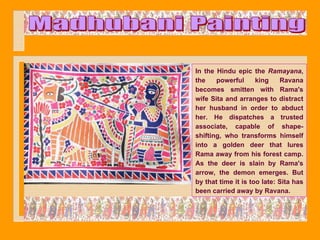
In the Hindu epic the Ramayana,
the    powerful      king    Ravana
becomes smitten with Rama's
wife Sita and arranges to distract
her husband in order to abduct
her. He dispatches a trusted
associate, capable of shape-
shifting, who transforms himself
into a golden deer that lures
Rama away from his forest camp.
As the deer is slain by Rama's
arrow, the demon emerges. But
by that time it is too late: Sita has
been carried away by Ravana.
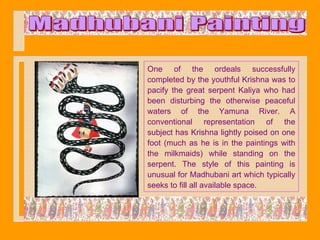
One of the ordeals successfully
completed by the youthful Krishna was to
pacify the great serpent Kaliya who had
been disturbing the otherwise peaceful
waters of the Yamuna River. A
conventional representation of the
subject has Krishna lightly poised on one
foot (much as he is in the paintings with
the milkmaids) while standing on the
serpent. The style of this painting is
unusual for Madhubani art which typically
seeks to fill all available space.
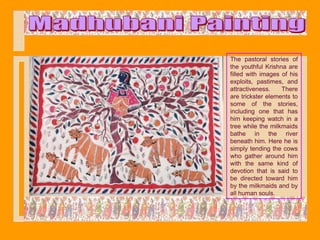
The pastoral stories of
the youthful Krishna are
filled with images of his
exploits, pastimes, and
attractiveness.    There
are trickster elements to
some of the stories,
including one that has
him keeping watch in a
tree while the milkmaids
bathe in the river
beneath him. Here he is
simply tending the cows
who gather around him
with the same kind of
devotion that is said to
be directed toward him
by the milkmaids and by
all human souls.
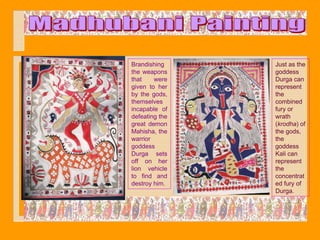
Brandishing     Just as the
the weapons     goddess
that    were    Durga can
given to her    represent
by the gods,    the
themselves      combined
incapable of    fury or
defeating the   wrath
great demon     (krodha) of
Mahisha, the    the gods,
warrior         the
goddess         goddess
Durga sets      Kali can
off on her      represent
lion vehicle    the
to find and     concentrat
destroy him.    ed fury of
                Durga.
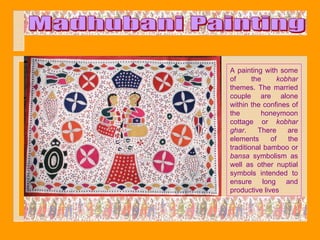
A painting with some
of      the     kobhar
themes. The married
couple are alone
within the confines of
the        honeymoon
cottage or kobhar
ghar.     There    are
elements      of   the
traditional bamboo or
bansa symbolism as
well as other nuptial
symbols intended to
ensure long and
productive lives
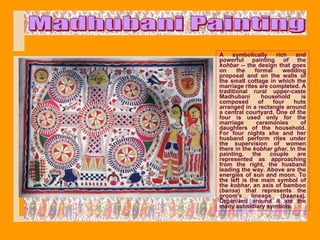
A    symbolically      rich   and
powerful painting of the
kohbar -- the design that goes
on     the     formal     wedding
proposal and on the walls of
the small cottage in which the
marriage rites are completed. A
traditional rural upper-caste
Madhubani         household     is
composed         of   four   huts
arranged in a rectangle around
a central courtyard. One of the
four is used only for the
marriage        ceremonies      of
daughters of the household.
For four nights she and her
husband perform rites under
the supervision of women
there in the kobhar ghar. In the
painting,     the    couple    are
represented as approaching
from the right, the husband
leading the way. Above are the
energies of sun and moon. To
the left is the main symbol of
the kobhar, an axis of bamboo
(bansa) that represents the
groom's      lineage     (baansa).
Organized around it are the
many subsidiary symbols.
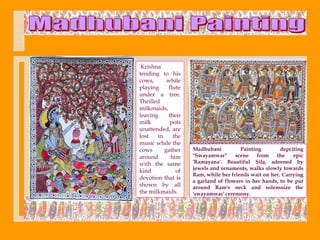
'Krishna'
tending to his
cows,      while
playing     flute
under a tree.
Thrilled
milkmaids,
leaving    their
milk        pots
unattended, are
lost   in     the
music while the
cows      gather    Madhubani          Painting        depciting
around       him    "Swayamwar"      scene    from   the    epic
with the same       'Ramayana'. Beautiful Sita, adorned by
                    jewels and ornaments, walks slowly towards
kind           of
                    Ram, while her friends wait on her. Carrying
devotion that is
                    a garland of flowers in her hands, to be put
shown by all        around Ram's neck and solemnize the
the milkmaids.      'swayamwar' ceremony.
Madubani painting pdf

Madubani painting pdf

  • 1.
    POWERPOINT PRESENTATION ON GOVT. OF BIHAR DEPARTMENT OF INDUSTRIES
  • 2.
    ORIGIN The origins fo Madhubani Painting are shrouded in antiquity, and a tradition states that this style of painting originated at the time of the Ramayana, when King Janak commissioned artists to do paintings at the time of marriage of his daughter SITA, to Hindu Lord Ram. Madhubani Painting has been done traditionally by the women of villages around the present town Madhubani, the literal meaning of which is forest of honey and the areas of Mithila. W.G.Archer, I.C.S., then S.D.O., Madhubani brought these paintings to the attention of outside world after the great Bihar Earthquake in 1934.
  • 3.
    ORIGIN The All IndiaHandicrafts Board, encouraged the women of Madhubani to paint on paper instead of Walls and Floor to facilitate the sale of paintings Outstanding Artists such as Jagadamba Devi. Sita Devi, Mahasundari Devi, Ookha Devi, Baua Devi and Karpoori Devi and many more were discovered. Credit goes to Puppul Jayakar, Bhaskar Kulkarni, Upendra Maharathi and Lalit Narayan Mishra for popularising the painting both in country and abroad.
  • 4.
    STYLE A style ofIndian Paintings practised in Madhubani, Darbhanga, Sitamarhi, Sheohar, Part of Samastipur, Purnea and Muzaffarpur. Depict Nature and Mythological events. Themes generally revolve around Hindu Deities like Krishna, Ram, Shiv, Durga, Laxmi, Kali and Saraswati. Natural objects like Sun, Moon and Religious plants like Tulsi and Social events like Wedding also painted. Paintings done on walls during festivals and religious events and other milestones of the life cycle such as Birth, Upanayan (sacred thread ceremony) and Marriage.
  • 5.
    MEDIA Wall Painting (BhittiChitra) Canvas Painting (Pata Chitra). Floor Painting (Aripan). Art shifted to Drawing Paper in 1960s This brought with it a new freedom and creativity as paper is moveable Painting on Clothes and Sunmica Now Bihari women use the style of Madhubani Paintings on Sarees, Dupattas etc with fabric paint.
  • 6.
    TYPES/STYLES BHARANI KACHANI GERUGOBAR GODANA TANTRIC COLOUR SCHEME Artist prepare colours from natural sources. Black Colour is obtained by mixing Soot with Cow dung; Yellow from Turmeric or Pollen, Blue from Indigo, Red from Kusum Flower juice or Red Sandalwood; Green from Leaves of the Apple tree, White from Rice powder, Orange from Palasha flowers. Raw materials mixed with Goat milk, gum arabic and juice from bean plants. The Colours are applied flat with no shading. There is normally a double line drawn for the outlines with the gap between the lines filled by cross or straight tiny lines.
  • 7.
    Bharani Style Kachni Style Geru Style
  • 8.
    Godana Style Gobar Style
  • 9.
    Tantric Style Aripan in Kachni Style
  • 10.
    TOOLS NO sophisticatedtools are needed in Madhubani Paintings. Artists are still unfamiliar with modern paintbrushes. One brush made from Bamboo Twigs Other used brush for filling in the space which is prepared from a small piece of cloth attached to a twig. SOCIAL GROUPS Women of the Brahim Caste Women of Kayastha Women belonging to Scheduled Castes Women of Minority
  • 11.
    ARTISANS About 4,000registered artisans are working in this field. Self help Groups have been formed. Several N.G.Os are active in Production and Marketing. NATIONAL AWARDEES SMT. JAGDAMBA DEVI - 1970 SMT. SITA DEVI - 1975 SMT. GANGA DEVI - 1976 SMT. GODAVARI DUTTA - 1980 SMT. MAHASUNDARI DEVI – 1981........
  • 12.
    STATE AWARDEES SMT. MAHASUNDARI DEVI – 1978-79 SMT. KARPOORI DEVI – 1980-81 SMT. SHASHIKALA DEVI – 1980-81 SMT. HIRA MISHRA – 1981-82 .............. CERTIFICATE OF EXCELLENCE BY THE STATE GOVT. LATE RAUDI PASWAN, SRI SWAROOP LAL PASWAN, SMT. PATALI DEVI, SMT. KAUSHLYA DEVI, SRI GANESH PASWAN, SMT.URMILA DEVI, SMT.SHILA DEVI, SRI RAMJI RAM, SMT.RAMPARI DEVI, SMT.CHANO DEVI, SRI SHIV NARAIN PASWAN, SRI UTTIM LAL, SMT.URMILA DEVI, SMT.PAVITRI DEVI, SMT.TRIPURA DEVI, SMT.SUMATI DAS, SMT. LALLI DEVI, SMT. VINA DEVI, SMT.MAHANAMA DEVI, SMT.YOGMAYA DEVI, MS. NAMITA KUMARI, SMT.VALESHWARI DEVI, SMT.DHARMSHILA DEVI, SMT.CHANDRAKALA DEVI, SMT.MUDRIKA DEVI.
  • 13.
    As the mapindicates, the Mithila region and the villages around Madhubani are situated near the northern edge of the state of Bihar as it approaches the India-Nepal border. People of Mithila have their own language and a sense of regional identity that goes back more than 2500 years.
  • 14.
    In the Hinduepic the Ramayana, the powerful king Ravana becomes smitten with Rama's wife Sita and arranges to distract her husband in order to abduct her. He dispatches a trusted associate, capable of shape- shifting, who transforms himself into a golden deer that lures Rama away from his forest camp. As the deer is slain by Rama's arrow, the demon emerges. But by that time it is too late: Sita has been carried away by Ravana.
  • 15.
    One of theordeals successfully completed by the youthful Krishna was to pacify the great serpent Kaliya who had been disturbing the otherwise peaceful waters of the Yamuna River. A conventional representation of the subject has Krishna lightly poised on one foot (much as he is in the paintings with the milkmaids) while standing on the serpent. The style of this painting is unusual for Madhubani art which typically seeks to fill all available space.
  • 16.
    The pastoral storiesof the youthful Krishna are filled with images of his exploits, pastimes, and attractiveness. There are trickster elements to some of the stories, including one that has him keeping watch in a tree while the milkmaids bathe in the river beneath him. Here he is simply tending the cows who gather around him with the same kind of devotion that is said to be directed toward him by the milkmaids and by all human souls.
  • 17.
    Brandishing Just as the the weapons goddess that were Durga can given to her represent by the gods, the themselves combined incapable of fury or defeating the wrath great demon (krodha) of Mahisha, the the gods, warrior the goddess goddess Durga sets Kali can off on her represent lion vehicle the to find and concentrat destroy him. ed fury of Durga.
  • 18.
    A painting withsome of the kobhar themes. The married couple are alone within the confines of the honeymoon cottage or kobhar ghar. There are elements of the traditional bamboo or bansa symbolism as well as other nuptial symbols intended to ensure long and productive lives
  • 19.
    A symbolically rich and powerful painting of the kohbar -- the design that goes on the formal wedding proposal and on the walls of the small cottage in which the marriage rites are completed. A traditional rural upper-caste Madhubani household is composed of four huts arranged in a rectangle around a central courtyard. One of the four is used only for the marriage ceremonies of daughters of the household. For four nights she and her husband perform rites under the supervision of women there in the kobhar ghar. In the painting, the couple are represented as approaching from the right, the husband leading the way. Above are the energies of sun and moon. To the left is the main symbol of the kobhar, an axis of bamboo (bansa) that represents the groom's lineage (baansa). Organized around it are the many subsidiary symbols.
  • 20.
    'Krishna' tending to his cows, while playing flute under a tree. Thrilled milkmaids, leaving their milk pots unattended, are lost in the music while the cows gather Madhubani Painting depciting around him "Swayamwar" scene from the epic with the same 'Ramayana'. Beautiful Sita, adorned by jewels and ornaments, walks slowly towards kind of Ram, while her friends wait on her. Carrying devotion that is a garland of flowers in her hands, to be put shown by all around Ram's neck and solemnize the the milkmaids. 'swayamwar' ceremony.