1
Who am I?
• Work in Probabilistic Machine Learning
• Like to teach 
• Feb 2017 – current: Senior Scientist, TCS Labs
• Previously at IBM Research India, IISc Bangalore
• 2006: Phd in CS, U. Maryland, College Park
• 1999: Btech in CSE, IIT KGP
Foundations of Algorithms and Machine Learning (CS60020), IIT KGP, 2017: Indrajit Bhattacharya
2
What about you?
• And what would you like to get out of this course?
Foundations of Algorithms and Machine Learning (CS60020), IIT KGP, 2017: Indrajit Bhattacharya
3
Logistics
• Pre-requisites
• Probability
• Linear algebra, optimization, high school calculus, …
• Recommended Books
• “Machine Learning: A Probabilistic Perspective”, Kevin Murphy
• “Pattern Recognition and Machine Learning”, Christopher Bishop
• “An Introduction to Probabilistic Graphical Models”, Michael
Jordan
• Evaluation
• Assignments
• Exam
Foundations of Algorithms and Machine Learning (CS60020), IIT KGP, 2017: Indrajit Bhattacharya
4
Machine Learning:
Why and What?
Foundations of Algorithms and Machine Learning (CS60020), IIT KGP, 2017: Indrajit Bhattacharya
5
How are ML problems different?
• Learning
• What does it mean?
• Abductive and inductive reasoning vs deductive reasoning
• Why do machines / programs need to learn?
• Does it “make sense” to learn to sort or to add?
Foundations of Algorithms and Machine Learning (CS60020), IIT KGP, 2017: Indrajit Bhattacharya
6
Why has ML taken off?
• Data
• Computational resources, storage
• Business interest
• Toolkits
• Sound mathematical principles
Foundations of Algorithms and Machine Learning (CS60020), IIT KGP, 2017: Indrajit Bhattacharya
7
Types of ML problems: Supervised Learning
• Predict response / output / label given input
• Input: d-dimensional vector. Features / attributes
• Output:
• Categorical: Binary, Multi-class, Multi-label
• Real valued: Simple regression, multiple regression
• Ordinal: Ordinal regression
• Ranking: Learning to rank
• Structured: Sequence, Tree, Graph
• Training set: both inputs and outputs available
• Test set: for evaluation; only inputs available
Foundations of Algorithms and Machine Learning (CS60020), IIT KGP, 2017: Indrajit Bhattacharya
8
Types of ML problems: Unsupervised Learning
• Also called Knowledge discovery
• No labels available
• No clear notion of training or test
• Discover “patterns” e.g. clusters in the data
• Density estimation
• Evaluation?
Foundations of Algorithms and Machine Learning (CS60020), IIT KGP, 2017: Indrajit Bhattacharya
9
Types of ML Problems: Reinforcement Learning
1. A robot vehicle on Mars
2. Learning to play chess
• Direct feedback only at the end
• Possibly closer to human learning
• Not covered in this course
Foundations of Algorithms and Machine Learning (CS60020), IIT KGP, 2017: Indrajit Bhattacharya
Foundations of Algorithms and Machine Learning (CS60020), IIT KGP, 2017: Indrajit Bhattacharya 10
Concept Learning: Example
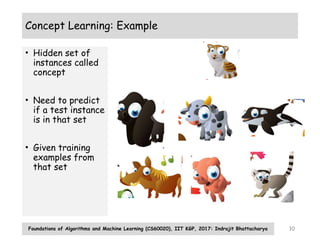
• Hidden set of
instances called
concept
• Need to predict
if a test instance
is in that set
• Given training
examples from
that set
Foundations of Algorithms and Machine Learning (CS60020), IIT KGP, 2017: Indrajit Bhattacharya 11
Probabilistic Concept Learning
• What are possible concepts? (Hypothesis space)
• How likely are the training examples to come from a particular
concept? (Training likelihood)
• How likely is the test example to belong to a particular
concept? (Test Likelihood)
• Bayesian Concept Learning
• How likely is a particular concept apriori? (Prior probability)
• How is likely is a particular concept after seeing the training
data? (posterior probability)
• How likely is the test example considering all these concepts and
their posterior probabilities?
12
Notions in ML
• Overfitting, generalization, regularization
• Validation of learning: whether future test instances are
correctly predicted
• Curse of dimensionality
• Lots of features is not always a good idea
• Model selection
• Need to know many different ML models
• “No free lunch” theorem
Foundations of Algorithms and Machine Learning (CS60020), IIT KGP, 2017: Indrajit Bhattacharya
13
Course Plan
• Module 1
• Introduction
• Machine Learning: What and why
• Probability review for Machine Learning
• Estimation and decision theory
• Simple probabilistic models for classification and regression
• Module 2
• Latent variable models
• Graphical Models: Models for complex (non-iid) data
• Module 3
• Non parametric models, Kernel methods
• Ensemble methods
Foundations of Algorithms and Machine Learning (CS60020), IIT KGP, 2017: Indrajit Bhattacharya

Machine Learning Theory and Algorithms Notes

  • 1.
    1 Who am I? •Work in Probabilistic Machine Learning • Like to teach  • Feb 2017 – current: Senior Scientist, TCS Labs • Previously at IBM Research India, IISc Bangalore • 2006: Phd in CS, U. Maryland, College Park • 1999: Btech in CSE, IIT KGP Foundations of Algorithms and Machine Learning (CS60020), IIT KGP, 2017: Indrajit Bhattacharya
  • 2.
    2 What about you? •And what would you like to get out of this course? Foundations of Algorithms and Machine Learning (CS60020), IIT KGP, 2017: Indrajit Bhattacharya
  • 3.
    3 Logistics • Pre-requisites • Probability •Linear algebra, optimization, high school calculus, … • Recommended Books • “Machine Learning: A Probabilistic Perspective”, Kevin Murphy • “Pattern Recognition and Machine Learning”, Christopher Bishop • “An Introduction to Probabilistic Graphical Models”, Michael Jordan • Evaluation • Assignments • Exam Foundations of Algorithms and Machine Learning (CS60020), IIT KGP, 2017: Indrajit Bhattacharya
  • 4.
    4 Machine Learning: Why andWhat? Foundations of Algorithms and Machine Learning (CS60020), IIT KGP, 2017: Indrajit Bhattacharya
  • 5.
    5 How are MLproblems different? • Learning • What does it mean? • Abductive and inductive reasoning vs deductive reasoning • Why do machines / programs need to learn? • Does it “make sense” to learn to sort or to add? Foundations of Algorithms and Machine Learning (CS60020), IIT KGP, 2017: Indrajit Bhattacharya
  • 6.
    6 Why has MLtaken off? • Data • Computational resources, storage • Business interest • Toolkits • Sound mathematical principles Foundations of Algorithms and Machine Learning (CS60020), IIT KGP, 2017: Indrajit Bhattacharya
  • 7.
    7 Types of MLproblems: Supervised Learning • Predict response / output / label given input • Input: d-dimensional vector. Features / attributes • Output: • Categorical: Binary, Multi-class, Multi-label • Real valued: Simple regression, multiple regression • Ordinal: Ordinal regression • Ranking: Learning to rank • Structured: Sequence, Tree, Graph • Training set: both inputs and outputs available • Test set: for evaluation; only inputs available Foundations of Algorithms and Machine Learning (CS60020), IIT KGP, 2017: Indrajit Bhattacharya
  • 8.
    8 Types of MLproblems: Unsupervised Learning • Also called Knowledge discovery • No labels available • No clear notion of training or test • Discover “patterns” e.g. clusters in the data • Density estimation • Evaluation? Foundations of Algorithms and Machine Learning (CS60020), IIT KGP, 2017: Indrajit Bhattacharya
  • 9.
    9 Types of MLProblems: Reinforcement Learning 1. A robot vehicle on Mars 2. Learning to play chess • Direct feedback only at the end • Possibly closer to human learning • Not covered in this course Foundations of Algorithms and Machine Learning (CS60020), IIT KGP, 2017: Indrajit Bhattacharya
  • 10.
    Foundations of Algorithmsand Machine Learning (CS60020), IIT KGP, 2017: Indrajit Bhattacharya 10 Concept Learning: Example • Hidden set of instances called concept • Need to predict if a test instance is in that set • Given training examples from that set
  • 11.
    Foundations of Algorithmsand Machine Learning (CS60020), IIT KGP, 2017: Indrajit Bhattacharya 11 Probabilistic Concept Learning • What are possible concepts? (Hypothesis space) • How likely are the training examples to come from a particular concept? (Training likelihood) • How likely is the test example to belong to a particular concept? (Test Likelihood) • Bayesian Concept Learning • How likely is a particular concept apriori? (Prior probability) • How is likely is a particular concept after seeing the training data? (posterior probability) • How likely is the test example considering all these concepts and their posterior probabilities?
  • 12.
    12 Notions in ML •Overfitting, generalization, regularization • Validation of learning: whether future test instances are correctly predicted • Curse of dimensionality • Lots of features is not always a good idea • Model selection • Need to know many different ML models • “No free lunch” theorem Foundations of Algorithms and Machine Learning (CS60020), IIT KGP, 2017: Indrajit Bhattacharya
  • 13.
    13 Course Plan • Module1 • Introduction • Machine Learning: What and why • Probability review for Machine Learning • Estimation and decision theory • Simple probabilistic models for classification and regression • Module 2 • Latent variable models • Graphical Models: Models for complex (non-iid) data • Module 3 • Non parametric models, Kernel methods • Ensemble methods Foundations of Algorithms and Machine Learning (CS60020), IIT KGP, 2017: Indrajit Bhattacharya