LAN Systems
Ethernet (CSAM/CD)
 Carriers Sense Multiple Access with Collision
Detection
 Xerox - Ethernet
 IEEE 802.3
IEEE802.3 Medium Access
Control
 Random Access
 Stations access medium randomly
 Contention
 Stations content for time on medium
ALOHA
 Packet Radio
 When station has frame, it sends
 Station listens (for max round trip time)plus small
increment
 If ACK, fine. If not, retransmit
 If no ACK after repeated transmissions, give up
 Frame check sequence (as in HDLC)
 If frame OK and address matches receiver, send ACK
 Frame may be damaged by noise or by another station
transmitting at the same time (collision)
 Any overlap of frames causes collision
 Max utilization 18%
Slotted ALOHA
 Time in uniform slots equal to frame
transmission time
 Need central clock (or other sync mechanism)
 Transmission begins at slot boundary
 Frames either miss or overlap totally
 Max utilization 37%
CSMA
 Propagation time is much less than transmission time
 All stations know that a transmission has started
almost immediately
 First listen for clear medium (carrier sense)
 If medium idle, transmit
 If two stations start at the same instant, collision
 Wait reasonable time (round trip plus ACK contention)
 No ACK then retransmit
 Max utilization depends on propagation time (medium
length) and frame length
 Longer frame and shorter propagation gives better utilization
If Busy?
Nonpersistent CSMA
1. If medium is idle, transmit; otherwise, go to 2
2. If medium is busy, wait amount of time drawn from
probability distribution (retransmission delay) and
repeat 1
 Random delays reduces probability of collisions
 Consider two stations become ready to transmit at same time
 While another transmission is in progress
 If both stations delay same time before retrying, both will
attempt to transmit at same time
 Capacity is wasted because medium will remain idle
following end of transmission
 Even if one or more stations waiting
 Nonpersistent stations deferential
1-persistent CSMA
 To avoid idle channel time, 1-persistent protocol
used
 Station wishing to transmit listens and obeys
following:
1. If medium idle, transmit; otherwise, go to step 2
2. If medium busy, listen until idle; then transmit
immediately
 1-persistent stations selfish
 If two or more stations waiting, collision guaranteed
 Gets sorted out after collision
P-persistent CSMA
 Compromise that attempts to reduce collisions
 Like nonpersistent
 And reduce idle time
 Like1-persistent
 Rules:
1. If medium idle, transmit with probability p, and delay
one time unit with probability (1 – p)
 Time unit typically maximum propagation delay
2. If medium busy, listen until idle and repeat step 1
3. If transmission is delayed one time unit, repeat step 1
 What is an effective value of p?
Value of p?
 Avoid instability under heavy load
 n stations waiting to send
 End of transmission, expected number of stations attempting to
transmit is number of stations ready times probability of
transmitting
 np
 If np > 1on average there will be a collision
 Repeated attempts to transmit almost guaranteeing more collisions
 Retries compete with new transmissions
 Eventually, all stations trying to send
 Continuous collisions; zero throughput
 So np < 1 for expected peaks of n
 If heavy load expected, p small
 However, as p made smaller, stations wait longer
 At low loads, this gives very long delays
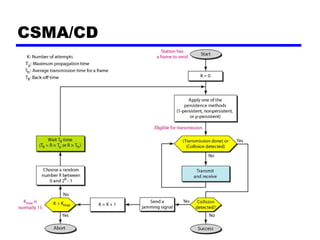
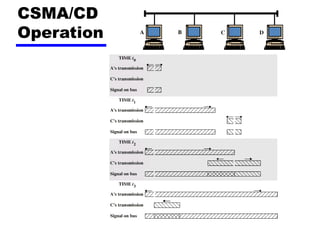
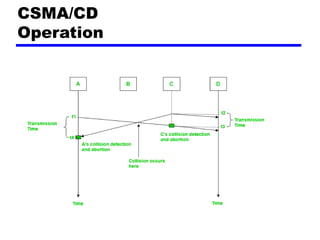
CSMA/CD
 With CSMA, collision occupies medium for
duration of transmission
 Stations listen whilst transmitting
 If medium idle, transmit
 If busy, listen for idle, then transmit
 If collision detected, jam then cease
transmission
 After jam, wait random time then start again
 Binary exponential back off
CSMA/CD
CSMA/CD
Operation
CSMA/CD
Operation
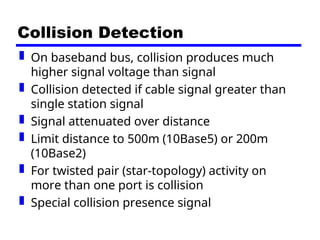
Collision Detection
 On baseband bus, collision produces much
higher signal voltage than signal
 Collision detected if cable signal greater than
single station signal
 Signal attenuated over distance
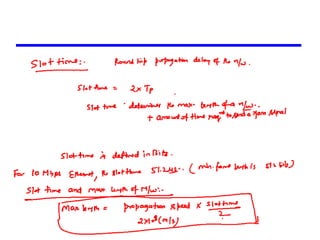
 Limit distance to 500m (10Base5) or 200m
(10Base2)
 For twisted pair (star-topology) activity on
more than one port is collision
 Special collision presence signal
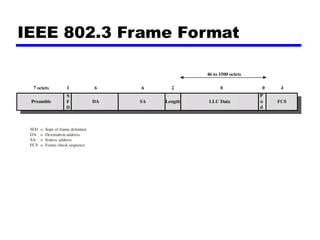
IEEE 802.3 Frame Format
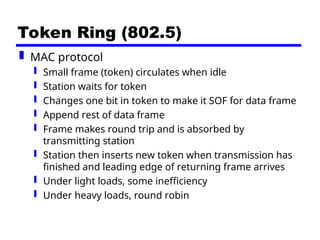
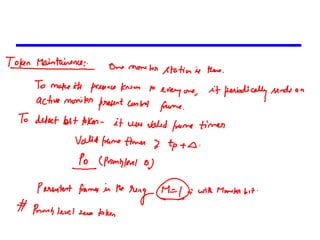
Token Ring (802.5)
 MAC protocol
 Small frame (token) circulates when idle
 Station waits for token
 Changes one bit in token to make it SOF for data frame
 Append rest of data frame
 Frame makes round trip and is absorbed by
transmitting station
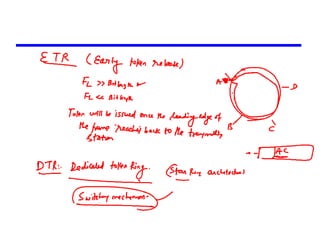
 Station then inserts new token when transmission has
finished and leading edge of returning frame arrives
 Under light loads, some inefficiency
 Under heavy loads, round robin
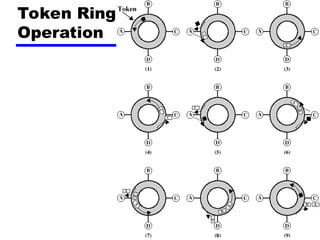
Token Ring
Operation
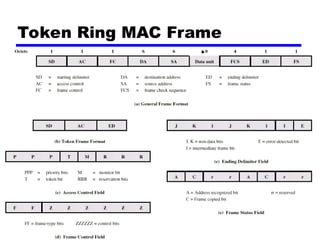
Token Ring MAC Frame
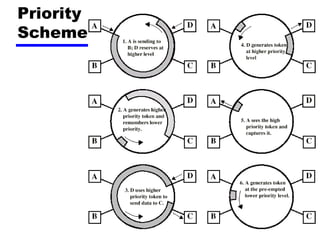
Priority
Scheme
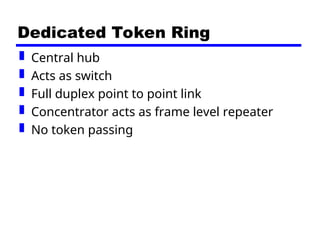
Dedicated Token Ring
 Central hub
 Acts as switch
 Full duplex point to point link
 Concentrator acts as frame level repeater
 No token passing
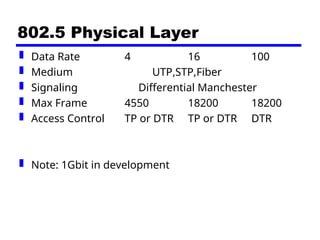
802.5 Physical Layer
 Data Rate 4 16 100
 Medium UTP,STP,Fiber
 Signaling Differential Manchester
 Max Frame 4550 18200 18200
 Access Control TP or DTR TP or DTR DTR
 Note: 1Gbit in development
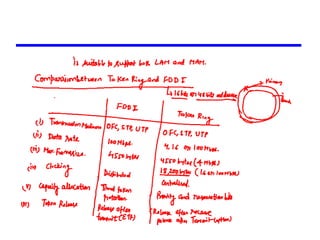
FDDI
 100Mbps
 LAN and MAN applications
 Token Ring
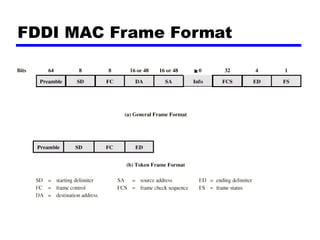
FDDI MAC Frame Format
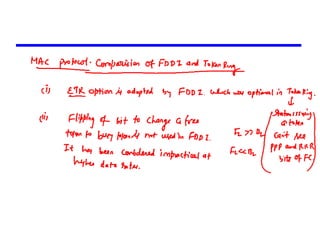
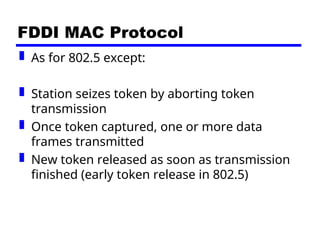
FDDI MAC Protocol
 As for 802.5 except:
 Station seizes token by aborting token
transmission
 Once token captured, one or more data
frames transmitted
 New token released as soon as transmission
finished (early token release in 802.5)
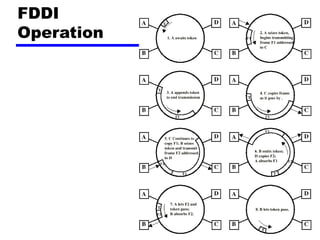
FDDI
Operation
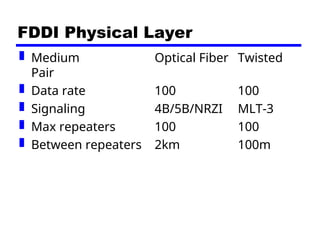
FDDI Physical Layer
 Medium Optical Fiber Twisted
Pair
 Data rate 100 100
 Signaling 4B/5B/NRZI MLT-3
 Max repeaters 100 100
 Between repeaters 2km 100m
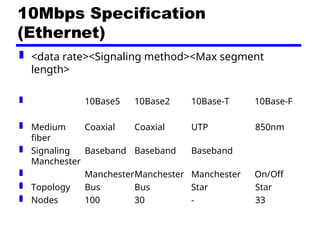
10Mbps Specification
(Ethernet)
 <data rate><Signaling method><Max segment
length>
 10Base5 10Base2 10Base-T 10Base-F
 Medium Coaxial Coaxial UTP 850nm
fiber
 Signaling Baseband Baseband Baseband
Manchester
 ManchesterManchester Manchester On/Off
 Topology Bus Bus Star Star
 Nodes 100 30 - 33
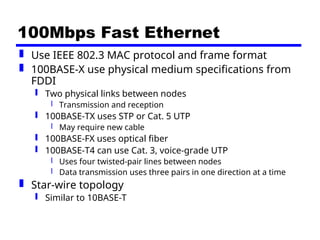
100Mbps Fast Ethernet
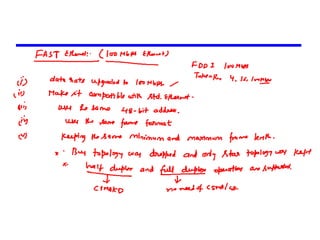
 Use IEEE 802.3 MAC protocol and frame format
 100BASE-X use physical medium specifications from
FDDI
 Two physical links between nodes
 Transmission and reception
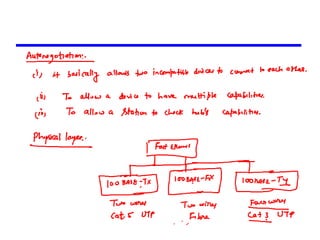
 100BASE-TX uses STP or Cat. 5 UTP
 May require new cable
 100BASE-FX uses optical fiber
 100BASE-T4 can use Cat. 3, voice-grade UTP
 Uses four twisted-pair lines between nodes
 Data transmission uses three pairs in one direction at a time
 Star-wire topology
 Similar to 10BASE-T
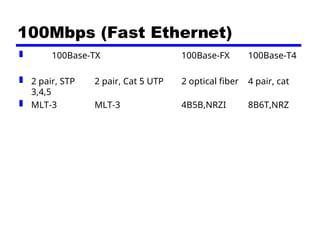
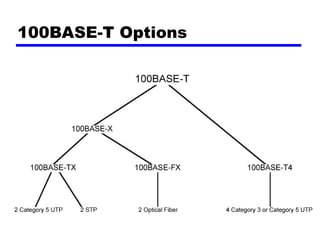
100Mbps (Fast Ethernet)
 100Base-TX 100Base-FX 100Base-T4
 2 pair, STP 2 pair, Cat 5 UTP 2 optical fiber 4 pair, cat
3,4,5
 MLT-3 MLT-3 4B5B,NRZI 8B6T,NRZ
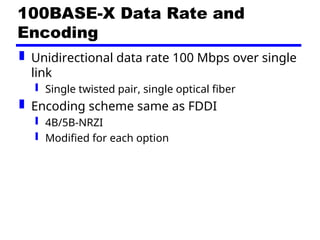
100BASE-X Data Rate and
Encoding
 Unidirectional data rate 100 Mbps over single
link
 Single twisted pair, single optical fiber
 Encoding scheme same as FDDI
 4B/5B-NRZI
 Modified for each option
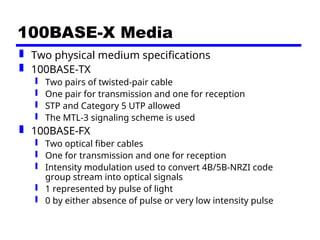
100BASE-X Media
 Two physical medium specifications
 100BASE-TX
 Two pairs of twisted-pair cable
 One pair for transmission and one for reception
 STP and Category 5 UTP allowed
 The MTL-3 signaling scheme is used
 100BASE-FX
 Two optical fiber cables
 One for transmission and one for reception
 Intensity modulation used to convert 4B/5B-NRZI code
group stream into optical signals
 1 represented by pulse of light
 0 by either absence of pulse or very low intensity pulse
100BASE-T4
 100-Mbps over lower-quality Cat 3 UTP
 Taking advantage of large installed base
 Cat 5 optional
 Does not transmit continuous signal between packets
 Useful in battery-powered applications
 Can not get 100 Mbps on single twisted pair
 Data stream split into three separate streams
 Each with an effective data rate of 33.33 Mbps
 Four twisted pairs used
 Data transmitted and received using three pairs
 Two pairs configured for bidirectional transmission
 NRZ encoding not used
 Would require signaling rate of 33 Mbps on each pair
 Does not provide synchronization
 Ternary signaling scheme (8B6T)
100BASE-T Options
Full Duplex Operation
 Traditional Ethernet half duplex
 Either transmit or receive but not both simultaneously
 With full-duplex, station can transmit and receive
simultaneously
 100-Mbps Ethernet in full-duplex mode, theoretical
transfer rate 200 Mbps
 Attached stations must have full-duplex adapter cards
 Must use switching hub
 Each station constitutes separate collision domain
 In fact, no collisions
 CSMA/CD algorithm no longer needed
 802.3 MAC frame format used
 Attached stations can continue CSMA/CD
Mixed Configurations
 Fast Ethernet supports mixture of existing 10-Mbps
LANs and newer 100-Mbps LANs
 E.g. 100-Mbps backbone LAN to support 10-Mbps
hubs
 Stations attach to 10-Mbps hubs using 10BASE-T
 Hubs connected to switching hubs using 100BASE-T
 Support 10-Mbps and 100-Mbps
 High-capacity workstations and servers attach directly to
10/100 switches
 Switches connected to 100-Mbps hubs using 100-Mbps links
 100-Mbps hubs provide building backbone
 Connected to router providing connection to WAN
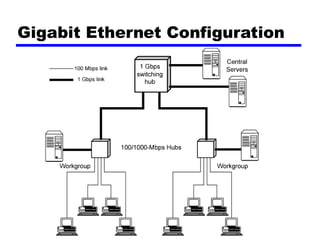
Gigabit Ethernet Configuration
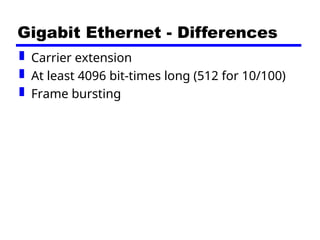
Gigabit Ethernet - Differences
 Carrier extension
 At least 4096 bit-times long (512 for 10/100)
 Frame bursting
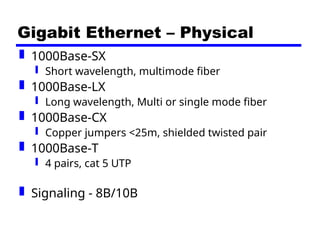
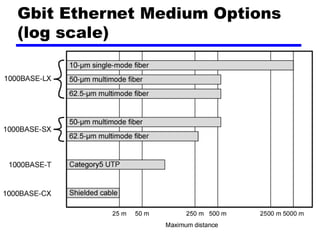
Gigabit Ethernet – Physical
 1000Base-SX
 Short wavelength, multimode fiber
 1000Base-LX
 Long wavelength, Multi or single mode fiber
 1000Base-CX
 Copper jumpers <25m, shielded twisted pair
 1000Base-T
 4 pairs, cat 5 UTP
 Signaling - 8B/10B
Gbit Ethernet Medium Options
(log scale)
10Gbps Ethernet - Uses
 High-speed, local backbone interconnection between large-
capacity switches
 Server farm
 Campus wide connectivity
 Enables Internet service providers (ISPs) and network service
providers (NSPs) to create very high-speed links at very low cost
 Allows construction of (MANs) and WANs
 Connect geographically dispersed LANs between campuses or
points of presence (PoPs)
 Ethernet competes with ATM and other WAN technologies
 10-Gbps Ethernet provides substantial value over ATM
10Gbps Ethernet - Advantages
 No expensive, bandwidth-consuming conversion
between Ethernet packets and ATM cells
 Network is Ethernet, end to end
 IP and Ethernet together offers QoS and traffic
policing approach ATM
 Advanced traffic engineering technologies available
to users and providers
 Variety of standard optical interfaces (wavelengths
and link distances) specified for 10 Gb Ethernet
 Optimizing operation and cost for LAN, MAN, or
WAN
10Gbps Ethernet - Advantages
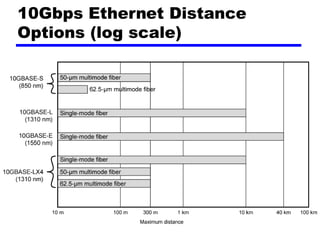
 Maximum link distances cover 300 m to 40 km
 Full-duplex mode only
 10GBASE-S (short):
 850 nm on multimode fiber
 Up to 300 m
 10GBASE-L (long)
 1310 nm on single-mode fiber
 Up to 10 km
 10GBASE-E (extended)
 1550 nm on single-mode fiber
 Up to 40 km
 10GBASE-LX4:
 1310 nm on single-mode or multimode fiber
 Up to 10 km
 Wavelength-division multiplexing (WDM) bit stream across four light
waves
10Gbps Ethernet Distance
Options (log scale)

MAC.ppt network computer data communication

  • 1.
  • 2.
    Ethernet (CSAM/CD)  CarriersSense Multiple Access with Collision Detection  Xerox - Ethernet  IEEE 802.3
  • 3.
    IEEE802.3 Medium Access Control Random Access  Stations access medium randomly  Contention  Stations content for time on medium
  • 4.
    ALOHA  Packet Radio When station has frame, it sends  Station listens (for max round trip time)plus small increment  If ACK, fine. If not, retransmit  If no ACK after repeated transmissions, give up  Frame check sequence (as in HDLC)  If frame OK and address matches receiver, send ACK  Frame may be damaged by noise or by another station transmitting at the same time (collision)  Any overlap of frames causes collision  Max utilization 18%
  • 5.
    Slotted ALOHA  Timein uniform slots equal to frame transmission time  Need central clock (or other sync mechanism)  Transmission begins at slot boundary  Frames either miss or overlap totally  Max utilization 37%
  • 6.
    CSMA  Propagation timeis much less than transmission time  All stations know that a transmission has started almost immediately  First listen for clear medium (carrier sense)  If medium idle, transmit  If two stations start at the same instant, collision  Wait reasonable time (round trip plus ACK contention)  No ACK then retransmit  Max utilization depends on propagation time (medium length) and frame length  Longer frame and shorter propagation gives better utilization
  • 7.
  • 8.
    Nonpersistent CSMA 1. Ifmedium is idle, transmit; otherwise, go to 2 2. If medium is busy, wait amount of time drawn from probability distribution (retransmission delay) and repeat 1  Random delays reduces probability of collisions  Consider two stations become ready to transmit at same time  While another transmission is in progress  If both stations delay same time before retrying, both will attempt to transmit at same time  Capacity is wasted because medium will remain idle following end of transmission  Even if one or more stations waiting  Nonpersistent stations deferential
  • 9.
    1-persistent CSMA  Toavoid idle channel time, 1-persistent protocol used  Station wishing to transmit listens and obeys following: 1. If medium idle, transmit; otherwise, go to step 2 2. If medium busy, listen until idle; then transmit immediately  1-persistent stations selfish  If two or more stations waiting, collision guaranteed  Gets sorted out after collision
  • 10.
    P-persistent CSMA  Compromisethat attempts to reduce collisions  Like nonpersistent  And reduce idle time  Like1-persistent  Rules: 1. If medium idle, transmit with probability p, and delay one time unit with probability (1 – p)  Time unit typically maximum propagation delay 2. If medium busy, listen until idle and repeat step 1 3. If transmission is delayed one time unit, repeat step 1  What is an effective value of p?
  • 11.
    Value of p? Avoid instability under heavy load  n stations waiting to send  End of transmission, expected number of stations attempting to transmit is number of stations ready times probability of transmitting  np  If np > 1on average there will be a collision  Repeated attempts to transmit almost guaranteeing more collisions  Retries compete with new transmissions  Eventually, all stations trying to send  Continuous collisions; zero throughput  So np < 1 for expected peaks of n  If heavy load expected, p small  However, as p made smaller, stations wait longer  At low loads, this gives very long delays
  • 12.
    CSMA/CD  With CSMA,collision occupies medium for duration of transmission  Stations listen whilst transmitting  If medium idle, transmit  If busy, listen for idle, then transmit  If collision detected, jam then cease transmission  After jam, wait random time then start again  Binary exponential back off
  • 13.
  • 14.
  • 15.
  • 16.
    Collision Detection  Onbaseband bus, collision produces much higher signal voltage than signal  Collision detected if cable signal greater than single station signal  Signal attenuated over distance  Limit distance to 500m (10Base5) or 200m (10Base2)  For twisted pair (star-topology) activity on more than one port is collision  Special collision presence signal
  • 17.
  • 18.
    Token Ring (802.5) MAC protocol  Small frame (token) circulates when idle  Station waits for token  Changes one bit in token to make it SOF for data frame  Append rest of data frame  Frame makes round trip and is absorbed by transmitting station  Station then inserts new token when transmission has finished and leading edge of returning frame arrives  Under light loads, some inefficiency  Under heavy loads, round robin
  • 19.
  • 20.
  • 21.
  • 24.
    Dedicated Token Ring Central hub  Acts as switch  Full duplex point to point link  Concentrator acts as frame level repeater  No token passing
  • 25.
    802.5 Physical Layer Data Rate 4 16 100  Medium UTP,STP,Fiber  Signaling Differential Manchester  Max Frame 4550 18200 18200  Access Control TP or DTR TP or DTR DTR  Note: 1Gbit in development
  • 26.
    FDDI  100Mbps  LANand MAN applications  Token Ring
  • 29.
  • 30.
    FDDI MAC Protocol As for 802.5 except:  Station seizes token by aborting token transmission  Once token captured, one or more data frames transmitted  New token released as soon as transmission finished (early token release in 802.5)
  • 31.
  • 32.
    FDDI Physical Layer Medium Optical Fiber Twisted Pair  Data rate 100 100  Signaling 4B/5B/NRZI MLT-3  Max repeaters 100 100  Between repeaters 2km 100m
  • 38.
    10Mbps Specification (Ethernet)  <datarate><Signaling method><Max segment length>  10Base5 10Base2 10Base-T 10Base-F  Medium Coaxial Coaxial UTP 850nm fiber  Signaling Baseband Baseband Baseband Manchester  ManchesterManchester Manchester On/Off  Topology Bus Bus Star Star  Nodes 100 30 - 33
  • 42.
    100Mbps Fast Ethernet Use IEEE 802.3 MAC protocol and frame format  100BASE-X use physical medium specifications from FDDI  Two physical links between nodes  Transmission and reception  100BASE-TX uses STP or Cat. 5 UTP  May require new cable  100BASE-FX uses optical fiber  100BASE-T4 can use Cat. 3, voice-grade UTP  Uses four twisted-pair lines between nodes  Data transmission uses three pairs in one direction at a time  Star-wire topology  Similar to 10BASE-T
  • 43.
    100Mbps (Fast Ethernet) 100Base-TX 100Base-FX 100Base-T4  2 pair, STP 2 pair, Cat 5 UTP 2 optical fiber 4 pair, cat 3,4,5  MLT-3 MLT-3 4B5B,NRZI 8B6T,NRZ
  • 44.
    100BASE-X Data Rateand Encoding  Unidirectional data rate 100 Mbps over single link  Single twisted pair, single optical fiber  Encoding scheme same as FDDI  4B/5B-NRZI  Modified for each option
  • 45.
    100BASE-X Media  Twophysical medium specifications  100BASE-TX  Two pairs of twisted-pair cable  One pair for transmission and one for reception  STP and Category 5 UTP allowed  The MTL-3 signaling scheme is used  100BASE-FX  Two optical fiber cables  One for transmission and one for reception  Intensity modulation used to convert 4B/5B-NRZI code group stream into optical signals  1 represented by pulse of light  0 by either absence of pulse or very low intensity pulse
  • 46.
    100BASE-T4  100-Mbps overlower-quality Cat 3 UTP  Taking advantage of large installed base  Cat 5 optional  Does not transmit continuous signal between packets  Useful in battery-powered applications  Can not get 100 Mbps on single twisted pair  Data stream split into three separate streams  Each with an effective data rate of 33.33 Mbps  Four twisted pairs used  Data transmitted and received using three pairs  Two pairs configured for bidirectional transmission  NRZ encoding not used  Would require signaling rate of 33 Mbps on each pair  Does not provide synchronization  Ternary signaling scheme (8B6T)
  • 47.
  • 48.
    Full Duplex Operation Traditional Ethernet half duplex  Either transmit or receive but not both simultaneously  With full-duplex, station can transmit and receive simultaneously  100-Mbps Ethernet in full-duplex mode, theoretical transfer rate 200 Mbps  Attached stations must have full-duplex adapter cards  Must use switching hub  Each station constitutes separate collision domain  In fact, no collisions  CSMA/CD algorithm no longer needed  802.3 MAC frame format used  Attached stations can continue CSMA/CD
  • 49.
    Mixed Configurations  FastEthernet supports mixture of existing 10-Mbps LANs and newer 100-Mbps LANs  E.g. 100-Mbps backbone LAN to support 10-Mbps hubs  Stations attach to 10-Mbps hubs using 10BASE-T  Hubs connected to switching hubs using 100BASE-T  Support 10-Mbps and 100-Mbps  High-capacity workstations and servers attach directly to 10/100 switches  Switches connected to 100-Mbps hubs using 100-Mbps links  100-Mbps hubs provide building backbone  Connected to router providing connection to WAN
  • 51.
  • 52.
    Gigabit Ethernet -Differences  Carrier extension  At least 4096 bit-times long (512 for 10/100)  Frame bursting
  • 53.
    Gigabit Ethernet –Physical  1000Base-SX  Short wavelength, multimode fiber  1000Base-LX  Long wavelength, Multi or single mode fiber  1000Base-CX  Copper jumpers <25m, shielded twisted pair  1000Base-T  4 pairs, cat 5 UTP  Signaling - 8B/10B
  • 54.
    Gbit Ethernet MediumOptions (log scale)
  • 55.
    10Gbps Ethernet -Uses  High-speed, local backbone interconnection between large- capacity switches  Server farm  Campus wide connectivity  Enables Internet service providers (ISPs) and network service providers (NSPs) to create very high-speed links at very low cost  Allows construction of (MANs) and WANs  Connect geographically dispersed LANs between campuses or points of presence (PoPs)  Ethernet competes with ATM and other WAN technologies  10-Gbps Ethernet provides substantial value over ATM
  • 56.
    10Gbps Ethernet -Advantages  No expensive, bandwidth-consuming conversion between Ethernet packets and ATM cells  Network is Ethernet, end to end  IP and Ethernet together offers QoS and traffic policing approach ATM  Advanced traffic engineering technologies available to users and providers  Variety of standard optical interfaces (wavelengths and link distances) specified for 10 Gb Ethernet  Optimizing operation and cost for LAN, MAN, or WAN
  • 57.
    10Gbps Ethernet -Advantages  Maximum link distances cover 300 m to 40 km  Full-duplex mode only  10GBASE-S (short):  850 nm on multimode fiber  Up to 300 m  10GBASE-L (long)  1310 nm on single-mode fiber  Up to 10 km  10GBASE-E (extended)  1550 nm on single-mode fiber  Up to 40 km  10GBASE-LX4:  1310 nm on single-mode or multimode fiber  Up to 10 km  Wavelength-division multiplexing (WDM) bit stream across four light waves
  • 58.