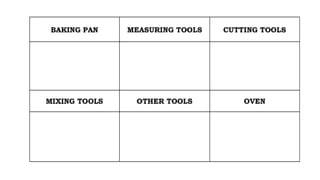
Classifying the toolswill help you to gather
and organize the materials during the actual
preparation. Let us review on what baking
tools can you recall under categories of baking
pans, measuring tools, cutting tools, mixing
tools, overs and other tools. Give at least 2
examples of each group.
4.
Baked products aremade from essentially the same
ingredients – flour, fats, sugar, eggs, water or milk,
and leavening
Combinations of these ingredients and preparation
methods produce the various general classifications
of baked products we see today.
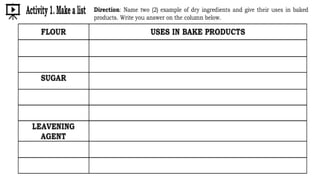
1. FLOUR:
– Itis the primary ingredient of most baked products
because it provides the structure of the merchandise.
The sort of flour commonly used in baking comes from
the wheat grain.
There are various varieties of flour that comes from
wheat but these will be generally classified as ‘strong’ or
‘weak’ flour.
This classification is predicated on the number of
proteins present within the flour.
8.
Gluten determines theform and texture of the merchandise.
Strong flours come from macaroni wheat and have high
protein content (whole wheat and bread flours).
These are best used for breads, while weak flours from wheat
with lower protein content (all-purpose flour and cake flour)
are utilized in cakes, quick breads, cookies, and pies.
Flour is usually starch, but the protein content (7 to 14%) is
vital because it determines gluten formation.
9.
Kinds of Flour
a.Whole Wheat Flour
– is also known as Graham or whole wheat flour. It is made
by grinding the entire wheat kernel. It is high in fat, it turns
rancid fast, and does not keep as long as white flour.
However, whole wheat flour is more nutritious than white
flour.
b. Bread Flour
- also known as strong or hard flour. It has more gluten
strength and protein content than all-purpose flour. Bread
flour has 12% to 14% protein and granular texture.
10.
c. All-Purpose Flour
-also known as general-purpose flour, has a protein
content that varies from 10% to 11%. It is slightly
weaker than bread flour but is versatile enough for
almost all cooking purposes.
d. Cake Flour
- is a type of soft wheat flour with a protein content of 7%
to 9%. Finely milled and highly bleached, it has a smooth
texture and pure white color, making it perfect for baking
cakes and delicate baked goods that need low gluten
content.
11.
Other kinds offlour
e. Rice Flour - It is made from finely milled rice. It can be made
from either white or brown rice. It has 6.5 to 7%
protein, but it does not form gluten.
Uses of Flour
1. Flour provides bulk and structure to baked products.
2. It contributes color, texture, and flavor to baked products.
3. It improves the nutritive value of food, because it
contains protein, riboflavin, iron, niacin, and other minerals.
4. It is used for various cooking purposes as a thickener,
binder, for dredging food, and as a stiffening agent in laundry.
12.
Proper Storage
Flour isbest stored in a very tightly closed container and kept in a
cool, dark pantry or shelf to forestall it from moisture, dirt, and
insects. All-purpose flour and cake flour are best stored at a
temperature in an exceedingly cool, dry place. Flour if properly kept it
will last up to 5-6 months.
Good Quality Flour
Good Quality flour is fresh and free from weevils, retain its
distinctive color and has no undesirable odor.
13.
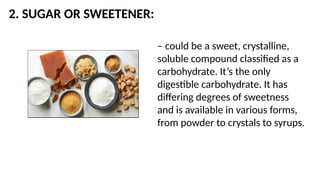
2. SUGAR ORSWEETENER:
– could be a sweet, crystalline,
soluble compound classified as a
carbohydrate. It’s the only
digestible carbohydrate. It has
differing degrees of sweetness
and is available in various forms,
from powder to crystals to syrups.
14.
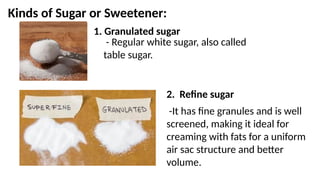
Kinds of Sugaror Sweetener:
1. Granulated sugar
- Regular white sugar, also called
table sugar.
2. Refine sugar
-It has fine granules and is well
screened, making it ideal for
creaming with fats for a uniform
air sac structure and better
volume.
15.
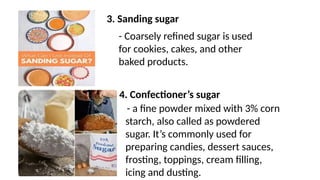
3. Sanding sugar
-Coarsely refined sugar is used
for cookies, cakes, and other
baked products.
4. Confectioner’s sugar
- a fine powder mixed with 3% corn
starch, also called as powdered
sugar. It’s commonly used for
preparing candies, dessert sauces,
frosting, toppings, cream filling,
icing and dusting.
16.
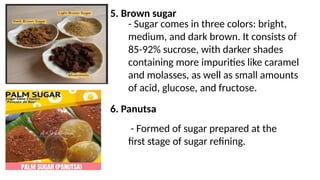
5. Brown sugar
-Sugar comes in three colors: bright,
medium, and dark brown. It consists of
85-92% sucrose, with darker shades
containing more impurities like caramel
and molasses, as well as small amounts
of acid, glucose, and fructose.
6. Panutsa
- Formed of sugar prepared at the
first stage of sugar refining.
17.
Uses of Sugarin Baked Products
1. Sugar gives sweetness and flavor to baked products.
2. Contribute to the tenderness and fineness of the texture of baked
products.
3. Increases its strong qualities by retaining moisture.
4. Gives richer crust color.
5. Serve as food for the yeast.
6. Serves as a creaming agent with fats and a foaming agent with eggs.
7. Increase dough development. It also increases tenderness and
develops crust color.
8. Add volume to bread.
18.
Proper
Storage of
Sugar
Sugar isbest stored in an airtight
container or canister. White sugar
is kept in a covered container in a
dry place at room temperature.
Brown sugar is kept in an airtight
container to prevent it from
drying and hardening.
19.
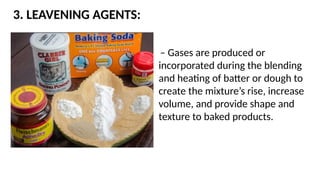
3. LEAVENING AGENTS:
–Gases are produced or
incorporated during the blending
and heating of batter or dough to
create the mixture’s rise, increase
volume, and provide shape and
texture to baked products.
20.
Kinds of LeaveningAgents:
Biological Leavening Agent
Yeast -- a living organism that consists of living yeast plants. It’s rich
in B vitamins and protein. Yeast needs liquid, food, and heat to
grow new yeast cells and form the gas that lightens the bread
and makes it rise.
Available as active dry yeast or instant yeast. Active dry yeast
consists of coarse oblong granules. Instant yeast or rapid-rise
yeast has smaller granules and dissolve faster.
Fermentation of yeast is vital within the formation and
stabilization of gluten; thus, it’s best used for breads and
other yeast products.
21.
Chemical Leavening agent
a.Baking Soda (Sodium hydrogen carbonate)
- contains hydrogen carbonate, which may be a slow-acting acid.
It’s a fine white powder that encompasses a slightly salty and
alkaline taste (mapakla)
b. Baking powder
- is formed of bicarbonate, a dry acidic powder, and cornstarch.
Overuse of leavening more than that laid out in the recipe results
in undesirable flavor and texture of baked products. It’s available
as single-acting or double-acting leaven. Single-acting leavening
requires only moisture to release gas. Double-acting leavening
releases gas in two stages. First, during mixing, and second
during the method of heating or baking.
22.
Uses of LeaveningAgent in Baked Products
1. Increase the volume.
2. Give shape and texture.
3. Make bread lighter and easier to chew.
Proper Storage
Fresh yeast should always be refrigerated. Dry yeast, baking
powder, and baking soda must be kept in an airtight container
in a cool, dry place away from heat and light. Because heat
causes deterioration and the leavening power is lost when the
container is left open.
NOTE:
But keep inmind that using a different
ingredient may result in changes in your
product’s texture and taste. It is a good
idea, before substituting, to understand
the role that ingredients play in the
recipe.
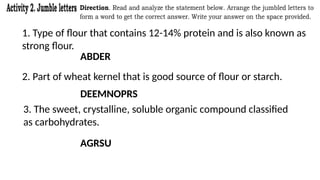
26.
1. Type offlour that contains 12-14% protein and is also known as
strong flour.
ABDER
2. Part of wheat kernel that is good source of flour or starch.
DEEMNOPRS
3. The sweet, crystalline, soluble organic compound classified
as carbohydrates.
AGRSU
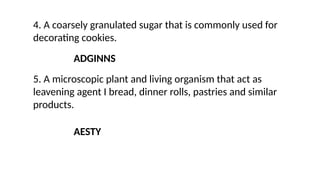
27.
4. A coarselygranulated sugar that is commonly used for
decorating cookies.
ADGINNS
5. A microscopic plant and living organism that act as
leavening agent I bread, dinner rolls, pastries and similar
products.
AESTY
28.
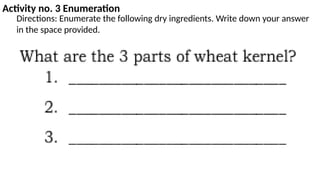
Activity no. 3Enumeration
Directions: Enumerate the following dry ingredients. Write down your answer
in the space provided.
32.
As a futureentrepreneur/baking enthusiast, would
you still consider using ingredients that are not
healthy/nutritious for your customers but would still
give good flavors on your products?
VALUING:
![baking ingredients and its functions [Autosaved].pptx](https://cdn.slidesharecdn.com/ss_thumbnails/bakingingredientsanditsfunctionsautosaved-230920210354-aa55c159-thumbnail.jpg?width=640&height=640&fit=bounds)
![baking ingredients and its functions [Autosaved].pptx](https://cdn.slidesharecdn.com/ss_thumbnails/bakingingredientsanditsfunctionsautosaved-240731053745-1a791d6a-thumbnail.jpg?width=640&height=640&fit=bounds)


