Copyright © 2010 Pearson Prentice Hall. All rights reserved.
Chapter 4
The Balance of
Payments
Copyright © 2010 Pearson Prentice Hall. All rights reserved.
4-2
The Balance of Payments
• International business transactions occur in
many different forms over the course of a
year
• The measurement of all international
economic transactions between the
residents of a country and foreign residents
is called the balance of payments (BOP)
Copyright © 2010 Pearson Prentice Hall. All rights reserved.
4-3
The Balance of Payments
• BOP data is important for government policymakers and
MNEs as it is a gauge of a nations competitiveness or health
(domestic and/or foreign)
• For a MNE both home and host country BOP data is
important as:
– An indication of pressure on a country’s foreign exchange
rate
– A signal of the imposition or removal of controls in
various sorts of payments (dividends, interest, license
fees, royalties and other cash disbursements)
– A forecast of a country’s market potential (especially in
the short run)
Copyright © 2010 Pearson Prentice Hall. All rights reserved.
4-4
Typical BOP Transactions
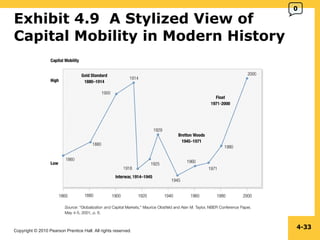
• Each of the following represents an international
economic transaction that is counted in and
captured in the US BOP:
– A US subsidiary of a foreign MNE acts as a distributor for
the MNEs products in the US market
– A US based firm, manages the construction of a major
water treatment facility in a foreign country
– The US subsidiary of a foreign firm pays profits
(dividends) back to a parent in its home (foreign) country
– The US government finances the purchase of military
equipment for a foreign military ally
Copyright © 2010 Pearson Prentice Hall. All rights reserved.
4-5
Fundamentals of BOP Accounting
• The BOP must balance
• It cannot be in disequilibrium unless
something has not been counted or has
been counted improperly
• Therefore it is incorrect to state that the
BOP is in disequilibrium
Copyright © 2010 Pearson Prentice Hall. All rights reserved.
4-6
Fundamentals of BOP Accounting
• There are three main elements of the actual process of
measuring international economic activity:
– Identifying what is and is not an international economic
transaction
– Understanding how the flow of goods, services, assets,
and money create debits and credits to the overall BOP
– Understanding the bookkeeping procedures for BOP
accounting
• It is a daunting task to measure all international transactions
that take place in and out of a country over a year
Copyright © 2010 Pearson Prentice Hall. All rights reserved.
4-7
The BOP as a Flow Statement
• The BOP is often misunderstood as many people
infer from its name that it is a balance sheet,
whereas in fact it is a cash flow statement
• By recording all international transactions over a
period of time such as a year, it tracks the
continuing flows of purchases and payments
between a country and all other countries
• It does not add up the value of all assets and
liabilities of a country on a specific date (as an
individual firm’s balance sheet would do)
Copyright © 2010 Pearson Prentice Hall. All rights reserved.
4-8
The BOP as a Flow Statement
• Two types of business transactions
dominate the balance of payments:
– Exchange of Real Assets
– Exchange of Financial Assets
• Although assets can be identified as
belonging to distinct groups, it is easier to
think of all assets simply as goods that can
be bought or sold (a clock versus a bond)
Copyright © 2010 Pearson Prentice Hall. All rights reserved.
4-9
The Accounts of the BOP
• The BOP is composed of two primary sub
accounts, the Current Account and the
Capital/Financial Account
• In addition, the Official Reserves account
tracks government currency transactions
• A fourth account, the Net Errors and
Omissions account is produced to
preserve the balance of the BOP
Copyright © 2010 Pearson Prentice Hall. All rights reserved.
4-10
The Current Account
• The Current Account includes all international
economic transactions with income or payment
flows occurring within one year, the current
period. It consists of the following four
subcategories:
– Goods trade and import of goods
– Services trade
– Income
– Current transfers
• The Current Account is typically dominated by the
first component which is known as the Balance of
Trade (BOT) even though it excludes service trade
Copyright © 2010 Pearson Prentice Hall. All rights reserved.
4-11
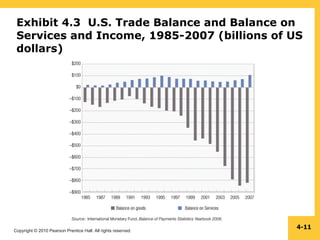
Exhibit 4.3 U.S. Trade Balance and Balance on
Services and Income, 1985-2007 (billions of US
dollars)
Copyright © 2010 Pearson Prentice Hall. All rights reserved.
4-12
The Current Account
• The deficits in the BOT of the past decade have
been an area of considerable concern for the
United States, in both the public and private
sectors
• The goods trade deficit saw the decline of heavy
traditional industries in the U.S. (steel,
automobiles, automotive parts, textiles)
Copyright © 2010 Pearson Prentice Hall. All rights reserved.
4-13
The Capital/Financial Account
• The Capital Account of the balance of
payments measures all international
economic transactions of financial assets.
It is divided into two major components:
– The Capital Account
– The Financial Account
• The Capital Account is minor (in
magnitude), while the Financial Account is
significant
Copyright © 2010 Pearson Prentice Hall. All rights reserved.
4-14
The Financial Account
• Financial assets can be classified in a
number of different ways including the
length of the life of the asset (maturity)
and the nature of the ownership (public or
private)
• The Financial Account, however, uses a
third method. This focuses on the degree
of investor control over the assets or
operations
Copyright © 2010 Pearson Prentice Hall. All rights reserved.
4-15
The Financial Account
• The Financial Account consists of three
components;
– Direct Investment – in which the investor exerts
some explicit degree of control over the assets
– Portfolio Investment – in which the investor has
no control over the assets
– Other Investment – consists of various short-
term and long-term trade credits, cross-border
loans, currency deposits, bank deposits and
other A/R and A/P related to cross-border trade
Copyright © 2010 Pearson Prentice Hall. All rights reserved.
4-16
Direct Investment
• This is the net balance of capital dispersed from and into the
US for the purpose of exerting control over assets.
• Foreign direct investment arises from 10% ownership of
voting shares in a domestic firm by foreign investors.
• The source of concern over foreign investment in any
country focuses on two topics: control and profit.
• Some countries possess restrictions on foreigners may own
in their country.
• The general rule or premise is that domestic land, assets
and industry should be owned by residents of the country.
• Concerns over profit stem from the same argument.
Copyright © 2010 Pearson Prentice Hall. All rights reserved.
4-17
Portfolio Investment
• This is the net balance of capital that flows in and
out of the U.S. but does not reach the 10%
threshold of direct investment.
• The purchase of debt securities across borders is
classified as portfolio investment because debt
securities by definition do not provide the buyer
with ownership or control.
• Portfolio investment is motivated by a search for
returns rather than to control or manage the
investment.
Copyright © 2010 Pearson Prentice Hall. All rights reserved.
4-18
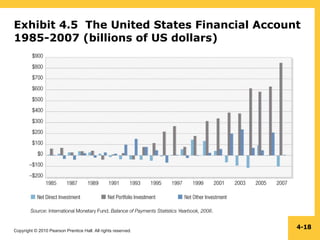
Exhibit 4.5 The United States Financial Account
1985-2007 (billions of US dollars)
Copyright © 2010 Pearson Prentice Hall. All rights reserved.
4-19
Net Errors & Omissions/Official
Reserves Accounts
• The Net Errors and Omissions account ensures
that the BOP actually balances.
• The Official Reserves Account is the total reserves
held by official monetary authorities within the
country.
• These reserves are normally composed of the
major currencies used in international trade and
financial transactions (hard currencies).
• The significance of official reserves depends
generally on whether the country is operating
under a fixed exchange rate regime or a floating
exchange rate system.
Copyright © 2010 Pearson Prentice Hall. All rights reserved.
4-20
The BOP in Total — Surplus
• A surplus in the BOP implies that the
demand for the country’s currency
exceeded the supply and that the
government should allow the currency
value to increase – in value – or intervene
and accumulate additional foreign currency
reserves in the Official Reserves Account.
Copyright © 2010 Pearson Prentice Hall. All rights reserved.
4-21
The BOP in Total — Deficit
• A deficit in the BOP implies an excess
supply of the country’s currency on world
markets, and the government should then
either devalue the currency or expend its
official reserves to support its value.
Copyright © 2010 Pearson Prentice Hall. All rights reserved.
4-22
The BOP Interaction with Key
Macroeconomic Variables
• A nation’s balance of payments interacts
with nearly all of its key macroeconomic
variables
• Interacts means that the BOP affects and is
affected by such key macroeconomic
factors as:
– Gross Domestic Product (GDP)
– The exchange rate
– Interest rates
– Inflation rates
Copyright © 2010 Pearson Prentice Hall. All rights reserved.
4-23
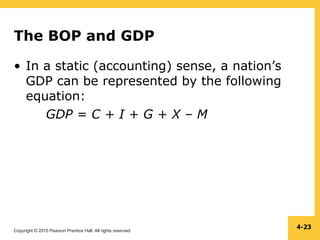
The BOP and GDP
• In a static (accounting) sense, a nation’s
GDP can be represented by the following
equation:
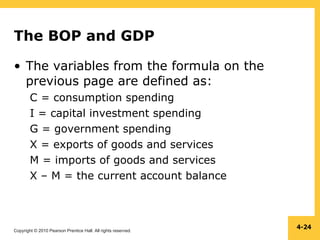
GDP = C + I + G + X – M
Copyright © 2010 Pearson Prentice Hall. All rights reserved.
4-24
The BOP and GDP
• The variables from the formula on the
previous page are defined as:
C = consumption spending
I = capital investment spending
G = government spending
X = exports of goods and services
M = imports of goods and services
X – M = the current account balance
Copyright © 2010 Pearson Prentice Hall. All rights reserved.
4-25
The BOP and Exchange Rates
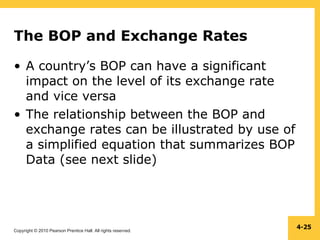
• A country’s BOP can have a significant
impact on the level of its exchange rate
and vice versa
• The relationship between the BOP and
exchange rates can be illustrated by use of
a simplified equation that summarizes BOP
Data (see next slide)
Copyright © 2010 Pearson Prentice Hall. All rights reserved.
4-26
The BOP and Exchange Rates
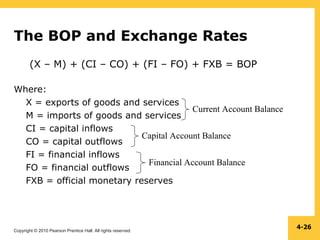
(X – M) + (CI – CO) + (FI – FO) + FXB = BOP
Where:
X = exports of goods and services
M = imports of goods and services
CI = capital inflows
CO = capital outflows
FI = financial inflows
FO = financial outflows
FXB = official monetary reserves
Current Account Balance
Capital Account Balance
Financial Account Balance
Copyright © 2010 Pearson Prentice Hall. All rights reserved.
4-27
The BOP and Exchange Rates
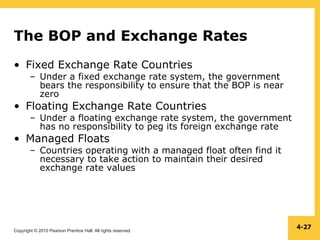
• Fixed Exchange Rate Countries
– Under a fixed exchange rate system, the government
bears the responsibility to ensure that the BOP is near
zero
• Floating Exchange Rate Countries
– Under a floating exchange rate system, the government
has no responsibility to peg its foreign exchange rate
• Managed Floats
– Countries operating with a managed float often find it
necessary to take action to maintain their desired
exchange rate values
Copyright © 2010 Pearson Prentice Hall. All rights reserved.
4-28
The BOP and Interest Rates
• Apart from the use of interest rates to intervene in the
foreign exchange market, the overall level of a country’s
interest rates compared to other countries does have and
impact on the financial account of the BOP
• Relatively low real interest rates should normally
stimulate an outflow of capital seeking higher rates
elsewhere
• However, in the case of the U.S., the opposite has
occurred due to perceived growth opportunities and
political stability – allowing it to finance its large fiscal
deficit
• However, it is beginning to appear that the favorable
inflow on the financial account is diminishing while the
current account balance is worsening – making the U.S. a
bigger debtor nation vis-à-vis the rest of the world
Copyright © 2010 Pearson Prentice Hall. All rights reserved.
4-29
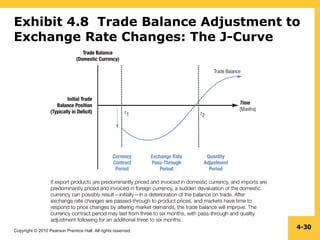
Trade Balances and Exchange Rates
• A country’s import and export of goods and
services is affected by changes in exchange
rates
• The transmission mechanism is in principle quite
simple: changes in exchange rates change
relative process of imports and exports, and
changing prices in turn result in changes in
quantities demanded through the price elasticity
of demand
• Theoretically, this is straightforward, in reality
global business is more complex
Copyright © 2010 Pearson Prentice Hall. All rights reserved.
4-30
Exhibit 4.8 Trade Balance Adjustment to
Exchange Rate Changes: The J-Curve
Copyright © 2010 Pearson Prentice Hall. All rights reserved.
4-31
Capital Mobility
• The degree to which capital moves freely
across borders is critically important to a
country’s balance of payments
• The financial account surplus has probably
been one of the major reasons that the
U.S. dollar has been able to maintain its
value over the past 20 years
Copyright © 2010 Pearson Prentice Hall. All rights reserved.
4-32
Capital Mobility
• The authors argue that the post-1860 era can be subdivided
into four distinct periods with regard to capital mobility.
– 1860-1914 – continuously increasing capital mobility as the gold
standard was adopted and international trade relations were
expanded
– 1914-1945 – global economic destruction, isolationist economic
policies, negative effect on capital movement between countries
– 1945-1971 – Bretton Woods era say a great expansion of
international trade
– 1971-2002 – floating exchange rates, economic volatility,
rapidly expanding cross-border capital flows
0
Copyright © 2010 Pearson Prentice Hall. All rights reserved.
4-33
0
Exhibit 4.9 A Stylized View of
Capital Mobility in Modern History
Copyright © 2010 Pearson Prentice Hall. All rights reserved.
4-34
Capital Flight
• Although no single definition of capital flight
exists, it has been characterized as occurring when
capital transfers by residents conflict with political
objectives.
• Many heavily indebted countries have suffered
capital flight, compounding their debt service
problems.
• Capital can be moved via international transfers,
with physical currency, collectables or precious
metals, money laundering or false invoicing of
international trade transactions.
0
Copyright © 2010 Pearson Prentice Hall. All rights reserved.
4-35
Mini-Case Questions: Turkey’s Kriz (A)
• Where in the current account would the
imported telecommunications equipment
be listed? Would this location correspond
to the increase in magnitude and timing of
the financial account?
• Why do you think that net direct
investment declined from $573 million in
1998 to $112 million in 2000?
• Why do you think that TelSim defaulted on
its payments for equipment imports from
Nokia and Motorola?
Copyright © 2010 Pearson Prentice Hall. All rights reserved.
Chapter 4
Additional
Chapter Exhibits
Copyright © 2010 Pearson Prentice Hall. All rights reserved.
4-37
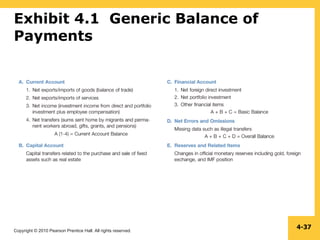
Exhibit 4.1 Generic Balance of
Payments
Copyright © 2010 Pearson Prentice Hall. All rights reserved.
4-38
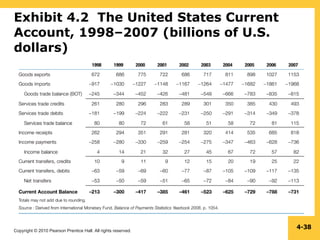
Exhibit 4.2 The United States Current
Account, 1998–2007 (billions of U.S.
dollars)
Copyright © 2010 Pearson Prentice Hall. All rights reserved.
4-39
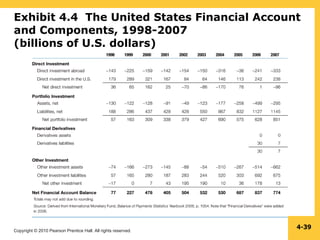
Exhibit 4.4 The United States Financial Account
and Components, 1998-2007
(billions of U.S. dollars)
Copyright © 2010 Pearson Prentice Hall. All rights reserved.
4-40
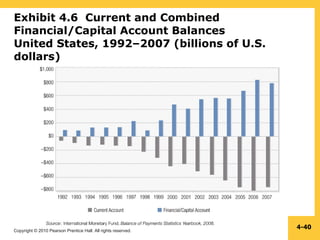
Exhibit 4.6 Current and Combined
Financial/Capital Account Balances
United States, 1992–2007 (billions of U.S.
dollars)
Copyright © 2010 Pearson Prentice Hall. All rights reserved.
4-41
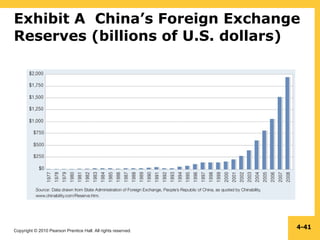
Exhibit A China’s Foreign Exchange
Reserves (billions of U.S. dollars)
Copyright © 2010 Pearson Prentice Hall. All rights reserved.
4-42
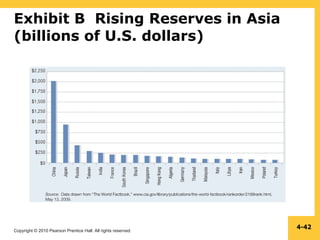
Exhibit B Rising Reserves in Asia
(billions of U.S. dollars)
Copyright © 2010 Pearson Prentice Hall. All rights reserved.
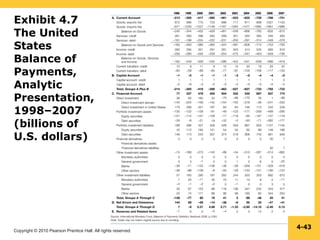
4-43
Exhibit 4.7
The United
States
Balance of
Payments,
Analytic
Presentation,
1998–2007
(billions of
U.S. dollars)
Copyright © 2010 Pearson Prentice Hall. All rights reserved.
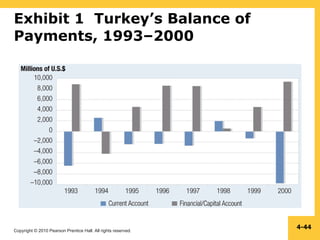
4-44
Exhibit 1 Turkey’s Balance of
Payments, 1993–2000
Copyright © 2010 Pearson Prentice Hall. All rights reserved.
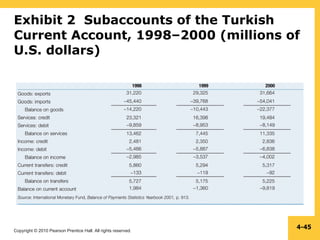
4-45
Exhibit 2 Subaccounts of the Turkish
Current Account, 1998–2000 (millions of
U.S. dollars)
Copyright © 2010 Pearson Prentice Hall. All rights reserved.
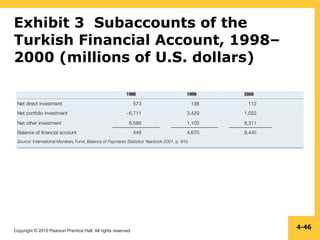
4-46
Exhibit 3 Subaccounts of the
Turkish Financial Account, 1998–
2000 (millions of U.S. dollars)

M04eiteman013609100812mbfc04 101228185436-phpapp02

  • 1.
    Copyright © 2010Pearson Prentice Hall. All rights reserved. Chapter 4 The Balance of Payments
  • 2.
    Copyright © 2010Pearson Prentice Hall. All rights reserved. 4-2 The Balance of Payments • International business transactions occur in many different forms over the course of a year • The measurement of all international economic transactions between the residents of a country and foreign residents is called the balance of payments (BOP)
  • 3.
    Copyright © 2010Pearson Prentice Hall. All rights reserved. 4-3 The Balance of Payments • BOP data is important for government policymakers and MNEs as it is a gauge of a nations competitiveness or health (domestic and/or foreign) • For a MNE both home and host country BOP data is important as: – An indication of pressure on a country’s foreign exchange rate – A signal of the imposition or removal of controls in various sorts of payments (dividends, interest, license fees, royalties and other cash disbursements) – A forecast of a country’s market potential (especially in the short run)
  • 4.
    Copyright © 2010Pearson Prentice Hall. All rights reserved. 4-4 Typical BOP Transactions • Each of the following represents an international economic transaction that is counted in and captured in the US BOP: – A US subsidiary of a foreign MNE acts as a distributor for the MNEs products in the US market – A US based firm, manages the construction of a major water treatment facility in a foreign country – The US subsidiary of a foreign firm pays profits (dividends) back to a parent in its home (foreign) country – The US government finances the purchase of military equipment for a foreign military ally
  • 5.
    Copyright © 2010Pearson Prentice Hall. All rights reserved. 4-5 Fundamentals of BOP Accounting • The BOP must balance • It cannot be in disequilibrium unless something has not been counted or has been counted improperly • Therefore it is incorrect to state that the BOP is in disequilibrium
  • 6.
    Copyright © 2010Pearson Prentice Hall. All rights reserved. 4-6 Fundamentals of BOP Accounting • There are three main elements of the actual process of measuring international economic activity: – Identifying what is and is not an international economic transaction – Understanding how the flow of goods, services, assets, and money create debits and credits to the overall BOP – Understanding the bookkeeping procedures for BOP accounting • It is a daunting task to measure all international transactions that take place in and out of a country over a year
  • 7.
    Copyright © 2010Pearson Prentice Hall. All rights reserved. 4-7 The BOP as a Flow Statement • The BOP is often misunderstood as many people infer from its name that it is a balance sheet, whereas in fact it is a cash flow statement • By recording all international transactions over a period of time such as a year, it tracks the continuing flows of purchases and payments between a country and all other countries • It does not add up the value of all assets and liabilities of a country on a specific date (as an individual firm’s balance sheet would do)
  • 8.
    Copyright © 2010Pearson Prentice Hall. All rights reserved. 4-8 The BOP as a Flow Statement • Two types of business transactions dominate the balance of payments: – Exchange of Real Assets – Exchange of Financial Assets • Although assets can be identified as belonging to distinct groups, it is easier to think of all assets simply as goods that can be bought or sold (a clock versus a bond)
  • 9.
    Copyright © 2010Pearson Prentice Hall. All rights reserved. 4-9 The Accounts of the BOP • The BOP is composed of two primary sub accounts, the Current Account and the Capital/Financial Account • In addition, the Official Reserves account tracks government currency transactions • A fourth account, the Net Errors and Omissions account is produced to preserve the balance of the BOP
  • 10.
    Copyright © 2010Pearson Prentice Hall. All rights reserved. 4-10 The Current Account • The Current Account includes all international economic transactions with income or payment flows occurring within one year, the current period. It consists of the following four subcategories: – Goods trade and import of goods – Services trade – Income – Current transfers • The Current Account is typically dominated by the first component which is known as the Balance of Trade (BOT) even though it excludes service trade
  • 11.
    Copyright © 2010Pearson Prentice Hall. All rights reserved. 4-11 Exhibit 4.3 U.S. Trade Balance and Balance on Services and Income, 1985-2007 (billions of US dollars)
  • 12.
    Copyright © 2010Pearson Prentice Hall. All rights reserved. 4-12 The Current Account • The deficits in the BOT of the past decade have been an area of considerable concern for the United States, in both the public and private sectors • The goods trade deficit saw the decline of heavy traditional industries in the U.S. (steel, automobiles, automotive parts, textiles)
  • 13.
    Copyright © 2010Pearson Prentice Hall. All rights reserved. 4-13 The Capital/Financial Account • The Capital Account of the balance of payments measures all international economic transactions of financial assets. It is divided into two major components: – The Capital Account – The Financial Account • The Capital Account is minor (in magnitude), while the Financial Account is significant
  • 14.
    Copyright © 2010Pearson Prentice Hall. All rights reserved. 4-14 The Financial Account • Financial assets can be classified in a number of different ways including the length of the life of the asset (maturity) and the nature of the ownership (public or private) • The Financial Account, however, uses a third method. This focuses on the degree of investor control over the assets or operations
  • 15.
    Copyright © 2010Pearson Prentice Hall. All rights reserved. 4-15 The Financial Account • The Financial Account consists of three components; – Direct Investment – in which the investor exerts some explicit degree of control over the assets – Portfolio Investment – in which the investor has no control over the assets – Other Investment – consists of various short- term and long-term trade credits, cross-border loans, currency deposits, bank deposits and other A/R and A/P related to cross-border trade
  • 16.
    Copyright © 2010Pearson Prentice Hall. All rights reserved. 4-16 Direct Investment • This is the net balance of capital dispersed from and into the US for the purpose of exerting control over assets. • Foreign direct investment arises from 10% ownership of voting shares in a domestic firm by foreign investors. • The source of concern over foreign investment in any country focuses on two topics: control and profit. • Some countries possess restrictions on foreigners may own in their country. • The general rule or premise is that domestic land, assets and industry should be owned by residents of the country. • Concerns over profit stem from the same argument.
  • 17.
    Copyright © 2010Pearson Prentice Hall. All rights reserved. 4-17 Portfolio Investment • This is the net balance of capital that flows in and out of the U.S. but does not reach the 10% threshold of direct investment. • The purchase of debt securities across borders is classified as portfolio investment because debt securities by definition do not provide the buyer with ownership or control. • Portfolio investment is motivated by a search for returns rather than to control or manage the investment.
  • 18.
    Copyright © 2010Pearson Prentice Hall. All rights reserved. 4-18 Exhibit 4.5 The United States Financial Account 1985-2007 (billions of US dollars)
  • 19.
    Copyright © 2010Pearson Prentice Hall. All rights reserved. 4-19 Net Errors & Omissions/Official Reserves Accounts • The Net Errors and Omissions account ensures that the BOP actually balances. • The Official Reserves Account is the total reserves held by official monetary authorities within the country. • These reserves are normally composed of the major currencies used in international trade and financial transactions (hard currencies). • The significance of official reserves depends generally on whether the country is operating under a fixed exchange rate regime or a floating exchange rate system.
  • 20.
    Copyright © 2010Pearson Prentice Hall. All rights reserved. 4-20 The BOP in Total — Surplus • A surplus in the BOP implies that the demand for the country’s currency exceeded the supply and that the government should allow the currency value to increase – in value – or intervene and accumulate additional foreign currency reserves in the Official Reserves Account.
  • 21.
    Copyright © 2010Pearson Prentice Hall. All rights reserved. 4-21 The BOP in Total — Deficit • A deficit in the BOP implies an excess supply of the country’s currency on world markets, and the government should then either devalue the currency or expend its official reserves to support its value.
  • 22.
    Copyright © 2010Pearson Prentice Hall. All rights reserved. 4-22 The BOP Interaction with Key Macroeconomic Variables • A nation’s balance of payments interacts with nearly all of its key macroeconomic variables • Interacts means that the BOP affects and is affected by such key macroeconomic factors as: – Gross Domestic Product (GDP) – The exchange rate – Interest rates – Inflation rates
  • 23.
    Copyright © 2010Pearson Prentice Hall. All rights reserved. 4-23 The BOP and GDP • In a static (accounting) sense, a nation’s GDP can be represented by the following equation: GDP = C + I + G + X – M
  • 24.
    Copyright © 2010Pearson Prentice Hall. All rights reserved. 4-24 The BOP and GDP • The variables from the formula on the previous page are defined as: C = consumption spending I = capital investment spending G = government spending X = exports of goods and services M = imports of goods and services X – M = the current account balance
  • 25.
    Copyright © 2010Pearson Prentice Hall. All rights reserved. 4-25 The BOP and Exchange Rates • A country’s BOP can have a significant impact on the level of its exchange rate and vice versa • The relationship between the BOP and exchange rates can be illustrated by use of a simplified equation that summarizes BOP Data (see next slide)
  • 26.
    Copyright © 2010Pearson Prentice Hall. All rights reserved. 4-26 The BOP and Exchange Rates (X – M) + (CI – CO) + (FI – FO) + FXB = BOP Where: X = exports of goods and services M = imports of goods and services CI = capital inflows CO = capital outflows FI = financial inflows FO = financial outflows FXB = official monetary reserves Current Account Balance Capital Account Balance Financial Account Balance
  • 27.
    Copyright © 2010Pearson Prentice Hall. All rights reserved. 4-27 The BOP and Exchange Rates • Fixed Exchange Rate Countries – Under a fixed exchange rate system, the government bears the responsibility to ensure that the BOP is near zero • Floating Exchange Rate Countries – Under a floating exchange rate system, the government has no responsibility to peg its foreign exchange rate • Managed Floats – Countries operating with a managed float often find it necessary to take action to maintain their desired exchange rate values
  • 28.
    Copyright © 2010Pearson Prentice Hall. All rights reserved. 4-28 The BOP and Interest Rates • Apart from the use of interest rates to intervene in the foreign exchange market, the overall level of a country’s interest rates compared to other countries does have and impact on the financial account of the BOP • Relatively low real interest rates should normally stimulate an outflow of capital seeking higher rates elsewhere • However, in the case of the U.S., the opposite has occurred due to perceived growth opportunities and political stability – allowing it to finance its large fiscal deficit • However, it is beginning to appear that the favorable inflow on the financial account is diminishing while the current account balance is worsening – making the U.S. a bigger debtor nation vis-à-vis the rest of the world
  • 29.
    Copyright © 2010Pearson Prentice Hall. All rights reserved. 4-29 Trade Balances and Exchange Rates • A country’s import and export of goods and services is affected by changes in exchange rates • The transmission mechanism is in principle quite simple: changes in exchange rates change relative process of imports and exports, and changing prices in turn result in changes in quantities demanded through the price elasticity of demand • Theoretically, this is straightforward, in reality global business is more complex
  • 30.
    Copyright © 2010Pearson Prentice Hall. All rights reserved. 4-30 Exhibit 4.8 Trade Balance Adjustment to Exchange Rate Changes: The J-Curve
  • 31.
    Copyright © 2010Pearson Prentice Hall. All rights reserved. 4-31 Capital Mobility • The degree to which capital moves freely across borders is critically important to a country’s balance of payments • The financial account surplus has probably been one of the major reasons that the U.S. dollar has been able to maintain its value over the past 20 years
  • 32.
    Copyright © 2010Pearson Prentice Hall. All rights reserved. 4-32 Capital Mobility • The authors argue that the post-1860 era can be subdivided into four distinct periods with regard to capital mobility. – 1860-1914 – continuously increasing capital mobility as the gold standard was adopted and international trade relations were expanded – 1914-1945 – global economic destruction, isolationist economic policies, negative effect on capital movement between countries – 1945-1971 – Bretton Woods era say a great expansion of international trade – 1971-2002 – floating exchange rates, economic volatility, rapidly expanding cross-border capital flows 0
  • 33.
    Copyright © 2010Pearson Prentice Hall. All rights reserved. 4-33 0 Exhibit 4.9 A Stylized View of Capital Mobility in Modern History
  • 34.
    Copyright © 2010Pearson Prentice Hall. All rights reserved. 4-34 Capital Flight • Although no single definition of capital flight exists, it has been characterized as occurring when capital transfers by residents conflict with political objectives. • Many heavily indebted countries have suffered capital flight, compounding their debt service problems. • Capital can be moved via international transfers, with physical currency, collectables or precious metals, money laundering or false invoicing of international trade transactions. 0
  • 35.
    Copyright © 2010Pearson Prentice Hall. All rights reserved. 4-35 Mini-Case Questions: Turkey’s Kriz (A) • Where in the current account would the imported telecommunications equipment be listed? Would this location correspond to the increase in magnitude and timing of the financial account? • Why do you think that net direct investment declined from $573 million in 1998 to $112 million in 2000? • Why do you think that TelSim defaulted on its payments for equipment imports from Nokia and Motorola?
  • 36.
    Copyright © 2010Pearson Prentice Hall. All rights reserved. Chapter 4 Additional Chapter Exhibits
  • 37.
    Copyright © 2010Pearson Prentice Hall. All rights reserved. 4-37 Exhibit 4.1 Generic Balance of Payments
  • 38.
    Copyright © 2010Pearson Prentice Hall. All rights reserved. 4-38 Exhibit 4.2 The United States Current Account, 1998–2007 (billions of U.S. dollars)
  • 39.
    Copyright © 2010Pearson Prentice Hall. All rights reserved. 4-39 Exhibit 4.4 The United States Financial Account and Components, 1998-2007 (billions of U.S. dollars)
  • 40.
    Copyright © 2010Pearson Prentice Hall. All rights reserved. 4-40 Exhibit 4.6 Current and Combined Financial/Capital Account Balances United States, 1992–2007 (billions of U.S. dollars)
  • 41.
    Copyright © 2010Pearson Prentice Hall. All rights reserved. 4-41 Exhibit A China’s Foreign Exchange Reserves (billions of U.S. dollars)
  • 42.
    Copyright © 2010Pearson Prentice Hall. All rights reserved. 4-42 Exhibit B Rising Reserves in Asia (billions of U.S. dollars)
  • 43.
    Copyright © 2010Pearson Prentice Hall. All rights reserved. 4-43 Exhibit 4.7 The United States Balance of Payments, Analytic Presentation, 1998–2007 (billions of U.S. dollars)
  • 44.
    Copyright © 2010Pearson Prentice Hall. All rights reserved. 4-44 Exhibit 1 Turkey’s Balance of Payments, 1993–2000
  • 45.
    Copyright © 2010Pearson Prentice Hall. All rights reserved. 4-45 Exhibit 2 Subaccounts of the Turkish Current Account, 1998–2000 (millions of U.S. dollars)
  • 46.
    Copyright © 2010Pearson Prentice Hall. All rights reserved. 4-46 Exhibit 3 Subaccounts of the Turkish Financial Account, 1998– 2000 (millions of U.S. dollars)