Pamposh Kumar |Initiatives in Learning & Exchange of
Water related Practices, Solutions & Values
Learning & Exchange: Moving Targets
Experience sharing and learning -
often can have collateral costs!
There could be learning at the cost of sharing
Also the sharing may cloud the essence of learning
Learning Exchange:
Many Gurus thought it could be KM!
(Knowledge Management)
Yes, it can be………
• content management system in knowledge sharing
• webtools/sites development, hosting & upgradation to
improve information management
• toolkits, media use & sharing, specialized assistance on
tools such as GIS
• training & technical support for capacity building, multi-
project or single-project group studies or exchanges,
cross portfolio events- platforms
And there are more modes & the same
object!
• Convening & support to local, regional &
transboundary dialogue processes
• Outreach and communications support & services -
to increase awareness, scalability, replication, impact and sustainability
• Co-creation of knowledge-sharing materials -Field Manuals,
Public Participation Guides, Communication Guidebooks, Experience Notes, Case Studies,
Multimedia, Newsletters and E-Bulletins
• Accompanied learning - IWRM and related cost of ecosystem services,
transboundary environmental flows & information management, economic valuation,
governance and management including public participation, etc.
The whole has more capacity
than the sum of its parts !
The whole has more capacity than
the sum of its parts !
• Access to project-related information, contacts, case studies, diagnostics,
strategic programmes, news and events across focal areas & sectors
• Replication for enhancing efficiency & effectiveness of interventions
• Synergy of tangible results with other initiatives
• Output utilization from conferences, global portfolio sharing,
guidance materials & products/services
• Policies-procedures, emerging priorities, project performance
Eco & WaSH Futures
support & catalysis
• Mentoring for community initiatives & innovation
• Addressing issues faced by one project & resolved by another
• World Water Day-Networking for WaSH (for States)
• Science for Sanitation (for States)
• UN Water Decade
• Consultative processes, knowledge sharing & networking
Eco & WaSH Futures
support & catalysis
• Capacity Building Workshops
• Local & regional dialogue facilitation
• Water Educator’s training
• Eco-regional approach/ Transboundary Waters
Management (TWM)
• Support for innovative models of outreach,
knowledge sharing, learning & solution exchange
Communities of Practice & Learning (CoPL)
Role of knowledge sharing and exchange hubs
• Portfolio workspaces & networking CoPLs in water stressed
regions
• Sharing on scientific and technical innovation
(constructed wetlands and nutrient management, etc.)
• Web based knowledge-authoring & sharing tools (wikis, blogs, etc.)
• Syndication (news, web, video, audio )
• Strategic support- short courses, guidance on PPP & CSR,
jobs, consultancy, training opportunities
Beyond Learning Exchange !
• Are the concerned communities supportive?
• How much replicable are the best practices exchanged ?
• Can we simulate more of the best practices?
• Can we anticipate more and unexpected scenarios?
Learning Inclusion
(LI)
• Is the participation truly inclusive?
• Can we identify the barriers to learning exchange
and participation?
• Can we develop approaches to self-review & analyse
organizational culture, policies and practices? 
• Can we develop inter-cultural channels of learning
inclusion?
• Do we have indices of inclusion?
LI : deciding your own priorities for change
• creating inclusive cultures
• producing inclusive policies
• evolving inclusive practices
Towards Indices for LI
Possible Indicators
• Building supportive community
• Establishing inclusive values
• Producing inclusive policies
• Organising support for diversity
• Evolving inclusive practices
• Mobilising & sharing resources
• Growing nodal & distributed LI capacities
How do we handle minefields of renewal
& challenge the exclusion
• Difference
• Dissonace
• Divergences
• Diversities
• Dissention
• Rebellion
Question hard the path of least
resistance and
of most convenience!
Evidence base for LI Capacity
• Creating LI specialisation & cross-specialisation
capacity in Water Literacy
• Mobilising & harnessing inter-cultural and multi-
cultural competencies
• Track of Learning Exchange & Solution Exchange
• Delivering LI services
• Developing it as integral part of existing development
policies & future plans
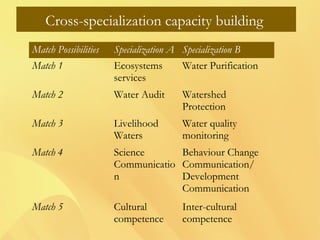
Match Possibilities Specialization A Specialization B
Match 1 Ecosystems
services
Water Purification
Match 2 Water Audit Watershed
Protection
Match 3 Livelihood
Waters
Water quality
monitoring
Match 4 Science
Communicatio
n
Behaviour Change
Communication/
Development
Communication
Match 5 Cultural
competence
Inter-cultural
competence
Cross-specialization capacity building
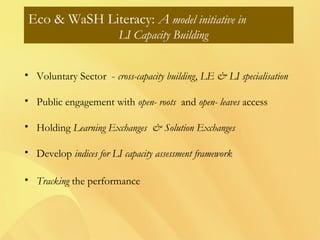
Eco & WaSH Literacy: A model initiative in
LI Capacity Building
• Voluntary Sector - cross-capacity building, LE & LI specialisation
• Public engagement with open- roots and open- leaves access
• Holding Learning Exchanges & Solution Exchanges
• Develop indices for LI capacity assessment framework
• Tracking the performance
Thank you.
Cogito ergo sum.
I understand, so I exist.

Talk- Learning Exchange & Inclusion

  • 1.
    Pamposh Kumar |Initiativesin Learning & Exchange of Water related Practices, Solutions & Values
  • 2.
    Learning & Exchange:Moving Targets Experience sharing and learning - often can have collateral costs! There could be learning at the cost of sharing Also the sharing may cloud the essence of learning
  • 3.
    Learning Exchange: Many Gurusthought it could be KM! (Knowledge Management) Yes, it can be……… • content management system in knowledge sharing • webtools/sites development, hosting & upgradation to improve information management • toolkits, media use & sharing, specialized assistance on tools such as GIS • training & technical support for capacity building, multi- project or single-project group studies or exchanges, cross portfolio events- platforms
  • 4.
    And there aremore modes & the same object! • Convening & support to local, regional & transboundary dialogue processes • Outreach and communications support & services - to increase awareness, scalability, replication, impact and sustainability • Co-creation of knowledge-sharing materials -Field Manuals, Public Participation Guides, Communication Guidebooks, Experience Notes, Case Studies, Multimedia, Newsletters and E-Bulletins • Accompanied learning - IWRM and related cost of ecosystem services, transboundary environmental flows & information management, economic valuation, governance and management including public participation, etc.
  • 5.
    The whole hasmore capacity than the sum of its parts !
  • 6.
    The whole hasmore capacity than the sum of its parts ! • Access to project-related information, contacts, case studies, diagnostics, strategic programmes, news and events across focal areas & sectors • Replication for enhancing efficiency & effectiveness of interventions • Synergy of tangible results with other initiatives • Output utilization from conferences, global portfolio sharing, guidance materials & products/services • Policies-procedures, emerging priorities, project performance
  • 7.
    Eco & WaSHFutures support & catalysis • Mentoring for community initiatives & innovation • Addressing issues faced by one project & resolved by another • World Water Day-Networking for WaSH (for States) • Science for Sanitation (for States) • UN Water Decade • Consultative processes, knowledge sharing & networking
  • 8.
    Eco & WaSHFutures support & catalysis • Capacity Building Workshops • Local & regional dialogue facilitation • Water Educator’s training • Eco-regional approach/ Transboundary Waters Management (TWM) • Support for innovative models of outreach, knowledge sharing, learning & solution exchange
  • 9.
    Communities of Practice& Learning (CoPL) Role of knowledge sharing and exchange hubs • Portfolio workspaces & networking CoPLs in water stressed regions • Sharing on scientific and technical innovation (constructed wetlands and nutrient management, etc.) • Web based knowledge-authoring & sharing tools (wikis, blogs, etc.) • Syndication (news, web, video, audio ) • Strategic support- short courses, guidance on PPP & CSR, jobs, consultancy, training opportunities
  • 10.
    Beyond Learning Exchange! • Are the concerned communities supportive? • How much replicable are the best practices exchanged ? • Can we simulate more of the best practices? • Can we anticipate more and unexpected scenarios?
  • 11.
    Learning Inclusion (LI) • Isthe participation truly inclusive? • Can we identify the barriers to learning exchange and participation? • Can we develop approaches to self-review & analyse organizational culture, policies and practices?  • Can we develop inter-cultural channels of learning inclusion? • Do we have indices of inclusion?
  • 12.
    LI : decidingyour own priorities for change • creating inclusive cultures • producing inclusive policies • evolving inclusive practices
  • 13.
    Towards Indices forLI Possible Indicators • Building supportive community • Establishing inclusive values • Producing inclusive policies • Organising support for diversity • Evolving inclusive practices • Mobilising & sharing resources • Growing nodal & distributed LI capacities
  • 14.
    How do wehandle minefields of renewal & challenge the exclusion • Difference • Dissonace • Divergences • Diversities • Dissention • Rebellion Question hard the path of least resistance and of most convenience!
  • 15.
    Evidence base forLI Capacity • Creating LI specialisation & cross-specialisation capacity in Water Literacy • Mobilising & harnessing inter-cultural and multi- cultural competencies • Track of Learning Exchange & Solution Exchange • Delivering LI services • Developing it as integral part of existing development policies & future plans
  • 16.
    Match Possibilities SpecializationA Specialization B Match 1 Ecosystems services Water Purification Match 2 Water Audit Watershed Protection Match 3 Livelihood Waters Water quality monitoring Match 4 Science Communicatio n Behaviour Change Communication/ Development Communication Match 5 Cultural competence Inter-cultural competence Cross-specialization capacity building
  • 17.
    Eco & WaSHLiteracy: A model initiative in LI Capacity Building • Voluntary Sector - cross-capacity building, LE & LI specialisation • Public engagement with open- roots and open- leaves access • Holding Learning Exchanges & Solution Exchanges • Develop indices for LI capacity assessment framework • Tracking the performance
  • 18.
    Thank you. Cogito ergosum. I understand, so I exist.