Lupus: Bringing Awareness to You
BobbiJo Glowacki
What is Lupus?
Lupus is an autoimmune disease. Auto meaning self, so by definition it is a
disease that attacks oneself. Lupus causes the body’s own immune system to turn
on itself. Instead of fighting off things such as parasites and viruses, your immune
system looks at your own tissues as invaders and attacks.
Who can getLupus?
Although Lupus can affect anyone, it most often affects women. It has a
higher occurrence in women of Asian, Hispanic, African American and Native
American descent. Caucasian women are affected as well.
Symptoms
Symptoms of Lupus can vary from personto person. Symptoms of Lupus
are also common symptoms of other diseases such as Multiple Sclerosis, Lyme’s
Disease and RA. Only a medical professional can test and diagnose you. If you
have any of the following, please see your healthcare provider and discuss your
concerns.
Common symptoms of Lupus include but are not limited to:
- Low grade fevers
- Extreme fatigue
- Extreme sun sensitivity
- Chest pain while taking a deep breath
- Enlarged lymph nodes
- Hair loss and bald patches
- Red flakey skin rash on face or body
- Mental confusion and seizures
- Severe muscle aches and joint pain
- Mouth throat or nose sores
- Toes and fingers have poorcirculation
PotentialCauses
Researchers aren’t sure exactly what causes Lupus. They agree heredity is a
defining factor. If Lupus runs in your family, you may be predisposed to a
diagnosis.
Research is looking into different factors such as environment and
medications as factors. Environment factors such as stress, smoking and exposure
to toxins suchas silica dust and trichloroethylene from well water. They are also
looking into hormonal factors such as elevated levels of estrogen. Medications are
also being suspected. There is a subset of Lupus known as “drug-induced” lupus
that has prodded research into this belief.
Types of Lupus
Several types of Lupus have been identified.
- Systemic lupus erythematosus or SLE, is the most severe form of Lupus.
This form can affect any or all of the body’s organs or organ systems.
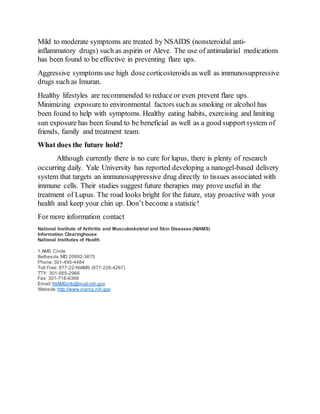
- Discoidlupus is limited to the skin. It is characterized by a rash that appears
on the face, scalp and neck.
- Drug induced lupus is caused by a reaction with certain prescription drugs,
causing symptoms similar to SLE.
- Neonatallupus is a very rare form of lupus that affects newborns.
So how is Lupus treated?
A team of health care providers is needed when you have a diagnosis of lupus
since it is a systemic disease. Your team may include but is not limited to;
- PCP
- Rheumatologists
- Immunologists
- Hematologists
- Nephrologists
- Neurologists
- Cardiologists
The goal of your treatment plan is to prevent flares, reduce organ damage and to
treat flares when they occur.
Mild to moderate symptoms are treated by NSAIDS (nonsteroidal anti-
inflammatory drugs) such as aspirin or Aleve. The use of antimalarial medications
has been found to be effective in preventing flare ups.
Aggressive symptoms use high dose corticosteroids as well as immunosuppressive
drugs such as Imuran.
Healthy lifestyles are recommended to reduce or even prevent flare ups.
Minimizing exposure to environmental factors such as smoking or alcohol has
been found to help with symptoms. Healthy eating habits, exercising and limiting
sun exposure has been found to be beneficial as well as a good supportsystem of
friends, family and treatment team.
What does the future hold?
Although currently there is no cure for lupus, there is plenty of research
occurring daily. Yale University has reported developing a nanogel-based delivery
system that targets an immunosuppressive drug directly to tissues associated with
immune cells. Their studies suggest future therapies may prove useful in the
treatment of Lupus. The road looks bright for the future, stay proactive with your
health and keep your chin up. Don’t become a statistic!
For more information contact
National Institute of Arthritis and Musculoskeletal and Skin Diseases (NIAMS)
Information Clearinghouse
National Institutes of Health
1 AMS Circle
Bethesda, MD 20892-3675
Phone:301-495-4484
Toll Free: 877-22-NIAMS (877-226-4267)
TTY: 301-565-2966
Fax: 301-718-6366
Email:NIAMSinfo@mail.nih.gov
Website:http://www.niams.nih.gov
Credits
Images are from Google Images. (n.d.). Retrieved February 5, 2015, from https://images.google.com/
WebMD Lupus Guide - Better Information for Better Health. (2015, January 1). Retrieved February 5,
2015, from http://www.webmd.com/lupus/guide/default.htm
Jewett-Tennant,J.(2014,December10). What CausesLupus?RetrievedFebruary5,2015, from
http://lupus.about.com/od/causesriskfactors/p/LupusCauses.htm
Lupus.(2009, October1). RetrievedFebruary5,2015, from
http://niams.nih.gov/Health_Info/Lupus/lupus_ff.asp

Lupus hcs 420

  • 1.
    Lupus: Bringing Awarenessto You BobbiJo Glowacki What is Lupus? Lupus is an autoimmune disease. Auto meaning self, so by definition it is a disease that attacks oneself. Lupus causes the body’s own immune system to turn on itself. Instead of fighting off things such as parasites and viruses, your immune system looks at your own tissues as invaders and attacks. Who can getLupus?
  • 2.
    Although Lupus canaffect anyone, it most often affects women. It has a higher occurrence in women of Asian, Hispanic, African American and Native American descent. Caucasian women are affected as well. Symptoms Symptoms of Lupus can vary from personto person. Symptoms of Lupus are also common symptoms of other diseases such as Multiple Sclerosis, Lyme’s Disease and RA. Only a medical professional can test and diagnose you. If you have any of the following, please see your healthcare provider and discuss your concerns. Common symptoms of Lupus include but are not limited to: - Low grade fevers - Extreme fatigue - Extreme sun sensitivity - Chest pain while taking a deep breath - Enlarged lymph nodes - Hair loss and bald patches - Red flakey skin rash on face or body - Mental confusion and seizures - Severe muscle aches and joint pain - Mouth throat or nose sores - Toes and fingers have poorcirculation PotentialCauses Researchers aren’t sure exactly what causes Lupus. They agree heredity is a defining factor. If Lupus runs in your family, you may be predisposed to a diagnosis. Research is looking into different factors such as environment and medications as factors. Environment factors such as stress, smoking and exposure to toxins suchas silica dust and trichloroethylene from well water. They are also looking into hormonal factors such as elevated levels of estrogen. Medications are also being suspected. There is a subset of Lupus known as “drug-induced” lupus that has prodded research into this belief.
  • 3.
    Types of Lupus Severaltypes of Lupus have been identified. - Systemic lupus erythematosus or SLE, is the most severe form of Lupus. This form can affect any or all of the body’s organs or organ systems. - Discoidlupus is limited to the skin. It is characterized by a rash that appears on the face, scalp and neck. - Drug induced lupus is caused by a reaction with certain prescription drugs, causing symptoms similar to SLE. - Neonatallupus is a very rare form of lupus that affects newborns. So how is Lupus treated? A team of health care providers is needed when you have a diagnosis of lupus since it is a systemic disease. Your team may include but is not limited to; - PCP - Rheumatologists - Immunologists - Hematologists - Nephrologists - Neurologists - Cardiologists The goal of your treatment plan is to prevent flares, reduce organ damage and to treat flares when they occur.
  • 4.
    Mild to moderatesymptoms are treated by NSAIDS (nonsteroidal anti- inflammatory drugs) such as aspirin or Aleve. The use of antimalarial medications has been found to be effective in preventing flare ups. Aggressive symptoms use high dose corticosteroids as well as immunosuppressive drugs such as Imuran. Healthy lifestyles are recommended to reduce or even prevent flare ups. Minimizing exposure to environmental factors such as smoking or alcohol has been found to help with symptoms. Healthy eating habits, exercising and limiting sun exposure has been found to be beneficial as well as a good supportsystem of friends, family and treatment team. What does the future hold? Although currently there is no cure for lupus, there is plenty of research occurring daily. Yale University has reported developing a nanogel-based delivery system that targets an immunosuppressive drug directly to tissues associated with immune cells. Their studies suggest future therapies may prove useful in the treatment of Lupus. The road looks bright for the future, stay proactive with your health and keep your chin up. Don’t become a statistic! For more information contact National Institute of Arthritis and Musculoskeletal and Skin Diseases (NIAMS) Information Clearinghouse National Institutes of Health 1 AMS Circle Bethesda, MD 20892-3675 Phone:301-495-4484 Toll Free: 877-22-NIAMS (877-226-4267) TTY: 301-565-2966 Fax: 301-718-6366 Email:NIAMSinfo@mail.nih.gov Website:http://www.niams.nih.gov
  • 5.
    Credits Images are fromGoogle Images. (n.d.). Retrieved February 5, 2015, from https://images.google.com/ WebMD Lupus Guide - Better Information for Better Health. (2015, January 1). Retrieved February 5, 2015, from http://www.webmd.com/lupus/guide/default.htm Jewett-Tennant,J.(2014,December10). What CausesLupus?RetrievedFebruary5,2015, from http://lupus.about.com/od/causesriskfactors/p/LupusCauses.htm Lupus.(2009, October1). RetrievedFebruary5,2015, from http://niams.nih.gov/Health_Info/Lupus/lupus_ff.asp