CURRENT TOPICS IN LUNG
CANCER IMAGING
Kenneth M. Neigut, M.D.
Overview
 Review lung cancer screening updates.
 Management of small lung nodules detected
on CT.
 The role and limitations of using PET/CT for
staging.
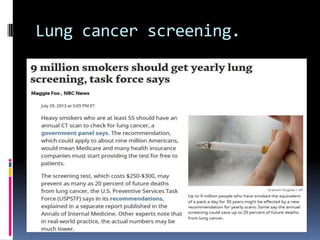
Lung cancer screening.
ACR position on CT lung
cancer screening.
 “Today’s USPSTF draft recommendation
marks a dramatic shift in views towards
diagnosing and treating lung cancer.”
 “Expanded use of lung cancer screening in
high risk patients is a landmark step in the
battle to defeat this terrible disease.”
Paul Ellenbogen MD, FACR, chair of the
American College of Radiology Board of
Chancellors
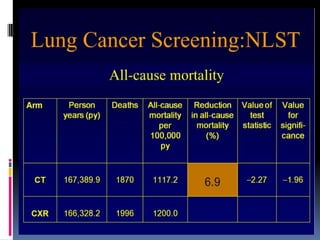
NLST
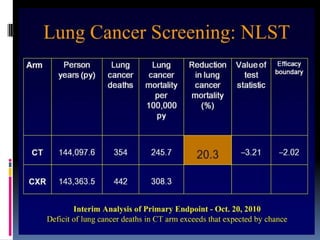
 53,454 current or former heavy smokers from
33 sites across US.
 Half received low-dose CT, half PA chest x-
ray (randomized trial).
 Three annual screenings were performed.
 Study began in 2002.
 Final results published in NEJM 8/4/2011.
NLST
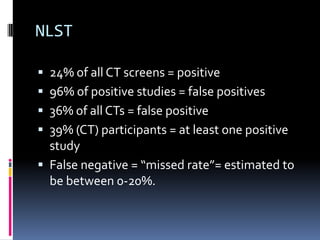
 24% of all CT screens = positive
 96% of positive studies = false positives
 36% of all CTs = false positive
 39% (CT) participants = at least one positive
study
 False negative = “missed rate”= estimated to
be between 0-20%.
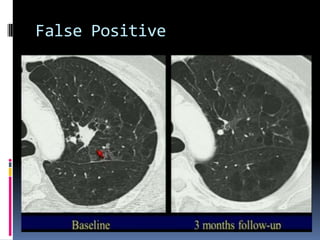
False Positive
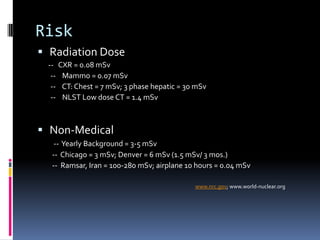
Risk
 Radiation Dose
-- CXR = 0.08 mSv
-- Mammo = 0.07 mSv
-- CT: Chest = 7 mSv; 3 phase hepatic = 30 mSv
-- NLST Low dose CT = 1.4 mSv
 Non-Medical
-- Yearly Background = 3-5 mSv
-- Chicago = 3 mSv; Denver = 6 mSv (1.5 mSv/ 3 mos.)
-- Ramsar, Iran = 100-280 mSv; airplane 10 hours = 0.04 mSv
www.nrc.gov; www.world-nuclear.org
New ultrafast CAT scan:
USPSTF Recommendations:
 Screen high-risk patients (55-79 years old
with a 30 pack year or greater history of
smoking and continue to smoke or quit fewer
than 15 years ago).
 Annual lung cancer screening.
 Find tumors early, when they are most
treatable.
 Benefits outweigh risks.
Facts:
 160,000 lung cancer deaths occur in the
United States every year.
 85% of these deaths occur in those with a
strong smoking history.
 Lung cancer is the number one cancer killer.
 Insurance companies will be required to cover
the $300-400 screening under a mandate in
the federal health law.
Downside of screening:
 Overdiagnosis
 Excess radiation exposure
 Lung biopsies for growths that turn out not to
be cancer.
Screening:
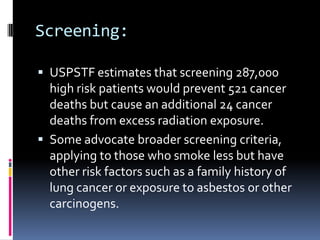
 USPSTF estimates that screening 287,000
high risk patients would prevent 521 cancer
deaths but cause an additional 24 cancer
deaths from excess radiation exposure.
 Some advocate broader screening criteria,
applying to those who smoke less but have
other risk factors such as a family history of
lung cancer or exposure to asbestos or other
carcinogens.
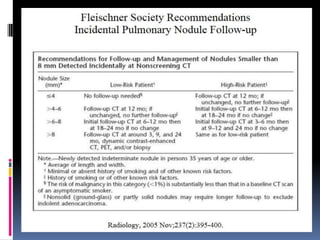
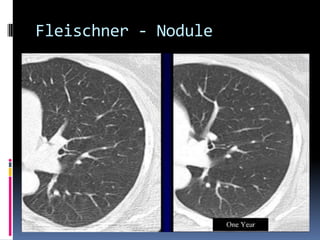
Fleischner - Nodule
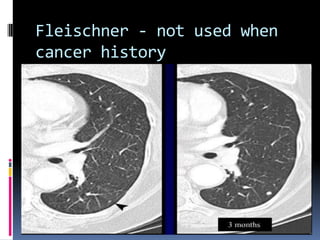
Fleischner - not used when
cancer history
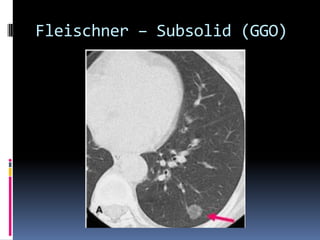
Subsolid nodules
 Ground glass (subsolid) nodules are less
dense than solid nodules and the surrounding
pulmonary vasculature and do not obscure
the lung parenchyma.
 Can be purely ground-glass in appearance or
can have mixed solid and ground-glass
components.
 Dilemma: morphologic characteristics of a
ground-glass nodule are less well described.
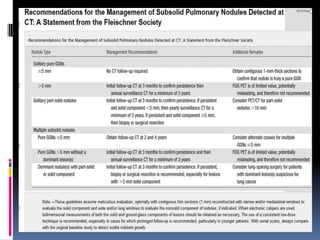
Fleischner – Subsolid (GGO)
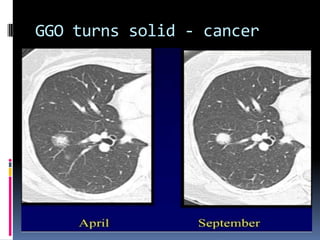
GGO turns solid - cancer
PET/CT: Limitations
 False positive
Infections
Inflammation – alveolitis
Tumor necrosis
 False negative
Bronchioloalveolar cell carcinoma
Small size (detection unreliable if <7mm nodule).
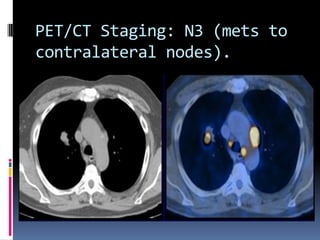
PET/CT Staging: N3 (mets to
contralateral nodes).
Summary
 Lung cancer screening with low dose CT will
allow earlier lung cancer detection and save
lives.
 Fleischner guidelines for lung nodule follow
up now include subsolid nodules.
 Be aware of the limitations of PET/CT.
End

Lung Cancer Screening

  • 1.
    CURRENT TOPICS INLUNG CANCER IMAGING Kenneth M. Neigut, M.D.
  • 2.
    Overview  Review lungcancer screening updates.  Management of small lung nodules detected on CT.  The role and limitations of using PET/CT for staging.
  • 3.
  • 4.
    ACR position onCT lung cancer screening.  “Today’s USPSTF draft recommendation marks a dramatic shift in views towards diagnosing and treating lung cancer.”  “Expanded use of lung cancer screening in high risk patients is a landmark step in the battle to defeat this terrible disease.” Paul Ellenbogen MD, FACR, chair of the American College of Radiology Board of Chancellors
  • 7.
    NLST  53,454 currentor former heavy smokers from 33 sites across US.  Half received low-dose CT, half PA chest x- ray (randomized trial).  Three annual screenings were performed.  Study began in 2002.  Final results published in NEJM 8/4/2011.
  • 10.
    NLST  24% ofall CT screens = positive  96% of positive studies = false positives  36% of all CTs = false positive  39% (CT) participants = at least one positive study  False negative = “missed rate”= estimated to be between 0-20%.
  • 11.
  • 12.
    Risk  Radiation Dose --CXR = 0.08 mSv -- Mammo = 0.07 mSv -- CT: Chest = 7 mSv; 3 phase hepatic = 30 mSv -- NLST Low dose CT = 1.4 mSv  Non-Medical -- Yearly Background = 3-5 mSv -- Chicago = 3 mSv; Denver = 6 mSv (1.5 mSv/ 3 mos.) -- Ramsar, Iran = 100-280 mSv; airplane 10 hours = 0.04 mSv www.nrc.gov; www.world-nuclear.org
  • 13.
  • 14.
    USPSTF Recommendations:  Screenhigh-risk patients (55-79 years old with a 30 pack year or greater history of smoking and continue to smoke or quit fewer than 15 years ago).  Annual lung cancer screening.  Find tumors early, when they are most treatable.  Benefits outweigh risks.
  • 15.
    Facts:  160,000 lungcancer deaths occur in the United States every year.  85% of these deaths occur in those with a strong smoking history.  Lung cancer is the number one cancer killer.  Insurance companies will be required to cover the $300-400 screening under a mandate in the federal health law.
  • 16.
    Downside of screening: Overdiagnosis  Excess radiation exposure  Lung biopsies for growths that turn out not to be cancer.
  • 17.
    Screening:  USPSTF estimatesthat screening 287,000 high risk patients would prevent 521 cancer deaths but cause an additional 24 cancer deaths from excess radiation exposure.  Some advocate broader screening criteria, applying to those who smoke less but have other risk factors such as a family history of lung cancer or exposure to asbestos or other carcinogens.
  • 19.
  • 20.
    Fleischner - notused when cancer history
  • 21.
    Subsolid nodules  Groundglass (subsolid) nodules are less dense than solid nodules and the surrounding pulmonary vasculature and do not obscure the lung parenchyma.  Can be purely ground-glass in appearance or can have mixed solid and ground-glass components.  Dilemma: morphologic characteristics of a ground-glass nodule are less well described.
  • 22.
  • 23.
  • 25.
    PET/CT: Limitations  Falsepositive Infections Inflammation – alveolitis Tumor necrosis  False negative Bronchioloalveolar cell carcinoma Small size (detection unreliable if <7mm nodule).
  • 26.
    PET/CT Staging: N3(mets to contralateral nodes).
  • 27.
    Summary  Lung cancerscreening with low dose CT will allow earlier lung cancer detection and save lives.  Fleischner guidelines for lung nodule follow up now include subsolid nodules.  Be aware of the limitations of PET/CT.
  • 29.

Editor's Notes

  • #8 Persons who had previously receiveda diagnosis of lung cancer, had undergonechest CT within 18 months before enrollment, hadhemoptysis, or had an unexplained weight loss ofmore than 6.8 kg (15 lb) in the preceding yearwere excluded.
  • #9 Low-dose CT scans that revealed any noncalcifiednodule measuring at least 4 mm in anydiameter and radiographic images that revealedany noncalcified nodule or mass were classifiedas positive, “suspicious for” lung cancer.