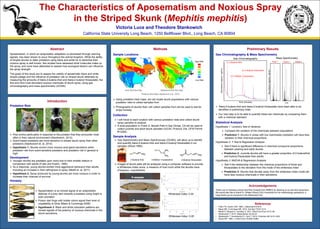
1) The study aims to assess how predation risk influences the defensive chemical compounds in striped skunk spray. Specifically, it will compare the amounts of trans-2-butene-thiol and trans-2-butenyl thioacetate, two abundant noxious chemicals, in skunk populations facing different predation pressures.
2) Gas chromatography-mass spectrometry will be used to identify and quantify the two target chemicals in spray samples collected from skunks in areas of high and low mammalian and avian predation risk.
3) Three hypotheses are that skunks in riskier areas will have more variable spray potency, juveniles will have stronger spray, and bolder