Guyren G Howe
guyren@relevantlogic.com
@unclouded
Brought to you by
https://github.com/gisborne/railsconf_lydb
Information Technology -
Database Language SQL
(Proposed revised text of DIS 9075)
July 1992
Postgres’ Little-Known Secret
• Postgres is a great programming platform
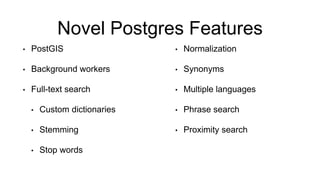
Novel Postgres Features
• PostGIS
• Background workers
• Full-text search
• Custom dictionaries
• Stemming
• Stop words
• Normalization
• Synonyms
• Multiple languages
• Phrase search
• Proximity search
Novel Postgres Features
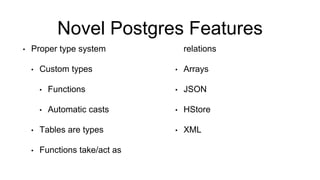
• Proper type system
• Custom types
• Functions
• Automatic casts
• Tables are types
• Functions take/act as
relations
• Arrays
• JSON
• HStore
• XML
Novel Postgres Features
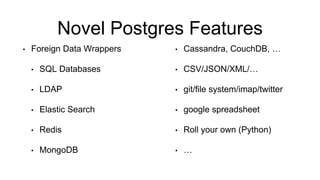
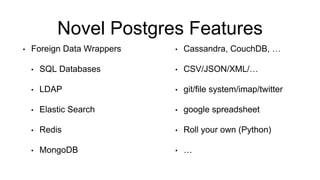
• Foreign Data Wrappers
• SQL Databases
• LDAP
• Elastic Search
• Redis
• MongoDB
• Cassandra, CouchDB, …
• CSV/JSON/XML/…
• git/file system/imap/twitter
• google spreadsheet
• Roll your own (Python)
• …
Novel Postgres Features
• Program in civilized languages
• Python
• Perl
• Javascript
• R
• Scheme
• C
• Java
• PHP
• sh
• …
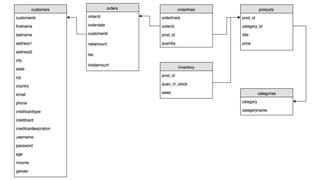
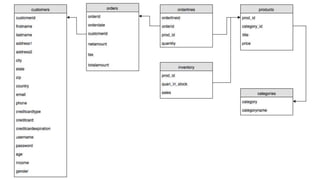
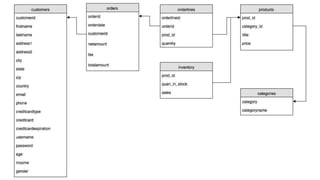
Model All the Things
Reporting
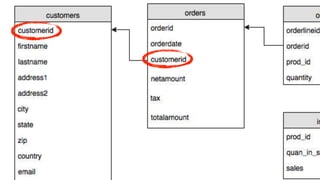
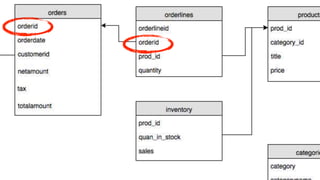
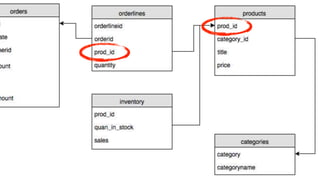
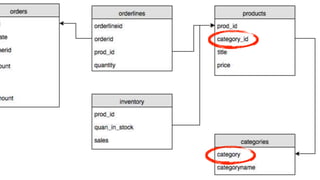
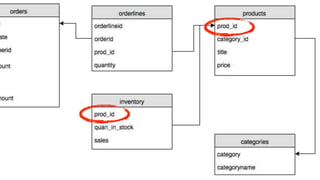
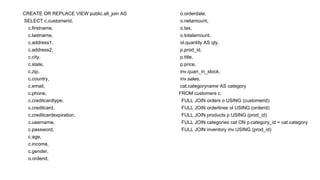
Check out public.all_join view
CREATE OR REPLACE VIEW public.all_join AS
SELECT c.customerid,
c.firstname,
c.lastname,
c.address1,
c.address2,
c.city,
c.state,
c.zip,
c.country,
c.email,
c.phone,
c.creditcardtype,
c.creditcard,
c.creditcardexpiration,
c.username,
c.password,
c.age,
c.income,
c.gender,
o.orderid,
o.orderdate,
o.netamount,
o.tax,
o.totalamount,
ol.quantity AS qty,
p.prod_id,
p.title,
p.price,
inv.quan_in_stock,
inv.sales,
cat.categoryname AS category
FROM customers c
FULL JOIN orders o USING (customerid)
FULL JOIN orderlines ol USING (orderid)
FULL JOIN products p USING (prod_id)
FULL JOIN categories cat ON p.category_id = cat.category
FULL JOIN inventory inv USING (prod_id)
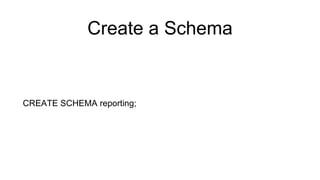
Create a Schema
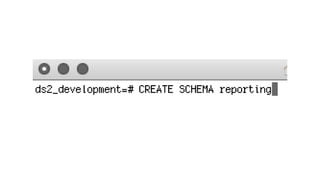
CREATE SCHEMA reporting;
Create a Schema
class AddReportingSchema < ActiveRecord::Migration[5.0]
def up
execute 'CREATE SCHEMA reporting'
end
def down
execute 'DROP SCHEMA reporting'
end
end
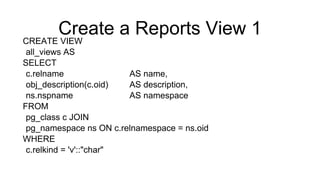
Create a Reports View 1
CREATE VIEW
all_views AS
SELECT
c.relname AS name,
obj_description(c.oid) AS description,
ns.nspname AS namespace
FROM
pg_class c JOIN
pg_namespace ns ON c.relnamespace = ns.oid
WHERE
c.relkind = 'v'::"char"
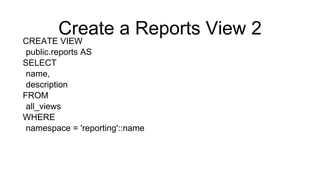
Create a Reports View 2
CREATE VIEW
public.reports AS
SELECT
name,
description
FROM
all_views
WHERE
namespace = 'reporting'::name
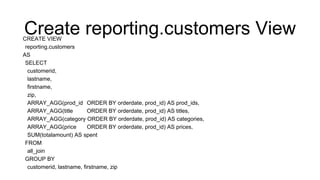
Create reporting.customers ViewCREATE VIEW
reporting.customers
AS
SELECT
customerid,
lastname,
firstname,
zip,
ARRAY_AGG(prod_id ORDER BY orderdate, prod_id) AS prod_ids,
ARRAY_AGG(title ORDER BY orderdate, prod_id) AS titles,
ARRAY_AGG(category ORDER BY orderdate, prod_id) AS categories,
ARRAY_AGG(price ORDER BY orderdate, prod_id) AS prices,
SUM(totalamount) AS spent
FROM
all_join
GROUP BY
customerid, lastname, firstname, zip
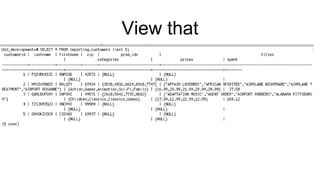
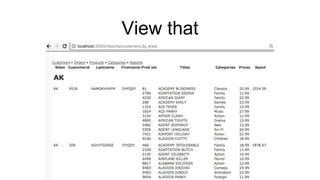
View that
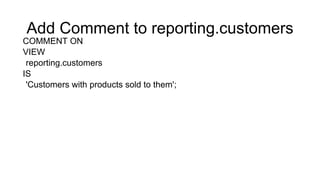
Add Comment to reporting.customers
COMMENT ON
VIEW
reporting.customers
IS
'Customers with products sold to them';
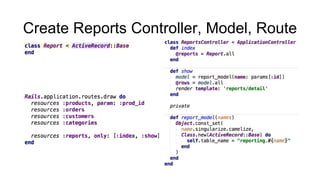
Create Reports Controller, Model, Route
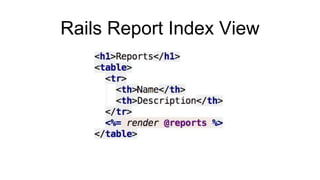
Rails Report Index View
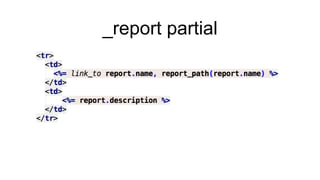
_report partial
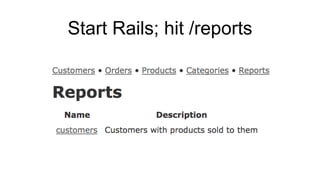
Start Rails; hit /reports
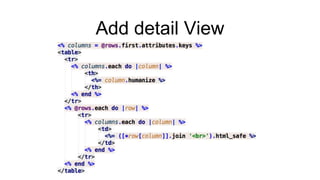
Add detail View
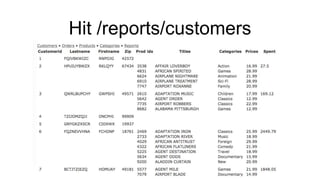
Hit /reports/customers
Cool
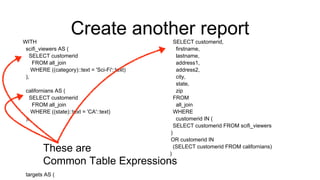
Create another reportWITH
scifi_viewers AS (
SELECT customerid
FROM all_join
WHERE ((category)::text = 'Sci-Fi'::text)
),
californians AS (
SELECT customerid
FROM all_join
WHERE ((state)::text = 'CA'::text)
),
targets AS (
SELECT customerid,
firstname,
lastname,
address1,
address2,
city,
state,
zip
FROM
all_join
WHERE
customerid IN (
SELECT customerid FROM scifi_viewers
)
OR customerid IN
(SELECT customerid FROM californians)
)
…
These are
Common Table Expressions
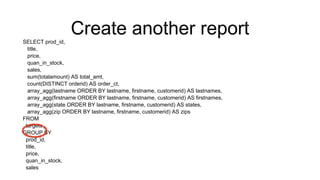
Create another reportSELECT prod_id,
title,
price,
quan_in_stock,
sales,
sum(totalamount) AS total_amt,
count(DISTINCT orderid) AS order_ct,
array_agg(lastname ORDER BY lastname, firstname, customerid) AS lastnames,
array_agg(firstname ORDER BY lastname, firstname, customerid) AS firstnames,
array_agg(state ORDER BY lastname, firstname, customerid) AS states,
array_agg(zip ORDER BY lastname, firstname, customerid) AS zips
FROM
targets
GROUP BY
prod_id,
title,
price,
quan_in_stock,
sales
Get Jiggy Wid It
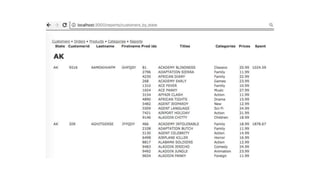
Create reporting.customers_by_state View
…
SELECT
state,
CASE
WHEN LAG(state) OVER (ORDER BY state, lastname) IS NULL
OR
LAG(state) OVER (ORDER BY state, lastname)::text <> state::text
THEN
(('{"break": [1, "'::text || state::text) || '"]}'::text)::jsonb
ELSE
NULL::jsonb
END AS _meta),
…
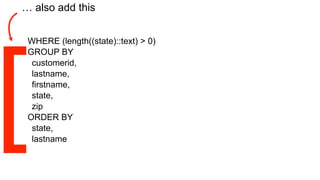
Copy customers and add this
WHERE (length((state)::text) > 0)
GROUP BY
customerid,
lastname,
firstname,
state,
zip
ORDER BY
state,
lastname
… also add this
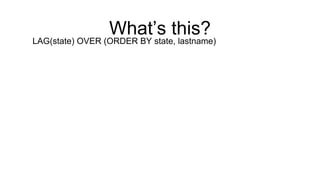
What’s this?
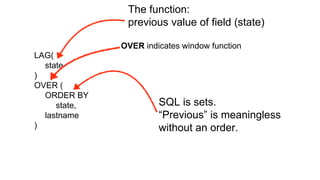
LAG(state) OVER (ORDER BY state, lastname)
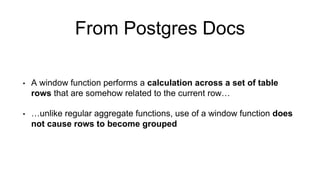
From Postgres Docs
• A window function performs a calculation across a set of table
rows that are somehow related to the current row…
• …unlike regular aggregate functions, use of a window function does
not cause rows to become grouped
Three parts
• The function
• Which rows (optional)
• Which order (optional)
LAG(
state
)
OVER (
ORDER BY
state,
lastname
)
The function:
previous value of field (state)
SQL is sets.
“Previous” is meaningless
without an order.
OVER indicates window function
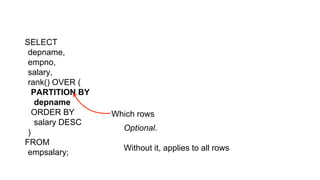
SELECT
depname,
empno,
salary,
rank() OVER (
PARTITION BY
depname
ORDER BY
salary DESC
)
FROM
empsalary;
Which rows
Optional.
Without it, applies to all rows
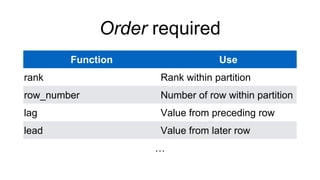
Order required
Function Use
rank Rank within partition
row_number Number of row within partition
lag Value from preceding row
lead Value from later row
…
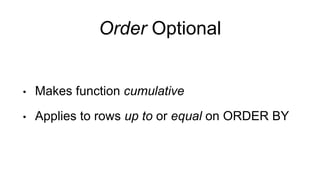
Order Optional
• Makes function cumulative
• Applies to rows up to or equal on ORDER BY
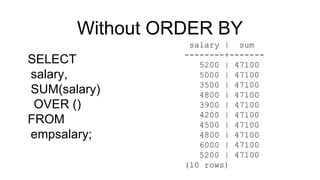
Without ORDER BY
SELECT
salary,
SUM(salary)
OVER ()
FROM
empsalary;
salary | sum
--------+-------
5200 | 47100
5000 | 47100
3500 | 47100
4800 | 47100
3900 | 47100
4200 | 47100
4500 | 47100
4800 | 47100
6000 | 47100
5200 | 47100
(10 rows)
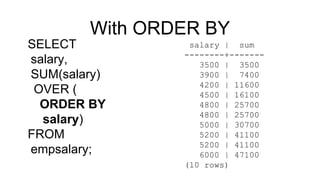
With ORDER BY
SELECT
salary,
SUM(salary)
OVER (
ORDER BY
salary)
FROM
empsalary;
salary | sum
--------+-------
3500 | 3500
3900 | 7400
4200 | 11600
4500 | 16100
4800 | 25700
4800 | 25700
5000 | 30700
5200 | 41100
5200 | 41100
6000 | 47100
(10 rows)
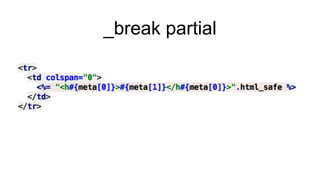
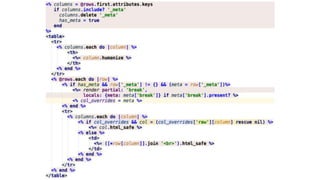
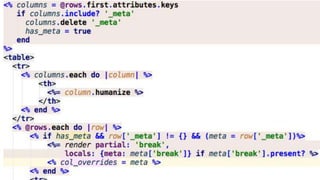
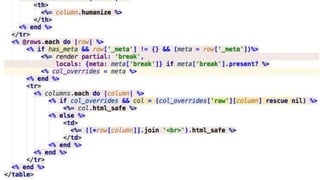
_break partial
View that
Get More Jiggy Wid It
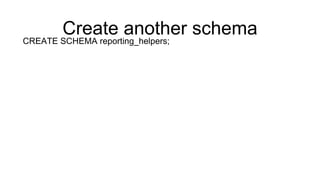
Create another schema
CREATE SCHEMA reporting_helpers;
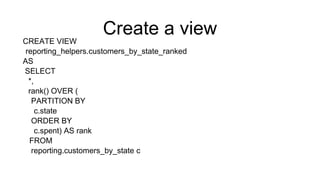
Create a view
CREATE VIEW
reporting_helpers.customers_by_state_ranked
AS
SELECT
*,
rank() OVER (
PARTITION BY
c.state
ORDER BY
c.spent) AS rank
FROM
reporting.customers_by_state c
Add Javascript
CREATE EXTENSION plv8;
Create a Javascript FunctionCREATE FUNCTION
reporting.formatted_cust_by_state_bold(
c reporting_helpers.customers_by_state_ranked
)
RETURNS
reporting_helpers.customers_by_state_ranked
LANGUAGE
plv8
STRICT COST 1
AS $function$
if (c.rank == 1) {
c['_meta'] = c['_meta'] || {}
c['_meta']['raw'] = c['_meta']['raw'] || {}
c['_meta']['raw']['spent'] = c['_meta']['raw']['spent'] || {}
c['_meta']['raw']['spent'] = "<td><b>" + c.spent + "</b></td>"
}
return c
$function$
A table/view defines a type
STRICT means “functional on a given db state”
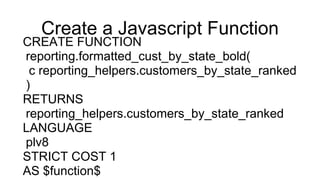
Create a Javascript Function
CREATE FUNCTION
reporting.formatted_cust_by_state_bold(
c reporting_helpers.customers_by_state_ranked
)
RETURNS
reporting_helpers.customers_by_state_ranked
LANGUAGE
plv8
STRICT COST 1
AS $function$
LANGUAGE
plv8
STRICT COST 1
AS $function$
if (c.rank == 1) {
c['_meta'] = c['meta'] || {}
c['_meta']['raw'] = c['_meta']['raw'] || {}
c['_meta']['raw']['spent'] = c['_meta']['raw']['spent'] || {}
c['_meta']['raw']['spent'] = "<td><b>" + c.spent + "</b></td>"
}
return c
$function$
Create a Javascript Function
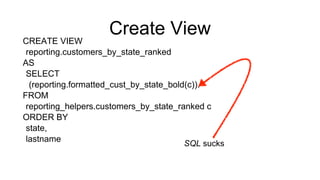
Create View
CREATE VIEW
reporting.customers_by_state_ranked
AS
SELECT
(reporting.formatted_cust_by_state_bold(c)).*
FROM
reporting_helpers.customers_by_state_ranked c
ORDER BY
state,
lastname
SQL sucks
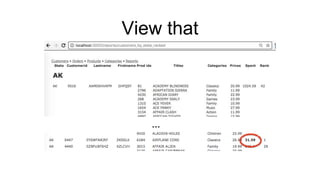
View that
…
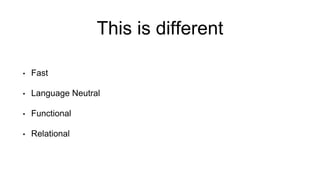
This is different
• Fast
• Language Neutral
• Functional
• Relational
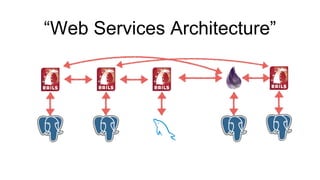
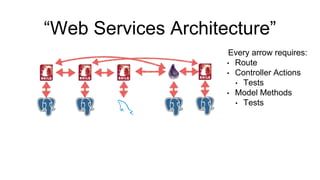
“Web Services Architecture”
Every arrow requires:
• Route
• Controller Actions
• Tests
• Model Methods
• Tests
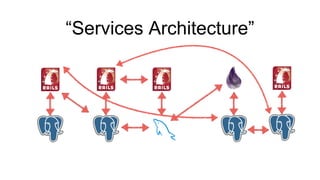
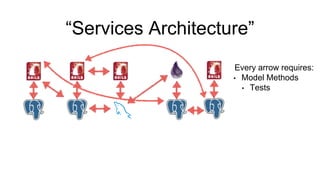
“Services Architecture”
Every arrow requires:
• Model Methods
• Tests
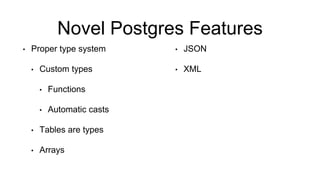
Novel Postgres Features
• Proper type system
• Custom types
• Functions
• Automatic casts
• Tables are types
• Arrays
• JSON
• XML
Novel Postgres Features
• Foreign Data Wrappers
• SQL Databases
• LDAP
• Elastic Search
• Redis
• MongoDB
• Cassandra, CouchDB, …
• CSV/JSON/XML/…
• git/file system/imap/twitter
• google spreadsheet
• Roll your own (Python)
• …
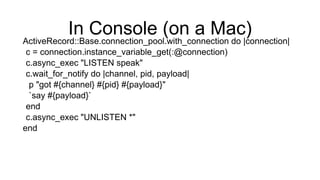
In Console (on a Mac)
ActiveRecord::Base.connection_pool.with_connection do |connection|
c = connection.instance_variable_get(:@connection)
c.async_exec "LISTEN speak"
c.wait_for_notify do |channel, pid, payload|
p "got #{channel} #{pid} #{payload}"
`say #{payload}`
end
c.async_exec "UNLISTEN *"
end
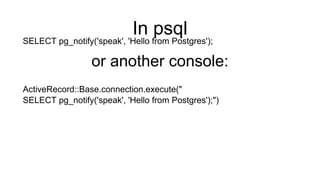
In psql
SELECT pg_notify('speak', 'Hello from Postgres');
or another console:
ActiveRecord::Base.connection.execute("
SELECT pg_notify('speak', 'Hello from Postgres');")
Discussion
Go.
We’re hiring
California
Connecticut
Illinois
Minnesota
New Jersey
North Carolina
Ohio
Pennsylvania
Tennessee
Texas
Washington
Guyren G Howe
guyren@relevantlogic.com
@unclouded
Brought to you by
http://scriptscribe.org
https://medium.com/@gisborne

Love Your Database Railsconf 2017

  • 1.
    Guyren G Howe guyren@relevantlogic.com @unclouded Broughtto you by https://github.com/gisborne/railsconf_lydb
  • 9.
    Information Technology - DatabaseLanguage SQL (Proposed revised text of DIS 9075) July 1992
  • 11.
    Postgres’ Little-Known Secret •Postgres is a great programming platform
  • 12.
    Novel Postgres Features •PostGIS • Background workers • Full-text search • Custom dictionaries • Stemming • Stop words • Normalization • Synonyms • Multiple languages • Phrase search • Proximity search
  • 13.
    Novel Postgres Features •Proper type system • Custom types • Functions • Automatic casts • Tables are types • Functions take/act as relations • Arrays • JSON • HStore • XML
  • 14.
    Novel Postgres Features •Foreign Data Wrappers • SQL Databases • LDAP • Elastic Search • Redis • MongoDB • Cassandra, CouchDB, … • CSV/JSON/XML/… • git/file system/imap/twitter • google spreadsheet • Roll your own (Python) • …
  • 15.
    Novel Postgres Features •Program in civilized languages • Python • Perl • Javascript • R • Scheme • C • Java • PHP • sh • …
  • 16.
  • 25.
  • 26.
  • 28.
    CREATE OR REPLACEVIEW public.all_join AS SELECT c.customerid, c.firstname, c.lastname, c.address1, c.address2, c.city, c.state, c.zip, c.country, c.email, c.phone, c.creditcardtype, c.creditcard, c.creditcardexpiration, c.username, c.password, c.age, c.income, c.gender, o.orderid, o.orderdate, o.netamount, o.tax, o.totalamount, ol.quantity AS qty, p.prod_id, p.title, p.price, inv.quan_in_stock, inv.sales, cat.categoryname AS category FROM customers c FULL JOIN orders o USING (customerid) FULL JOIN orderlines ol USING (orderid) FULL JOIN products p USING (prod_id) FULL JOIN categories cat ON p.category_id = cat.category FULL JOIN inventory inv USING (prod_id)
  • 29.
    Create a Schema CREATESCHEMA reporting;
  • 30.
    Create a Schema classAddReportingSchema < ActiveRecord::Migration[5.0] def up execute 'CREATE SCHEMA reporting' end def down execute 'DROP SCHEMA reporting' end end
  • 32.
    Create a ReportsView 1 CREATE VIEW all_views AS SELECT c.relname AS name, obj_description(c.oid) AS description, ns.nspname AS namespace FROM pg_class c JOIN pg_namespace ns ON c.relnamespace = ns.oid WHERE c.relkind = 'v'::"char"
  • 33.
    Create a ReportsView 2 CREATE VIEW public.reports AS SELECT name, description FROM all_views WHERE namespace = 'reporting'::name
  • 34.
    Create reporting.customers ViewCREATEVIEW reporting.customers AS SELECT customerid, lastname, firstname, zip, ARRAY_AGG(prod_id ORDER BY orderdate, prod_id) AS prod_ids, ARRAY_AGG(title ORDER BY orderdate, prod_id) AS titles, ARRAY_AGG(category ORDER BY orderdate, prod_id) AS categories, ARRAY_AGG(price ORDER BY orderdate, prod_id) AS prices, SUM(totalamount) AS spent FROM all_join GROUP BY customerid, lastname, firstname, zip
  • 35.
  • 36.
    Add Comment toreporting.customers COMMENT ON VIEW reporting.customers IS 'Customers with products sold to them';
  • 37.
  • 38.
  • 39.
  • 40.
  • 41.
  • 42.
  • 43.
  • 44.
    Create another reportWITH scifi_viewersAS ( SELECT customerid FROM all_join WHERE ((category)::text = 'Sci-Fi'::text) ), californians AS ( SELECT customerid FROM all_join WHERE ((state)::text = 'CA'::text) ), targets AS ( SELECT customerid, firstname, lastname, address1, address2, city, state, zip FROM all_join WHERE customerid IN ( SELECT customerid FROM scifi_viewers ) OR customerid IN (SELECT customerid FROM californians) ) … These are Common Table Expressions
  • 45.
    Create another reportSELECTprod_id, title, price, quan_in_stock, sales, sum(totalamount) AS total_amt, count(DISTINCT orderid) AS order_ct, array_agg(lastname ORDER BY lastname, firstname, customerid) AS lastnames, array_agg(firstname ORDER BY lastname, firstname, customerid) AS firstnames, array_agg(state ORDER BY lastname, firstname, customerid) AS states, array_agg(zip ORDER BY lastname, firstname, customerid) AS zips FROM targets GROUP BY prod_id, title, price, quan_in_stock, sales
  • 46.
  • 48.
    Create reporting.customers_by_state View … SELECT state, CASE WHENLAG(state) OVER (ORDER BY state, lastname) IS NULL OR LAG(state) OVER (ORDER BY state, lastname)::text <> state::text THEN (('{"break": [1, "'::text || state::text) || '"]}'::text)::jsonb ELSE NULL::jsonb END AS _meta), … Copy customers and add this
  • 49.
    WHERE (length((state)::text) >0) GROUP BY customerid, lastname, firstname, state, zip ORDER BY state, lastname … also add this
  • 50.
    What’s this? LAG(state) OVER(ORDER BY state, lastname)
  • 51.
    From Postgres Docs •A window function performs a calculation across a set of table rows that are somehow related to the current row… • …unlike regular aggregate functions, use of a window function does not cause rows to become grouped
  • 52.
    Three parts • Thefunction • Which rows (optional) • Which order (optional)
  • 53.
    LAG( state ) OVER ( ORDER BY state, lastname ) Thefunction: previous value of field (state) SQL is sets. “Previous” is meaningless without an order. OVER indicates window function
  • 54.
    SELECT depname, empno, salary, rank() OVER ( PARTITIONBY depname ORDER BY salary DESC ) FROM empsalary; Which rows Optional. Without it, applies to all rows
  • 55.
    Order required Function Use rankRank within partition row_number Number of row within partition lag Value from preceding row lead Value from later row …
  • 56.
    Order Optional • Makesfunction cumulative • Applies to rows up to or equal on ORDER BY
  • 57.
    Without ORDER BY SELECT salary, SUM(salary) OVER() FROM empsalary; salary | sum --------+------- 5200 | 47100 5000 | 47100 3500 | 47100 4800 | 47100 3900 | 47100 4200 | 47100 4500 | 47100 4800 | 47100 6000 | 47100 5200 | 47100 (10 rows)
  • 58.
    With ORDER BY SELECT salary, SUM(salary) OVER( ORDER BY salary) FROM empsalary; salary | sum --------+------- 3500 | 3500 3900 | 7400 4200 | 11600 4500 | 16100 4800 | 25700 4800 | 25700 5000 | 30700 5200 | 41100 5200 | 41100 6000 | 47100 (10 rows)
  • 59.
  • 63.
  • 64.
  • 65.
    Create another schema CREATESCHEMA reporting_helpers;
  • 66.
    Create a view CREATEVIEW reporting_helpers.customers_by_state_ranked AS SELECT *, rank() OVER ( PARTITION BY c.state ORDER BY c.spent) AS rank FROM reporting.customers_by_state c
  • 67.
  • 68.
    Create a JavascriptFunctionCREATE FUNCTION reporting.formatted_cust_by_state_bold( c reporting_helpers.customers_by_state_ranked ) RETURNS reporting_helpers.customers_by_state_ranked LANGUAGE plv8 STRICT COST 1 AS $function$ if (c.rank == 1) { c['_meta'] = c['_meta'] || {} c['_meta']['raw'] = c['_meta']['raw'] || {} c['_meta']['raw']['spent'] = c['_meta']['raw']['spent'] || {} c['_meta']['raw']['spent'] = "<td><b>" + c.spent + "</b></td>" } return c $function$ A table/view defines a type STRICT means “functional on a given db state”
  • 69.
    Create a JavascriptFunction CREATE FUNCTION reporting.formatted_cust_by_state_bold( c reporting_helpers.customers_by_state_ranked ) RETURNS reporting_helpers.customers_by_state_ranked LANGUAGE plv8 STRICT COST 1 AS $function$
  • 70.
    LANGUAGE plv8 STRICT COST 1 AS$function$ if (c.rank == 1) { c['_meta'] = c['meta'] || {} c['_meta']['raw'] = c['_meta']['raw'] || {} c['_meta']['raw']['spent'] = c['_meta']['raw']['spent'] || {} c['_meta']['raw']['spent'] = "<td><b>" + c.spent + "</b></td>" } return c $function$ Create a Javascript Function
  • 71.
  • 72.
  • 74.
    This is different •Fast • Language Neutral • Functional • Relational
  • 75.
  • 76.
    “Web Services Architecture” Everyarrow requires: • Route • Controller Actions • Tests • Model Methods • Tests
  • 78.
  • 79.
    “Services Architecture” Every arrowrequires: • Model Methods • Tests
  • 80.
    Novel Postgres Features •Proper type system • Custom types • Functions • Automatic casts • Tables are types • Arrays • JSON • XML
  • 81.
    Novel Postgres Features •Foreign Data Wrappers • SQL Databases • LDAP • Elastic Search • Redis • MongoDB • Cassandra, CouchDB, … • CSV/JSON/XML/… • git/file system/imap/twitter • google spreadsheet • Roll your own (Python) • …
  • 83.
    In Console (ona Mac) ActiveRecord::Base.connection_pool.with_connection do |connection| c = connection.instance_variable_get(:@connection) c.async_exec "LISTEN speak" c.wait_for_notify do |channel, pid, payload| p "got #{channel} #{pid} #{payload}" `say #{payload}` end c.async_exec "UNLISTEN *" end
  • 84.
    In psql SELECT pg_notify('speak','Hello from Postgres'); or another console: ActiveRecord::Base.connection.execute(" SELECT pg_notify('speak', 'Hello from Postgres');")
  • 85.
  • 87.
    We’re hiring California Connecticut Illinois Minnesota New Jersey NorthCarolina Ohio Pennsylvania Tennessee Texas Washington
  • 88.
    Guyren G Howe guyren@relevantlogic.com @unclouded Broughtto you by http://scriptscribe.org https://medium.com/@gisborne