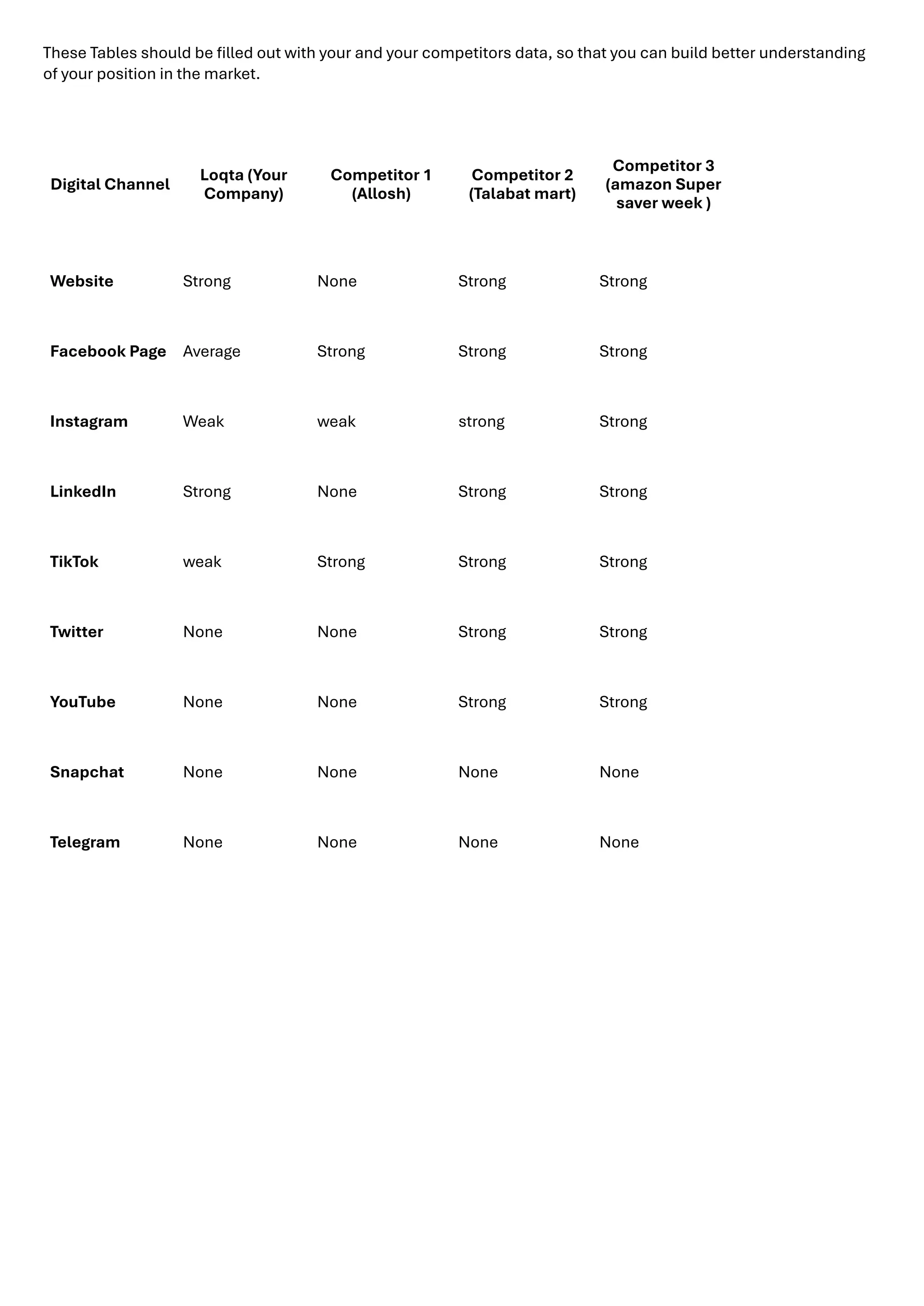
These Tables shouldbe filled out with your and your competitors data, so that you can build better understanding
of your position in the market.
Digital Channel
Loqta (Your
Company)
Competitor 1
(Allosh)
Competitor 2
(Talabat mart)
Competitor 3
(amazon Super
saver week )
Website Strong None Strong Strong
Facebook Page Average Strong Strong Strong
Instagram Weak weak strong Strong
LinkedIn Strong None Strong Strong
TikTok weak Strong Strong Strong
Twitter None None Strong Strong
YouTube None None Strong Strong
Snapchat None None None None
Telegram None None None None
2.
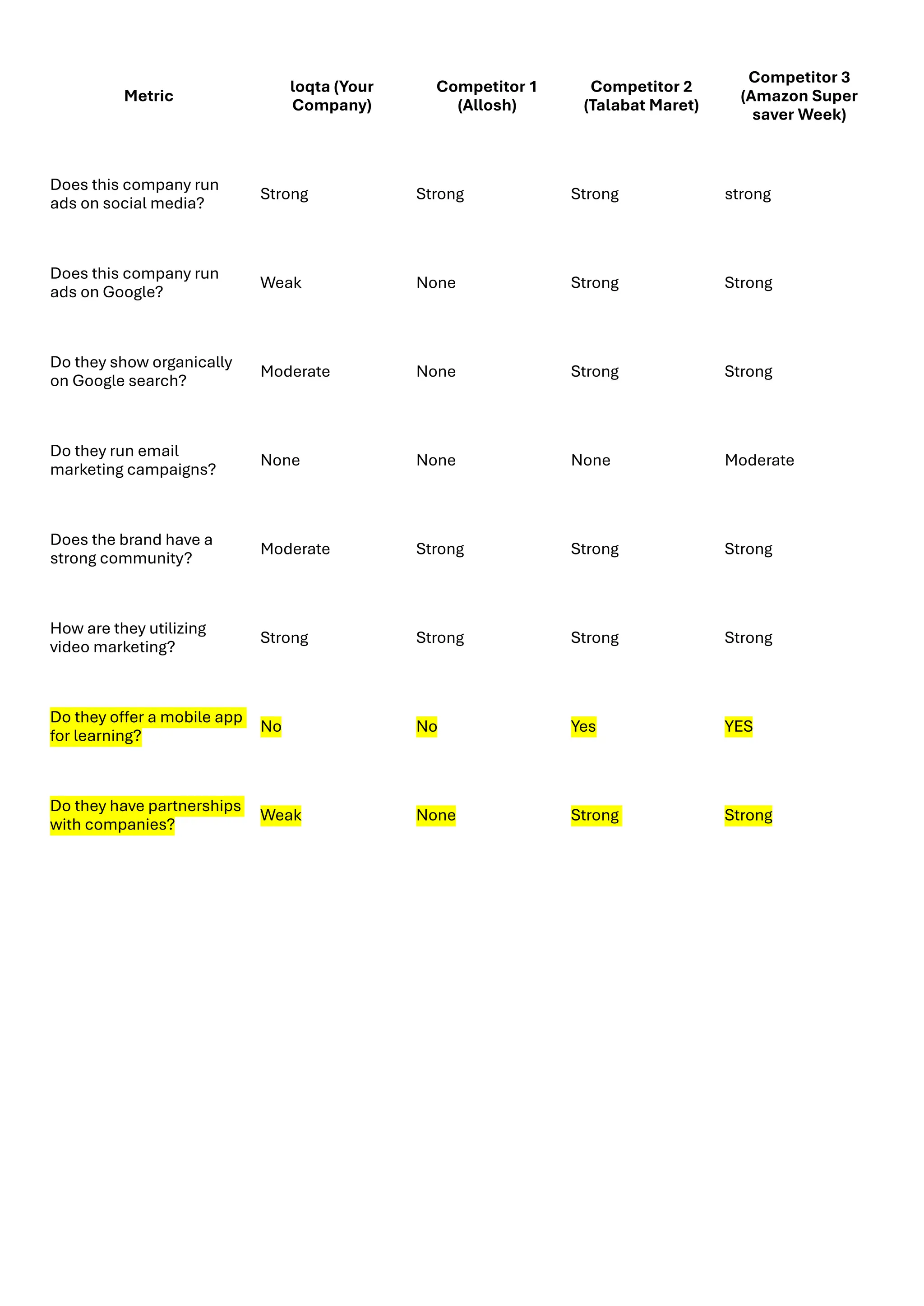
Metric
loqta (Your
Company)
Competitor 1
(Allosh)
Competitor2
(Talabat Maret)
Competitor 3
(Amazon Super
saver Week)
Does this company run
ads on social media?
Strong Strong Strong strong
Does this company run
ads on Google?
Weak None Strong Strong
Do they show organically
on Google search?
Moderate None Strong Strong
Do they run email
marketing campaigns?
None None None Moderate
Does the brand have a
strong community?
Moderate Strong Strong Strong
How are they utilizing
video marketing?
Strong Strong Strong Strong
Do they offer a mobile app
for learning?
No No Yes YES
Do they have partnerships
with companies?
Weak None Strong Strong
3.
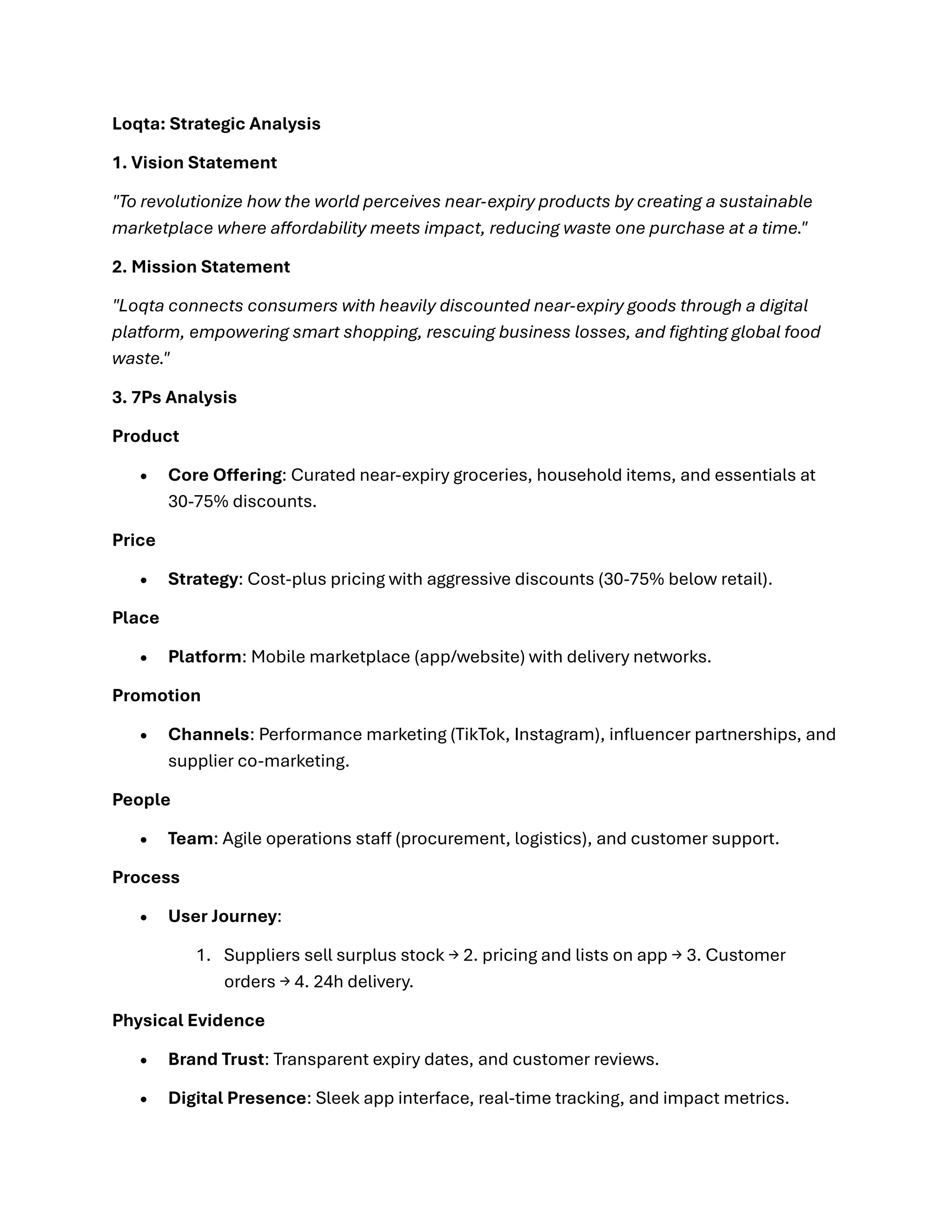
Loqta: Strategic Analysis
1.Vision Statement
"To revolutionize how the world perceives near-expiry products by creating a sustainable
marketplace where affordability meets impact, reducing waste one purchase at a time."
2. Mission Statement
"Loqta connects consumers with heavily discounted near-expiry goods through a digital
platform, empowering smart shopping, rescuing business losses, and fighting global food
waste."
3. 7Ps Analysis
Product
• Core Offering: Curated near-expiry groceries, household items, and essentials at
30-75% discounts.
Price
• Strategy: Cost-plus pricing with aggressive discounts (30-75% below retail).
Place
• Platform: Mobile marketplace (app/website) with delivery networks.
Promotion
• Channels: Performance marketing (TikTok, Instagram), influencer partnerships, and
supplier co-marketing.
People
• Team: Agile operations staff (procurement, logistics), and customer support.
Process
• User Journey:
1. Suppliers sell surplus stock → 2. pricing and lists on app → 3. Customer
orders → 4. 24h delivery.
Physical Evidence
• Brand Trust: Transparent expiry dates, and customer reviews.
• Digital Presence: Sleek app interface, real-time tracking, and impact metrics.
4.
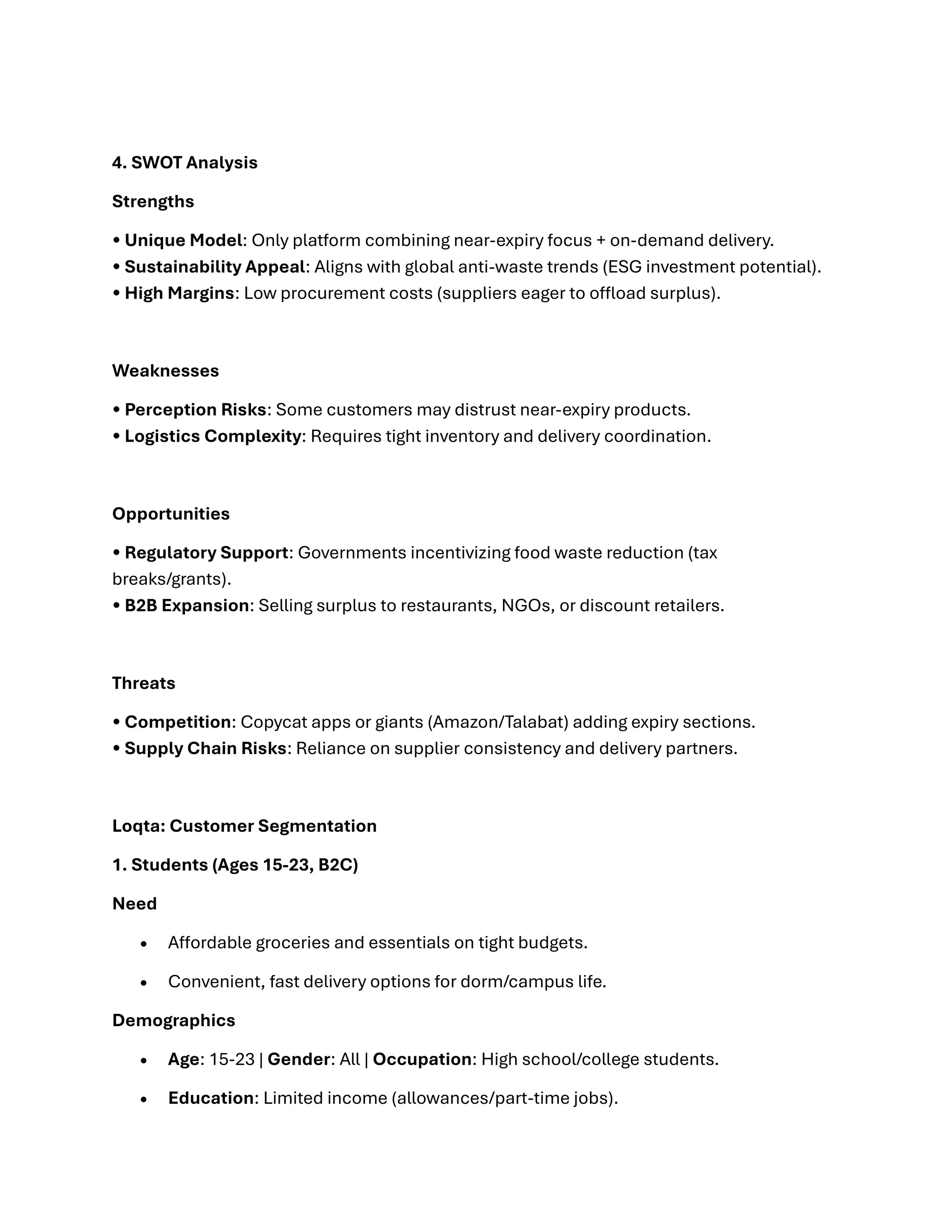
4. SWOT Analysis
Strengths
•Unique Model: Only platform combining near-expiry focus + on-demand delivery.
• Sustainability Appeal: Aligns with global anti-waste trends (ESG investment potential).
• High Margins: Low procurement costs (suppliers eager to offload surplus).
Weaknesses
• Perception Risks: Some customers may distrust near-expiry products.
• Logistics Complexity: Requires tight inventory and delivery coordination.
Opportunities
• Regulatory Support: Governments incentivizing food waste reduction (tax
breaks/grants).
• B2B Expansion: Selling surplus to restaurants, NGOs, or discount retailers.
Threats
• Competition: Copycat apps or giants (Amazon/Talabat) adding expiry sections.
• Supply Chain Risks: Reliance on supplier consistency and delivery partners.
Loqta: Customer Segmentation
1. Students (Ages 15-23, B2C)
Need
• Affordable groceries and essentials on tight budgets.
• Convenient, fast delivery options for dorm/campus life.
Demographics
• Age: 15-23 | Gender: All | Occupation: High school/college students.
• Education: Limited income (allowances/part-time jobs).
5.
• Income: Lowdiscretionary spending .
Psychographics
• Motivations: Saving money, eco-conscious but price-sensitive.
• Values: Quick deals, app-based convenience, peer recommendations.
Behavior
• Active on TikTok, Instagram, Snapchat.
• Engage with flash sales, referral discounts, and gamified rewards.
2. Young Professionals (Ages 23-35, B2C)
Need
• Time-strapped, seeking budget-friendly grocery solutions.
• Open to sustainable shopping if convenient.
Demographics
• Age: 23-35 | Gender: All | Occupation: Entry/mid-level professionals.
• Income: willing to spend on convenience.
Psychographics
• Motivations: Balancing health, cost, and environmental impact.
• Values: Transparency (clear expiry dates), subscription models.
• Challenges: Busy schedules; distrust of near-expiry freshness.
Behavior
• Shop via Instagram ads, influencer endorsements.
• Leave reviews; respond to loyalty programs.
3. Parents/Households (Ages 35-60, B2C)
Need
• Bulk purchases for families, minimizing grocery bills.
6.
• Safe, quality-assurednear-expiry products for kids.
Demographics
• Age: 35-60 | Gender: Primarily female decision-makers.
• Income: Middle-class families.
Psychographics
• Motivations: Feeding families affordably without compromising quality.
• Values: Trust, bulk discounts.
• Challenges: Stigma around near-expiry; need for kid-safe items.
Behavior
• Shop via Facebook Groups, WhatsApp communities.
• Engage with user-generated content.
4. Business Owners (Ages 20-50, B2B)
Need
• Cost-effective inventory for cafes, restaurants, small retailers.
• Reliable, large-quantity surplus goods.
Demographics
• Age: 20-50 | Gender: All | Occupation: F&B owners, small retailers.
• Income: Varies; prioritize high-volume, low-cost procurement.
Psychographics
• Motivations: Maximizing profit margins by reducing ingredient costs.
• Values: Bulk pricing, consistent supply, minimal delivery delays.
• Challenges: Perceived risk of expire dates.
Behavior
• Order via dedicated sales reps/WhatsApp Business.
• Prefer customized pallets.
7.
Targeting & Positioning(STP) for Loqta
1. Targeting
a. Primary Target Segment: B2B Clients
• Who: Restaurants, cafes, small retailers, and caterers.
• Reason for Targeting:
o High Volume Demand: Businesses need consistent, low-cost inventory to
maintain margins.
o Recurring Revenue: Frequent bulk orders drive predictable sales.
o Scalability: Partnering with businesses accelerates market penetration.
b. Secondary Target Segment: Budget-Conscious Households (B2C)
• Who: Families and young professionals prioritizing savings.
• Reason for Targeting:
o Large Market: High demand for discounted groceries in inflationary
economies.
o Brand Advocacy: Satisfied households refer others, boosting organic
growth.
2. Positioning
Positioning Statement
"Loqta is the cheapest supplier of near-expiry goods for businesses, offering bulk
purchases at huge discounts below wholesale prices. For households, we deliver
unmatched savings on quality groceries—rescuing waste and wallets."
Key Positioning Elements
For B2B Clients (Primary Focus)
• Cost Leadership:
o "Cut ingredient costs by 50% with our surplus inventory network."
8.
o Highlight pricecomparison tables vs. traditional wholesalers.
• Reliability:
o "Guaranteed weekly deliveries of curated near-expiry stock—no surprises."
• Custom Solutions:
o "Tailored pallets for your business type—bakery, café, or retail."
For B2C Households (Secondary Focus)
• Savings + Sustainability:
o "Feed your family for less while fighting food waste."
• Trust Building:
o "100% freshness guarantee or your money back."
o Feature user-generated content.
Persona: Restaurant & Café Owners (B2B Primary Target for Loqta)
1. Demographic Profile
• Age: 20-50 years
• Gender: All genders
• Occupation: Owners/managers of small-to-medium restaurants, cafés, bakeries,
and catering businesses
• Location: Urban areas.
• Education: Varied.
• Income: Business revenue-dependent; typically seeks cost-saving solutions
2. Psychographic Profile
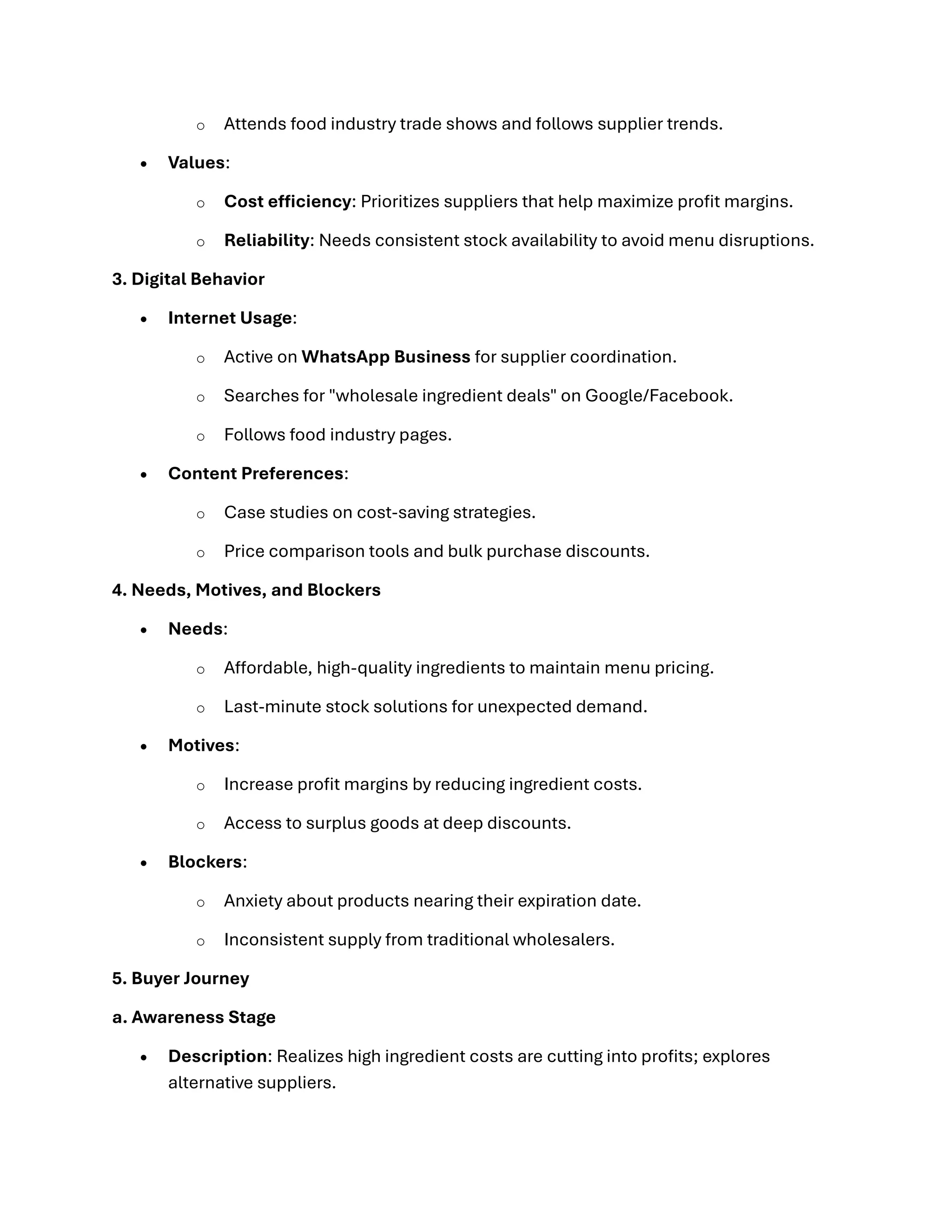
• Lifestyle:
o Juggles kitchen operations, staff management, and customer service.
o Constantly seeks ways to reduce overhead costs without compromising
quality.
9.
o Attends foodindustry trade shows and follows supplier trends.
• Values:
o Cost efficiency: Prioritizes suppliers that help maximize profit margins.
o Reliability: Needs consistent stock availability to avoid menu disruptions.
3. Digital Behavior
• Internet Usage:
o Active on WhatsApp Business for supplier coordination.
o Searches for "wholesale ingredient deals" on Google/Facebook.
o Follows food industry pages.
• Content Preferences:
o Case studies on cost-saving strategies.
o Price comparison tools and bulk purchase discounts.
4. Needs, Motives, and Blockers
• Needs:
o Affordable, high-quality ingredients to maintain menu pricing.
o Last-minute stock solutions for unexpected demand.
• Motives:
o Increase profit margins by reducing ingredient costs.
o Access to surplus goods at deep discounts.
• Blockers:
o Anxiety about products nearing their expiration date.
o Inconsistent supply from traditional wholesalers.
5. Buyer Journey
a. Awareness Stage
• Description: Realizes high ingredient costs are cutting into profits; explores
alternative suppliers.
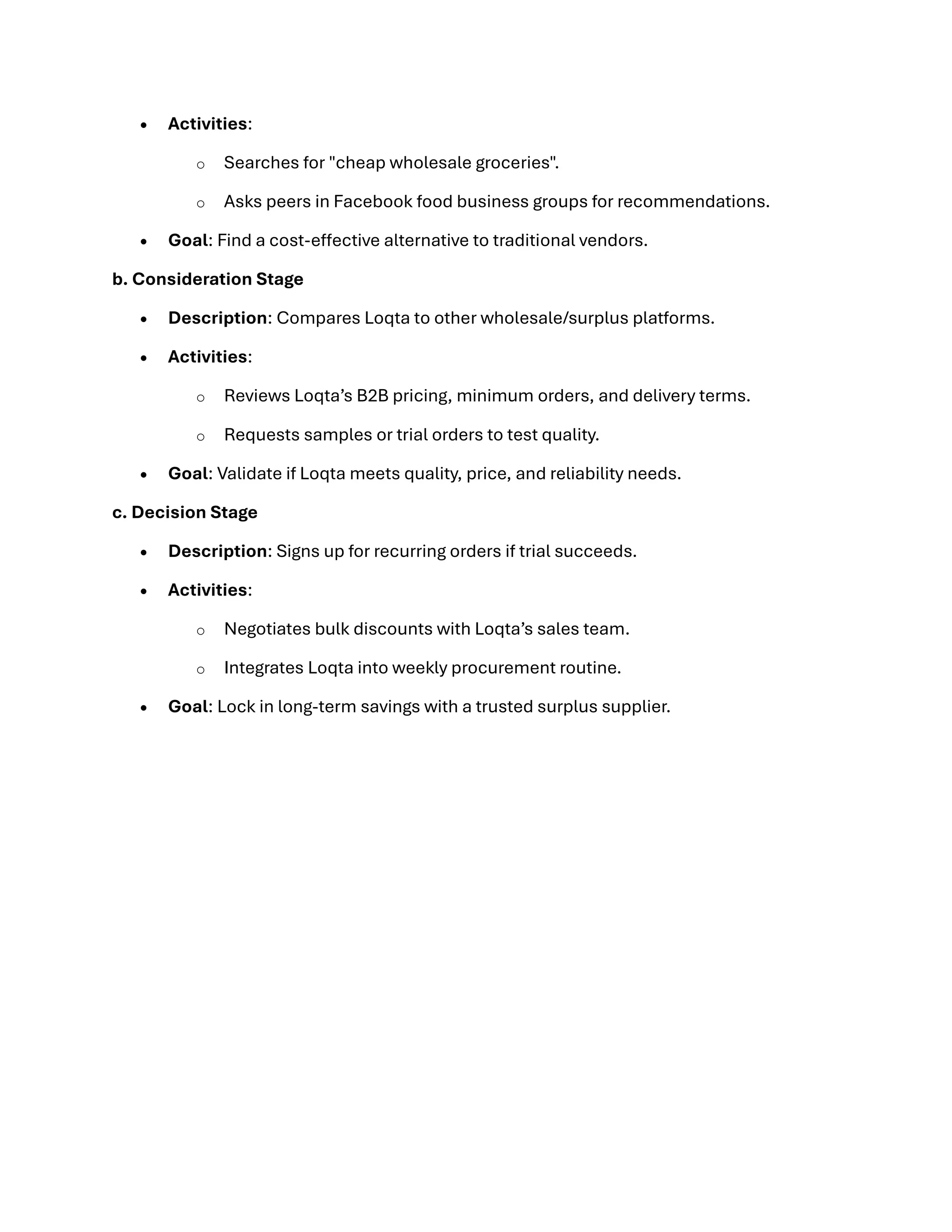
10.
• Activities:
o Searchesfor "cheap wholesale groceries".
o Asks peers in Facebook food business groups for recommendations.
• Goal: Find a cost-effective alternative to traditional vendors.
b. Consideration Stage
• Description: Compares Loqta to other wholesale/surplus platforms.
• Activities:
o Reviews Loqta’s B2B pricing, minimum orders, and delivery terms.
o Requests samples or trial orders to test quality.
• Goal: Validate if Loqta meets quality, price, and reliability needs.
c. Decision Stage
• Description: Signs up for recurring orders if trial succeeds.
• Activities:
o Negotiates bulk discounts with Loqta’s sales team.
o Integrates Loqta into weekly procurement routine.
• Goal: Lock in long-term savings with a trusted surplus supplier.
11.
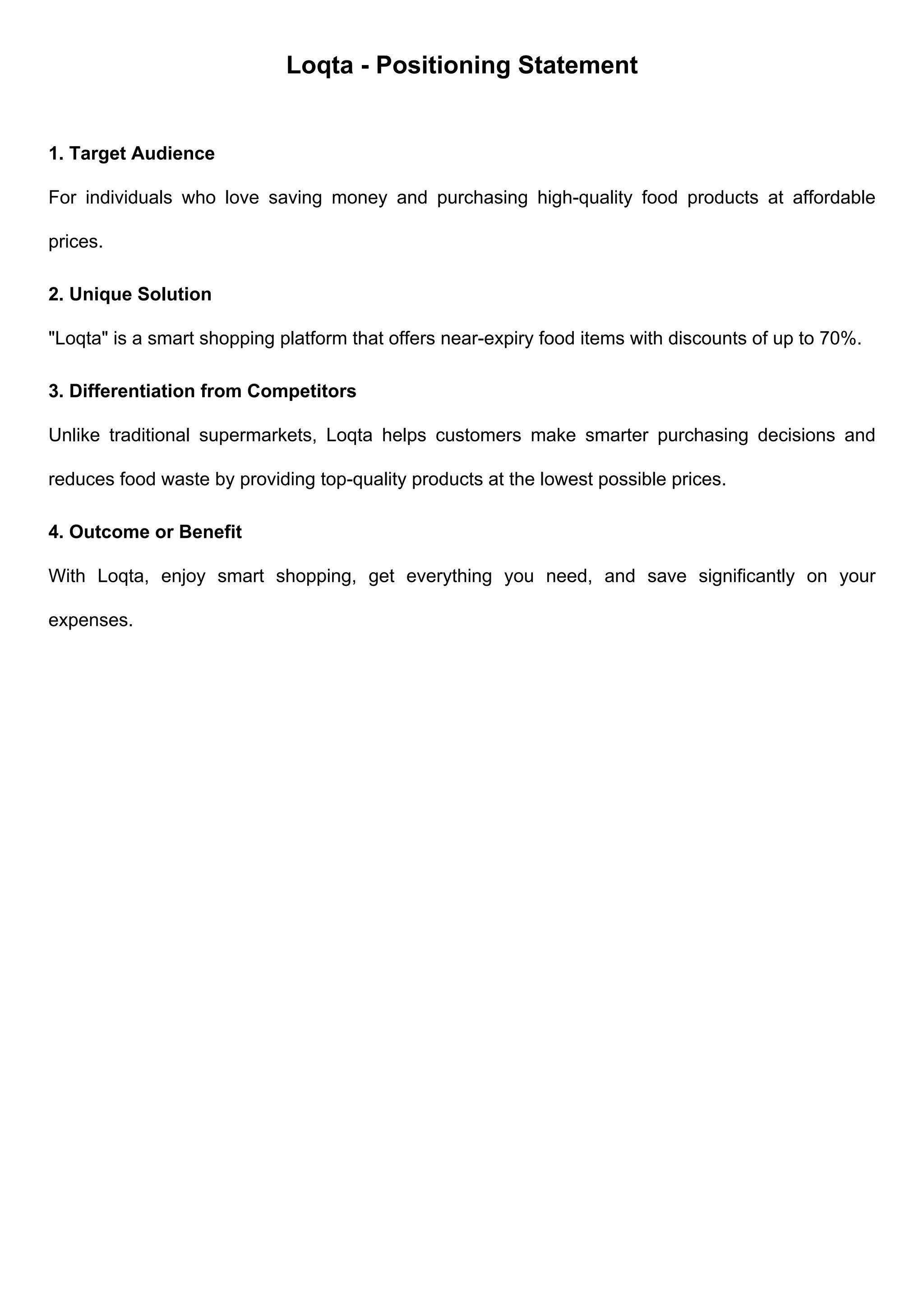
Loqta - PositioningStatement
1. Target Audience
For individuals who love saving money and purchasing high-quality food products at affordable
prices.
2. Unique Solution
"Loqta" is a smart shopping platform that offers near-expiry food items with discounts of up to 70%.
3. Differentiation from Competitors
Unlike traditional supermarkets, Loqta helps customers make smarter purchasing decisions and
reduces food waste by providing top-quality products at the lowest possible prices.
4. Outcome or Benefit
With Loqta, enjoy smart shopping, get everything you need, and save significantly on your
expenses.