1
CS505 – Advanced Computer Architectures
2
ILP
What is instruction Level Parallelism (ILP)?
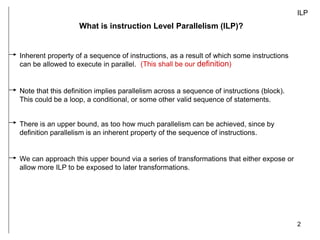
Inherent property of a sequence of instructions, as a result of which some instructions
can be allowed to execute in parallel.
There is an upper bound, as too how much parallelism can be achieved, since by
definition parallelism is an inherent property of the sequence of instructions.
(This shall be our definition)
Note that this definition implies parallelism across a sequence of instructions (block).
This could be a loop, a conditional, or some other valid sequence of statements.
We can approach this upper bound via a series of transformations that either expose or
allow more ILP to be exposed to later transformations.
3
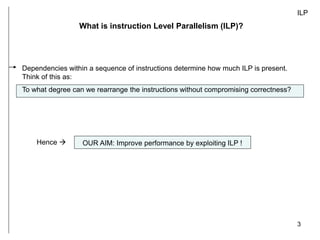
OUR AIM: Improve performance by exploiting ILP !
Hence 
ILP
What is instruction Level Parallelism (ILP)?
Dependencies within a sequence of instructions determine how much ILP is present.
Think of this as:
To what degree can we rearrange the instructions without compromising correctness?
4
ILP
How do we exploit ILP?
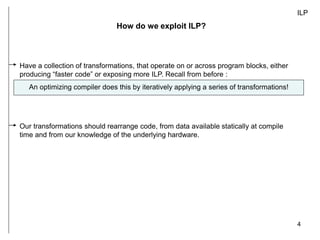
Have a collection of transformations, that operate on or across program blocks, either
producing “faster code” or exposing more ILP. Recall from before :
An optimizing compiler does this by iteratively applying a series of transformations!
Our transformations should rearrange code, from data available statically at compile
time and from our knowledge of the underlying hardware.
5
ILP
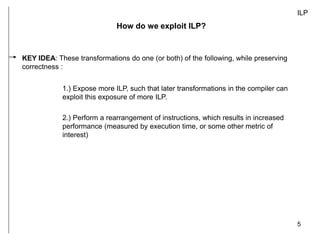
How do we exploit ILP?
KEY IDEA: These transformations do one (or both) of the following, while preserving
correctness :
1.) Expose more ILP, such that later transformations in the compiler can
exploit this exposure of more ILP.
2.) Perform a rearrangement of instructions, which results in increased
performance (measured by execution time, or some other metric of
interest)
6
ILP
An Example of Loop Level Dependences
for (i = 0; i <= 100; i++) {
A[ i + 1] = A[ i ] + C [ i ] ; // S1
B[ i + 1] = B[ i ] + A [i + 1] ; // S2
}
A Loop Independent Dependence
Consider the following loop:
N.B. how do we know A[i+1] and A[i+1] refer to the same location? In general by
performing pointer/index variable analysis from conditions known at compile time.
7
ILP
An Example of Loop Level Dependences
for (i = 0; i <= 100; i++) {
A[ i + 1] = A[ i ] + C [ i ] ; // S1
B[ i + 1] = B[ i ] + A [i + 1] ; // S2
}
Two Loop Carried Dependences
Consider the following loop:
We’ll make use of these concepts when we talk about loop unrolling !
8
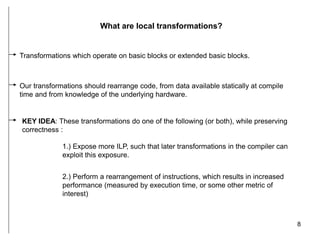
What are local transformations?
Transformations which operate on basic blocks or extended basic blocks.
Our transformations should rearrange code, from data available statically at compile
time and from knowledge of the underlying hardware.
KEY IDEA: These transformations do one of the following (or both), while preserving
correctness :
1.) Expose more ILP, such that later transformations in the compiler can
exploit this exposure.
2.) Perform a rearrangement of instructions, which results in increased
performance (measured by execution time, or some other metric of
interest)
9
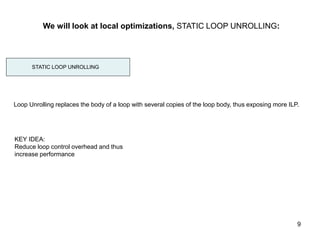
We will look at local optimizations, STATIC LOOP UNROLLING:
STATIC LOOP UNROLLING
Loop Unrolling replaces the body of a loop with several copies of the loop body, thus exposing more ILP.
KEY IDEA:
Reduce loop control overhead and thus
increase performance
10
STATIC LOOP UNROLLING
OBSERVATION: A high proportion of loop instructions executed are loop management
instructions (next example should give a clearer picture) on the induction variable.
KEY IDEA: Eliminating this overhead could potentially significantly increase the
performance of the loop:
We’ll use the following loop as our example:
for (i = 1000 ; i > 0 ; I -- ) {
x[ i ] = x[ i ] + constant;
}
11
STATIC LOOP UNROLLING (continued) – a trivial translation to MIPS
for (i = 1000 ; i > 0 ; I -- ) {
x[ i ] = x[ i ] + constant;
}
L.D
ADD.D
S.D
DADDUI
BNE
Loop : F0,0(R1)
F4,F0,F2
F4,0(R1)
R1,R1,#-8
R1,R2,Loop
; F0 = array elem.
; add scalar in F2
; store result
; decrement ptr
; branch if R1 !=R2
Our example translates into the MIPS
assembly code below (without any
scheduling).
Note the loop independent
dependence in the loop ,i.e. x[ i ] on
x[ i ]
12
LOCAL
STATIC LOOP UNROLLING (continued) – issuing our instructions
L.D
ADD.D
S.D
DADDUI
BNE
Loop : F0,0(R1)
stall
F4,F0,F2
stall
stall
F4,0(R1)
R1,R1,#-8
stall
R1,R2,Loop
stall
1
2
3
4
5
6
7
8
9
10
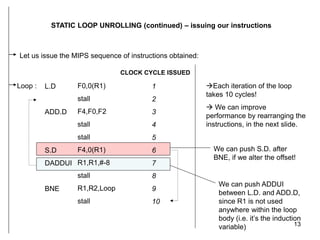
Let us issue the MIPS sequence of instructions obtained:
CLOCK CYCLE ISSUED
13
STATIC LOOP UNROLLING (continued) – issuing our instructions
L.D
ADD.D
S.D
DADDUI
BNE
Loop : F0,0(R1)
stall
F4,F0,F2
stall
stall
F4,0(R1)
R1,R1,#-8
stall
R1,R2,Loop
stall
1
2
3
4
5
6
7
8
9
10
Let us issue the MIPS sequence of instructions obtained:
CLOCK CYCLE ISSUED
Each iteration of the loop
takes 10 cycles!
 We can improve
performance by rearranging the
instructions, in the next slide.
We can push S.D. after
BNE, if we alter the offset!
We can push ADDUI
between L.D. and ADD.D,
since R1 is not used
anywhere within the loop
body (i.e. it’s the induction
variable)
14
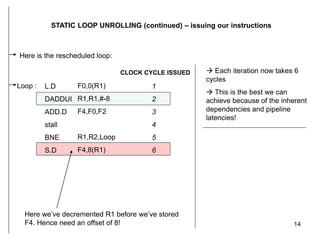
STATIC LOOP UNROLLING (continued) – issuing our instructions
L.D
DADDUI
ADD.D
stall
BNE
S.D
Loop : F0,0(R1)
R1,R1,#-8
F4,F0,F2
R1,R2,Loop
F4,8(R1)
1
2
3
4
5
6
Here is the rescheduled loop:
CLOCK CYCLE ISSUED
Here we’ve decremented R1 before we’ve stored
F4. Hence need an offset of 8!
 Each iteration now takes 6
cycles
 This is the best we can
achieve because of the inherent
dependencies and pipeline
latencies!
15
STATIC LOOP UNROLLING (continued) – issuing our instructions
L.D
DADDUI
ADD.D
stall
BNE
S.D
Loop : F0,0(R1)
R1,R1,#-8
F4,F0,F2
R1,R2,Loop
F4,8(R1)
1
2
3
4
5
6
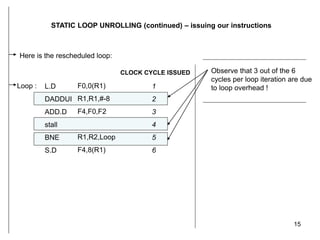
Here is the rescheduled loop:
CLOCK CYCLE ISSUED Observe that 3 out of the 6
cycles per loop iteration are due
to loop overhead !
16
STATIC LOOP UNROLLING (continued)
Hence, if we could decrease the loop management overhead, we could increase the
performance.
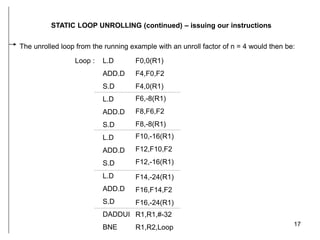
SOLUTION : Static Loop Unrolling
 Make n copies of the loop body, adjusting the loop terminating conditions
and perhaps renaming registers (we’ll very soon see why!),
 This results in less loop management overhead, since we effectively merge
n iterations into one !
 This exposes more ILP, since it allows instructions from different iterations to
be scheduled together!
17
STATIC LOOP UNROLLING (continued) – issuing our instructions
L.D
ADD.D
S.D
L.D
ADD.D
S.D
L.D
ADD.D
S.D
L.D
ADD.D
S.D
DADDUI
BNE
Loop : F0,0(R1)
F4,F0,F2
F4,0(R1)
The unrolled loop from the running example with an unroll factor of n = 4 would then be:
F6,-8(R1)
F8,F6,F2
F8,-8(R1)
F10,-16(R1)
F12,F10,F2
F12,-16(R1)
F14,-24(R1)
F16,F14,F2
F16,-24(R1)
R1,R1,#-32
R1,R2,Loop
18
STATIC LOOP UNROLLING (continued) – issuing our instructions
L.D
ADD.D
S.D
L.D
ADD.D
S.D
L.D
ADD.D
S.D
L.D
ADD.D
S.D
DADDUI
BNE
Loop : F0,0(R1)
F4,F0,F2
F4,0(R1)
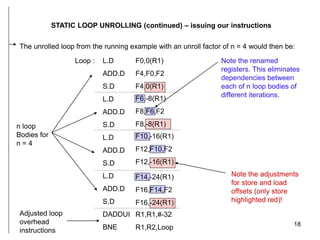
The unrolled loop from the running example with an unroll factor of n = 4 would then be:
F6,-8(R1)
F8,F6,F2
F8,-8(R1)
F10,-16(R1)
F12,F10,F2
F12,-16(R1)
F14,-24(R1)
F16,F14,F2
F16,-24(R1)
R1,R1,#-32
R1,R2,Loop
n loop
Bodies for
n = 4
Adjusted loop
overhead
instructions
Note the adjustments
for store and load
offsets (only store
highlighted red)!
Note the renamed
registers. This eliminates
dependencies between
each of n loop bodies of
different iterations.
19
STATIC LOOP UNROLLING (continued) – issuing our instructions
L.D
L.D
L.D
L.D
ADD.D
ADD.D
ADD.D
ADD.D
S.D
S.D
DADDUI
S.D
BNE
S.D
Loop : F0,0(R1)
F6,-8(R1)
F10,-16(R1)
F14,-24(R1)
F4,F0,F2
F8,F6,F2
F12,F10,F2
F16,F14,F2
F4,0(R1)
F8,-8(R1)
R1,R1,#-32
F12,16(R1)
R1,R2,Loop
F16,8(R1);
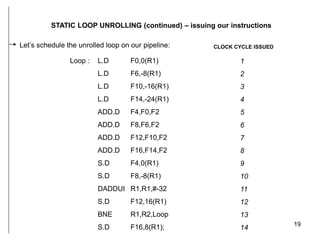
Let’s schedule the unrolled loop on our pipeline:
1
2
3
4
5
6
7
8
9
10
11
12
13
14
CLOCK CYCLE ISSUED
20
STATIC LOOP UNROLLING (continued) – issuing our instructions
L.D
L.D
L.D
L.D
ADD.D
ADD.D
ADD.D
ADD.D
S.D
S.D
DADDUI
S.D
BNE
S.D
Loop : F0,0(R1)
F6,-8(R1)
F10,-16(R1)
F14,-24(R1)
F4,F0,F2
F8,F6,F2
F12,F10,F2
F16,F14,F2
F4,0(R1)
F8,-8(R1)
R1,R1,#-32
F12,16(R1)
R1,R2,Loop
F16,8(R1);
Let’s schedule the unrolled loop on our pipeline:
1
2
3
4
5
6
7
8
9
10
11
12
13
14
CLOCK CYCLE ISSUED
This takes 14 cycles for 1
iteration of the unrolled
loop.
Therefore w.r.t. original
loop we now have 14/4 =
3.5 cycles per iteration.
Previously 6 was the best
we could do!
 We gain an increase in
performance, at the
expense of extra code and
higher register
usage/pressure
 The performance gain
on superscalar
architectures would be
even higher!
21
STATIC LOOP UNROLLING (continued)
However loop unrolling has some significant complications and disadvantages:
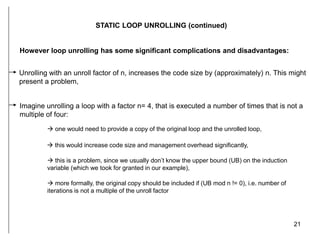
Imagine unrolling a loop with a factor n= 4, that is executed a number of times that is not a
multiple of four:
 more formally, the original copy should be included if (UB mod n != 0), i.e. number of
iterations is not a multiple of the unroll factor
 one would need to provide a copy of the original loop and the unrolled loop,
 this would increase code size and management overhead significantly,
 this is a problem, since we usually don’t know the upper bound (UB) on the induction
variable (which we took for granted in our example),
Unrolling with an unroll factor of n, increases the code size by (approximately) n. This might
present a problem,
22
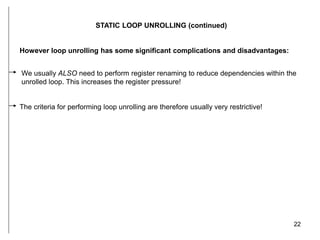
We usually ALSO need to perform register renaming to reduce dependencies within the
unrolled loop. This increases the register pressure!
STATIC LOOP UNROLLING (continued)
However loop unrolling has some significant complications and disadvantages:
The criteria for performing loop unrolling are therefore usually very restrictive!

Loop Unroll_ACA_CS505.ppt

  • 1.
    1 CS505 – AdvancedComputer Architectures
  • 2.
    2 ILP What is instructionLevel Parallelism (ILP)? Inherent property of a sequence of instructions, as a result of which some instructions can be allowed to execute in parallel. There is an upper bound, as too how much parallelism can be achieved, since by definition parallelism is an inherent property of the sequence of instructions. (This shall be our definition) Note that this definition implies parallelism across a sequence of instructions (block). This could be a loop, a conditional, or some other valid sequence of statements. We can approach this upper bound via a series of transformations that either expose or allow more ILP to be exposed to later transformations.
  • 3.
    3 OUR AIM: Improveperformance by exploiting ILP ! Hence  ILP What is instruction Level Parallelism (ILP)? Dependencies within a sequence of instructions determine how much ILP is present. Think of this as: To what degree can we rearrange the instructions without compromising correctness?
  • 4.
    4 ILP How do weexploit ILP? Have a collection of transformations, that operate on or across program blocks, either producing “faster code” or exposing more ILP. Recall from before : An optimizing compiler does this by iteratively applying a series of transformations! Our transformations should rearrange code, from data available statically at compile time and from our knowledge of the underlying hardware.
  • 5.
    5 ILP How do weexploit ILP? KEY IDEA: These transformations do one (or both) of the following, while preserving correctness : 1.) Expose more ILP, such that later transformations in the compiler can exploit this exposure of more ILP. 2.) Perform a rearrangement of instructions, which results in increased performance (measured by execution time, or some other metric of interest)
  • 6.
    6 ILP An Example ofLoop Level Dependences for (i = 0; i <= 100; i++) { A[ i + 1] = A[ i ] + C [ i ] ; // S1 B[ i + 1] = B[ i ] + A [i + 1] ; // S2 } A Loop Independent Dependence Consider the following loop: N.B. how do we know A[i+1] and A[i+1] refer to the same location? In general by performing pointer/index variable analysis from conditions known at compile time.
  • 7.
    7 ILP An Example ofLoop Level Dependences for (i = 0; i <= 100; i++) { A[ i + 1] = A[ i ] + C [ i ] ; // S1 B[ i + 1] = B[ i ] + A [i + 1] ; // S2 } Two Loop Carried Dependences Consider the following loop: We’ll make use of these concepts when we talk about loop unrolling !
  • 8.
    8 What are localtransformations? Transformations which operate on basic blocks or extended basic blocks. Our transformations should rearrange code, from data available statically at compile time and from knowledge of the underlying hardware. KEY IDEA: These transformations do one of the following (or both), while preserving correctness : 1.) Expose more ILP, such that later transformations in the compiler can exploit this exposure. 2.) Perform a rearrangement of instructions, which results in increased performance (measured by execution time, or some other metric of interest)
  • 9.
    9 We will lookat local optimizations, STATIC LOOP UNROLLING: STATIC LOOP UNROLLING Loop Unrolling replaces the body of a loop with several copies of the loop body, thus exposing more ILP. KEY IDEA: Reduce loop control overhead and thus increase performance
  • 10.
    10 STATIC LOOP UNROLLING OBSERVATION:A high proportion of loop instructions executed are loop management instructions (next example should give a clearer picture) on the induction variable. KEY IDEA: Eliminating this overhead could potentially significantly increase the performance of the loop: We’ll use the following loop as our example: for (i = 1000 ; i > 0 ; I -- ) { x[ i ] = x[ i ] + constant; }
  • 11.
    11 STATIC LOOP UNROLLING(continued) – a trivial translation to MIPS for (i = 1000 ; i > 0 ; I -- ) { x[ i ] = x[ i ] + constant; } L.D ADD.D S.D DADDUI BNE Loop : F0,0(R1) F4,F0,F2 F4,0(R1) R1,R1,#-8 R1,R2,Loop ; F0 = array elem. ; add scalar in F2 ; store result ; decrement ptr ; branch if R1 !=R2 Our example translates into the MIPS assembly code below (without any scheduling). Note the loop independent dependence in the loop ,i.e. x[ i ] on x[ i ]
  • 12.
    12 LOCAL STATIC LOOP UNROLLING(continued) – issuing our instructions L.D ADD.D S.D DADDUI BNE Loop : F0,0(R1) stall F4,F0,F2 stall stall F4,0(R1) R1,R1,#-8 stall R1,R2,Loop stall 1 2 3 4 5 6 7 8 9 10 Let us issue the MIPS sequence of instructions obtained: CLOCK CYCLE ISSUED
  • 13.
    13 STATIC LOOP UNROLLING(continued) – issuing our instructions L.D ADD.D S.D DADDUI BNE Loop : F0,0(R1) stall F4,F0,F2 stall stall F4,0(R1) R1,R1,#-8 stall R1,R2,Loop stall 1 2 3 4 5 6 7 8 9 10 Let us issue the MIPS sequence of instructions obtained: CLOCK CYCLE ISSUED Each iteration of the loop takes 10 cycles!  We can improve performance by rearranging the instructions, in the next slide. We can push S.D. after BNE, if we alter the offset! We can push ADDUI between L.D. and ADD.D, since R1 is not used anywhere within the loop body (i.e. it’s the induction variable)
  • 14.
    14 STATIC LOOP UNROLLING(continued) – issuing our instructions L.D DADDUI ADD.D stall BNE S.D Loop : F0,0(R1) R1,R1,#-8 F4,F0,F2 R1,R2,Loop F4,8(R1) 1 2 3 4 5 6 Here is the rescheduled loop: CLOCK CYCLE ISSUED Here we’ve decremented R1 before we’ve stored F4. Hence need an offset of 8!  Each iteration now takes 6 cycles  This is the best we can achieve because of the inherent dependencies and pipeline latencies!
  • 15.
    15 STATIC LOOP UNROLLING(continued) – issuing our instructions L.D DADDUI ADD.D stall BNE S.D Loop : F0,0(R1) R1,R1,#-8 F4,F0,F2 R1,R2,Loop F4,8(R1) 1 2 3 4 5 6 Here is the rescheduled loop: CLOCK CYCLE ISSUED Observe that 3 out of the 6 cycles per loop iteration are due to loop overhead !
  • 16.
    16 STATIC LOOP UNROLLING(continued) Hence, if we could decrease the loop management overhead, we could increase the performance. SOLUTION : Static Loop Unrolling  Make n copies of the loop body, adjusting the loop terminating conditions and perhaps renaming registers (we’ll very soon see why!),  This results in less loop management overhead, since we effectively merge n iterations into one !  This exposes more ILP, since it allows instructions from different iterations to be scheduled together!
  • 17.
    17 STATIC LOOP UNROLLING(continued) – issuing our instructions L.D ADD.D S.D L.D ADD.D S.D L.D ADD.D S.D L.D ADD.D S.D DADDUI BNE Loop : F0,0(R1) F4,F0,F2 F4,0(R1) The unrolled loop from the running example with an unroll factor of n = 4 would then be: F6,-8(R1) F8,F6,F2 F8,-8(R1) F10,-16(R1) F12,F10,F2 F12,-16(R1) F14,-24(R1) F16,F14,F2 F16,-24(R1) R1,R1,#-32 R1,R2,Loop
  • 18.
    18 STATIC LOOP UNROLLING(continued) – issuing our instructions L.D ADD.D S.D L.D ADD.D S.D L.D ADD.D S.D L.D ADD.D S.D DADDUI BNE Loop : F0,0(R1) F4,F0,F2 F4,0(R1) The unrolled loop from the running example with an unroll factor of n = 4 would then be: F6,-8(R1) F8,F6,F2 F8,-8(R1) F10,-16(R1) F12,F10,F2 F12,-16(R1) F14,-24(R1) F16,F14,F2 F16,-24(R1) R1,R1,#-32 R1,R2,Loop n loop Bodies for n = 4 Adjusted loop overhead instructions Note the adjustments for store and load offsets (only store highlighted red)! Note the renamed registers. This eliminates dependencies between each of n loop bodies of different iterations.
  • 19.
    19 STATIC LOOP UNROLLING(continued) – issuing our instructions L.D L.D L.D L.D ADD.D ADD.D ADD.D ADD.D S.D S.D DADDUI S.D BNE S.D Loop : F0,0(R1) F6,-8(R1) F10,-16(R1) F14,-24(R1) F4,F0,F2 F8,F6,F2 F12,F10,F2 F16,F14,F2 F4,0(R1) F8,-8(R1) R1,R1,#-32 F12,16(R1) R1,R2,Loop F16,8(R1); Let’s schedule the unrolled loop on our pipeline: 1 2 3 4 5 6 7 8 9 10 11 12 13 14 CLOCK CYCLE ISSUED
  • 20.
    20 STATIC LOOP UNROLLING(continued) – issuing our instructions L.D L.D L.D L.D ADD.D ADD.D ADD.D ADD.D S.D S.D DADDUI S.D BNE S.D Loop : F0,0(R1) F6,-8(R1) F10,-16(R1) F14,-24(R1) F4,F0,F2 F8,F6,F2 F12,F10,F2 F16,F14,F2 F4,0(R1) F8,-8(R1) R1,R1,#-32 F12,16(R1) R1,R2,Loop F16,8(R1); Let’s schedule the unrolled loop on our pipeline: 1 2 3 4 5 6 7 8 9 10 11 12 13 14 CLOCK CYCLE ISSUED This takes 14 cycles for 1 iteration of the unrolled loop. Therefore w.r.t. original loop we now have 14/4 = 3.5 cycles per iteration. Previously 6 was the best we could do!  We gain an increase in performance, at the expense of extra code and higher register usage/pressure  The performance gain on superscalar architectures would be even higher!
  • 21.
    21 STATIC LOOP UNROLLING(continued) However loop unrolling has some significant complications and disadvantages: Imagine unrolling a loop with a factor n= 4, that is executed a number of times that is not a multiple of four:  more formally, the original copy should be included if (UB mod n != 0), i.e. number of iterations is not a multiple of the unroll factor  one would need to provide a copy of the original loop and the unrolled loop,  this would increase code size and management overhead significantly,  this is a problem, since we usually don’t know the upper bound (UB) on the induction variable (which we took for granted in our example), Unrolling with an unroll factor of n, increases the code size by (approximately) n. This might present a problem,
  • 22.
    22 We usually ALSOneed to perform register renaming to reduce dependencies within the unrolled loop. This increases the register pressure! STATIC LOOP UNROLLING (continued) However loop unrolling has some significant complications and disadvantages: The criteria for performing loop unrolling are therefore usually very restrictive!