Long considered an invasive weed, this
warm-season grass is managed by many
courses as a desirable turf species.
By Patrick J. Gross
Kikuyugrass is the Rodney Dangerfield of turf - it
gets no respect. While many courses fought the inva-
sion and spread of kikuyugrass for decades, others
have learned to manage this grass to provide good
playing quality on tees, fairways, and rough. Why the
change of heart? Some courses had no choice but to
learn to manage their former enemy as it gradually
spread over most of the course. Other courses did not
have the budget or resources to control infestations
with multiple herbicide sprays, physical removal, and
sodding. As superintendents learned more about the
grass, they were able to adapt management practices
to provide a dense, uniform turf with good playing
quality. Although much of the literature to this point
has focused on the control of kikuyugrass, this article
will look at the culture and management of kikuyu-
grass as a fine turf for golf courses.
History and Background
Kikuyugrass (Pennisetum clandestinum) is a warm-
season grass that is native to the Kenyan highlands of
Africa. It is a course-textured grass with a rapid
growth rate, and it is commonly used as a forage grass
and turfgrass in mild coastal climates and sub-tropical
regions. The spread of kikuyugrass was aided by the
Dutch, who brought the grass from Kenya to South
Africa and Australia during the Boer War. Kikuyu-
grass was eventually transported to other areas and is
now cultivated in many mild climates throughout the
world, including South Africa, Australia, New
Zealand, Mexico, Spain, Central America, South
America, and portions of the United States.
Improvement of kikuyugrass began in the 1950s
when the Australian government awarded a grant to a
plant breeder to develop a seeded forage type for live-
stock. The rapid growth rate, palatability, and high
protein content made kikuyugrass an ideal forage for
cattle and livestock. The breeder, Dr. Whittet, devel-
oped the cultivar that bears his name and sold the first
22 lb. batch of seed to the Eykamp family for com-
mercial seed production in New South Wales, Aus-
tralia, where the Whittet variety is still grown today.
The establishment of kikuyugrass in the United
States occurred in 1918 when it was imported to Pa-
cific Palisades, California, as an erosion control for
ditch banks, and it gradually spread to the coast and
inland valley areas. Many golf course superintendents
and homeowners misidentified the grass as St. Au-
gustinegrass due to the similarities in leaf blade
width, color, thick stolon, and dense canopy. From
California, the grass was transported and spread to
several states, including Hawaii, Arizona, and Texas.
Don Eykamp, son of the original grower, brought
kikuyugrass seed to the United States in 1995 with the
intention of producing seed and improving the species
for the American forage and turf market. The main
stumbling block was that kikuyugrass was listed as a
noxious weed in most states due to concerns that it
might be a host for an insect or a fungus that could
Looking Kindly
at Kikuyugrass
Green Section Record-July/August 2003
Continued on page 2
GOLF COURSE CAREGOLF COURSE CARE
devastate the United States millet crop. The host plant
relationship was disproved, but the federal govern-
ment continues to list kikuyugrass as a noxious weed,
citing that it has an invasive growth habit. The status
of kikuyugrass currently is under review, and a ruling
by the governing agency, APHIS, is expected in the
coming year.
In the meantime, seed produc-
tion of Whittet went forward in
Arizona under special permit.
During this time, further improve-
ment in kikuyugrass occurred in
the seed fields of Arizona as a re-
sult of natural selection. A patch
of kikuyugrass with a finer texture
and improved density was ob-
served in a field of Whittet. The
seed from the unusual patch was
replanted, and the progeny dis-
played the same desirable charac-
teristics, resulting in the new
variety Arizona-1 (also called AZ-
1).
Today, kikuyugrass is managed as the primary turf in
fairways and rough at several golf courses, including
prominent PGA Tour stops Riviera Country Club, Tor-
rey Pines Golf Course, and La Costa Resort and Spa.
Kikuyugrass Characteristics
Kikuyugrass has been described as "bermudagrass
on steroids." It is a coarse- to medium-texture warm-
season grass with a rapid growth rate. The leaf width
ranges from 1/8" to 1/4", comparable to Japanese
lawngrass (Zoysia japonica) and St. Augustinegrass
(Stenotaphrum secdundatum). The wider leaf blade is
typical of the native types, while the narrow leaf blade
is typical of improved varieties under intensive man-
agement. The leaf blades are flat and pointed at the tip
and typically grow in length from 1" to 10". Leaf
color is a medium to lime-green that some golfers and
superintendents find objectionable.
Kikuyugrass is often confused with St. Augustine-
grass due to similarities in texture, color, growth
habit, and the thick, fleshy stolons. Kikuyugrass is
distinguished by the pointed leaf tip, flat leaf blade,
and the long fringe of hairs that parallels the stem
near the leaf collar. In contrast, St. Augustinegrass has
sharply folded leaves and blunt leaf tips. Another dis-
tinguishing characteristic of kikuyugrass is the promi-
nent anther and white filament that extends above the
canopy on closely cut turf. The white filaments typi-
cally are visible in the spring
and fall, but they can be seen
throughout the year in some lo-
cations. The white filaments re-
turn within a day of mowing,
giving the turf a silvery cast.
The female part of the flower is
near the base of the plant, and
the seed is formed within the
leaf sheath. The seeds are
rounded and dark brown, ap-
proximately 1/8" in length.
The growth rate of kikuyu-
grass is very rapid under warm,
moist conditions. Shoot exten-
sion can exceed 1" per day at
the height of the growing season. Active growth oc-
curs at temperatures between 60° to 90°F, and it can
survive well at temperatures near 100°F. Kikuyugrass
sustains active growth and retains color at tempera-
tures below 60°F, when most other warm-season
grasses exhibit a loss of color and a slower growth
pattern. In California, kikuyugrass may not go dor-
mant during the winter along the coast, although it
tends to enter dormancy from late November until
February in colder inland valley locations. Kikuyu-
grass appears to have the best winter color retention
of all the warm-season grasses and can tolerate light
frost without a loss of color.
Kikuyugrass spreads by stolons, rhizomes, and
seed. The thick, fleshy stolon and relatively wide leaf
blade contribute to a somewhat open growth habit at
mowing heights above 11/2". Canopy density is sig-
nificantly improved at mowing heights below 5/8".
Rooting occurs at the nodes of stolons under moist
soil conditions. Rooting is significantly restricted in
Looking Kindly at Kikuyugrass Continued from Page 1
Continued on page 32
dry soil, causing the turf to become puffy and more
prone to mower scalping.
The rapid growth rate and thick mat layer associ-
ated with kikuyugrass contribute to excellent traffic
tolerance and recovery from divot injury. The rapid
growth rate is both a benefit and a challenge for main-
tenance. Excessive thatch contributes to spongy sur-
face conditions, mower scalping, and diminished
quality. If left unmowed, kikuyugrass has been ob-
served growing over fences, up utility poles, and into
trees and shrubs. Under routine mowing and mainte-
nance, it can invade greens and tees unless a routine
edging and hand-picking program are in place to con-
trol encroachment. Kikuyugrass provides good play-
ing conditions and ball support when closely mowed,
but the heavy thatch layer tends to limit ball roll on
fairways and provides unpredictable bounces on the
putting green approach. It can be especially treacher-
ous in the rough, where the thick stolons and wide
leaf blades tend to grab the club and make it difficult
to extract the ball.
Kikuyugrass tolerates a wide range of soil condi-
tions. Optimum growth seems to occur in medium- to
heavy-texture soils with a neutral to alkaline pH. Like
many warm-season grasses, kikuyugrass has good tol-
erance to heat, drought, and salinity. It prefers ade-
quate soil moisture but survives drought with a slight
loss of color and a reduction in growth rate.
Propagation and Establishment
The irony of kikuyugrass is that it spreads rapidly
where it is unwanted, but it can be slow to establish in
existing turf or when efforts are made to actively cul-
tivate and spread it. Control efforts are usually aban-
doned once kikuyugrass populations reach 30% to
40%. At this point, most superintendents begin active
programs to cultivate and spread kikuyugrass to en-
courage a uniform stand.
The primary methods of propagation are sod, plugs,
sprigs, and seed. The most successful method of es-
tablishment is transferring sod to provide a solid turf
cover. Until recently, golf courses in the United States
had to propagate their own sod in a nursery area, but
commercially grown sod is now available in Southern
California at a cost of approximately 85¢ to $1.00 per
square foot.
Some courses have attempted to establish plugs of
kikuyugrass in existing stands of bermudagrass using
a specially modified aerifier that removes 2" to 3" di-
ameter cores for transplanting. The plugs can be slow
to establish even if planted in the fall when bermuda-
grass is less competitive. Plugs planted on 12" centers
in the fall will provide reasonable coverage by the end
of the next growing season.
Sprigs collected following vertical mowing can be
used to establish kikuyugrass in bare or renovated
areas. Stolons should be spread evenly over the soil,
pressed or spiked into the surface, and topdressed
with a light covering of compost to retain adequate
moisture. Good establishment is usually evident
within 4 to 6 weeks when temperatures are above
60°F.
Seed can be established on bare soil with relative
ease. The recommended seeding rate is 1/2 lb. per
1,000 sq. ft. or 25 lbs. per acre. The germination per-
centage of the seed is approximately 85% to 90%, and
germination is usually evident within 6 to 10 days
when soil temperatures are 65°F or above. Seeding
into existing turf has been a challenge for many super-
intendents. The recommended planting method is to
Looking Kindly at Kikuyugrass Continued from Page 2
Continued on page 43
lightly dimple the surface with a core aerifier, broad-
cast the seed at the rate of 1 lb. per 1,000 sq. ft., fol-
lowed by a very light covering of compost. Ample
moisture is critical during the germination and estab-
lishment period. Efforts to slit seed kikuyugrass into
existing turf generally have been unsuccessful.
Kikuyugrass Management
While kikuyugrass can survive with only a moder-
ate level of maintenance, a more intensive program is
necessary to provide optimum playing conditions.
Components of a successful management regime
should include frequent mowing, thatch control, care-
fully controlling nitrogen applications, irrigation man-
agement, pest control, and other routine management
practices.
Mowing. Kikuyugrass tolerates a wide range of mow-
ing heights from 1/4" on tees and collars to greater
than 2" in the rough. Because of the rapid growth rate,
frequent mowing with a motor-driven reel mower is
necessary to provide good surface quality and mini-
mize scalping. Heavier cutting units are preferred
over lightweight mowers because the added weight
pushes the reels further into the turf canopy to help
control thatch and provide a better quality cut. Daily
mowing is required when the cutting height is less
than 1/2", such as on tees and collars. Optimum cut-
ting heights for fairways range from 1/2" to 5/8", with
a mowing frequency of four to five times per week
during the active growing season. It is recommended
to maintain kikuyugrass rough at a mowing height of
11/2" and not more than 2" to avoid excessively diffi-
cult conditions for the average golfer. Mowing of the
rough normally is required two times per week during
the active growing season. Ignoring recommended
mowing frequencies can contribute to mower scalping
and an unsightly appearance throughout the course.
Once kikuyugrass is scalped, it can be slow to re-
cover. To reduce scalping injury, some superintend-
ents begin fairway mowing in the early spring at 1/2"
and gradually raise the cutting height to 3/4" by mid
November, which also provides additional mat and
wear tolerance during the winter. It is important to
point out the accelerated wear on mowing equipment
when maintaining kikuyugrass. The added wear typi-
cally reduces the expected life span of mowers by
10% or more.
Vertical mowing. Vertical mowing is an important
program for controlling rapid thatch accumulation
during the active growing season. Studies at the Uni-
versity of California at Riverside showed that opti-
mum quality was achieved with three vertical mowing
treatments (April, July, September) at approximately
the depth of the turf canopy (1/2"). Because of the
heavy yield of clippings that must be removed and
swept following such a treatment, many superintend-
ents prefer to vertical mow lightly, approximately 1/4"
below the turf canopy, on a monthly schedule from
April through September.
Aeration. Core aeration should be performed a mini-
mum of one time per year and preferably two to three
times per year to aid in thatch control, encourage
healthy root growth, and promote rhizome develop-
ment. Additional treatments will be necessary where
excessive thatch is a problem. Kikuyugrass also bene-
fits from deep aeration (6" to 10") with a solid-tine
aerifier in the spring. The deep aeration treatment
does a better job of relieving soil compaction and also
contributes to better air and water movement for
healthy root growth and rhizome development going
into summer.
Fertility. Kikuyugrass is very sensitive to nitrogen ap-
plications, requiring only 2 to 3 lbs. of nitrogen per
1,000 sq. ft. annually. In some cases, the nitrogen sup-
plied by effluent water is adequate to sustain active
growth without the need for supplemental applica-
tions. Excessive levels of nitrogen further accelerate
Looking Kindly at Kikuyugrass Continued from Page 3
Continued on page 54
the already rapid growth rate and contribute to mower
scalping. Research at the University of California at
Riverside showed that applications of 16-16-16 at the
rate of 1 lb. actual nitrogen per 1,000 sq. ft. in April,
June, and August produced the best visual quality
while minimizing scalping injury. Many superintend-
ents prefer to apply 2 lbs. actual nitrogen per 1,000
sq. ft. in the late spring using a slow-release carrier
and supplement with monthly applications of 1/8 lb.
to 1/4 lb. of nitrogen per 1,000 sq. ft. through the ac-
tive growing season. Kikuyugrass responds well to
applications of chelated iron and manganese to en-
hance green color without promoting excessive
growth. Iron is often applied monthly with light rates
of nitrogen as part of a spoon-feeding program.
Applications of phosphorus, potassium, and other nu-
trients should be made based on the results of annual
soil tests.
Water requirements. Kikuyugrass will take as much
water as you can give it, but it prefers evenly moist
soil conditions for active root growth and develop-
ment. Good irrigation coverage is important to pre-
vent localized dry spots and loss of root growth that
contributes to puffy surface conditions and mower
scalping. Growth can be controlled to some degree by
restricting irrigation as long as the soil does not be-
come too dry. Kikuyugrass is drought tolerant but ap-
pears to require more water than other
drought-tolerant species such as bermudagrass.
Pest control. Kikuyugrass is sensitive to most com-
monly used broadleaf herbicides, which can result in
discoloration and suppressed turf growth following ap-
plication at recommended label rates. Many superin-
tendents use a combination of 2,4-D, mecoprop, and
dicamba at 1/4 to 1/2 the recommended label rates to
control broadleaf weeds when the turf is actively
growing. Kikuyugrass is very sensitive to triclopyr and
MSMA, which are commonly recommended for con-
trol in unwanted areas. Applications of clopyralid do
not appear to cause any damage and can be used to
control certain broadleaf weeds without damaging the
turf. Although kikuyugrass is reported to have no dis-
ease problems, many courses in California are experi-
encing significant damage from brown patch and
take-all patch. Research by Stowell and Gelertner of
PACE Research Institute indicates that applications of
manganese sulfate at the rate of 1 lb. of material per
1,000 sq. ft. can suppress take-all patch and aid in turf
recovery while reducing the need for fungicide sprays.
Use of plant growth regulators. Kikuyugrass re-
sponds well to routine applications of trinexapac-ethyl
during the active growing season. Research by Stow-
ell and Gelertner of PACE Research Institute found
that monthly applications of trinexapac-ethyl liquid
from April through September at the rate of 0.2 oz. to
0.5 oz. per 1,000 sq. ft. dramatically enhanced color
and density while reducing scalping injury and thatch
formation. Rates of the WSB formulation of trinexa-
pac-ethyl should be reduced by half to achieve the
same results. Temporary yellowing can occur follow-
ing the first application of trinexapac-ethyl, but turf
color recovers within two weeks after the first appli-
cation. Discoloration can be masked by the addition
of nitrogen and chelated iron at light rates to the
spray mixture.
Controlling encroachment. Stolons of kikuyugrass
can rapidly encroach into tees, collars, and putting
greens if not actively controlled. Most superintendents
find it necessary to edge the perimeter of greens every
one to two weeks during the active growing season
and remove any encroaching stolons by hand. Another
method to control encroachment near greens is to es-
tablish the collar with perennial ryegrass and treat en-
croaching stolons with recommended label rates of
quinchlorac or a combination of MSMA and triclopyr.
Conclusion
Superintendents have learned to successfully man-
age kikuyugrass as a fine golfing turf for fairways,
roughs, and even tees by embracing the strengths of
the grass and overcoming the problems with creative
maintenance practices. The same was done in the past
with bermudagrass and seashore paspalum, which
were considered by many to be invasive grassy weeds
until plant breeders took the initiative to improve the
turf characteristics of these grasses. With recent ad-
vances in biotechnology and plant breeding, there is
ample opportunity to develop new varieties of kikuyu-
grass that capitalize on the positive attributes of win-
ter color retention, wear tolerance, and low fertility
requirement while working to improve the texture and
Looking Kindly at Kikuyugrass Continued from Page 4
5
Continued on page 6
winter hardiness and reduce rapid thatch
accumulation. It is interesting to see the be-
ginning of such advances with the recent
release of AZ-1 kikuyugrass, and with luck
and hard work, there will be more cultivars
to follow. In the meantime, more and more
courses are taking a kindly look at kikuyu-
grass and realizing that their former enemy
can become their friend in an effort to pro-
vide good golfing conditions throughout
the year.
Looking Kindly at Kikuyugrass Continued from Page 5
1415 East 6th Street • P.O. Box 21488 • Los Angeles, California 90021
Phone: (213) 626-9668 • Toll-Free: (800) 621-0315 • Fax: (213) 626-4920
www.stoverseed.com
References:
Beard, J. B. 1973. Turfgrass: Science and Culture. Prentice-Hall,
Inc. Englewood Cliffs, N.J.
Cockerham, Stephen, R. Kahn, V. Gibeault. 1998. Kikuyugrass
Cultural Practices. California Turfgrass Culture. Vol. 48, Nos. 3 & 4.
Culley, James. Kikuyugrass - First by Force, Now by Choice.
California Fairways. November/December 2002. pp. 16-17.
Ormsby, David. Kikuyu: Is it always a weed? New Zealand Turf
Management Journal. February 1996. pp. 9-10.
Research Update: The Kikuyu Debate Continues. Grounds
Maintenance. May 1998. p. 82.
Cooley, Richard. Personal communication, March 15, 2002.
Patrick Gross is the director of the USGA Green Section Southwest
Region, where an increasing number of courses successfully
manage kikuyugrass on golf courses, including Torrey Pines, site
of the 2008 U.S. Open Championship.
Routine vertical mowing is a key management practice to control
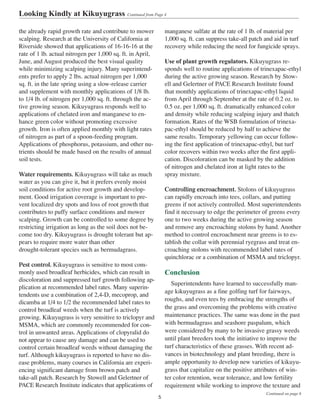
thatch and maintain good playing quality on kikuyugrass fairways.
Long considered a noxious weed, kikuyugrass is now considered a
desirable turf by an increasing number of golf courses in temperate
climates.
Kikuyugrass responds well to applications of the growth regulator
trinexapac-ethyl. A stolon from an untreated area (top) exhibits a
wider leaf blade and greater internode length compared to a stolon
from a treated area (bottom) that displays a finer leaf blade, darker
green color, and shorter internode length.
A distinguishing characteristic of kikuyugrass is the prominent
anther and white filament that extends above the canopy on
closely cut turf, which can give the turf an objectionable silvery
cast but does not affect playing quality.
Kikuyugrass has a rapid growth rate and can develop a dense
thatch layer as observed on this bunker lip.

Looking Kindly at Kikuyugrass

  • 1.
    Long considered aninvasive weed, this warm-season grass is managed by many courses as a desirable turf species. By Patrick J. Gross Kikuyugrass is the Rodney Dangerfield of turf - it gets no respect. While many courses fought the inva- sion and spread of kikuyugrass for decades, others have learned to manage this grass to provide good playing quality on tees, fairways, and rough. Why the change of heart? Some courses had no choice but to learn to manage their former enemy as it gradually spread over most of the course. Other courses did not have the budget or resources to control infestations with multiple herbicide sprays, physical removal, and sodding. As superintendents learned more about the grass, they were able to adapt management practices to provide a dense, uniform turf with good playing quality. Although much of the literature to this point has focused on the control of kikuyugrass, this article will look at the culture and management of kikuyu- grass as a fine turf for golf courses. History and Background Kikuyugrass (Pennisetum clandestinum) is a warm- season grass that is native to the Kenyan highlands of Africa. It is a course-textured grass with a rapid growth rate, and it is commonly used as a forage grass and turfgrass in mild coastal climates and sub-tropical regions. The spread of kikuyugrass was aided by the Dutch, who brought the grass from Kenya to South Africa and Australia during the Boer War. Kikuyu- grass was eventually transported to other areas and is now cultivated in many mild climates throughout the world, including South Africa, Australia, New Zealand, Mexico, Spain, Central America, South America, and portions of the United States. Improvement of kikuyugrass began in the 1950s when the Australian government awarded a grant to a plant breeder to develop a seeded forage type for live- stock. The rapid growth rate, palatability, and high protein content made kikuyugrass an ideal forage for cattle and livestock. The breeder, Dr. Whittet, devel- oped the cultivar that bears his name and sold the first 22 lb. batch of seed to the Eykamp family for com- mercial seed production in New South Wales, Aus- tralia, where the Whittet variety is still grown today. The establishment of kikuyugrass in the United States occurred in 1918 when it was imported to Pa- cific Palisades, California, as an erosion control for ditch banks, and it gradually spread to the coast and inland valley areas. Many golf course superintendents and homeowners misidentified the grass as St. Au- gustinegrass due to the similarities in leaf blade width, color, thick stolon, and dense canopy. From California, the grass was transported and spread to several states, including Hawaii, Arizona, and Texas. Don Eykamp, son of the original grower, brought kikuyugrass seed to the United States in 1995 with the intention of producing seed and improving the species for the American forage and turf market. The main stumbling block was that kikuyugrass was listed as a noxious weed in most states due to concerns that it might be a host for an insect or a fungus that could Looking Kindly at Kikuyugrass Green Section Record-July/August 2003 Continued on page 2 GOLF COURSE CAREGOLF COURSE CARE
  • 2.
    devastate the UnitedStates millet crop. The host plant relationship was disproved, but the federal govern- ment continues to list kikuyugrass as a noxious weed, citing that it has an invasive growth habit. The status of kikuyugrass currently is under review, and a ruling by the governing agency, APHIS, is expected in the coming year. In the meantime, seed produc- tion of Whittet went forward in Arizona under special permit. During this time, further improve- ment in kikuyugrass occurred in the seed fields of Arizona as a re- sult of natural selection. A patch of kikuyugrass with a finer texture and improved density was ob- served in a field of Whittet. The seed from the unusual patch was replanted, and the progeny dis- played the same desirable charac- teristics, resulting in the new variety Arizona-1 (also called AZ- 1). Today, kikuyugrass is managed as the primary turf in fairways and rough at several golf courses, including prominent PGA Tour stops Riviera Country Club, Tor- rey Pines Golf Course, and La Costa Resort and Spa. Kikuyugrass Characteristics Kikuyugrass has been described as "bermudagrass on steroids." It is a coarse- to medium-texture warm- season grass with a rapid growth rate. The leaf width ranges from 1/8" to 1/4", comparable to Japanese lawngrass (Zoysia japonica) and St. Augustinegrass (Stenotaphrum secdundatum). The wider leaf blade is typical of the native types, while the narrow leaf blade is typical of improved varieties under intensive man- agement. The leaf blades are flat and pointed at the tip and typically grow in length from 1" to 10". Leaf color is a medium to lime-green that some golfers and superintendents find objectionable. Kikuyugrass is often confused with St. Augustine- grass due to similarities in texture, color, growth habit, and the thick, fleshy stolons. Kikuyugrass is distinguished by the pointed leaf tip, flat leaf blade, and the long fringe of hairs that parallels the stem near the leaf collar. In contrast, St. Augustinegrass has sharply folded leaves and blunt leaf tips. Another dis- tinguishing characteristic of kikuyugrass is the promi- nent anther and white filament that extends above the canopy on closely cut turf. The white filaments typi- cally are visible in the spring and fall, but they can be seen throughout the year in some lo- cations. The white filaments re- turn within a day of mowing, giving the turf a silvery cast. The female part of the flower is near the base of the plant, and the seed is formed within the leaf sheath. The seeds are rounded and dark brown, ap- proximately 1/8" in length. The growth rate of kikuyu- grass is very rapid under warm, moist conditions. Shoot exten- sion can exceed 1" per day at the height of the growing season. Active growth oc- curs at temperatures between 60° to 90°F, and it can survive well at temperatures near 100°F. Kikuyugrass sustains active growth and retains color at tempera- tures below 60°F, when most other warm-season grasses exhibit a loss of color and a slower growth pattern. In California, kikuyugrass may not go dor- mant during the winter along the coast, although it tends to enter dormancy from late November until February in colder inland valley locations. Kikuyu- grass appears to have the best winter color retention of all the warm-season grasses and can tolerate light frost without a loss of color. Kikuyugrass spreads by stolons, rhizomes, and seed. The thick, fleshy stolon and relatively wide leaf blade contribute to a somewhat open growth habit at mowing heights above 11/2". Canopy density is sig- nificantly improved at mowing heights below 5/8". Rooting occurs at the nodes of stolons under moist soil conditions. Rooting is significantly restricted in Looking Kindly at Kikuyugrass Continued from Page 1 Continued on page 32
  • 3.
    dry soil, causingthe turf to become puffy and more prone to mower scalping. The rapid growth rate and thick mat layer associ- ated with kikuyugrass contribute to excellent traffic tolerance and recovery from divot injury. The rapid growth rate is both a benefit and a challenge for main- tenance. Excessive thatch contributes to spongy sur- face conditions, mower scalping, and diminished quality. If left unmowed, kikuyugrass has been ob- served growing over fences, up utility poles, and into trees and shrubs. Under routine mowing and mainte- nance, it can invade greens and tees unless a routine edging and hand-picking program are in place to con- trol encroachment. Kikuyugrass provides good play- ing conditions and ball support when closely mowed, but the heavy thatch layer tends to limit ball roll on fairways and provides unpredictable bounces on the putting green approach. It can be especially treacher- ous in the rough, where the thick stolons and wide leaf blades tend to grab the club and make it difficult to extract the ball. Kikuyugrass tolerates a wide range of soil condi- tions. Optimum growth seems to occur in medium- to heavy-texture soils with a neutral to alkaline pH. Like many warm-season grasses, kikuyugrass has good tol- erance to heat, drought, and salinity. It prefers ade- quate soil moisture but survives drought with a slight loss of color and a reduction in growth rate. Propagation and Establishment The irony of kikuyugrass is that it spreads rapidly where it is unwanted, but it can be slow to establish in existing turf or when efforts are made to actively cul- tivate and spread it. Control efforts are usually aban- doned once kikuyugrass populations reach 30% to 40%. At this point, most superintendents begin active programs to cultivate and spread kikuyugrass to en- courage a uniform stand. The primary methods of propagation are sod, plugs, sprigs, and seed. The most successful method of es- tablishment is transferring sod to provide a solid turf cover. Until recently, golf courses in the United States had to propagate their own sod in a nursery area, but commercially grown sod is now available in Southern California at a cost of approximately 85¢ to $1.00 per square foot. Some courses have attempted to establish plugs of kikuyugrass in existing stands of bermudagrass using a specially modified aerifier that removes 2" to 3" di- ameter cores for transplanting. The plugs can be slow to establish even if planted in the fall when bermuda- grass is less competitive. Plugs planted on 12" centers in the fall will provide reasonable coverage by the end of the next growing season. Sprigs collected following vertical mowing can be used to establish kikuyugrass in bare or renovated areas. Stolons should be spread evenly over the soil, pressed or spiked into the surface, and topdressed with a light covering of compost to retain adequate moisture. Good establishment is usually evident within 4 to 6 weeks when temperatures are above 60°F. Seed can be established on bare soil with relative ease. The recommended seeding rate is 1/2 lb. per 1,000 sq. ft. or 25 lbs. per acre. The germination per- centage of the seed is approximately 85% to 90%, and germination is usually evident within 6 to 10 days when soil temperatures are 65°F or above. Seeding into existing turf has been a challenge for many super- intendents. The recommended planting method is to Looking Kindly at Kikuyugrass Continued from Page 2 Continued on page 43
  • 4.
    lightly dimple thesurface with a core aerifier, broad- cast the seed at the rate of 1 lb. per 1,000 sq. ft., fol- lowed by a very light covering of compost. Ample moisture is critical during the germination and estab- lishment period. Efforts to slit seed kikuyugrass into existing turf generally have been unsuccessful. Kikuyugrass Management While kikuyugrass can survive with only a moder- ate level of maintenance, a more intensive program is necessary to provide optimum playing conditions. Components of a successful management regime should include frequent mowing, thatch control, care- fully controlling nitrogen applications, irrigation man- agement, pest control, and other routine management practices. Mowing. Kikuyugrass tolerates a wide range of mow- ing heights from 1/4" on tees and collars to greater than 2" in the rough. Because of the rapid growth rate, frequent mowing with a motor-driven reel mower is necessary to provide good surface quality and mini- mize scalping. Heavier cutting units are preferred over lightweight mowers because the added weight pushes the reels further into the turf canopy to help control thatch and provide a better quality cut. Daily mowing is required when the cutting height is less than 1/2", such as on tees and collars. Optimum cut- ting heights for fairways range from 1/2" to 5/8", with a mowing frequency of four to five times per week during the active growing season. It is recommended to maintain kikuyugrass rough at a mowing height of 11/2" and not more than 2" to avoid excessively diffi- cult conditions for the average golfer. Mowing of the rough normally is required two times per week during the active growing season. Ignoring recommended mowing frequencies can contribute to mower scalping and an unsightly appearance throughout the course. Once kikuyugrass is scalped, it can be slow to re- cover. To reduce scalping injury, some superintend- ents begin fairway mowing in the early spring at 1/2" and gradually raise the cutting height to 3/4" by mid November, which also provides additional mat and wear tolerance during the winter. It is important to point out the accelerated wear on mowing equipment when maintaining kikuyugrass. The added wear typi- cally reduces the expected life span of mowers by 10% or more. Vertical mowing. Vertical mowing is an important program for controlling rapid thatch accumulation during the active growing season. Studies at the Uni- versity of California at Riverside showed that opti- mum quality was achieved with three vertical mowing treatments (April, July, September) at approximately the depth of the turf canopy (1/2"). Because of the heavy yield of clippings that must be removed and swept following such a treatment, many superintend- ents prefer to vertical mow lightly, approximately 1/4" below the turf canopy, on a monthly schedule from April through September. Aeration. Core aeration should be performed a mini- mum of one time per year and preferably two to three times per year to aid in thatch control, encourage healthy root growth, and promote rhizome develop- ment. Additional treatments will be necessary where excessive thatch is a problem. Kikuyugrass also bene- fits from deep aeration (6" to 10") with a solid-tine aerifier in the spring. The deep aeration treatment does a better job of relieving soil compaction and also contributes to better air and water movement for healthy root growth and rhizome development going into summer. Fertility. Kikuyugrass is very sensitive to nitrogen ap- plications, requiring only 2 to 3 lbs. of nitrogen per 1,000 sq. ft. annually. In some cases, the nitrogen sup- plied by effluent water is adequate to sustain active growth without the need for supplemental applica- tions. Excessive levels of nitrogen further accelerate Looking Kindly at Kikuyugrass Continued from Page 3 Continued on page 54
  • 5.
    the already rapidgrowth rate and contribute to mower scalping. Research at the University of California at Riverside showed that applications of 16-16-16 at the rate of 1 lb. actual nitrogen per 1,000 sq. ft. in April, June, and August produced the best visual quality while minimizing scalping injury. Many superintend- ents prefer to apply 2 lbs. actual nitrogen per 1,000 sq. ft. in the late spring using a slow-release carrier and supplement with monthly applications of 1/8 lb. to 1/4 lb. of nitrogen per 1,000 sq. ft. through the ac- tive growing season. Kikuyugrass responds well to applications of chelated iron and manganese to en- hance green color without promoting excessive growth. Iron is often applied monthly with light rates of nitrogen as part of a spoon-feeding program. Applications of phosphorus, potassium, and other nu- trients should be made based on the results of annual soil tests. Water requirements. Kikuyugrass will take as much water as you can give it, but it prefers evenly moist soil conditions for active root growth and develop- ment. Good irrigation coverage is important to pre- vent localized dry spots and loss of root growth that contributes to puffy surface conditions and mower scalping. Growth can be controlled to some degree by restricting irrigation as long as the soil does not be- come too dry. Kikuyugrass is drought tolerant but ap- pears to require more water than other drought-tolerant species such as bermudagrass. Pest control. Kikuyugrass is sensitive to most com- monly used broadleaf herbicides, which can result in discoloration and suppressed turf growth following ap- plication at recommended label rates. Many superin- tendents use a combination of 2,4-D, mecoprop, and dicamba at 1/4 to 1/2 the recommended label rates to control broadleaf weeds when the turf is actively growing. Kikuyugrass is very sensitive to triclopyr and MSMA, which are commonly recommended for con- trol in unwanted areas. Applications of clopyralid do not appear to cause any damage and can be used to control certain broadleaf weeds without damaging the turf. Although kikuyugrass is reported to have no dis- ease problems, many courses in California are experi- encing significant damage from brown patch and take-all patch. Research by Stowell and Gelertner of PACE Research Institute indicates that applications of manganese sulfate at the rate of 1 lb. of material per 1,000 sq. ft. can suppress take-all patch and aid in turf recovery while reducing the need for fungicide sprays. Use of plant growth regulators. Kikuyugrass re- sponds well to routine applications of trinexapac-ethyl during the active growing season. Research by Stow- ell and Gelertner of PACE Research Institute found that monthly applications of trinexapac-ethyl liquid from April through September at the rate of 0.2 oz. to 0.5 oz. per 1,000 sq. ft. dramatically enhanced color and density while reducing scalping injury and thatch formation. Rates of the WSB formulation of trinexa- pac-ethyl should be reduced by half to achieve the same results. Temporary yellowing can occur follow- ing the first application of trinexapac-ethyl, but turf color recovers within two weeks after the first appli- cation. Discoloration can be masked by the addition of nitrogen and chelated iron at light rates to the spray mixture. Controlling encroachment. Stolons of kikuyugrass can rapidly encroach into tees, collars, and putting greens if not actively controlled. Most superintendents find it necessary to edge the perimeter of greens every one to two weeks during the active growing season and remove any encroaching stolons by hand. Another method to control encroachment near greens is to es- tablish the collar with perennial ryegrass and treat en- croaching stolons with recommended label rates of quinchlorac or a combination of MSMA and triclopyr. Conclusion Superintendents have learned to successfully man- age kikuyugrass as a fine golfing turf for fairways, roughs, and even tees by embracing the strengths of the grass and overcoming the problems with creative maintenance practices. The same was done in the past with bermudagrass and seashore paspalum, which were considered by many to be invasive grassy weeds until plant breeders took the initiative to improve the turf characteristics of these grasses. With recent ad- vances in biotechnology and plant breeding, there is ample opportunity to develop new varieties of kikuyu- grass that capitalize on the positive attributes of win- ter color retention, wear tolerance, and low fertility requirement while working to improve the texture and Looking Kindly at Kikuyugrass Continued from Page 4 5 Continued on page 6
  • 6.
    winter hardiness andreduce rapid thatch accumulation. It is interesting to see the be- ginning of such advances with the recent release of AZ-1 kikuyugrass, and with luck and hard work, there will be more cultivars to follow. In the meantime, more and more courses are taking a kindly look at kikuyu- grass and realizing that their former enemy can become their friend in an effort to pro- vide good golfing conditions throughout the year. Looking Kindly at Kikuyugrass Continued from Page 5 1415 East 6th Street • P.O. Box 21488 • Los Angeles, California 90021 Phone: (213) 626-9668 • Toll-Free: (800) 621-0315 • Fax: (213) 626-4920 www.stoverseed.com References: Beard, J. B. 1973. Turfgrass: Science and Culture. Prentice-Hall, Inc. Englewood Cliffs, N.J. Cockerham, Stephen, R. Kahn, V. Gibeault. 1998. Kikuyugrass Cultural Practices. California Turfgrass Culture. Vol. 48, Nos. 3 & 4. Culley, James. Kikuyugrass - First by Force, Now by Choice. California Fairways. November/December 2002. pp. 16-17. Ormsby, David. Kikuyu: Is it always a weed? New Zealand Turf Management Journal. February 1996. pp. 9-10. Research Update: The Kikuyu Debate Continues. Grounds Maintenance. May 1998. p. 82. Cooley, Richard. Personal communication, March 15, 2002. Patrick Gross is the director of the USGA Green Section Southwest Region, where an increasing number of courses successfully manage kikuyugrass on golf courses, including Torrey Pines, site of the 2008 U.S. Open Championship. Routine vertical mowing is a key management practice to control thatch and maintain good playing quality on kikuyugrass fairways. Long considered a noxious weed, kikuyugrass is now considered a desirable turf by an increasing number of golf courses in temperate climates. Kikuyugrass responds well to applications of the growth regulator trinexapac-ethyl. A stolon from an untreated area (top) exhibits a wider leaf blade and greater internode length compared to a stolon from a treated area (bottom) that displays a finer leaf blade, darker green color, and shorter internode length. A distinguishing characteristic of kikuyugrass is the prominent anther and white filament that extends above the canopy on closely cut turf, which can give the turf an objectionable silvery cast but does not affect playing quality. Kikuyugrass has a rapid growth rate and can develop a dense thatch layer as observed on this bunker lip.