Representation: Women
         Read the following extract about women’s
         gender and magazines, bullet point the main
         arguments made:

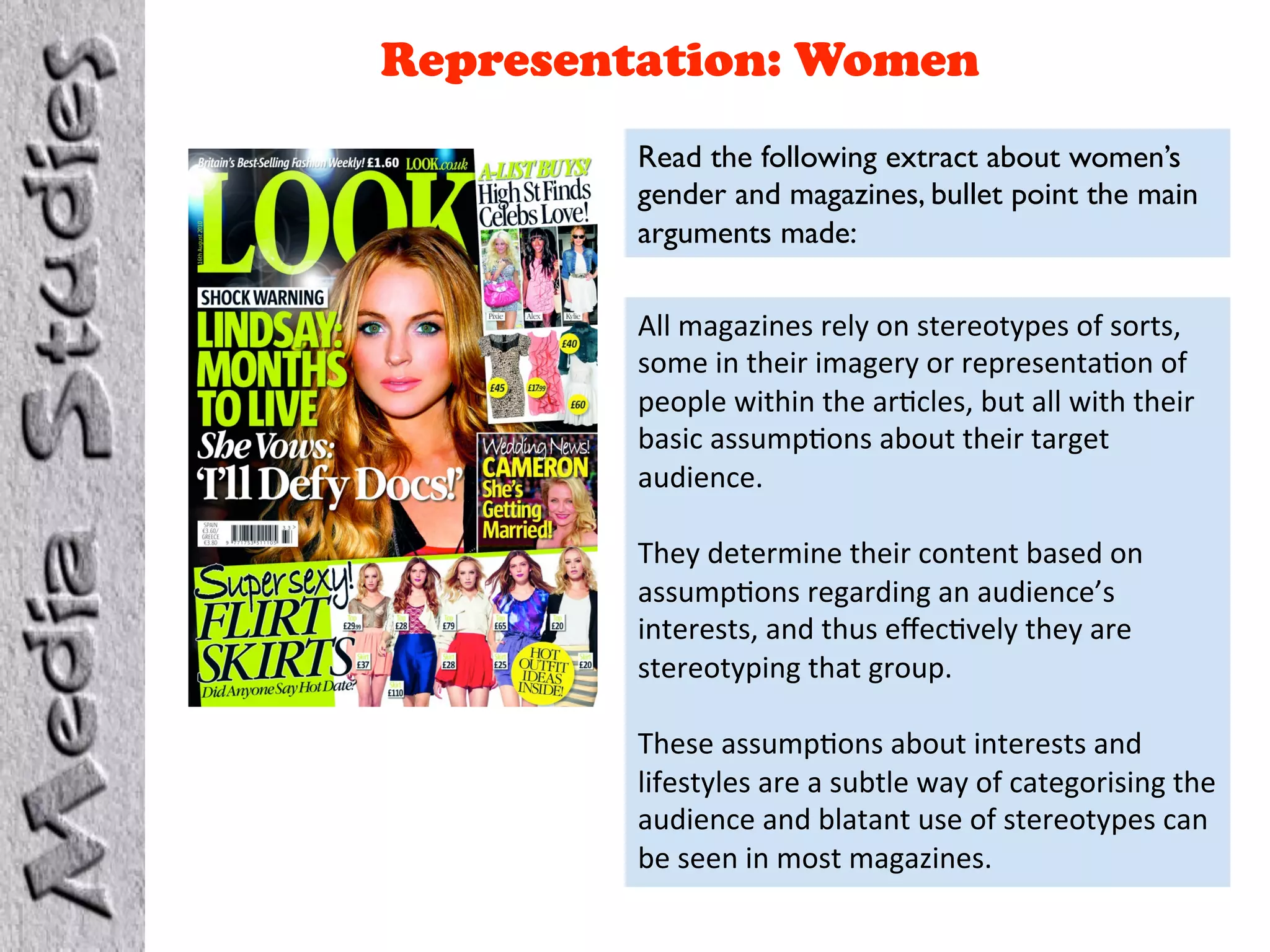
         All magazines rely on stereotypes of sorts, 
         some in their imagery or representa4on of 
         people within the ar4cles, but all with their 
         basic assump4ons about their target 
         audience.  
          
         They determine their content based on 
         assump4ons regarding an audience’s 
         interests, and thus effec4vely they are 
         stereotyping that group.  
          
         These assump4ons about interests and 
         lifestyles are a subtle way of categorising the 
         audience and blatant use of stereotypes can 
         be seen in most magazines.  
Representation: Women
Female lifestyle magazines may make less liberal 
use of stereotypes than their male counterparts.  
 
A recent ar4cle in Glamour magazine presented 
the sex lives of a porn star, a plas4c surgeon and a 
gynaecologist. It first summed up the stereotypical 
assump4ons about such professions from the point 
of view of the interviewees, and then gave the 
male and female interviewees a chance to present 
their side.  
 
The ar4cle offered a posi4ve construc4on of the 
male porn star, who might have otherwise been 
portrayed stereotypically as a chauvinist or 
womanizer or even a sex object himself.  
 
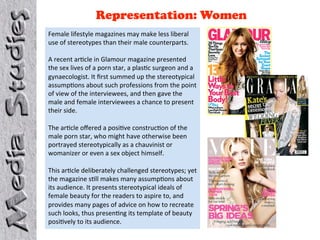
This ar4cle deliberately challenged stereotypes; yet 
the magazine s4ll makes many assump4ons about 
its audience. It presents stereotypical ideals of 
female beauty for the readers to aspire to, and 
provides many pages of advice on how to recreate 
such looks, thus presen4ng its template of beauty 
posi4vely to its audience. 
Representation: Women
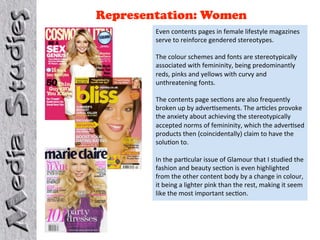
        Even contents pages in female lifestyle magazines 
        serve to reinforce gendered stereotypes.  
         
        The colour schemes and fonts are stereotypically 
        associated with femininity, being predominantly 
        reds, pinks and yellows with curvy and 
        unthreatening fonts.  
         
        The contents page sec4ons are also frequently 
        broken up by adver4sements. The ar4cles provoke 
        the anxiety about achieving the stereotypically 
        accepted norms of femininity, which the adver4sed 
        products then (coincidentally) claim to have the 
        solu4on to.  
         
        In the par4cular issue of Glamour that I studied the 
        fashion and beauty sec4on is even highlighted 
        from the other content body by a change in colour, 
        it being a lighter pink than the rest, making it seem 
        like the most important sec4on. 

Look 4a