Longitudinal Research on Aging Drivers
(LongROAD) Study: Project Overview
Nicole Zanier, BA
David W. Eby, PhD and Lisa J. Molnar, PhD
Traffic Safety Conference
College Station, TX
June 7, 2016
Population Aging Globally
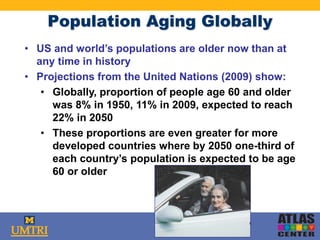
• US and world’s populations are older now than at
any time in history
• Projections from the United Nations (2009) show:
• Globally, proportion of people age 60 and older
was 8% in 1950, 11% in 2009, expected to reach
22% in 2050
• These proportions are even greater for more
developed countries where by 2050 one-third of
each country’s population is expected to be age
60 or older
Driving Likely to Remain Primary
Mode of Travel for Older Adults
• Older adults prefer to maintain mobility through the
use of a personal vehicle
• Will likely be the case for next generation of older
drivers
• Most older adults currently travel by car either as a
driver or passenger
• Recent Michigan study* found that 99% of older
adults most often rely on driving or riding as a
passenger to get around
* Eby, et al., 2011
Functional Declines in
Older Adults
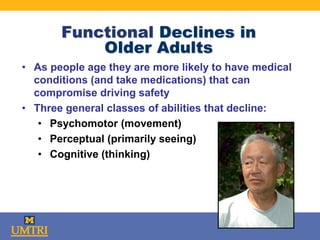
• As people age they are more likely to have medical
conditions (and take medications) that can
compromise driving safety
• Three general classes of abilities that decline:
• Psychomotor (movement)
• Perceptual (primarily seeing)
• Cognitive (thinking)
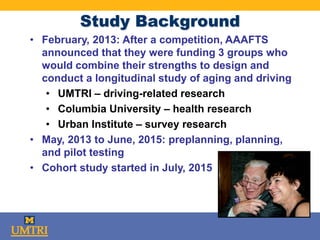
Study Background
• February, 2013: After a competition, AAAFTS
announced that they were funding 3 groups who
would combine their strengths to design and
conduct a longitudinal study of aging and driving
• UMTRI – driving-related research
• Columbia University – health research
• Urban Institute – survey research
• May, 2013 to June, 2015: preplanning, planning,
and pilot testing
• Cohort study started in July, 2015
Study Goals
• To understand natural history, determinants, and
mechanisms of driving behavior, safety and related
outcomes among older drivers
• Generate extensive longitudinal data and knowledge
base that will fuel future research and decision
making
• Improve understanding of the safety needs of older
drivers and support development of
countermeasures to keep people driving for as long
as they can do so
Research Questions
• What are the risks and protective factors in older
driver safety?
• What are the effects of medications on driving
behavior/outcomes?
• What are the effects of declining physical
functioning on self-regulation of driving?
• What is the extent/use/effect of new vehicle
technology and aftermarket vehicle adaptations?
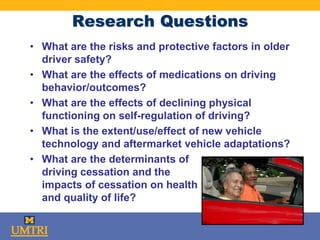
• What are the determinants of
driving cessation and the
impacts of cessation on health
and quality of life?
Study Details
• Management:
• Principal Investigator (Dr. Guohua Li, Columbia)
• Co-Principal Investigator (Dr. David W. Eby, UMTRI)
• Co-Principal Investigator (Mr. Robert Santos, Urban
Institute)
• Data Collection Sites:
• Ann Arbor, MI
• Cooperstown, NY
• Denver, CO
• Baltimore, MD
• San Diego, CA
• Project is expected to
continue through April, 2019
Research Design Overview
• Cohort study of 3,000 drivers age 65 to 79 years -
600 drivers at each of the 5 sites
• Participants followed for to 2-3 years and assessed
annually
• Questionnaire (telephone) in alternate years
• Assessments and data collected measure key
domains (i.e., driving, cognition, motor, perception,
demographic, mental health, physical health, social
health and psychosocial factors)
• Primary vehicle instrumented w/ Danlaw Datalogger
(small, unobtrusive geographic positioning system
[GPS] device) to collect detailed driving data
Participants
• Three older driver age groups with an equal
number of men and women:
• 65-69 years; 70-74 years; and 75-79 years
• Eligibility criteria:
• Valid driver license
• Driving at least once per week on average
• Receiving primary care through site’s health system
• Residing in study area 10 months per year
• No plans to move outside of area in 5 years
• Motor vehicle of model year 1996 or newer
• Driving one vehicle ≥ 80% of the time
• No significant cognitive impairment at the time of
enrollment (six-item screener score ≥4)
Objective Health Data
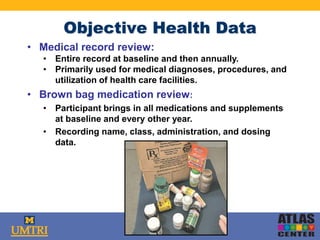
• Medical record review:
• Entire record at baseline and then annually.
• Primarily used for medical diagnoses, procedures, and
utilization of health care facilities.
• Brown bag medication review:
• Participant brings in all medications and supplements
at baseline and every other year.
• Recording name, class, administration, and dosing
data.
Objective Health Data
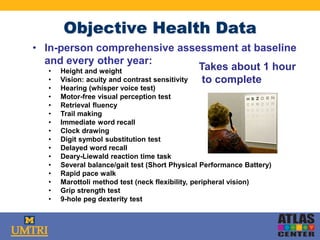
• In-person comprehensive assessment at baseline
and every other year:
• Height and weight
• Vision: acuity and contrast sensitivity
• Hearing (whisper voice test)
• Motor-free visual perception test
• Retrieval fluency
• Trail making
• Immediate word recall
• Clock drawing
• Digit symbol substitution test
• Delayed word recall
• Deary-Liewald reaction time task
• Several balance/gait test (Short Physical Performance Battery)
• Rapid pace walk
• Marottoli method test (neck flexibility, peripheral vision)
• Grip strength test
• 9-hole peg dexterity test
Takes about 1 hour
to complete
Questionnaire Data
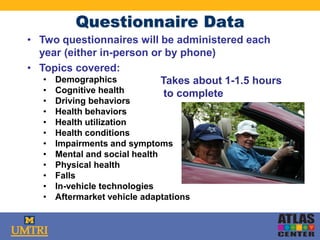
• Two questionnaires will be administered each
year (either in-person or by phone)
• Topics covered:
• Demographics
• Cognitive health
• Driving behaviors
• Health behaviors
• Health utilization
• Health conditions
• Impairments and symptoms
• Mental and social health
• Physical health
• Falls
• In-vehicle technologies
• Aftermarket vehicle adaptations
Takes about 1-1.5 hours
to complete
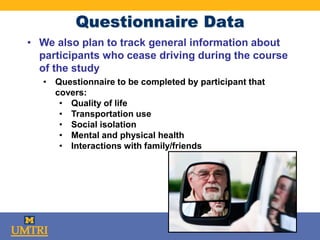
Questionnaire Data
• We also plan to track general information about
participants who cease driving during the course
of the study
• Questionnaire to be completed by participant that
covers:
• Quality of life
• Transportation use
• Social isolation
• Mental and physical health
• Interactions with family/friends
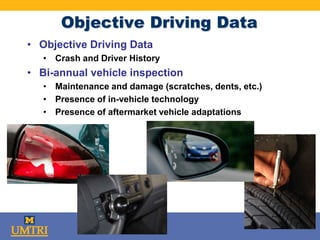
Objective Driving Data
• Objective Driving Data
• Crash and Driver History
• Bi-annual vehicle inspection
• Maintenance and damage (scratches, dents, etc.)
• Presence of in-vehicle technology
• Presence of aftermarket vehicle adaptations
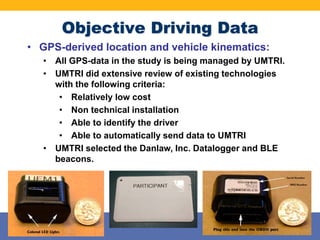
Objective Driving Data
• GPS-derived location and vehicle kinematics:
• All GPS-data in the study is being managed by UMTRI.
• UMTRI did extensive review of existing technologies
with the following criteria:
• Relatively low cost
• Non technical installation
• Able to identify the driver
• Able to automatically send data to UMTRI
• UMTRI selected the Danlaw, Inc. Datalogger and BLE
beacons.
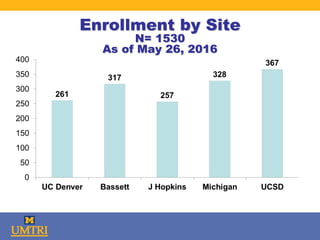
Enrollment by Site
N= 1530
As of May 26, 2016
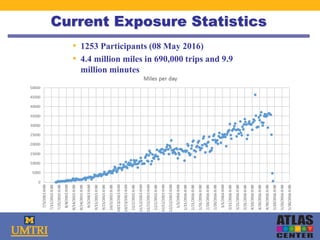
• 1253 Participants (08 May 2016)
• 4.4 million miles in 690,000 trips and 9.9
million minutes
Current Exposure Statistics
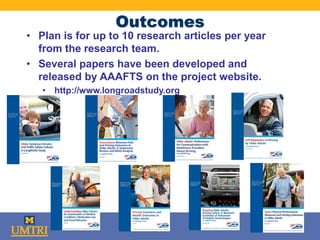
Outcomes
• Plan is for up to 10 research articles per year
from the research team.
• Several papers have been developed and
released by AAAFTS on the project website.
• http://www.longroadstudy.org
Questions?

Longitudinal Research on Aging Drivers (LongROAD) Study: Project Overview

  • 1.
    Longitudinal Research onAging Drivers (LongROAD) Study: Project Overview Nicole Zanier, BA David W. Eby, PhD and Lisa J. Molnar, PhD Traffic Safety Conference College Station, TX June 7, 2016
  • 2.
    Population Aging Globally •US and world’s populations are older now than at any time in history • Projections from the United Nations (2009) show: • Globally, proportion of people age 60 and older was 8% in 1950, 11% in 2009, expected to reach 22% in 2050 • These proportions are even greater for more developed countries where by 2050 one-third of each country’s population is expected to be age 60 or older
  • 3.
    Driving Likely toRemain Primary Mode of Travel for Older Adults • Older adults prefer to maintain mobility through the use of a personal vehicle • Will likely be the case for next generation of older drivers • Most older adults currently travel by car either as a driver or passenger • Recent Michigan study* found that 99% of older adults most often rely on driving or riding as a passenger to get around * Eby, et al., 2011
  • 4.
    Functional Declines in OlderAdults • As people age they are more likely to have medical conditions (and take medications) that can compromise driving safety • Three general classes of abilities that decline: • Psychomotor (movement) • Perceptual (primarily seeing) • Cognitive (thinking)
  • 5.
    Study Background • February,2013: After a competition, AAAFTS announced that they were funding 3 groups who would combine their strengths to design and conduct a longitudinal study of aging and driving • UMTRI – driving-related research • Columbia University – health research • Urban Institute – survey research • May, 2013 to June, 2015: preplanning, planning, and pilot testing • Cohort study started in July, 2015
  • 6.
    Study Goals • Tounderstand natural history, determinants, and mechanisms of driving behavior, safety and related outcomes among older drivers • Generate extensive longitudinal data and knowledge base that will fuel future research and decision making • Improve understanding of the safety needs of older drivers and support development of countermeasures to keep people driving for as long as they can do so
  • 7.
    Research Questions • Whatare the risks and protective factors in older driver safety? • What are the effects of medications on driving behavior/outcomes? • What are the effects of declining physical functioning on self-regulation of driving? • What is the extent/use/effect of new vehicle technology and aftermarket vehicle adaptations? • What are the determinants of driving cessation and the impacts of cessation on health and quality of life?
  • 8.
    Study Details • Management: •Principal Investigator (Dr. Guohua Li, Columbia) • Co-Principal Investigator (Dr. David W. Eby, UMTRI) • Co-Principal Investigator (Mr. Robert Santos, Urban Institute) • Data Collection Sites: • Ann Arbor, MI • Cooperstown, NY • Denver, CO • Baltimore, MD • San Diego, CA • Project is expected to continue through April, 2019
  • 9.
    Research Design Overview •Cohort study of 3,000 drivers age 65 to 79 years - 600 drivers at each of the 5 sites • Participants followed for to 2-3 years and assessed annually • Questionnaire (telephone) in alternate years • Assessments and data collected measure key domains (i.e., driving, cognition, motor, perception, demographic, mental health, physical health, social health and psychosocial factors) • Primary vehicle instrumented w/ Danlaw Datalogger (small, unobtrusive geographic positioning system [GPS] device) to collect detailed driving data
  • 10.
    Participants • Three olderdriver age groups with an equal number of men and women: • 65-69 years; 70-74 years; and 75-79 years • Eligibility criteria: • Valid driver license • Driving at least once per week on average • Receiving primary care through site’s health system • Residing in study area 10 months per year • No plans to move outside of area in 5 years • Motor vehicle of model year 1996 or newer • Driving one vehicle ≥ 80% of the time • No significant cognitive impairment at the time of enrollment (six-item screener score ≥4)
  • 11.
    Objective Health Data •Medical record review: • Entire record at baseline and then annually. • Primarily used for medical diagnoses, procedures, and utilization of health care facilities. • Brown bag medication review: • Participant brings in all medications and supplements at baseline and every other year. • Recording name, class, administration, and dosing data.
  • 12.
    Objective Health Data •In-person comprehensive assessment at baseline and every other year: • Height and weight • Vision: acuity and contrast sensitivity • Hearing (whisper voice test) • Motor-free visual perception test • Retrieval fluency • Trail making • Immediate word recall • Clock drawing • Digit symbol substitution test • Delayed word recall • Deary-Liewald reaction time task • Several balance/gait test (Short Physical Performance Battery) • Rapid pace walk • Marottoli method test (neck flexibility, peripheral vision) • Grip strength test • 9-hole peg dexterity test Takes about 1 hour to complete
  • 13.
    Questionnaire Data • Twoquestionnaires will be administered each year (either in-person or by phone) • Topics covered: • Demographics • Cognitive health • Driving behaviors • Health behaviors • Health utilization • Health conditions • Impairments and symptoms • Mental and social health • Physical health • Falls • In-vehicle technologies • Aftermarket vehicle adaptations Takes about 1-1.5 hours to complete
  • 14.
    Questionnaire Data • Wealso plan to track general information about participants who cease driving during the course of the study • Questionnaire to be completed by participant that covers: • Quality of life • Transportation use • Social isolation • Mental and physical health • Interactions with family/friends
  • 15.
    Objective Driving Data •Objective Driving Data • Crash and Driver History • Bi-annual vehicle inspection • Maintenance and damage (scratches, dents, etc.) • Presence of in-vehicle technology • Presence of aftermarket vehicle adaptations
  • 16.
    Objective Driving Data •GPS-derived location and vehicle kinematics: • All GPS-data in the study is being managed by UMTRI. • UMTRI did extensive review of existing technologies with the following criteria: • Relatively low cost • Non technical installation • Able to identify the driver • Able to automatically send data to UMTRI • UMTRI selected the Danlaw, Inc. Datalogger and BLE beacons.
  • 17.
    Enrollment by Site N=1530 As of May 26, 2016
  • 18.
    • 1253 Participants(08 May 2016) • 4.4 million miles in 690,000 trips and 9.9 million minutes Current Exposure Statistics
  • 19.
    Outcomes • Plan isfor up to 10 research articles per year from the research team. • Several papers have been developed and released by AAAFTS on the project website. • http://www.longroadstudy.org
  • 20.