Drive change through education.
MEDICALLY AT RISK DRIVERS
What you don’t know can hurt you
2
HOUSEKEEPING
2
• Webinar slide deck AND recording will be made available on hni.com,
and you’ll be sent a link to access
• Ask questions by typing into the chat window, or tweet @HNIRisk
using the hashtag #hniu!
Tweet us!
SPONSORS
3
3
WHO IS ON THE LINE?
Jeff Borchardt, CEO/Managing Partner
Safeway Driver Fitness Centers
4
THE FUTURE OF DRIVER SAFETY FOR
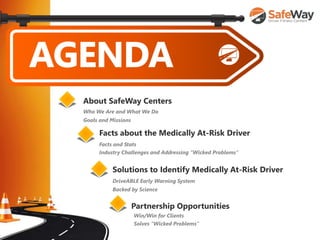
About SafeWay Centers
Facts about the Medically At-Risk Driver
Solutions to Identify Medically At-Risk Driver
Partnership Opportunities
Who We Are and What We Do
Goals and Missions
Facts and Stats
Industry Challenges and Addressing “Wicked Problems”
Backed by Science
DriveABLE Early Warning System
Win/Win for Clients
Solves “Wicked Problems”
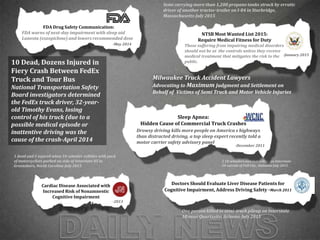
2 18-wheelers and SUV collide on Interstate
20 outside of Pell City, Alabama-July 2015
September: “More Than 300
Killed in Pakistani Factory
Fires”
FDA Drug Safety Communication:
FDA warns of next-day impairment with sleep aid
Lunesta (eszopiclone) and lowers recommended dose
-May 2014 September: “More Than 300
Fires”
NTSB Most Wanted List 2015:
Require Medical Fitness for Duty
Those suffering from impairing medical disorders
should not be at the controls unless they receive
medical treatment that mitigates the risk to the
public.
-January 2015
September: “More Than
300 Killed in Pakistani
Factory Fires”
Cardiac Disease Associated with
Increased Risk of Nonamnestic
Cognitive Impairment
-2013
September: “More Than 300 Killed in
Pakistani Factory Fires”Drowsy driving kills more people on America s highways
than distracted driving, a top sleep expert recently told a
motor carrier safety advisory panel
Sleep Apnea:
Hidden Cause of Commercial Truck Crashes
-December 2011
September: “More Than 300 Fires”
Doctors Should Evaluate Liver Disease Patients for
Cognitive Impairment, Address Driving Safety -March 2011
1 dead and 5 injured when 18-wheeler collides with pack
of motorcyclists parked on side of Interstate 85 in
Greensboro, North Carolina-July 2015
One person killed in semi-truck pileup on Interstate
10 near Quartzsite, Arizona-July 2015
Semi carrying more than 1,200 propane tanks struck by erratic
driver of another tractor-trailer on I-84 in Sturbridge,
Massachusetts-July 2015
10 Dead, Dozens Injured in
Fiery Crash Between FedEx
Truck and Tour Bus
National Transportation Safety
Board investigators determined
the FedEx truck driver, 32-year-
old Timothy Evans, losing
control of his truck (due to a
possible medical episode or
inattentive driving was the
cause of the crash-April 2014
Milwaukee Truck Accident Lawyers
Advocating to Maximum Judgment and Settlement on
Behalf of Victims of Semi Truck and Motor Vehicle Injuries
THE FUTURE OF DRIVER SAFETY FOR
ABOUT US
SafeWay Driver Fitness Centers™ offer globally recognized, evidence-
based solutions for the fair and accurate assessment and identification of
the Medically At-Risk Driver.
We utilize assessment technologies that afford organizations valuable
and objective information that can be used to make tangible and cost-
saving business decisions
In an effort to identify the medically at-risk
driver, who may pose a danger to
themselves, their passengers and other road
users, we seek to develop partnerships with
key industry leaders and healthcare
professionals to do so.
HNI and their clients understand that the
transportation industry faces unique challenges…
Rising cost of benefits
Managing and improving driver
performance
Driver recruitment and retention
Need to become better at preventing
and managing collisions
Known Collectively As…
ALIGNS WITH CORE VALUES
To assist commercial
companies, healthcare
professionals, insurance
underwriters and government
entities in placing the most
cognitively sound and safest
drivers on the road today by
identifying the
MEDICALLY AT-RISK DRIVER
1
THE FUTURE OF DRIVER SAFETY FOR
MEDICALLY AT RISK
The Medically At-Risk Driver
• What does it mean to be a medically at-
risk?
• Who is at risk?
• How much riskier versus healthy drivers?
• Identification methods?
• What if nothing is done?
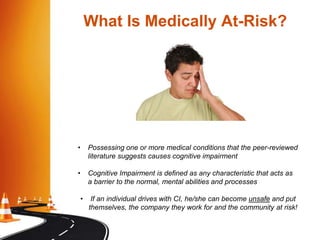
What Is Medically At-Risk?
• Possessing one or more medical conditions that the peer-reviewed
literature suggests causes cognitive impairment
• Cognitive Impairment is defined as any characteristic that acts as
a barrier to the normal, mental abilities and processes
• If an individual drives with CI, he/she can become unsafe and put
themselves, the company they work for and the community at risk!
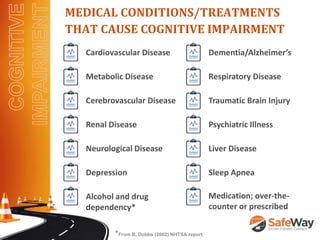
MEDICAL CONDITIONS/TREATMENTS
THAT CAUSE COGNITIVE IMPAIRMENT
*From B. Dobbs (2002) NHTSA report
Cardiovascular Disease
Metabolic Disease
Cerebrovascular Disease
Renal Disease
Neurological Disease
Depression
Alcohol and drug
dependency*
Dementia/Alzheimer’s
Respiratory Disease
Traumatic Brain Injury
Psychiatric Illness
Liver Disease
Medication; over-the-
counter or prescribed
Sleep Apnea
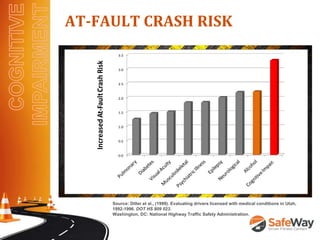
AT-FAULT CRASH RISK
0.0
0.5
1.0
1.5
2.0
2.5
3.0
3.5
IncreasedAt-FaultCrashRisk
Source: Diller et al., (1999). Evaluating drivers licensed with medical conditions in Utah,
1992-1996. DOT HS 809 023.
Washington, DC: National Highway Traffic Safety Administration.
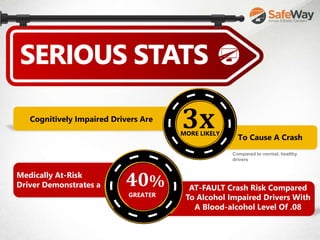
Cognitively Impaired Drivers Are
3xMORE LIKELY
To Cause A Crash
50%40%
GREATER
Medically At-Risk
Driver Demonstrates a AT-FAULT Crash Risk Compared
To Alcohol Impaired Drivers With
A Blood-alcohol Level Of .08
Compared to normal, healthy
drivers
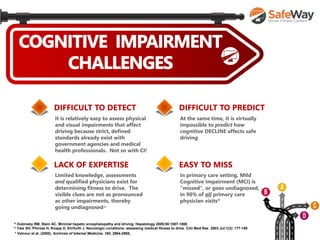
It is relatively easy to assess physical
and visual impairments that affect
driving because strict, defined
standards already exist with
government agencies and medical
health professionals. Not so with CI!
DIFFICULT TO DETECT
LACK OF EXPERTISE
Limited knowledge, assessments
and qualified physicians exist for
determining fitness to drive. The
visible clues are not as pronounced
as other impairments, thereby
going undiagnosed^
At the same time, it is virtually
impossible to predict how
cognitive DECLINE affects safe
driving
DIFFICULT TO PREDICT
EASY TO MISS
In primary care setting, Mild
Cognitive Impairment (MCI) is
“missed", or goes undiagnosed,
in 90% of all primary care
physician visits*
^ Dubinsky RM, Stein AC. Minimal hepatic encephalopathy and driving. Hepatology 2009;50:1007-1008
^ Yale SH, Phiroze H, Knapp D, Ehrfurth J. Neurologic conditions: assessing medical fitness to drive. Clin Med Res 2003 Jul;1(3): 177-188
* Valcour et al. (2000). Archives of Internal Medicine, 160, 2964-2968.
THE FUTURE OF DRIVER SAFETY FOR
SOLUTION
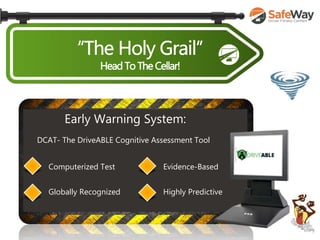
Computerized Test
Globally Recognized
Evidence-Based
Highly Predictive
Early Warning System:
DCAT- The DriveABLE Cognitive Assessment Tool
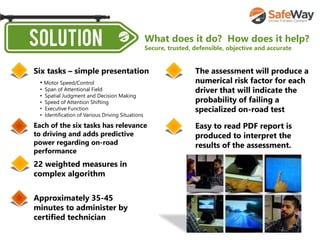
Approximately 35-45
minutes to administer by
certified technician
Easy to read PDF report is
produced to interpret the
results of the assessment.
What does it do? How does it help?
Secure, trusted, defensible, objective and accurate
• Motor Speed/Control
• Span of Attentional Field
• Spatial Judgment and Decision Making
• Speed of Attention Shifting
• Executive Function
• Identification of Various Driving Situations
Six tasks – simple presentation The assessment will produce a
numerical risk factor for each
driver that will indicate the
probability of failing a
specialized on-road test
Each of the six tasks has relevance
to driving and adds predictive
power regarding on-road
performance
22 weighted measures in
complex algorithm
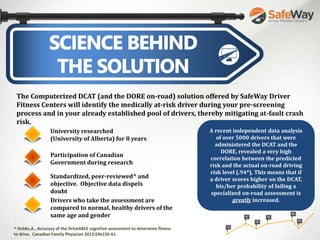
The Computerized DCAT (and the DORE on-road) solution offered by SafeWay Driver
Fitness Centers will identify the medically at-risk driver during your pre-screening
process and in your already established pool of drivers, thereby mitigating at-fault crash
risk.
University researched
(University of Alberta) for 8 years
Participation of Canadian
Government during research
Standardized, peer-reviewed^ and
objective. Objective data dispels
doubt
Drivers who take the assessment are
compared to normal, healthy drivers of the
same age and gender
A recent independent data analysis
of over 5000 drivers that were
administered the DCAT and the
DORE, revealed a very high
correlation between the predicted
risk and the actual on-road driving
risk level (.94*), This means that if
a driver scores higher on the DCAT,
his/her probability of failing a
specialized on-road assessment is
greatly increased.
^ Dobbs,A., Accuracy of the DriveABLE cognitive assessment to determine fitness
to drive. Canadian Family Physician 2013;59e156-61
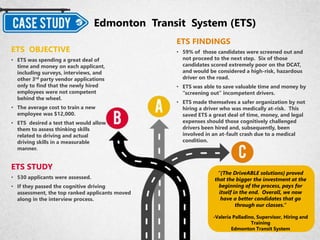
Edmonton Transit System (ETS)
“{The DriveABLE solutions} proved
that the bigger the investment at the
beginning of the process, pays for
itself in the end. Overall, we now
have a better candidates that go
through our classes.”
-Valeria Palladino, Supervisor, Hiring and
Training
Edmonton Transit System
ETS STUDY
• 530 applicants were assessed.
• If they passed the cognitive driving
assessment, the top ranked applicants moved
along in the interview process.
ETS FINDINGS
• 59% of those candidates were screened out and
not proceed to the next step. Six of those
candidates scored extremely poor on the DCAT,
and would be considered a high-risk, hazardous
driver on the road.
• ETS was able to save valuable time and money by
“screening out” incompetent drivers.
• ETS made themselves a safer organization by not
hiring a driver who was medically at-risk. This
saved ETS a great deal of time, money, and legal
expenses should those cognitively challenged
drivers been hired and, subsequently, been
involved in an at-fault crash due to a medical
condition.
ETS OBJECTIVE
• ETS was spending a great deal of
time and money on each applicant,
including surveys, interviews, and
other 3rd party vendor applications
only to find that the newly hired
employees were not competent
behind the wheel.
• The average cost to train a new
employee was $12,000.
• ETS desired a test that would allow
them to assess thinking skills
related to driving and actual
driving skills in a measurable
manner.
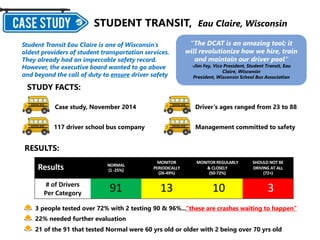
STUDENT TRANSIT, Eau Claire, Wisconsin
“The DCAT is an amazing tool; it
will revolutionize how we hire, train
and maintain our driver pool”
-Jim Fey, Vice President, Student Transit, Eau
Claire, Wisconsin
President, Wisconsin School Bus Association
Results NORMAL
(1 -25%)
MONITOR
PERIODICALLY
(26-49%)
MONITOR REGULARLY
& CLOSELY
(50-72%)
SHOULD NOT BE
DRIVING AT ALL
(72+)
# of Drivers
Per Category
91 13 10 3
Case study, November 2014
117 driver school bus company
Driver’s ages ranged from 23 to 88
STUDY FACTS:
Student Transit Eau Claire is one of Wisconsin’s
oldest providers of student transportation services.
They already had an impeccable safety record.
However, the executive board wanted to go above
and beyond the call of duty to ensure driver safety
Management committed to safety
RESULTS:
21 of the 91 that tested Normal were 60 yrs old or older with 2 being over 70 yrs old
22% needed further evaluation
3 people tested over 72% with 2 testing 90 & 96%...“these are crashes waiting to happen”
Using the most advanced
assessment technology to assist
HNI and their clients in finding
those ‘Needles in the Haystack’
who may be unsafe to drive
IT’S ALL ABOUT MITIGATING RISK !
THE FUTURE OF DRIVER SAFETY FOR
PARTNERSHIP
* Transportation Research Board 2011
Partnering with SafeWay will provide a
tangible solution to your “Wicked Problems”
Do Certain Drivers Pose a Real Threat to the Way
Your Company Operates on a Daily Basis? If ‘YES’:
These solutions can reduce liability and reduce
turnover* (by bringing individuals with higher
cognitive skills to the company)
Improve and ensure safety while saving time
and money for your clients
Win/Win opportunity for all – including the
community!
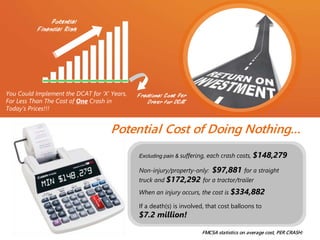
Potential Cost of Doing Nothing…
FMCSA statistics on average cost, PER CRASH:
Excluding pain & suffering, each crash costs, $148,279
Non-injury/property-only: $97,881 for a straight
truck and $172,292 for a tractor/trailer
When an injury occurs, the cost is $334,882
If a death(s) is involved, that cost balloons to
$7.2 million!
You Could Implement the DCAT for ‘X’ Years,
For Less Than The Cost of One Crash in
Today’s Prices!!!
in Pakistani Factory Fires”
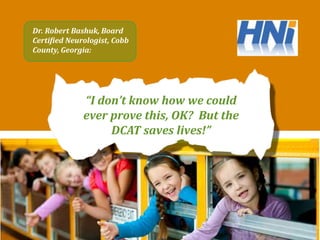
“I don’t know how we could
ever prove this, OK? But the
DCAT saves lives!”
Dr. Robert Bashuk, Board
Certified Neurologist, Cobb
County, Georgia:
THE FUTURE OF DRIVER SAFETY FOR
Drive change through education.
QUESTIONS?
Please direct your questions to:
Michael Natalizio, Director of Marketing & Analytics
mnatalizio2@hni.com
THANK YOU FOR JOINING US!

HNI U: Medically at risk drivers

  • 1.
    Drive change througheducation. MEDICALLY AT RISK DRIVERS What you don’t know can hurt you
  • 2.
    2 HOUSEKEEPING 2 • Webinar slidedeck AND recording will be made available on hni.com, and you’ll be sent a link to access • Ask questions by typing into the chat window, or tweet @HNIRisk using the hashtag #hniu! Tweet us!
  • 3.
  • 4.
    WHO IS ONTHE LINE? Jeff Borchardt, CEO/Managing Partner Safeway Driver Fitness Centers 4
  • 5.
    THE FUTURE OFDRIVER SAFETY FOR
  • 6.
    About SafeWay Centers Factsabout the Medically At-Risk Driver Solutions to Identify Medically At-Risk Driver Partnership Opportunities Who We Are and What We Do Goals and Missions Facts and Stats Industry Challenges and Addressing “Wicked Problems” Backed by Science DriveABLE Early Warning System Win/Win for Clients Solves “Wicked Problems”
  • 7.
    2 18-wheelers andSUV collide on Interstate 20 outside of Pell City, Alabama-July 2015 September: “More Than 300 Killed in Pakistani Factory Fires” FDA Drug Safety Communication: FDA warns of next-day impairment with sleep aid Lunesta (eszopiclone) and lowers recommended dose -May 2014 September: “More Than 300 Fires” NTSB Most Wanted List 2015: Require Medical Fitness for Duty Those suffering from impairing medical disorders should not be at the controls unless they receive medical treatment that mitigates the risk to the public. -January 2015 September: “More Than 300 Killed in Pakistani Factory Fires” Cardiac Disease Associated with Increased Risk of Nonamnestic Cognitive Impairment -2013 September: “More Than 300 Killed in Pakistani Factory Fires”Drowsy driving kills more people on America s highways than distracted driving, a top sleep expert recently told a motor carrier safety advisory panel Sleep Apnea: Hidden Cause of Commercial Truck Crashes -December 2011 September: “More Than 300 Fires” Doctors Should Evaluate Liver Disease Patients for Cognitive Impairment, Address Driving Safety -March 2011 1 dead and 5 injured when 18-wheeler collides with pack of motorcyclists parked on side of Interstate 85 in Greensboro, North Carolina-July 2015 One person killed in semi-truck pileup on Interstate 10 near Quartzsite, Arizona-July 2015 Semi carrying more than 1,200 propane tanks struck by erratic driver of another tractor-trailer on I-84 in Sturbridge, Massachusetts-July 2015 10 Dead, Dozens Injured in Fiery Crash Between FedEx Truck and Tour Bus National Transportation Safety Board investigators determined the FedEx truck driver, 32-year- old Timothy Evans, losing control of his truck (due to a possible medical episode or inattentive driving was the cause of the crash-April 2014 Milwaukee Truck Accident Lawyers Advocating to Maximum Judgment and Settlement on Behalf of Victims of Semi Truck and Motor Vehicle Injuries
  • 8.
    THE FUTURE OFDRIVER SAFETY FOR ABOUT US
  • 9.
    SafeWay Driver FitnessCenters™ offer globally recognized, evidence- based solutions for the fair and accurate assessment and identification of the Medically At-Risk Driver. We utilize assessment technologies that afford organizations valuable and objective information that can be used to make tangible and cost- saving business decisions In an effort to identify the medically at-risk driver, who may pose a danger to themselves, their passengers and other road users, we seek to develop partnerships with key industry leaders and healthcare professionals to do so.
  • 10.
    HNI and theirclients understand that the transportation industry faces unique challenges… Rising cost of benefits Managing and improving driver performance Driver recruitment and retention Need to become better at preventing and managing collisions Known Collectively As…
  • 11.
    ALIGNS WITH COREVALUES To assist commercial companies, healthcare professionals, insurance underwriters and government entities in placing the most cognitively sound and safest drivers on the road today by identifying the MEDICALLY AT-RISK DRIVER 1
  • 12.
    THE FUTURE OFDRIVER SAFETY FOR MEDICALLY AT RISK
  • 13.
    The Medically At-RiskDriver • What does it mean to be a medically at- risk? • Who is at risk? • How much riskier versus healthy drivers? • Identification methods? • What if nothing is done?
  • 14.
    What Is MedicallyAt-Risk? • Possessing one or more medical conditions that the peer-reviewed literature suggests causes cognitive impairment • Cognitive Impairment is defined as any characteristic that acts as a barrier to the normal, mental abilities and processes • If an individual drives with CI, he/she can become unsafe and put themselves, the company they work for and the community at risk!
  • 15.
    MEDICAL CONDITIONS/TREATMENTS THAT CAUSECOGNITIVE IMPAIRMENT *From B. Dobbs (2002) NHTSA report Cardiovascular Disease Metabolic Disease Cerebrovascular Disease Renal Disease Neurological Disease Depression Alcohol and drug dependency* Dementia/Alzheimer’s Respiratory Disease Traumatic Brain Injury Psychiatric Illness Liver Disease Medication; over-the- counter or prescribed Sleep Apnea
  • 16.
    AT-FAULT CRASH RISK 0.0 0.5 1.0 1.5 2.0 2.5 3.0 3.5 IncreasedAt-FaultCrashRisk Source:Diller et al., (1999). Evaluating drivers licensed with medical conditions in Utah, 1992-1996. DOT HS 809 023. Washington, DC: National Highway Traffic Safety Administration.
  • 17.
    Cognitively Impaired DriversAre 3xMORE LIKELY To Cause A Crash 50%40% GREATER Medically At-Risk Driver Demonstrates a AT-FAULT Crash Risk Compared To Alcohol Impaired Drivers With A Blood-alcohol Level Of .08 Compared to normal, healthy drivers
  • 18.
    It is relativelyeasy to assess physical and visual impairments that affect driving because strict, defined standards already exist with government agencies and medical health professionals. Not so with CI! DIFFICULT TO DETECT LACK OF EXPERTISE Limited knowledge, assessments and qualified physicians exist for determining fitness to drive. The visible clues are not as pronounced as other impairments, thereby going undiagnosed^ At the same time, it is virtually impossible to predict how cognitive DECLINE affects safe driving DIFFICULT TO PREDICT EASY TO MISS In primary care setting, Mild Cognitive Impairment (MCI) is “missed", or goes undiagnosed, in 90% of all primary care physician visits* ^ Dubinsky RM, Stein AC. Minimal hepatic encephalopathy and driving. Hepatology 2009;50:1007-1008 ^ Yale SH, Phiroze H, Knapp D, Ehrfurth J. Neurologic conditions: assessing medical fitness to drive. Clin Med Res 2003 Jul;1(3): 177-188 * Valcour et al. (2000). Archives of Internal Medicine, 160, 2964-2968.
  • 21.
    THE FUTURE OFDRIVER SAFETY FOR SOLUTION
  • 22.
    Computerized Test Globally Recognized Evidence-Based HighlyPredictive Early Warning System: DCAT- The DriveABLE Cognitive Assessment Tool
  • 23.
    Approximately 35-45 minutes toadminister by certified technician Easy to read PDF report is produced to interpret the results of the assessment. What does it do? How does it help? Secure, trusted, defensible, objective and accurate • Motor Speed/Control • Span of Attentional Field • Spatial Judgment and Decision Making • Speed of Attention Shifting • Executive Function • Identification of Various Driving Situations Six tasks – simple presentation The assessment will produce a numerical risk factor for each driver that will indicate the probability of failing a specialized on-road test Each of the six tasks has relevance to driving and adds predictive power regarding on-road performance 22 weighted measures in complex algorithm
  • 24.
    The Computerized DCAT(and the DORE on-road) solution offered by SafeWay Driver Fitness Centers will identify the medically at-risk driver during your pre-screening process and in your already established pool of drivers, thereby mitigating at-fault crash risk. University researched (University of Alberta) for 8 years Participation of Canadian Government during research Standardized, peer-reviewed^ and objective. Objective data dispels doubt Drivers who take the assessment are compared to normal, healthy drivers of the same age and gender A recent independent data analysis of over 5000 drivers that were administered the DCAT and the DORE, revealed a very high correlation between the predicted risk and the actual on-road driving risk level (.94*), This means that if a driver scores higher on the DCAT, his/her probability of failing a specialized on-road assessment is greatly increased. ^ Dobbs,A., Accuracy of the DriveABLE cognitive assessment to determine fitness to drive. Canadian Family Physician 2013;59e156-61
  • 25.
    Edmonton Transit System(ETS) “{The DriveABLE solutions} proved that the bigger the investment at the beginning of the process, pays for itself in the end. Overall, we now have a better candidates that go through our classes.” -Valeria Palladino, Supervisor, Hiring and Training Edmonton Transit System ETS STUDY • 530 applicants were assessed. • If they passed the cognitive driving assessment, the top ranked applicants moved along in the interview process. ETS FINDINGS • 59% of those candidates were screened out and not proceed to the next step. Six of those candidates scored extremely poor on the DCAT, and would be considered a high-risk, hazardous driver on the road. • ETS was able to save valuable time and money by “screening out” incompetent drivers. • ETS made themselves a safer organization by not hiring a driver who was medically at-risk. This saved ETS a great deal of time, money, and legal expenses should those cognitively challenged drivers been hired and, subsequently, been involved in an at-fault crash due to a medical condition. ETS OBJECTIVE • ETS was spending a great deal of time and money on each applicant, including surveys, interviews, and other 3rd party vendor applications only to find that the newly hired employees were not competent behind the wheel. • The average cost to train a new employee was $12,000. • ETS desired a test that would allow them to assess thinking skills related to driving and actual driving skills in a measurable manner.
  • 26.
    STUDENT TRANSIT, EauClaire, Wisconsin “The DCAT is an amazing tool; it will revolutionize how we hire, train and maintain our driver pool” -Jim Fey, Vice President, Student Transit, Eau Claire, Wisconsin President, Wisconsin School Bus Association Results NORMAL (1 -25%) MONITOR PERIODICALLY (26-49%) MONITOR REGULARLY & CLOSELY (50-72%) SHOULD NOT BE DRIVING AT ALL (72+) # of Drivers Per Category 91 13 10 3 Case study, November 2014 117 driver school bus company Driver’s ages ranged from 23 to 88 STUDY FACTS: Student Transit Eau Claire is one of Wisconsin’s oldest providers of student transportation services. They already had an impeccable safety record. However, the executive board wanted to go above and beyond the call of duty to ensure driver safety Management committed to safety RESULTS: 21 of the 91 that tested Normal were 60 yrs old or older with 2 being over 70 yrs old 22% needed further evaluation 3 people tested over 72% with 2 testing 90 & 96%...“these are crashes waiting to happen”
  • 27.
    Using the mostadvanced assessment technology to assist HNI and their clients in finding those ‘Needles in the Haystack’ who may be unsafe to drive IT’S ALL ABOUT MITIGATING RISK !
  • 28.
    THE FUTURE OFDRIVER SAFETY FOR PARTNERSHIP
  • 29.
    * Transportation ResearchBoard 2011 Partnering with SafeWay will provide a tangible solution to your “Wicked Problems” Do Certain Drivers Pose a Real Threat to the Way Your Company Operates on a Daily Basis? If ‘YES’: These solutions can reduce liability and reduce turnover* (by bringing individuals with higher cognitive skills to the company) Improve and ensure safety while saving time and money for your clients Win/Win opportunity for all – including the community!
  • 30.
    Potential Cost ofDoing Nothing… FMCSA statistics on average cost, PER CRASH: Excluding pain & suffering, each crash costs, $148,279 Non-injury/property-only: $97,881 for a straight truck and $172,292 for a tractor/trailer When an injury occurs, the cost is $334,882 If a death(s) is involved, that cost balloons to $7.2 million! You Could Implement the DCAT for ‘X’ Years, For Less Than The Cost of One Crash in Today’s Prices!!!
  • 31.
    in Pakistani FactoryFires” “I don’t know how we could ever prove this, OK? But the DCAT saves lives!” Dr. Robert Bashuk, Board Certified Neurologist, Cobb County, Georgia:
  • 32.
    THE FUTURE OFDRIVER SAFETY FOR
  • 33.
    Drive change througheducation. QUESTIONS? Please direct your questions to: Michael Natalizio, Director of Marketing & Analytics mnatalizio2@hni.com THANK YOU FOR JOINING US!