Long and winding roads?from university to working life -or:percentages and interviewsVisa Tuominen, Juhani Rautopuro & Antero Puhakkavisa.tuominen@uef.fijuhani.rautopuro@jyu.fiantero.puhakka@uef.fi
1. IntroductionBologna declaration1999European higher education areaacademic degree standardsquality assuranceLondon communiqué 2007Employability of graduatesconnection between universities and the world of work
2. ConsequencesThe bonds between educational system and the labour market have tightenedUniversities in Europe have said to become more school-like and vocational (e.g. Kivinen & Nurmi 2003)university studies are increasingly following the assumed needs of the labour market and various professions(e.g. Grupp & Lazerson 2005)
2. Consequences (continued)Students (in general) nowadays: being more instrumental and vocationally oriented  (e.g. Wood 2004)come to universities to exchange a degree for professional status - for a well paid occupation or a secure job (Harvey et al 2002, Maharosoa & Hay 2001).
3. Research question
4. Data and methodsGraduates from University of Joensuu(nowadays University of Eastern Finland) 2001-2003. Surveys have been conducted in the autumn of 2006-2008 e.g. five years after their graduation. Altogether 1221 answers (response rate approximately 65 %, men 60 %, women 67 %)Mostly quantitative methodsIn addition, personal interviews, each person was interviewed three times (n= 16, three men)First interview: in June, after the graduation year.Second interview: in June, a year after the first interview.Third interview:  in June, five years after the graduation.
6. Results (1)
6. Results (2)   
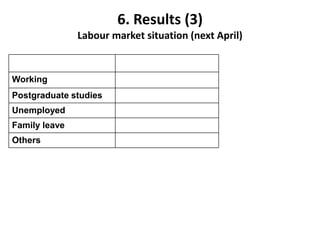
6. Results (3)Labour market situation (next April) 
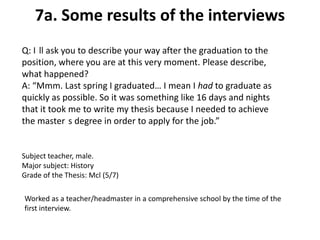
7a. Some results of the interviewsQ: I´ll ask you to describe your way after the graduation to the position, where you are at this very moment. Please describe, what happened?A: “Mmm. Last spring I graduated… I mean I had to graduate as quickly as possible. So it was something like 16 days and nights that it took me to write my thesis because I needed to achieve the master´s degree in order to apply for the job.”  Subject teacher, male. Major subject: HistoryGrade of the Thesis: Mcl (5/7) Worked as a teacher/headmaster in a comprehensive school by the time of the first interview.
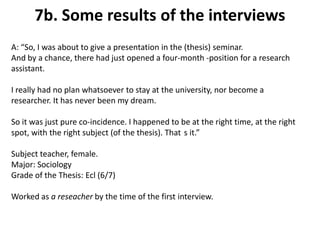
7b. Some results of the interviewsA: “So, I was about to give a presentation in the (thesis) seminar. And by a chance, there had just opened a four-month -position for a research assistant. I really had no plan whatsoever to stay at the university, nor become a researcher. It has never been my dream. So it was just pure co-incidence. I happened to be at the right time, at the right spot, with the right subject (of the thesis). That´s it.”  Subject teacher, female. Major: SociologyGrade of the Thesis: Ecl (6/7)Worked as a reseacher by the time of the first interview.  
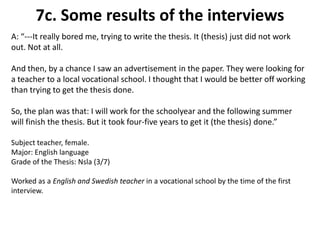
7c. Some results of the interviewsA: “---It really bored me, trying to write the thesis. It (thesis) just did not work out. Not at all. And then, by a chance I saw an advertisement in the paper. They were looking for a teacher to a local vocational school. I thought that I would be better off working than trying to get the thesis done.  So, the plan was that: I will work for the schoolyear and the following summer will finish the thesis. But it took four-five years to get it (the thesis) done.”Subject teacher, female. Major: English languageGrade of the Thesis: Nsla (3/7) Worked as a English and Swedish teacher in a vocational school by the time of the first interview.  
8. Conclusions  
 

Long and winding roads

  • 1.
    Long and windingroads?from university to working life -or:percentages and interviewsVisa Tuominen, Juhani Rautopuro & Antero Puhakkavisa.tuominen@uef.fijuhani.rautopuro@jyu.fiantero.puhakka@uef.fi
  • 2.
    1. IntroductionBologna declaration1999Europeanhigher education areaacademic degree standardsquality assuranceLondon communiqué 2007Employability of graduatesconnection between universities and the world of work
  • 3.
    2. ConsequencesThe bondsbetween educational system and the labour market have tightenedUniversities in Europe have said to become more school-like and vocational (e.g. Kivinen & Nurmi 2003)university studies are increasingly following the assumed needs of the labour market and various professions(e.g. Grupp & Lazerson 2005)
  • 4.
    2. Consequences (continued)Students(in general) nowadays: being more instrumental and vocationally oriented (e.g. Wood 2004)come to universities to exchange a degree for professional status - for a well paid occupation or a secure job (Harvey et al 2002, Maharosoa & Hay 2001).
  • 5.
  • 6.
    4. Data andmethodsGraduates from University of Joensuu(nowadays University of Eastern Finland) 2001-2003. Surveys have been conducted in the autumn of 2006-2008 e.g. five years after their graduation. Altogether 1221 answers (response rate approximately 65 %, men 60 %, women 67 %)Mostly quantitative methodsIn addition, personal interviews, each person was interviewed three times (n= 16, three men)First interview: in June, after the graduation year.Second interview: in June, a year after the first interview.Third interview: in June, five years after the graduation.
  • 7.
  • 8.
  • 9.
    6. Results (3)Labourmarket situation (next April) 
  • 10.
    7a. Some resultsof the interviewsQ: I´ll ask you to describe your way after the graduation to the position, where you are at this very moment. Please describe, what happened?A: “Mmm. Last spring I graduated… I mean I had to graduate as quickly as possible. So it was something like 16 days and nights that it took me to write my thesis because I needed to achieve the master´s degree in order to apply for the job.”  Subject teacher, male. Major subject: HistoryGrade of the Thesis: Mcl (5/7) Worked as a teacher/headmaster in a comprehensive school by the time of the first interview.
  • 11.
    7b. Some resultsof the interviewsA: “So, I was about to give a presentation in the (thesis) seminar. And by a chance, there had just opened a four-month -position for a research assistant. I really had no plan whatsoever to stay at the university, nor become a researcher. It has never been my dream. So it was just pure co-incidence. I happened to be at the right time, at the right spot, with the right subject (of the thesis). That´s it.”  Subject teacher, female. Major: SociologyGrade of the Thesis: Ecl (6/7)Worked as a reseacher by the time of the first interview.  
  • 12.
    7c. Some resultsof the interviewsA: “---It really bored me, trying to write the thesis. It (thesis) just did not work out. Not at all. And then, by a chance I saw an advertisement in the paper. They were looking for a teacher to a local vocational school. I thought that I would be better off working than trying to get the thesis done.  So, the plan was that: I will work for the schoolyear and the following summer will finish the thesis. But it took four-five years to get it (the thesis) done.”Subject teacher, female. Major: English languageGrade of the Thesis: Nsla (3/7) Worked as a English and Swedish teacher in a vocational school by the time of the first interview.  
  • 13.
  • 14.