Digital Accessibility
Regulatory Landscape –
are you ready?
Abi James
@abijames
Tonight’s topic
• Current state of accessibility regulations
• What does it mean for accessibility
professionals?
“Accessibility community”:
Who’s here?
Abi James, Accessibility Consultant
• I am not a lawyer (i.e. this talk does not constitute legal advice)
Why am I talking about regulations?
Answer questions and
0 1 0 2 0 3
Source A The front cover of a French magazine
showing a German gunboat close to Agadir,
Morocco, in 1911. The magazine said that the
gunboat was a threat to the peace of
Europe.
AGADIR
What about in the real world?
Digital accessibility
regulations are increasing
UK Equality
Act 2010
Americans
with
Disabilities
Act (ADA)
1990
UK Disability
Discrimination
Act (DDA) 1995
A few non-discrimination laws
India Rights of
Persons with
Disabilities Act
2016
Rep of Korea Act
on Welfare of
Persons with
Disability 2008
UN Convention on
the Rights of
Persons with
Disabilities (CRPD)
2006 (signed by
177 countries)
UN Sustainable
Development goals
2030 include focus
on disability 2015
Japan Disabled
Peoples’
Fundamental
Law 1993
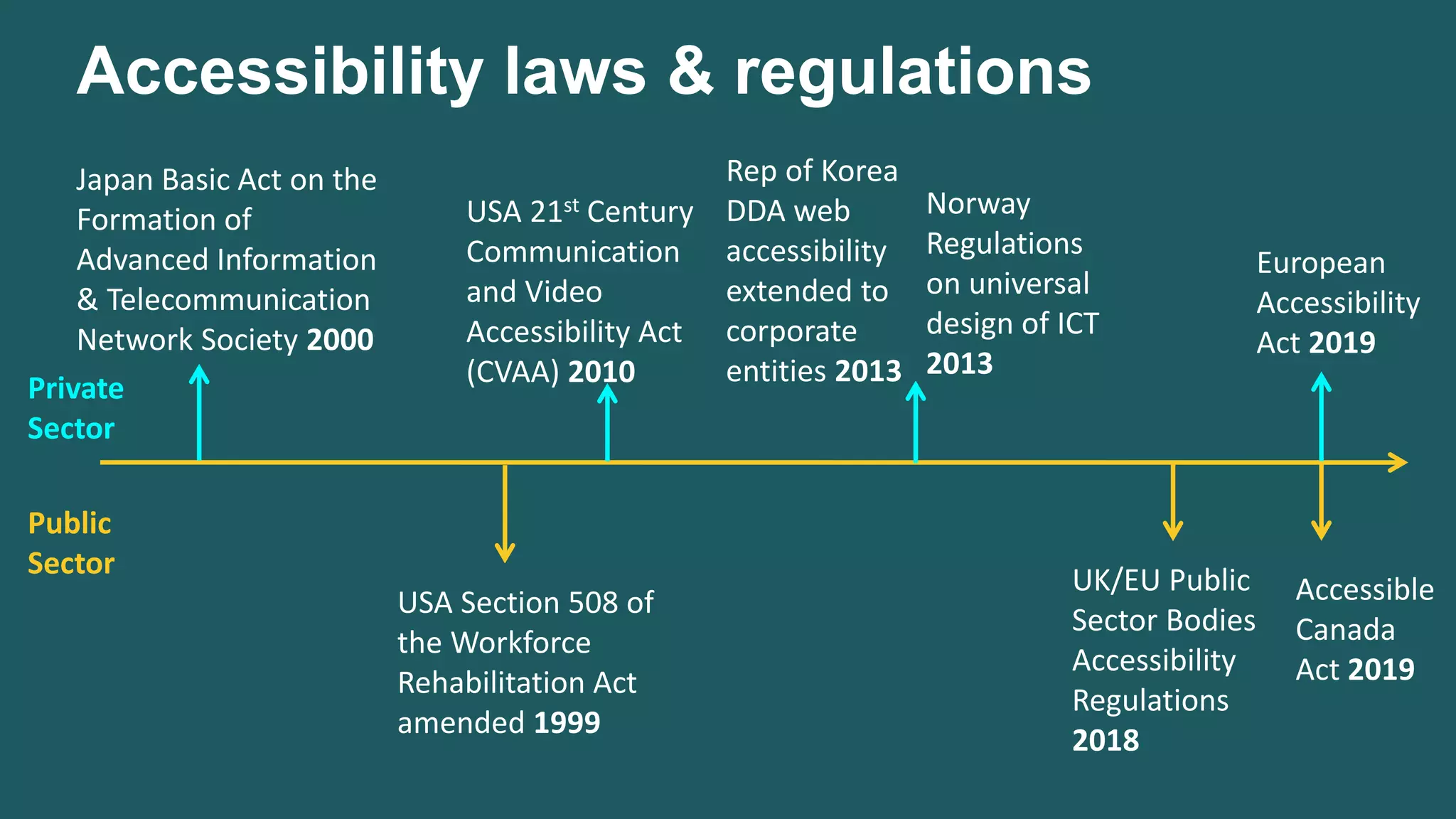
UK/EU Public
Sector Bodies
Accessibility
Regulations
2018
USA Section 508 of
the Workforce
Rehabilitation Act
amended 1999
Japan Basic Act on the
Formation of
Advanced Information
& Telecommunication
Network Society 2000
Accessibility laws & regulations
European
Accessibility
Act 2019
Norway
Regulations
on universal
design of ICT
2013
USA 21st Century
Communication
and Video
Accessibility Act
(CVAA) 2010
Rep of Korea
DDA web
accessibility
extended to
corporate
entities 2013
Accessible
Canada
Act 2019
Public
Sector
Private
Sector
UK: Public Sector Bodies (Websites and
Mobile Applications) Accessibility
Regulations 2018
B• Results from the 2016 EU Web Accessibility Directive (WAD)
• Transposed into EU member laws by Sept 2018
• Now UK law
The Public Sector Bodies (Websites and
Mobile Applications) Accessibility
Regulations 2018
Involves:
1.Websites, intranets, online documents and apps of public
sector bodies to comply with the “accessibility
requirement”
2.Websites and apps must have an accessibility statement
3.Government is required to monitor compliance
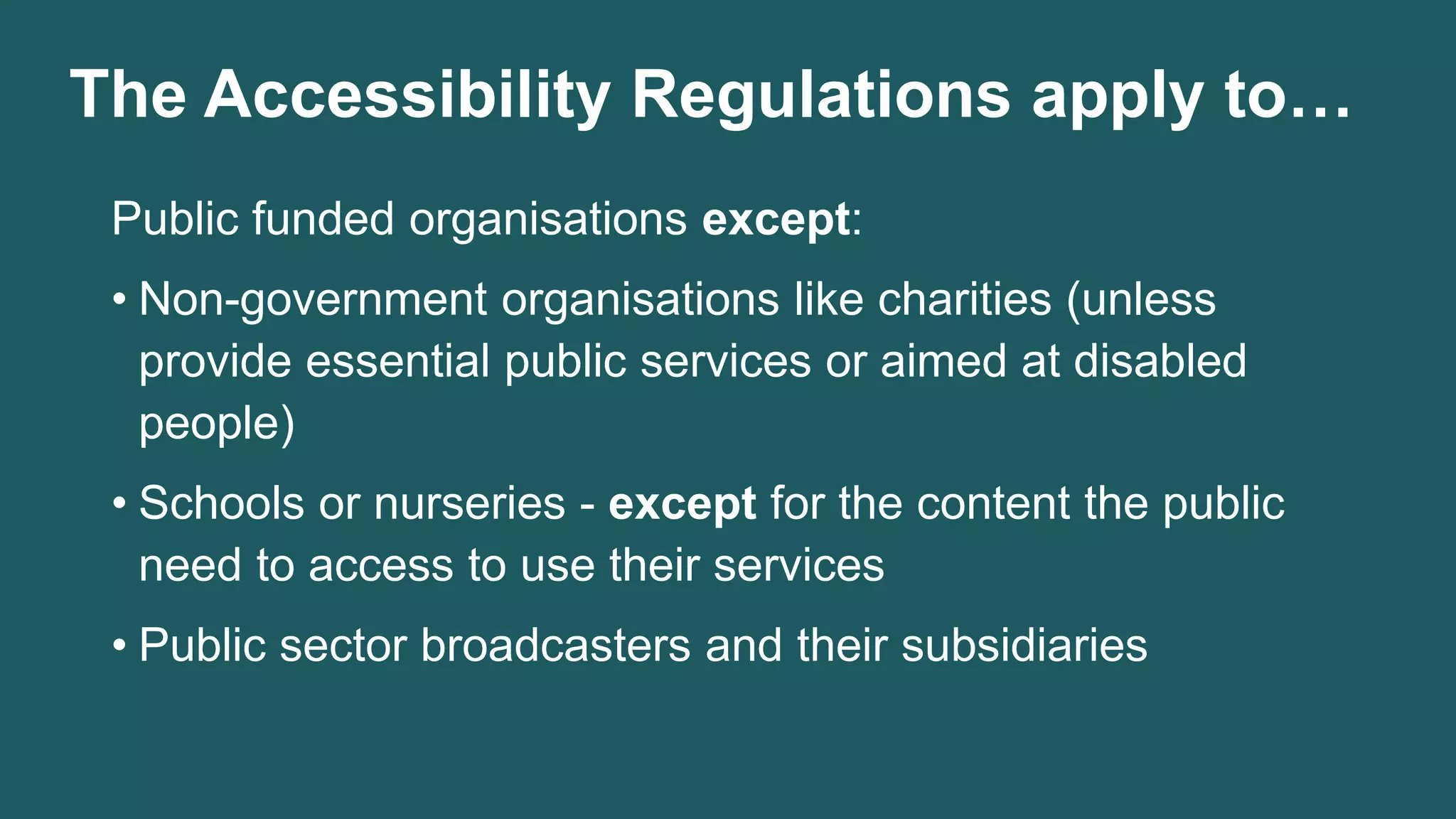
The Accessibility Regulations apply to…
Public funded organisations except:
• Non-government organisations like charities (unless
provide essential public services or aimed at disabled
people)
• Schools or nurseries - except for the content the public
need to access to use their services
• Public sector broadcasters and their subsidiaries
What is the “accessibility requirement”?
→ Perceivable, Operable, Understandable and Robust
→ Demonstrated through meeting the European accessibility
standard EN 301 549
→ Aligned to WCAG 2.1 Level AA
However, EN 301 549 covers more areas than WCAG e.g.
• Accessible documentation and help with accessibility
• Requirements for authoring tools, video players, biometrics etc
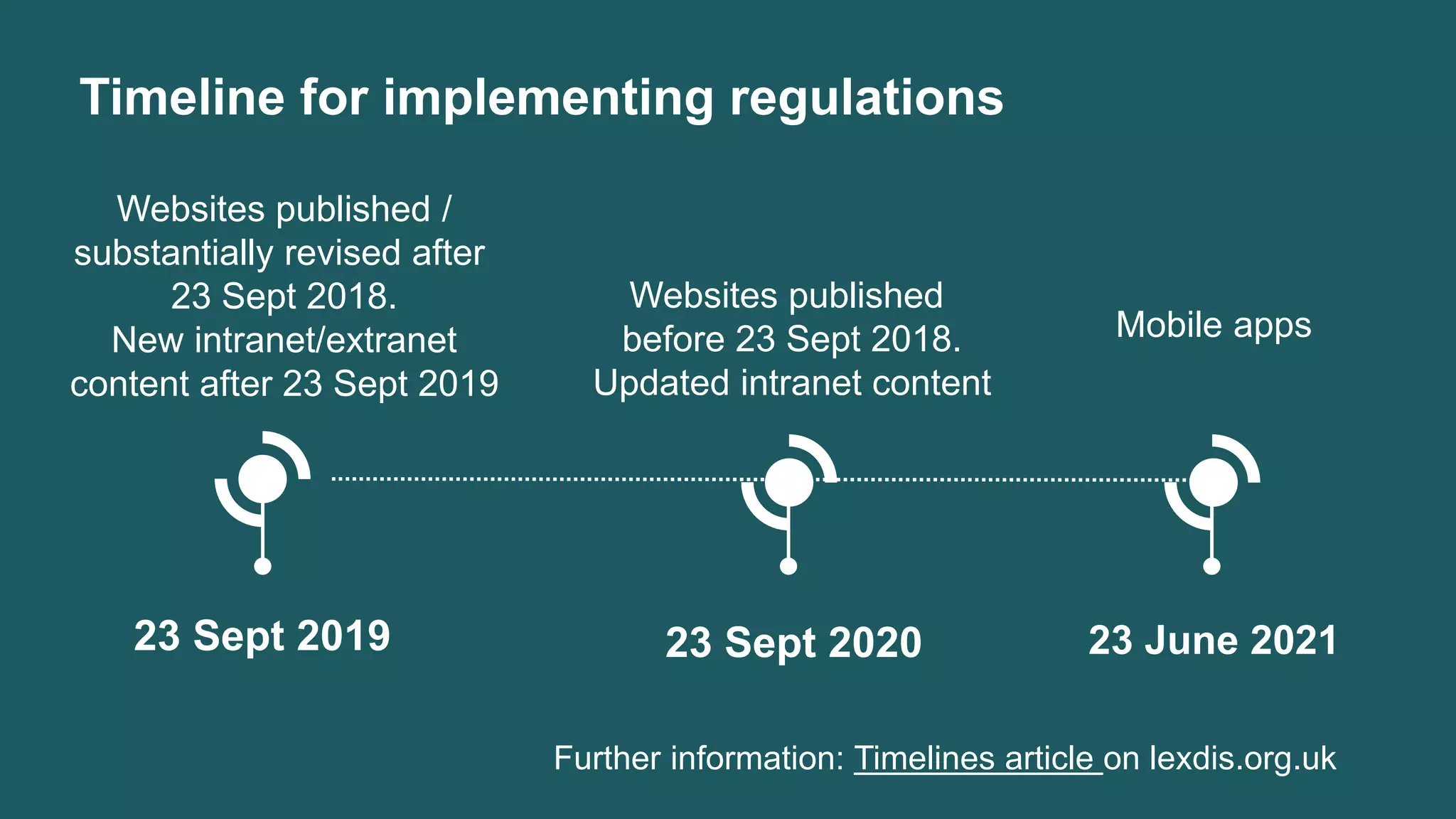
Mobile apps
23 June 2021
Websites published
before 23 Sept 2018.
Updated intranet content
23 Sept 2020
Websites published /
substantially revised after
23 Sept 2018.
New intranet/extranet
content after 23 Sept 2019
23 Sept 2019
Timeline for implementing regulations
Further information: Timelines article on lexdis.org.uk
Use this as
opportunity to
communicate to
your users
about how you
can support
their access
needs
• User focused description of what is accessible and what
isn’t e.g. alternatives to content that’s not accessible
• Statement of compliance – fully, partially or not comply
• Which parts of your service do not meet accessibility
standards and why
• Who to contact to report accessibility problems
• Information on how the regulations are monitor and how
to escalate issues to the monitoring body
Accessibility Statement must include:
GOV.uk sample accessibility statement
16
• GDS required to monitor public service websites to ensure
compliance
• Must sample proportion of sites each year from different types of
organisations
• Advised by stakeholder groups
• Sample size based on UK population
• Simplified monitoring ~ 2000 per year
• In-depth monitoring ~ 130 per year
• Ultimately EHRC are responsible for non-compliance
Monitoring of accessibility compliance
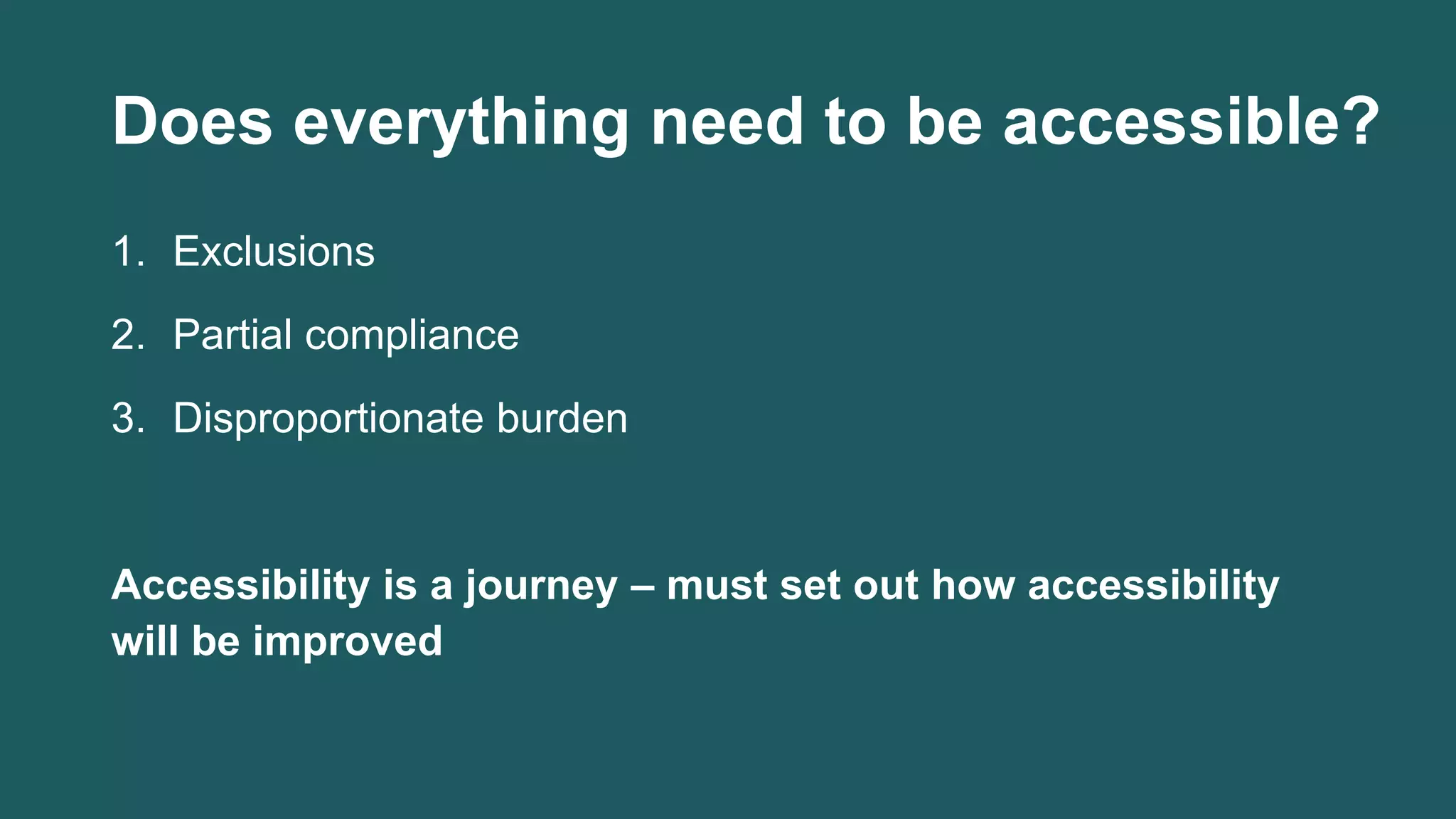
Does everything need to be accessible?
1. Exclusions
2. Partial compliance
3. Disproportionate burden
Accessibility is a journey – must set out how accessibility
will be improved
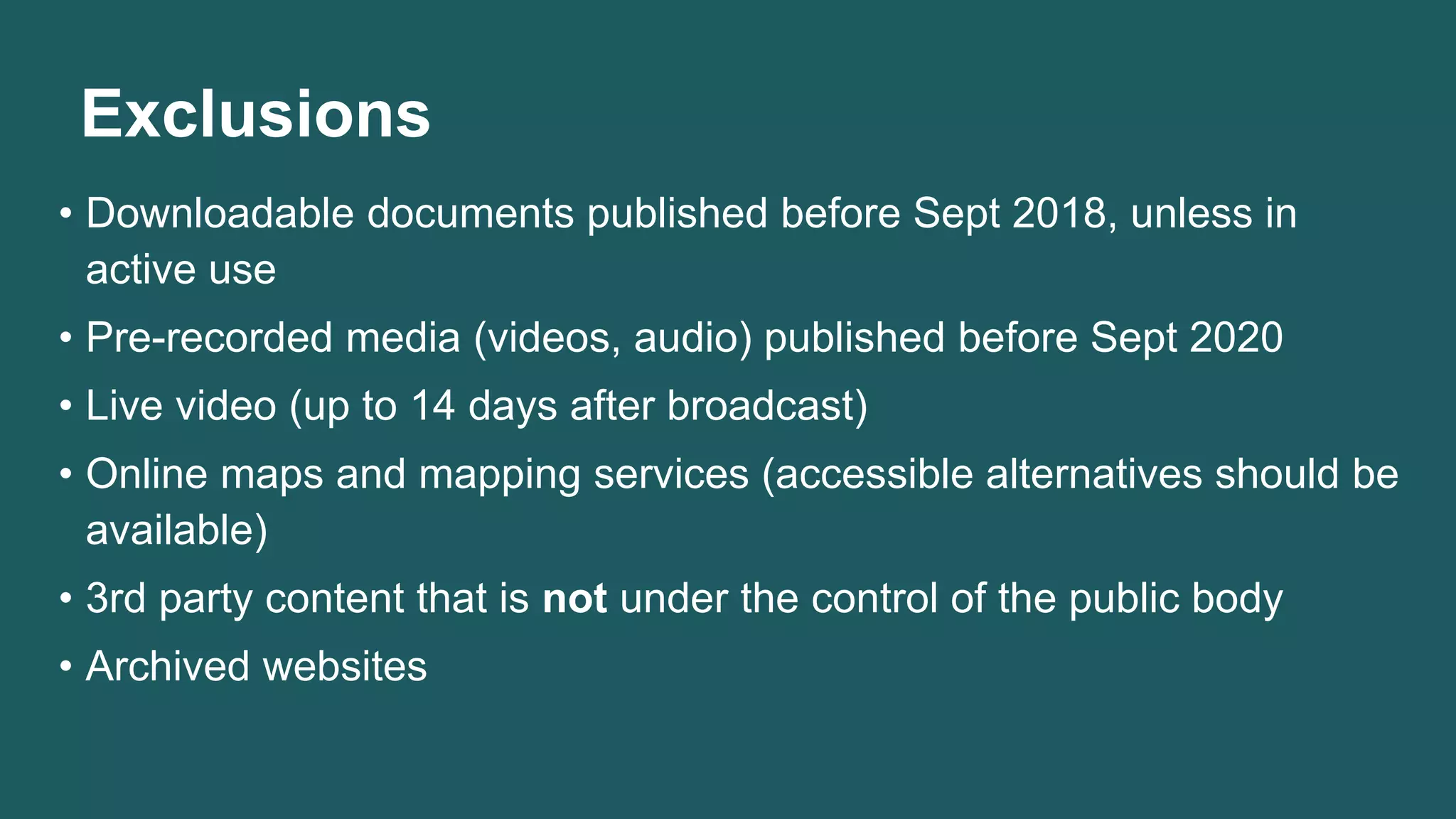
Exclusions
• Downloadable documents published before Sept 2018, unless in
active use
• Pre-recorded media (videos, audio) published before Sept 2020
• Live video (up to 14 days after broadcast)
• Online maps and mapping services (accessible alternatives should be
available)
• 3rd party content that is not under the control of the public body
• Archived websites
Claiming disproportionate burden
Perform initial assessment of extent to which compliance with the
accessibility requirement imposes a disproportionate burden:
• Size and resources of organisation
• Costs and benefits to people with disabilities
• Taking into account use of app / website / document
• Time-limited – can’t claim dipropionate burden for ever
Publish this in your accessibility statement
Unanswered questions
“substantially
revised”
“active
administrative
purposes”
“a website”
Does this apply to my organisation?
• “All UK service providers have a legal obligation to make reasonable
adjustments under the Equality Act 2010 or the Disability Discrimination
Act 1995 (in Northern Ireland)”. (GOV.uk)
• Neglecting to provide a web service to a disabled person that is
normally provided to other persons could be indirect discrimination.
• Public Sector Web Accessibility regulations state:
“A failure by a public sector body to comply with the accessibility
requirement is to be treated as a failure to make a reasonable
adjustment under the Equality Act.”
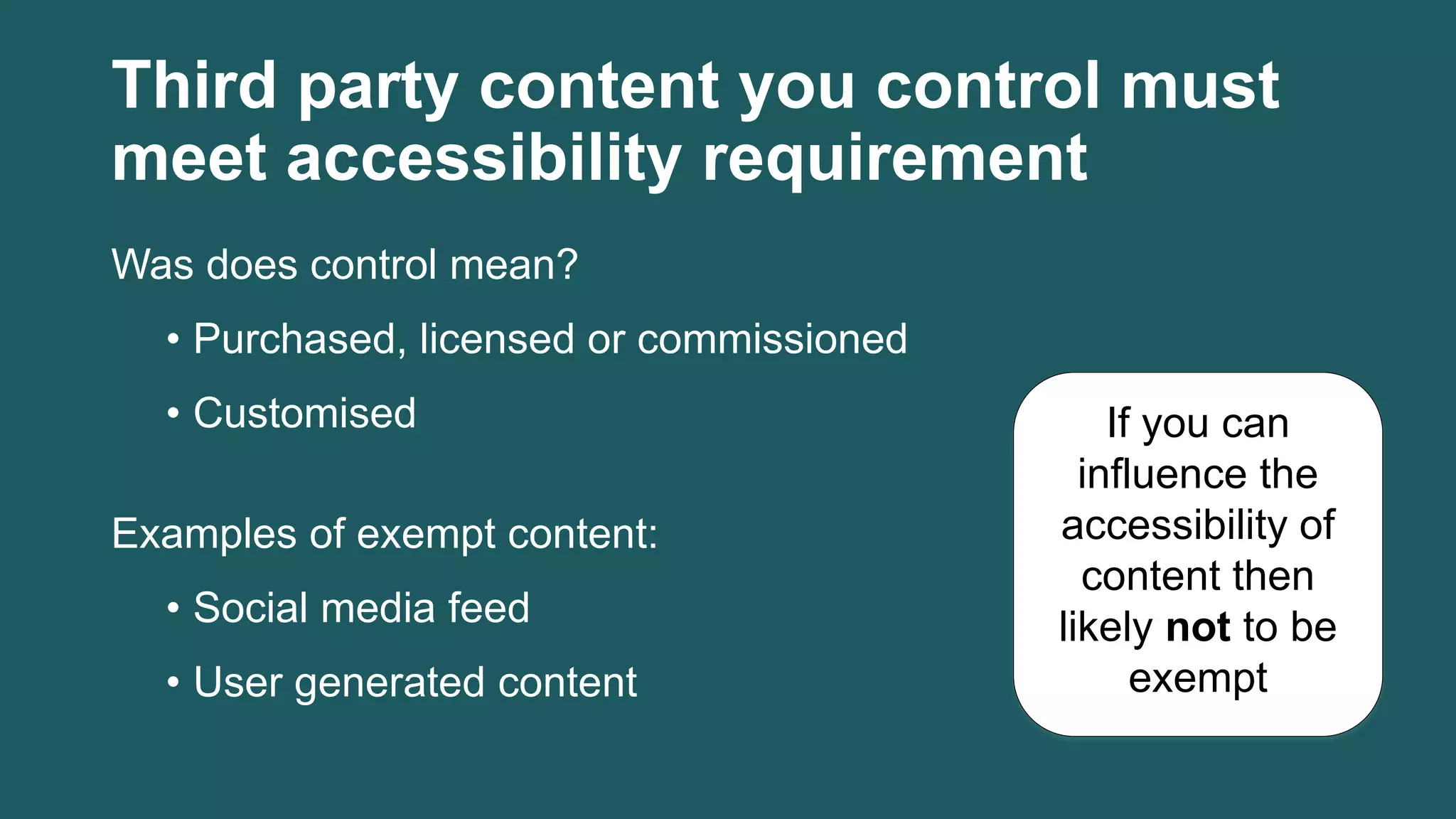
Third party content you control must
meet accessibility requirement
Was does control mean?
• Purchased, licensed or commissioned
• Customised
Examples of exempt content:
• Social media feed
• User generated content
If you can
influence the
accessibility of
content then
likely not to be
exempt
Do you have an accessibility
statement?
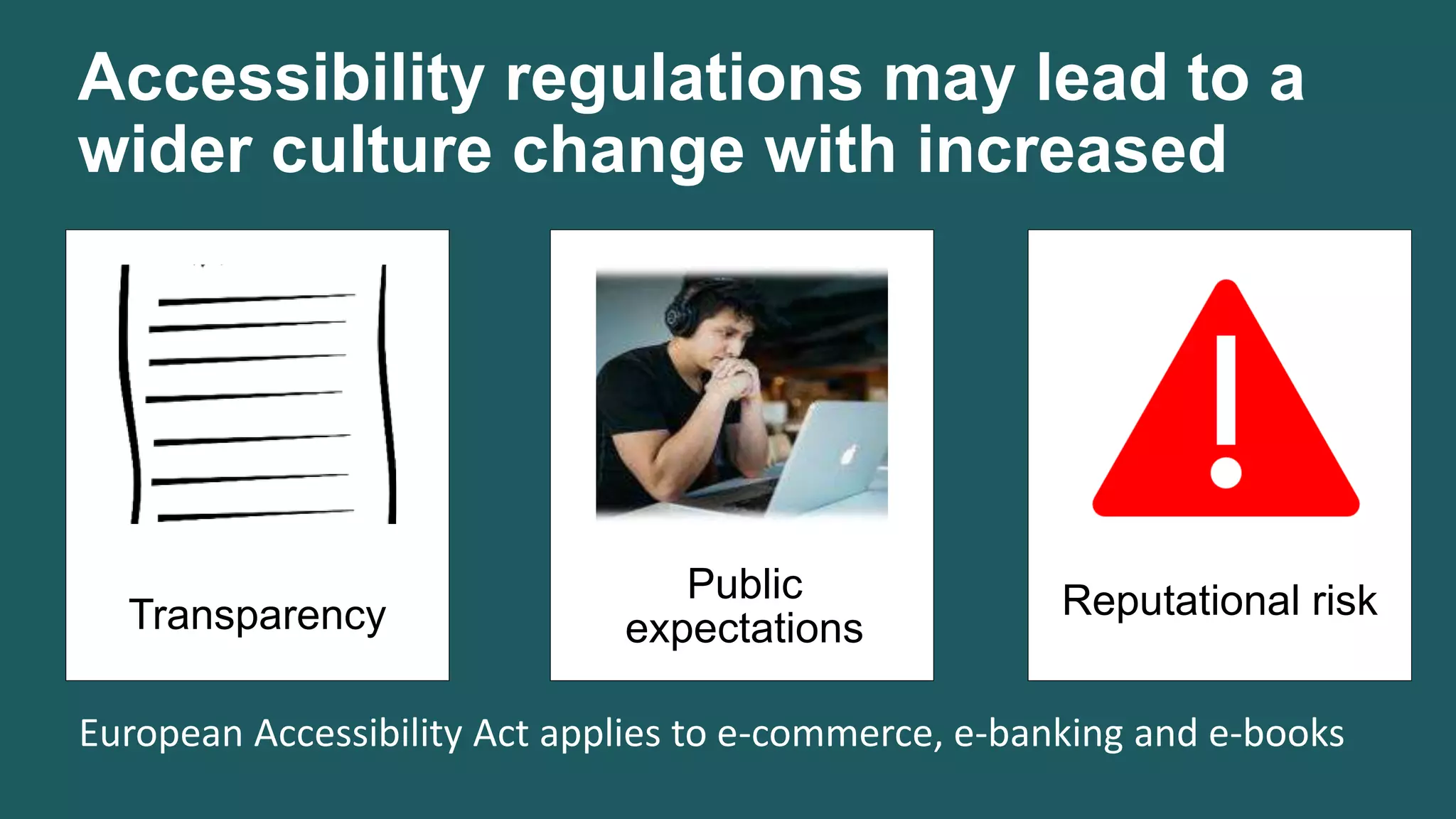
Accessibility regulations may lead to a
wider culture change with increased
Transparency
Public
expectations
Reputational risk
European Accessibility Act applies to e-commerce, e-banking and e-books
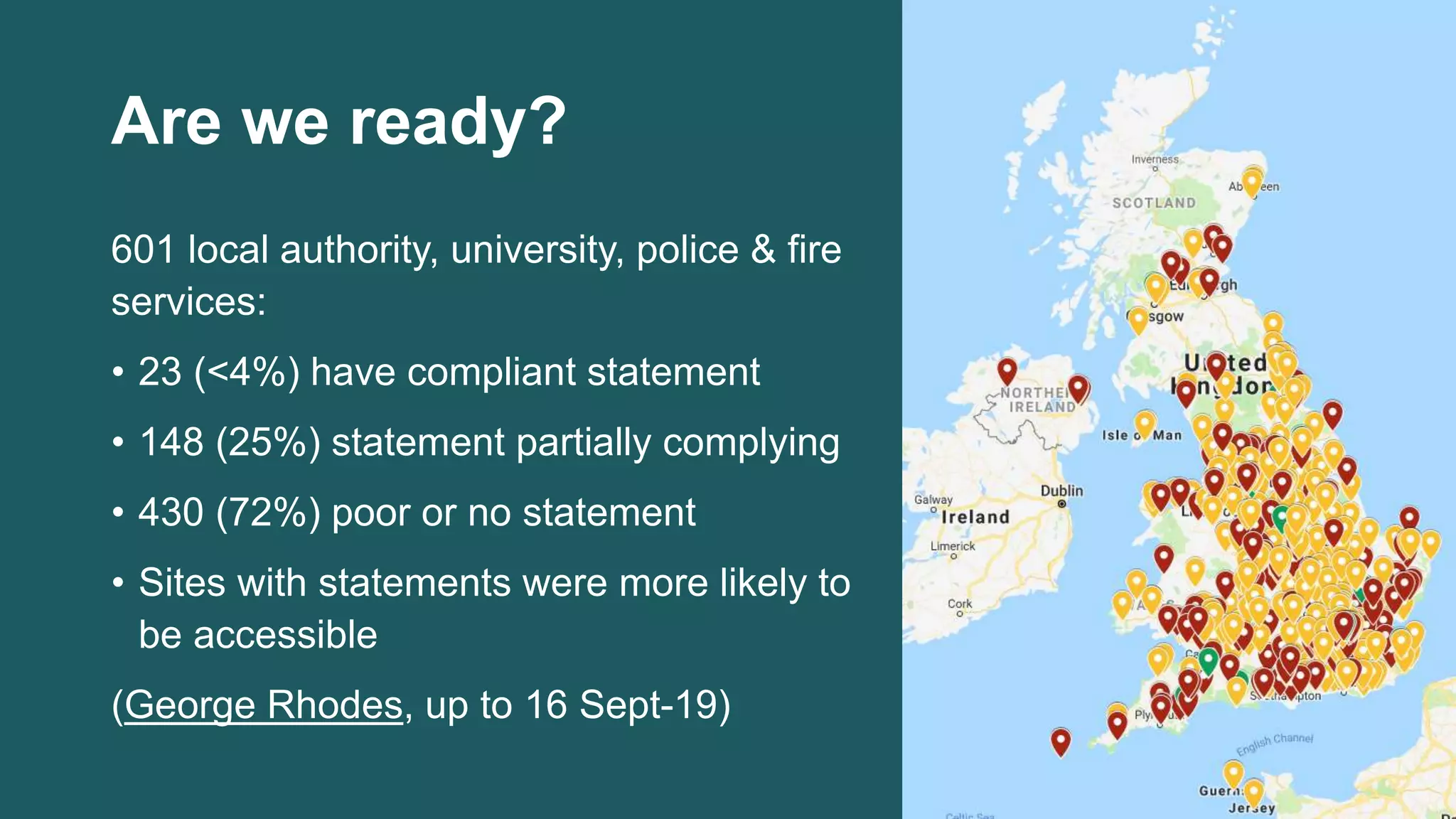
Are we ready?
601 local authority, university, police & fire
services:
• 23 (<4%) have compliant statement
• 148 (25%) statement partially complying
• 430 (72%) poor or no statement
• Sites with statements were more likely to
be accessible
(George Rhodes, up to 16 Sept-19)
Key requirements for implementing
web accessibility regulations
• Training (internally and externally)
• Clear understanding of coverage
• Type of organisation
• Content
• Technical standard
• Examples of best practice
• Code
• Organisation
Do we have the right skills?
Advocacy
• Usability
• Roadmap
Compliance
• Pass/fail
Develop
communities of
practice
Professional
recognition e.g.
IAAP
Understanding
what “good”
looks like
Questions and comments
abijames@abilitynet.org.uk @abijames
Resources
• Government advice pages:
https://www.gov.uk/guidance/accessibility-requirements-for-public-
sector-websites-and-apps
• AbilityNet https://abilitynet.org.uk/digital-accessibility-in-HE
• Techshare Pro 20/21st November 2019 www.techsharepro.com
• LexDis digital accessibility toolkit: https://www.lexdis.org.uk/digital-
accessibility/
• Email forum: JISC digital accessibility,

London a11y meetup abi james

  • 1.
    Digital Accessibility Regulatory Landscape– are you ready? Abi James @abijames
  • 2.
    Tonight’s topic • Currentstate of accessibility regulations • What does it mean for accessibility professionals?
  • 3.
  • 4.
    Abi James, AccessibilityConsultant • I am not a lawyer (i.e. this talk does not constitute legal advice)
  • 5.
    Why am Italking about regulations? Answer questions and 0 1 0 2 0 3 Source A The front cover of a French magazine showing a German gunboat close to Agadir, Morocco, in 1911. The magazine said that the gunboat was a threat to the peace of Europe. AGADIR
  • 6.
    What about inthe real world?
  • 7.
  • 8.
    UK Equality Act 2010 Americans with Disabilities Act(ADA) 1990 UK Disability Discrimination Act (DDA) 1995 A few non-discrimination laws India Rights of Persons with Disabilities Act 2016 Rep of Korea Act on Welfare of Persons with Disability 2008 UN Convention on the Rights of Persons with Disabilities (CRPD) 2006 (signed by 177 countries) UN Sustainable Development goals 2030 include focus on disability 2015 Japan Disabled Peoples’ Fundamental Law 1993
  • 9.
    UK/EU Public Sector Bodies Accessibility Regulations 2018 USASection 508 of the Workforce Rehabilitation Act amended 1999 Japan Basic Act on the Formation of Advanced Information & Telecommunication Network Society 2000 Accessibility laws & regulations European Accessibility Act 2019 Norway Regulations on universal design of ICT 2013 USA 21st Century Communication and Video Accessibility Act (CVAA) 2010 Rep of Korea DDA web accessibility extended to corporate entities 2013 Accessible Canada Act 2019 Public Sector Private Sector
  • 10.
    UK: Public SectorBodies (Websites and Mobile Applications) Accessibility Regulations 2018 B• Results from the 2016 EU Web Accessibility Directive (WAD) • Transposed into EU member laws by Sept 2018 • Now UK law
  • 11.
    The Public SectorBodies (Websites and Mobile Applications) Accessibility Regulations 2018 Involves: 1.Websites, intranets, online documents and apps of public sector bodies to comply with the “accessibility requirement” 2.Websites and apps must have an accessibility statement 3.Government is required to monitor compliance
  • 12.
    The Accessibility Regulationsapply to… Public funded organisations except: • Non-government organisations like charities (unless provide essential public services or aimed at disabled people) • Schools or nurseries - except for the content the public need to access to use their services • Public sector broadcasters and their subsidiaries
  • 13.
    What is the“accessibility requirement”? → Perceivable, Operable, Understandable and Robust → Demonstrated through meeting the European accessibility standard EN 301 549 → Aligned to WCAG 2.1 Level AA However, EN 301 549 covers more areas than WCAG e.g. • Accessible documentation and help with accessibility • Requirements for authoring tools, video players, biometrics etc
  • 14.
    Mobile apps 23 June2021 Websites published before 23 Sept 2018. Updated intranet content 23 Sept 2020 Websites published / substantially revised after 23 Sept 2018. New intranet/extranet content after 23 Sept 2019 23 Sept 2019 Timeline for implementing regulations Further information: Timelines article on lexdis.org.uk
  • 15.
    Use this as opportunityto communicate to your users about how you can support their access needs • User focused description of what is accessible and what isn’t e.g. alternatives to content that’s not accessible • Statement of compliance – fully, partially or not comply • Which parts of your service do not meet accessibility standards and why • Who to contact to report accessibility problems • Information on how the regulations are monitor and how to escalate issues to the monitoring body Accessibility Statement must include: GOV.uk sample accessibility statement
  • 16.
    16 • GDS requiredto monitor public service websites to ensure compliance • Must sample proportion of sites each year from different types of organisations • Advised by stakeholder groups • Sample size based on UK population • Simplified monitoring ~ 2000 per year • In-depth monitoring ~ 130 per year • Ultimately EHRC are responsible for non-compliance Monitoring of accessibility compliance
  • 17.
    Does everything needto be accessible? 1. Exclusions 2. Partial compliance 3. Disproportionate burden Accessibility is a journey – must set out how accessibility will be improved
  • 18.
    Exclusions • Downloadable documentspublished before Sept 2018, unless in active use • Pre-recorded media (videos, audio) published before Sept 2020 • Live video (up to 14 days after broadcast) • Online maps and mapping services (accessible alternatives should be available) • 3rd party content that is not under the control of the public body • Archived websites
  • 19.
    Claiming disproportionate burden Performinitial assessment of extent to which compliance with the accessibility requirement imposes a disproportionate burden: • Size and resources of organisation • Costs and benefits to people with disabilities • Taking into account use of app / website / document • Time-limited – can’t claim dipropionate burden for ever Publish this in your accessibility statement
  • 20.
  • 21.
    Does this applyto my organisation? • “All UK service providers have a legal obligation to make reasonable adjustments under the Equality Act 2010 or the Disability Discrimination Act 1995 (in Northern Ireland)”. (GOV.uk) • Neglecting to provide a web service to a disabled person that is normally provided to other persons could be indirect discrimination. • Public Sector Web Accessibility regulations state: “A failure by a public sector body to comply with the accessibility requirement is to be treated as a failure to make a reasonable adjustment under the Equality Act.”
  • 22.
    Third party contentyou control must meet accessibility requirement Was does control mean? • Purchased, licensed or commissioned • Customised Examples of exempt content: • Social media feed • User generated content If you can influence the accessibility of content then likely not to be exempt
  • 23.
    Do you havean accessibility statement?
  • 24.
    Accessibility regulations maylead to a wider culture change with increased Transparency Public expectations Reputational risk European Accessibility Act applies to e-commerce, e-banking and e-books
  • 25.
    Are we ready? 601local authority, university, police & fire services: • 23 (<4%) have compliant statement • 148 (25%) statement partially complying • 430 (72%) poor or no statement • Sites with statements were more likely to be accessible (George Rhodes, up to 16 Sept-19)
  • 26.
    Key requirements forimplementing web accessibility regulations • Training (internally and externally) • Clear understanding of coverage • Type of organisation • Content • Technical standard • Examples of best practice • Code • Organisation
  • 27.
    Do we havethe right skills? Advocacy • Usability • Roadmap Compliance • Pass/fail Develop communities of practice Professional recognition e.g. IAAP Understanding what “good” looks like
  • 28.
  • 29.
    Resources • Government advicepages: https://www.gov.uk/guidance/accessibility-requirements-for-public- sector-websites-and-apps • AbilityNet https://abilitynet.org.uk/digital-accessibility-in-HE • Techshare Pro 20/21st November 2019 www.techsharepro.com • LexDis digital accessibility toolkit: https://www.lexdis.org.uk/digital- accessibility/ • Email forum: JISC digital accessibility,

Editor's Notes

  • #10 18 US states have statues related to tech accessibility
  • #15 Timeline for application of regulations Sept 2019: Web sites created after 23 Sept 2018 and intranet content published after 23 Sept 2019. Sept 2020: Websites created before 23 Sept 2018. Intranet content is more complex but generally exempt if created before 23 Sept 2019 until it is updated. Sept 2021: Mobile apps
  • #16  Member States shall ensure that the declarations made in the statement, as regards compliance with the requirements set out in Directive (EU) 2016/2102 are accurate and based on one of the following: (a) an actual evaluation of the website's or mobile application's compliance with the requirements of Directive (EU) 2016/2102, such as: – a self-assessment done by the public sector body; – an assessment carried out by a third party, for example a certification; (b) any other measures, as deemed appropriate by the Member States, which provide equal assurance that the declarations made in the statement are accurate. 2. The statement shall indicate the method used as referred to in paragraph 1.
  • #17 shall be monitored: a) the home, login, sitemap, contact, help and legal information pages; b) at least one relevant page for each type of service provided by the website or mobile application and any other primary intended uses of it, including the search functionality; c) the pages containing the accessibility statement or policy and the pages containing the feedback mechanism; d) examples of pages having a substantially distinct appearance or presenting a different type of content; e) at least one relevant downloadable document, where applicable, for each type of service provided by the website or mobile application and any other primary intended uses of it;
  • #21 WCAG-EM: A coherent collection of one or more related web pages that together provide common use or functionality. It includes static web pages, dynamically generated web pages, and mobile websites and applications - Software moved to browser apps
  • #24 Poll: Yes & reviewed it in the past 12 months Yes but haven’t reviewed it in the last 12 months No Not sure
  • #26 So lets get into the research. I want to start with a quick overview of the entire piece. We have looked at: 369 Local Authorities (County and District Levels) 131 Universities 48 Police Forces 53 Fire and Rescue Services On the left I have a picture of each of these organisations mapped out across the UK. Green shows compliant statements, yellow partial statements and red for no statements. The tables on the right show some of the number breakdowns for these outcomes. The top table shows number of organisations in each category. I should explain that we have a deeper dive on the range of partial statements that is not out yet that starts to break down that vast category into good and poor attempts. This is because within the range of partial statements it can be anything from missing a couple of the requirements from the regs to having barely provided a web page. For the top table the results are: Compliant Statements: 23 Good Attempts: 39 Partial Attempts: 109 Poor Attempts: 258 Partial Statements overall: 406 (combined good, partial and poor attempts) No Statements: 172 The second Table shows the percentage breakdown for each section. Compliant Statements: 3.8% Good Attempts: 6.5% Partial Attempts: 18.1% Poor Attempts: 42.9% Partial Statements overall: 67.5% (combined good, partial and poor attempts) No Statements: 28.6% The third table shows avg WebAIM Million scores for each section. We used the WebAIM Million which is a WAVE automated check of the top million website home pages to try and figure out if there was a correlation between statement quality and overall accessibility. In these cases a lower number is better as it denotes less issues. Compliant Statements: 133,771.39 Good Attempts: 167,677.72 Partial Attempts: 199,561.95 Poor Attempts: 243,873.16 No Statements: 241,464.54 The final figure is the overall WebAIM score for all organisations we looked at. The score was 225,989.35 which denotes around 18 issues with a home page on average.
  • #27 Training – not uncommon to see US court settlements require organisations to regularly train staff on web accessibility
  • #28 Strict compliance view can lead to restricting technology Advocacy can lead to more understand of users needs Accessibility skills cross 8 different academic and professional disciplines form Health to compute science to business/management