LogStash in Action
What’s In It for You?
Data ingestion workhorse
Events enrichment and transformation
Extensible plugin ecosystem
Pluggable pipeline architecture
Horizontally scalable data processing pipeline
Strong Elasticsearch and Kibana synergy
Handles data of all shapes and sizes
Key Features of LogStash
What’s In It for You?
Installation and Configuration
The Pre-requisites
Installation and Configuration
Prerequisites
requires Java 7 or higher
Installation steps
Download from elastic.co web site
Use Linux package manager to install
LogStash
Install LogStash as a service
The Service Commands
Installation and Configuration
Video Demonstration
Installing LogStash
Play Video
The Service Commands
Installation and Configuration
Start or stop service commands :
sudo /etc/init.d/logstash start
sudo /etc/init.d/logstash stop
sudo /etc/init.d/logstash restart
sudo /etc/init.d/logstash status
Simple Pipeline
Installation and Configuration
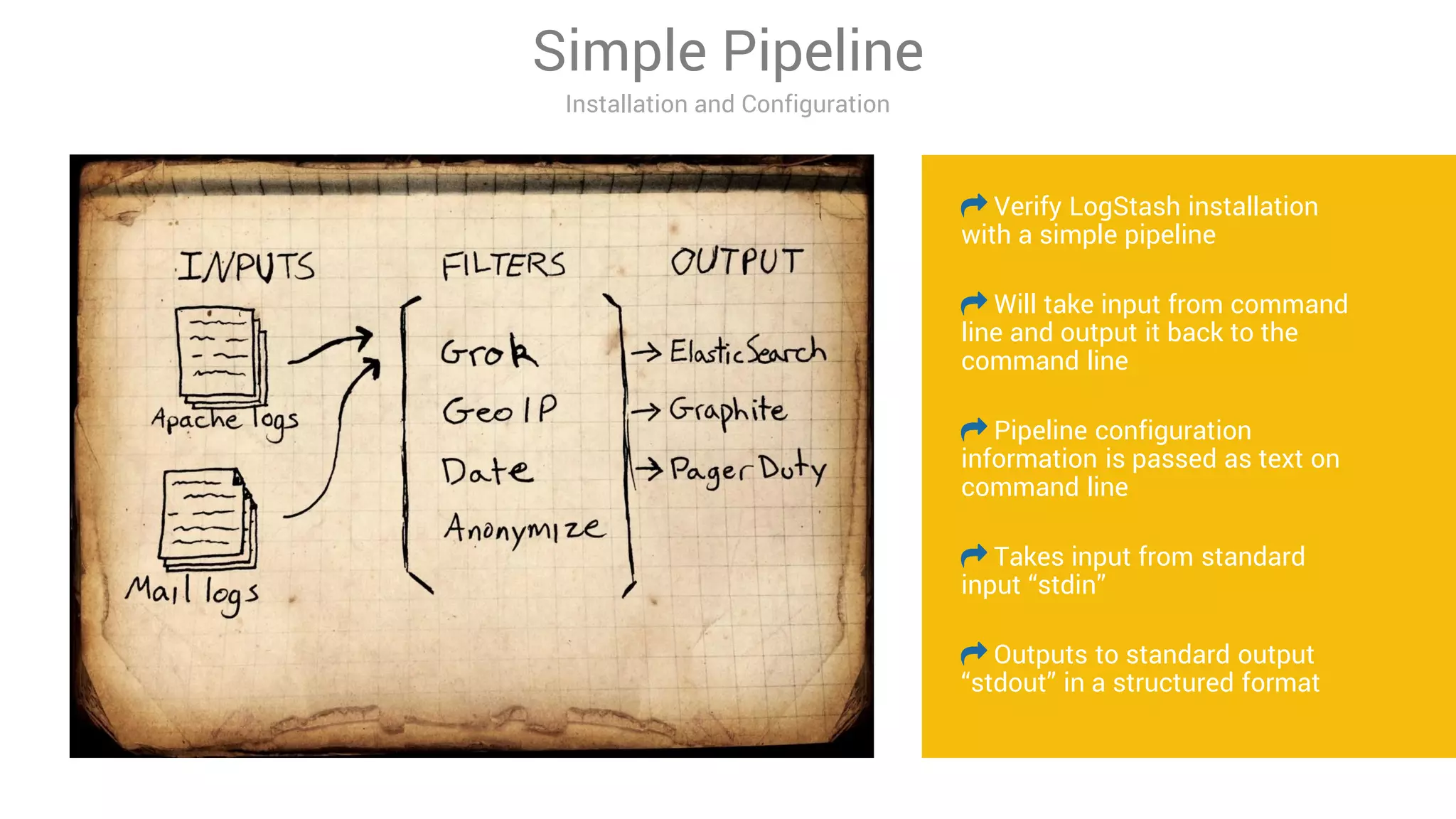
Verify LogStash installation
with a simple pipeline
Will take input from command
line and output it back to the
command line
Pipeline configuration
information is passed as text on
command line
Takes input from standard
input “stdin”
Outputs to standard output
“stdout” in a structured format
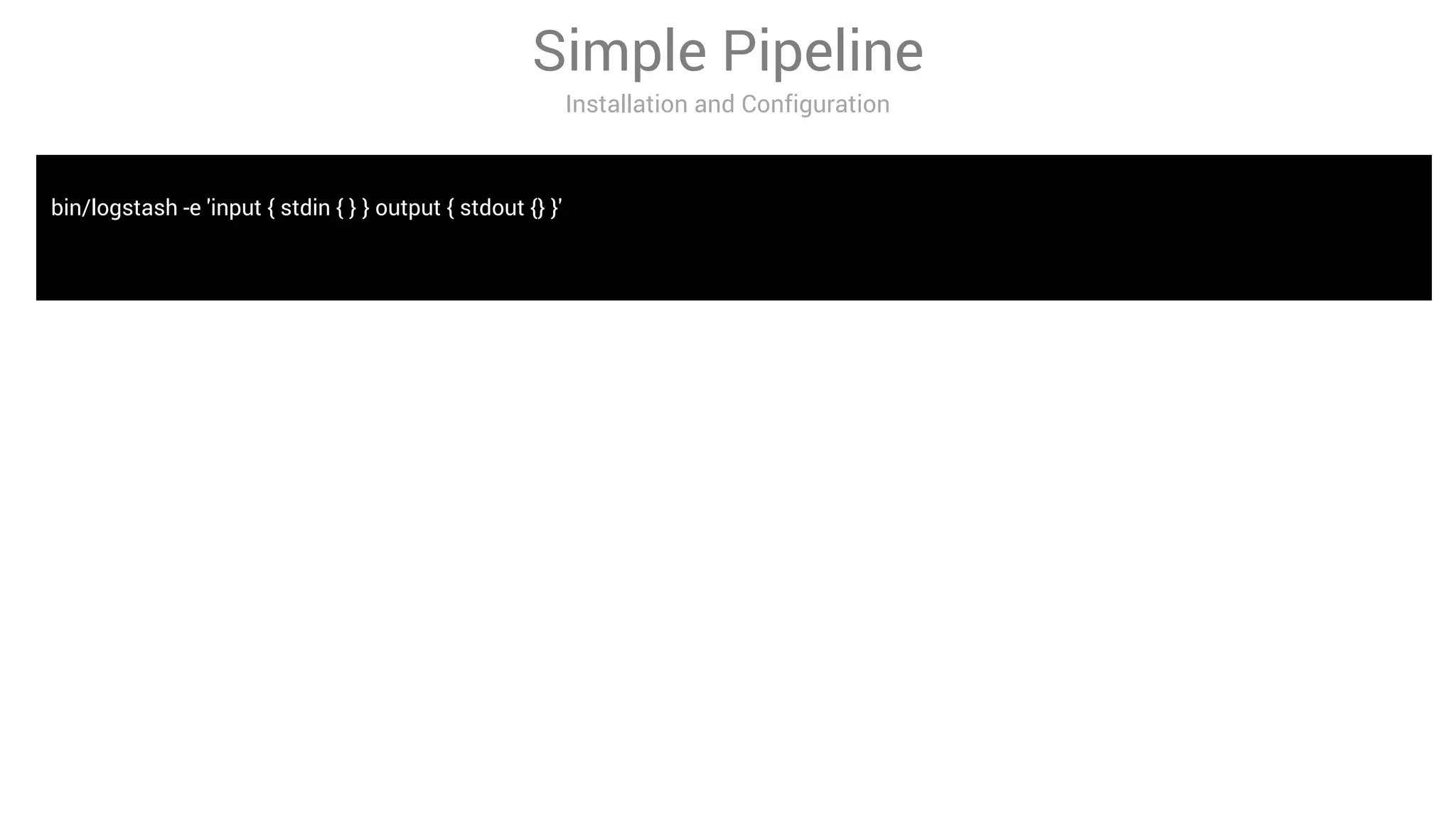
bin/logstash -e 'input { stdin { } } output { stdout {} }'
Simple Pipeline
Installation and Configuration
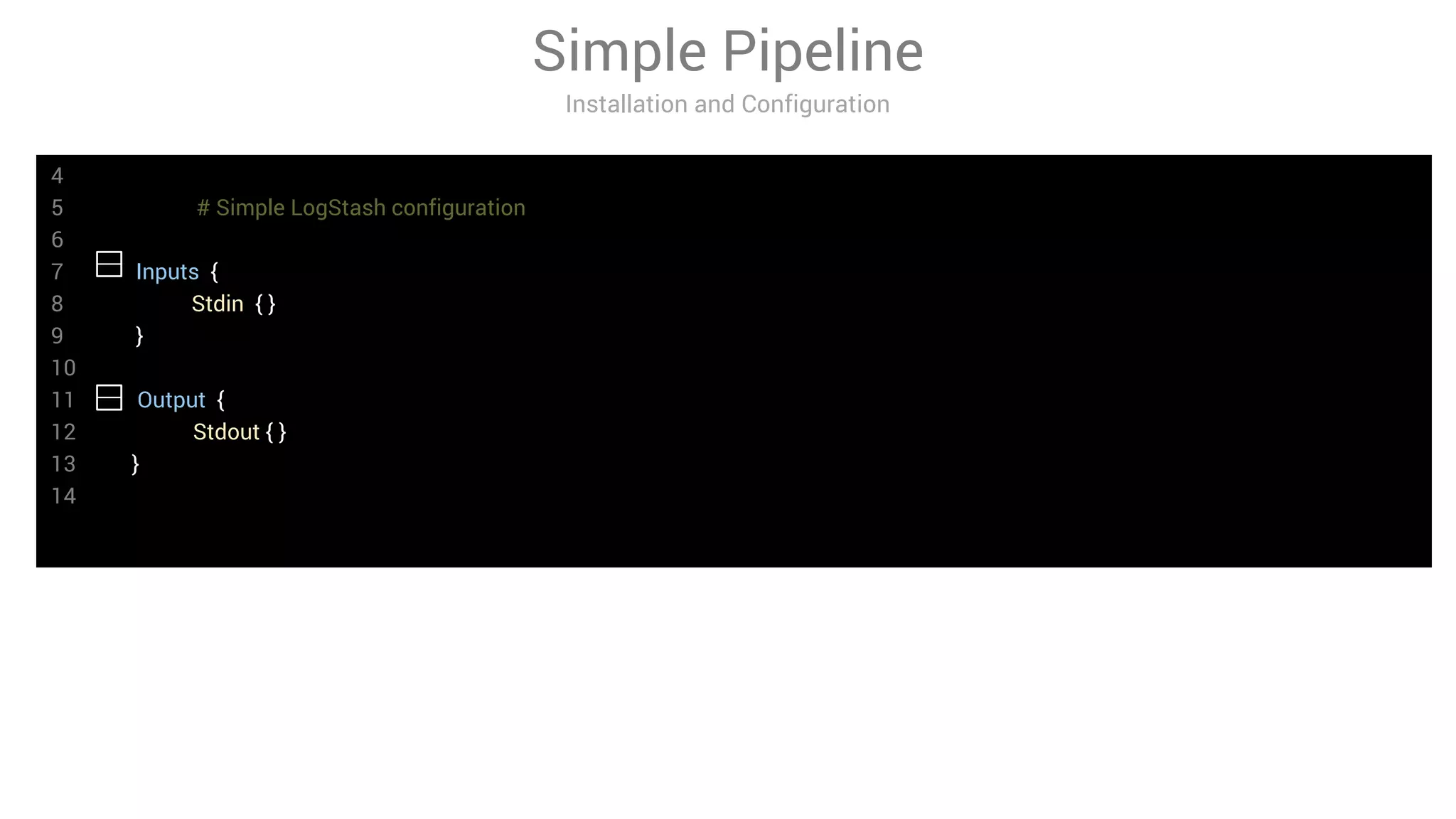
4
5 # Simple LogStash configuration
6
7 Inputs {
8 Stdin { }
9 }
10
11 Output {
12 Stdout { }
13 }
14
Simple Pipeline
Installation and Configuration
Video Demonstration
Configuring a Simple Pipeline
Play Video
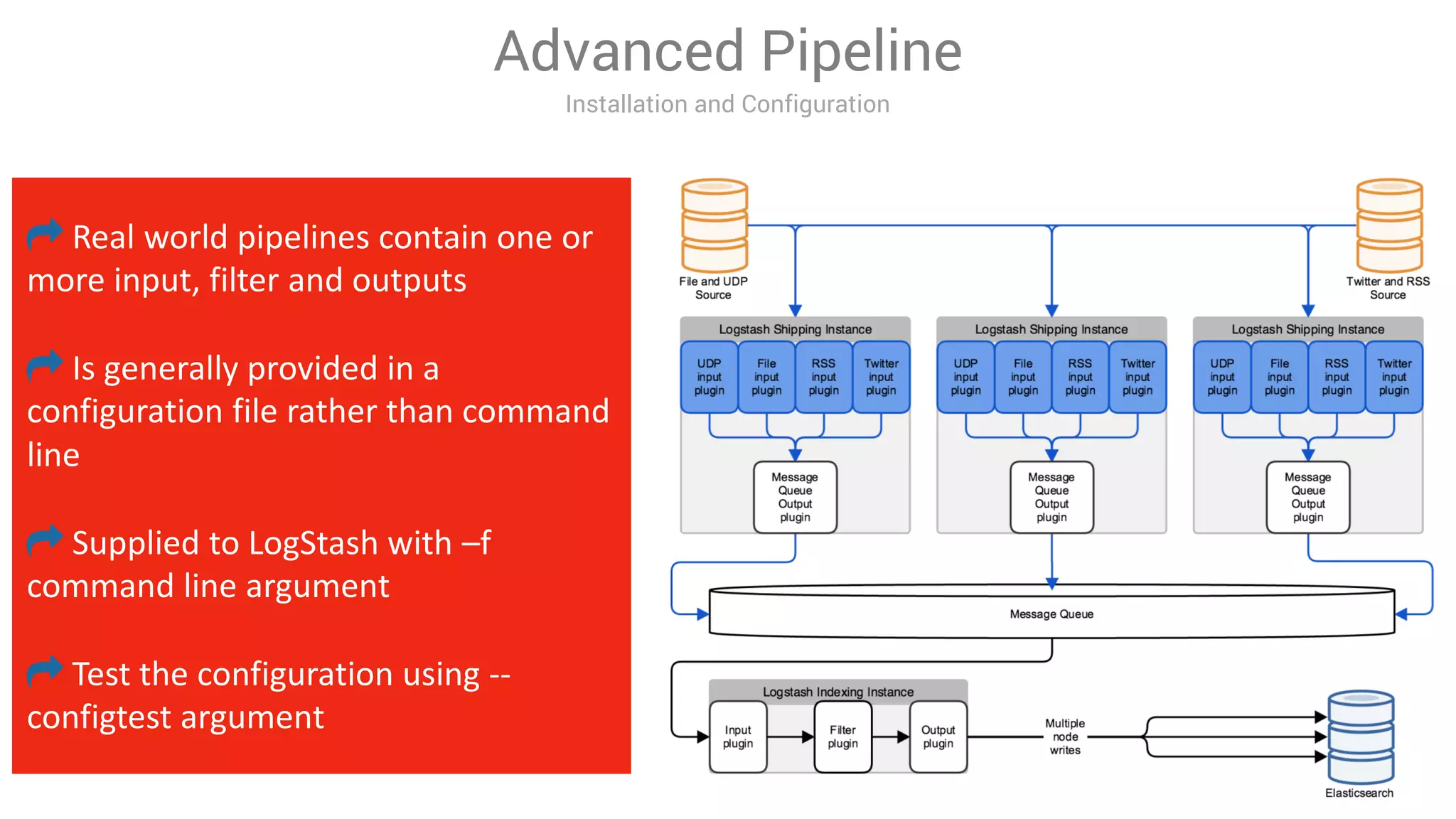
Advanced Pipeline
Installation and Configuration
Real world pipelines contain one or
more input, filter and outputs
Is generally provided in a
configuration file rather than command
line
Supplied to LogStash with –f
command line argument
Test the configuration using --
configtest argument
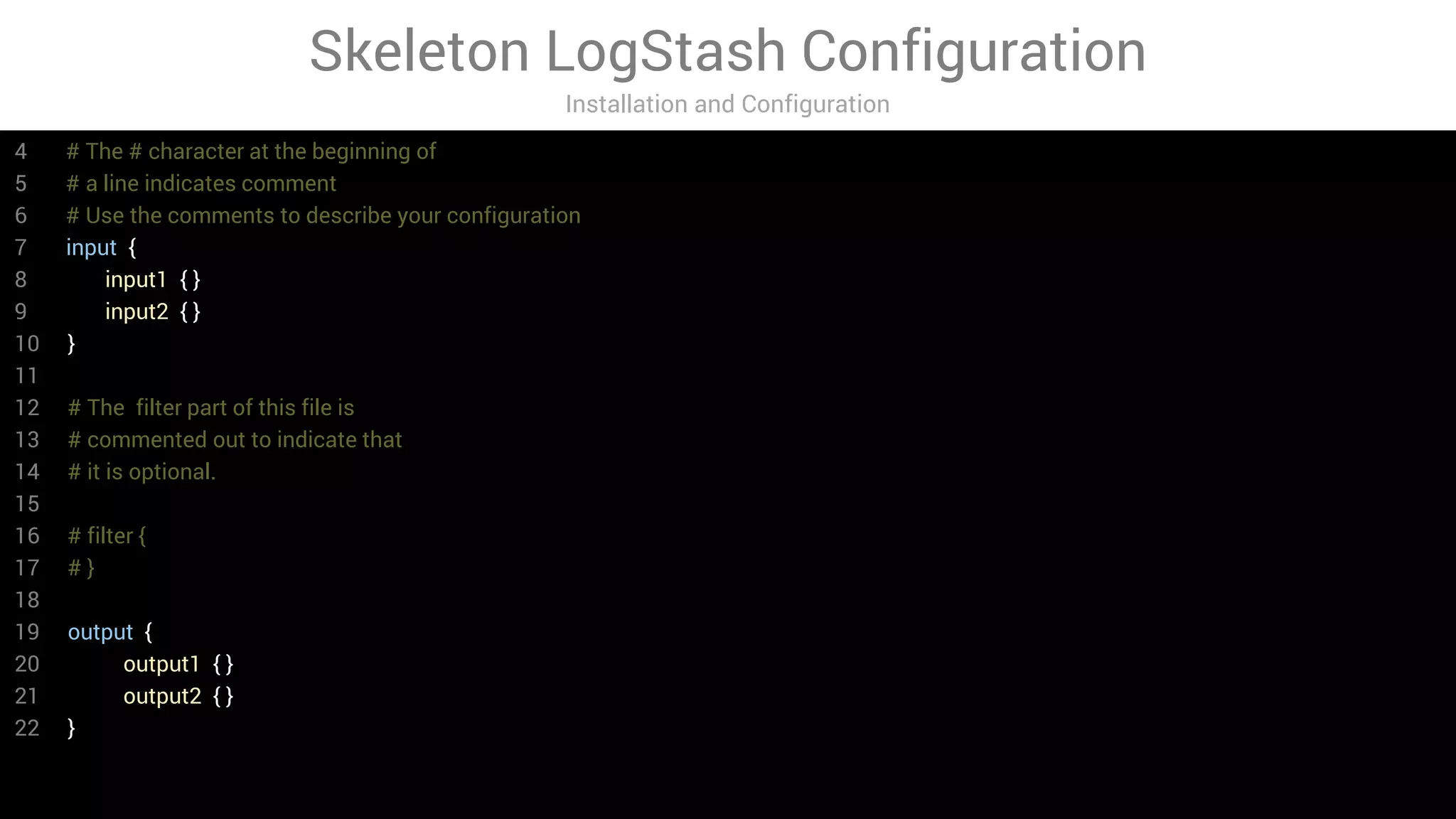
Skeleton LogStash Configuration
Installation and Configuration
4 # The # character at the beginning of
5 # a line indicates comment
6 # Use the comments to describe your configuration
7 input {
8 input1 { }
9 input2 { }
10 }
11
12 # The filter part of this file is
13 # commented out to indicate that
14 # it is optional.
15
16 # filter {
17 # }
18
19 output {
20 output1 { }
21 output2 { }
22 }
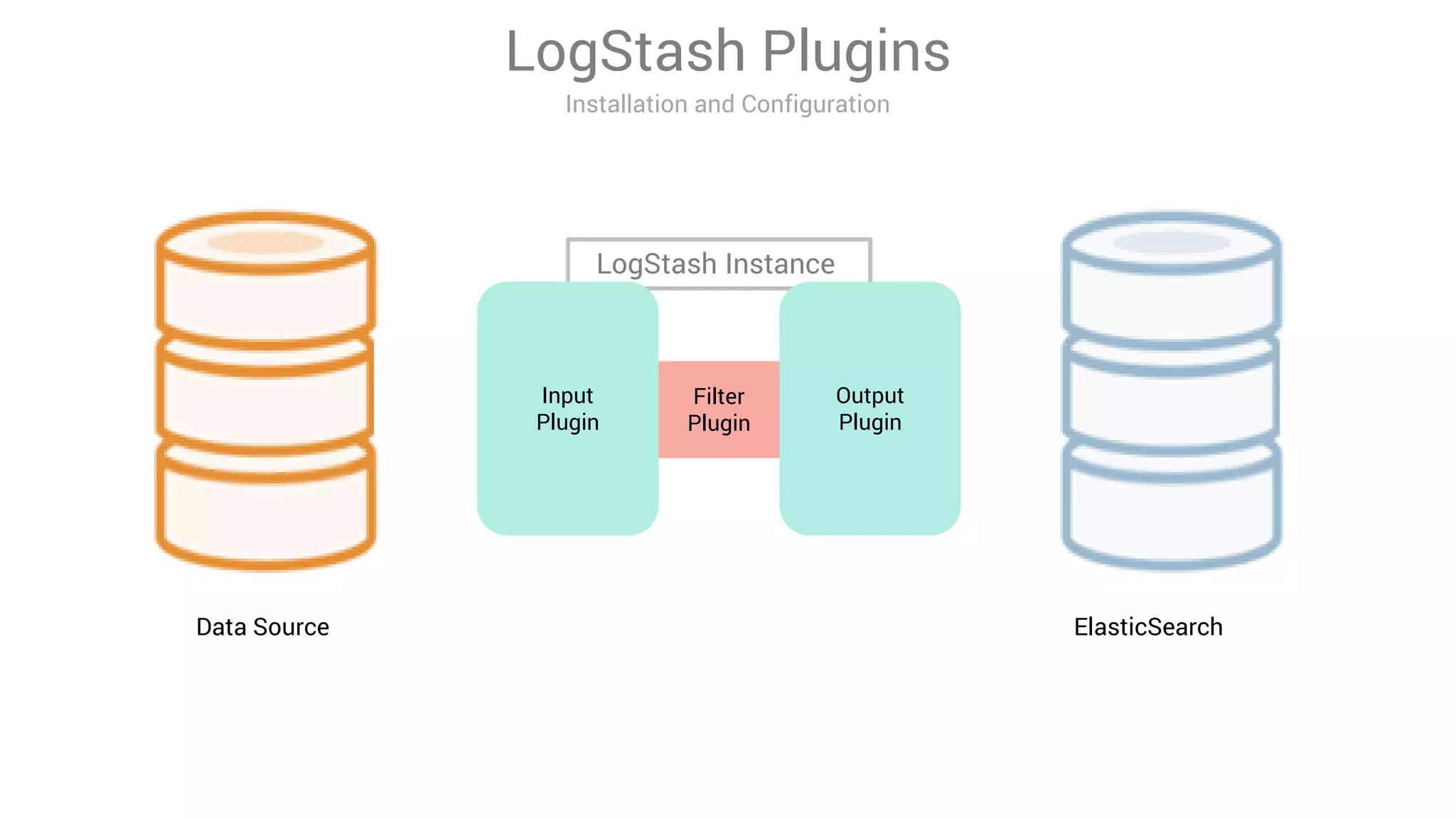
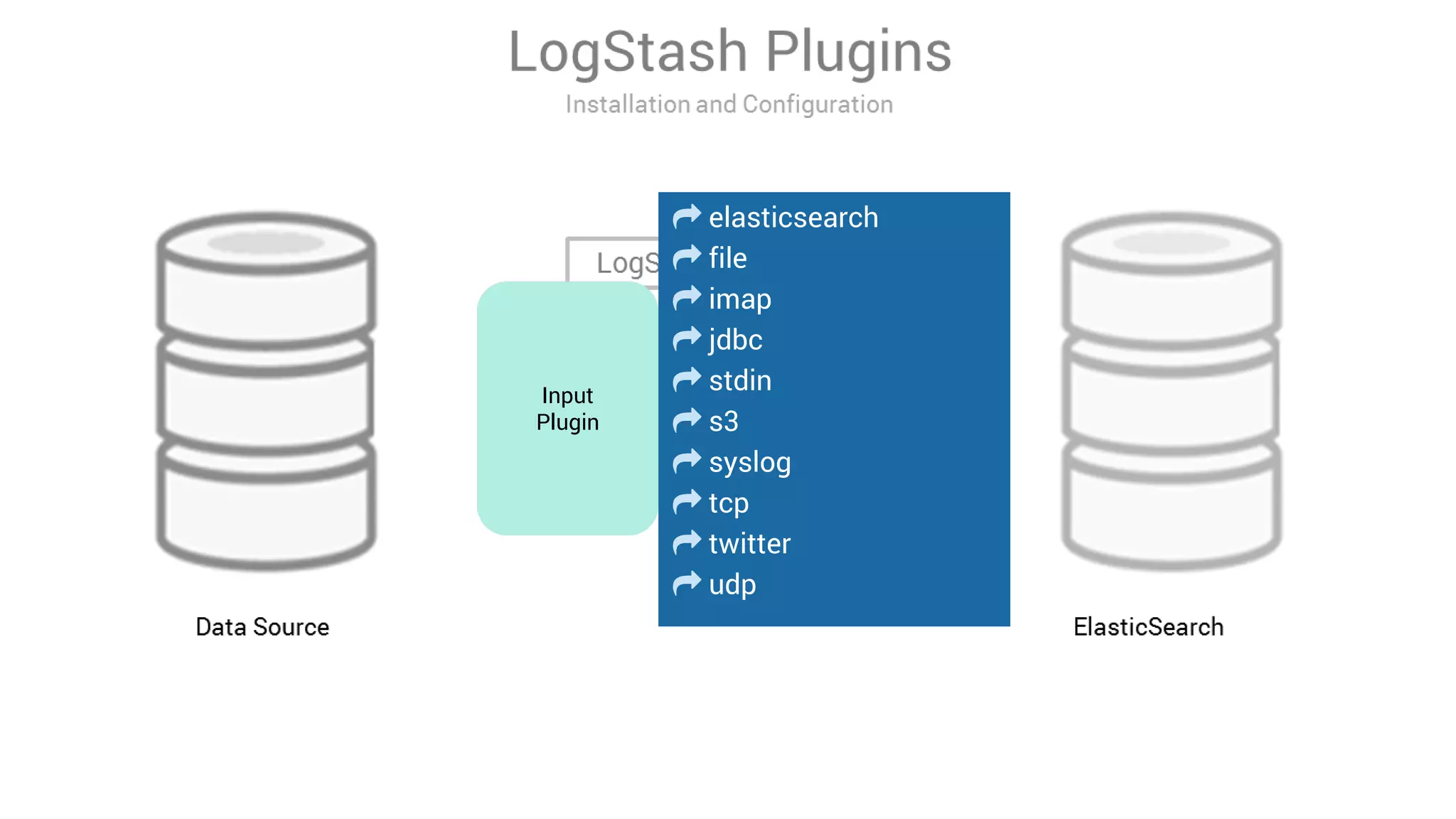
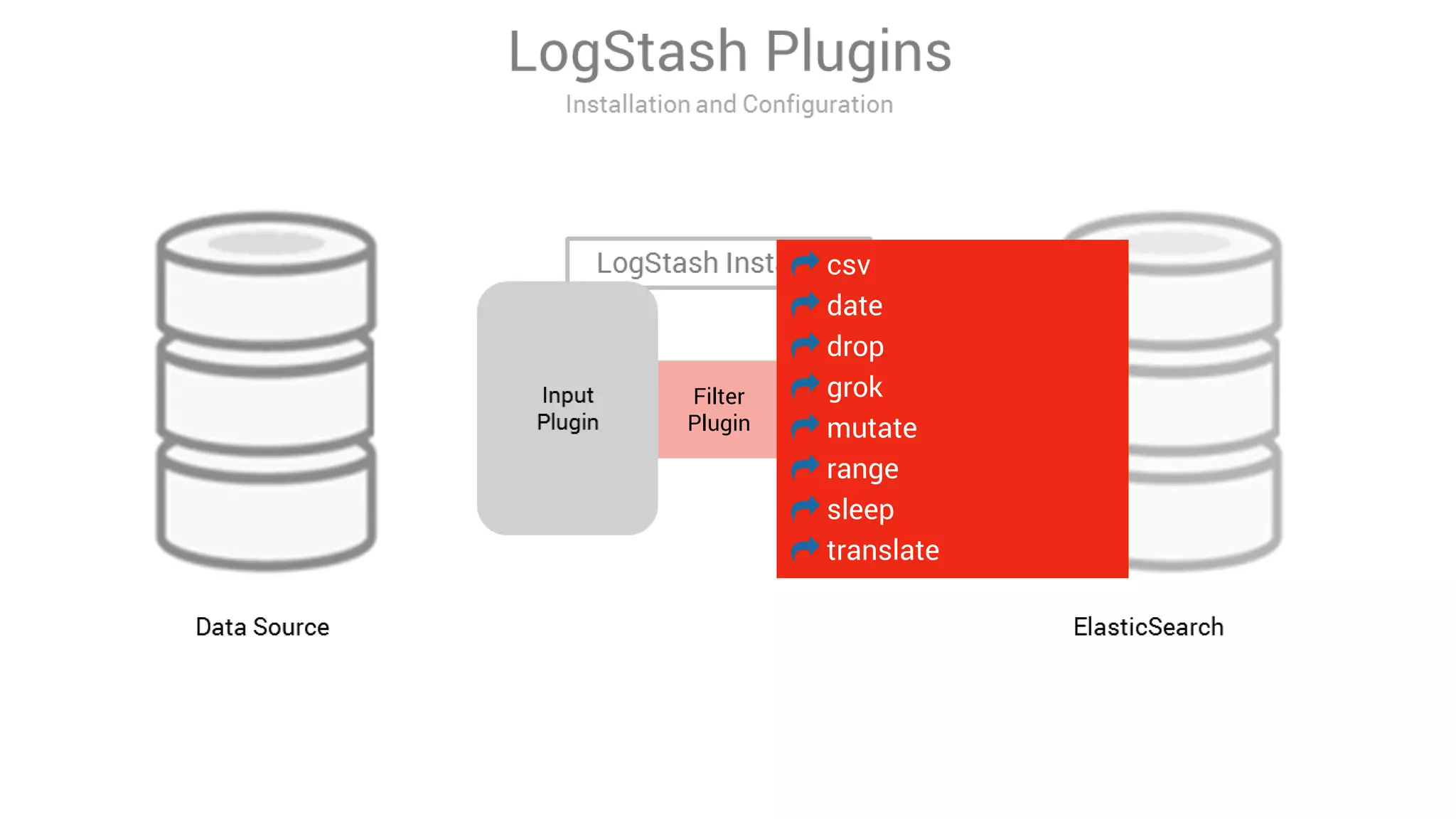
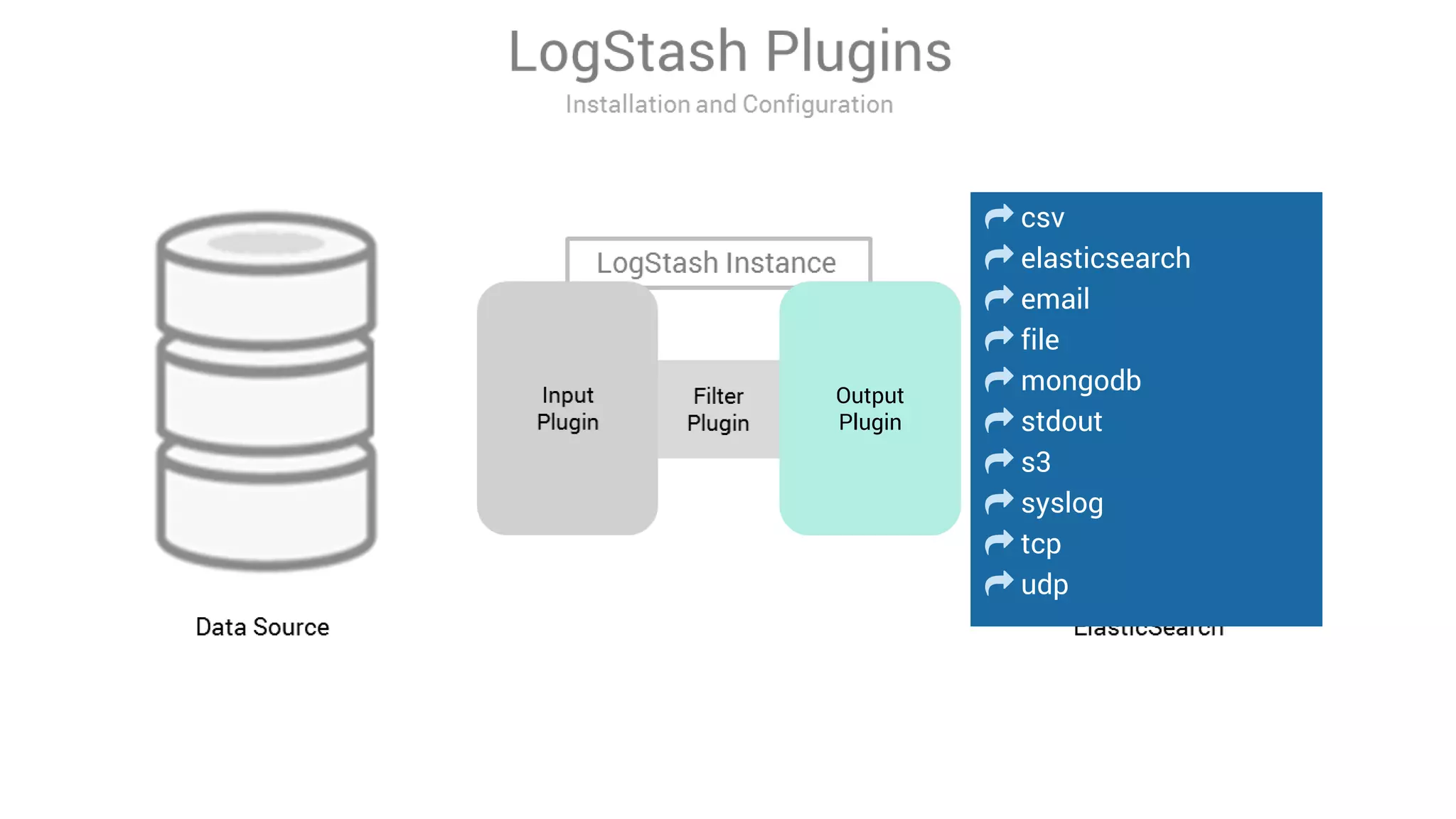
LogStash Plugins
Installation and Configuration
LogStash Instance
Data Source ElasticSearch
Filter
Plugin
Output
Plugin
Input
Plugin
Input
Plugin
elasticsearch
file
imap
jdbc
stdin
s3
syslog
tcp
twitter
udp
Filter
Plugin
csv
date
drop
grok
mutate
range
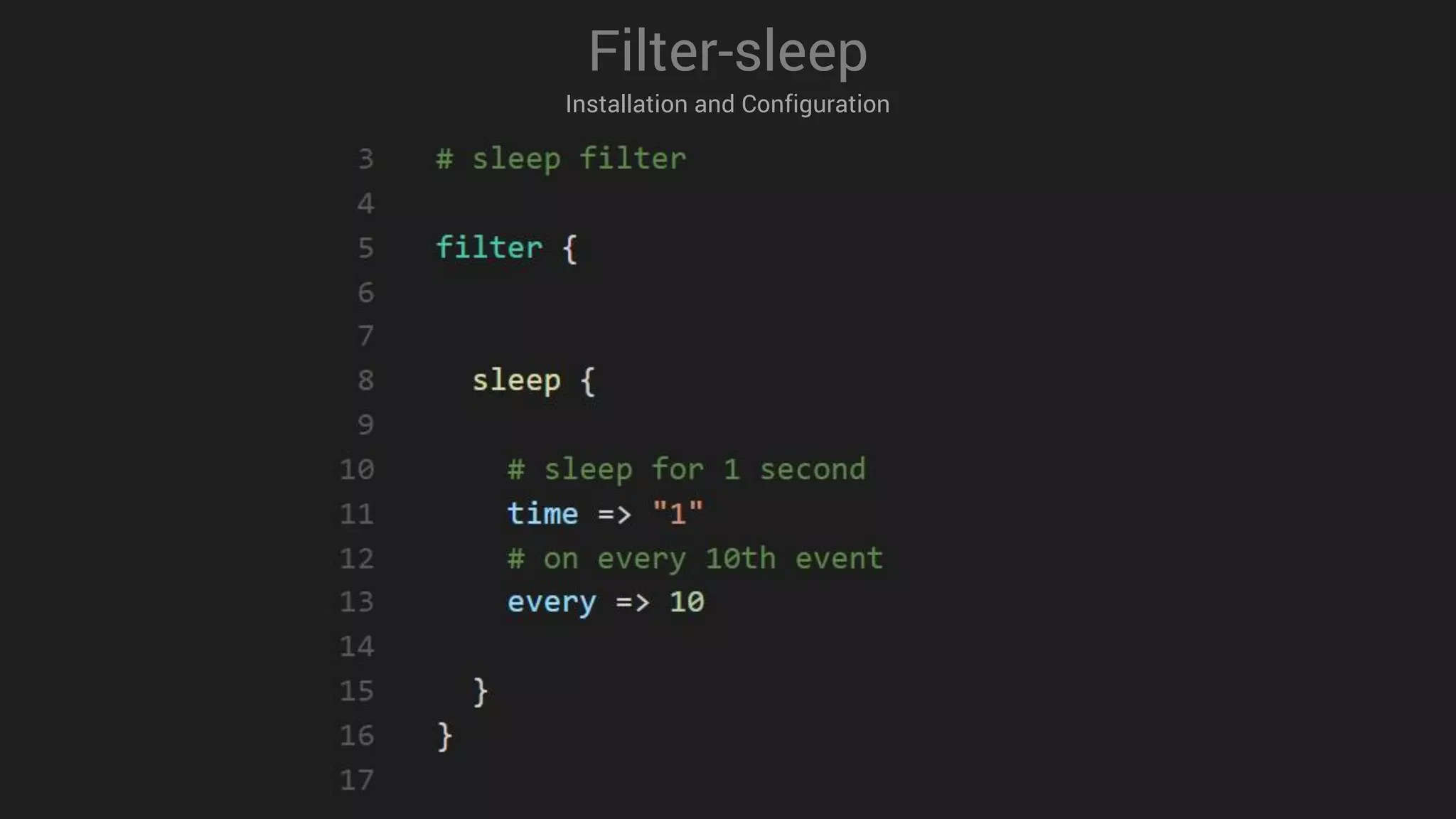
sleep
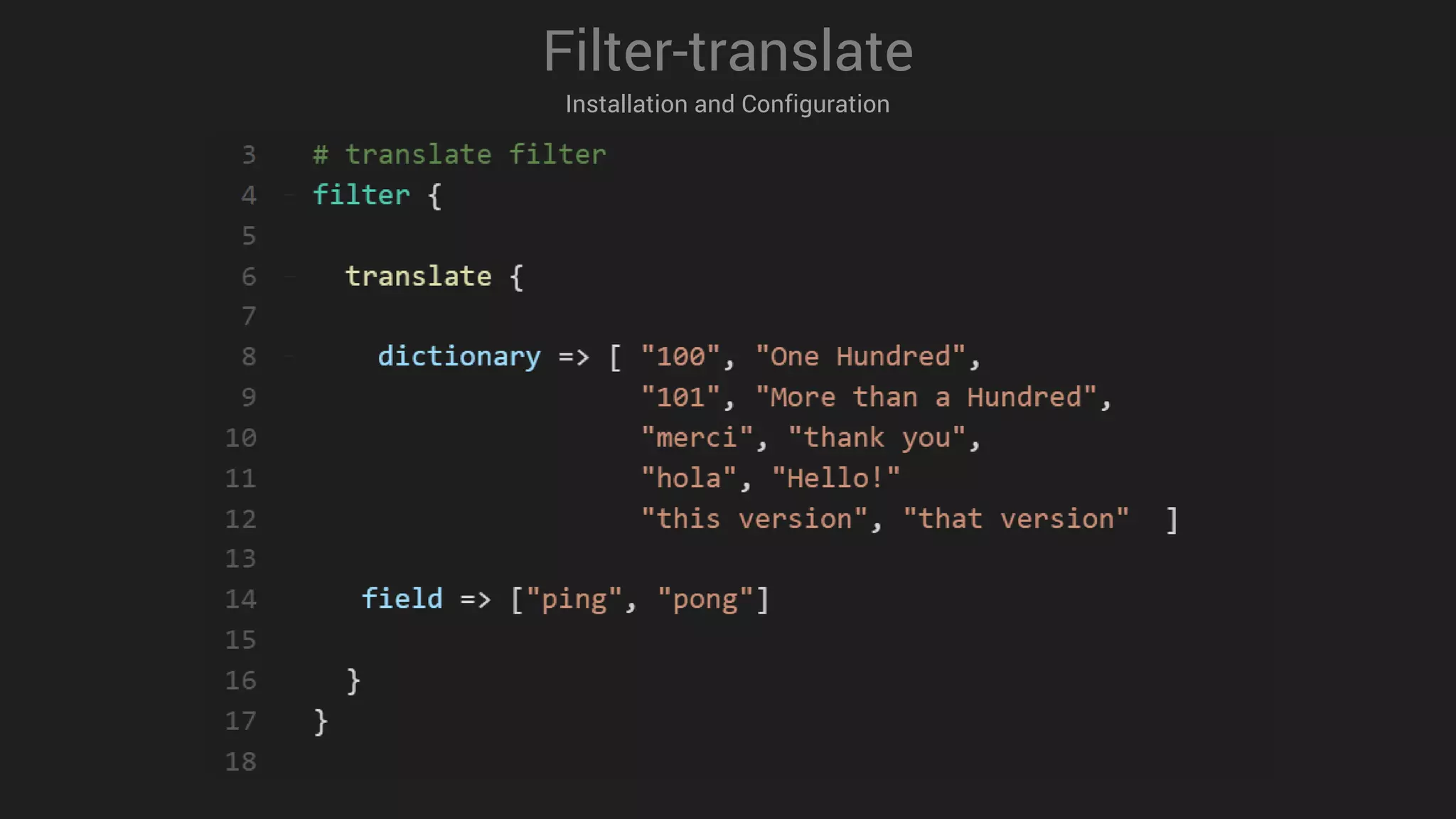
translate
Output
Plugin
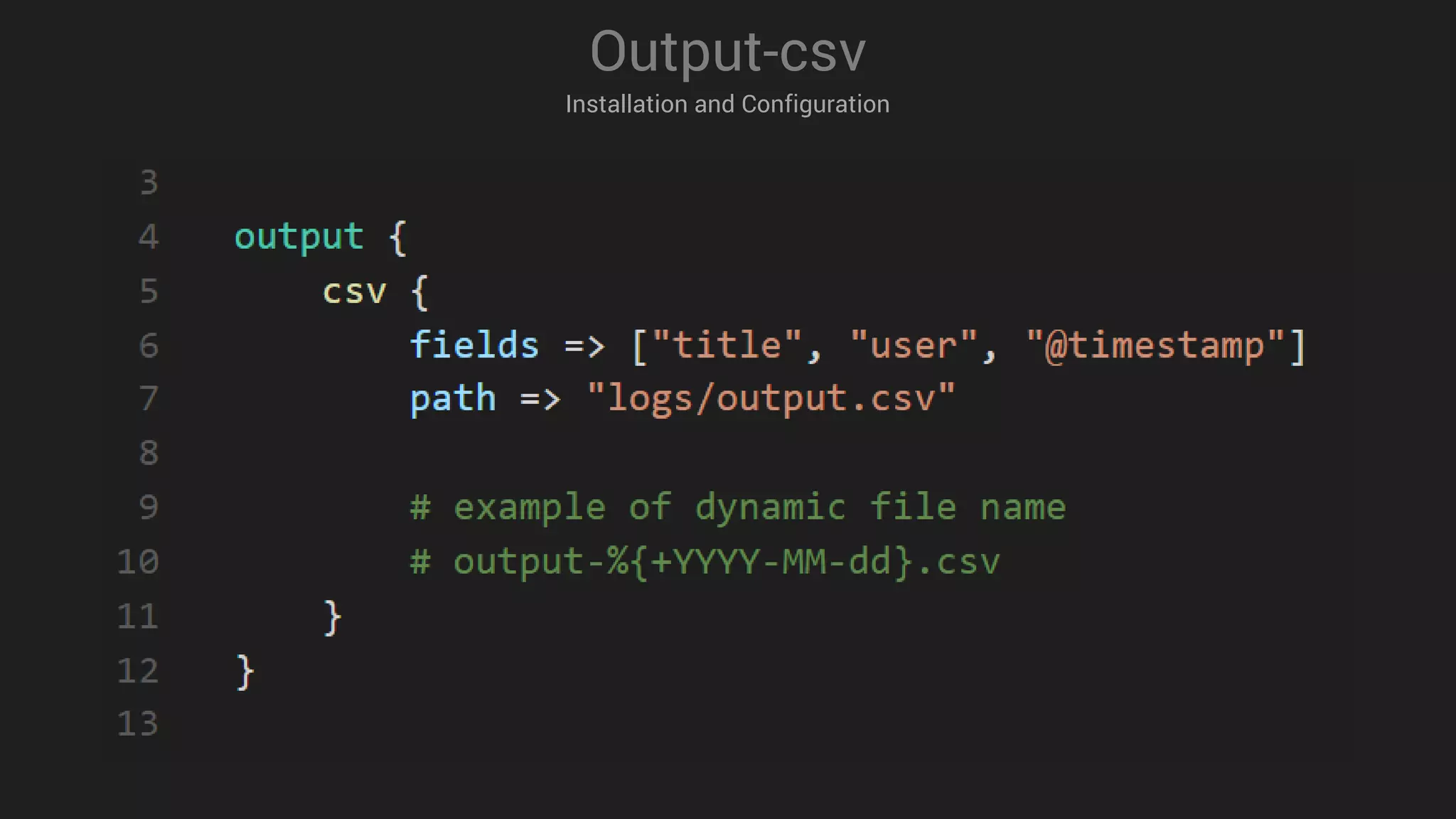
csv
elasticsearch
email
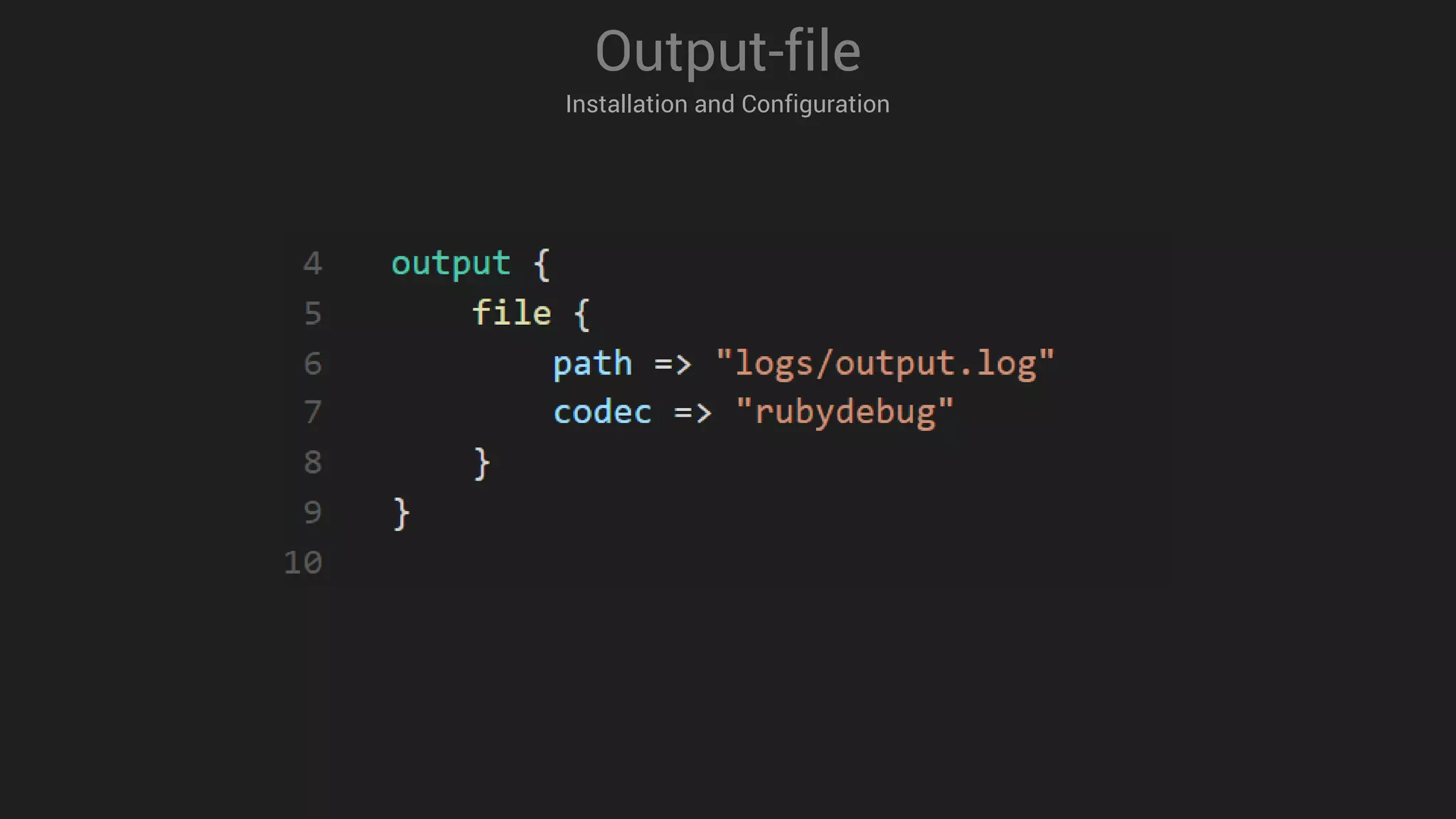
file
mongodb
stdout
s3
syslog
tcp
udp
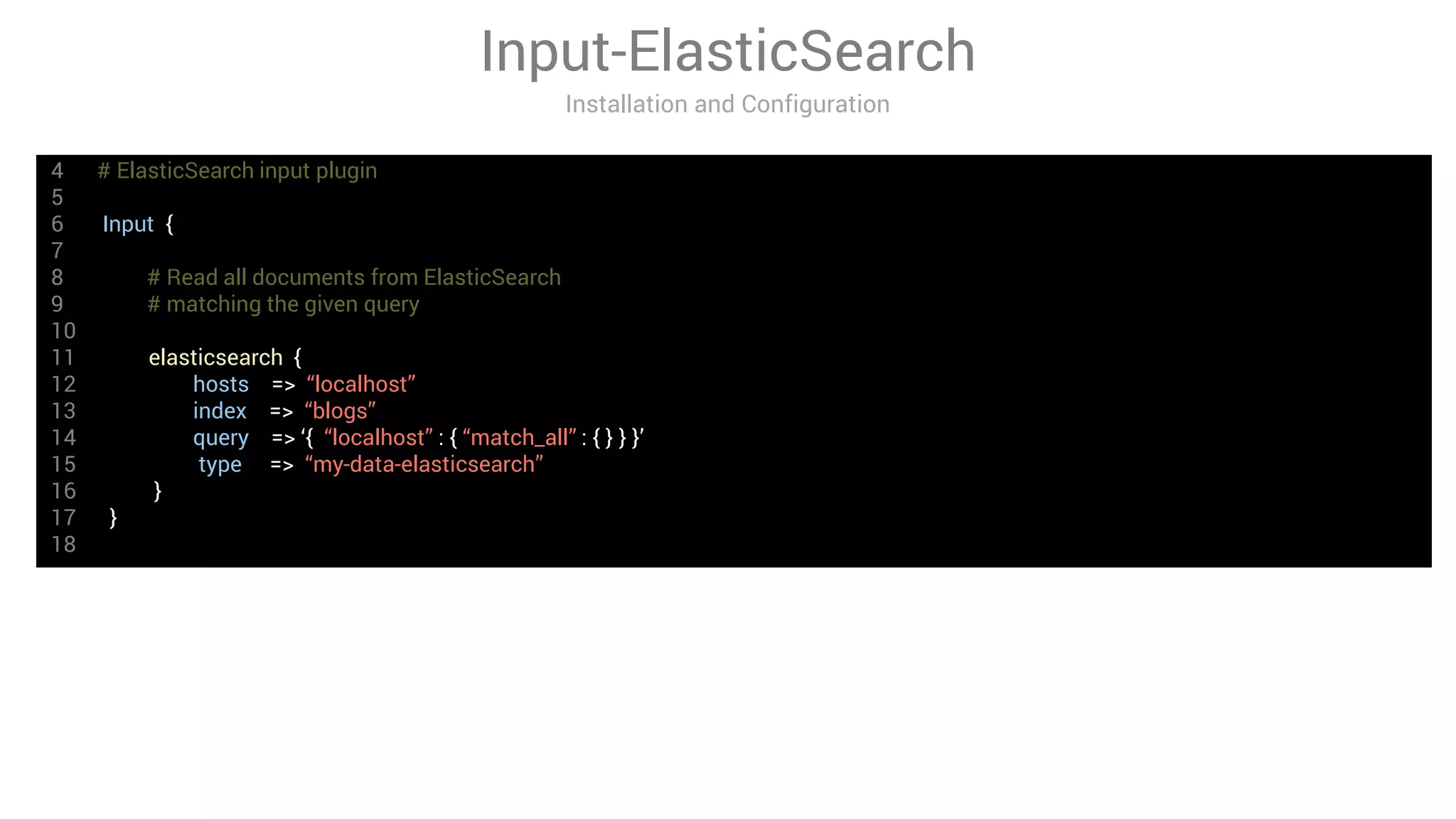
4 # ElasticSearch input plugin
5
6 Input {
7
8 # Read all documents from ElasticSearch
9 # matching the given query
10
11 elasticsearch {
12 hosts => “localhost”
13 index => “blogs”
14 query => ‘{ “localhost” : { “match_all” : { } } }’
15 type => “my-data-elasticsearch”
16 }
17 }
18
Input-ElasticSearch
Installation and Configuration
3
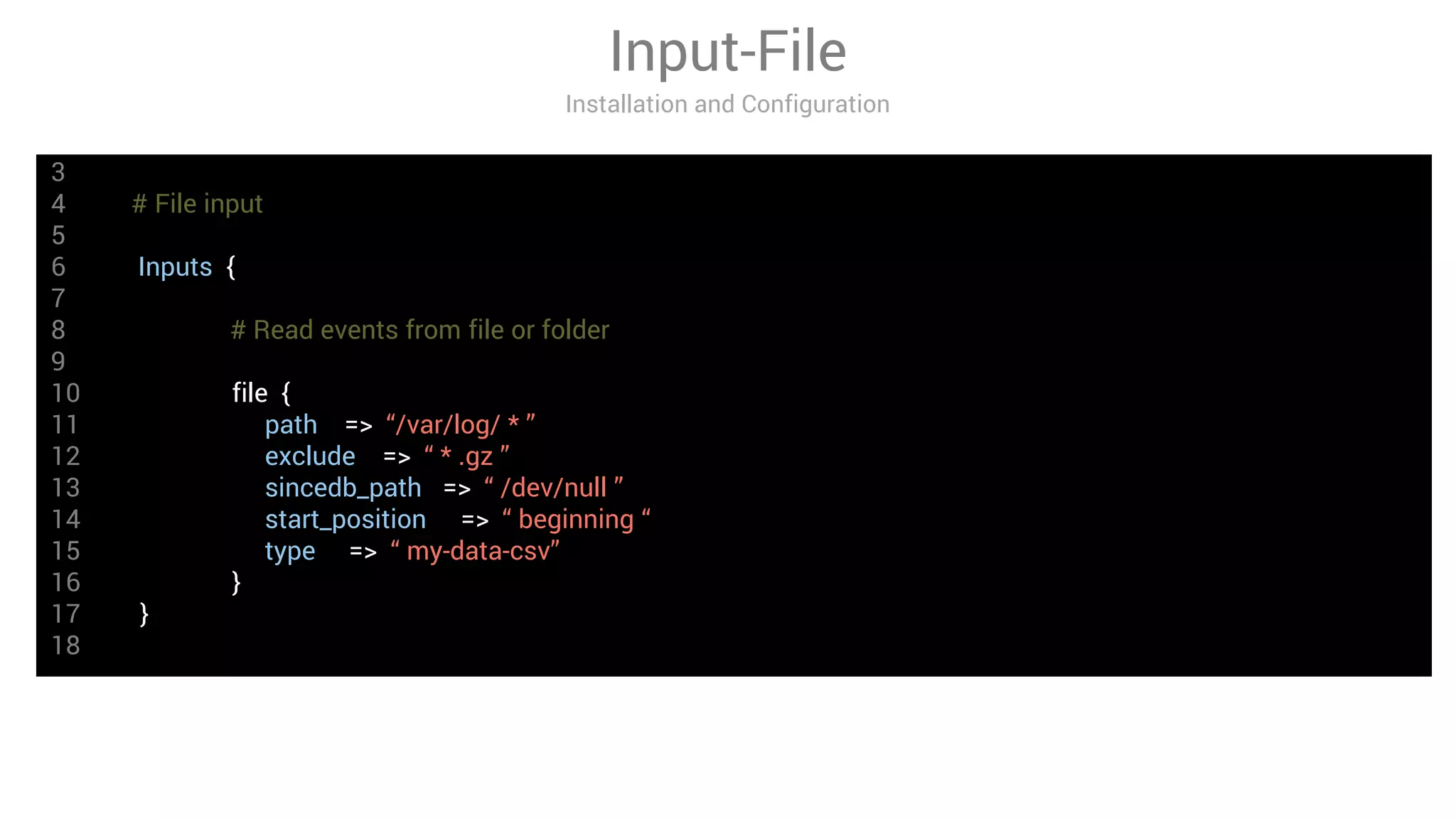
4 # File input
5
6 Inputs {
7
8 # Read events from file or folder
9
10 file {
11 path => “/var/log/ * ”
12 exclude => “ * .gz ”
13 sincedb_path => “ /dev/null ”
14 start_position => “ beginning “
15 type => “ my-data-csv”
16 }
17 }
18
Input-File
Installation and Configuration
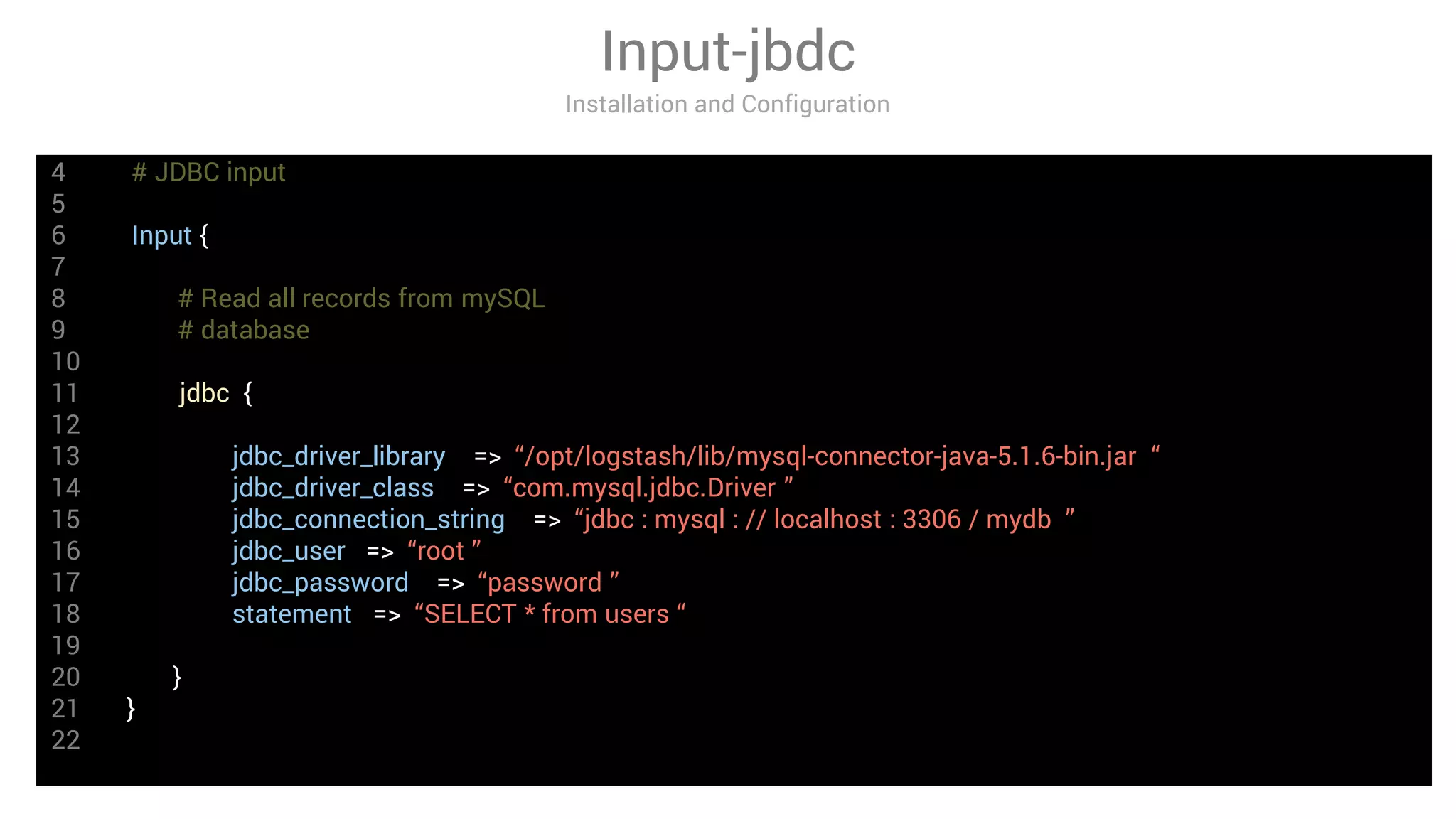
4 # JDBC input
5
6 Input {
7
8 # Read all records from mySQL
9 # database
10
11 jdbc {
12
13 jdbc_driver_library => “/opt/logstash/lib/mysql-connector-java-5.1.6-bin.jar “
14 jdbc_driver_class => “com.mysql.jdbc.Driver ”
15 jdbc_connection_string => “jdbc : mysql : // localhost : 3306 / mydb ”
16 jdbc_user => “root ”
17 jdbc_password => “password ”
18 statement => “SELECT * from users “
19
20 }
21 }
22
Input-jbdc
Installation and Configuration
3 # AWS S3 input
4
5 Input {
6
7 # Read all documents from AWS S3
8
9 s3 {
10
11 bucket => “my-bucket “
12 credentials => [ “my-aws-key “ , “my-aws-token “ ]
13 region_endpoint => “us-east-1 “
14 codec => “json “
15
16 }
17 }
18
Input-s3
Installation and Configuration
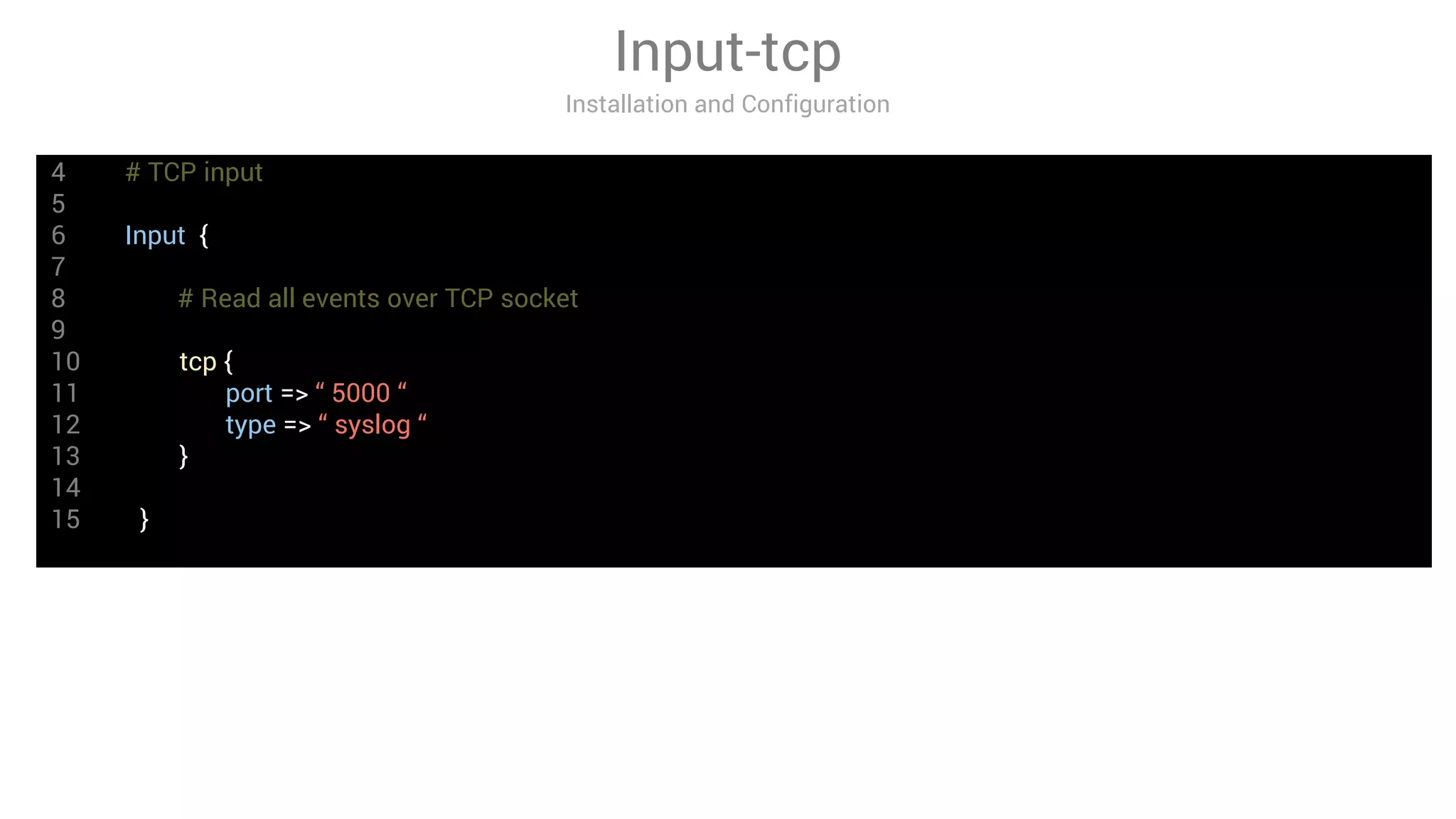
4 # TCP input
5
6 Input {
7
8 # Read all events over TCP socket
9
10 tcp {
11 port => “ 5000 “
12 type => “ syslog “
13 }
14
15 }
Input-tcp
Installation and Configuration
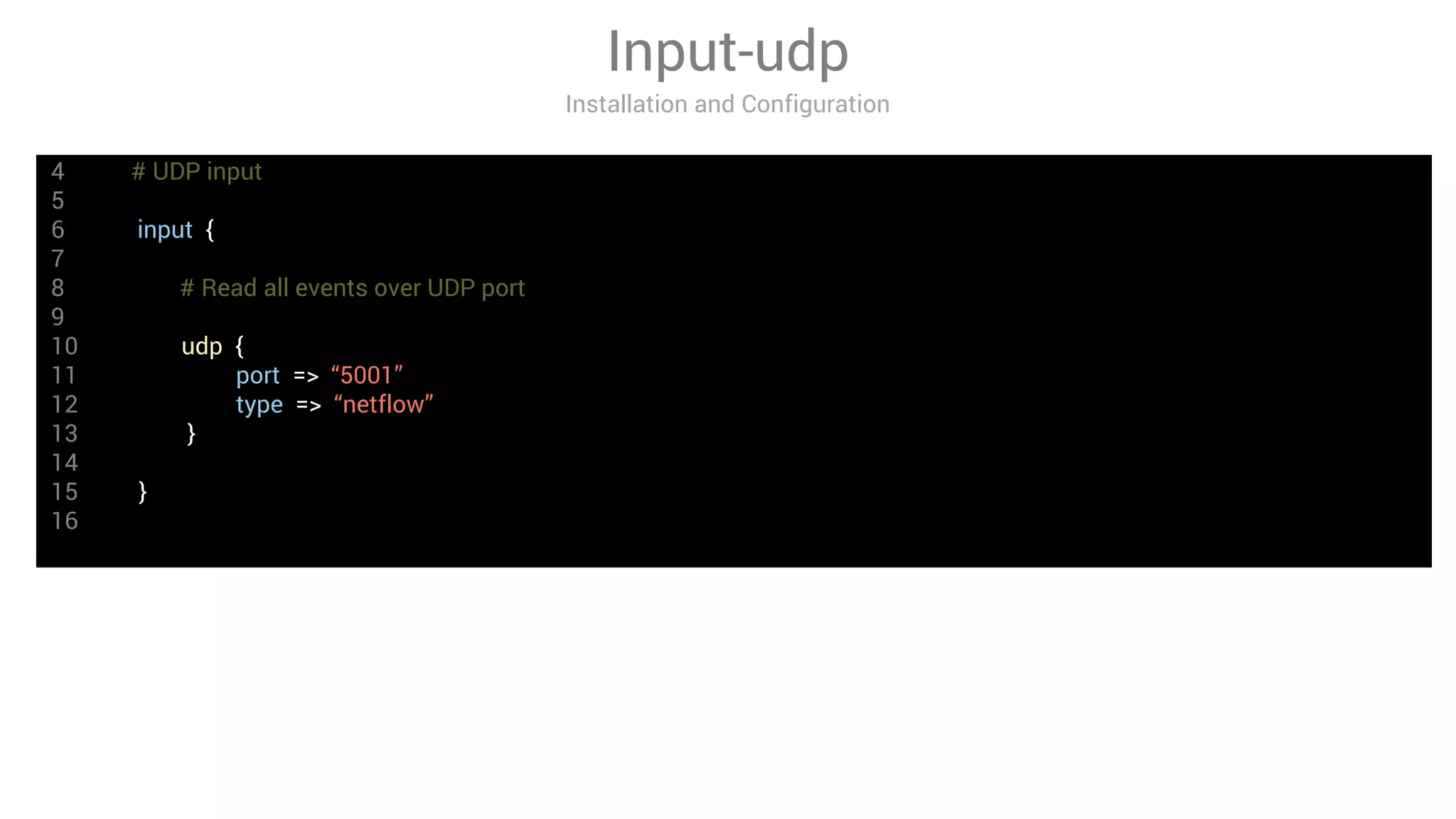
4 # UDP input
5
6 input {
7
8 # Read all events over UDP port
9
10 udp {
11 port => “5001”
12 type => “netflow”
13 }
14
15 }
16
Input-udp
Installation and Configuration
Filter-csv
Installation and Configuration
2
3 # CSV filter
4 filter {
5
6 csv {
7
8 # List of columns as they appear in csv
9 column => [ “column_1” , “column_2” ]
10 column => { “column_3” => “integer” , “column_4” => “boolean” }
11 type => “syslog”
12
13 }
14
15 }
16
2
3 # date filter
4
5 filter {
6
7
8 date {
9
10 match => [ “logdate” , “MMM dd HH:mm:ss” ]
11 # Default for target is @timestamp
12 target => “logdate_modified”
13
14 }
15 }
Filter-date
Installation and Configuration
• Used for parsing dates and use as LogStash event timestamp in ISO8601 format
• For example “Jan 01 10:40:01” can be parsed using the pattern “MMM dd HH:mm:ss”
Filter-drop
Installation and Configuration
2
3 # drop filter
4
5 filter {
6
7 # drop the events of their loglevel is debug
8 drop {
9 if [ loglevel ] = = “debug” {
10 drop { }
11 }
12 }
13 }
14
15
Filter-range
Installation and Configuration
2
3 # range filter
4
5 filter {
6 range {
7 ranges => [“request_time” , 0, 10, “tag: short” ,
8 “request_time” , 11, 100, “tag: medium”,
9 “request_time” , 101, 1000, “tag: long”,
10 “request_time” , 1001, 100000, “drop”,
11 “request_length” , 0, 100, “field: size: small”,
12 “request_length” , 101, 200, “field: size: normal”,
13 “request_length” , 201, 1000, “field: size: big”,
14 “request_length” , 1001, 100000, “field: size: hugel”,
15 “number_of_requests” , 0, 10, “tag: request_from_%{host}” ]
16 }
17 }
Filter-grok
Installation and Configuration
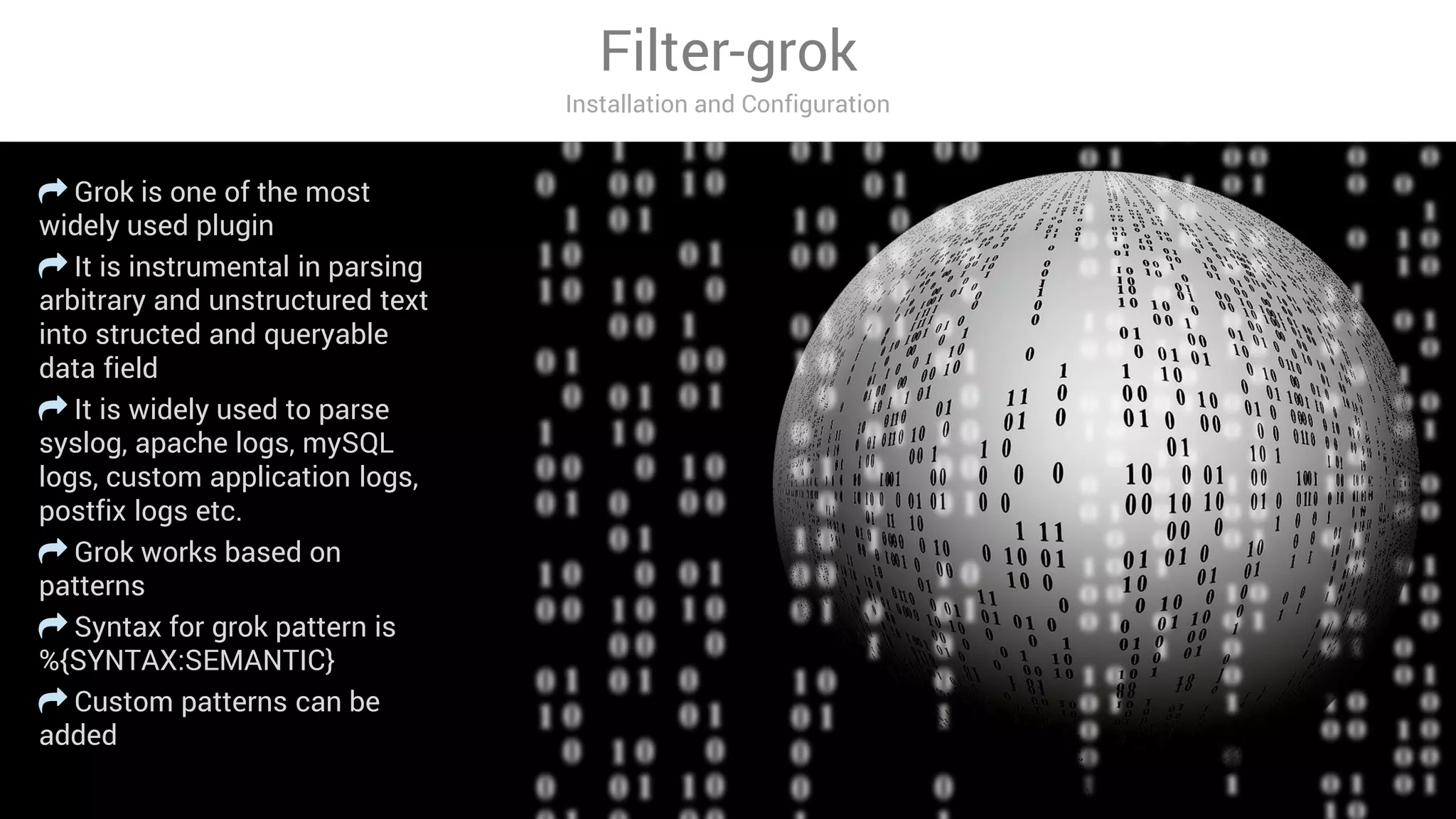
Grok is one of the most
widely used plugin
It is instrumental in parsing
arbitrary and unstructured text
into structed and queryable
data field
It is widely used to parse
syslog, apache logs, mySQL
logs, custom application logs,
postfix logs etc.
Grok works based on
patterns
Syntax for grok pattern is
%{SYNTAX:SEMANTIC}
Custom patterns can be
added
Filter-grok
Installation and Configuration
2
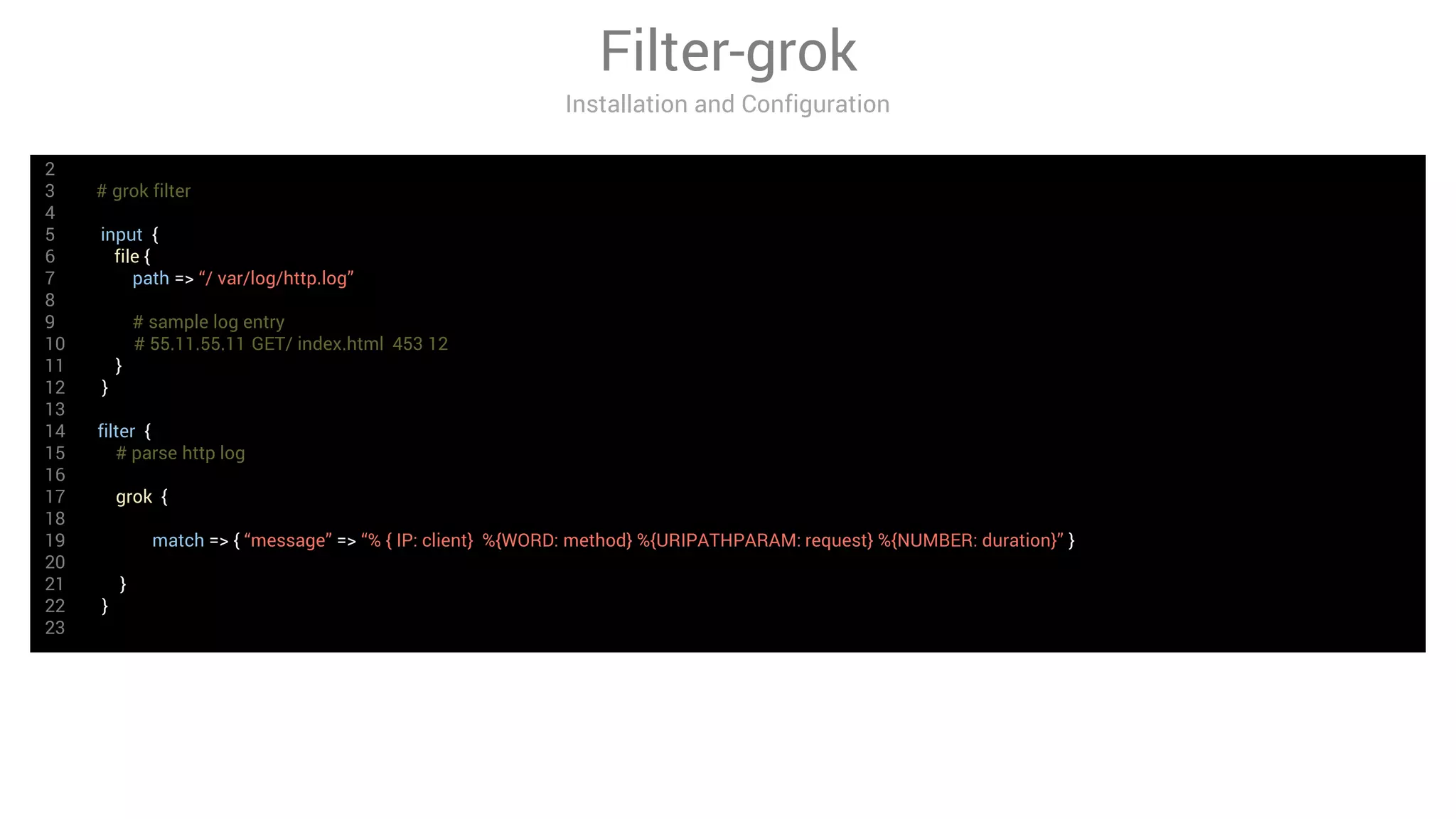
3 # grok filter
4
5 input {
6 file {
7 path => “/ var/log/http.log”
8
9 # sample log entry
10 # 55.11.55.11 GET/ index.html 453 12
11 }
12 }
13
14 filter {
15 # parse http log
16
17 grok {
18
19 match => { “message” => “% { IP: client} %{WORD: method} %{URIPATHPARAM: request} %{NUMBER: duration}” }
20
21 }
22 }
23
Filter-grok
Installation and Configuration
2
3 # grok filter
4
5 input {
6 file {
7 path => “/ var/log/http.log”
8
9 # sample log entry
10 # 55.11.55.11 GET/ index.html 453 12
11 }
12 }
13
14 filter {
15 # parse http log
16
17 grok {
18
19 match => { “message” => “% { IP: client} %{WORD: method} %{URIPATHPARAM: request} %{NUMBER: duration}” }
20
21 }
22 }
23
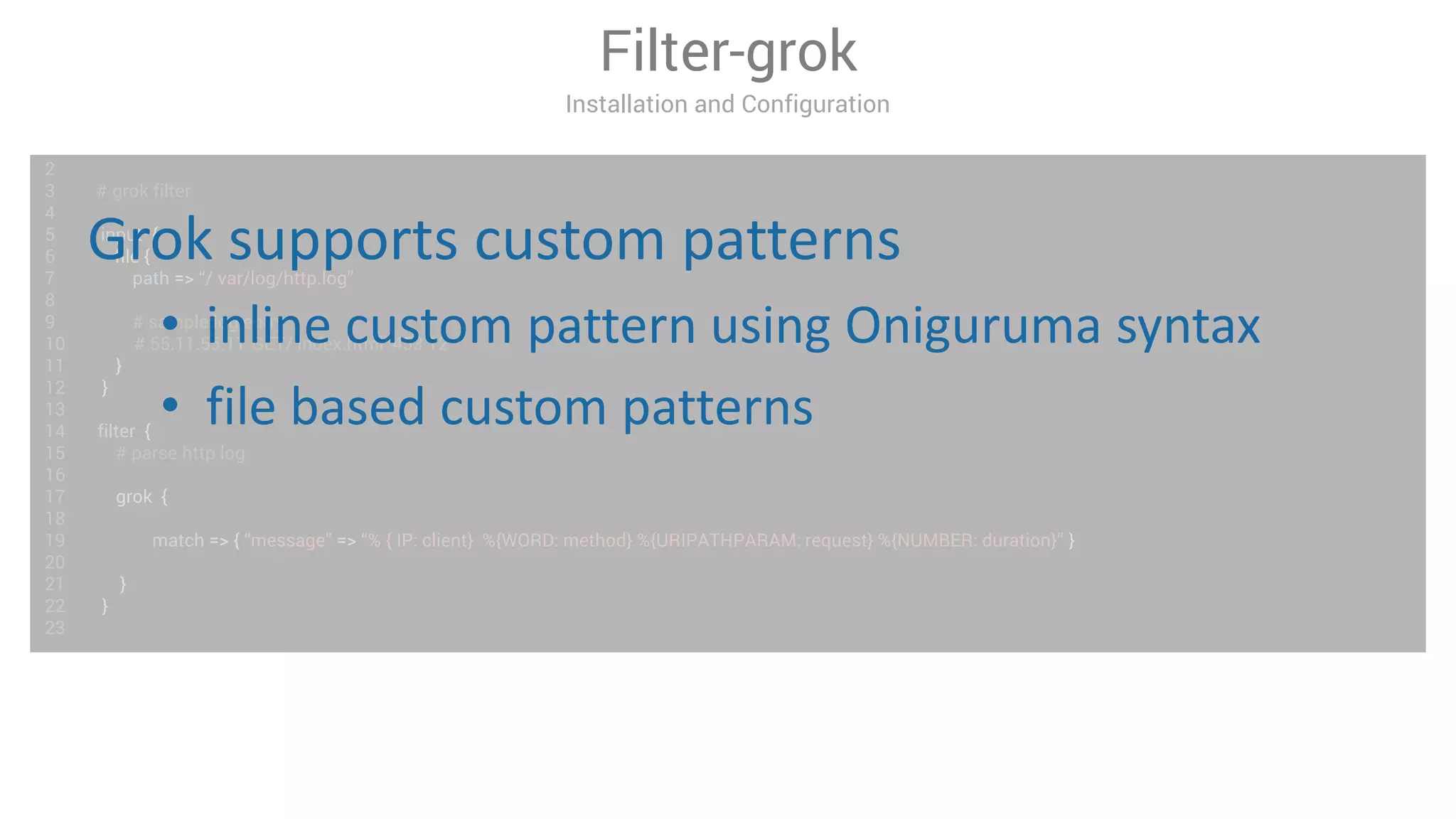
Grok supports custom patterns
• inline custom pattern using Oniguruma syntax
• file based custom patterns
Filter-grok
Installation and Configuration
43 # ( ? < field_name> the pattern here
44
45
46 ( ? < message_id> [0-9A-F] {10, 11}
24
25 # grok filter
26
27 filter {
28
29 grok {
30
31 patterns_dir => [ “~/patterns” ]
32 match => { “message” => “% {SYSLOGBASE} %{POSTFIXQUEUEID: queue_id}: %{GREEDYDATA:syslog_message}” }
33
34 }
35 }
Filter-grok
Installation and Configuration
Filter-mutate
Installation and Configuration
Filter-sleep
Installation and Configuration
Filter-translate
Installation and Configuration
Output-csv
Installation and Configuration
Output-file
Installation and Configuration
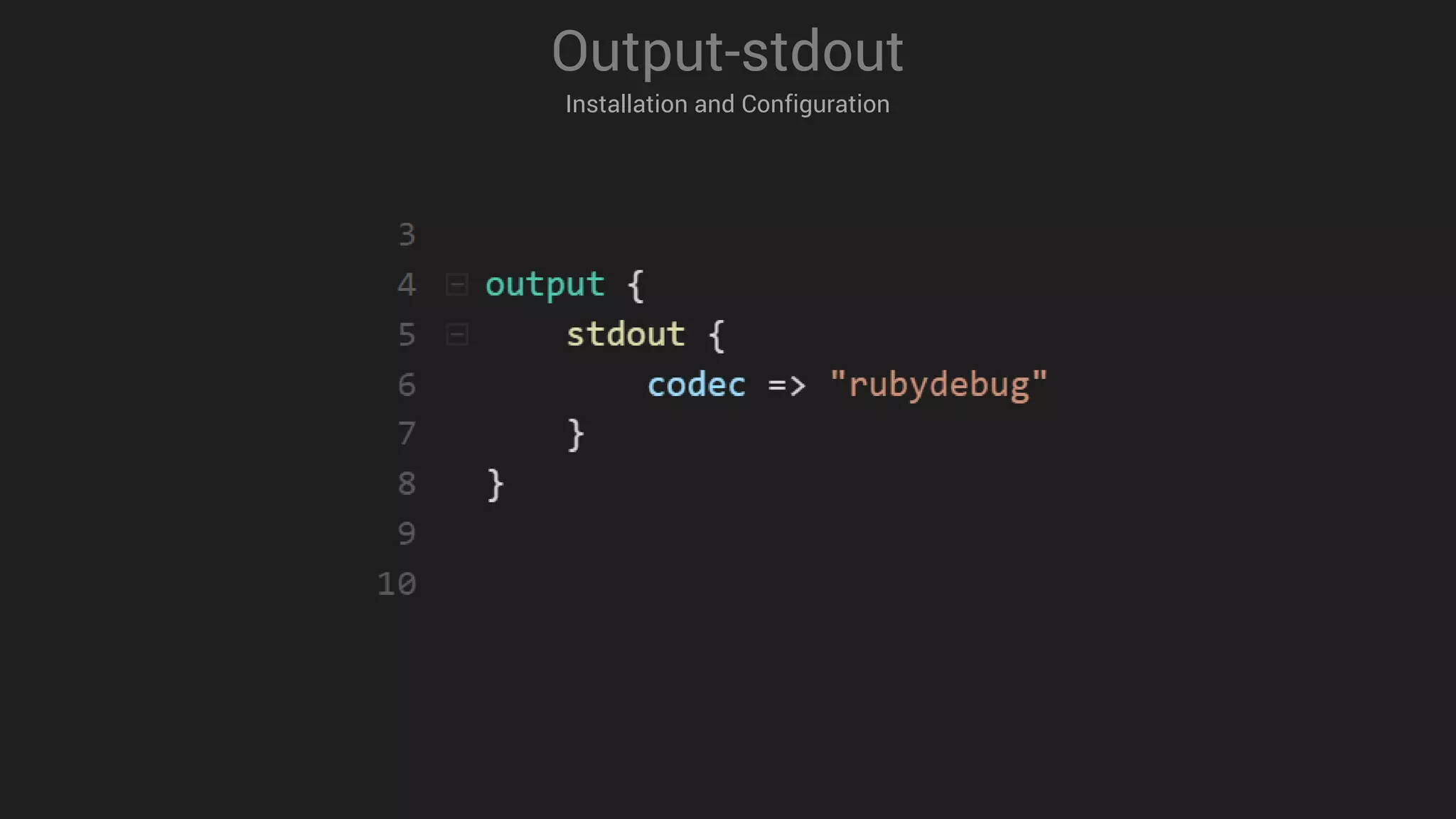
Output-stdout
Installation and Configuration
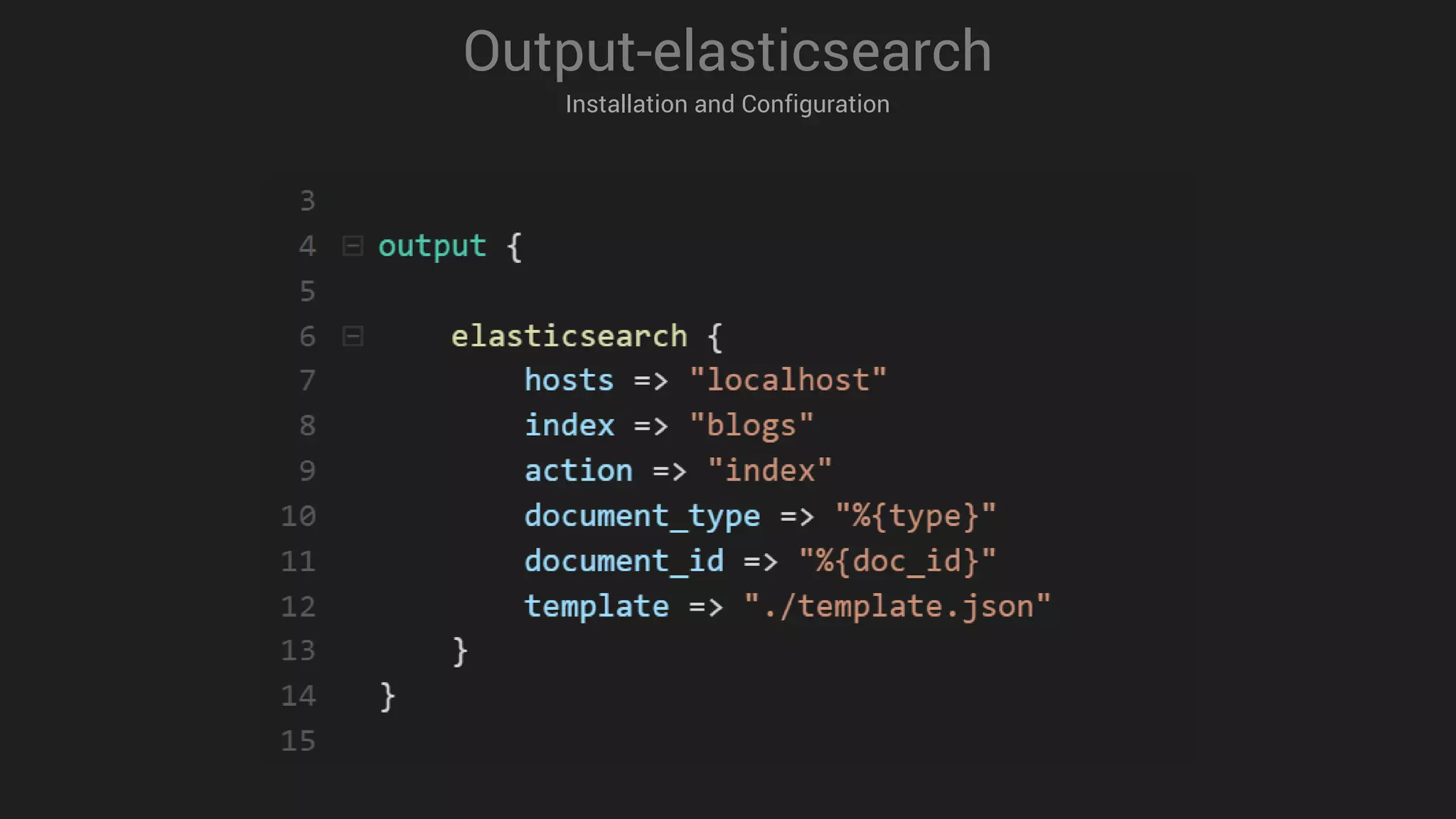
Output-elasticsearch
Installation and Configuration
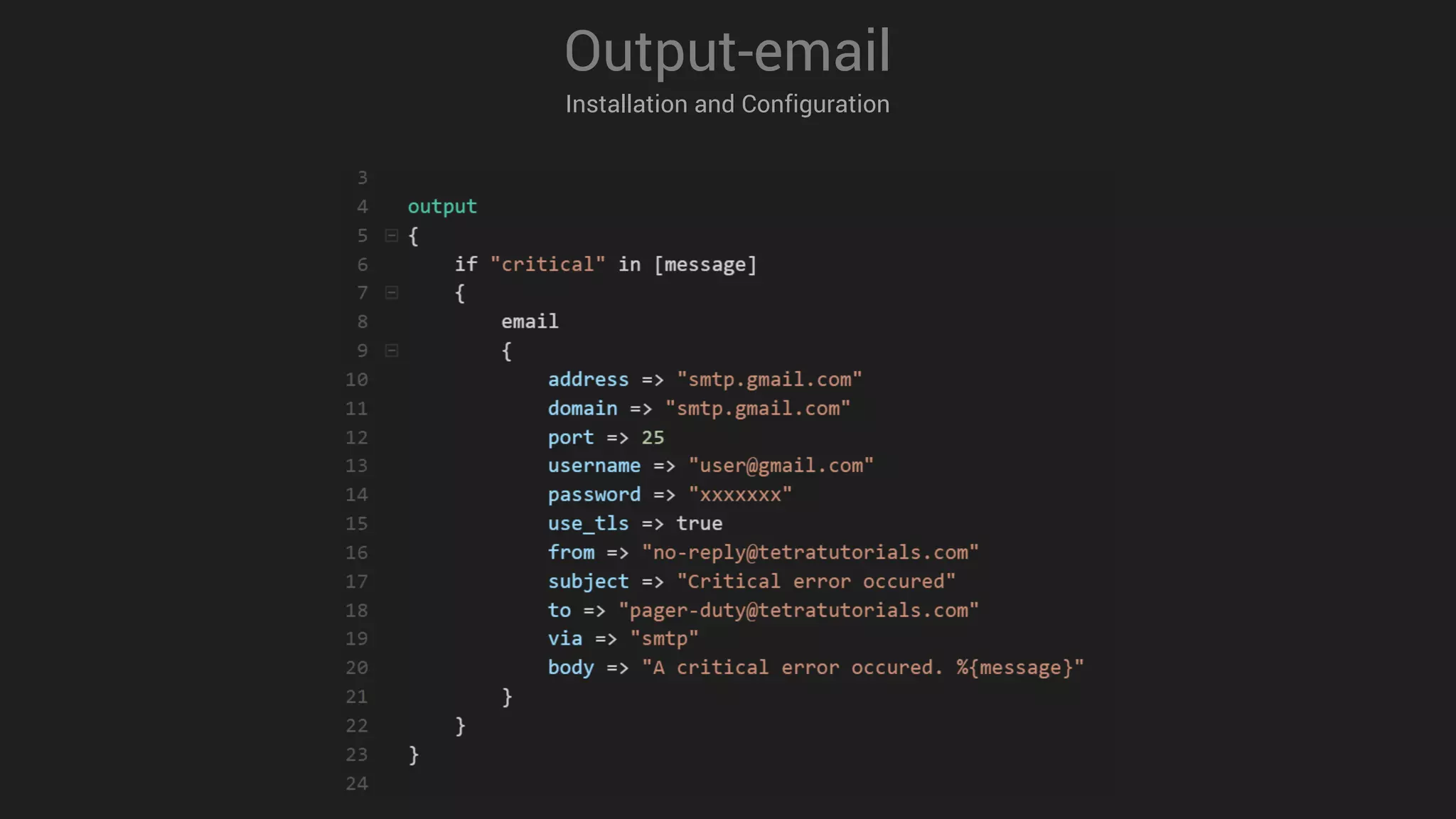
Output-email
Installation and Configuration
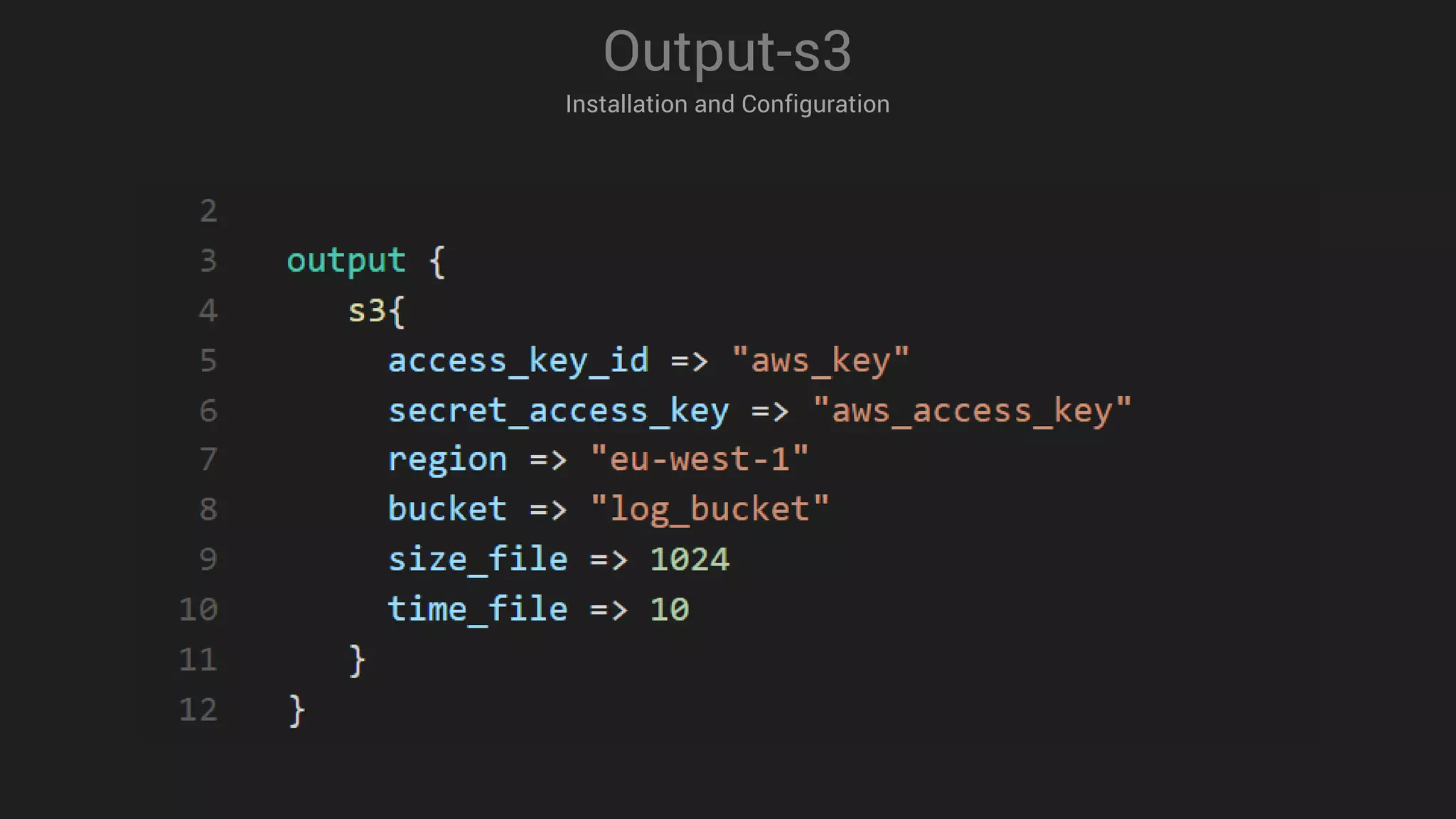
Output-s3
Installation and Configuration
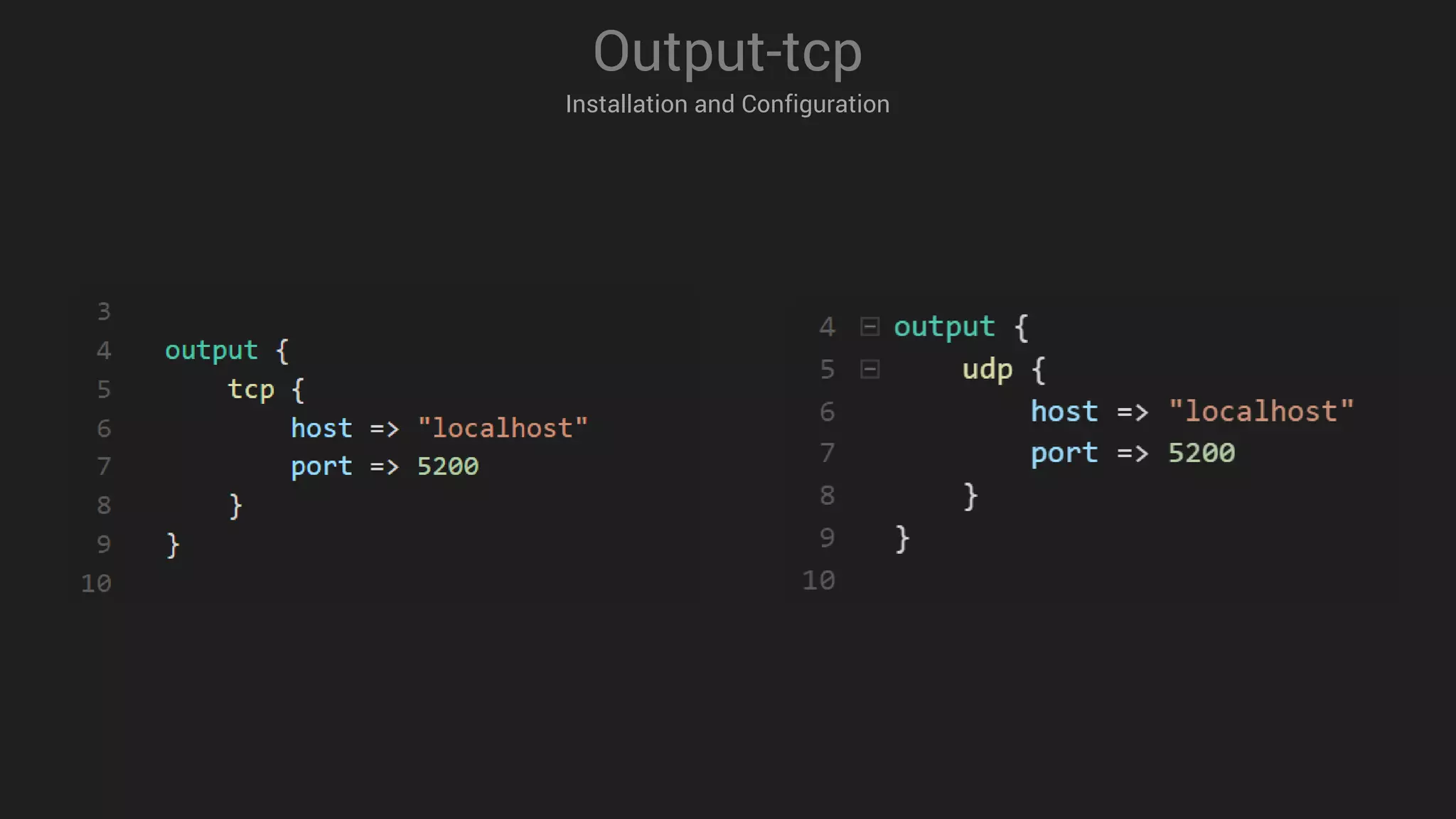
Output-tcp
Installation and Configuration
LogStash in action
LogStash in action

LogStash in action

  • 2.
  • 3.
  • 4.
    Data ingestion workhorse Eventsenrichment and transformation Extensible plugin ecosystem Pluggable pipeline architecture Horizontally scalable data processing pipeline Strong Elasticsearch and Kibana synergy Handles data of all shapes and sizes Key Features of LogStash What’s In It for You?
  • 5.
  • 6.
    The Pre-requisites Installation andConfiguration Prerequisites requires Java 7 or higher Installation steps Download from elastic.co web site Use Linux package manager to install LogStash Install LogStash as a service
  • 7.
  • 8.
  • 9.
  • 10.
    The Service Commands Installationand Configuration Start or stop service commands : sudo /etc/init.d/logstash start sudo /etc/init.d/logstash stop sudo /etc/init.d/logstash restart sudo /etc/init.d/logstash status
  • 11.
    Simple Pipeline Installation andConfiguration Verify LogStash installation with a simple pipeline Will take input from command line and output it back to the command line Pipeline configuration information is passed as text on command line Takes input from standard input “stdin” Outputs to standard output “stdout” in a structured format
  • 12.
    bin/logstash -e 'input{ stdin { } } output { stdout {} }' Simple Pipeline Installation and Configuration
  • 13.
    4 5 # SimpleLogStash configuration 6 7 Inputs { 8 Stdin { } 9 } 10 11 Output { 12 Stdout { } 13 } 14 Simple Pipeline Installation and Configuration
  • 14.
  • 15.
  • 16.
    Advanced Pipeline Installation andConfiguration Real world pipelines contain one or more input, filter and outputs Is generally provided in a configuration file rather than command line Supplied to LogStash with –f command line argument Test the configuration using -- configtest argument
  • 17.
    Skeleton LogStash Configuration Installationand Configuration 4 # The # character at the beginning of 5 # a line indicates comment 6 # Use the comments to describe your configuration 7 input { 8 input1 { } 9 input2 { } 10 } 11 12 # The filter part of this file is 13 # commented out to indicate that 14 # it is optional. 15 16 # filter { 17 # } 18 19 output { 20 output1 { } 21 output2 { } 22 }
  • 18.
    LogStash Plugins Installation andConfiguration LogStash Instance Data Source ElasticSearch Filter Plugin Output Plugin Input Plugin
  • 19.
  • 20.
  • 21.
  • 22.
    4 # ElasticSearchinput plugin 5 6 Input { 7 8 # Read all documents from ElasticSearch 9 # matching the given query 10 11 elasticsearch { 12 hosts => “localhost” 13 index => “blogs” 14 query => ‘{ “localhost” : { “match_all” : { } } }’ 15 type => “my-data-elasticsearch” 16 } 17 } 18 Input-ElasticSearch Installation and Configuration
  • 23.
    3 4 # Fileinput 5 6 Inputs { 7 8 # Read events from file or folder 9 10 file { 11 path => “/var/log/ * ” 12 exclude => “ * .gz ” 13 sincedb_path => “ /dev/null ” 14 start_position => “ beginning “ 15 type => “ my-data-csv” 16 } 17 } 18 Input-File Installation and Configuration
  • 24.
    4 # JDBCinput 5 6 Input { 7 8 # Read all records from mySQL 9 # database 10 11 jdbc { 12 13 jdbc_driver_library => “/opt/logstash/lib/mysql-connector-java-5.1.6-bin.jar “ 14 jdbc_driver_class => “com.mysql.jdbc.Driver ” 15 jdbc_connection_string => “jdbc : mysql : // localhost : 3306 / mydb ” 16 jdbc_user => “root ” 17 jdbc_password => “password ” 18 statement => “SELECT * from users “ 19 20 } 21 } 22 Input-jbdc Installation and Configuration
  • 25.
    3 # AWSS3 input 4 5 Input { 6 7 # Read all documents from AWS S3 8 9 s3 { 10 11 bucket => “my-bucket “ 12 credentials => [ “my-aws-key “ , “my-aws-token “ ] 13 region_endpoint => “us-east-1 “ 14 codec => “json “ 15 16 } 17 } 18 Input-s3 Installation and Configuration
  • 26.
    4 # TCPinput 5 6 Input { 7 8 # Read all events over TCP socket 9 10 tcp { 11 port => “ 5000 “ 12 type => “ syslog “ 13 } 14 15 } Input-tcp Installation and Configuration
  • 27.
    4 # UDPinput 5 6 input { 7 8 # Read all events over UDP port 9 10 udp { 11 port => “5001” 12 type => “netflow” 13 } 14 15 } 16 Input-udp Installation and Configuration
  • 28.
    Filter-csv Installation and Configuration 2 3# CSV filter 4 filter { 5 6 csv { 7 8 # List of columns as they appear in csv 9 column => [ “column_1” , “column_2” ] 10 column => { “column_3” => “integer” , “column_4” => “boolean” } 11 type => “syslog” 12 13 } 14 15 } 16
  • 29.
    2 3 # datefilter 4 5 filter { 6 7 8 date { 9 10 match => [ “logdate” , “MMM dd HH:mm:ss” ] 11 # Default for target is @timestamp 12 target => “logdate_modified” 13 14 } 15 } Filter-date Installation and Configuration • Used for parsing dates and use as LogStash event timestamp in ISO8601 format • For example “Jan 01 10:40:01” can be parsed using the pattern “MMM dd HH:mm:ss”
  • 30.
    Filter-drop Installation and Configuration 2 3# drop filter 4 5 filter { 6 7 # drop the events of their loglevel is debug 8 drop { 9 if [ loglevel ] = = “debug” { 10 drop { } 11 } 12 } 13 } 14 15
  • 31.
    Filter-range Installation and Configuration 2 3# range filter 4 5 filter { 6 range { 7 ranges => [“request_time” , 0, 10, “tag: short” , 8 “request_time” , 11, 100, “tag: medium”, 9 “request_time” , 101, 1000, “tag: long”, 10 “request_time” , 1001, 100000, “drop”, 11 “request_length” , 0, 100, “field: size: small”, 12 “request_length” , 101, 200, “field: size: normal”, 13 “request_length” , 201, 1000, “field: size: big”, 14 “request_length” , 1001, 100000, “field: size: hugel”, 15 “number_of_requests” , 0, 10, “tag: request_from_%{host}” ] 16 } 17 }
  • 32.
    Filter-grok Installation and Configuration Grokis one of the most widely used plugin It is instrumental in parsing arbitrary and unstructured text into structed and queryable data field It is widely used to parse syslog, apache logs, mySQL logs, custom application logs, postfix logs etc. Grok works based on patterns Syntax for grok pattern is %{SYNTAX:SEMANTIC} Custom patterns can be added
  • 33.
    Filter-grok Installation and Configuration 2 3# grok filter 4 5 input { 6 file { 7 path => “/ var/log/http.log” 8 9 # sample log entry 10 # 55.11.55.11 GET/ index.html 453 12 11 } 12 } 13 14 filter { 15 # parse http log 16 17 grok { 18 19 match => { “message” => “% { IP: client} %{WORD: method} %{URIPATHPARAM: request} %{NUMBER: duration}” } 20 21 } 22 } 23
  • 34.
    Filter-grok Installation and Configuration 2 3# grok filter 4 5 input { 6 file { 7 path => “/ var/log/http.log” 8 9 # sample log entry 10 # 55.11.55.11 GET/ index.html 453 12 11 } 12 } 13 14 filter { 15 # parse http log 16 17 grok { 18 19 match => { “message” => “% { IP: client} %{WORD: method} %{URIPATHPARAM: request} %{NUMBER: duration}” } 20 21 } 22 } 23 Grok supports custom patterns • inline custom pattern using Oniguruma syntax • file based custom patterns
  • 35.
    Filter-grok Installation and Configuration 43# ( ? < field_name> the pattern here 44 45 46 ( ? < message_id> [0-9A-F] {10, 11}
  • 36.
    24 25 # grokfilter 26 27 filter { 28 29 grok { 30 31 patterns_dir => [ “~/patterns” ] 32 match => { “message” => “% {SYSLOGBASE} %{POSTFIXQUEUEID: queue_id}: %{GREEDYDATA:syslog_message}” } 33 34 } 35 } Filter-grok Installation and Configuration
  • 37.
  • 38.
  • 39.
  • 40.
  • 41.
  • 42.
  • 43.
  • 44.
  • 45.
  • 46.