Reflective Practice Guidance Log # 1
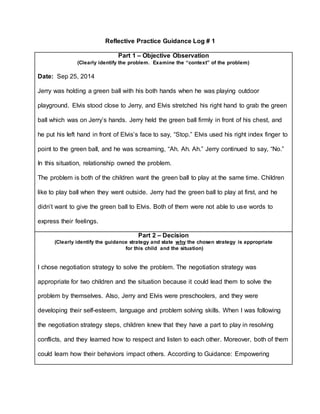
Part 1 – Objective Observation
(Clearly identify the problem. Examine the “context” of the problem)
Date: Sep 25, 2014
Jerry was holding a green ball with his both hands when he was playing outdoor
playground. Elvis stood close to Jerry, and Elvis stretched his right hand to grab the green
ball which was on Jerry’s hands. Jerry held the green ball firmly in front of his chest, and
he put his left hand in front of Elvis’s face to say, “Stop.” Elvis used his right index finger to
point to the green ball, and he was screaming, “Ah. Ah. Ah.” Jerry continued to say, “No.”
In this situation, relationship owned the problem.
The problem is both of the children want the green ball to play at the same time. Children
like to play ball when they went outside. Jerry had the green ball to play at first, and he
didn’t want to give the green ball to Elvis. Both of them were not able to use words to
express their feelings.
Part 2 – Decision
(Clearly identify the guidance strategy and state why the chosen strategy is appropriate
for this child and the situation)
I chose negotiation strategy to solve the problem. The negotiation strategy was
appropriate for two children and the situation because it could lead them to solve the
problem by themselves. Also, Jerry and Elvis were preschoolers, and they were
developing their self-esteem, language and problem solving skills. When I was following
the negotiation strategy steps, children knew that they have a part to play in resolving
conflicts, and they learned how to respect and listen to each other. Moreover, both of them
could learn how their behaviors impact others. According to Guidance: Empowering
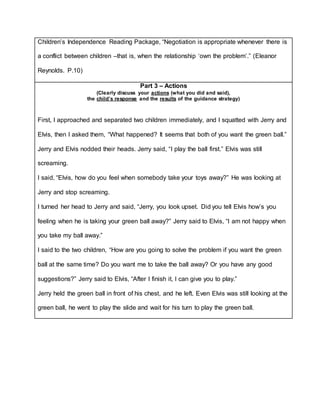
Children’s Independence Reading Package, “Negotiation is appropriate whenever there is
a conflict between children –that is, when the relationship ‘own the problem’.” (Eleanor
Reynolds. P.10)
Part 3 – Actions
(Clearly discuss your actions (what you did and said),
the child’s response and the results of the guidance strategy)
First, I approached and separated two children immediately, and I squatted with Jerry and
Elvis, then I asked them, “What happened? It seems that both of you want the green ball.”
Jerry and Elvis nodded their heads. Jerry said, “I play the ball first.” Elvis was still
screaming.
I said, “Elvis, how do you feel when somebody take your toys away?” He was looking at
Jerry and stop screaming.
I turned her head to Jerry and said, “Jerry, you look upset. Did you tell Elvis how’s you
feeling when he is taking your green ball away?” Jerry said to Elvis, “I am not happy when
you take my ball away.”
I said to the two children, “How are you going to solve the problem if you want the green
ball at the same time? Do you want me to take the ball away? Or you have any good
suggestions?” Jerry said to Elvis, “After I finish it, I can give you to play.”
Jerry held the green ball in front of his chest, and he left. Even Elvis was still looking at the
green ball, he went to play the slide and wait for his turn to play the green ball.
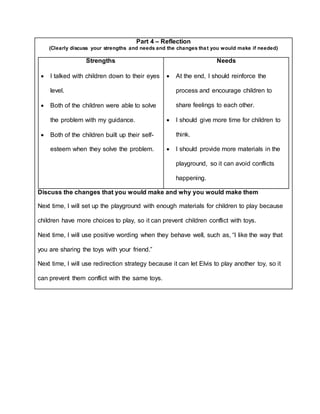
Part 4 – Reflection
(Clearly discuss your strengths and needs and the changes that you would make if needed)
Strengths
 I talked with children down to their eyes
level.
 Both of the children were able to solve
the problem with my guidance.
 Both of the children built up their self-
esteem when they solve the problem.
Needs
 At the end, I should reinforce the
process and encourage children to
share feelings to each other.
 I should give more time for children to
think.
 I should provide more materials in the
playground, so it can avoid conflicts
happening.
Discuss the changes that you would make and why you would make them
Next time, I will set up the playground with enough materials for children to play because
children have more choices to play, so it can prevent children conflict with toys.
Next time, I will use positive wording when they behave well, such as, “I like the way that
you are sharing the toys with your friend.”
Next time, I will use redirection strategy because it can let Elvis to play another toy, so it
can prevent them conflict with the same toys.
Supervising ECE Signature
Dear ECE Supervising Teacher: Please read and review the guidance log. Select
the appropriate box below.
o This log is accurate based on your observations.
o This log is somewhat accurate.
Please explain: _______________________________________________
___________________________________________________________
o This log is not accurate based on your observations.
Agency Name: _____________________________________
Phone Number: _____________________________________
Name of ECE: (Please Print) _____________________________________
ECE Signature: _____________________________________
Date of Signature: ________________________________
Thank-you!
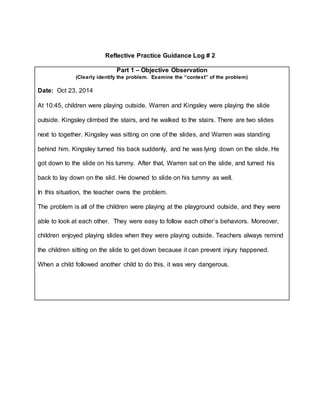
Reflective Practice Guidance Log # 2
Part 1 – Objective Observation
(Clearly identify the problem. Examine the “context” of the problem)
Date: Oct 23, 2014
At 10:45, children were playing outside. Warren and Kingsley were playing the slide
outside. Kingsley climbed the stairs, and he walked to the stairs. There are two slides
next to together. Kingsley was sitting on one of the slides, and Warren was standing
behind him. Kingsley turned his back suddenly, and he was lying down on the slide. He
got down to the slide on his tummy. After that, Warren sat on the slide, and turned his
back to lay down on the slid. He downed to slide on his tummy as well.
In this situation, the teacher owns the problem.
The problem is all of the children were playing at the playground outside, and they were
able to look at each other. They were easy to follow each other’s behaviors. Moreover,
children enjoyed playing slides when they were playing outside. Teachers always remind
the children sitting on the slide to get down because it can prevent injury happened.
When a child followed another child to do this, it was very dangerous.
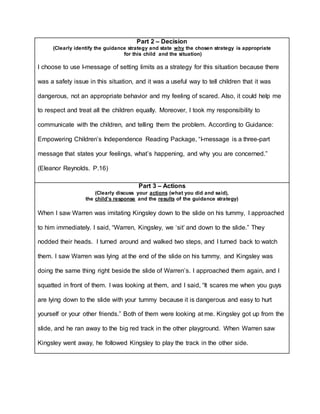
Part 2 – Decision
(Clearly identify the guidance strategy and state why the chosen strategy is appropriate
for this child and the situation)
I choose to use I-message of setting limits as a strategy for this situation because there
was a safety issue in this situation, and it was a useful way to tell children that it was
dangerous, not an appropriate behavior and my feeling of scared. Also, it could help me
to respect and treat all the children equally. Moreover, I took my responsibility to
communicate with the children, and telling them the problem. According to Guidance:
Empowering Children’s Independence Reading Package, “I-message is a three-part
message that states your feelings, what’s happening, and why you are concerned.”
(Eleanor Reynolds. P.16)
Part 3 – Actions
(Clearly discuss your actions (what you did and said),
the child’s response and the results of the guidance strategy)
When I saw Warren was imitating Kingsley down to the slide on his tummy, I approached
to him immediately. I said, “Warren, Kingsley, we ‘sit’ and down to the slide.” They
nodded their heads. I turned around and walked two steps, and I turned back to watch
them. I saw Warren was lying at the end of the slide on his tummy, and Kingsley was
doing the same thing right beside the slide of Warren’s. I approached them again, and I
squatted in front of them. I was looking at them, and I said, “It scares me when you guys
are lying down to the slide with your tummy because it is dangerous and easy to hurt
yourself or your other friends.” Both of them were looking at me. Kingsley got up from the
slide, and he ran away to the big red track in the other playground. When Warren saw
Kingsley went away, he followed Kingsley to play the track in the other side.
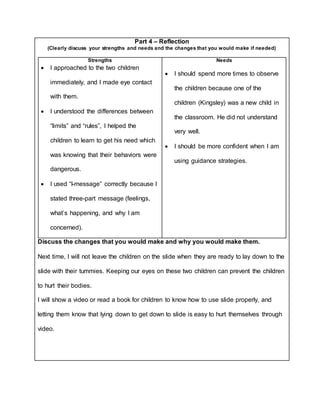
Part 4 – Reflection
(Clearly discuss your strengths and needs and the changes that you would make if needed)
Strengths
 I approached to the two children
immediately, and I made eye contact
with them.
 I understood the differences between
“limits” and “rules”, I helped the
children to learn to get his need which
was knowing that their behaviors were
dangerous.
 I used “I-message” correctly because I
stated three-part message (feelings,
what’s happening, and why I am
concerned).
Needs
 I should spend more times to observe
the children because one of the
children (Kingsley) was a new child in
the classroom. He did not understand
very well.
 I should be more confident when I am
using guidance strategies.
Discuss the changes that you would make and why you would make them.
Next time, I will not leave the children on the slide when they are ready to lay down to the
slide with their tummies. Keeping our eyes on these two children can prevent the children
to hurt their bodies.
I will show a video or read a book for children to know how to use slide properly, and
letting them know that lying down to get down to slide is easy to hurt themselves through
video.
Supervising ECE Signature
Dear ECE Supervising Teacher: Please read and review the guidance log. Select
the appropriate box below.
o This log is accurate based on your observations.
o This log is somewhat accurate.
Please explain: _______________________________________________
___________________________________________________________
o This log is not accurate based on your observations.
Agency Name: _____________________________________
Phone Number: _____________________________________
Name of ECE: (Please Print) _____________________________________
ECE Signature: _____________________________________
Date of Signature: ________________________________
Thank-you!
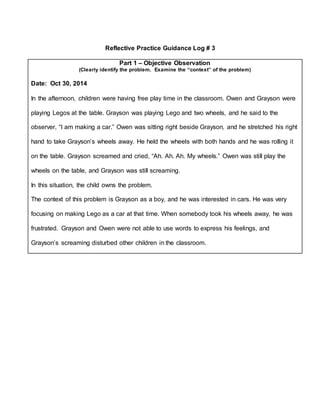
Reflective Practice Guidance Log # 3
Part 1 – Objective Observation
(Clearly identify the problem. Examine the “context” of the problem)
Date: Oct 30, 2014
In the afternoon, children were having free play time in the classroom. Owen and Grayson were
playing Legos at the table. Grayson was playing Lego and two wheels, and he said to the
observer, “I am making a car.” Owen was sitting right beside Grayson, and he stretched his right
hand to take Grayson’s wheels away. He held the wheels with both hands and he was rolling it
on the table. Grayson screamed and cried, “Ah. Ah. Ah. My wheels.” Owen was still play the
wheels on the table, and Grayson was still screaming.
In this situation, the child owns the problem.
The context of this problem is Grayson as a boy, and he was interested in cars. He was very
focusing on making Lego as a car at that time. When somebody took his wheels away, he was
frustrated. Grayson and Owen were not able to use words to express his feelings, and
Grayson’s screaming disturbed other children in the classroom.
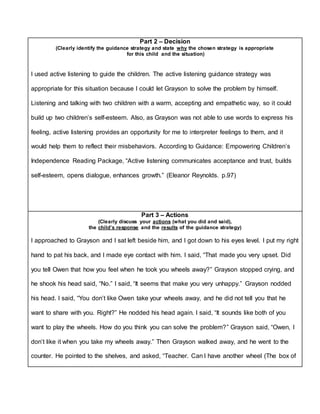
Part 2 – Decision
(Clearly identify the guidance strategy and state why the chosen strategy is appropriate
for this child and the situation)
I used active listening to guide the children. The active listening guidance strategy was
appropriate for this situation because I could let Grayson to solve the problem by himself.
Listening and talking with two children with a warm, accepting and empathetic way, so it could
build up two children’s self-esteem. Also, as Grayson was not able to use words to express his
feeling, active listening provides an opportunity for me to interpreter feelings to them, and it
would help them to reflect their misbehaviors. According to Guidance: Empowering Children’s
Independence Reading Package, “Active listening communicates acceptance and trust, builds
self-esteem, opens dialogue, enhances growth.” (Eleanor Reynolds. p.97)
Part 3 – Actions
(Clearly discuss your actions (what you did and said),
the child’s response and the results of the guidance strategy)
I approached to Grayson and I sat left beside him, and I got down to his eyes level. I put my right
hand to pat his back, and I made eye contact with him. I said, “That made you very upset. Did
you tell Owen that how you feel when he took you wheels away?” Grayson stopped crying, and
he shook his head said, “No.” I said, “It seems that make you very unhappy.” Grayson nodded
his head. I said, “You don’t like Owen take your wheels away, and he did not tell you that he
want to share with you. Right?” He nodded his head again. I said, “It sounds like both of you
want to play the wheels. How do you think you can solve the problem?” Grayson said, “Owen, I
don’t like it when you take my wheels away.” Then Grayson walked away, and he went to the
counter. He pointed to the shelves, and asked, “Teacher. Can I have another wheel (The box of
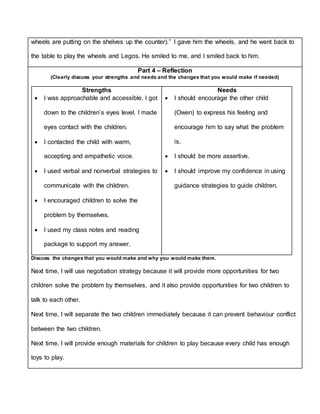
wheels are putting on the shelves up the counter).” I gave him the wheels, and he went back to
the table to play the wheels and Legos. He smiled to me, and I smiled back to him.
Part 4 – Reflection
(Clearly discuss your strengths and needs and the changes that you would make if needed)
Strengths
 I was approachable and accessible. I got
down to the children’s eyes level. I made
eyes contact with the children.
 I contacted the child with warm,
accepting and empathetic voice.
 I used verbal and nonverbal strategies to
communicate with the children.
 I encouraged children to solve the
problem by themselves.
 I used my class notes and reading
package to support my answer.
Needs
 I should encourage the other child
(Owen) to express his feeling and
encourage him to say what the problem
is.
 I should be more assertive.
 I should improve my confidence in using
guidance strategies to guide children.
Discuss the changes that you would make and why you would make them.
Next time, I will use negotiation strategy because it will provide more opportunities for two
children solve the problem by themselves, and it also provide opportunities for two children to
talk to each other.
Next time, I will separate the two children immediately because it can prevent behaviour conflict
between the two children.
Next time, I will provide enough materials for children to play because every child has enough
toys to play.
Supervising ECE Signature
Dear ECE Supervising Teacher: Please read and review the guidance log. Select
the appropriate box below.
o This log is accurate based on your observations.
o This log is somewhat accurate.
Please explain: _______________________________________________
___________________________________________________________
o This log is not accurate based on your observations.
Agency Name: _____________________________________
Phone Number: _____________________________________
Name of ECE: (Please Print) _____________________________________
ECE Signature: _____________________________________
Date of Signature: ________________________________
Thank-you!

Logs

  • 1.
    Reflective Practice GuidanceLog # 1 Part 1 – Objective Observation (Clearly identify the problem. Examine the “context” of the problem) Date: Sep 25, 2014 Jerry was holding a green ball with his both hands when he was playing outdoor playground. Elvis stood close to Jerry, and Elvis stretched his right hand to grab the green ball which was on Jerry’s hands. Jerry held the green ball firmly in front of his chest, and he put his left hand in front of Elvis’s face to say, “Stop.” Elvis used his right index finger to point to the green ball, and he was screaming, “Ah. Ah. Ah.” Jerry continued to say, “No.” In this situation, relationship owned the problem. The problem is both of the children want the green ball to play at the same time. Children like to play ball when they went outside. Jerry had the green ball to play at first, and he didn’t want to give the green ball to Elvis. Both of them were not able to use words to express their feelings. Part 2 – Decision (Clearly identify the guidance strategy and state why the chosen strategy is appropriate for this child and the situation) I chose negotiation strategy to solve the problem. The negotiation strategy was appropriate for two children and the situation because it could lead them to solve the problem by themselves. Also, Jerry and Elvis were preschoolers, and they were developing their self-esteem, language and problem solving skills. When I was following the negotiation strategy steps, children knew that they have a part to play in resolving conflicts, and they learned how to respect and listen to each other. Moreover, both of them could learn how their behaviors impact others. According to Guidance: Empowering
  • 2.
    Children’s Independence ReadingPackage, “Negotiation is appropriate whenever there is a conflict between children –that is, when the relationship ‘own the problem’.” (Eleanor Reynolds. P.10) Part 3 – Actions (Clearly discuss your actions (what you did and said), the child’s response and the results of the guidance strategy) First, I approached and separated two children immediately, and I squatted with Jerry and Elvis, then I asked them, “What happened? It seems that both of you want the green ball.” Jerry and Elvis nodded their heads. Jerry said, “I play the ball first.” Elvis was still screaming. I said, “Elvis, how do you feel when somebody take your toys away?” He was looking at Jerry and stop screaming. I turned her head to Jerry and said, “Jerry, you look upset. Did you tell Elvis how’s you feeling when he is taking your green ball away?” Jerry said to Elvis, “I am not happy when you take my ball away.” I said to the two children, “How are you going to solve the problem if you want the green ball at the same time? Do you want me to take the ball away? Or you have any good suggestions?” Jerry said to Elvis, “After I finish it, I can give you to play.” Jerry held the green ball in front of his chest, and he left. Even Elvis was still looking at the green ball, he went to play the slide and wait for his turn to play the green ball.
  • 3.
    Part 4 –Reflection (Clearly discuss your strengths and needs and the changes that you would make if needed) Strengths  I talked with children down to their eyes level.  Both of the children were able to solve the problem with my guidance.  Both of the children built up their self- esteem when they solve the problem. Needs  At the end, I should reinforce the process and encourage children to share feelings to each other.  I should give more time for children to think.  I should provide more materials in the playground, so it can avoid conflicts happening. Discuss the changes that you would make and why you would make them Next time, I will set up the playground with enough materials for children to play because children have more choices to play, so it can prevent children conflict with toys. Next time, I will use positive wording when they behave well, such as, “I like the way that you are sharing the toys with your friend.” Next time, I will use redirection strategy because it can let Elvis to play another toy, so it can prevent them conflict with the same toys.
  • 4.
    Supervising ECE Signature DearECE Supervising Teacher: Please read and review the guidance log. Select the appropriate box below. o This log is accurate based on your observations. o This log is somewhat accurate. Please explain: _______________________________________________ ___________________________________________________________ o This log is not accurate based on your observations. Agency Name: _____________________________________ Phone Number: _____________________________________ Name of ECE: (Please Print) _____________________________________ ECE Signature: _____________________________________ Date of Signature: ________________________________ Thank-you!
  • 5.
    Reflective Practice GuidanceLog # 2 Part 1 – Objective Observation (Clearly identify the problem. Examine the “context” of the problem) Date: Oct 23, 2014 At 10:45, children were playing outside. Warren and Kingsley were playing the slide outside. Kingsley climbed the stairs, and he walked to the stairs. There are two slides next to together. Kingsley was sitting on one of the slides, and Warren was standing behind him. Kingsley turned his back suddenly, and he was lying down on the slide. He got down to the slide on his tummy. After that, Warren sat on the slide, and turned his back to lay down on the slid. He downed to slide on his tummy as well. In this situation, the teacher owns the problem. The problem is all of the children were playing at the playground outside, and they were able to look at each other. They were easy to follow each other’s behaviors. Moreover, children enjoyed playing slides when they were playing outside. Teachers always remind the children sitting on the slide to get down because it can prevent injury happened. When a child followed another child to do this, it was very dangerous.
  • 6.
    Part 2 –Decision (Clearly identify the guidance strategy and state why the chosen strategy is appropriate for this child and the situation) I choose to use I-message of setting limits as a strategy for this situation because there was a safety issue in this situation, and it was a useful way to tell children that it was dangerous, not an appropriate behavior and my feeling of scared. Also, it could help me to respect and treat all the children equally. Moreover, I took my responsibility to communicate with the children, and telling them the problem. According to Guidance: Empowering Children’s Independence Reading Package, “I-message is a three-part message that states your feelings, what’s happening, and why you are concerned.” (Eleanor Reynolds. P.16) Part 3 – Actions (Clearly discuss your actions (what you did and said), the child’s response and the results of the guidance strategy) When I saw Warren was imitating Kingsley down to the slide on his tummy, I approached to him immediately. I said, “Warren, Kingsley, we ‘sit’ and down to the slide.” They nodded their heads. I turned around and walked two steps, and I turned back to watch them. I saw Warren was lying at the end of the slide on his tummy, and Kingsley was doing the same thing right beside the slide of Warren’s. I approached them again, and I squatted in front of them. I was looking at them, and I said, “It scares me when you guys are lying down to the slide with your tummy because it is dangerous and easy to hurt yourself or your other friends.” Both of them were looking at me. Kingsley got up from the slide, and he ran away to the big red track in the other playground. When Warren saw Kingsley went away, he followed Kingsley to play the track in the other side.
  • 7.
    Part 4 –Reflection (Clearly discuss your strengths and needs and the changes that you would make if needed) Strengths  I approached to the two children immediately, and I made eye contact with them.  I understood the differences between “limits” and “rules”, I helped the children to learn to get his need which was knowing that their behaviors were dangerous.  I used “I-message” correctly because I stated three-part message (feelings, what’s happening, and why I am concerned). Needs  I should spend more times to observe the children because one of the children (Kingsley) was a new child in the classroom. He did not understand very well.  I should be more confident when I am using guidance strategies. Discuss the changes that you would make and why you would make them. Next time, I will not leave the children on the slide when they are ready to lay down to the slide with their tummies. Keeping our eyes on these two children can prevent the children to hurt their bodies. I will show a video or read a book for children to know how to use slide properly, and letting them know that lying down to get down to slide is easy to hurt themselves through video.
  • 8.
    Supervising ECE Signature DearECE Supervising Teacher: Please read and review the guidance log. Select the appropriate box below. o This log is accurate based on your observations. o This log is somewhat accurate. Please explain: _______________________________________________ ___________________________________________________________ o This log is not accurate based on your observations. Agency Name: _____________________________________ Phone Number: _____________________________________ Name of ECE: (Please Print) _____________________________________ ECE Signature: _____________________________________ Date of Signature: ________________________________ Thank-you!
  • 9.
    Reflective Practice GuidanceLog # 3 Part 1 – Objective Observation (Clearly identify the problem. Examine the “context” of the problem) Date: Oct 30, 2014 In the afternoon, children were having free play time in the classroom. Owen and Grayson were playing Legos at the table. Grayson was playing Lego and two wheels, and he said to the observer, “I am making a car.” Owen was sitting right beside Grayson, and he stretched his right hand to take Grayson’s wheels away. He held the wheels with both hands and he was rolling it on the table. Grayson screamed and cried, “Ah. Ah. Ah. My wheels.” Owen was still play the wheels on the table, and Grayson was still screaming. In this situation, the child owns the problem. The context of this problem is Grayson as a boy, and he was interested in cars. He was very focusing on making Lego as a car at that time. When somebody took his wheels away, he was frustrated. Grayson and Owen were not able to use words to express his feelings, and Grayson’s screaming disturbed other children in the classroom.
  • 10.
    Part 2 –Decision (Clearly identify the guidance strategy and state why the chosen strategy is appropriate for this child and the situation) I used active listening to guide the children. The active listening guidance strategy was appropriate for this situation because I could let Grayson to solve the problem by himself. Listening and talking with two children with a warm, accepting and empathetic way, so it could build up two children’s self-esteem. Also, as Grayson was not able to use words to express his feeling, active listening provides an opportunity for me to interpreter feelings to them, and it would help them to reflect their misbehaviors. According to Guidance: Empowering Children’s Independence Reading Package, “Active listening communicates acceptance and trust, builds self-esteem, opens dialogue, enhances growth.” (Eleanor Reynolds. p.97) Part 3 – Actions (Clearly discuss your actions (what you did and said), the child’s response and the results of the guidance strategy) I approached to Grayson and I sat left beside him, and I got down to his eyes level. I put my right hand to pat his back, and I made eye contact with him. I said, “That made you very upset. Did you tell Owen that how you feel when he took you wheels away?” Grayson stopped crying, and he shook his head said, “No.” I said, “It seems that make you very unhappy.” Grayson nodded his head. I said, “You don’t like Owen take your wheels away, and he did not tell you that he want to share with you. Right?” He nodded his head again. I said, “It sounds like both of you want to play the wheels. How do you think you can solve the problem?” Grayson said, “Owen, I don’t like it when you take my wheels away.” Then Grayson walked away, and he went to the counter. He pointed to the shelves, and asked, “Teacher. Can I have another wheel (The box of
  • 11.
    wheels are puttingon the shelves up the counter).” I gave him the wheels, and he went back to the table to play the wheels and Legos. He smiled to me, and I smiled back to him. Part 4 – Reflection (Clearly discuss your strengths and needs and the changes that you would make if needed) Strengths  I was approachable and accessible. I got down to the children’s eyes level. I made eyes contact with the children.  I contacted the child with warm, accepting and empathetic voice.  I used verbal and nonverbal strategies to communicate with the children.  I encouraged children to solve the problem by themselves.  I used my class notes and reading package to support my answer. Needs  I should encourage the other child (Owen) to express his feeling and encourage him to say what the problem is.  I should be more assertive.  I should improve my confidence in using guidance strategies to guide children. Discuss the changes that you would make and why you would make them. Next time, I will use negotiation strategy because it will provide more opportunities for two children solve the problem by themselves, and it also provide opportunities for two children to talk to each other. Next time, I will separate the two children immediately because it can prevent behaviour conflict between the two children. Next time, I will provide enough materials for children to play because every child has enough toys to play.
  • 12.
    Supervising ECE Signature DearECE Supervising Teacher: Please read and review the guidance log. Select the appropriate box below. o This log is accurate based on your observations. o This log is somewhat accurate. Please explain: _______________________________________________ ___________________________________________________________ o This log is not accurate based on your observations. Agency Name: _____________________________________ Phone Number: _____________________________________ Name of ECE: (Please Print) _____________________________________ ECE Signature: _____________________________________ Date of Signature: ________________________________ Thank-you!