OBJECTIVE:
Determines the missing term/s in a sequence of
numbers. (e.g odd numbers, even numbers, multiples of
a number, factors of a number, etc.) m4al-iiie.5
REVIEW:
A. Tell whether the set of numbers form patterns or are
multiples of the succeeding numbers.
1) 3, 6, 9, 12, 15,…
2) 1, 2, 4, 8, 16,….
3) 5, 10 15, 20, 25,…..
B. What is the meaning of pattern based from our previous
lesson? What is meant by sequence?
• PATTERNS
- can be recognized, named, extended, and created
using shapes, numbers, and symbols with their
attributes.
• SEQUENCE
- an ordered set of numbers, letters, shapes or symbols
- each number, letter, shape or symbol in the sequence
is called a term
•Distribute the puzzles.
Task: Identify what is in the puzzle.
What can you say about the pictures?
Why do you think this happened?
How can we avoid this to happen?
What should we do?
Motive question
What did Dan do with the empty
cans?
Read the situation.
Dan found some empty bins to put cans for
recycling. He put 3 empty cans in the first bin. 6
empty cans in the second bin. 12 empty cans in
the third bin and 24 empty cans in the fourth
bin. If this pattern continues, how many empty
cans will Dan put in the fifth bin?
1. What did Dan do with the empty cans?
2. Where did Dan put the empty cans?
3. How many empty bins did Dan find?
4. Aside from recycling, in what other
ways can we minimize garbage disposal?
5. How do we recycle? reduce? reuse?
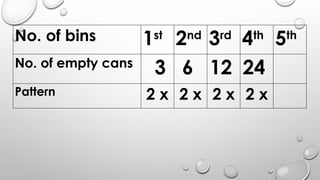
Going back to the situation, what is being asked?
What are the given data? Let us fill up the table below
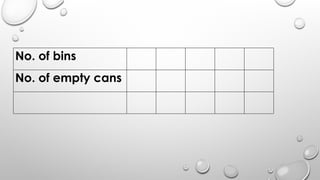
No. of bins
No. of empty cans
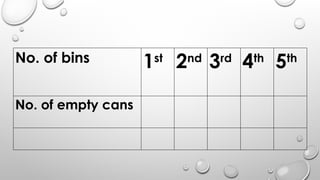
No. of bins 1st
2nd
3rd
4th
5th
No. of empty cans
No. of bins 1st
2nd
3rd
4th
5th
No. of empty cans
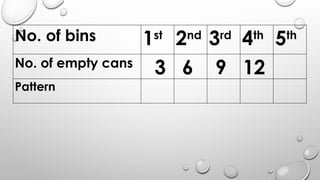
3 6 9 12
Pattern
No. of bins 1st
2nd
3rd
4th
5th
No. of empty cans
3 6 12 24
Pattern 2 x 2 x 2 x 2 x
No. of bins 1st
2nd
3rd
4th
5th
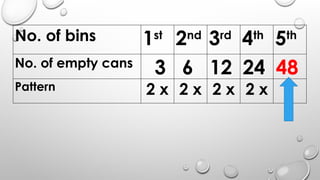
No. of empty cans
3 6 12 24 48
Pattern 2 x 2 x 2 x 2 x
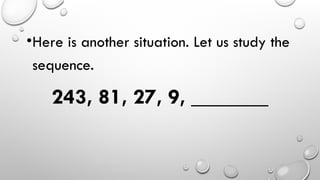
•Here is another situation. Let us study the
sequence.
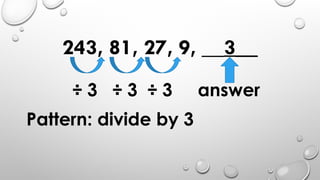
243, 81, 27, 9, _______
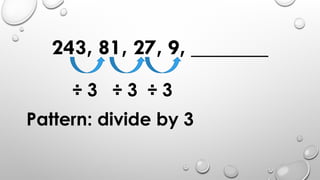
243, 81, 27, 9, _______
á 3 á 3 á 3
Pattern: divide by 3
243, 81, 27, 9, __3__
á 3 á 3 á 3 answer
Pattern: divide by 3
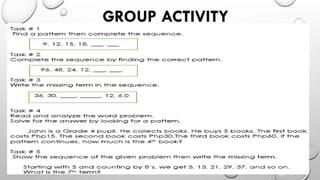
GROUP ACTIVITY
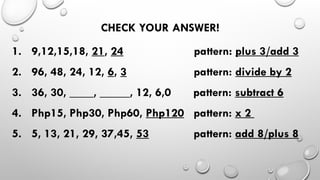
CHECK YOUR ANSWER!
1. 9,12,15,18, 21, 24 pattern: plus 3/add 3
2. 96, 48, 24, 12, 6, 3 pattern: divide by 2
3. 36, 30, ____, _____, 12, 6,0 pattern: subtract 6
4. Php15, Php30, Php60, Php120 pattern: x 2
5. 5, 13, 21, 29, 37,45, 53 pattern: add 8/plus 8
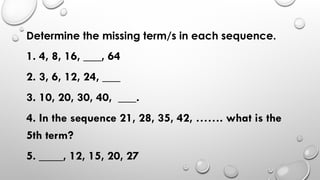
Determine the missing term/s in each sequence.
1. 4, 8, 16, ___, 64
2. 3, 6, 12, 24, ___
3. 10, 20, 30, 40, ___.
4. In the sequence 21, 28, 35, 42, ……. what is the
5th term?
5. ____, 12, 15, 20, 27
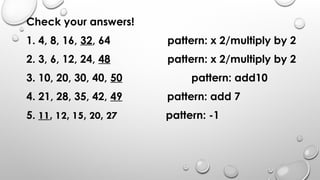
Check your answers!
1. 4, 8, 16, 32, 64 pattern: x 2/multiply by 2
2. 3, 6, 12, 24, 48 pattern: x 2/multiply by 2
3. 10, 20, 30, 40, 50 pattern: add10
4. 21, 28, 35, 42, 49 pattern: add 7
5. 11, 12, 15, 20, 27 pattern: -1
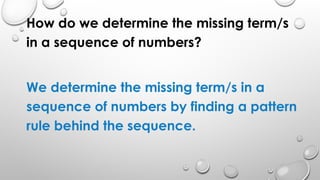
How do we determine the missing term/s
in a sequence of numbers?
We determine the missing term/s in a
sequence of numbers by finding a pattern
rule behind the sequence.
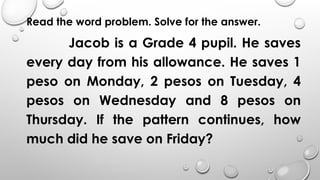
Read the word problem. Solve for the answer.
Jacob is a Grade 4 pupil. He saves
every day from his allowance. He saves 1
peso on Monday, 2 pesos on Tuesday, 4
pesos on Wednesday and 8 pesos on
Thursday. If the pattern continues, how
much did he save on Friday?
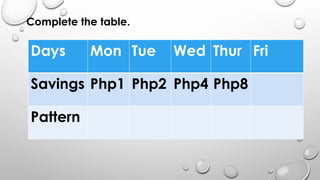
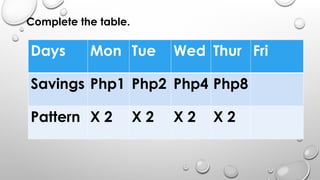
Complete the table.
Complete the table.
Days Mon Tue Wed Thur Fri
Savings Php1 Php2 Php4 Php8
Complete the table.
Days Mon Tue Wed Thur Fri
Savings Php1 Php2 Php4 Php8
Pattern
Complete the table.
Days Mon Tue Wed Thur Fri
Savings Php1 Php2 Php4 Php8
Pattern X 2 X 2 X 2 X 2
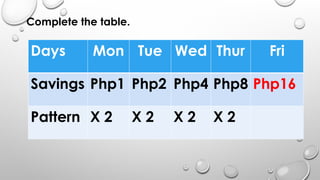
Complete the table.
Days Mon Tue Wed Thur Fri
Savings Php1 Php2 Php4 Php8 Php16
Pattern X 2 X 2 X 2 X 2
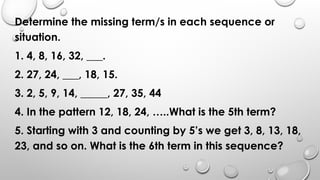
Determine the missing term/s in each sequence or
situation.
1. 4, 8, 16, 32, ___.
2. 27, 24, ___, 18, 15.
3. 2, 5, 9, 14, _____, 27, 35, 44
4. In the pattern 12, 18, 24, …..What is the 5th term?
5. Starting with 3 and counting by 5’s we get 3, 8, 13, 18,
23, and so on. What is the 6th term in this sequence?
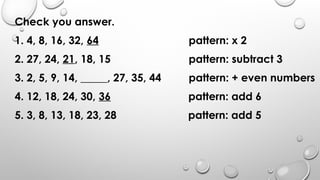
Check you answer.
1. 4, 8, 16, 32, 64 pattern: x 2
2. 27, 24, 21, 18, 15 pattern: subtract 3
3. 2, 5, 9, 14, _____, 27, 35, 44 pattern: + even numbers
4. 12, 18, 24, 30, 36 pattern: add 6
5. 3, 8, 13, 18, 23, 28 pattern: add 5
Congratulations!
You know how to determine the
missing term/s in a sequence of
numbers.

Determine the pattern rule in a sequence

  • 1.
    OBJECTIVE: Determines the missingterm/s in a sequence of numbers. (e.g odd numbers, even numbers, multiples of a number, factors of a number, etc.) m4al-iiie.5
  • 2.
    REVIEW: A. Tell whetherthe set of numbers form patterns or are multiples of the succeeding numbers. 1) 3, 6, 9, 12, 15,… 2) 1, 2, 4, 8, 16,…. 3) 5, 10 15, 20, 25,….. B. What is the meaning of pattern based from our previous lesson? What is meant by sequence?
  • 3.
    • PATTERNS - canbe recognized, named, extended, and created using shapes, numbers, and symbols with their attributes. • SEQUENCE - an ordered set of numbers, letters, shapes or symbols - each number, letter, shape or symbol in the sequence is called a term
  • 4.
    •Distribute the puzzles. Task:Identify what is in the puzzle.
  • 5.
    What can yousay about the pictures? Why do you think this happened? How can we avoid this to happen? What should we do?
  • 6.
    Motive question What didDan do with the empty cans?
  • 7.
    Read the situation. Danfound some empty bins to put cans for recycling. He put 3 empty cans in the first bin. 6 empty cans in the second bin. 12 empty cans in the third bin and 24 empty cans in the fourth bin. If this pattern continues, how many empty cans will Dan put in the fifth bin?
  • 8.
    1. What didDan do with the empty cans? 2. Where did Dan put the empty cans? 3. How many empty bins did Dan find? 4. Aside from recycling, in what other ways can we minimize garbage disposal? 5. How do we recycle? reduce? reuse?
  • 9.
    Going back tothe situation, what is being asked? What are the given data? Let us fill up the table below
  • 10.
    No. of bins No.of empty cans
  • 11.
    No. of bins1st 2nd 3rd 4th 5th No. of empty cans
  • 12.
    No. of bins1st 2nd 3rd 4th 5th No. of empty cans 3 6 9 12 Pattern
  • 13.
    No. of bins1st 2nd 3rd 4th 5th No. of empty cans 3 6 12 24 Pattern 2 x 2 x 2 x 2 x
  • 14.
    No. of bins1st 2nd 3rd 4th 5th No. of empty cans 3 6 12 24 48 Pattern 2 x 2 x 2 x 2 x
  • 15.
    •Here is anothersituation. Let us study the sequence. 243, 81, 27, 9, _______
  • 16.
    243, 81, 27,9, _______ á 3 á 3 á 3 Pattern: divide by 3
  • 17.
    243, 81, 27,9, __3__ á 3 á 3 á 3 answer Pattern: divide by 3
  • 18.
  • 19.
    CHECK YOUR ANSWER! 1.9,12,15,18, 21, 24 pattern: plus 3/add 3 2. 96, 48, 24, 12, 6, 3 pattern: divide by 2 3. 36, 30, ____, _____, 12, 6,0 pattern: subtract 6 4. Php15, Php30, Php60, Php120 pattern: x 2 5. 5, 13, 21, 29, 37,45, 53 pattern: add 8/plus 8
  • 20.
    Determine the missingterm/s in each sequence. 1. 4, 8, 16, ___, 64 2. 3, 6, 12, 24, ___ 3. 10, 20, 30, 40, ___. 4. In the sequence 21, 28, 35, 42, ……. what is the 5th term? 5. ____, 12, 15, 20, 27
  • 21.
    Check your answers! 1.4, 8, 16, 32, 64 pattern: x 2/multiply by 2 2. 3, 6, 12, 24, 48 pattern: x 2/multiply by 2 3. 10, 20, 30, 40, 50 pattern: add10 4. 21, 28, 35, 42, 49 pattern: add 7 5. 11, 12, 15, 20, 27 pattern: -1
  • 22.
    How do wedetermine the missing term/s in a sequence of numbers? We determine the missing term/s in a sequence of numbers by finding a pattern rule behind the sequence.
  • 23.
    Read the wordproblem. Solve for the answer. Jacob is a Grade 4 pupil. He saves every day from his allowance. He saves 1 peso on Monday, 2 pesos on Tuesday, 4 pesos on Wednesday and 8 pesos on Thursday. If the pattern continues, how much did he save on Friday?
  • 24.
  • 25.
    Complete the table. DaysMon Tue Wed Thur Fri Savings Php1 Php2 Php4 Php8
  • 26.
    Complete the table. DaysMon Tue Wed Thur Fri Savings Php1 Php2 Php4 Php8 Pattern
  • 27.
    Complete the table. DaysMon Tue Wed Thur Fri Savings Php1 Php2 Php4 Php8 Pattern X 2 X 2 X 2 X 2
  • 28.
    Complete the table. DaysMon Tue Wed Thur Fri Savings Php1 Php2 Php4 Php8 Php16 Pattern X 2 X 2 X 2 X 2
  • 29.
    Determine the missingterm/s in each sequence or situation. 1. 4, 8, 16, 32, ___. 2. 27, 24, ___, 18, 15. 3. 2, 5, 9, 14, _____, 27, 35, 44 4. In the pattern 12, 18, 24, …..What is the 5th term? 5. Starting with 3 and counting by 5’s we get 3, 8, 13, 18, 23, and so on. What is the 6th term in this sequence?
  • 30.
    Check you answer. 1.4, 8, 16, 32, 64 pattern: x 2 2. 27, 24, 21, 18, 15 pattern: subtract 3 3. 2, 5, 9, 14, _____, 27, 35, 44 pattern: + even numbers 4. 12, 18, 24, 30, 36 pattern: add 6 5. 3, 8, 13, 18, 23, 28 pattern: add 5
  • 31.
    Congratulations! You know howto determine the missing term/s in a sequence of numbers.