Logic Gates
Unit III
EXERCISE
1. Evaluate the following Boolean expression using Truth
Table.
(a) X’Y’+X’Y (b) X’YZ’+XY’
(c) XY’(Z+YZ’)+Z’
2. Verify that P+(PQ)’ is a Tautology.
3. Verify that (X+Y)’=X’Y’
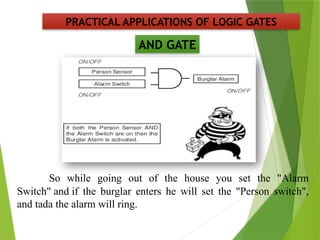
AND GATE
So while going out of the house you set the "Alarm
Switch" and if the burglar enters he will set the "Person switch",
and tada the alarm will ring.
PRACTICAL APPLICATIONS OF LOGIC GATES
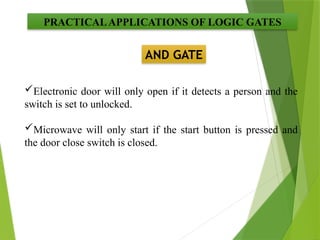
AND GATE
PRACTICALAPPLICATIONS OF LOGIC GATES
Electronic door will only open if it detects a person and the
switch is set to unlocked.
Microwave will only start if the start button is pressed and
the door close switch is closed.
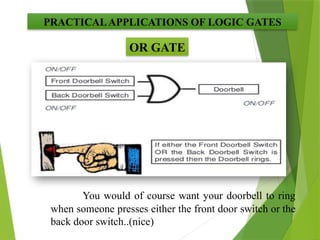
OR GATE
You would of course want your doorbell to ring
when someone presses either the front door switch or the
back door switch..(nice)
PRACTICALAPPLICATIONS OF LOGIC GATES
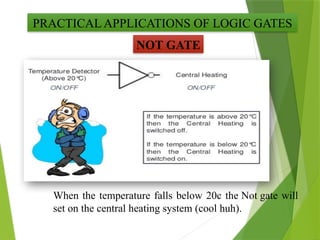
NOT GATE
When the temperature falls below 20c the Not gate will
set on the central heating system (cool huh).
PRACTICAL APPLICATIONS OF LOGIC GATES
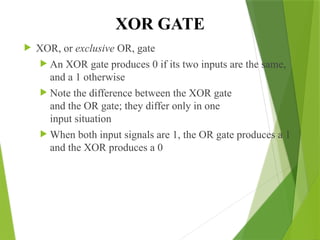
XOR GATE
 XOR, or exclusive OR, gate
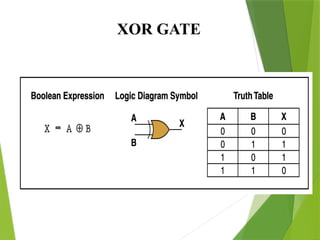
 An XOR gate produces 0 if its two inputs are the same,
and a 1 otherwise
 Note the difference between the XOR gate
and the OR gate; they differ only in one
input situation
 When both input signals are 1, the OR gate produces a 1
and the XOR produces a 0
XOR GATE
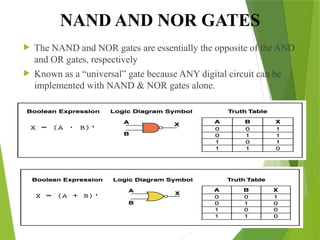
NAND AND NOR GATES
 The NAND and NOR gates are essentially the opposite of the AND
and OR gates, respectively
 Known as a “universal” gate because ANY digital circuit can be
implemented with NAND & NOR gates alone.
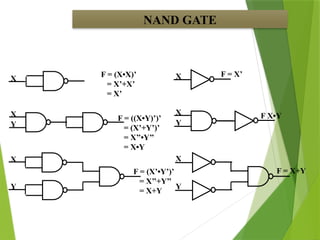
NAND GATE
X
X
F = (X•X)’
= X’+X’
= X’
X
Y
Y
F = ((X•Y)’)’
= (X’+Y’)’
= X’’•Y’’
= X•Y
F = (X’•Y’)’
= X’’+Y’’
= X+Y
X
X
F = X’
X
Y
Y
F X•Y
F = X+Y
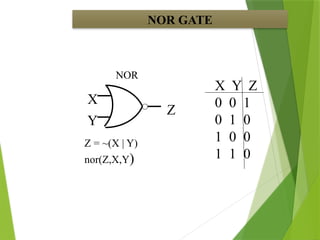
NOR GATE
NOR
X
Y
Z
X Y Z
0 0 1
0 1 0
1 0 0
1 1 0
Z = ~(X | Y)
nor(Z,X,Y)
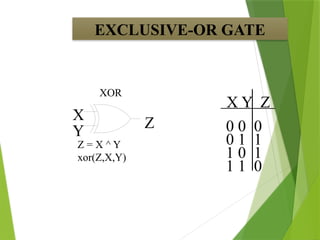
EXCLUSIVE-OR GATE
X Y Z
XOR
X
Y
Z 0 0 0
0 1 1
1 0 1
1 1 0
Z = X ^ Y
xor(Z,X,Y)
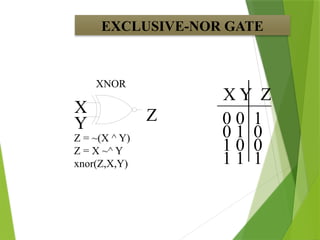
EXCLUSIVE-NOR GATE
X Y Z
XNOR
X
Y Z 0 0 1
0 1 0
1 0 0
1 1 1
Z = ~(X ^ Y)
Z = X ~^ Y
xnor(Z,X,Y)
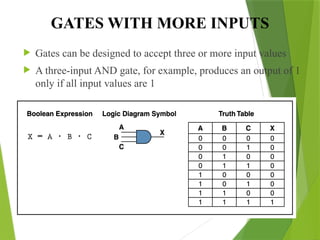
GATES WITH MORE INPUTS
 Gates can be designed to accept three or more input values
 A three-input AND gate, for example, produces an output of 1
only if all input values are 1
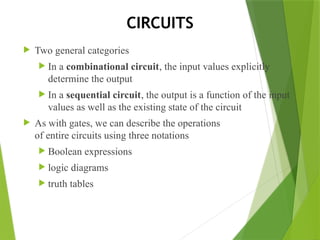
CIRCUITS
 Two general categories
 In a combinational circuit, the input values explicitly
determine the output
 In a sequential circuit, the output is a function of the input
values as well as the existing state of the circuit
 As with gates, we can describe the operations
of entire circuits using three notations
 Boolean expressions
 logic diagrams
 truth tables
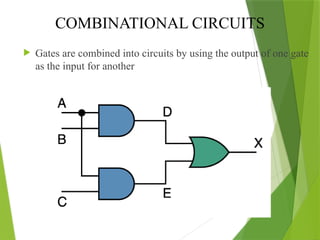
COMBINATIONAL CIRCUITS
 Gates are combined into circuits by using the output of one gate
as the input for another
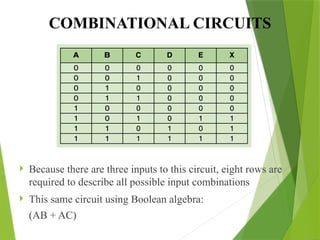
COMBINATIONAL CIRCUITS
 Because there are three inputs to this circuit, eight rows are
required to describe all possible input combinations
 This same circuit using Boolean algebra:
(AB + AC)
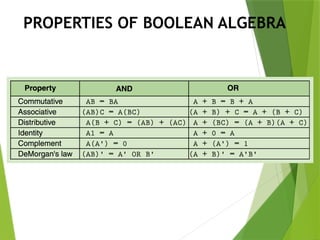
NOW LET’S GO THE OTHER WAY; LET’S
TAKE A BOOLEAN EXPRESSION AND DRAW
 Consider the following Boolean expression: A(B + C)
• Now compare the final result column in this truth table to the
truth table for the previous example
• They are identical
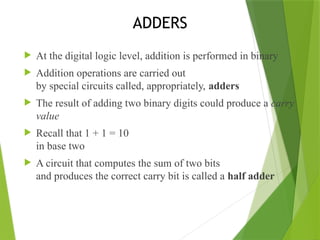
PROPERTIES OF BOOLEAN ALGEBRA
ADDERS
 At the digital logic level, addition is performed in binary
 Addition operations are carried out
by special circuits called, appropriately, adders
 The result of adding two binary digits could produce a carry
value
 Recall that 1 + 1 = 10
in base two
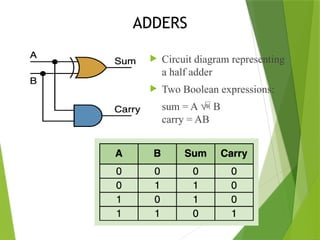
 A circuit that computes the sum of two bits
and produces the correct carry bit is called a half adder
ADDERS
 Circuit diagram representing
a half adder
 Two Boolean expressions:
sum = A  B
carry = AB
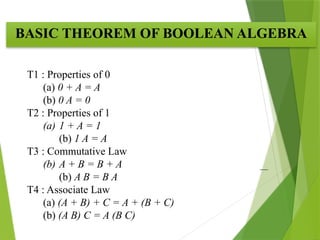
BASIC THEOREM OF BOOLEAN ALGEBRA
T1 : Properties of 0
(a) 0 + A = A
(b) 0 A = 0
T2 : Properties of 1
(a) 1 + A = 1
(b) 1 A = A
T3 : Commutative Law
(b) A + B = B + A
(b) A B = B A
T4 : Associate Law
(a) (A + B) + C = A + (B + C)
(b) (A B) C = A (B C)
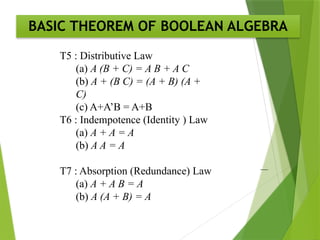
BASIC THEOREM OF BOOLEAN ALGEBRA
T5 : Distributive Law
(a) A (B + C) = A B + A C
(b) A + (B C) = (A + B) (A +
C)
(c) A+A’B = A+B
T6 : Indempotence (Identity ) Law
(a) A + A = A
(b) A A = A
T7 : Absorption (Redundance) Law
(a) A + A B = A
(b) A (A + B) = A
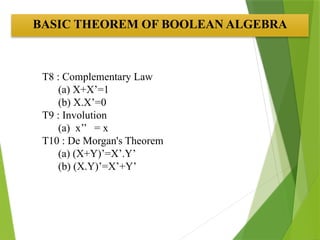
T8 : Complementary Law
(a) X+X’=1
(b) X.X’=0
T9 : Involution
(a) x’’ = x
T10 : De Morgan's Theorem
(a) (X+Y)’=X’.Y’
(b) (X.Y)’=X’+Y’
BASIC THEOREM OF BOOLEAN ALGEBRA
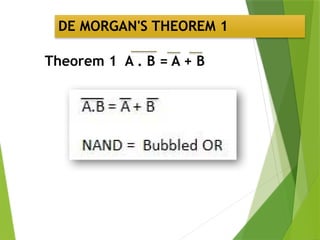
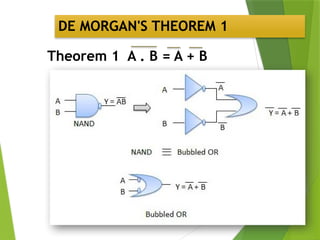
DE MORGAN'S THEOREM 1
Theorem 1 A . B = A + B
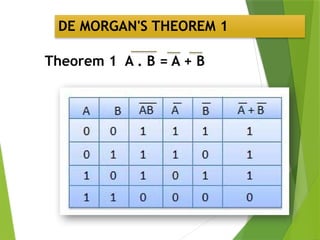
DE MORGAN'S THEOREM 1
Theorem 1 A . B = A + B
DE MORGAN'S THEOREM 1
Theorem 1 A . B = A + B
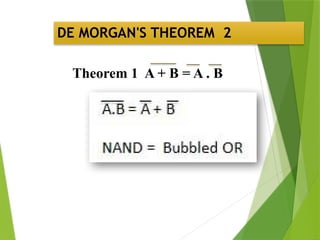
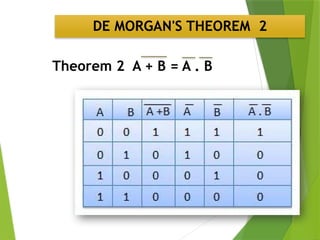
DE MORGAN'S THEOREM 2
Theorem 1 A + B = A . B
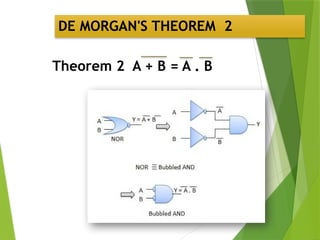
DE MORGAN'S THEOREM 2
Theorem 2 A + B = A . B
DE MORGAN'S THEOREM 2
Theorem 2 A + B = A . B
Thank You

Logic gates problems and examples were solved

  • 1.
  • 2.
    EXERCISE 1. Evaluate thefollowing Boolean expression using Truth Table. (a) X’Y’+X’Y (b) X’YZ’+XY’ (c) XY’(Z+YZ’)+Z’ 2. Verify that P+(PQ)’ is a Tautology. 3. Verify that (X+Y)’=X’Y’
  • 3.
    AND GATE So whilegoing out of the house you set the "Alarm Switch" and if the burglar enters he will set the "Person switch", and tada the alarm will ring. PRACTICAL APPLICATIONS OF LOGIC GATES
  • 4.
    AND GATE PRACTICALAPPLICATIONS OFLOGIC GATES Electronic door will only open if it detects a person and the switch is set to unlocked. Microwave will only start if the start button is pressed and the door close switch is closed.
  • 5.
    OR GATE You wouldof course want your doorbell to ring when someone presses either the front door switch or the back door switch..(nice) PRACTICALAPPLICATIONS OF LOGIC GATES
  • 6.
    NOT GATE When thetemperature falls below 20c the Not gate will set on the central heating system (cool huh). PRACTICAL APPLICATIONS OF LOGIC GATES
  • 7.
    XOR GATE  XOR,or exclusive OR, gate  An XOR gate produces 0 if its two inputs are the same, and a 1 otherwise  Note the difference between the XOR gate and the OR gate; they differ only in one input situation  When both input signals are 1, the OR gate produces a 1 and the XOR produces a 0
  • 8.
  • 9.
    NAND AND NORGATES  The NAND and NOR gates are essentially the opposite of the AND and OR gates, respectively  Known as a “universal” gate because ANY digital circuit can be implemented with NAND & NOR gates alone.
  • 10.
    NAND GATE X X F =(X•X)’ = X’+X’ = X’ X Y Y F = ((X•Y)’)’ = (X’+Y’)’ = X’’•Y’’ = X•Y F = (X’•Y’)’ = X’’+Y’’ = X+Y X X F = X’ X Y Y F X•Y F = X+Y
  • 11.
    NOR GATE NOR X Y Z X YZ 0 0 1 0 1 0 1 0 0 1 1 0 Z = ~(X | Y) nor(Z,X,Y)
  • 12.
    EXCLUSIVE-OR GATE X YZ XOR X Y Z 0 0 0 0 1 1 1 0 1 1 1 0 Z = X ^ Y xor(Z,X,Y)
  • 13.
    EXCLUSIVE-NOR GATE X YZ XNOR X Y Z 0 0 1 0 1 0 1 0 0 1 1 1 Z = ~(X ^ Y) Z = X ~^ Y xnor(Z,X,Y)
  • 14.
    GATES WITH MOREINPUTS  Gates can be designed to accept three or more input values  A three-input AND gate, for example, produces an output of 1 only if all input values are 1
  • 15.
    CIRCUITS  Two generalcategories  In a combinational circuit, the input values explicitly determine the output  In a sequential circuit, the output is a function of the input values as well as the existing state of the circuit  As with gates, we can describe the operations of entire circuits using three notations  Boolean expressions  logic diagrams  truth tables
  • 16.
    COMBINATIONAL CIRCUITS  Gatesare combined into circuits by using the output of one gate as the input for another
  • 17.
    COMBINATIONAL CIRCUITS  Becausethere are three inputs to this circuit, eight rows are required to describe all possible input combinations  This same circuit using Boolean algebra: (AB + AC)
  • 18.
    NOW LET’S GOTHE OTHER WAY; LET’S TAKE A BOOLEAN EXPRESSION AND DRAW  Consider the following Boolean expression: A(B + C) • Now compare the final result column in this truth table to the truth table for the previous example • They are identical
  • 19.
  • 20.
    ADDERS  At thedigital logic level, addition is performed in binary  Addition operations are carried out by special circuits called, appropriately, adders  The result of adding two binary digits could produce a carry value  Recall that 1 + 1 = 10 in base two  A circuit that computes the sum of two bits and produces the correct carry bit is called a half adder
  • 21.
    ADDERS  Circuit diagramrepresenting a half adder  Two Boolean expressions: sum = A  B carry = AB
  • 22.
    BASIC THEOREM OFBOOLEAN ALGEBRA T1 : Properties of 0 (a) 0 + A = A (b) 0 A = 0 T2 : Properties of 1 (a) 1 + A = 1 (b) 1 A = A T3 : Commutative Law (b) A + B = B + A (b) A B = B A T4 : Associate Law (a) (A + B) + C = A + (B + C) (b) (A B) C = A (B C)
  • 23.
    BASIC THEOREM OFBOOLEAN ALGEBRA T5 : Distributive Law (a) A (B + C) = A B + A C (b) A + (B C) = (A + B) (A + C) (c) A+A’B = A+B T6 : Indempotence (Identity ) Law (a) A + A = A (b) A A = A T7 : Absorption (Redundance) Law (a) A + A B = A (b) A (A + B) = A
  • 24.
    T8 : ComplementaryLaw (a) X+X’=1 (b) X.X’=0 T9 : Involution (a) x’’ = x T10 : De Morgan's Theorem (a) (X+Y)’=X’.Y’ (b) (X.Y)’=X’+Y’ BASIC THEOREM OF BOOLEAN ALGEBRA
  • 25.
    DE MORGAN'S THEOREM1 Theorem 1 A . B = A + B
  • 26.
    DE MORGAN'S THEOREM1 Theorem 1 A . B = A + B
  • 27.
    DE MORGAN'S THEOREM1 Theorem 1 A . B = A + B
  • 28.
    DE MORGAN'S THEOREM2 Theorem 1 A + B = A . B
  • 29.
    DE MORGAN'S THEOREM2 Theorem 2 A + B = A . B
  • 30.
    DE MORGAN'S THEOREM2 Theorem 2 A + B = A . B
  • 31.