LOGARITHM
Logarithm
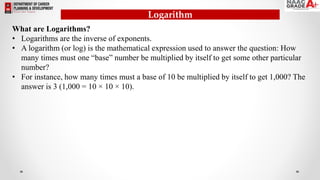
What are Logarithms?
• Logarithms are the inverse of exponents.
• A logarithm (or log) is the mathematical expression used to answer the question: How
many times must one “base” number be multiplied by itself to get some other particular
number?
• For instance, how many times must a base of 10 be multiplied by itself to get 1,000? The
answer is 3 (1,000 = 10 × 10 × 10).
Logarithm
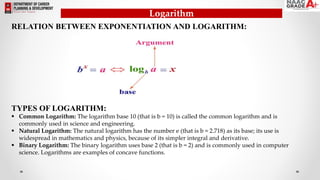
RELATION BETWEEN EXPONENTIATION AND LOGARITHM:
TYPES OF LOGARITHM:
 Common Logarithm: The logarithm base 10 (that is b = 10) is called the common logarithm and is
commonly used in science and engineering.
 Natural Logarithm: The natural logarithm has the number e (that is b ≈ 2.718) as its base; its use is
widespread in mathematics and physics, because of its simpler integral and derivative.
 Binary Logarithm: The binary logarithm uses base 2 (that is b = 2) and is commonly used in computer
science. Logarithms are examples of concave functions.
Logarithm
Logarithm
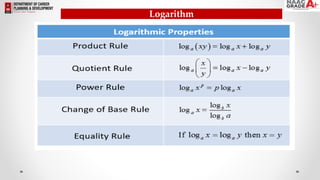
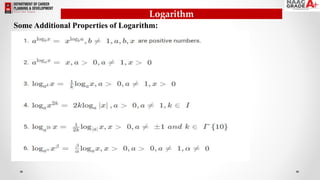
Some Additional Properties of Logarithm:
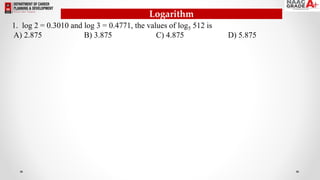
1. log 2 = 0.3010 and log 3 = 0.4771, the values of log5 512 is
A) 2.875 B) 3.875 C) 4.875 D) 5.875
Logarithm
Logarithm
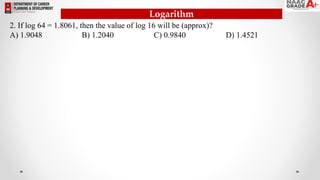
2. If log 64 = 1.8061, then the value of log 16 will be (approx)?
A) 1.9048 B) 1.2040 C) 0.9840 D) 1.4521
Logarithm
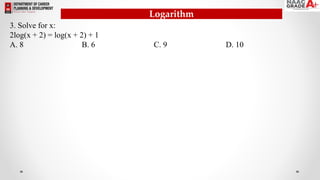
3. Solve for x:
2log(x + 2) = log(x + 2) + 1
A. 8 B. 6 C. 9 D. 10
Logarithm
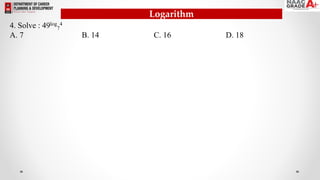
4. Solve : 49log
7
4
A. 7 B. 14 C. 16 D. 18
Logarithm
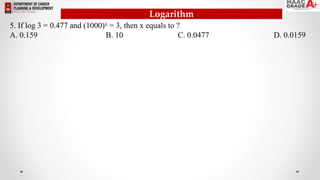
5. If log 3 = 0.477 and (1000)x = 3, then x equals to ?
A. 0.159 B. 10 C. 0.0477 D. 0.0159
Logarithm
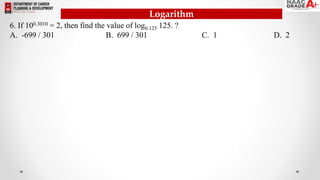
6. If 100.3010 = 2, then find the value of log0.125 125. ?
A. -699 / 301 B. 699 / 301 C. 1 D. 2
Logarithm
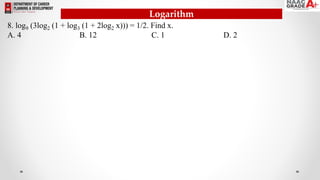
8. log9 (3log2 (1 + log3 (1 + 2log2 x))) = 1/2. Find x.
A. 4 B. 12 C. 1 D. 2
Logarithm
9. If log X/(a2 + ab + b2) = log Y/(b2 + bc + c2) = log Z/(c2 + ca + a2), then X a – b .Yb - c. Z c - a =?
A. 0 B. -1 C. 1 D. 2
Logarithm
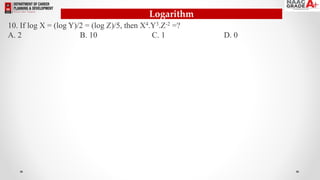
10. If log X = (log Y)/2 = (log Z)/5, then X4.Y3.Z-2 =?
A. 2 B. 10 C. 1 D. 0
Logarithm
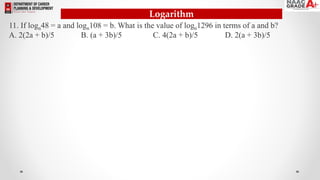
11. If logn48 = a and logn108 = b. What is the value of logn1296 in terms of a and b?
A. 2(2a + b)/5 B. (a + 3b)/5 C. 4(2a + b)/5 D. 2(a + 3b)/5
Logarithm
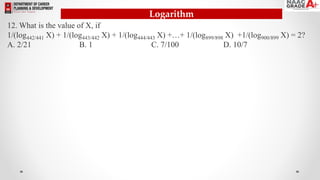
12. What is the value of X, if
1/(log442/441 X) + 1/(log443/442 X) + 1/(log444/443 X) +…+ 1/(log899/898 X) +1/(log900/899 X) = 2?
A. 2/21 B. 1 C. 7/100 D. 10/7
Logarithm
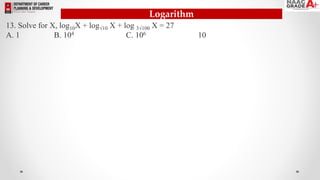
13. Solve for X, log10X + log√10 X + log 3√100 X = 27
A. 1 B. 104 C. 106 10
Logarithm
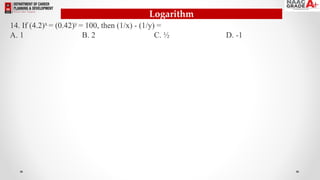
14. If (4.2)x = (0.42)y = 100, then (1/x) - (1/y) =
A. 1 B. 2 C. ½ D. -1
Logarithm
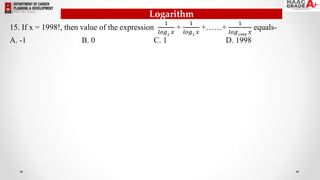
15. If x = 1998!, then value of the expression
1
𝑙𝑜𝑔2
𝑥
+
1
𝑙𝑜𝑔3
𝑥
+……+
1
𝑙𝑜𝑔1998
𝑥
equals-
A. -1 B. 0 C. 1 D. 1998
Logarithm
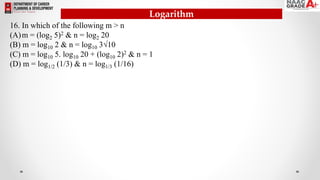
16. In which of the following m > n
(A)m = (log2 5)2 & n = log2 20
(B) m = log10 2 & n = log10 3√10
(C) m = log10 5. log10 20 + (log10 2)2 & n = 1
(D) m = log1/2 (1/3) & n = log1/3 (1/16)
Logarithm
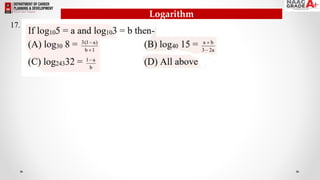
17.
Logarithm
18. If log3[log2 (x2 – 4x – 37)] = 1, where ‘x’ is a natural number, find the value of x.
A. 9 B. 10 C. 7 D. 4
Logarithm
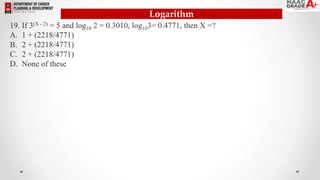
19. If 3(X - 2) = 5 and log10 2 = 0.3010, log103= 0.4771, then X =?
A. 1 + (2218/4771)
B. 2 + (2218/4771)
C. 2 + (2218/4771)
D. None of these
Logarithm
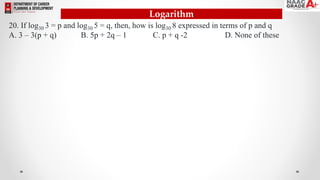
20. If log30 3 = p and log30 5 = q, then, how is log30 8 expressed in terms of p and q
A. 3 – 3(p + q) B. 5p + 2q – 1 C. p + q -2 D. None of these
Logarithm
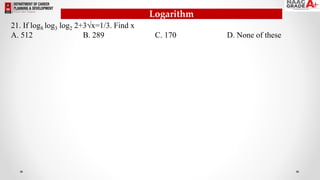
21. If log8 log3 log2 2+3√x=1/3. Find x
A. 512 B. 289 C. 170 D. None of these
Logarithm
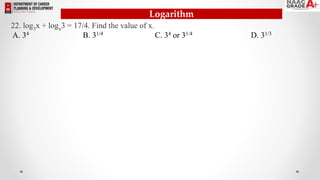
22. log3x + logx3 = 17/4. Find the value of x.
A. 34 B. 31/4 C. 34 or 31/4 D. 31/3
Logarithm
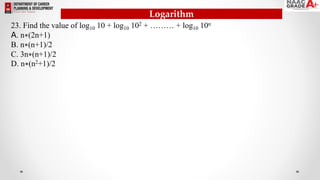
23. Find the value of log10 10 + log10 102 + ……… + log10 10n
A. n∗(2n+1)
B. n∗(n+1)/2
C. 3n∗(n+1)/2
D. n∗(n2+1)/2
Logarithm
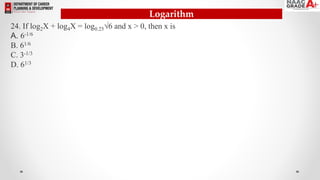
24. If log2X + log4X = log0.25√6 and x > 0, then x is
A. 6-1/6
B. 61/6
C. 3-1/3
D. 61/3
Logarithm
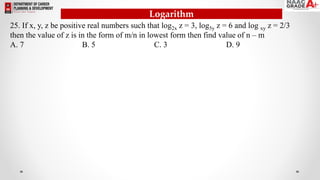
25. If x, y, z be positive real numbers such that log2x z = 3, log5y z = 6 and log xy z = 2/3
then the value of z is in the form of m/n in lowest form then find value of n – m
A. 7 B. 5 C. 3 D. 9
Logarithm
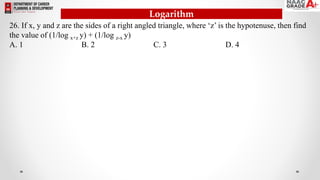
26. If x, y and z are the sides of a right angled triangle, where ‘z’ is the hypotenuse, then find
the value of (1/log x+z y) + (1/log z-x y)
A. 1 B. 2 C. 3 D. 4
Logarithm
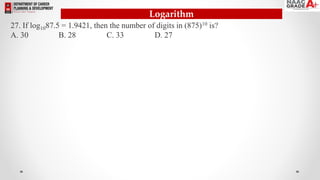
27. If log1087.5 = 1.9421, then the number of digits in (875)10 is?
A. 30 B. 28 C. 33 D. 27
Logarithm
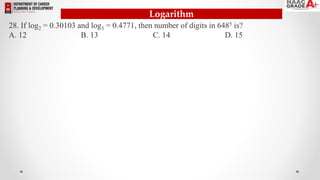
28. If log2 = 0.30103 and log3 = 0.4771, then number of digits in 6485 is?
A. 12 B. 13 C. 14 D. 15
Logarithm
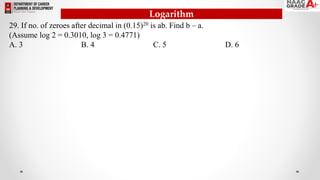
29. If no. of zeroes after decimal in (0.15)20 is ab. Find b – a.
(Assume log 2 = 0.3010, log 3 = 0.4771)
A. 3 B. 4 C. 5 D. 6
Logarithm
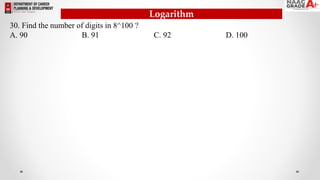
30. Find the number of digits in 8^100 ?
A. 90 B. 91 C. 92 D. 100
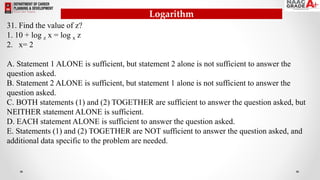
31. Find the value of z?
1. 10 + log z x = log x z
2. x= 2
A. Statement 1 ALONE is sufficient, but statement 2 alone is not sufficient to answer the
question asked.
B. Statement 2 ALONE is sufficient, but statement 1 alone is not sufficient to answer the
question asked.
C. BOTH statements (1) and (2) TOGETHER are sufficient to answer the question asked, but
NEITHER statement ALONE is sufficient.
D. EACH statement ALONE is sufficient to answer the question asked.
E. Statements (1) and (2) TOGETHER are NOT sufficient to answer the question asked, and
additional data specific to the problem are needed.
Logarithm
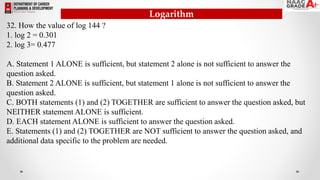
32. How the value of log 144 ?
1. log 2 = 0.301
2. log 3= 0.477
A. Statement 1 ALONE is sufficient, but statement 2 alone is not sufficient to answer the
question asked.
B. Statement 2 ALONE is sufficient, but statement 1 alone is not sufficient to answer the
question asked.
C. BOTH statements (1) and (2) TOGETHER are sufficient to answer the question asked, but
NEITHER statement ALONE is sufficient.
D. EACH statement ALONE is sufficient to answer the question asked.
E. Statements (1) and (2) TOGETHER are NOT sufficient to answer the question asked, and
additional data specific to the problem are needed.
Logarithm
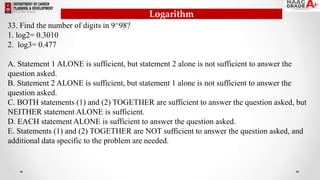
33. Find the number of digits in 9^98?
1. log2= 0.3010
2. log3= 0.477
A. Statement 1 ALONE is sufficient, but statement 2 alone is not sufficient to answer the
question asked.
B. Statement 2 ALONE is sufficient, but statement 1 alone is not sufficient to answer the
question asked.
C. BOTH statements (1) and (2) TOGETHER are sufficient to answer the question asked, but
NEITHER statement ALONE is sufficient.
D. EACH statement ALONE is sufficient to answer the question asked.
E. Statements (1) and (2) TOGETHER are NOT sufficient to answer the question asked, and
additional data specific to the problem are needed.
Logarithm
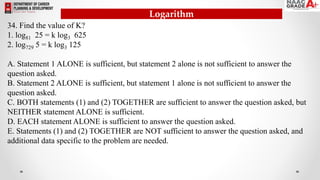
34. Find the value of K?
1. log81 25 = k log3 625
2. log729 5 = k log3 125
A. Statement 1 ALONE is sufficient, but statement 2 alone is not sufficient to answer the
question asked.
B. Statement 2 ALONE is sufficient, but statement 1 alone is not sufficient to answer the
question asked.
C. BOTH statements (1) and (2) TOGETHER are sufficient to answer the question asked, but
NEITHER statement ALONE is sufficient.
D. EACH statement ALONE is sufficient to answer the question asked.
E. Statements (1) and (2) TOGETHER are NOT sufficient to answer the question asked, and
additional data specific to the problem are needed.
Logarithm
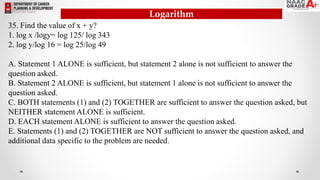
35. Find the value of x + y?
1. log x /logy= log 125/ log 343
2. log y/log 16 = log 25/log 49
A. Statement 1 ALONE is sufficient, but statement 2 alone is not sufficient to answer the
question asked.
B. Statement 2 ALONE is sufficient, but statement 1 alone is not sufficient to answer the
question asked.
C. BOTH statements (1) and (2) TOGETHER are sufficient to answer the question asked, but
NEITHER statement ALONE is sufficient.
D. EACH statement ALONE is sufficient to answer the question asked.
E. Statements (1) and (2) TOGETHER are NOT sufficient to answer the question asked, and
additional data specific to the problem are needed.
Logarithm
40

Logarithm_CH.Logarithim questionsghjhjhpptx

  • 1.
  • 2.
    Logarithm What are Logarithms? •Logarithms are the inverse of exponents. • A logarithm (or log) is the mathematical expression used to answer the question: How many times must one “base” number be multiplied by itself to get some other particular number? • For instance, how many times must a base of 10 be multiplied by itself to get 1,000? The answer is 3 (1,000 = 10 × 10 × 10).
  • 3.
    Logarithm RELATION BETWEEN EXPONENTIATIONAND LOGARITHM: TYPES OF LOGARITHM:  Common Logarithm: The logarithm base 10 (that is b = 10) is called the common logarithm and is commonly used in science and engineering.  Natural Logarithm: The natural logarithm has the number e (that is b ≈ 2.718) as its base; its use is widespread in mathematics and physics, because of its simpler integral and derivative.  Binary Logarithm: The binary logarithm uses base 2 (that is b = 2) and is commonly used in computer science. Logarithms are examples of concave functions.
  • 4.
  • 5.
  • 6.
    1. log 2= 0.3010 and log 3 = 0.4771, the values of log5 512 is A) 2.875 B) 3.875 C) 4.875 D) 5.875 Logarithm
  • 7.
    Logarithm 2. If log64 = 1.8061, then the value of log 16 will be (approx)? A) 1.9048 B) 1.2040 C) 0.9840 D) 1.4521
  • 8.
    Logarithm 3. Solve forx: 2log(x + 2) = log(x + 2) + 1 A. 8 B. 6 C. 9 D. 10
  • 9.
    Logarithm 4. Solve :49log 7 4 A. 7 B. 14 C. 16 D. 18
  • 10.
    Logarithm 5. If log3 = 0.477 and (1000)x = 3, then x equals to ? A. 0.159 B. 10 C. 0.0477 D. 0.0159
  • 11.
    Logarithm 6. If 100.3010= 2, then find the value of log0.125 125. ? A. -699 / 301 B. 699 / 301 C. 1 D. 2
  • 12.
    Logarithm 8. log9 (3log2(1 + log3 (1 + 2log2 x))) = 1/2. Find x. A. 4 B. 12 C. 1 D. 2
  • 13.
    Logarithm 9. If logX/(a2 + ab + b2) = log Y/(b2 + bc + c2) = log Z/(c2 + ca + a2), then X a – b .Yb - c. Z c - a =? A. 0 B. -1 C. 1 D. 2
  • 14.
    Logarithm 10. If logX = (log Y)/2 = (log Z)/5, then X4.Y3.Z-2 =? A. 2 B. 10 C. 1 D. 0
  • 15.
    Logarithm 11. If logn48= a and logn108 = b. What is the value of logn1296 in terms of a and b? A. 2(2a + b)/5 B. (a + 3b)/5 C. 4(2a + b)/5 D. 2(a + 3b)/5
  • 16.
    Logarithm 12. What isthe value of X, if 1/(log442/441 X) + 1/(log443/442 X) + 1/(log444/443 X) +…+ 1/(log899/898 X) +1/(log900/899 X) = 2? A. 2/21 B. 1 C. 7/100 D. 10/7
  • 17.
    Logarithm 13. Solve forX, log10X + log√10 X + log 3√100 X = 27 A. 1 B. 104 C. 106 10
  • 18.
    Logarithm 14. If (4.2)x= (0.42)y = 100, then (1/x) - (1/y) = A. 1 B. 2 C. ½ D. -1
  • 19.
    Logarithm 15. If x= 1998!, then value of the expression 1 𝑙𝑜𝑔2 𝑥 + 1 𝑙𝑜𝑔3 𝑥 +……+ 1 𝑙𝑜𝑔1998 𝑥 equals- A. -1 B. 0 C. 1 D. 1998
  • 20.
    Logarithm 16. In whichof the following m > n (A)m = (log2 5)2 & n = log2 20 (B) m = log10 2 & n = log10 3√10 (C) m = log10 5. log10 20 + (log10 2)2 & n = 1 (D) m = log1/2 (1/3) & n = log1/3 (1/16)
  • 21.
  • 22.
    Logarithm 18. If log3[log2(x2 – 4x – 37)] = 1, where ‘x’ is a natural number, find the value of x. A. 9 B. 10 C. 7 D. 4
  • 23.
    Logarithm 19. If 3(X- 2) = 5 and log10 2 = 0.3010, log103= 0.4771, then X =? A. 1 + (2218/4771) B. 2 + (2218/4771) C. 2 + (2218/4771) D. None of these
  • 24.
    Logarithm 20. If log303 = p and log30 5 = q, then, how is log30 8 expressed in terms of p and q A. 3 – 3(p + q) B. 5p + 2q – 1 C. p + q -2 D. None of these
  • 25.
    Logarithm 21. If log8log3 log2 2+3√x=1/3. Find x A. 512 B. 289 C. 170 D. None of these
  • 26.
    Logarithm 22. log3x +logx3 = 17/4. Find the value of x. A. 34 B. 31/4 C. 34 or 31/4 D. 31/3
  • 27.
    Logarithm 23. Find thevalue of log10 10 + log10 102 + ……… + log10 10n A. n∗(2n+1) B. n∗(n+1)/2 C. 3n∗(n+1)/2 D. n∗(n2+1)/2
  • 28.
    Logarithm 24. If log2X+ log4X = log0.25√6 and x > 0, then x is A. 6-1/6 B. 61/6 C. 3-1/3 D. 61/3
  • 29.
    Logarithm 25. If x,y, z be positive real numbers such that log2x z = 3, log5y z = 6 and log xy z = 2/3 then the value of z is in the form of m/n in lowest form then find value of n – m A. 7 B. 5 C. 3 D. 9
  • 30.
    Logarithm 26. If x,y and z are the sides of a right angled triangle, where ‘z’ is the hypotenuse, then find the value of (1/log x+z y) + (1/log z-x y) A. 1 B. 2 C. 3 D. 4
  • 31.
    Logarithm 27. If log1087.5= 1.9421, then the number of digits in (875)10 is? A. 30 B. 28 C. 33 D. 27
  • 32.
    Logarithm 28. If log2= 0.30103 and log3 = 0.4771, then number of digits in 6485 is? A. 12 B. 13 C. 14 D. 15
  • 33.
    Logarithm 29. If no.of zeroes after decimal in (0.15)20 is ab. Find b – a. (Assume log 2 = 0.3010, log 3 = 0.4771) A. 3 B. 4 C. 5 D. 6
  • 34.
    Logarithm 30. Find thenumber of digits in 8^100 ? A. 90 B. 91 C. 92 D. 100
  • 35.
    31. Find thevalue of z? 1. 10 + log z x = log x z 2. x= 2 A. Statement 1 ALONE is sufficient, but statement 2 alone is not sufficient to answer the question asked. B. Statement 2 ALONE is sufficient, but statement 1 alone is not sufficient to answer the question asked. C. BOTH statements (1) and (2) TOGETHER are sufficient to answer the question asked, but NEITHER statement ALONE is sufficient. D. EACH statement ALONE is sufficient to answer the question asked. E. Statements (1) and (2) TOGETHER are NOT sufficient to answer the question asked, and additional data specific to the problem are needed. Logarithm
  • 36.
    32. How thevalue of log 144 ? 1. log 2 = 0.301 2. log 3= 0.477 A. Statement 1 ALONE is sufficient, but statement 2 alone is not sufficient to answer the question asked. B. Statement 2 ALONE is sufficient, but statement 1 alone is not sufficient to answer the question asked. C. BOTH statements (1) and (2) TOGETHER are sufficient to answer the question asked, but NEITHER statement ALONE is sufficient. D. EACH statement ALONE is sufficient to answer the question asked. E. Statements (1) and (2) TOGETHER are NOT sufficient to answer the question asked, and additional data specific to the problem are needed. Logarithm
  • 37.
    33. Find thenumber of digits in 9^98? 1. log2= 0.3010 2. log3= 0.477 A. Statement 1 ALONE is sufficient, but statement 2 alone is not sufficient to answer the question asked. B. Statement 2 ALONE is sufficient, but statement 1 alone is not sufficient to answer the question asked. C. BOTH statements (1) and (2) TOGETHER are sufficient to answer the question asked, but NEITHER statement ALONE is sufficient. D. EACH statement ALONE is sufficient to answer the question asked. E. Statements (1) and (2) TOGETHER are NOT sufficient to answer the question asked, and additional data specific to the problem are needed. Logarithm
  • 38.
    34. Find thevalue of K? 1. log81 25 = k log3 625 2. log729 5 = k log3 125 A. Statement 1 ALONE is sufficient, but statement 2 alone is not sufficient to answer the question asked. B. Statement 2 ALONE is sufficient, but statement 1 alone is not sufficient to answer the question asked. C. BOTH statements (1) and (2) TOGETHER are sufficient to answer the question asked, but NEITHER statement ALONE is sufficient. D. EACH statement ALONE is sufficient to answer the question asked. E. Statements (1) and (2) TOGETHER are NOT sufficient to answer the question asked, and additional data specific to the problem are needed. Logarithm
  • 39.
    35. Find thevalue of x + y? 1. log x /logy= log 125/ log 343 2. log y/log 16 = log 25/log 49 A. Statement 1 ALONE is sufficient, but statement 2 alone is not sufficient to answer the question asked. B. Statement 2 ALONE is sufficient, but statement 1 alone is not sufficient to answer the question asked. C. BOTH statements (1) and (2) TOGETHER are sufficient to answer the question asked, but NEITHER statement ALONE is sufficient. D. EACH statement ALONE is sufficient to answer the question asked. E. Statements (1) and (2) TOGETHER are NOT sufficient to answer the question asked, and additional data specific to the problem are needed. Logarithm
  • 40.

Editor's Notes

  • #7 Correct option: B Easy (Compulsory)
  • #8 Option B Easy (Compulsory)
  • #9 Option A. Easy (Compulsory)
  • #10 Option C Easy (Compulsory)
  • #11 Option A Easy (Compulsory)
  • #12 Option B Easy (Compulsory)
  • #13 Option D Moderate (Compulsory)
  • #14 Option C Expert (Compulsory)
  • #15 Option C Moderate (Optional)
  • #16 Option D Moderate (Compulsory)
  • #17 Option D Expert (Compulsory)
  • #18 Option C Moderate (Compulsory)
  • #19 Option C Moderate (Optional)
  • #20 Option C Expert (Compulsory)
  • #21 Option A Moderate (Compulsory)
  • #22 Option D Easy (Optional)
  • #23 Option A Moderate (Compulsory)
  • #24 Option C Expert (Compulsory)
  • #25 Option A Moderate (Optional)
  • #26 Option D Moderate (Compulsory)
  • #27 Option C Easy (Optional)
  • #28 Option B Expert (Compulsory)
  • #29 Option A Moderate (Optional)
  • #30 Option D Moderate (Compulsory)
  • #31 Option B Moderate (Compulsory)
  • #32 Option A Easy (Compulsory)
  • #33 Option D Easy (Optional)
  • #34 Option C Moderate (Compulsory)
  • #35 Option B Expert (Compulsory)
  • #36 Ans C Easy (Optional)
  • #37 Ans C Easy (Compulsory)
  • #38 Ans B Moderate (Optional)
  • #39 Ans D Moderate (Compulsory)
  • #40 Ans C Moderate (Optional)