Load Testing
• Load Testing is a type of Performance
Testing which determines the performance of a
system, software product or software application
under real life based load conditions.
• Load testing determines the behavior of the
application when multiple users use it at the same
time. It is the response of the system measured
under varying load conditions.
• The load testing is carried out for normal and
extreme load conditions.
Objectives of Load Testing:
• To maximize the operating capacity of a software
application.
• To determine whether the latest infrastructure is
capable to run the software application or not.
• To determine the sustainability of application with
respect to extreme user load.
• To find out the total count of users that can
access the application at the same time.
• To determine scalability of the application.
• To allow more users to access the application.
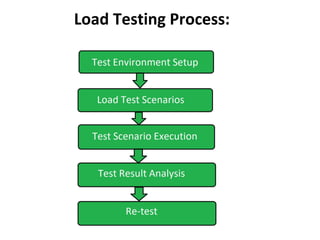
Load Testing Process:
• Test Environment Setup:
Firstly create a dedicated test environment setup
for performing the load testing. It ensures that
testing would be done in a proper way.
• Load Test Scenario:
In second step load test scenarios are created.
Then load testing transactions are determined for
an application and data is prepared for each
transaction.
• Test Scenario Execution:
Load test scenarios that were created in previous step
are now executed. Different measurements and
metrices are gathered to collect the information.
• Test Result Analysis:
Results of the testing performed is analyzed and
various recommendations are made.
• Re-test:
If the test is failed then the test is performed again in
order to get the result in correct way.
Load Testing Tools:
Apache Jmeter
WebLoad
NeoLoad
LoadNinja
HP Performance Tester
LoadUI Pro
LoadView
Advantages of Load Testing:
• Load testing enhances the sustainability of the
system or software application.
• It improves the scalability of the system or
software application.
• It helps in the minimization of the risks related
to system downtime.
• It reduces the costs of failure of the system.
• It increases customer’s satisfaction.
Disadvantages of Load Testing:
• Need programming knowledge to use load
testing tools.
• Tools can be expensive as pricing depends on
the number of virtual users supported.

Load Testing.pdf

  • 1.
    Load Testing • LoadTesting is a type of Performance Testing which determines the performance of a system, software product or software application under real life based load conditions. • Load testing determines the behavior of the application when multiple users use it at the same time. It is the response of the system measured under varying load conditions. • The load testing is carried out for normal and extreme load conditions.
  • 2.
    Objectives of LoadTesting: • To maximize the operating capacity of a software application. • To determine whether the latest infrastructure is capable to run the software application or not. • To determine the sustainability of application with respect to extreme user load. • To find out the total count of users that can access the application at the same time. • To determine scalability of the application. • To allow more users to access the application.
  • 3.
  • 4.
    • Test EnvironmentSetup: Firstly create a dedicated test environment setup for performing the load testing. It ensures that testing would be done in a proper way. • Load Test Scenario: In second step load test scenarios are created. Then load testing transactions are determined for an application and data is prepared for each transaction.
  • 5.
    • Test ScenarioExecution: Load test scenarios that were created in previous step are now executed. Different measurements and metrices are gathered to collect the information. • Test Result Analysis: Results of the testing performed is analyzed and various recommendations are made. • Re-test: If the test is failed then the test is performed again in order to get the result in correct way.
  • 6.
    Load Testing Tools: ApacheJmeter WebLoad NeoLoad LoadNinja HP Performance Tester LoadUI Pro LoadView
  • 7.
    Advantages of LoadTesting: • Load testing enhances the sustainability of the system or software application. • It improves the scalability of the system or software application. • It helps in the minimization of the risks related to system downtime. • It reduces the costs of failure of the system. • It increases customer’s satisfaction.
  • 8.
    Disadvantages of LoadTesting: • Need programming knowledge to use load testing tools. • Tools can be expensive as pricing depends on the number of virtual users supported.