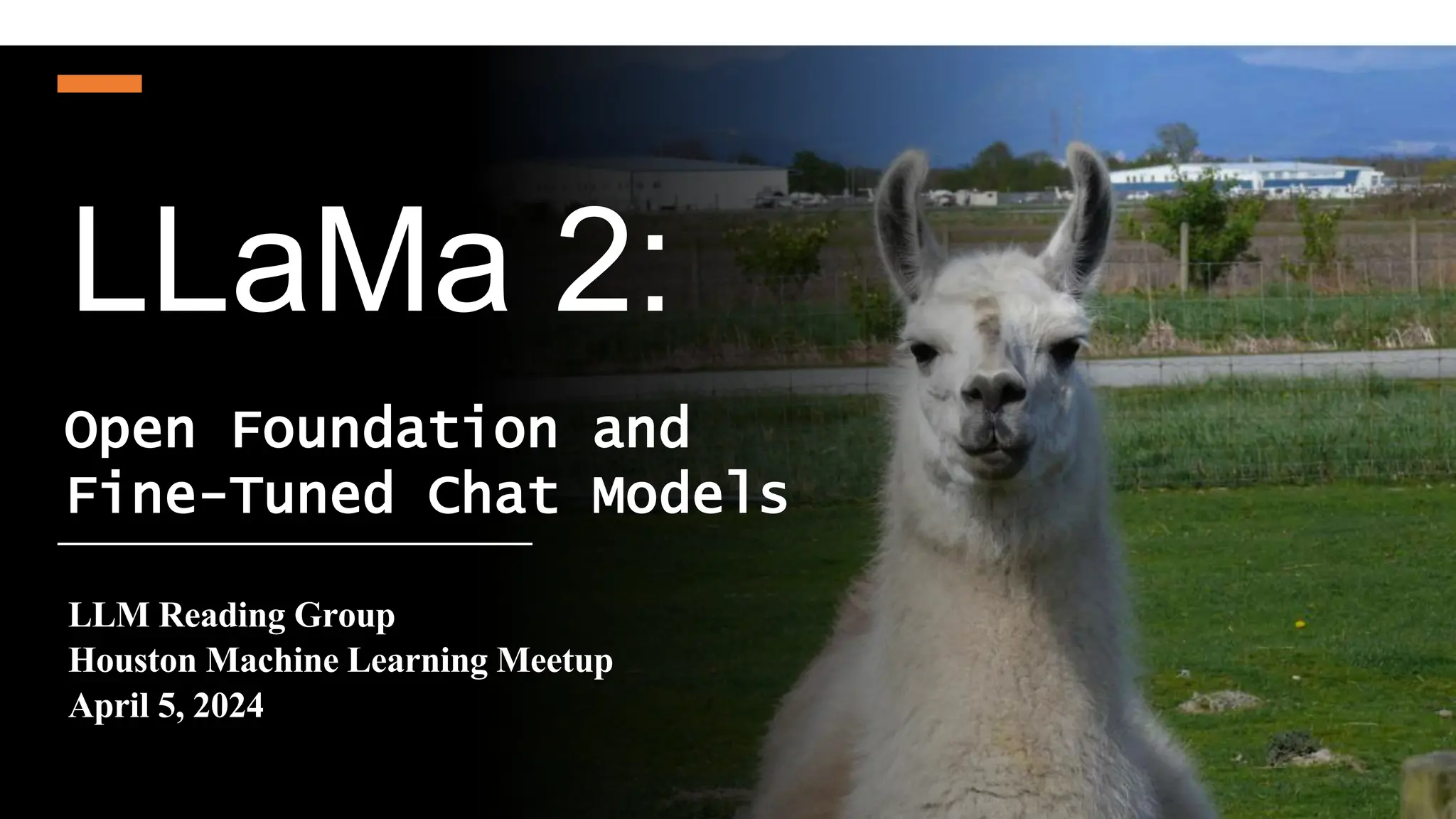
Open Foundation and
Fine-Tuned Chat Models
LLM Reading Group
Houston Machine Learning Meetup
April 5, 2024
LLaMa 2:
LLaMA series
• LLaMA: Open and Efficient Foundation Language Models, Feb 2023
• LLaMA 2: Open Foundation and Fine-Tuned Chat Models, July 2023
• Variants of LLaMA: Alpaca, Vicuna, LLaVA
• Hands-on session: Fine-tune a LLaMA model
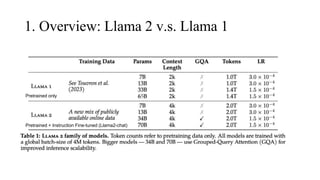
1. Overview: Llama 2 v.s. Llama 1
Pretrained only
Pretrained + Instruction Fine-tuned (Llama2-chat)
Architecture
Llama 2 adopt most of the pretraining setting and model
architecture from Llama 1:
1) Pre-normalization with RMSNorm [GPT3]
SwiGLU activation function [PaLM]
Rotary Embeddings [GPTNeo]
Refer to my Llama 1 presentation for more details: Llama 1 @
YanAITalk Youtube channel
2. Approach
SwiGLU
Activation
Pos Embedding
The primary architectural differences from Llama 1
include increased context length and grouped-query
attention (GQA)
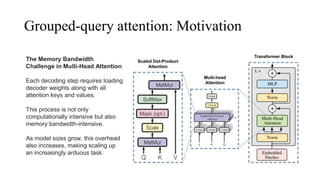
Grouped-query attention: Motivation
The Memory Bandwidth
Challenge in Multi-Head Attention
Each decoding step requires loading
decoder weights along with all
attention keys and values.
This process is not only
computationally intensive but also
memory bandwidth-intensive.
As model sizes grow, this overhead
also increases, making scaling up
an increasingly arduous task.
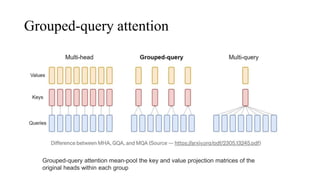
Grouped-query attention
Grouped-query attention mean-pool the key and value projection matrices of the
original heads within each group
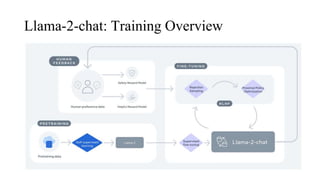
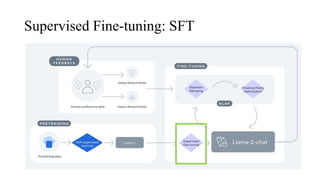
Llama-2-chat: Training Overview
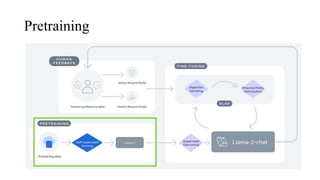
Pretraining
Pretraining Datasets
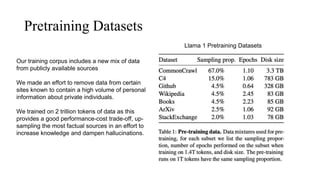
Llama 1 Pretraining Datasets
Our training corpus includes a new mix of data
from publicly available sources
We made an effort to remove data from certain
sites known to contain a high volume of personal
information about private individuals.
We trained on 2 trillion tokens of data as this
provides a good performance-cost trade-off, up-
sampling the most factual sources in an effort to
increase knowledge and dampen hallucinations.
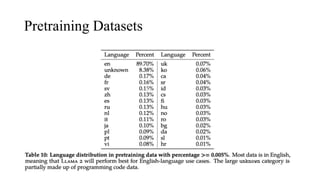
Pretraining Datasets
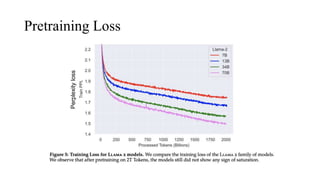
Pretraining Loss
Perplexity
loss
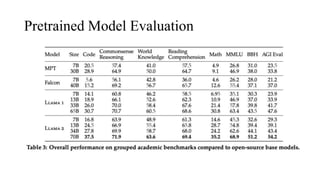
Pretrained Model Evaluation
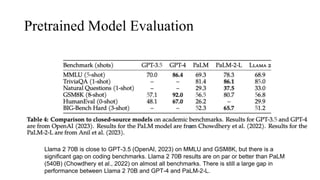
Llama 2 70B is close to GPT-3.5 (OpenAI, 2023) on MMLU and GSM8K, but there is a
significant gap on coding benchmarks. Llama 2 70B results are on par or better than PaLM
(540B) (Chowdhery et al., 2022) on almost all benchmarks. There is still a large gap in
performance between Llama 2 70B and GPT-4 and PaLM-2-L.
Supervised Fine-tuning: SFT
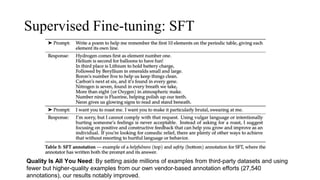
Quality Is All You Need: By setting aside millions of examples from third-party datasets and using
fewer but higher-quality examples from our own vendor-based annotation efforts (27,540
annotations), our results notably improved.
Human Preference Data
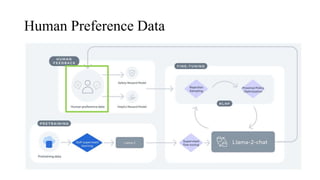
Human Preference Data Collection
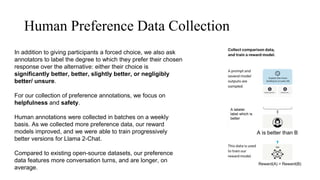
In addition to giving participants a forced choice, we also ask
annotators to label the degree to which they prefer their chosen
response over the alternative: either their choice is
significantly better, better, slightly better, or negligibly
better/ unsure.
For our collection of preference annotations, we focus on
helpfulness and safety.
Human annotations were collected in batches on a weekly
basis. As we collected more preference data, our reward
models improved, and we were able to train progressively
better versions for Llama 2-Chat.
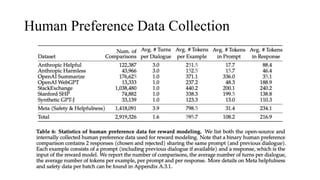
Compared to existing open-source datasets, our preference
data features more conversation turns, and are longer, on
average.
A labeler
label which is
better
A is better than B
Reward(A) > Reward(B)
A is better than B
Human Preference Data Collection
Reward Modeling
Reward Modeling
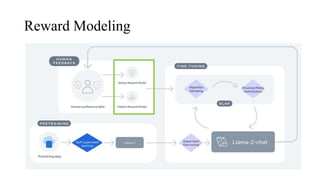
We train two separate reward models, one optimized for helpfulness (referred to as Helpfulness RM) and
another for safety (Safety RM).
We initialize our reward models from pretrained chat model checkpoints, as it ensures that both models
benefit from knowledge acquired in pretraining.
The model architecture and hyper-parameters are identical to those of the pretrained language models, except
that the classification head for next-token prediction is replaced with a regression head for outputting a scalar
reward.
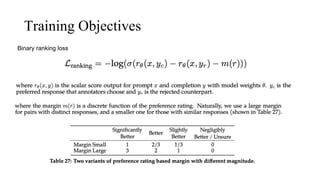
Training Objectives
Binary ranking loss
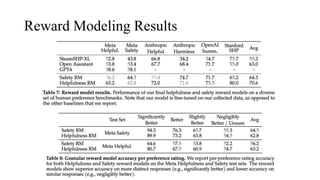
Reward Modeling Results
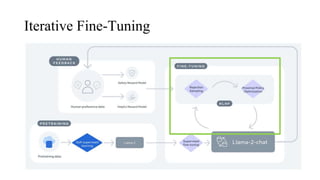
Iterative Fine-Tuning
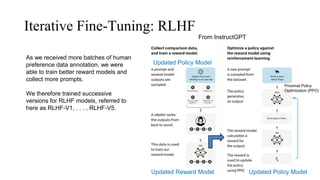
Iterative Fine-Tuning: RLHF
As we received more batches of human
preference data annotation, we were
able to train better reward models and
collect more prompts.
We therefore trained successive
versions for RLHF models, referred to
here as RLHF-V1, . . . , RLHF-V5.
From InstructGPT
Updated Policy Model
Updated Reward Model Updated Policy Model
Proximal Policy
Optimization (PPO)
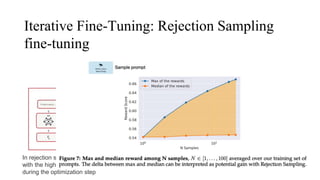
Iterative Fine-Tuning: Rejection Sampling
fine-tuning
In rejection sampling, K outputs are drawn, and the one
with the highest reward is chosen for the gradient update
during the optimization step
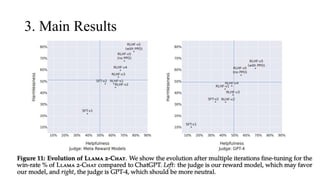
3. Main Results
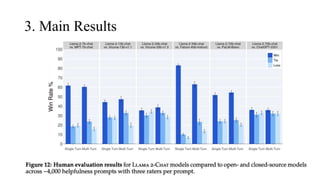
3. Main Results
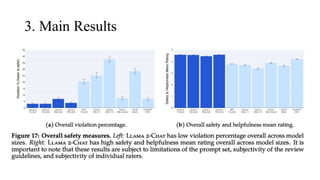
3. Main Results
4. Conclusion
• These models have demonstrated their competitiveness with existing open-
source chat models, as well as competency that is equivalent to some proprietary
models on evaluation sets we examined, although they still lag behind other
models like GPT-4.
• We meticulously elaborated on the methods and techniques applied in achieving
our models, with a heavy emphasis on their alignment with the principles of
helpfulness and safety.
• To contribute more significantly to society and foster the pace of research, we
have responsibly opened access to Llama 2 and Llama 2-Chat. As part of our
ongoing commitment to transparency and safety, we plan to make further
improvements to Llama 2-Chat in future work.
LLaMA series
• LLaMA: Open and Efficient Foundation Language Models, Feb 2023
• LLaMA 2: Open Foundation and Fine-Tuned Chat Models, July 2023
• Variants of LLaMA: Alpaca, Vicuna, LLaVA
• Hands-on session: Fine-tune a LLaMA model

Llama 2: Open Foundation and Fine-tuned Chat Models

  • 1.
    Open Foundation and Fine-TunedChat Models LLM Reading Group Houston Machine Learning Meetup April 5, 2024 LLaMa 2:
  • 2.
    LLaMA series • LLaMA:Open and Efficient Foundation Language Models, Feb 2023 • LLaMA 2: Open Foundation and Fine-Tuned Chat Models, July 2023 • Variants of LLaMA: Alpaca, Vicuna, LLaVA • Hands-on session: Fine-tune a LLaMA model
  • 3.
    1. Overview: Llama2 v.s. Llama 1 Pretrained only Pretrained + Instruction Fine-tuned (Llama2-chat)
  • 4.
    Architecture Llama 2 adoptmost of the pretraining setting and model architecture from Llama 1: 1) Pre-normalization with RMSNorm [GPT3] SwiGLU activation function [PaLM] Rotary Embeddings [GPTNeo] Refer to my Llama 1 presentation for more details: Llama 1 @ YanAITalk Youtube channel 2. Approach SwiGLU Activation Pos Embedding The primary architectural differences from Llama 1 include increased context length and grouped-query attention (GQA)
  • 5.
    Grouped-query attention: Motivation TheMemory Bandwidth Challenge in Multi-Head Attention Each decoding step requires loading decoder weights along with all attention keys and values. This process is not only computationally intensive but also memory bandwidth-intensive. As model sizes grow, this overhead also increases, making scaling up an increasingly arduous task.
  • 6.
    Grouped-query attention Grouped-query attentionmean-pool the key and value projection matrices of the original heads within each group
  • 7.
  • 8.
  • 9.
    Pretraining Datasets Llama 1Pretraining Datasets Our training corpus includes a new mix of data from publicly available sources We made an effort to remove data from certain sites known to contain a high volume of personal information about private individuals. We trained on 2 trillion tokens of data as this provides a good performance-cost trade-off, up- sampling the most factual sources in an effort to increase knowledge and dampen hallucinations.
  • 10.
  • 11.
  • 12.
  • 13.
    Pretrained Model Evaluation Llama2 70B is close to GPT-3.5 (OpenAI, 2023) on MMLU and GSM8K, but there is a significant gap on coding benchmarks. Llama 2 70B results are on par or better than PaLM (540B) (Chowdhery et al., 2022) on almost all benchmarks. There is still a large gap in performance between Llama 2 70B and GPT-4 and PaLM-2-L.
  • 14.
  • 15.
    Supervised Fine-tuning: SFT QualityIs All You Need: By setting aside millions of examples from third-party datasets and using fewer but higher-quality examples from our own vendor-based annotation efforts (27,540 annotations), our results notably improved.
  • 16.
  • 17.
    Human Preference DataCollection In addition to giving participants a forced choice, we also ask annotators to label the degree to which they prefer their chosen response over the alternative: either their choice is significantly better, better, slightly better, or negligibly better/ unsure. For our collection of preference annotations, we focus on helpfulness and safety. Human annotations were collected in batches on a weekly basis. As we collected more preference data, our reward models improved, and we were able to train progressively better versions for Llama 2-Chat. Compared to existing open-source datasets, our preference data features more conversation turns, and are longer, on average. A labeler label which is better A is better than B Reward(A) > Reward(B) A is better than B
  • 18.
  • 19.
  • 20.
    Reward Modeling We traintwo separate reward models, one optimized for helpfulness (referred to as Helpfulness RM) and another for safety (Safety RM). We initialize our reward models from pretrained chat model checkpoints, as it ensures that both models benefit from knowledge acquired in pretraining. The model architecture and hyper-parameters are identical to those of the pretrained language models, except that the classification head for next-token prediction is replaced with a regression head for outputting a scalar reward.
  • 21.
  • 22.
  • 23.
  • 24.
    Iterative Fine-Tuning: RLHF Aswe received more batches of human preference data annotation, we were able to train better reward models and collect more prompts. We therefore trained successive versions for RLHF models, referred to here as RLHF-V1, . . . , RLHF-V5. From InstructGPT Updated Policy Model Updated Reward Model Updated Policy Model Proximal Policy Optimization (PPO)
  • 25.
    Iterative Fine-Tuning: RejectionSampling fine-tuning In rejection sampling, K outputs are drawn, and the one with the highest reward is chosen for the gradient update during the optimization step
  • 26.
  • 27.
  • 28.
  • 29.
    4. Conclusion • Thesemodels have demonstrated their competitiveness with existing open- source chat models, as well as competency that is equivalent to some proprietary models on evaluation sets we examined, although they still lag behind other models like GPT-4. • We meticulously elaborated on the methods and techniques applied in achieving our models, with a heavy emphasis on their alignment with the principles of helpfulness and safety. • To contribute more significantly to society and foster the pace of research, we have responsibly opened access to Llama 2 and Llama 2-Chat. As part of our ongoing commitment to transparency and safety, we plan to make further improvements to Llama 2-Chat in future work.
  • 30.
    LLaMA series • LLaMA:Open and Efficient Foundation Language Models, Feb 2023 • LLaMA 2: Open Foundation and Fine-Tuned Chat Models, July 2023 • Variants of LLaMA: Alpaca, Vicuna, LLaVA • Hands-on session: Fine-tune a LLaMA model

Editor's Notes

  • #5 Gated linear unit