UNIVERSITY OF GAZIANTEP
FACULTY OF ENGINEERING
DEPARTMENT OF MECHANICAL ENGINEERING
ME399
ENGINEERING PRACTICE PROGRAMME
PREPARED BY : İLKER ALTINSOY / 200961071
~ 1 ~
CONTENTS
INFORMATION OF THE COMPANY .............................................................................. 3
Name and Location of The Company ....................................................................... 3
History ......................................................................................................................... 3
Working Area and Structure of MIP ....................................................................... 4
Employement of MIP ................................................................................................. 4
Organization Chart .................................................................................................... 4
INTRODUCTION .................................................................................................................. 5
GENERAL OVERWİEV OF MERSİN PORT ................................................................... 6
TECHNICAL SPECIFICATIONS ....................................................................................... 6
PORT SERVICES .................................................................................................................. 8
Container Services ...................................................................................................... 8
CFS(Container Freight Station) Services ............................................................... 10
Railway Terminal Services ....................................................................................... 11
CONVENTIONAL CARGO SERVICES .......................................................................... 12
Dry Bulk Cargo ......................................................................................................... 13
Liquid Bulk Cargo .................................................................................................... 14
Project Cargo ............................................................................................................ 15
General Cargo ........................................................................................................... 16
Roll-on/Roll-off (RO-RO) Cargo ............................................................................. 17
PassengerTerminal .................................................................................................. 19
MARINE SERVICES ........................................................................................................... 20
EQUIPMENTS AND THEIR SPECIFICATIONS ........................................................... 21
Cranes ........................................................................................................................ 21
~ 2 ~
Stackers ..................................................................................................................... 24
Other Equipments and Vehicles ............................................................................. 25
CONTAINER TYPES ......................................................................................................... 26
Container Types by Their Weight .......................................................................... 26
Container Types by Their Types ............................................................................ 26
DEPARTMENTS ................................................................................................................. 35
Engineering Department ......................................................................................... 35
Operation Department ............................................................................................. 35
COST ANALYSIS ................................................................................................................ 37
CONCLUSION ..................................................................................................................... 40
~ 3 ~
INFORMATION OF THE COMPANY
1. NAME AND LOCATION OF THE COMPANY
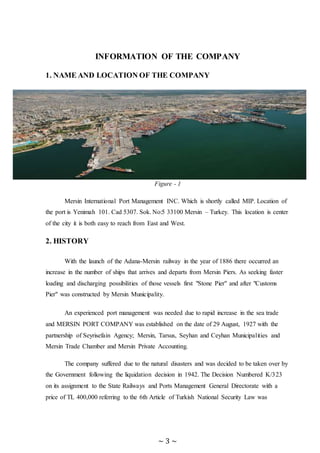
Figure - 1
Mersin International Port Management INC. Which is shortly called MIP. Location of
the port is Yenimah 101. Cad 5307. Sok. No:5 33100 Mersin – Turkey. This location is center
of the city it is both easy to reach from East and West.
2. HISTORY
With the launch of the Adana-Mersin railway in the year of 1886 there occurred an
increase in the number of ships that arrives and departs from Mersin Piers. As seeking faster
loading and discharging possibilities of those vessels first "Stone Pier" and after "Customs
Pier" was constructed by Mersin Municipality.
An experienced port management was needed due to rapid increase in the sea trade
and MERSIN PORT COMPANY was established on the date of 29 August, 1927 with the
partnership of Seyrisefain Agency; Mersin, Tarsus, Seyhan and Ceyhan Municipalities and
Mersin Trade Chamber and Mersin Private Accounting.
The company suffered due to the natural disasters and was decided to be taken over by
the Government following the liquidation decision in 1942. The Decision Numbered K/323
on its assignment to the State Railways and Ports Management General Directorate with a
price of TL 400,000 referring to the 6th Article of Turkish National Security Law was
~ 4 ~
approved with the Council of Ministers Decree Numbered 2/17874 and dated on 9 May, 1942
published on the Official Gazette Numbered 5106 and dated on 14 May.
3. WORKING AREA AND STRUCTURE OF MIP
MIP, which was established as a partnership between PSA International and Akfen
Holding, took over T.C.D.D. Mersin Port Management for a period of 36 years on May 11
2007.
Mersin International Port (MIP) located in PSA, has an international port management
network around the globe. Besides having an extensive experience of port management.
Akfen Holding, which has started its operations in 1976, operates primarily in the
fields of airport and sea port investment and management, among other fields such as energy
and various infrastructure investments and the development of real estate investment projects.
Mersin International Port (MIP) is connected via railways and highways with Turkey’s
industrialized cities such as Ankara, Gaziantep, Kayseri, Kahramanmaraş and Konya, and
with bordering countries such as Syria, Iraq and Iran. It is one of the main container ports in
the Mediterranean Region with its transit and hinterland connections with the Middle East and
the Black Sea.
Mersin International Port (MIP) meets a significant portion of Turkey’s import and
export volumes with its vast hinterland, accessible transportation opportunities and qualified
human resources.
4. EMPLOYEMENTOF MIP
Mersin International Port (MIP) has an engineering department there are 4 engineers
which two of them are electrical and electronic engineer other two are mechanical engineer
also this department has many technician. Engineering department main job is maintenance
and fix malfunctions of the work equipments such as cranes, trucks, lifts etc. Some of
technicians are mobile and they try to fix malfunctions on the field, others stays at the
workshop to make routine maintenance and fix malfunctions which cannot be done on the
field.
5. ORGANIZATION CHART
Organization chart of the company is in Appendix A.
~ 5 ~
INTRODUCTION
The subject of the summer practice is having a chance to examine the management
and organization of the factory and learn about organizations and relationship between
employer – employee.
I have done my summer practice at Mersin International Port. My internship was 20
working days as usual. I was in company between 17.08.2015 and 11.08.2015.
I spend my first week at workshop I had chance to examine storage unit and
maintenance team. After one week I went to business development more specifically planning
department. This department is the heart of the port every ship comes to port and every
movement they make is planning in this department. That’s why I wanted to see this
department. I have spent my remaining time in business development especially in planning
department.
I had a chance to have knowledge about equipment management, planning, and human
relations between executives and workers. I also have clearly seen that engineering is one of
the most important jobs in an organization from bottom to top. Engineers can organize
workloads with the best efficiency and solve difficulties quickly with minimum damage
besides their technical knowledge.
As far as I concern, these knowledge will be very useful for every engineering student
when they graduated from their faculties and start their job in a company. We will have an
idea about how should we behave to technicians and react to obstacles in our ways during our
work life.
~ 6 ~
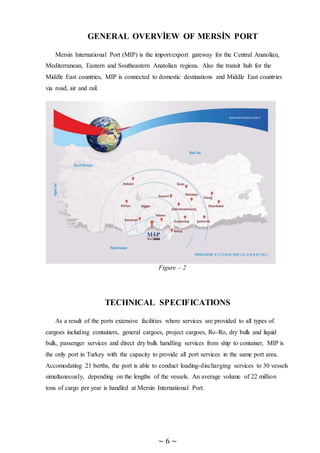
GENERAL OVERVİEW OF MERSİN PORT
Mersin International Port (MIP) is the import/export gateway for the Central Anatolian,
Mediterranean, Eastern and Southeastern Anatolian regions. Also the transit hub for the
Middle East countries, MIP is connected to domestic destinations and Middle East countries
via road, air and rail.
Figure – 2
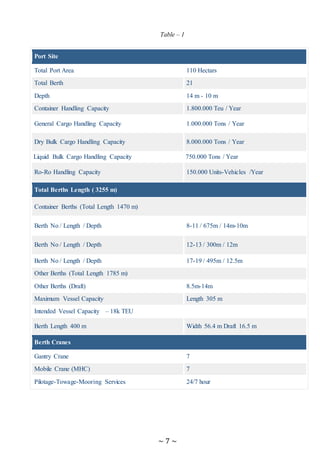
TECHNICAL SPECIFICATIONS
As a result of the ports extensive facilities where services are provided to all types of
cargoes including containers, general cargoes, project cargoes, Ro-Ro, dry bulk and liquid
bulk, passenger services and direct dry bulk handling services from ship to container, MIP is
the only port in Turkey with the capacity to provide all port services in the same port area.
Accomodating 21 berths, the port is able to conduct loading-discharging services to 30 vessels
simultaneously, depending on the lengths of the vessels. An average volume of 22 million
tons of cargo per year is handled at Mersin International Port.
~ 7 ~
Table – 1
Port Site
Total Port Area 110 Hectars
Total Berth 21
Depth 14 m - 10 m
Container Handling Capacity 1.800.000 Teu / Year
General Cargo Handling Capacity 1.000.000 Tons / Year
Dry Bulk Cargo Handling Capacity 8.000.000 Tons / Year
Liquid Bulk Cargo Handling Capacity 750.000 Tons / Year
Ro-Ro Handling Capacity 150.000 Units-Vehicles /Year
Total Berths Length ( 3255 m)
Container Berths (Total Length 1470 m)
Berth No / Length / Depth 8-11 / 675m / 14m-10m
Berth No / Length / Depth 12-13 / 300m / 12m
Berth No / Length / Depth 17-19 / 495m / 12.5m
Other Berths (Total Length 1785 m)
Other Berths (Draft) 8.5m-14m
Maximum Vessel Capacity Length 305 m
Intended Vessel Capacity – 18k TEU
Berth Length 400 m Width 56.4 m Draft 16.5 m
Berth Cranes
Gantry Crane 7
Mobile Crane (MHC) 7
Pilotage-Towage-Mooring Services 24/7 hour
~ 8 ~
PORT SERVICES
1. Container Services
Mersin International Port is one of the largest container ports in South of Turkey, serving
a wide industrial hinterland in the region with a signficant contribution to the country's
foreign trade. It is connected to all main ports around the world through over 20 shipping
lines making regular calls.
24/7 nonstop service is provided with modern equipments at the Container Terminal with
a total 1470m berth length and 14m draft.
Table - 2
Container Terminal Capacity
Information
Column1
Capacity 1,8m TEU
Container Berths 6 + 3 ( Multipurpose )
Maximum Ship Berthing Capacity
Post Panamax ( 5,000 - 6,500
TEUs )
Container Site Surface Area 35 Aha
Ground Slot 10,225
Table - 3
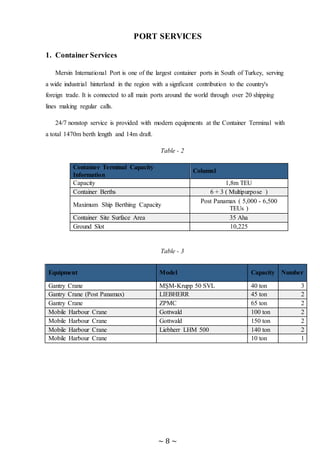
Equipment Model Capacity Number
Gantry Crane MŞM-Krupp 50 SVL 40 ton 3
Gantry Crane (Post Panamax) LIEBHERR 45 ton 2
Gantry Crane ZPMC 65 ton 2
Mobile Harbour Crane Gottwald 100 ton 2
Mobile Harbour Crane Gottwald 150 ton 2
Mobile Harbour Crane Liebherr LHM 500 140 ton 2
Mobile Harbour Crane 10 ton 1
~ 9 ~
1.1. Container Terminal Services
 Loading / Discharging / Transhipment / Cabotage
 Lashing / Unlashing and Twistlock Services
 CFS Services
o Container Stuffing
o Container Unstuffing
 Inspection, Full Inspection
 Reefer Container Services
 IMCO Container Services
o IMCO Container Labeling Services
1.2. Container Information Management Systems
 24/7 online container tracking with the work orders
 Network structure that enables wireless data communication and security over a total
of 110 hectares of port and extension areas.
 24/7 monitoring the port and extension areas with 150 CCTV cameras
 Running all Port Operations by the Terminal Operating System. (TOS)
 Monitoring port operations online by the users
1.3. Loading / Unloading/ Transhipment / Cabotage
Loading / Unloading/ Transhipment / Cabotage services are provided to approximately
1,500 container vessels per year at Mersin International Port.
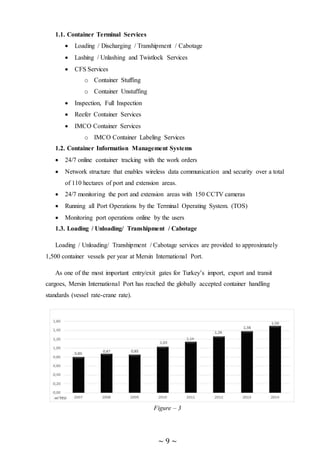
As one of the most important entry/exit gates for Turkey’s import, export and transit
cargoes, Mersin International Port has reached the globally accepted container handling
standards (vessel rate-crane rate).
Figure – 3
~ 10 ~
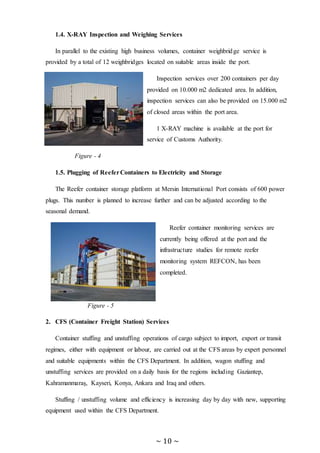
1.4. X-RAY Inspection and Weighing Services
In parallel to the existing high business volumes, container weighbridge service is
provided by a total of 12 weighbridges located on suitable areas inside the port.
Inspection services over 200 containers per day
provided on 10.000 m2 dedicated area. In addition,
inspection services can also be provided on 15.000 m2
of closed areas within the port area.
1 X-RAY machine is available at the port for
service of Customs Authority.
Figure - 4
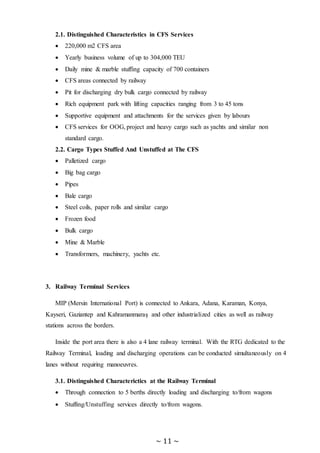
1.5. Plugging of ReeferContainers to Electricity and Storage
The Reefer container storage platform at Mersin International Port consists of 600 power
plugs. This number is planned to increase further and can be adjusted according to the
seasonal demand.
Reefer container monitoring services are
currently being offered at the port and the
infrastructure studies for remote reefer
monitoring system REFCON, has been
completed.
Figure - 5
2. CFS (Container Freight Station) Services
Container stuffing and unstuffing operations of cargo subject to import, export or transit
regimes, either with equipment or labour, are carried out at the CFS areas by expert personnel
and suitable equipments within the CFS Department. In addition, wagon stuffing and
unstuffing services are provided on a daily basis for the regions including Gaziantep,
Kahramanmaraş, Kayseri, Konya, Ankara and Iraq and others.
Stuffing / unstuffing volume and efficiency is increasing day by day with new, supporting
equipment used within the CFS Department.
~ 11 ~
2.1. Distinguished Characteristics in CFS Services
 220,000 m2 CFS area
 Yearly business volume of up to 304,000 TEU
 Daily mine & marble stuffing capacity of 700 containers
 CFS areas connected by railway
 Pit for discharging dry bulk cargo connected by railway
 Rich equipment park with lifting capacities ranging from 3 to 45 tons
 Supportive equipment and attachments for the services given by labours
 CFS services for OOG, project and heavy cargo such as yachts and similar non
standard cargo.
2.2. Cargo Types Stuffed And Unstuffed at The CFS
 Palletized cargo
 Big bag cargo
 Pipes
 Bale cargo
 Steel coils, paper rolls and similar cargo
 Frozen food
 Bulk cargo
 Mine & Marble
 Transformers, machinery, yachts etc.
3. Railway Terminal Services
MIP (Mersin International Port) is connected to Ankara, Adana, Karaman, Konya,
Kayseri, Gaziantep and Kahramanmaraş and other industrialized cities as well as railway
stations across the borders.
Inside the port area there is also a 4 lane railway terminal. With the RTG dedicated to the
Railway Terminal, loading and discharging operations can be conducted simultaneously on 4
lanes without requiring manoeuvres.
3.1. Distinguished Characterictics at the Railway Terminal
 Through connection to 5 berths directly loading and discharging to/from wagons
 Stuffing/Unstuffing services directly to/from wagons.
~ 12 ~
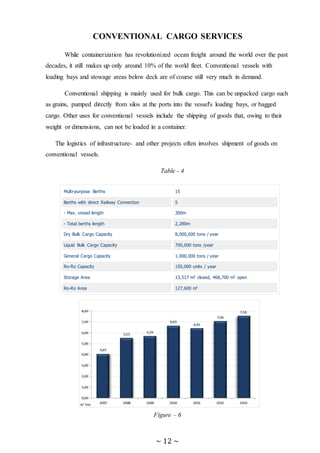
CONVENTIONAL CARGO SERVICES
While containerization has revolutionized ocean freight around the world over the past
decades, it still makes up only around 10% of the world fleet. Conventional vessels with
loading bays and stowage areas below deck are of course still very much in demand.
Conventional shipping is mainly used for bulk cargo. This can be unpacked cargo such
as grains, pumped directly from silos at the ports into the vessel's loading bays, or bagged
cargo. Other uses for conventional vessels include the shipping of goods that, owing to their
weight or dimensions, can not be loaded in a container.
The logistics of infrastructure- and other projects often involves shipment of goods on
conventional vessels.
Table - 4
Figure – 6
Multi-purpose Berths 15
Berths with direct Railway Connection 5
- Max. vessel length 300m
- Total berths length 2,280m
Dry Bulk Cargo Capacity 8,000,000 tons / year
Liquid Bulk Cargo Capacity 750,000 tons /year
General Cargo Capacity 1,000,000 tons / year
Ro-Ro Capacity 150,000 units / year
Storage Area 13,517 m2
closed, 468,700 m2
open
Ro-Ro Area 127,600 m2
~ 13 ~
1. DRY BULK CARGO
Loading and discharging performance up to 20,000 tons per day can be provided to post-
panamax vessels size of up to 60,000 tons at Mersin International Port, one of the most
important dry bulk terminals in the East Mediterranean region.
Dry bulk cargoes are handled such as: cereals, pulses, cement, clinker, coal, petrocoke,
gypsum, salt, fertilizer, sand, chrome, iron ore etc.
1.1. Bulk Dry Cargo Handling Equipment
Dry bulk discharged at the Port of Mersin can be stuffed directly into containers in a fast
and efficient manner by using bunkers and chassis with dumpers.
Cargo handled such as: leguminous seeds, rice, soy beans, cereals, lentils, sunflower
seeds, manure, peas, broad bean, wheat etc.
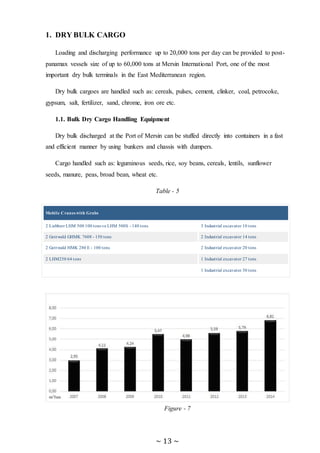
Table - 5
Mobile Cranes with Grabs
2 Liebherr LHM 500 100 tons ve LHM 500S - 140 tons 3 Industrial excavator 10 tons
2 Gottwald GHMK 7608 - 150 tons 2 Industrial excavator 14 tons
2 Gottwald HMK 280 E - 100 tons 2 Industrial excavator 20 tons
2 LHM250 64 tons 1 Industrial excavator 27 tons
1 Industrial excavator 30 tons
Figure - 7
~ 14 ~
2. LIQUID BULK CARGO
The loading and discharging of all types of liquid bulk cargo can be handled at Mersin
International Port with 3 mobile quay platforms and 2 conveyor pipelines.
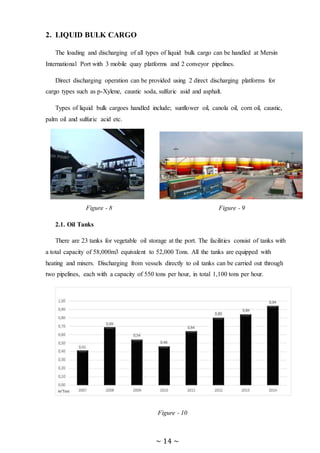
Direct discharging operation can be provided using 2 direct discharging platforms for
cargo types such as p-Xylene, caustic soda, sulfuric asid and asphalt.
Types of liquid bulk cargoes handled include; sunflower oil, canola oil, corn oil, caustic,
palm oil and sulfuric acid etc.
Figure - 8 Figure - 9
2.1. Oil Tanks
There are 23 tanks for vegetable oil storage at the port. The facilities consist of tanks with
a total capacity of 58,000m3 equivalent to 52,000 Tons. All the tanks are equipped with
heating and mixers. Discharging from vessels directly to oil tanks can be carried out through
two pipelines, each with a capacity of 550 tons per hour, in total 1,100 tons per hour.
Figure - 10
~ 15 ~
3. PROJECTCARGO
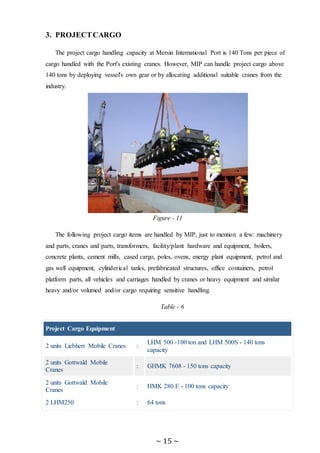
The project cargo handling capacity at Mersin International Port is 140 Tons per piece of
cargo handled with the Port's existing cranes. However, MIP can handle project cargo above
140 tons by deploying vessel's own gear or by allocating additional suitable cranes from the
industry.
Figure - 11
The following project cargo items are handled by MIP, just to mention a few: machinery
and parts, cranes and parts, transformers, facility/plant hardware and equipment, boilers,
concrete plants, cement mills, cased cargo, poles, ovens, energy plant equipment, petrol and
gas well equipment, cylinderical tanks, prefabricated structures, office containers, petrol
platform parts, all vehicles and carriages handled by cranes or heavy equipment and similar
heavy and/or volumed and/or cargo requiring sensitive handling.
Table - 6
Project Cargo Equipment
2 units Liebherr Mobile Cranes :
LHM 500 -100 ton and LHM 500S - 140 tons
capacity
2 units Gottwald Mobile
Cranes
: GHMK 7608 - 150 tons capacity
2 units Gottwald Mobile
Cranes
: HMK 280 E - 100 tons capacity
2 LHM250 : 64 tons
~ 16 ~
4. GENERALCARGO
General Cargo loading and discharging services can be provided on 15 different berths,
out of which 5 have direct railway connections. Thus import/export cargoes can be berthed on
berths with railway connections and can be loaded directly onto wagons.
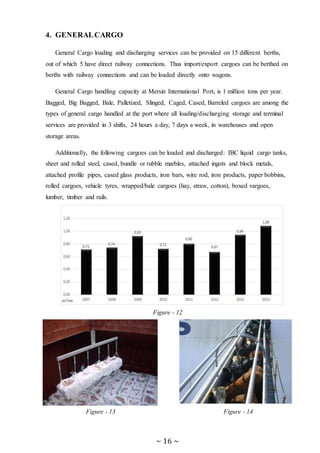
General Cargo handling capacity at Mersin International Port, is 1 million tons per year.
Bagged, Big Bagged, Bale, Palletized, Slinged, Caged, Cased, Barreled cargoes are among the
types of general cargo handled at the port where all loading/discharging storage and terminal
services are provided in 3 shifts, 24 hours a day, 7 days a week, in warehouses and open
storage areas.
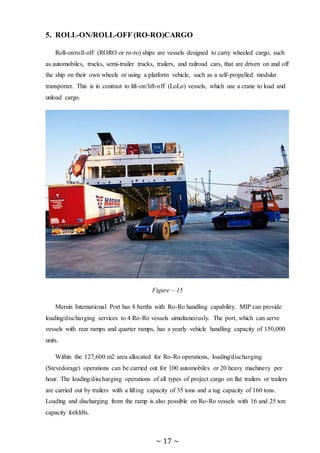
Additionally, the following cargoes can be loaded and discharged: IBC liquid cargo tanks,
sheet and rolled steel, cased, bundle or rubble marbles, attached ingots and block metals,
attached profile pipes, cased glass products, iron bars, wire rod, iron products, paper bobbins,
rolled cargoes, vehicle tyres, wrapped/bale cargoes (hay, straw, cotton), boxed vargoes,
lumber, timber and rails.
Figure - 12
Figure - 13 Figure - 14
~ 17 ~
5. ROLL-ON/ROLL-OFF (RO-RO)CARGO
Roll-on/roll-off (RORO or ro-ro) ships are vessels designed to carry wheeled cargo, such
as automobiles, trucks, semi-trailer trucks, trailers, and railroad cars, that are driven on and off
the ship on their own wheels or using a platform vehicle, such as a self-propelled modular
transporter. This is in contrast to lift-on/lift-off (LoLo) vessels, which use a crane to load and
unload cargo.
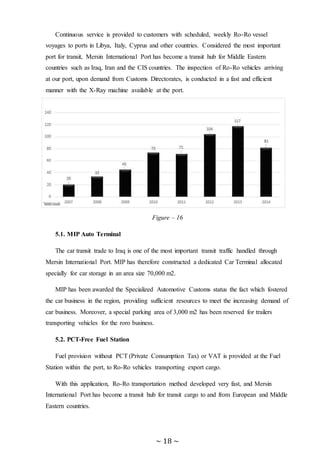
RORO vessels have built-in ramps that allow the cargo to be efficiently rolled on and off
the vessel when in port. While smaller ferries that operate across rivers and other short
distances often have built-in ramps, the term RORO is generally reserved for large
oceangoing vessels. The ramps and doors may be stern-only, or bow and stern for quick
loading.
Figure – 15
Mersin International Port has 8 berths with Ro-Ro handling capability. MIP can provide
loading/discharging services to 4 Ro-Ro vessels simultaneously. The port, which can serve
vessels with rear ramps and quarter ramps, has a yearly vehicle handling capacity of 150,000
units.
Within the 127,600 m2 area allocated for Ro-Ro operations, loading/discharging
(Stevedorage) operations can be carried out for 100 automobiles or 20 heavy machinery per
hour. The loading/discharging operations of all types of project cargo on flat trailers or trailers
are carried out by trailers with a lifting capacity of 35 tons and a tug capacity of 160 tons.
Loading and discharging from the ramp is also possible on Ro-Ro vessels with 16 and 25 ton
capacity forklifts.
~ 18 ~
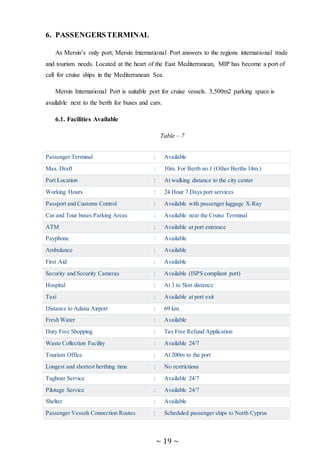
Continuous service is provided to customers with scheduled, weekly Ro-Ro vessel
voyages to ports in Libya, Italy, Cyprus and other countries. Considered the most important
port for transit, Mersin International Port has become a transit hub for Middle Eastern
countries such as Iraq, Iran and the CIS countries. The inspection of Ro-Ro vehicles arriving
at our port, upon demand from Customs Directorates, is conducted in a fast and efficient
manner with the X-Ray machine available at the port.
Figure – 16
5.1. MIP Auto Terminal
The car transit trade to Iraq is one of the most important transit traffic handled through
Mersin International Port. MIP has therefore constructed a dedicated Car Terminal allocated
specially for car storage in an area size 70,000 m2.
MIP has been awarded the Specialized Automotive Customs status the fact which fostered
the car business in the region, providing sufficient resources to meet the increasing demand of
car business. Moreover, a special parking area of 3,000 m2 has been reserved for trailers
transporting vehicles for the roro business.
5.2. PCT-Free Fuel Station
Fuel provision without PCT (Private Consumption Tax) or VAT is provided at the Fuel
Station within the port, to Ro-Ro vehicles transporting export cargo.
With this application, Ro-Ro transportation method developed very fast, and Mersin
International Port has become a transit hub for transit cargo to and from European and Middle
Eastern countries.
~ 19 ~
6. PASSENGERSTERMINAL
As Mersin’s only port, Mersin International Port answers to the regions international trade
and tourism needs. Located at the heart of the East Mediterranean, MIP has become a port of
call for cruise ships in the Mediterranean Sea.
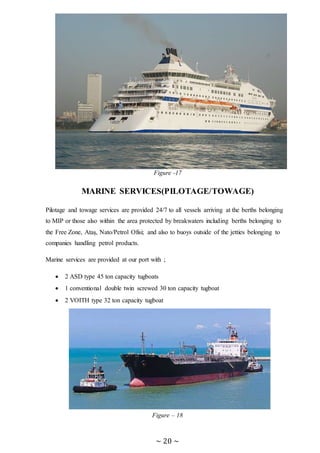
Mersin International Port is suitable port for cruise vessels. 3,500m2 parking space is
available next to the berth for buses and cars.
6.1. Facilities Available
Table – 7
Passenger Terminal : Available
Max. Draft : 10m. For Berth no.1 (Other Berths 14m.)
Port Location : At walking distance to the city center
Working Hours : 24 Hour 7 Days port services
Passport and Customs Control : Available with passenger luggage X-Ray
Car and Tour buses Parking Areas : Available near the Cruise Terminal
ATM : Available at port entrance
Payphone : Available
Ambulance : Available
First Aid : Available
Security and Security Cameras : Available (ISPS compliant port)
Hospital : At 3 to 5km distance
Taxi : Available at port exit
Distance to Adana Airport : 69 km
Fresh Water : Available
Duty Free Shopping : Tax Free Refund Application
Waste Collection Facility : Available 24/7
Tourism Office : At 200m to the port
Longest and shortest berthing time : No restrictions
Tugboat Service : Available 24/7
Pilotage Service : Available 24/7
Shelter : Available
Passenger Vessels Connection Routes : Scheduled passenger ships to North Cyprus
~ 20 ~
Figure -17
MARINE SERVICES(PILOTAGE/TOWAGE)
Pilotage and towage services are provided 24/7 to all vessels arriving at the berths belonging
to MIP or those also within the area protected by breakwaters including berths belonging to
the Free Zone, Ataş, Nato/Petrol Ofisi; and also to buoys outside of the jetties belonging to
companies handling petrol products.
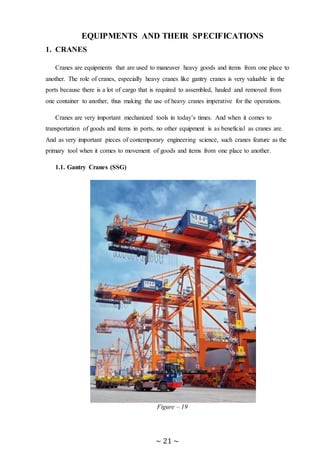
Marine services are provided at our port with ;
 2 ASD type 45 ton capacity tugboats
 1 conventional double twin screwed 30 ton capacity tugboat
 2 VOITH type 32 ton capacity tugboat
Figure – 18
~ 21 ~
EQUIPMENTS AND THEIR SPECIFICATIONS
1. CRANES
Cranes are equipments that are used to maneuver heavy goods and items from one place to
another. The role of cranes, especially heavy cranes like gantry cranes is very valuable in the
ports because there is a lot of cargo that is required to assembled, hauled and removed from
one container to another, thus making the use of heavy cranes imperative for the operations.
Cranes are very important mechanized tools in today’s times. And when it comes to
transportation of goods and items in ports, no other equipment is as beneficial as cranes are.
And as very important pieces of contemporary engineering science, such cranes feature as the
primary tool when it comes to movement of goods and items from one place to another.
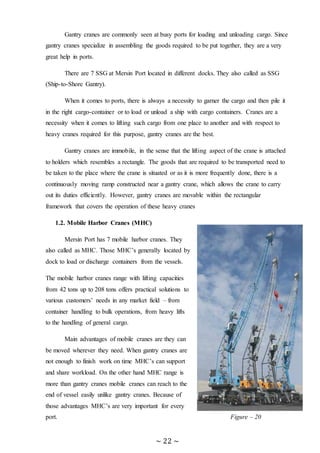
1.1. Gantry Cranes (SSG)
Figure – 19
~ 22 ~
Gantry cranes are commonly seen at busy ports for loading and unloading cargo. Since
gantry cranes specialize in assembling the goods required to be put together, they are a very
great help in ports.
There are 7 SSG at Mersin Port located in different docks. They also called as SSG
(Ship-to-Shore Gantry).
When it comes to ports, there is always a necessity to garner the cargo and then pile it
in the right cargo-container or to load or unload a ship with cargo containers. Cranes are a
necessity when it comes to lifting such cargo from one place to another and with respect to
heavy cranes required for this purpose, gantry cranes are the best.
Gantry cranes are immobile, in the sense that the lifting aspect of the crane is attached
to holders which resembles a rectangle. The goods that are required to be transported need to
be taken to the place where the crane is situated or as it is more frequently done, there is a
continuously moving ramp constructed near a gantry crane, which allows the crane to carry
out its duties efficiently. However, gantry cranes are movable within the rectangular
framework that covers the operation of these heavy cranes
1.2. Mobile Harbor Cranes (MHC)
Mersin Port has 7 mobile harbor cranes. They
also called as MHC. Those MHC’s generally located by
dock to load or discharge containers from the vessels.
The mobile harbor cranes range with lifting capacities
from 42 tons up to 208 tons offers practical solutions to
various customers’ needs in any market field – from
container handling to bulk operations, from heavy lifts
to the handling of general cargo.
Main advantages of mobile cranes are they can
be moved wherever they need. When gantry cranes are
not enough to finish work on time MHC’s can support
and share workload. On the other hand MHC range is
more than gantry cranes mobile cranes can reach to the
end of vessel easily unlike gantry cranes. Because of
those advantages MHC’s are very important for every
port. Figure – 20
~ 23 ~
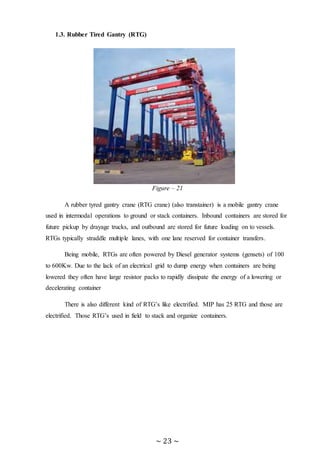
1.3. Rubber Tired Gantry (RTG)
Figure – 21
A rubber tyred gantry crane (RTG crane) (also transtainer) is a mobile gantry crane
used in intermodal operations to ground or stack containers. Inbound containers are stored for
future pickup by drayage trucks, and outbound are stored for future loading on to vessels.
RTGs typically straddle multiple lanes, with one lane reserved for container transfers.
Being mobile, RTGs are often powered by Diesel generator systems (gensets) of 100
to 600Kw. Due to the lack of an electrical grid to dump energy when containers are being
lowered they often have large resistor packs to rapidly dissipate the energy of a lowering or
decelerating container
There is also different kind of RTG’s like electrified. MIP has 25 RTG and those are
electrified. Those RTG’s used in field to stack and organize containers.
~ 24 ~
2. STACKERS
There are two types of stackers. They are Reach Stackers (RS) and Empty Stackers
(ES). Stackers use to moves containers in port. Also they are used in specific areas where
there is no RTG. MIP totally has 30 stackers. 18 of them are RS and the other 12 are ES.
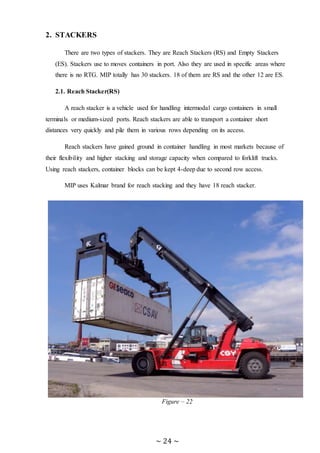
2.1. Reach Stacker(RS)
A reach stacker is a vehicle used for handling intermodal cargo containers in small
terminals or medium-sized ports. Reach stackers are able to transport a container short
distances very quickly and pile them in various rows depending on its access.
Reach stackers have gained ground in container handling in most markets because of
their flexibility and higher stacking and storage capacity when compared to forklift trucks.
Using reach stackers, container blocks can be kept 4-deep due to second row access.
MIP uses Kalmar brand for reach stacking and they have 18 reach stacker.
Figure – 22
~ 25 ~
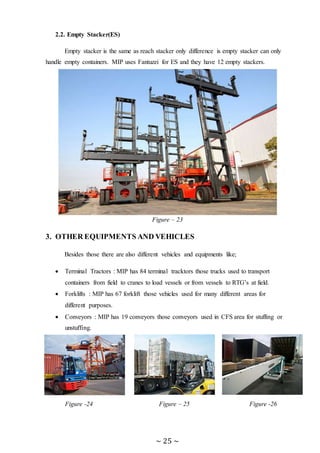
2.2. Empty Stacker(ES)
Empty stacker is the same as reach stacker only difference is empty stacker can only
handle empty containers. MIP uses Fantuzzi for ES and they have 12 empty stackers.
Figure – 23
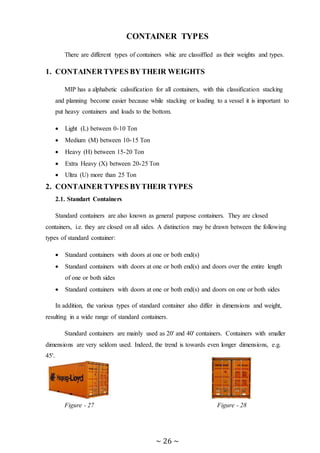
3. OTHER EQUIPMENTS AND VEHICLES
Besides those there are also different vehicles and equipments like;
 Terminal Tractors : MIP has 84 terminal tracktors those trucks used to transport
containers from field to cranes to load vessels or from vessels to RTG’s at field.
 Forklifts : MIP has 67 forklift those vehicles used for many different areas for
different purposes.
 Conveyors : MIP has 19 conveyors those conveyors used in CFS area for stuffing or
unstuffing.
Figure -24 Figure – 25 Figure -26
~ 26 ~
CONTAINER TYPES
There are different types of containers whic are classiffied as their weights and types.
1. CONTAINER TYPES BYTHEIR WEIGHTS
MIP has a alphabetic calssification for all containers, with this classification stacking
and planning become easier because while stacking or loading to a vessel it is important to
put heavy containers and loads to the bottom.
 Light (L) between 0-10 Ton
 Medium (M) between 10-15 Ton
 Heavy (H) between 15-20 Ton
 Extra Heavy (X) between 20-25 Ton
 Ultra (U) more than 25 Ton
2. CONTAINER TYPES BYTHEIR TYPES
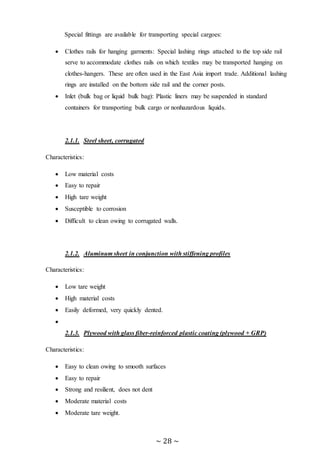
2.1. Standart Containers
Standard containers are also known as general purpose containers. They are closed
containers, i.e. they are closed on all sides. A distinction may be drawn between the following
types of standard container:
 Standard containers with doors at one or both end(s)
 Standard containers with doors at one or both end(s) and doors over the entire length
of one or both sides
 Standard containers with doors at one or both end(s) and doors on one or both sides
In addition, the various types of standard container also differ in dimensions and weight,
resulting in a wide range of standard containers.
Standard containers are mainly used as 20' and 40' containers. Containers with smaller
dimensions are very seldom used. Indeed, the trend is towards even longer dimensions, e.g.
45'.
Figure - 27 Figure - 28
~ 27 ~
The floor is generally made of wood, usually planking or plywood. Although wood is
relatively expensive, it has substantial advantages over other materials: it is strong and
resilient, does not dent, may be easily replaced during repairs and, when appropriately
finished, has an adequate coefficient of friction, which is important for cargo securing.
Standard containers may additionally be equipped with certain optional extras:
 Forklift pockets: these allow handling of empty containers with forklift trucks. Packed
containers must not be picked up in this way unless specifically permitted. Forklift
pockets are installed only in 20' containers and are arranged parallel to the center of
the container in the bottom side rails. 40' containers do not have forklift pockets, since
the pockets are relatively close together and such large containers would be difficult to
balance. In addition, the forklift truck travel paths are often not wide enough.
 Gooseneck tunnel: Many 40' containers have a recess in the floor at the front end
which serves to center the containers on so-called gooseneck chassis. These recesses
allow the containers to lie lower and therefore to be of taller construction.
Figure - 29 Figure - 30
 Grappler pockets: In general, containers are handled by top spreaders using the corner
fittings or corner castings. However, some containers have grappler pockets for
handling by means of grapplers.
Figure – 31
~ 28 ~
Special fittings are available for transporting special cargoes:
 Clothes rails for hanging garments: Special lashing rings attached to the top side rail
serve to accommodate clothes rails on which textiles may be transported hanging on
clothes-hangers. These are often used in the East Asia import trade. Additional lashing
rings are installed on the bottom side rail and the corner posts.
 Inlet (bulk bag or liquid bulk bag): Plastic liners may be suspended in standard
containers for transporting bulk cargo or nonhazardous liquids.
2.1.1. Steel sheet, corrugated
Characteristics:
 Low material costs
 Easy to repair
 High tare weight
 Susceptible to corrosion
 Difficult to clean owing to corrugated walls.
2.1.2. Aluminum sheet in conjunction with stiffening profiles
Characteristics:
 Low tare weight
 High material costs
 Easily deformed, very quickly dented.

2.1.3. Plywood with glass fiber-reinforced plastic coating (plywood + GRP)
Characteristics:
 Easy to clean owing to smooth surfaces
 Easy to repair
 Strong and resilient, does not dent
 Moderate material costs
 Moderate tare weight.
~ 29 ~
2.2. High-Cube Containers
High-cube containers are similar in structure to standard containers, but taller. In contrast
to standard containers, which have a maximum height of 2591 mm (8'6"), high-cube
containers are 2896 mm, or 9'6", tall. High-cube containers are for the most part 40' long, but
are sometimes made as 45' containers.
A number of lashing rings, capable of bearing loads of at most 1000 kg, are mounted on
the front top end rail and bottom cross member and the corner posts.
Many 40' containers have a recess in the floor at the front end which serves to center the
containers on so-called gooseneck chassis. These recesses allow the containers to lie lower
and therefore to be of taller construction. The walls of open-top containers are generally made
of corrugated steel. The floor is made of wood.
2.3. Open-Top Containers
It has the following typical distinguishing structural features. The roof consists of
removable bows and a removable tarpaulin. The door header may be swivelled out.
These two structural features greatly simplify the process of packing and unpacking the
container. In particular, it is very easy to pack and unpack the container from above or
through the doors by crane or crab when the roof is open and the door header is swivelled out.
It should be noted, however, that the purpose of the roof bows of an open-top container is
not solely to support the tarpaulin but also to contribute to container stability. Flatracks are
therefore more suitable for overheight cargoes.
Lashing rings, to which the cargo may be secured, are installed in the upper and lower
side rails and the corner posts. The lashing rings may take loads of up to 1,000 kg.
Usual open-top container dimensions are 20' and 40'.
2.4. Flatracks
Flatracks consist of a floor structure with a high loading capacity composed of a steel
frame and a softwood floor and two end walls, which may either be fixed or collapsible. The
end walls are stable enough to allow cargo securing means to be attached and several flatracks
to be stacked on top of one another. Flatracks are available in 20' and 40' sizes.
~ 30 ~
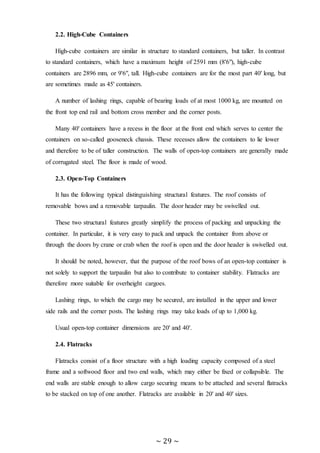
A number of lashing rings, to which the cargo may be secured, are installed in the side
rails, the corner posts and the floor. The lashing rings may take loads of up to 2000 kg in the
case of 20' flatracks or up to 4000 kg in the case of 40' flatracks.
40' flatracks have gooseneck tunnels at each end. In addition, they are sometimes
equipped with lashing winches with 2 metric ton lashing belts.
For transport of certain cargoes, flatracks may be provided with stanchions.
Figure - 32
2.5. Platforms (Plats)
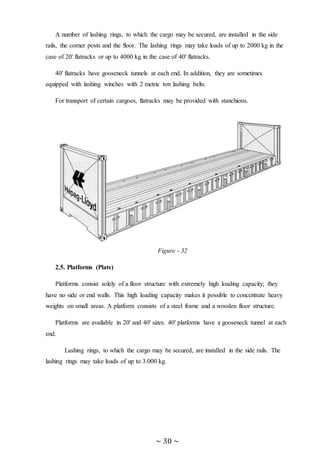
Platforms consist solely of a floor structure with extremely high loading capacity; they
have no side or end walls. This high loading capacity makes it possible to concentrate heavy
weights on small areas. A platform consists of a steel frame and a wooden floor structure.
Platforms are available in 20' and 40' sizes. 40' platforms have a gooseneck tunnel at each
end.
Lashing rings, to which the cargo may be secured, are installed in the side rails. The
lashing rings may take loads of up to 3.000 kg.
~ 31 ~
Figure - 33
2.6. Refrigerated and insulated containers
Refrigerated and insulated containers are mainly available as 20' and 40' containers. A
distinction may be drawn between two different systems:
2.6.1. Integral Unit (Integral Reefer Container, Integrated Unit):
This type of refrigerated container has an integral refrigeration unit for controlling the
temperature inside the container. The refrigeration unit is arranged in such a way that the
external dimensions of the container meet ISO standards and thus fit into the container ship
cell guides, for example. The presence of an integral refrigeration unit entails a loss of internal
volume and payload.
When being transported by ship, integral units have to be connected to the on-board
power supply system. The number of refrigerated containers which may be connected
depends on the capacity of the ship's power supply system. If the aforesaid capacity is too low
for the refrigerated containers to be transported, "power packs" may be used, which are
equipped with relatively large diesel generators and satisfy ISO requirements with regard to
the dimensions of a 20' container. When at the terminal, the containers are connected to the
terminal's power supply system. For transport by road and rail, most integral unit refrigeration
units are operated by a generator set (genset). This may either be a component of the
refrigeration unit or connected to the refrigeration unit.
~ 32 ~
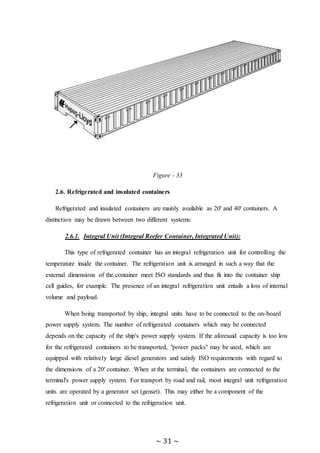
Figure - 34
Air flows through the container from bottom to top. In general, the "warm" air is
drawn off from the inside of the container, cooled in the refrigeration unit and then blown
back in the container as cold air.
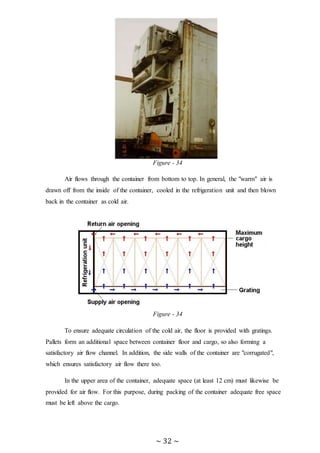
Figure - 34
To ensure adequate circulation of the cold air, the floor is provided with gratings.
Pallets form an additional space between container floor and cargo, so also forming a
satisfactory air flow channel. In addition, the side walls of the container are "corrugated",
which ensures satisfactory air flow there too.
In the upper area of the container, adequate space (at least 12 cm) must likewise be
provided for air flow. For this purpose, during packing of the container adequate free space
must be left above the cargo.
~ 33 ~
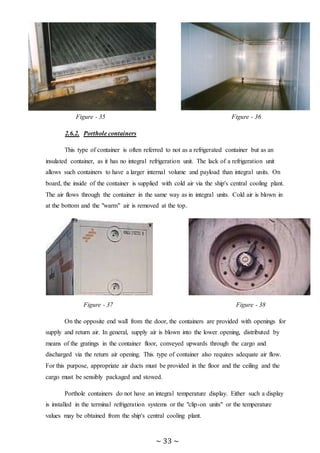
Figure - 35 Figure - 36
2.6.2. Porthole containers
This type of container is often referred to not as a refrigerated container but as an
insulated container, as it has no integral refrigeration unit. The lack of a refrigeration unit
allows such containers to have a larger internal volume and payload than integral units. On
board, the inside of the container is supplied with cold air via the ship's central cooling plant.
The air flows through the container in the same way as in integral units. Cold air is blown in
at the bottom and the "warm" air is removed at the top.
Figure - 37 Figure - 38
On the opposite end wall from the door, the containers are provided with openings for
supply and return air. In general, supply air is blown into the lower opening, distributed by
means of the gratings in the container floor, conveyed upwards through the cargo and
discharged via the return air opening. This type of container also requires adequate air flow.
For this purpose, appropriate air ducts must be provided in the floor and the ceiling and the
cargo must be sensibly packaged and stowed.
Porthole containers do not have an integral temperature display. Either such a display
is installed in the terminal refrigeration systems or the "clip-on units" or the temperature
values may be obtained from the ship's central cooling plant.
~ 34 ~
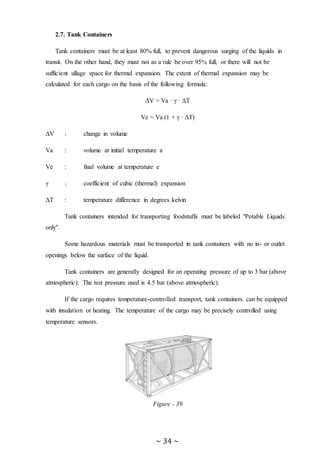
2.7. Tank Containers
Tank containers must be at least 80% full, to prevent dangerous surging of the liquids in
transit. On the other hand, they must not as a rule be over 95% full, or there will not be
sufficient ullage space for thermal expansion. The extent of thermal expansion may be
calculated for each cargo on the basis of the following formula:
ΔV = Va · γ · ΔT
Ve = Va (1 + γ · ΔT)
ΔV : change in volume
Va : volume at initial temperature a
Ve : final volume at temperature e
γ : coefficient of cubic (thermal) expansion
ΔT : temperature difference in degrees kelvin
Tank containers intended for transporting foodstuffs must be labeled "Potable Liquids
only".
Some hazardous materials must be transported in tank containers with no in- or outlet
openings below the surface of the liquid.
Tank containers are generally designed for an operating pressure of up to 3 bar (above
atmospheric). The test pressure used is 4.5 bar (above atmospheric).
If the cargo requires temperature-controlled transport, tank containers can be equipped
with insulation or heating. The temperature of the cargo may be precisely controlled using
temperature sensors.
Figure - 39
~ 35 ~
DEPARTMENTS
In a management of MIP, there are many different departments. I have been in two
different departments during my internship. Which are Engineering Department and
Operation department.
1. ENGINEERING DEPARTMENT
Engineering department responsible for all kind of maintenance, repair, service,
malfunctions, planning and electrical infrastructure projects for every equipments and jobs
realated to electricity.
There are one maintenance manager and one service manager in the engineering
department. There are two type of job definition for technicians. One of them is regular
maintenance of equipments which is done in a workshop. Other one is repair malfunctions of
equipments inside of the port those technicians are mobile and they interfere problems in the
field of Mersin Port.
Also engineering department is responsible for the storage of the equipment parts and
replacement when it is necessary. Engineering department uses a software called INFOR.
This software usefull for both storage management and tracking malfunction of equipments.
2. OPERATION DEPARTMENT
Operation Department job definition is in below ;
Manage the Container Terminal of Mersin International Port,
In charge of 650 staff including Control Center , planning department , Operators, Wos and
Port Workers.
Communicates with the shipping lines and the container agencies for all operations,
Monitoring operations cost for effective operations ,
Prepare the budget of Container terminal,
Evaluate the performance reports of container terminal and present to senior Management
Coach the team to improve their skills and knowledge and help them work efficiently and
effectively and to manage future Operations team succession planning,
~ 36 ~
Ensure effective working relations with other elements and departments to ensure support to
operations,
Set target to control room for operation including terminal turnaround time of vessels, Vessel
rates and gross crane rates.
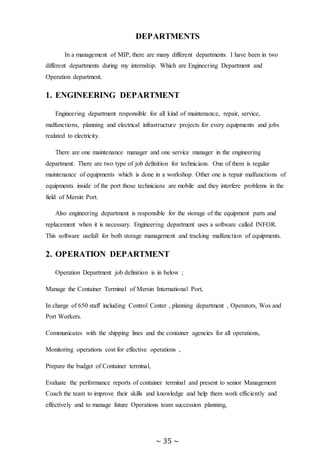
2.1. YOMC (Yard Operations Monitoring and Control)
YOMC is responsible for every movement and planning about yard. For example,
planning time and locations on the dock while berthing of the vessels, preparing Berthing
Chart, preparing DAP(Daily Action Plan), field stacking are job definition of the YOMC.
Example of Berthing Chart can be found in the Appendix B and DAP (Daily Action Plan)
in the Appendix C.
2.2. VOMC (Vessel Operations Monitoring and Control)
VOMC is responsible for every movement and planning about vessel. Loding and
discharhing are mostly related for this department. They are responsible for planning the
vessel and confirm that plan to the second captain of the vessel. Also planning of equipments
are related to this department. Every equipment from trucks to cranes are planning for loading
or discharhing by that team.
Figure - 40
~ 37 ~
COST ANALYSIS
MIP is related to AKFEN Holding. The holding has joint ventures with such well-
renowned national and international corporate enterprises as Tepe İnşaat Sanayi A.Ş., PSA
International, Souter Investments LLP and Kardan N.V. Akfen also has a strategic
cooperation agreement with the leading global hotel chain ACCOR S.A., related to the
construction of Novotel and Ibis brand hotels in Turkey.
In 2010 Akfen Holding went public with a free-float rate of 28.26% and the shares of the
company is traded on the Istanbul Stock Exchange (“ISE”) under the ticker symbol
“AKFEN”.
One of the top business groups in Turkey with a robust management structure, a strong
human resources base and a commitment to transparency policy, Akfen Holding continues to
grow by multiplying the riches of Turkey.
Figure – 41
~ 38 ~
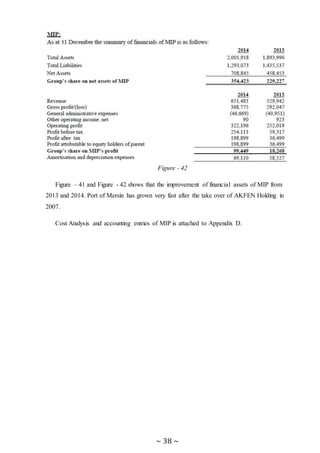
Figure - 42
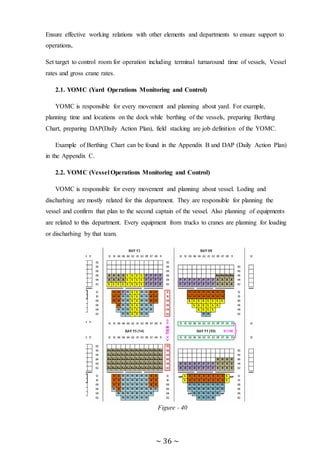
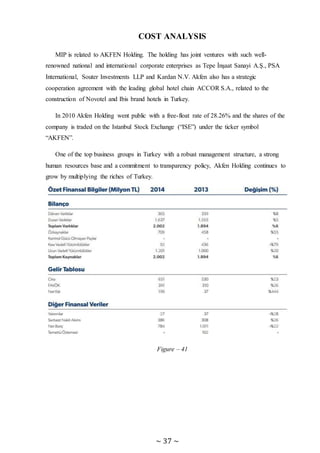
Figure – 41 and Figure - 42 shows that the improvement of financial assets of MIP from
2013 and 2014. Port of Mersin has grown very fast after the take over of AKFEN Holding in
2007.
Cost Analysis and accounting entries of MIP is attached to Appendix D.
~ 39 ~
CONCLUSION
I spent my 20 days in a Mersin International Port Management INC.. In my opinion, it is
important to experience internship in a corporate firm especially for management internship
(ME399). Corporate firms are more regular and reliable according to other firms.
When I examine working principles of employees’ from manager to worker. I can easily
say that everyone job definition is certain, because of that there is no confusion in a firm and
everything is under control. This is important because whenever something goes wrong every
employee knows who should give information to so, there will be no time wasting and the
trouble can fix as soon as possible. In order to being fast is the key point for every company
because time is money.From the view point of factory, if a production line stops for a day
factory might not afford this. In a same way if MIP stops working for a day that would be a
huge problem for firm. They might lose milions of dollars.
This is obvious that, responsibles are getting bigger and bigger from worker to manager.
Workers might have done mistakes and this effects only minimum but a managers’ mistake
effect is much more than a worker. One mistake can effect whole firm, thats why manager
responsibles are so heavy. In addition to that managers are responsible for every mistake that
might be occur every employee under their control. Managers educate theirselves as well as
their employees.
I spent most of my time during my internship in a operation department. MIP is a firm
which sells services they don’t produce anything but they earn in return of their services.
Giving services is harder than selling physical products. For this reason, everything should be
perfect as much as possible. Every single mistake costs much more than any other factory. I
believe that MIP is very successful on this matter.
I am glad to do my internship in MIP because I had chance to examine a organization
from any point. I had some information about organizations but now everything about
working principles, job definitions and worker-manager relationship is clear than ever.

İlker ALTINSOY - ME399

  • 1.
    UNIVERSITY OF GAZIANTEP FACULTYOF ENGINEERING DEPARTMENT OF MECHANICAL ENGINEERING ME399 ENGINEERING PRACTICE PROGRAMME PREPARED BY : İLKER ALTINSOY / 200961071
  • 2.
    ~ 1 ~ CONTENTS INFORMATIONOF THE COMPANY .............................................................................. 3 Name and Location of The Company ....................................................................... 3 History ......................................................................................................................... 3 Working Area and Structure of MIP ....................................................................... 4 Employement of MIP ................................................................................................. 4 Organization Chart .................................................................................................... 4 INTRODUCTION .................................................................................................................. 5 GENERAL OVERWİEV OF MERSİN PORT ................................................................... 6 TECHNICAL SPECIFICATIONS ....................................................................................... 6 PORT SERVICES .................................................................................................................. 8 Container Services ...................................................................................................... 8 CFS(Container Freight Station) Services ............................................................... 10 Railway Terminal Services ....................................................................................... 11 CONVENTIONAL CARGO SERVICES .......................................................................... 12 Dry Bulk Cargo ......................................................................................................... 13 Liquid Bulk Cargo .................................................................................................... 14 Project Cargo ............................................................................................................ 15 General Cargo ........................................................................................................... 16 Roll-on/Roll-off (RO-RO) Cargo ............................................................................. 17 PassengerTerminal .................................................................................................. 19 MARINE SERVICES ........................................................................................................... 20 EQUIPMENTS AND THEIR SPECIFICATIONS ........................................................... 21 Cranes ........................................................................................................................ 21
  • 3.
    ~ 2 ~ Stackers..................................................................................................................... 24 Other Equipments and Vehicles ............................................................................. 25 CONTAINER TYPES ......................................................................................................... 26 Container Types by Their Weight .......................................................................... 26 Container Types by Their Types ............................................................................ 26 DEPARTMENTS ................................................................................................................. 35 Engineering Department ......................................................................................... 35 Operation Department ............................................................................................. 35 COST ANALYSIS ................................................................................................................ 37 CONCLUSION ..................................................................................................................... 40
  • 4.
    ~ 3 ~ INFORMATIONOF THE COMPANY 1. NAME AND LOCATION OF THE COMPANY Figure - 1 Mersin International Port Management INC. Which is shortly called MIP. Location of the port is Yenimah 101. Cad 5307. Sok. No:5 33100 Mersin – Turkey. This location is center of the city it is both easy to reach from East and West. 2. HISTORY With the launch of the Adana-Mersin railway in the year of 1886 there occurred an increase in the number of ships that arrives and departs from Mersin Piers. As seeking faster loading and discharging possibilities of those vessels first "Stone Pier" and after "Customs Pier" was constructed by Mersin Municipality. An experienced port management was needed due to rapid increase in the sea trade and MERSIN PORT COMPANY was established on the date of 29 August, 1927 with the partnership of Seyrisefain Agency; Mersin, Tarsus, Seyhan and Ceyhan Municipalities and Mersin Trade Chamber and Mersin Private Accounting. The company suffered due to the natural disasters and was decided to be taken over by the Government following the liquidation decision in 1942. The Decision Numbered K/323 on its assignment to the State Railways and Ports Management General Directorate with a price of TL 400,000 referring to the 6th Article of Turkish National Security Law was
  • 5.
    ~ 4 ~ approvedwith the Council of Ministers Decree Numbered 2/17874 and dated on 9 May, 1942 published on the Official Gazette Numbered 5106 and dated on 14 May. 3. WORKING AREA AND STRUCTURE OF MIP MIP, which was established as a partnership between PSA International and Akfen Holding, took over T.C.D.D. Mersin Port Management for a period of 36 years on May 11 2007. Mersin International Port (MIP) located in PSA, has an international port management network around the globe. Besides having an extensive experience of port management. Akfen Holding, which has started its operations in 1976, operates primarily in the fields of airport and sea port investment and management, among other fields such as energy and various infrastructure investments and the development of real estate investment projects. Mersin International Port (MIP) is connected via railways and highways with Turkey’s industrialized cities such as Ankara, Gaziantep, Kayseri, Kahramanmaraş and Konya, and with bordering countries such as Syria, Iraq and Iran. It is one of the main container ports in the Mediterranean Region with its transit and hinterland connections with the Middle East and the Black Sea. Mersin International Port (MIP) meets a significant portion of Turkey’s import and export volumes with its vast hinterland, accessible transportation opportunities and qualified human resources. 4. EMPLOYEMENTOF MIP Mersin International Port (MIP) has an engineering department there are 4 engineers which two of them are electrical and electronic engineer other two are mechanical engineer also this department has many technician. Engineering department main job is maintenance and fix malfunctions of the work equipments such as cranes, trucks, lifts etc. Some of technicians are mobile and they try to fix malfunctions on the field, others stays at the workshop to make routine maintenance and fix malfunctions which cannot be done on the field. 5. ORGANIZATION CHART Organization chart of the company is in Appendix A.
  • 6.
    ~ 5 ~ INTRODUCTION Thesubject of the summer practice is having a chance to examine the management and organization of the factory and learn about organizations and relationship between employer – employee. I have done my summer practice at Mersin International Port. My internship was 20 working days as usual. I was in company between 17.08.2015 and 11.08.2015. I spend my first week at workshop I had chance to examine storage unit and maintenance team. After one week I went to business development more specifically planning department. This department is the heart of the port every ship comes to port and every movement they make is planning in this department. That’s why I wanted to see this department. I have spent my remaining time in business development especially in planning department. I had a chance to have knowledge about equipment management, planning, and human relations between executives and workers. I also have clearly seen that engineering is one of the most important jobs in an organization from bottom to top. Engineers can organize workloads with the best efficiency and solve difficulties quickly with minimum damage besides their technical knowledge. As far as I concern, these knowledge will be very useful for every engineering student when they graduated from their faculties and start their job in a company. We will have an idea about how should we behave to technicians and react to obstacles in our ways during our work life.
  • 7.
    ~ 6 ~ GENERALOVERVİEW OF MERSİN PORT Mersin International Port (MIP) is the import/export gateway for the Central Anatolian, Mediterranean, Eastern and Southeastern Anatolian regions. Also the transit hub for the Middle East countries, MIP is connected to domestic destinations and Middle East countries via road, air and rail. Figure – 2 TECHNICAL SPECIFICATIONS As a result of the ports extensive facilities where services are provided to all types of cargoes including containers, general cargoes, project cargoes, Ro-Ro, dry bulk and liquid bulk, passenger services and direct dry bulk handling services from ship to container, MIP is the only port in Turkey with the capacity to provide all port services in the same port area. Accomodating 21 berths, the port is able to conduct loading-discharging services to 30 vessels simultaneously, depending on the lengths of the vessels. An average volume of 22 million tons of cargo per year is handled at Mersin International Port.
  • 8.
    ~ 7 ~ Table– 1 Port Site Total Port Area 110 Hectars Total Berth 21 Depth 14 m - 10 m Container Handling Capacity 1.800.000 Teu / Year General Cargo Handling Capacity 1.000.000 Tons / Year Dry Bulk Cargo Handling Capacity 8.000.000 Tons / Year Liquid Bulk Cargo Handling Capacity 750.000 Tons / Year Ro-Ro Handling Capacity 150.000 Units-Vehicles /Year Total Berths Length ( 3255 m) Container Berths (Total Length 1470 m) Berth No / Length / Depth 8-11 / 675m / 14m-10m Berth No / Length / Depth 12-13 / 300m / 12m Berth No / Length / Depth 17-19 / 495m / 12.5m Other Berths (Total Length 1785 m) Other Berths (Draft) 8.5m-14m Maximum Vessel Capacity Length 305 m Intended Vessel Capacity – 18k TEU Berth Length 400 m Width 56.4 m Draft 16.5 m Berth Cranes Gantry Crane 7 Mobile Crane (MHC) 7 Pilotage-Towage-Mooring Services 24/7 hour
  • 9.
    ~ 8 ~ PORTSERVICES 1. Container Services Mersin International Port is one of the largest container ports in South of Turkey, serving a wide industrial hinterland in the region with a signficant contribution to the country's foreign trade. It is connected to all main ports around the world through over 20 shipping lines making regular calls. 24/7 nonstop service is provided with modern equipments at the Container Terminal with a total 1470m berth length and 14m draft. Table - 2 Container Terminal Capacity Information Column1 Capacity 1,8m TEU Container Berths 6 + 3 ( Multipurpose ) Maximum Ship Berthing Capacity Post Panamax ( 5,000 - 6,500 TEUs ) Container Site Surface Area 35 Aha Ground Slot 10,225 Table - 3 Equipment Model Capacity Number Gantry Crane MŞM-Krupp 50 SVL 40 ton 3 Gantry Crane (Post Panamax) LIEBHERR 45 ton 2 Gantry Crane ZPMC 65 ton 2 Mobile Harbour Crane Gottwald 100 ton 2 Mobile Harbour Crane Gottwald 150 ton 2 Mobile Harbour Crane Liebherr LHM 500 140 ton 2 Mobile Harbour Crane 10 ton 1
  • 10.
    ~ 9 ~ 1.1.Container Terminal Services  Loading / Discharging / Transhipment / Cabotage  Lashing / Unlashing and Twistlock Services  CFS Services o Container Stuffing o Container Unstuffing  Inspection, Full Inspection  Reefer Container Services  IMCO Container Services o IMCO Container Labeling Services 1.2. Container Information Management Systems  24/7 online container tracking with the work orders  Network structure that enables wireless data communication and security over a total of 110 hectares of port and extension areas.  24/7 monitoring the port and extension areas with 150 CCTV cameras  Running all Port Operations by the Terminal Operating System. (TOS)  Monitoring port operations online by the users 1.3. Loading / Unloading/ Transhipment / Cabotage Loading / Unloading/ Transhipment / Cabotage services are provided to approximately 1,500 container vessels per year at Mersin International Port. As one of the most important entry/exit gates for Turkey’s import, export and transit cargoes, Mersin International Port has reached the globally accepted container handling standards (vessel rate-crane rate). Figure – 3
  • 11.
    ~ 10 ~ 1.4.X-RAY Inspection and Weighing Services In parallel to the existing high business volumes, container weighbridge service is provided by a total of 12 weighbridges located on suitable areas inside the port. Inspection services over 200 containers per day provided on 10.000 m2 dedicated area. In addition, inspection services can also be provided on 15.000 m2 of closed areas within the port area. 1 X-RAY machine is available at the port for service of Customs Authority. Figure - 4 1.5. Plugging of ReeferContainers to Electricity and Storage The Reefer container storage platform at Mersin International Port consists of 600 power plugs. This number is planned to increase further and can be adjusted according to the seasonal demand. Reefer container monitoring services are currently being offered at the port and the infrastructure studies for remote reefer monitoring system REFCON, has been completed. Figure - 5 2. CFS (Container Freight Station) Services Container stuffing and unstuffing operations of cargo subject to import, export or transit regimes, either with equipment or labour, are carried out at the CFS areas by expert personnel and suitable equipments within the CFS Department. In addition, wagon stuffing and unstuffing services are provided on a daily basis for the regions including Gaziantep, Kahramanmaraş, Kayseri, Konya, Ankara and Iraq and others. Stuffing / unstuffing volume and efficiency is increasing day by day with new, supporting equipment used within the CFS Department.
  • 12.
    ~ 11 ~ 2.1.Distinguished Characteristics in CFS Services  220,000 m2 CFS area  Yearly business volume of up to 304,000 TEU  Daily mine & marble stuffing capacity of 700 containers  CFS areas connected by railway  Pit for discharging dry bulk cargo connected by railway  Rich equipment park with lifting capacities ranging from 3 to 45 tons  Supportive equipment and attachments for the services given by labours  CFS services for OOG, project and heavy cargo such as yachts and similar non standard cargo. 2.2. Cargo Types Stuffed And Unstuffed at The CFS  Palletized cargo  Big bag cargo  Pipes  Bale cargo  Steel coils, paper rolls and similar cargo  Frozen food  Bulk cargo  Mine & Marble  Transformers, machinery, yachts etc. 3. Railway Terminal Services MIP (Mersin International Port) is connected to Ankara, Adana, Karaman, Konya, Kayseri, Gaziantep and Kahramanmaraş and other industrialized cities as well as railway stations across the borders. Inside the port area there is also a 4 lane railway terminal. With the RTG dedicated to the Railway Terminal, loading and discharging operations can be conducted simultaneously on 4 lanes without requiring manoeuvres. 3.1. Distinguished Characterictics at the Railway Terminal  Through connection to 5 berths directly loading and discharging to/from wagons  Stuffing/Unstuffing services directly to/from wagons.
  • 13.
    ~ 12 ~ CONVENTIONALCARGO SERVICES While containerization has revolutionized ocean freight around the world over the past decades, it still makes up only around 10% of the world fleet. Conventional vessels with loading bays and stowage areas below deck are of course still very much in demand. Conventional shipping is mainly used for bulk cargo. This can be unpacked cargo such as grains, pumped directly from silos at the ports into the vessel's loading bays, or bagged cargo. Other uses for conventional vessels include the shipping of goods that, owing to their weight or dimensions, can not be loaded in a container. The logistics of infrastructure- and other projects often involves shipment of goods on conventional vessels. Table - 4 Figure – 6 Multi-purpose Berths 15 Berths with direct Railway Connection 5 - Max. vessel length 300m - Total berths length 2,280m Dry Bulk Cargo Capacity 8,000,000 tons / year Liquid Bulk Cargo Capacity 750,000 tons /year General Cargo Capacity 1,000,000 tons / year Ro-Ro Capacity 150,000 units / year Storage Area 13,517 m2 closed, 468,700 m2 open Ro-Ro Area 127,600 m2
  • 14.
    ~ 13 ~ 1.DRY BULK CARGO Loading and discharging performance up to 20,000 tons per day can be provided to post- panamax vessels size of up to 60,000 tons at Mersin International Port, one of the most important dry bulk terminals in the East Mediterranean region. Dry bulk cargoes are handled such as: cereals, pulses, cement, clinker, coal, petrocoke, gypsum, salt, fertilizer, sand, chrome, iron ore etc. 1.1. Bulk Dry Cargo Handling Equipment Dry bulk discharged at the Port of Mersin can be stuffed directly into containers in a fast and efficient manner by using bunkers and chassis with dumpers. Cargo handled such as: leguminous seeds, rice, soy beans, cereals, lentils, sunflower seeds, manure, peas, broad bean, wheat etc. Table - 5 Mobile Cranes with Grabs 2 Liebherr LHM 500 100 tons ve LHM 500S - 140 tons 3 Industrial excavator 10 tons 2 Gottwald GHMK 7608 - 150 tons 2 Industrial excavator 14 tons 2 Gottwald HMK 280 E - 100 tons 2 Industrial excavator 20 tons 2 LHM250 64 tons 1 Industrial excavator 27 tons 1 Industrial excavator 30 tons Figure - 7
  • 15.
    ~ 14 ~ 2.LIQUID BULK CARGO The loading and discharging of all types of liquid bulk cargo can be handled at Mersin International Port with 3 mobile quay platforms and 2 conveyor pipelines. Direct discharging operation can be provided using 2 direct discharging platforms for cargo types such as p-Xylene, caustic soda, sulfuric asid and asphalt. Types of liquid bulk cargoes handled include; sunflower oil, canola oil, corn oil, caustic, palm oil and sulfuric acid etc. Figure - 8 Figure - 9 2.1. Oil Tanks There are 23 tanks for vegetable oil storage at the port. The facilities consist of tanks with a total capacity of 58,000m3 equivalent to 52,000 Tons. All the tanks are equipped with heating and mixers. Discharging from vessels directly to oil tanks can be carried out through two pipelines, each with a capacity of 550 tons per hour, in total 1,100 tons per hour. Figure - 10
  • 16.
    ~ 15 ~ 3.PROJECTCARGO The project cargo handling capacity at Mersin International Port is 140 Tons per piece of cargo handled with the Port's existing cranes. However, MIP can handle project cargo above 140 tons by deploying vessel's own gear or by allocating additional suitable cranes from the industry. Figure - 11 The following project cargo items are handled by MIP, just to mention a few: machinery and parts, cranes and parts, transformers, facility/plant hardware and equipment, boilers, concrete plants, cement mills, cased cargo, poles, ovens, energy plant equipment, petrol and gas well equipment, cylinderical tanks, prefabricated structures, office containers, petrol platform parts, all vehicles and carriages handled by cranes or heavy equipment and similar heavy and/or volumed and/or cargo requiring sensitive handling. Table - 6 Project Cargo Equipment 2 units Liebherr Mobile Cranes : LHM 500 -100 ton and LHM 500S - 140 tons capacity 2 units Gottwald Mobile Cranes : GHMK 7608 - 150 tons capacity 2 units Gottwald Mobile Cranes : HMK 280 E - 100 tons capacity 2 LHM250 : 64 tons
  • 17.
    ~ 16 ~ 4.GENERALCARGO General Cargo loading and discharging services can be provided on 15 different berths, out of which 5 have direct railway connections. Thus import/export cargoes can be berthed on berths with railway connections and can be loaded directly onto wagons. General Cargo handling capacity at Mersin International Port, is 1 million tons per year. Bagged, Big Bagged, Bale, Palletized, Slinged, Caged, Cased, Barreled cargoes are among the types of general cargo handled at the port where all loading/discharging storage and terminal services are provided in 3 shifts, 24 hours a day, 7 days a week, in warehouses and open storage areas. Additionally, the following cargoes can be loaded and discharged: IBC liquid cargo tanks, sheet and rolled steel, cased, bundle or rubble marbles, attached ingots and block metals, attached profile pipes, cased glass products, iron bars, wire rod, iron products, paper bobbins, rolled cargoes, vehicle tyres, wrapped/bale cargoes (hay, straw, cotton), boxed vargoes, lumber, timber and rails. Figure - 12 Figure - 13 Figure - 14
  • 18.
    ~ 17 ~ 5.ROLL-ON/ROLL-OFF (RO-RO)CARGO Roll-on/roll-off (RORO or ro-ro) ships are vessels designed to carry wheeled cargo, such as automobiles, trucks, semi-trailer trucks, trailers, and railroad cars, that are driven on and off the ship on their own wheels or using a platform vehicle, such as a self-propelled modular transporter. This is in contrast to lift-on/lift-off (LoLo) vessels, which use a crane to load and unload cargo. RORO vessels have built-in ramps that allow the cargo to be efficiently rolled on and off the vessel when in port. While smaller ferries that operate across rivers and other short distances often have built-in ramps, the term RORO is generally reserved for large oceangoing vessels. The ramps and doors may be stern-only, or bow and stern for quick loading. Figure – 15 Mersin International Port has 8 berths with Ro-Ro handling capability. MIP can provide loading/discharging services to 4 Ro-Ro vessels simultaneously. The port, which can serve vessels with rear ramps and quarter ramps, has a yearly vehicle handling capacity of 150,000 units. Within the 127,600 m2 area allocated for Ro-Ro operations, loading/discharging (Stevedorage) operations can be carried out for 100 automobiles or 20 heavy machinery per hour. The loading/discharging operations of all types of project cargo on flat trailers or trailers are carried out by trailers with a lifting capacity of 35 tons and a tug capacity of 160 tons. Loading and discharging from the ramp is also possible on Ro-Ro vessels with 16 and 25 ton capacity forklifts.
  • 19.
    ~ 18 ~ Continuousservice is provided to customers with scheduled, weekly Ro-Ro vessel voyages to ports in Libya, Italy, Cyprus and other countries. Considered the most important port for transit, Mersin International Port has become a transit hub for Middle Eastern countries such as Iraq, Iran and the CIS countries. The inspection of Ro-Ro vehicles arriving at our port, upon demand from Customs Directorates, is conducted in a fast and efficient manner with the X-Ray machine available at the port. Figure – 16 5.1. MIP Auto Terminal The car transit trade to Iraq is one of the most important transit traffic handled through Mersin International Port. MIP has therefore constructed a dedicated Car Terminal allocated specially for car storage in an area size 70,000 m2. MIP has been awarded the Specialized Automotive Customs status the fact which fostered the car business in the region, providing sufficient resources to meet the increasing demand of car business. Moreover, a special parking area of 3,000 m2 has been reserved for trailers transporting vehicles for the roro business. 5.2. PCT-Free Fuel Station Fuel provision without PCT (Private Consumption Tax) or VAT is provided at the Fuel Station within the port, to Ro-Ro vehicles transporting export cargo. With this application, Ro-Ro transportation method developed very fast, and Mersin International Port has become a transit hub for transit cargo to and from European and Middle Eastern countries.
  • 20.
    ~ 19 ~ 6.PASSENGERSTERMINAL As Mersin’s only port, Mersin International Port answers to the regions international trade and tourism needs. Located at the heart of the East Mediterranean, MIP has become a port of call for cruise ships in the Mediterranean Sea. Mersin International Port is suitable port for cruise vessels. 3,500m2 parking space is available next to the berth for buses and cars. 6.1. Facilities Available Table – 7 Passenger Terminal : Available Max. Draft : 10m. For Berth no.1 (Other Berths 14m.) Port Location : At walking distance to the city center Working Hours : 24 Hour 7 Days port services Passport and Customs Control : Available with passenger luggage X-Ray Car and Tour buses Parking Areas : Available near the Cruise Terminal ATM : Available at port entrance Payphone : Available Ambulance : Available First Aid : Available Security and Security Cameras : Available (ISPS compliant port) Hospital : At 3 to 5km distance Taxi : Available at port exit Distance to Adana Airport : 69 km Fresh Water : Available Duty Free Shopping : Tax Free Refund Application Waste Collection Facility : Available 24/7 Tourism Office : At 200m to the port Longest and shortest berthing time : No restrictions Tugboat Service : Available 24/7 Pilotage Service : Available 24/7 Shelter : Available Passenger Vessels Connection Routes : Scheduled passenger ships to North Cyprus
  • 21.
    ~ 20 ~ Figure-17 MARINE SERVICES(PILOTAGE/TOWAGE) Pilotage and towage services are provided 24/7 to all vessels arriving at the berths belonging to MIP or those also within the area protected by breakwaters including berths belonging to the Free Zone, Ataş, Nato/Petrol Ofisi; and also to buoys outside of the jetties belonging to companies handling petrol products. Marine services are provided at our port with ;  2 ASD type 45 ton capacity tugboats  1 conventional double twin screwed 30 ton capacity tugboat  2 VOITH type 32 ton capacity tugboat Figure – 18
  • 22.
    ~ 21 ~ EQUIPMENTSAND THEIR SPECIFICATIONS 1. CRANES Cranes are equipments that are used to maneuver heavy goods and items from one place to another. The role of cranes, especially heavy cranes like gantry cranes is very valuable in the ports because there is a lot of cargo that is required to assembled, hauled and removed from one container to another, thus making the use of heavy cranes imperative for the operations. Cranes are very important mechanized tools in today’s times. And when it comes to transportation of goods and items in ports, no other equipment is as beneficial as cranes are. And as very important pieces of contemporary engineering science, such cranes feature as the primary tool when it comes to movement of goods and items from one place to another. 1.1. Gantry Cranes (SSG) Figure – 19
  • 23.
    ~ 22 ~ Gantrycranes are commonly seen at busy ports for loading and unloading cargo. Since gantry cranes specialize in assembling the goods required to be put together, they are a very great help in ports. There are 7 SSG at Mersin Port located in different docks. They also called as SSG (Ship-to-Shore Gantry). When it comes to ports, there is always a necessity to garner the cargo and then pile it in the right cargo-container or to load or unload a ship with cargo containers. Cranes are a necessity when it comes to lifting such cargo from one place to another and with respect to heavy cranes required for this purpose, gantry cranes are the best. Gantry cranes are immobile, in the sense that the lifting aspect of the crane is attached to holders which resembles a rectangle. The goods that are required to be transported need to be taken to the place where the crane is situated or as it is more frequently done, there is a continuously moving ramp constructed near a gantry crane, which allows the crane to carry out its duties efficiently. However, gantry cranes are movable within the rectangular framework that covers the operation of these heavy cranes 1.2. Mobile Harbor Cranes (MHC) Mersin Port has 7 mobile harbor cranes. They also called as MHC. Those MHC’s generally located by dock to load or discharge containers from the vessels. The mobile harbor cranes range with lifting capacities from 42 tons up to 208 tons offers practical solutions to various customers’ needs in any market field – from container handling to bulk operations, from heavy lifts to the handling of general cargo. Main advantages of mobile cranes are they can be moved wherever they need. When gantry cranes are not enough to finish work on time MHC’s can support and share workload. On the other hand MHC range is more than gantry cranes mobile cranes can reach to the end of vessel easily unlike gantry cranes. Because of those advantages MHC’s are very important for every port. Figure – 20
  • 24.
    ~ 23 ~ 1.3.Rubber Tired Gantry (RTG) Figure – 21 A rubber tyred gantry crane (RTG crane) (also transtainer) is a mobile gantry crane used in intermodal operations to ground or stack containers. Inbound containers are stored for future pickup by drayage trucks, and outbound are stored for future loading on to vessels. RTGs typically straddle multiple lanes, with one lane reserved for container transfers. Being mobile, RTGs are often powered by Diesel generator systems (gensets) of 100 to 600Kw. Due to the lack of an electrical grid to dump energy when containers are being lowered they often have large resistor packs to rapidly dissipate the energy of a lowering or decelerating container There is also different kind of RTG’s like electrified. MIP has 25 RTG and those are electrified. Those RTG’s used in field to stack and organize containers.
  • 25.
    ~ 24 ~ 2.STACKERS There are two types of stackers. They are Reach Stackers (RS) and Empty Stackers (ES). Stackers use to moves containers in port. Also they are used in specific areas where there is no RTG. MIP totally has 30 stackers. 18 of them are RS and the other 12 are ES. 2.1. Reach Stacker(RS) A reach stacker is a vehicle used for handling intermodal cargo containers in small terminals or medium-sized ports. Reach stackers are able to transport a container short distances very quickly and pile them in various rows depending on its access. Reach stackers have gained ground in container handling in most markets because of their flexibility and higher stacking and storage capacity when compared to forklift trucks. Using reach stackers, container blocks can be kept 4-deep due to second row access. MIP uses Kalmar brand for reach stacking and they have 18 reach stacker. Figure – 22
  • 26.
    ~ 25 ~ 2.2.Empty Stacker(ES) Empty stacker is the same as reach stacker only difference is empty stacker can only handle empty containers. MIP uses Fantuzzi for ES and they have 12 empty stackers. Figure – 23 3. OTHER EQUIPMENTS AND VEHICLES Besides those there are also different vehicles and equipments like;  Terminal Tractors : MIP has 84 terminal tracktors those trucks used to transport containers from field to cranes to load vessels or from vessels to RTG’s at field.  Forklifts : MIP has 67 forklift those vehicles used for many different areas for different purposes.  Conveyors : MIP has 19 conveyors those conveyors used in CFS area for stuffing or unstuffing. Figure -24 Figure – 25 Figure -26
  • 27.
    ~ 26 ~ CONTAINERTYPES There are different types of containers whic are classiffied as their weights and types. 1. CONTAINER TYPES BYTHEIR WEIGHTS MIP has a alphabetic calssification for all containers, with this classification stacking and planning become easier because while stacking or loading to a vessel it is important to put heavy containers and loads to the bottom.  Light (L) between 0-10 Ton  Medium (M) between 10-15 Ton  Heavy (H) between 15-20 Ton  Extra Heavy (X) between 20-25 Ton  Ultra (U) more than 25 Ton 2. CONTAINER TYPES BYTHEIR TYPES 2.1. Standart Containers Standard containers are also known as general purpose containers. They are closed containers, i.e. they are closed on all sides. A distinction may be drawn between the following types of standard container:  Standard containers with doors at one or both end(s)  Standard containers with doors at one or both end(s) and doors over the entire length of one or both sides  Standard containers with doors at one or both end(s) and doors on one or both sides In addition, the various types of standard container also differ in dimensions and weight, resulting in a wide range of standard containers. Standard containers are mainly used as 20' and 40' containers. Containers with smaller dimensions are very seldom used. Indeed, the trend is towards even longer dimensions, e.g. 45'. Figure - 27 Figure - 28
  • 28.
    ~ 27 ~ Thefloor is generally made of wood, usually planking or plywood. Although wood is relatively expensive, it has substantial advantages over other materials: it is strong and resilient, does not dent, may be easily replaced during repairs and, when appropriately finished, has an adequate coefficient of friction, which is important for cargo securing. Standard containers may additionally be equipped with certain optional extras:  Forklift pockets: these allow handling of empty containers with forklift trucks. Packed containers must not be picked up in this way unless specifically permitted. Forklift pockets are installed only in 20' containers and are arranged parallel to the center of the container in the bottom side rails. 40' containers do not have forklift pockets, since the pockets are relatively close together and such large containers would be difficult to balance. In addition, the forklift truck travel paths are often not wide enough.  Gooseneck tunnel: Many 40' containers have a recess in the floor at the front end which serves to center the containers on so-called gooseneck chassis. These recesses allow the containers to lie lower and therefore to be of taller construction. Figure - 29 Figure - 30  Grappler pockets: In general, containers are handled by top spreaders using the corner fittings or corner castings. However, some containers have grappler pockets for handling by means of grapplers. Figure – 31
  • 29.
    ~ 28 ~ Specialfittings are available for transporting special cargoes:  Clothes rails for hanging garments: Special lashing rings attached to the top side rail serve to accommodate clothes rails on which textiles may be transported hanging on clothes-hangers. These are often used in the East Asia import trade. Additional lashing rings are installed on the bottom side rail and the corner posts.  Inlet (bulk bag or liquid bulk bag): Plastic liners may be suspended in standard containers for transporting bulk cargo or nonhazardous liquids. 2.1.1. Steel sheet, corrugated Characteristics:  Low material costs  Easy to repair  High tare weight  Susceptible to corrosion  Difficult to clean owing to corrugated walls. 2.1.2. Aluminum sheet in conjunction with stiffening profiles Characteristics:  Low tare weight  High material costs  Easily deformed, very quickly dented.  2.1.3. Plywood with glass fiber-reinforced plastic coating (plywood + GRP) Characteristics:  Easy to clean owing to smooth surfaces  Easy to repair  Strong and resilient, does not dent  Moderate material costs  Moderate tare weight.
  • 30.
    ~ 29 ~ 2.2.High-Cube Containers High-cube containers are similar in structure to standard containers, but taller. In contrast to standard containers, which have a maximum height of 2591 mm (8'6"), high-cube containers are 2896 mm, or 9'6", tall. High-cube containers are for the most part 40' long, but are sometimes made as 45' containers. A number of lashing rings, capable of bearing loads of at most 1000 kg, are mounted on the front top end rail and bottom cross member and the corner posts. Many 40' containers have a recess in the floor at the front end which serves to center the containers on so-called gooseneck chassis. These recesses allow the containers to lie lower and therefore to be of taller construction. The walls of open-top containers are generally made of corrugated steel. The floor is made of wood. 2.3. Open-Top Containers It has the following typical distinguishing structural features. The roof consists of removable bows and a removable tarpaulin. The door header may be swivelled out. These two structural features greatly simplify the process of packing and unpacking the container. In particular, it is very easy to pack and unpack the container from above or through the doors by crane or crab when the roof is open and the door header is swivelled out. It should be noted, however, that the purpose of the roof bows of an open-top container is not solely to support the tarpaulin but also to contribute to container stability. Flatracks are therefore more suitable for overheight cargoes. Lashing rings, to which the cargo may be secured, are installed in the upper and lower side rails and the corner posts. The lashing rings may take loads of up to 1,000 kg. Usual open-top container dimensions are 20' and 40'. 2.4. Flatracks Flatracks consist of a floor structure with a high loading capacity composed of a steel frame and a softwood floor and two end walls, which may either be fixed or collapsible. The end walls are stable enough to allow cargo securing means to be attached and several flatracks to be stacked on top of one another. Flatracks are available in 20' and 40' sizes.
  • 31.
    ~ 30 ~ Anumber of lashing rings, to which the cargo may be secured, are installed in the side rails, the corner posts and the floor. The lashing rings may take loads of up to 2000 kg in the case of 20' flatracks or up to 4000 kg in the case of 40' flatracks. 40' flatracks have gooseneck tunnels at each end. In addition, they are sometimes equipped with lashing winches with 2 metric ton lashing belts. For transport of certain cargoes, flatracks may be provided with stanchions. Figure - 32 2.5. Platforms (Plats) Platforms consist solely of a floor structure with extremely high loading capacity; they have no side or end walls. This high loading capacity makes it possible to concentrate heavy weights on small areas. A platform consists of a steel frame and a wooden floor structure. Platforms are available in 20' and 40' sizes. 40' platforms have a gooseneck tunnel at each end. Lashing rings, to which the cargo may be secured, are installed in the side rails. The lashing rings may take loads of up to 3.000 kg.
  • 32.
    ~ 31 ~ Figure- 33 2.6. Refrigerated and insulated containers Refrigerated and insulated containers are mainly available as 20' and 40' containers. A distinction may be drawn between two different systems: 2.6.1. Integral Unit (Integral Reefer Container, Integrated Unit): This type of refrigerated container has an integral refrigeration unit for controlling the temperature inside the container. The refrigeration unit is arranged in such a way that the external dimensions of the container meet ISO standards and thus fit into the container ship cell guides, for example. The presence of an integral refrigeration unit entails a loss of internal volume and payload. When being transported by ship, integral units have to be connected to the on-board power supply system. The number of refrigerated containers which may be connected depends on the capacity of the ship's power supply system. If the aforesaid capacity is too low for the refrigerated containers to be transported, "power packs" may be used, which are equipped with relatively large diesel generators and satisfy ISO requirements with regard to the dimensions of a 20' container. When at the terminal, the containers are connected to the terminal's power supply system. For transport by road and rail, most integral unit refrigeration units are operated by a generator set (genset). This may either be a component of the refrigeration unit or connected to the refrigeration unit.
  • 33.
    ~ 32 ~ Figure- 34 Air flows through the container from bottom to top. In general, the "warm" air is drawn off from the inside of the container, cooled in the refrigeration unit and then blown back in the container as cold air. Figure - 34 To ensure adequate circulation of the cold air, the floor is provided with gratings. Pallets form an additional space between container floor and cargo, so also forming a satisfactory air flow channel. In addition, the side walls of the container are "corrugated", which ensures satisfactory air flow there too. In the upper area of the container, adequate space (at least 12 cm) must likewise be provided for air flow. For this purpose, during packing of the container adequate free space must be left above the cargo.
  • 34.
    ~ 33 ~ Figure- 35 Figure - 36 2.6.2. Porthole containers This type of container is often referred to not as a refrigerated container but as an insulated container, as it has no integral refrigeration unit. The lack of a refrigeration unit allows such containers to have a larger internal volume and payload than integral units. On board, the inside of the container is supplied with cold air via the ship's central cooling plant. The air flows through the container in the same way as in integral units. Cold air is blown in at the bottom and the "warm" air is removed at the top. Figure - 37 Figure - 38 On the opposite end wall from the door, the containers are provided with openings for supply and return air. In general, supply air is blown into the lower opening, distributed by means of the gratings in the container floor, conveyed upwards through the cargo and discharged via the return air opening. This type of container also requires adequate air flow. For this purpose, appropriate air ducts must be provided in the floor and the ceiling and the cargo must be sensibly packaged and stowed. Porthole containers do not have an integral temperature display. Either such a display is installed in the terminal refrigeration systems or the "clip-on units" or the temperature values may be obtained from the ship's central cooling plant.
  • 35.
    ~ 34 ~ 2.7.Tank Containers Tank containers must be at least 80% full, to prevent dangerous surging of the liquids in transit. On the other hand, they must not as a rule be over 95% full, or there will not be sufficient ullage space for thermal expansion. The extent of thermal expansion may be calculated for each cargo on the basis of the following formula: ΔV = Va · γ · ΔT Ve = Va (1 + γ · ΔT) ΔV : change in volume Va : volume at initial temperature a Ve : final volume at temperature e γ : coefficient of cubic (thermal) expansion ΔT : temperature difference in degrees kelvin Tank containers intended for transporting foodstuffs must be labeled "Potable Liquids only". Some hazardous materials must be transported in tank containers with no in- or outlet openings below the surface of the liquid. Tank containers are generally designed for an operating pressure of up to 3 bar (above atmospheric). The test pressure used is 4.5 bar (above atmospheric). If the cargo requires temperature-controlled transport, tank containers can be equipped with insulation or heating. The temperature of the cargo may be precisely controlled using temperature sensors. Figure - 39
  • 36.
    ~ 35 ~ DEPARTMENTS Ina management of MIP, there are many different departments. I have been in two different departments during my internship. Which are Engineering Department and Operation department. 1. ENGINEERING DEPARTMENT Engineering department responsible for all kind of maintenance, repair, service, malfunctions, planning and electrical infrastructure projects for every equipments and jobs realated to electricity. There are one maintenance manager and one service manager in the engineering department. There are two type of job definition for technicians. One of them is regular maintenance of equipments which is done in a workshop. Other one is repair malfunctions of equipments inside of the port those technicians are mobile and they interfere problems in the field of Mersin Port. Also engineering department is responsible for the storage of the equipment parts and replacement when it is necessary. Engineering department uses a software called INFOR. This software usefull for both storage management and tracking malfunction of equipments. 2. OPERATION DEPARTMENT Operation Department job definition is in below ; Manage the Container Terminal of Mersin International Port, In charge of 650 staff including Control Center , planning department , Operators, Wos and Port Workers. Communicates with the shipping lines and the container agencies for all operations, Monitoring operations cost for effective operations , Prepare the budget of Container terminal, Evaluate the performance reports of container terminal and present to senior Management Coach the team to improve their skills and knowledge and help them work efficiently and effectively and to manage future Operations team succession planning,
  • 37.
    ~ 36 ~ Ensureeffective working relations with other elements and departments to ensure support to operations, Set target to control room for operation including terminal turnaround time of vessels, Vessel rates and gross crane rates. 2.1. YOMC (Yard Operations Monitoring and Control) YOMC is responsible for every movement and planning about yard. For example, planning time and locations on the dock while berthing of the vessels, preparing Berthing Chart, preparing DAP(Daily Action Plan), field stacking are job definition of the YOMC. Example of Berthing Chart can be found in the Appendix B and DAP (Daily Action Plan) in the Appendix C. 2.2. VOMC (Vessel Operations Monitoring and Control) VOMC is responsible for every movement and planning about vessel. Loding and discharhing are mostly related for this department. They are responsible for planning the vessel and confirm that plan to the second captain of the vessel. Also planning of equipments are related to this department. Every equipment from trucks to cranes are planning for loading or discharhing by that team. Figure - 40
  • 38.
    ~ 37 ~ COSTANALYSIS MIP is related to AKFEN Holding. The holding has joint ventures with such well- renowned national and international corporate enterprises as Tepe İnşaat Sanayi A.Ş., PSA International, Souter Investments LLP and Kardan N.V. Akfen also has a strategic cooperation agreement with the leading global hotel chain ACCOR S.A., related to the construction of Novotel and Ibis brand hotels in Turkey. In 2010 Akfen Holding went public with a free-float rate of 28.26% and the shares of the company is traded on the Istanbul Stock Exchange (“ISE”) under the ticker symbol “AKFEN”. One of the top business groups in Turkey with a robust management structure, a strong human resources base and a commitment to transparency policy, Akfen Holding continues to grow by multiplying the riches of Turkey. Figure – 41
  • 39.
    ~ 38 ~ Figure- 42 Figure – 41 and Figure - 42 shows that the improvement of financial assets of MIP from 2013 and 2014. Port of Mersin has grown very fast after the take over of AKFEN Holding in 2007. Cost Analysis and accounting entries of MIP is attached to Appendix D.
  • 40.
    ~ 39 ~ CONCLUSION Ispent my 20 days in a Mersin International Port Management INC.. In my opinion, it is important to experience internship in a corporate firm especially for management internship (ME399). Corporate firms are more regular and reliable according to other firms. When I examine working principles of employees’ from manager to worker. I can easily say that everyone job definition is certain, because of that there is no confusion in a firm and everything is under control. This is important because whenever something goes wrong every employee knows who should give information to so, there will be no time wasting and the trouble can fix as soon as possible. In order to being fast is the key point for every company because time is money.From the view point of factory, if a production line stops for a day factory might not afford this. In a same way if MIP stops working for a day that would be a huge problem for firm. They might lose milions of dollars. This is obvious that, responsibles are getting bigger and bigger from worker to manager. Workers might have done mistakes and this effects only minimum but a managers’ mistake effect is much more than a worker. One mistake can effect whole firm, thats why manager responsibles are so heavy. In addition to that managers are responsible for every mistake that might be occur every employee under their control. Managers educate theirselves as well as their employees. I spent most of my time during my internship in a operation department. MIP is a firm which sells services they don’t produce anything but they earn in return of their services. Giving services is harder than selling physical products. For this reason, everything should be perfect as much as possible. Every single mistake costs much more than any other factory. I believe that MIP is very successful on this matter. I am glad to do my internship in MIP because I had chance to examine a organization from any point. I had some information about organizations but now everything about working principles, job definitions and worker-manager relationship is clear than ever.