Livelihood Skills
Cookery
SPED
Transition
Livelihood Skills SPED – Transition
Self-Learning Module (SLM)
Quarter 1 – Module 1: Kitchen Utensils, Tools, and Equipment
First Edition, 2020
Republic Act 8293, section 176 states that: No copyright shall subsist in any work of
the Government of the Philippines. However, prior approval of the government agency or office
wherein the work is created shall be necessary for exploitation of such work for profit. Such
agency or office may, among other things, impose as a condition the payment of royalties.
Borrowed materials (i.e., songs, stories, poems, pictures, photos, brand names,
trademarks, etc.) included in this module are owned by their respective copyright holders.
Every effort has been exerted to locate and seek permission to use these materials from their
respective copyright owners. The publisher and authors do not represent nor claim ownership
over them.
Printed in the Philippines by Department of Education – SOCCSKSARGENRegion
Office Address: Regional Center, Brgy. Carpenter Hill, City of Koronadal
Telefax: (083) 2288825/ (083) 2281893
E-mail Address: region12@deped.gov.ph
Development Team of the Module
Writers: Christine Jensen M. Manjares
Editors: Joane Cher F. Yturalde
Reviewers: Joane Cher F. Yturalde
Illustrator: Fitzroy Cezar M. Dagol
Layout Artist: Fitzroy Cezar M. Dagol
Cover Art Designer: Reggie D. Galindez
Management Team: Allan G. Farnazo, CESO IV – Regional Director
Fiel Y. Almendra, CESO V – Assistant Regional Director
Leonardo M. Balala, CESE – Schools Division Superintendent
Gilbert B. Barrera – Chief, CLMD
Arturo D. Tingson Jr. – REPS, LRMS
Peter Van C. Ang-ug – REPS, ADM
Cynthia Diaz – REPS, SPED
Ismael M. Ambalgan – CID Chief
Sheryl L. Osano – EPS, LRMS
Josevic F. Hurtada – EPS, ADM/SPED
SPED
Transition
Livelihood Skills
Cookery
Quarter 1 – Module 1:
Kitchen Utensils, Tools
and Equipment
ii
Introductory Message
For the facilitator:
Welcome to the SPED Transition Livelihood Skills- Self-Learning Module (SLM) on
Cookery!
This module was collaboratively designed, developed and reviewed by educators both
from public and private institutions to assist you, the teacher or facilitator in helping
the learners meet the standards set by the K to 12 Curriculum while overcoming
their personal, social, and economic constraints in schooling.
This learning resource hopes to engage the learners into guided and independent
learning activities at their own pace and time. Furthermore, this also aims to help
learners acquire the needed 21st century skills while taking into consideration their
needs and circumstances.
In addition to the material in the main text, you will also see this box in the body of
the module:
As a facilitator you are expected to orient the learners on how to use this module.
You also need to keep track of the learners' progress while allowing them to manage
their own learning. Furthermore, you are expected to encourage and assist the
learners as they do the tasks included in the module.
Notes to the Teacher
Advice your learner to ask assistance from
their parents in doing the activity.
iii
For the learner:
Welcome to the LWD Transition Livelihood Skills- Self-Learning Module (SLM) on
Bread and Pastry Production!
This module was designed to provide you with fun and meaningful opportunities for
guided and independent learning at your own pace and time. You will be enabled to
process the contents of the learning resource while being an active learner.
This module has the following parts and corresponding icons:
What I Need to Know This will give you an idea of the skills or
competencies you are expected to learn in the
module.
What I Know This part includes an activity that aims to
check what you already know about the
lesson to take. If you get all the answers
correct (100%), you may decide to skip this
module.
What’s In This is a brief drill or review to help you link
the current lesson with the previous one.
What’s New In this portion, the new lesson will be
introduced to you in various ways; a story, a
song, a poem, a problem opener, an activity
or a situation.
What is It This section provides a brief discussion of the
lesson. This aims to help you discover and
understand new concepts and skills.
What’s More This comprises activities for independent
practice to solidify your understanding and
skills of the topic. You may check the answers
to the exercises using the Answer Key at the
end of the module.
What I Have Learned This includes questions or blank
sentence/paragraph to be filled into process
what you learned from the lesson.
What I Can Do This section provides an activity which will
help you transfer your new knowledge or skill
into real life situations or concerns.
iv
Assessment This is a task which aims to evaluate your
level of mastery in achieving the learning
competency.
Additional Activities In this portion, another activity will be given
to you to enrich your knowledge or skill of the
lesson learned.
Answer Key This contains answers to all activities in the
module.
At the end of this module you will also find:
The following are some reminders in using this module:
1. Use the module with care. Do not put unnecessary mark/s on any part of the
module. Use a separate sheet of paper in answering the exercises.
2. Don’t forget to answer What I Know before moving on to the other activities
included in the module.
3. Read the instruction carefully before doing each task.
4. Observe honesty and integrity in doing the tasks and checking your answers.
5. Finish the task at hand before proceeding to the next.
6. Return this module to your teacher/facilitator once you are through with it.
If you encounter any difficulty in answering the tasks in this module, do not
hesitate to consult your teacher or facilitator. Always bear in mind that you are
not alone.
We hope that through this material, you will experience meaningful learning and
gain deep understanding of the relevant competencies. You can do it!
References This is a list of all sources used in developing
this module.
1
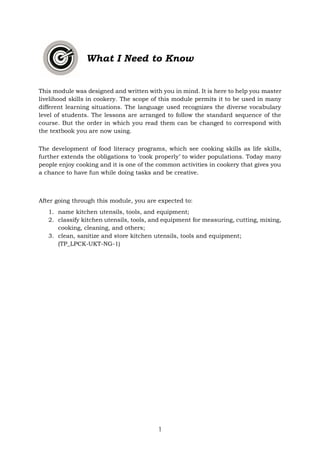
What I Need to Know
This module was designed and written with you in mind. It is here to help you master
livelihood skills in cookery. The scope of this module permits it to be used in many
different learning situations. The language used recognizes the diverse vocabulary
level of students. The lessons are arranged to follow the standard sequence of the
course. But the order in which you read them can be changed to correspond with
the textbook you are now using.
The development of food literacy programs, which see cooking skills as life skills,
further extends the obligations to ‘cook properly’ to wider populations. Today many
people enjoy cooking and it is one of the common activities in cookery that gives you
a chance to have fun while doing tasks and be creative.
After going through this module, you are expected to:
1. name kitchen utensils, tools, and equipment;
2. classify kitchen utensils, tools, and equipment for measuring, cutting, mixing,
cooking, cleaning, and others;
3. clean, sanitize and store kitchen utensils, tools and equipment;
(TP_LPCK-UKT-NG-1)
2
What I Know
Hi there! Have you ever seen your mother or your father cook? Can you name
the kitchen utensils or equipment that she or he used? Let’s see if you remember
some of these utensils or equipment. Do the activity below.
Part I. Directions: identify the drawing on the right. Choose the letter of the best
answer. Write your answer in your activity sheet.
_______1. A. can opener
B. colander
C. flipper
D. spoon
_______2. A. fork
B. glass
C. plate
D. spoon
________3. A. chopping board
B. cup
C. flipper
D. funnel
_______4. A. cooking pan
B. double boiler
C. grinder
D. kettle
_______5. A. blender
B. microwave
C. oven
D. refrigerator
3
Part II. Directions. Classify the kitchen utensils, tools, and equipment as to their
uses. Choose your answer from the box and write it on the blank provided. Do this
in your activity sheet.
1. - __________________________
2. - __________________________
3. - ___________________________
4. - ___________________________
5. - _____________________________
cleaning cooking cutting measuring mixing cleaning
4
Lesson
1 Livelihood Skills: Cookery
What’s In
Hi! How are you today? Welcome to a new learning opportunity. Are you
excited? Great! Do you love food? Well, today, you will learn about different kitchen
utensils, tools, and equipment which are used in cooking food. Are you ready? Good!
But before you explore further, do the activity below.
Directions: Which kitchen utensils at home do you find the most useful to you and
your family? Draw and color three (3) of it in the box below.
5
What’s New
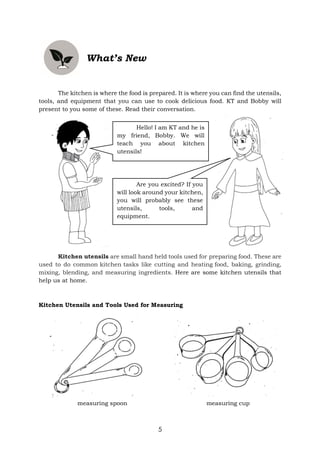
The kitchen is where the food is prepared. It is where you can find the utensils,
tools, and equipment that you can use to cook delicious food. KT and Bobby will
present to you some of these. Read their conversation.
Kitchen utensils are small hand held tools used for preparing food. These are
used to do common kitchen tasks like cutting and heating food, baking, grinding,
mixing, blending, and measuring ingredients. Here are some kitchen utensils that
help us at home.
Kitchen Utensils and Tools Used for Measuring
measuring spoon measuring cup
Hello! I am KT and he is
my friend, Bobby. We will
teach you about kitchen
utensils!
Are you excited? If you
will look around your kitchen,
you will probably see these
utensils, tools, and
equipment.
6
scale liquid measuring cup
Kitchen Utensils and Tools Used for Cutting
knives cutting board
sharpening steel kitchen shear/scissor
Kitchen Utensils and Tools Used for Mixing
flipper spatula
7
pasta spoon soup ladle
mixing bowl whisk
Kitchen Utensils and Tools Used for Cooking
basting brush double boiler
colander serving tong
8
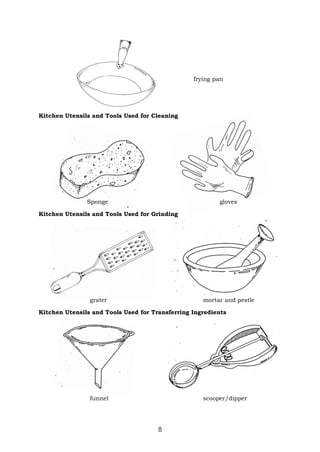
frying pan
Kitchen Utensils and Tools Used for Cleaning
Sponge gloves
Kitchen Utensils and Tools Used for Grinding
grater mortar and pestle
Kitchen Utensils and Tools Used for Transferring Ingredients
funnel scooper/dipper
9
Others
can opener dredger
strainer
Kitchen equipment are the larger items that can help prepare your food.
These things will help you do your work faster in the kitchen. Some of the most
commonly used are the following:
Wow! There are so many useful
kitchen utensils, KT.
Yes, Bobby! But there’s more! We
also have kitchen equipment
that help us and give us more
convenience when cooking.
10
Kitchen Equipment Used for Storing Food
refrigerator
Kitchen Equipment Used for Cooking
rice cooker oven toaster
gas range
Kitchen Equipment Used for Mixing
blender
There are so many kitchen utensils, tools, and equipment, that can help you
prepare food easier and faster. The next part will teach you how to maintain the
cleanliness of these tools. Keep on learning!
11
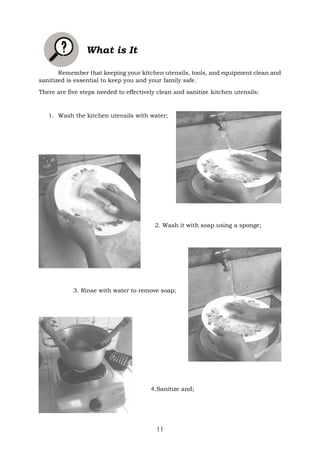
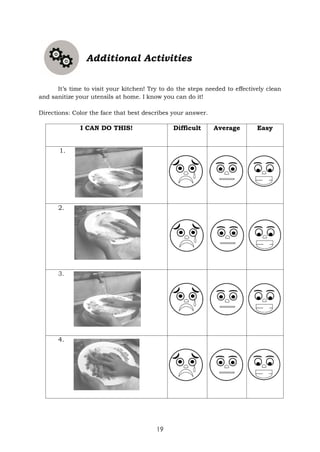
Remember that keeping your kitchen utensils, tools, and equipment clean and
sanitized is essential to keep you and your family safe.
There are five steps needed to effectively clean and sanitize kitchen utensils:
1. Wash the kitchen utensils with water;
2. Wash it with soap using a sponge;
3. Rinse with water to remove soap;
4.Sanitize and;
What is It
12
5. Dry up.
What’s More
Hello! It is your time to be creative! I hope you will have fun with this activity.
Follow the instructions carefully. Do this in your activity sheet.
1. Draw and name your two (2)
favorite kitchen utensils.
Kitchen utensils
13
2. Draw and name your two (2)
favorite kitchen equipment.
3. Draw and name your two (2)
favorite kitchen tools.
Kitchen measuring tools
14
What I Have Learned
Hey! You are doing great! Are you now familiar with different kitchen utensils,
tools, and equipment? Here are your key takeaways for this module;
Now let us have another activity to check your learning.
1. Kitchen utensils are small hand held tools used for preparing food. These
are used to do common kitchen tasks like cutting and heating food,
baking, grinding, mixing, blending, and measuring ingredients. Some
examples are can opener, colander, ladle, spoon, tong, and knives.
2. Kitchen equipment are the larger items that can help prepare your food.
These things will help you do your work faster in the kitchen. Some
examples are refrigerator, microwave oven, and rice cooker.
3. Measuring cups and spoons are examples of kitchen tools.
4. Kitchen utensils, tools, and equipment have their specific purpose and
uses. They can be used in measuring, cooking, cutting, mixing, grinding,
among others.
5. To keep kitchen utensils clean and sanitized, wash it with soap and water,
sanitize, and then, dry.
To help you remember more about this topic, do the activity below.
Directions: Circle the correct picture. Do this in your activity sheet.
1. scoop
15
2. basting
brush
3. colander
4. serving tong
5. pasta spoon
16
How did you do? Did you get the correct answers? Awesome! Always remember
that kitchen utensils, tools, and equipment make our work easier and faster. Thus,
you should always keep them cleaned and sanitized.
What I Can Do
It seems that you’ve learned a lot! This time, be excited for your next activity.
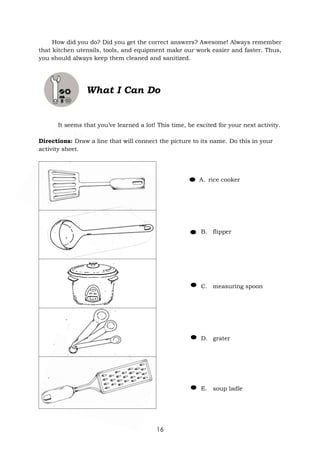
Directions: Draw a line that will connect the picture to its name. Do this in your
activity sheet.
A. rice cooker
B. flipper
C. measuring spoon
D. grater
E. soup ladle
17
Assessment
Part I. Directions: Name the following kitchen utensils and equipment.
1.
________________________
2.
_______________________
3. _________________________
4.
_______________________
5.
_______________________
18
Part II. Directions: Classify the following utensils as to kitchen utensils,
tools, or equipment.
Kitchen Utensils Kitchen Tools Kitchen Equipment
1. ______________________
2. ______________________
3. _______________________
4. _______________________
5. _______________________
6. _______________________
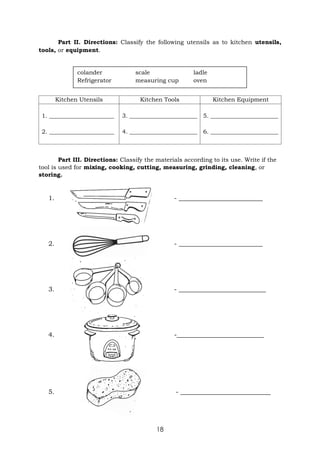
Part III. Directions: Classify the materials according to its use. Write if the
tool is used for mixing, cooking, cutting, measuring, grinding, cleaning, or
storing.
1. - __________________________
2. - __________________________
3. - ___________________________
4. -___________________________
5. - ____________________________
colander scale ladle
Refrigerator measuring cup oven
19
Additional Activities
It’s time to visit your kitchen! Try to do the steps needed to effectively clean
and sanitize your utensils at home. I know you can do it!
Directions: Color the face that best describes your answer.
I CAN DO THIS! Difficult Average Easy
1.
2.
3.
4.
20
What
I
Can
Do
Answer Key
What
I
Know
Part
I
1.
A
2.
D
3.
B
4.
A
5.
C
Part
II
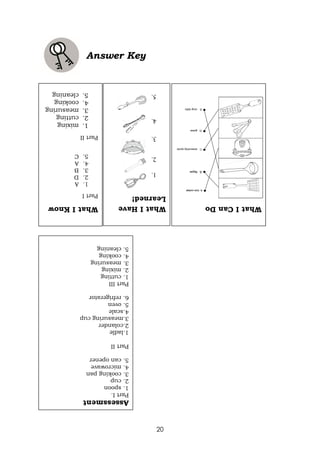
1.
mixing
2.
cutting
3.
measuring
4.
cooking
5.
cleaning
What
I
Have
Learned!
1.
2.
3.
4.
5.
Assessment
Part
I.
1.
spoon
2.
cup
3.
cooking
pan
4.
microwave
5.
can
opener
Part
II
1.ladle
2.colander
3.measuring
cup
4.scale
5.
oven
6.
refrigerator
Part
III
1.
cutting
2.
mixing
3.
measuring
4.
cooking
5.
cleaning
21
References
Susan Campbell. Cooks' Tools: The Complete Manual of Kitchen Implements
and how to Use Them. Bantam Books, 1980.
Sebastian Conran and Joseph Patrick O'connor. Kitchen equipment. U.S.
Patent 6,035,771, issued March 14, 2000.
Shobha, H. Kaur, and M. Sidhu. Modern Kitchen Tools: A Boon for
Homemakers: Studies on Home and CommunityScience 5, no. 2, 2011, 127-
129.
https://hipages.com.au/article/what_are_kitchen_utensils.
T.L.E. Learning Module, https://gltnhs-tle.weebly.com/lesson-13.html
T.L.E. Learning Module, https://gltnhs-tle.weebly.com/lesson-22.html
T.L.E. Learning Module, https://gltnhs-tle.weebly.com/lesson-42.html
DISCLAIMER
This Self-Learning Module (SLM) was developed by DepEd
SOCCSKSARGEN with the primary objective of preparing for and addressing
the new normal. Contents of this module were based on DepEd’s Most
Essential Learning Competencies (MELC). This is a supplementary material
to be used by all learners of Region XII in all public schools beginning SY
2020-2021. The process of LR development was observed in the production of
this module. This is version 1.0. We highly encourage feedback, comments,
and recommendations.
For inquiries or feedback, please write or call:
Department of Education – SOCCSKSARGEN
Learning Resource Management System (LRMS)
Regional Center, Brgy. Carpenter Hill, City of Koronadal
Telefax No.: (083) 2288825/ (083) 2281893
Email Address: region12@deped.gov.ph

Livelihood.cookery.module 1

  • 1.
  • 2.
    Livelihood Skills SPED– Transition Self-Learning Module (SLM) Quarter 1 – Module 1: Kitchen Utensils, Tools, and Equipment First Edition, 2020 Republic Act 8293, section 176 states that: No copyright shall subsist in any work of the Government of the Philippines. However, prior approval of the government agency or office wherein the work is created shall be necessary for exploitation of such work for profit. Such agency or office may, among other things, impose as a condition the payment of royalties. Borrowed materials (i.e., songs, stories, poems, pictures, photos, brand names, trademarks, etc.) included in this module are owned by their respective copyright holders. Every effort has been exerted to locate and seek permission to use these materials from their respective copyright owners. The publisher and authors do not represent nor claim ownership over them. Printed in the Philippines by Department of Education – SOCCSKSARGENRegion Office Address: Regional Center, Brgy. Carpenter Hill, City of Koronadal Telefax: (083) 2288825/ (083) 2281893 E-mail Address: region12@deped.gov.ph Development Team of the Module Writers: Christine Jensen M. Manjares Editors: Joane Cher F. Yturalde Reviewers: Joane Cher F. Yturalde Illustrator: Fitzroy Cezar M. Dagol Layout Artist: Fitzroy Cezar M. Dagol Cover Art Designer: Reggie D. Galindez Management Team: Allan G. Farnazo, CESO IV – Regional Director Fiel Y. Almendra, CESO V – Assistant Regional Director Leonardo M. Balala, CESE – Schools Division Superintendent Gilbert B. Barrera – Chief, CLMD Arturo D. Tingson Jr. – REPS, LRMS Peter Van C. Ang-ug – REPS, ADM Cynthia Diaz – REPS, SPED Ismael M. Ambalgan – CID Chief Sheryl L. Osano – EPS, LRMS Josevic F. Hurtada – EPS, ADM/SPED
  • 3.
    SPED Transition Livelihood Skills Cookery Quarter 1– Module 1: Kitchen Utensils, Tools and Equipment
  • 4.
    ii Introductory Message For thefacilitator: Welcome to the SPED Transition Livelihood Skills- Self-Learning Module (SLM) on Cookery! This module was collaboratively designed, developed and reviewed by educators both from public and private institutions to assist you, the teacher or facilitator in helping the learners meet the standards set by the K to 12 Curriculum while overcoming their personal, social, and economic constraints in schooling. This learning resource hopes to engage the learners into guided and independent learning activities at their own pace and time. Furthermore, this also aims to help learners acquire the needed 21st century skills while taking into consideration their needs and circumstances. In addition to the material in the main text, you will also see this box in the body of the module: As a facilitator you are expected to orient the learners on how to use this module. You also need to keep track of the learners' progress while allowing them to manage their own learning. Furthermore, you are expected to encourage and assist the learners as they do the tasks included in the module. Notes to the Teacher Advice your learner to ask assistance from their parents in doing the activity.
  • 5.
    iii For the learner: Welcometo the LWD Transition Livelihood Skills- Self-Learning Module (SLM) on Bread and Pastry Production! This module was designed to provide you with fun and meaningful opportunities for guided and independent learning at your own pace and time. You will be enabled to process the contents of the learning resource while being an active learner. This module has the following parts and corresponding icons: What I Need to Know This will give you an idea of the skills or competencies you are expected to learn in the module. What I Know This part includes an activity that aims to check what you already know about the lesson to take. If you get all the answers correct (100%), you may decide to skip this module. What’s In This is a brief drill or review to help you link the current lesson with the previous one. What’s New In this portion, the new lesson will be introduced to you in various ways; a story, a song, a poem, a problem opener, an activity or a situation. What is It This section provides a brief discussion of the lesson. This aims to help you discover and understand new concepts and skills. What’s More This comprises activities for independent practice to solidify your understanding and skills of the topic. You may check the answers to the exercises using the Answer Key at the end of the module. What I Have Learned This includes questions or blank sentence/paragraph to be filled into process what you learned from the lesson. What I Can Do This section provides an activity which will help you transfer your new knowledge or skill into real life situations or concerns.
  • 6.
    iv Assessment This isa task which aims to evaluate your level of mastery in achieving the learning competency. Additional Activities In this portion, another activity will be given to you to enrich your knowledge or skill of the lesson learned. Answer Key This contains answers to all activities in the module. At the end of this module you will also find: The following are some reminders in using this module: 1. Use the module with care. Do not put unnecessary mark/s on any part of the module. Use a separate sheet of paper in answering the exercises. 2. Don’t forget to answer What I Know before moving on to the other activities included in the module. 3. Read the instruction carefully before doing each task. 4. Observe honesty and integrity in doing the tasks and checking your answers. 5. Finish the task at hand before proceeding to the next. 6. Return this module to your teacher/facilitator once you are through with it. If you encounter any difficulty in answering the tasks in this module, do not hesitate to consult your teacher or facilitator. Always bear in mind that you are not alone. We hope that through this material, you will experience meaningful learning and gain deep understanding of the relevant competencies. You can do it! References This is a list of all sources used in developing this module.
  • 7.
    1 What I Needto Know This module was designed and written with you in mind. It is here to help you master livelihood skills in cookery. The scope of this module permits it to be used in many different learning situations. The language used recognizes the diverse vocabulary level of students. The lessons are arranged to follow the standard sequence of the course. But the order in which you read them can be changed to correspond with the textbook you are now using. The development of food literacy programs, which see cooking skills as life skills, further extends the obligations to ‘cook properly’ to wider populations. Today many people enjoy cooking and it is one of the common activities in cookery that gives you a chance to have fun while doing tasks and be creative. After going through this module, you are expected to: 1. name kitchen utensils, tools, and equipment; 2. classify kitchen utensils, tools, and equipment for measuring, cutting, mixing, cooking, cleaning, and others; 3. clean, sanitize and store kitchen utensils, tools and equipment; (TP_LPCK-UKT-NG-1)
  • 8.
    2 What I Know Hithere! Have you ever seen your mother or your father cook? Can you name the kitchen utensils or equipment that she or he used? Let’s see if you remember some of these utensils or equipment. Do the activity below. Part I. Directions: identify the drawing on the right. Choose the letter of the best answer. Write your answer in your activity sheet. _______1. A. can opener B. colander C. flipper D. spoon _______2. A. fork B. glass C. plate D. spoon ________3. A. chopping board B. cup C. flipper D. funnel _______4. A. cooking pan B. double boiler C. grinder D. kettle _______5. A. blender B. microwave C. oven D. refrigerator
  • 9.
    3 Part II. Directions.Classify the kitchen utensils, tools, and equipment as to their uses. Choose your answer from the box and write it on the blank provided. Do this in your activity sheet. 1. - __________________________ 2. - __________________________ 3. - ___________________________ 4. - ___________________________ 5. - _____________________________ cleaning cooking cutting measuring mixing cleaning
  • 10.
    4 Lesson 1 Livelihood Skills:Cookery What’s In Hi! How are you today? Welcome to a new learning opportunity. Are you excited? Great! Do you love food? Well, today, you will learn about different kitchen utensils, tools, and equipment which are used in cooking food. Are you ready? Good! But before you explore further, do the activity below. Directions: Which kitchen utensils at home do you find the most useful to you and your family? Draw and color three (3) of it in the box below.
  • 11.
    5 What’s New The kitchenis where the food is prepared. It is where you can find the utensils, tools, and equipment that you can use to cook delicious food. KT and Bobby will present to you some of these. Read their conversation. Kitchen utensils are small hand held tools used for preparing food. These are used to do common kitchen tasks like cutting and heating food, baking, grinding, mixing, blending, and measuring ingredients. Here are some kitchen utensils that help us at home. Kitchen Utensils and Tools Used for Measuring measuring spoon measuring cup Hello! I am KT and he is my friend, Bobby. We will teach you about kitchen utensils! Are you excited? If you will look around your kitchen, you will probably see these utensils, tools, and equipment.
  • 12.
    6 scale liquid measuringcup Kitchen Utensils and Tools Used for Cutting knives cutting board sharpening steel kitchen shear/scissor Kitchen Utensils and Tools Used for Mixing flipper spatula
  • 13.
    7 pasta spoon soupladle mixing bowl whisk Kitchen Utensils and Tools Used for Cooking basting brush double boiler colander serving tong
  • 14.
    8 frying pan Kitchen Utensilsand Tools Used for Cleaning Sponge gloves Kitchen Utensils and Tools Used for Grinding grater mortar and pestle Kitchen Utensils and Tools Used for Transferring Ingredients funnel scooper/dipper
  • 15.
    9 Others can opener dredger strainer Kitchenequipment are the larger items that can help prepare your food. These things will help you do your work faster in the kitchen. Some of the most commonly used are the following: Wow! There are so many useful kitchen utensils, KT. Yes, Bobby! But there’s more! We also have kitchen equipment that help us and give us more convenience when cooking.
  • 16.
    10 Kitchen Equipment Usedfor Storing Food refrigerator Kitchen Equipment Used for Cooking rice cooker oven toaster gas range Kitchen Equipment Used for Mixing blender There are so many kitchen utensils, tools, and equipment, that can help you prepare food easier and faster. The next part will teach you how to maintain the cleanliness of these tools. Keep on learning!
  • 17.
    11 Remember that keepingyour kitchen utensils, tools, and equipment clean and sanitized is essential to keep you and your family safe. There are five steps needed to effectively clean and sanitize kitchen utensils: 1. Wash the kitchen utensils with water; 2. Wash it with soap using a sponge; 3. Rinse with water to remove soap; 4.Sanitize and; What is It
  • 18.
    12 5. Dry up. What’sMore Hello! It is your time to be creative! I hope you will have fun with this activity. Follow the instructions carefully. Do this in your activity sheet. 1. Draw and name your two (2) favorite kitchen utensils. Kitchen utensils
  • 19.
    13 2. Draw andname your two (2) favorite kitchen equipment. 3. Draw and name your two (2) favorite kitchen tools. Kitchen measuring tools Kitchen measuring tools
  • 20.
    14 What I HaveLearned Hey! You are doing great! Are you now familiar with different kitchen utensils, tools, and equipment? Here are your key takeaways for this module; Now let us have another activity to check your learning. 1. Kitchen utensils are small hand held tools used for preparing food. These are used to do common kitchen tasks like cutting and heating food, baking, grinding, mixing, blending, and measuring ingredients. Some examples are can opener, colander, ladle, spoon, tong, and knives. 2. Kitchen equipment are the larger items that can help prepare your food. These things will help you do your work faster in the kitchen. Some examples are refrigerator, microwave oven, and rice cooker. 3. Measuring cups and spoons are examples of kitchen tools. 4. Kitchen utensils, tools, and equipment have their specific purpose and uses. They can be used in measuring, cooking, cutting, mixing, grinding, among others. 5. To keep kitchen utensils clean and sanitized, wash it with soap and water, sanitize, and then, dry. To help you remember more about this topic, do the activity below. Directions: Circle the correct picture. Do this in your activity sheet. 1. scoop
  • 21.
    15 2. basting brush 3. colander 4.serving tong 5. pasta spoon
  • 22.
    16 How did youdo? Did you get the correct answers? Awesome! Always remember that kitchen utensils, tools, and equipment make our work easier and faster. Thus, you should always keep them cleaned and sanitized. What I Can Do It seems that you’ve learned a lot! This time, be excited for your next activity. Directions: Draw a line that will connect the picture to its name. Do this in your activity sheet. A. rice cooker B. flipper C. measuring spoon D. grater E. soup ladle
  • 23.
    17 Assessment Part I. Directions:Name the following kitchen utensils and equipment. 1. ________________________ 2. _______________________ 3. _________________________ 4. _______________________ 5. _______________________
  • 24.
    18 Part II. Directions:Classify the following utensils as to kitchen utensils, tools, or equipment. Kitchen Utensils Kitchen Tools Kitchen Equipment 1. ______________________ 2. ______________________ 3. _______________________ 4. _______________________ 5. _______________________ 6. _______________________ Part III. Directions: Classify the materials according to its use. Write if the tool is used for mixing, cooking, cutting, measuring, grinding, cleaning, or storing. 1. - __________________________ 2. - __________________________ 3. - ___________________________ 4. -___________________________ 5. - ____________________________ colander scale ladle Refrigerator measuring cup oven
  • 25.
    19 Additional Activities It’s timeto visit your kitchen! Try to do the steps needed to effectively clean and sanitize your utensils at home. I know you can do it! Directions: Color the face that best describes your answer. I CAN DO THIS! Difficult Average Easy 1. 2. 3. 4.
  • 26.
  • 27.
    21 References Susan Campbell. Cooks'Tools: The Complete Manual of Kitchen Implements and how to Use Them. Bantam Books, 1980. Sebastian Conran and Joseph Patrick O'connor. Kitchen equipment. U.S. Patent 6,035,771, issued March 14, 2000. Shobha, H. Kaur, and M. Sidhu. Modern Kitchen Tools: A Boon for Homemakers: Studies on Home and CommunityScience 5, no. 2, 2011, 127- 129. https://hipages.com.au/article/what_are_kitchen_utensils. T.L.E. Learning Module, https://gltnhs-tle.weebly.com/lesson-13.html T.L.E. Learning Module, https://gltnhs-tle.weebly.com/lesson-22.html T.L.E. Learning Module, https://gltnhs-tle.weebly.com/lesson-42.html
  • 28.
    DISCLAIMER This Self-Learning Module(SLM) was developed by DepEd SOCCSKSARGEN with the primary objective of preparing for and addressing the new normal. Contents of this module were based on DepEd’s Most Essential Learning Competencies (MELC). This is a supplementary material to be used by all learners of Region XII in all public schools beginning SY 2020-2021. The process of LR development was observed in the production of this module. This is version 1.0. We highly encourage feedback, comments, and recommendations. For inquiries or feedback, please write or call: Department of Education – SOCCSKSARGEN Learning Resource Management System (LRMS) Regional Center, Brgy. Carpenter Hill, City of Koronadal Telefax No.: (083) 2288825/ (083) 2281893 Email Address: region12@deped.gov.ph