EDUC 6708: Literacy Development in a Culturally and Linguistically Diverse Classroom
Lesson Plan Template
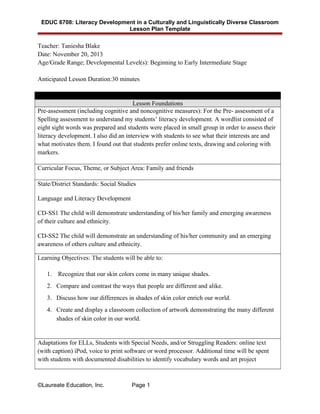
Teacher: Taniesha Blake
Date: November 20, 2013
Age/Grade Range; Developmental Level(s): Beginning to Early Intermediate Stage
Anticipated Lesson Duration:30 minutes
Lesson Foundations
Pre-assessment (including cognitive and noncognitive measures): For the Pre- assessment of a
Spelling assessment to understand my students’ literacy development. A wordlist consisted of
eight sight words was prepared and students were placed in small group in order to assess their
literacy development. I also did an interview with students to see what their interests are and
what motivates them. I found out that students prefer online texts, drawing and coloring with
markers.
Curricular Focus, Theme, or Subject Area: Family and friends
State/District Standards: Social Studies
Language and Literacy Development
CD-SS1 The child will demonstrate understanding of his/her family and emerging awareness
of their culture and ethnicity.
CD-SS2 The child will demonstrate an understanding of his/her community and an emerging
awareness of others culture and ethnicity.
Learning Objectives: The students will be able to:
1. Recognize that our skin colors come in many unique shades.
2. Compare and contrast the ways that people are different and alike.
3. Discuss how our differences in shades of skin color enrich our world.
4. Create and display a classroom collection of artwork demonstrating the many different
shades of skin color in our world.
Adaptations for ELLs, Students with Special Needs, and/or Struggling Readers: online text
(with caption) iPod, voice to print software or word processor. Additional time will be spent
with students with documented disabilities to identify vocabulary words and art project
©Laureate Education, Inc. Page 1
EDUC 6708: Literacy Development in a Culturally and Linguistically Diverse Classroom
Lesson Plan Template
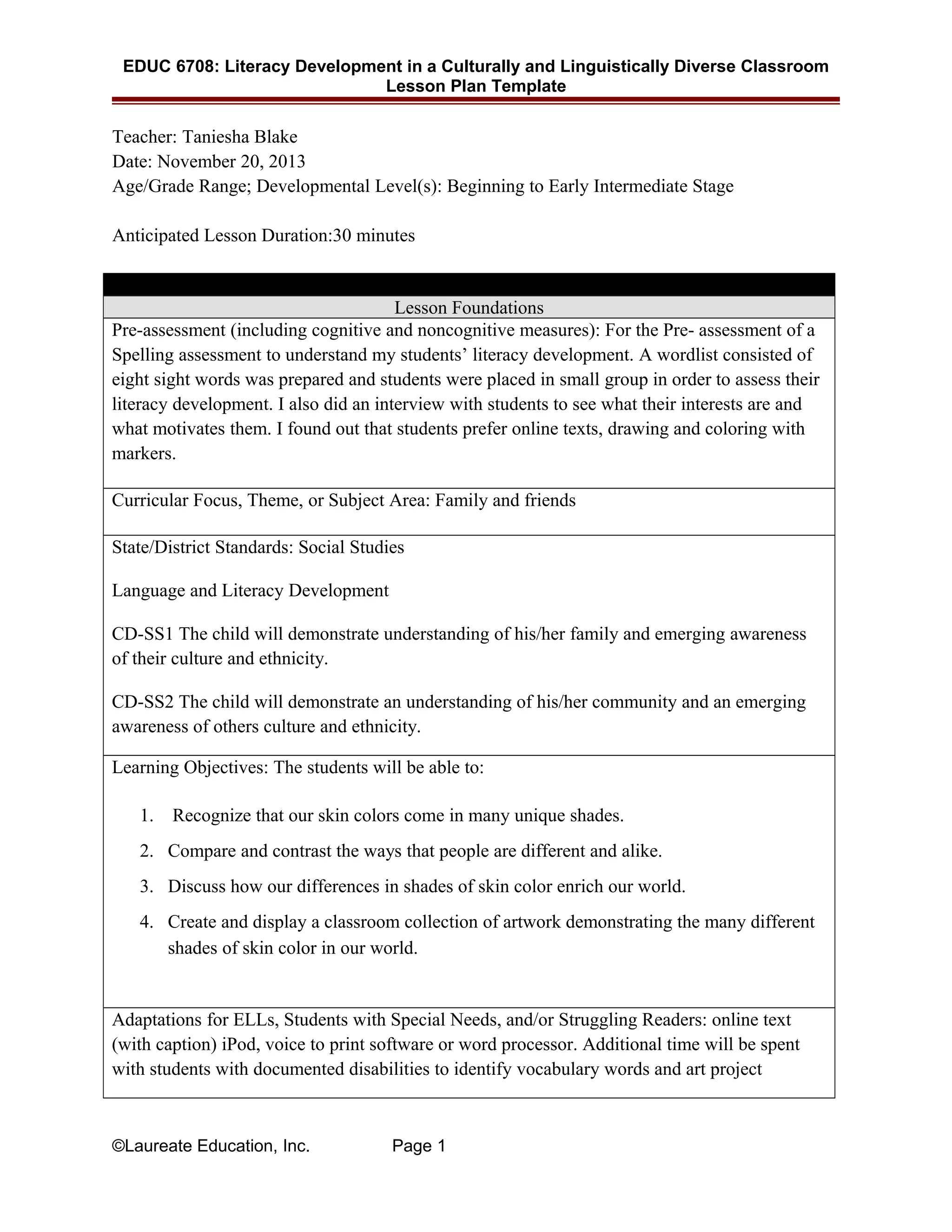
Perspective(s) addressed in this lesson (Interactive, Critical, and/or Response): Interactive
Perspective
Texts: ‘The Color of US’ Author: Katz, K., New York: Henry Holt and Company (The actual
text will be present as well as online)
This text selection will help students to connect food they eat as a family and how the color is
similar to the color of their skin. This text will also help students recognize their similarities
and differences. In addition students like to look at each other and make comparisons daily
therefore this was a fun and exciting experience for students as they embrace their culture
differences in the skin color of their friends.
Other Materials/Technology/Equipment/Resources: word processor, iPod, computer/internet
Grouping structures (one-on-one, small group, whole class):Small Group
Lesson Sequence
Learning Activities Assessment Opportunities
Introduction/Anticipatory Set: I set up an interview
with students to see where their interests were. For
example I asked students how they prefer to hear a
story read.
The teacher will then model the thought process of
same and different as it relates to colors. For example
the teacher asks, ‘what is the same about me and Ms
Jennifer’? Another example the teacher gave was,
‘what is not the same about me and Ms. Tasha next
door’?
In their Small Group the students will be guided into a
discussion about how we are all similar but different.
The interview will help me gain
background knowledge of my
students’ interest and what motivates
them.
The students will be assessed based
on their ability to use prior experience
to what they are now learning.
Students’ response during discussion
will be assessed.
Building/Applying Knowledge and Skills:
I will start the lesson by asking, ‘what is similar with
the person who sits next to you’? Then I will have
them turn to someone else and ask them to tell ‘what is
not the same about that other person’. Children will be
paired to discuss what makes them different.
Students’ response to questions will
be assessed.
©Laureate Education, Inc. Page 2
EDUC 6708: Literacy Development in a Culturally and Linguistically Diverse Classroom
Lesson Plan Template
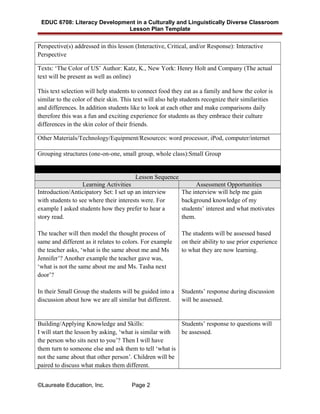
Before the story is read the teacher will write some
key vocabulary words on chart paper and students will
review to connect them to sentences from the text and
their everyday life. Some of the key vocabulary are,
color, mother, food, skin.
The teacher will then allow students to listen to the
text and see caption of text online. The teacher will
ask students questions before, during and after text is
read online. For example before the text is read teacher
will show students the cover of the actual text and ask
‘what do you see on the cover of the text’? During text
being read she would ask, ‘why did Lena say her skin
is the color of cinnamon’? ‘Does Sonia skin color
really look like peanut butter to you’?
Students will be given spices and food mentioned in
the story and copies of pictures of characters from the
book. The students as a group will match up the
food/spice sample to the correct character and discuss
whether or not they agree whether there were good
descriptions. The students will also discuss whether
they are similar or different to the characters in the
text.
Students will be paired facing each other and paint a
picture of their partners face on paper. The teacher will
walk around to each group to talk about similarities
and differences in eyes, hair, ears, skin color gives us
our own individuality. She would help them realize
that we are all similar, just a few drop of paint makes
us have a different skin tone.
Student’s ability to identify
vocabulary words will be assessed.
Students responses/comprehension of
text will be assessed before, during
and after text is read.
Synthesis/Closure: As a closing activity each student
©Laureate Education, Inc. Page 3
EDUC 6708: Literacy Development in a Culturally and Linguistically Diverse Classroom
Lesson Plan Template
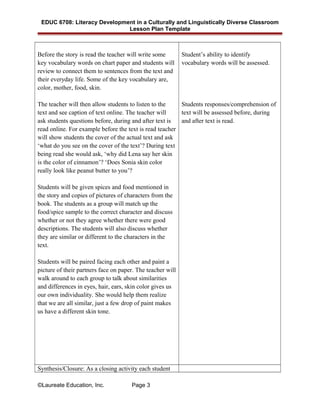
will place one hand on a piece of paper, then the
teacher will have students trace their hand and match
the paint closet to their skin tone and paint their traced
hand. The students will cut their hands then arrange
from darkest to lightest. Teacher will review other
food and spices in nature with similar color, then allow
children to copy/write the name of spice or food that
matches their skin tone.
Extension/Enrichment/Transfer or Generalization of Knowledge: Students will have access to
the text and write vocabulary words that relates to them. This will help me assess their writing.
Students will be asked to find out what is same and different about their family members an
share with their classmates the next day.
For an extension of this lesson I will invite two parents to the classroom one from a Hispanic
background and another from an African American background to talk about similarities and
differences.
The knowledge to be gained from this lesson is for students to recognize similarities and
differences of people and that although we may differ in some ways we are the same. In order
for the development of English language students will be provided with opportunities to
explore text and vocabulary words from the text. Students will participate in guided discussions
as well as pair discussion to bring forward content knowledge of similarities and differences
among people. I will also model whenever possible to help student connect to the content or
vocabulary words.
©Laureate Education, Inc. Page 4

Literacy development lesson

  • 1.
    EDUC 6708: LiteracyDevelopment in a Culturally and Linguistically Diverse Classroom Lesson Plan Template Teacher: Taniesha Blake Date: November 20, 2013 Age/Grade Range; Developmental Level(s): Beginning to Early Intermediate Stage Anticipated Lesson Duration:30 minutes Lesson Foundations Pre-assessment (including cognitive and noncognitive measures): For the Pre- assessment of a Spelling assessment to understand my students’ literacy development. A wordlist consisted of eight sight words was prepared and students were placed in small group in order to assess their literacy development. I also did an interview with students to see what their interests are and what motivates them. I found out that students prefer online texts, drawing and coloring with markers. Curricular Focus, Theme, or Subject Area: Family and friends State/District Standards: Social Studies Language and Literacy Development CD-SS1 The child will demonstrate understanding of his/her family and emerging awareness of their culture and ethnicity. CD-SS2 The child will demonstrate an understanding of his/her community and an emerging awareness of others culture and ethnicity. Learning Objectives: The students will be able to: 1. Recognize that our skin colors come in many unique shades. 2. Compare and contrast the ways that people are different and alike. 3. Discuss how our differences in shades of skin color enrich our world. 4. Create and display a classroom collection of artwork demonstrating the many different shades of skin color in our world. Adaptations for ELLs, Students with Special Needs, and/or Struggling Readers: online text (with caption) iPod, voice to print software or word processor. Additional time will be spent with students with documented disabilities to identify vocabulary words and art project ©Laureate Education, Inc. Page 1
  • 2.
    EDUC 6708: LiteracyDevelopment in a Culturally and Linguistically Diverse Classroom Lesson Plan Template Perspective(s) addressed in this lesson (Interactive, Critical, and/or Response): Interactive Perspective Texts: ‘The Color of US’ Author: Katz, K., New York: Henry Holt and Company (The actual text will be present as well as online) This text selection will help students to connect food they eat as a family and how the color is similar to the color of their skin. This text will also help students recognize their similarities and differences. In addition students like to look at each other and make comparisons daily therefore this was a fun and exciting experience for students as they embrace their culture differences in the skin color of their friends. Other Materials/Technology/Equipment/Resources: word processor, iPod, computer/internet Grouping structures (one-on-one, small group, whole class):Small Group Lesson Sequence Learning Activities Assessment Opportunities Introduction/Anticipatory Set: I set up an interview with students to see where their interests were. For example I asked students how they prefer to hear a story read. The teacher will then model the thought process of same and different as it relates to colors. For example the teacher asks, ‘what is the same about me and Ms Jennifer’? Another example the teacher gave was, ‘what is not the same about me and Ms. Tasha next door’? In their Small Group the students will be guided into a discussion about how we are all similar but different. The interview will help me gain background knowledge of my students’ interest and what motivates them. The students will be assessed based on their ability to use prior experience to what they are now learning. Students’ response during discussion will be assessed. Building/Applying Knowledge and Skills: I will start the lesson by asking, ‘what is similar with the person who sits next to you’? Then I will have them turn to someone else and ask them to tell ‘what is not the same about that other person’. Children will be paired to discuss what makes them different. Students’ response to questions will be assessed. ©Laureate Education, Inc. Page 2
  • 3.
    EDUC 6708: LiteracyDevelopment in a Culturally and Linguistically Diverse Classroom Lesson Plan Template Before the story is read the teacher will write some key vocabulary words on chart paper and students will review to connect them to sentences from the text and their everyday life. Some of the key vocabulary are, color, mother, food, skin. The teacher will then allow students to listen to the text and see caption of text online. The teacher will ask students questions before, during and after text is read online. For example before the text is read teacher will show students the cover of the actual text and ask ‘what do you see on the cover of the text’? During text being read she would ask, ‘why did Lena say her skin is the color of cinnamon’? ‘Does Sonia skin color really look like peanut butter to you’? Students will be given spices and food mentioned in the story and copies of pictures of characters from the book. The students as a group will match up the food/spice sample to the correct character and discuss whether or not they agree whether there were good descriptions. The students will also discuss whether they are similar or different to the characters in the text. Students will be paired facing each other and paint a picture of their partners face on paper. The teacher will walk around to each group to talk about similarities and differences in eyes, hair, ears, skin color gives us our own individuality. She would help them realize that we are all similar, just a few drop of paint makes us have a different skin tone. Student’s ability to identify vocabulary words will be assessed. Students responses/comprehension of text will be assessed before, during and after text is read. Synthesis/Closure: As a closing activity each student ©Laureate Education, Inc. Page 3
  • 4.
    EDUC 6708: LiteracyDevelopment in a Culturally and Linguistically Diverse Classroom Lesson Plan Template will place one hand on a piece of paper, then the teacher will have students trace their hand and match the paint closet to their skin tone and paint their traced hand. The students will cut their hands then arrange from darkest to lightest. Teacher will review other food and spices in nature with similar color, then allow children to copy/write the name of spice or food that matches their skin tone. Extension/Enrichment/Transfer or Generalization of Knowledge: Students will have access to the text and write vocabulary words that relates to them. This will help me assess their writing. Students will be asked to find out what is same and different about their family members an share with their classmates the next day. For an extension of this lesson I will invite two parents to the classroom one from a Hispanic background and another from an African American background to talk about similarities and differences. The knowledge to be gained from this lesson is for students to recognize similarities and differences of people and that although we may differ in some ways we are the same. In order for the development of English language students will be provided with opportunities to explore text and vocabulary words from the text. Students will participate in guided discussions as well as pair discussion to bring forward content knowledge of similarities and differences among people. I will also model whenever possible to help student connect to the content or vocabulary words. ©Laureate Education, Inc. Page 4