 Introduction
 Philosophical Background
 Sources
 Lippes Influence Over Kent:
 Plan And Construction
 Special Features
 Drawbacks And Critical Review
 Conclusion
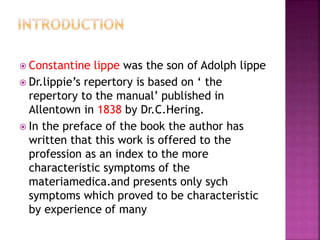
 Constantine lippe was the son of Adolph lippe
 Dr.lippie’s repertory is based on ‘ the
repertory to the manual’ published in
Allentown in 1838 by Dr.C.Hering.
 In the preface of the book the author has
written that this work is offered to the
profession as an index to the more
characteristic symptoms of the
materiamedica.and presents only sych
symptoms which proved to be characteristic
by experience of many
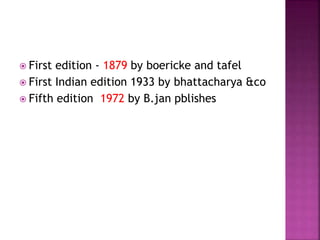
 First edition - 1879 by boericke and tafel
 First Indian edition 1933 by bhattacharya &co
 Fifth edition 1972 by B.jan pblishes
 This repertory is based on the first repertory
and materiamedica published in the English
language by Dr.C.Hering The repertory to
the manual published in Allentown in the
year 1838.
 Boenninghausen’s work
 A.lippe’smateriamedica
 Bell’s diarrhea
 H.N.Guernsey’ work
 Hering’s work
 Jahr’s work
 A need was felt by the kent for a new and a more
complete and useful repertory .
 Initially kent used therapeutic pocket book but was
soon dissatisfied with its philosophy
 He started to go through the repertories→ liked
the plan and arrangement repertory to more
characteristic symptoms of our material medica by
Constantine lippe
 He Added Notes To Each Syptom Or
Rubric.This Was Interleaved Many Time
 Hence Kent Got Into Contact With Lipppe
,Who Wanted Kent To Work Along With Lee
Who Was Preparing A 3rd Edition Of Lippes
Repertory
 By This Time Dr.Kent Had Prepared A
Repertory Of Urinary
Organs,chill,fever,sweat,etc.Hence It Canbe
Said That Lippes Work Was The Base For
Kents Repertory.
 Dr. Lippe used the principle ie, GENERALS
TO PARTICULARS. He has given first the
mental symptoms and then followed in the
order as per used in material medica pura
i.e, from above downwards.
 All the sections are to be compared with
generalities.
 After the death of Dr. C.Lippe all the
manuscripts he had written for a second
edition of his repertory was secured and
included in Dr. Edumand lee’s ‘ repertory of
the characteristic symptoms of the
homoeopathic materiamedica’. This
repertory might infact be considered as the
second edition of Dr.lippe’s book.
 Hahnemannian schema is followed and ends
with section called generalities which all
previous sections are to be compared
Repertory contains 3 parts
 1.preface
 2.repertory proper
 3.index of remedies.
 PREFACE ;
 it deals the philosophical background and
about publication of the repertory and books
referred And instructions to the users.
 The repertory part consist of 34 chapters as
follows.
 Mind and disposition
 Sensorium- cloudiness, giddiness, vertigo etc.
 Head interior, headache, congestion of blood,
heaviness and fullness
 Scalp
 Eyes and sight
 Nose and smell
 Ears and hearing
 Face, lips and lower jaw
 Teeth and gums
 mouth , palate and tongue.
 Fauces, pharynx and oesophagus
 Appetite and taste, hunger and thirst
 Complaints during and after meals
 Eructations, nausea, vomiting, hiccough, heartburn and
waterbrash
 Stomach and pit of stomach
 Hypochondriae, kidneys , diaphragm, liver and spleen
 Abdomen, groin and flatulency
 Stool and anus
 Urine and urinary organs
 Male sexual organs
 Female sexual organs
 Coryza
 Larynx and trachea
 Cough
 Respiration
 chest and heart
 mammae and nipples
 Neck. Back and sacrum
 Upper extremities
 Lower extremities
 Sleep and dreams
 Fever
 Skin
 Generalities, aggravation and amelioration
 INDEX OF REMEDIES:
At the end of the book there is a index of remedies
with their abbreviations. which consist of 602
remedies.
 GRADATION:
 Dr.Lippe has used gradations for the remedies in
this repertory to the more characteristic symptoms
of the materiamedica
 1st grade- Italics
 2nd grade-Ordinary roman
 Rubrics are arranged alphabetically .in the section head
the rubrics and sub rubrics are arranged according to
the following schema :
 LOCATION;
SUB SENSATION,
SIDES-RIGHT,LEFT
EXTENSION /RADIATION.
MODALITIY
(Example)
 In chapter HEAD
 Forehead (page32)
-throbing.
--left side of forehead
--from forehead to occiput
 Conditions(page 40)
 Accompanied by(page45)
 SENSATION
 SUB LOCATION
SIDES-RIGHT,LEFT
EXTENSION /RADIATION.
MODALITIY
 CONDITIONS
 ACCOMPANIED BY
(Example )
 In chapter LOWER EXTREMITIES;
 Coldness (page303)
-feet
-On one side
--in the morning
--in the evening
 In morning (page 320)
 At night
 With epistaxis(page 322)
 -In conditions (modalities ,rubrics starts with
time followed by alphabetic arranged which
includes aggrevation and ameliorations.
 Under accompanied by rubrics arranged
alphabetically
- unuiformity in the arrangement of rubrics.
 Eg: in the chapter eyes and sight
 Burning
 Burning in the morning
 At twilight
 Blow the eye when rubbing
 On the brows
 In canthi
 Edges
 The lids
 The repertory although the rubrics have been
arranged on the basis of deductive logic i.e, from
general to particular but unuiformity in the
arrangement of rubrics.
 Eg: in the chapter eyes and sight
 Burning
 Burning in the morning
 At twilight
 Blow the eye when rubbing
 On the brows
 In canthi
 Edges
 The lids
 Whereas in chapter upper extremities :
 Swelling arms :
 Brachial bones
 Shoulder
 Upper arm
 Elbow joint
 Forearm
 Wrist
 Hands
 Night
 Dorsum
 Pain in
 Night
 Fingers
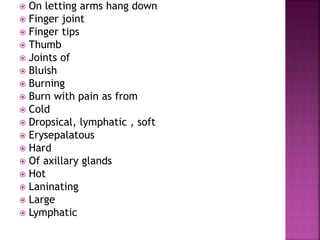
 On letting arms hang down
 Finger joint
 Finger tips
 Thumb
 Joints of
 Bluish
 Burning
 Burn with pain as from
 Cold
 Dropsical, lymphatic , soft
 Erysepalatous
 Hard
 Of axillary glands
 Hot
 Laninating
 Large
 Lymphatic
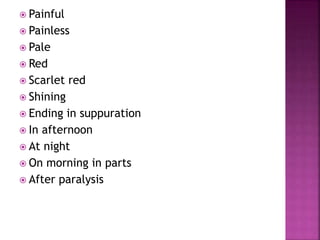
 Painful
 Painless
 Pale
 Red
 Scarlet red
 Shining
 Ending in suppuration
 In afternoon
 At night
 On morning in parts
 After paralysis
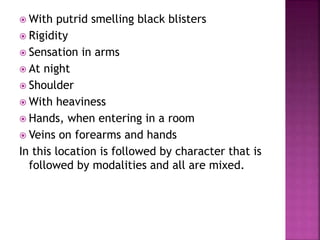
 With putrid smelling black blisters
 Rigidity
 Sensation in arms
 At night
 Shoulder
 With heaviness
 Hands, when entering in a room
 Veins on forearms and hands
In this location is followed by character that is
followed by modalities and all are mixed.
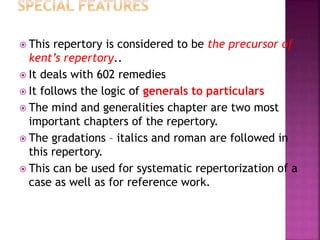
 This repertory is considered to be the precursor of
kent’s repertory..
 It deals with 602 remedies
 It follows the logic of generals to particulars
 The mind and generalities chapter are two most
important chapters of the repertory.
 The gradations – italics and roman are followed in
this repertory.
 This can be used for systematic repertorization of a
case as well as for reference work.
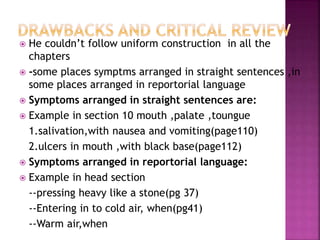
 He couldn’t follow uniform construction in all the
chapters
 -some places symptms arranged in straight sentences ,in
some places arranged in reportorial language
 Symptoms arranged in straight sentences are:
 Example in section 10 mouth ,palate ,toungue
1.salivation,with nausea and vomiting(page110)
2.ulcers in mouth ,with black base(page112)
 Symptoms arranged in reportorial language:
 Example in head section
--pressing heavy like a stone(pg 37)
--Entering in to cold air, when(pg41)
--Warm air,when
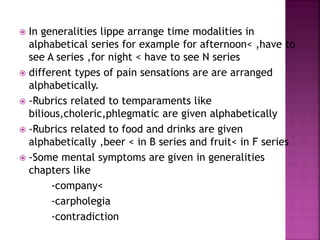
 In generalities lippe arrange time modalities in
alphabetical series for example for afternoon< ,have to
see A series ,for night < have to see N series
 different types of pain sensations are are arranged
alphabetically.
 -Rubrics related to temparaments like
bilious,choleric,phlegmatic are given alphabetically
 -Rubrics related to food and drinks are given
alphabetically ,beer < in B series and fruit< in F series
 -Some mental symptoms are given in generalities
chapters like
-company<
-carpholegia
-contradiction
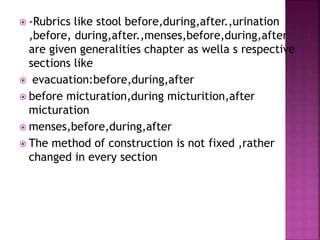
 -Rubrics like stool before,during,after.,urination
,before, during,after.,menses,before,during,after
are given generalities chapter as wella s respective
sections like
 evacuation:before,during,after
 before micturation,during micturition,after
micturation
 menses,before,during,after
 The method of construction is not fixed ,rather
changed in every section
 Although there are some non uniformities in
the arrangement of rubrics still it is a good
pioneer work that showed a light in the
correct direction as a result of which a
correct repertory by kent has become
possible.
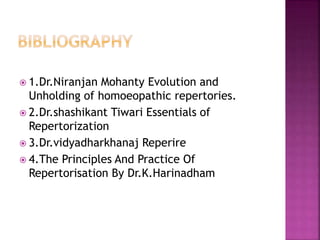
 1.Dr.Niranjan Mohanty Evolution and
Unholding of homoeopathic repertories.
 2.Dr.shashikant Tiwari Essentials of
Repertorization
 3.Dr.vidyadharkhanaj Reperire
 4.The Principles And Practice Of
Repertorisation By Dr.K.Harinadham
Lippes repertory

Lippes repertory

  • 2.
     Introduction  PhilosophicalBackground  Sources  Lippes Influence Over Kent:  Plan And Construction  Special Features  Drawbacks And Critical Review  Conclusion
  • 3.
     Constantine lippewas the son of Adolph lippe  Dr.lippie’s repertory is based on ‘ the repertory to the manual’ published in Allentown in 1838 by Dr.C.Hering.  In the preface of the book the author has written that this work is offered to the profession as an index to the more characteristic symptoms of the materiamedica.and presents only sych symptoms which proved to be characteristic by experience of many
  • 4.
     First edition- 1879 by boericke and tafel  First Indian edition 1933 by bhattacharya &co  Fifth edition 1972 by B.jan pblishes
  • 5.
     This repertoryis based on the first repertory and materiamedica published in the English language by Dr.C.Hering The repertory to the manual published in Allentown in the year 1838.  Boenninghausen’s work  A.lippe’smateriamedica  Bell’s diarrhea  H.N.Guernsey’ work  Hering’s work  Jahr’s work
  • 6.
     A needwas felt by the kent for a new and a more complete and useful repertory .  Initially kent used therapeutic pocket book but was soon dissatisfied with its philosophy  He started to go through the repertories→ liked the plan and arrangement repertory to more characteristic symptoms of our material medica by Constantine lippe
  • 7.
     He AddedNotes To Each Syptom Or Rubric.This Was Interleaved Many Time  Hence Kent Got Into Contact With Lipppe ,Who Wanted Kent To Work Along With Lee Who Was Preparing A 3rd Edition Of Lippes Repertory  By This Time Dr.Kent Had Prepared A Repertory Of Urinary Organs,chill,fever,sweat,etc.Hence It Canbe Said That Lippes Work Was The Base For Kents Repertory.
  • 8.
     Dr. Lippeused the principle ie, GENERALS TO PARTICULARS. He has given first the mental symptoms and then followed in the order as per used in material medica pura i.e, from above downwards.  All the sections are to be compared with generalities.
  • 9.
     After thedeath of Dr. C.Lippe all the manuscripts he had written for a second edition of his repertory was secured and included in Dr. Edumand lee’s ‘ repertory of the characteristic symptoms of the homoeopathic materiamedica’. This repertory might infact be considered as the second edition of Dr.lippe’s book.
  • 10.
     Hahnemannian schemais followed and ends with section called generalities which all previous sections are to be compared Repertory contains 3 parts  1.preface  2.repertory proper  3.index of remedies.
  • 11.
     PREFACE ; it deals the philosophical background and about publication of the repertory and books referred And instructions to the users.
  • 12.
     The repertorypart consist of 34 chapters as follows.  Mind and disposition  Sensorium- cloudiness, giddiness, vertigo etc.  Head interior, headache, congestion of blood, heaviness and fullness  Scalp  Eyes and sight  Nose and smell  Ears and hearing  Face, lips and lower jaw  Teeth and gums  mouth , palate and tongue.  Fauces, pharynx and oesophagus
  • 13.
     Appetite andtaste, hunger and thirst  Complaints during and after meals  Eructations, nausea, vomiting, hiccough, heartburn and waterbrash  Stomach and pit of stomach  Hypochondriae, kidneys , diaphragm, liver and spleen  Abdomen, groin and flatulency  Stool and anus  Urine and urinary organs  Male sexual organs  Female sexual organs  Coryza  Larynx and trachea  Cough
  • 14.
     Respiration  chestand heart  mammae and nipples  Neck. Back and sacrum  Upper extremities  Lower extremities  Sleep and dreams  Fever  Skin  Generalities, aggravation and amelioration
  • 15.
     INDEX OFREMEDIES: At the end of the book there is a index of remedies with their abbreviations. which consist of 602 remedies.  GRADATION:  Dr.Lippe has used gradations for the remedies in this repertory to the more characteristic symptoms of the materiamedica  1st grade- Italics  2nd grade-Ordinary roman
  • 16.
     Rubrics arearranged alphabetically .in the section head the rubrics and sub rubrics are arranged according to the following schema :  LOCATION; SUB SENSATION, SIDES-RIGHT,LEFT EXTENSION /RADIATION. MODALITIY (Example)  In chapter HEAD  Forehead (page32) -throbing. --left side of forehead --from forehead to occiput  Conditions(page 40)  Accompanied by(page45)
  • 17.
     SENSATION  SUBLOCATION SIDES-RIGHT,LEFT EXTENSION /RADIATION. MODALITIY  CONDITIONS  ACCOMPANIED BY (Example )  In chapter LOWER EXTREMITIES;  Coldness (page303) -feet -On one side --in the morning --in the evening  In morning (page 320)  At night  With epistaxis(page 322)
  • 18.
     -In conditions(modalities ,rubrics starts with time followed by alphabetic arranged which includes aggrevation and ameliorations.  Under accompanied by rubrics arranged alphabetically
  • 19.
    - unuiformity inthe arrangement of rubrics.  Eg: in the chapter eyes and sight  Burning  Burning in the morning  At twilight  Blow the eye when rubbing  On the brows  In canthi  Edges  The lids
  • 20.
     The repertoryalthough the rubrics have been arranged on the basis of deductive logic i.e, from general to particular but unuiformity in the arrangement of rubrics.  Eg: in the chapter eyes and sight  Burning  Burning in the morning  At twilight  Blow the eye when rubbing  On the brows  In canthi  Edges  The lids
  • 21.
     Whereas inchapter upper extremities :  Swelling arms :  Brachial bones  Shoulder  Upper arm  Elbow joint  Forearm  Wrist  Hands  Night  Dorsum  Pain in  Night  Fingers
  • 22.
     On lettingarms hang down  Finger joint  Finger tips  Thumb  Joints of  Bluish  Burning  Burn with pain as from  Cold  Dropsical, lymphatic , soft  Erysepalatous  Hard  Of axillary glands  Hot  Laninating  Large  Lymphatic
  • 23.
     Painful  Painless Pale  Red  Scarlet red  Shining  Ending in suppuration  In afternoon  At night  On morning in parts  After paralysis
  • 24.
     With putridsmelling black blisters  Rigidity  Sensation in arms  At night  Shoulder  With heaviness  Hands, when entering in a room  Veins on forearms and hands In this location is followed by character that is followed by modalities and all are mixed.
  • 25.
     This repertoryis considered to be the precursor of kent’s repertory..  It deals with 602 remedies  It follows the logic of generals to particulars  The mind and generalities chapter are two most important chapters of the repertory.  The gradations – italics and roman are followed in this repertory.  This can be used for systematic repertorization of a case as well as for reference work.
  • 26.
     He couldn’tfollow uniform construction in all the chapters  -some places symptms arranged in straight sentences ,in some places arranged in reportorial language  Symptoms arranged in straight sentences are:  Example in section 10 mouth ,palate ,toungue 1.salivation,with nausea and vomiting(page110) 2.ulcers in mouth ,with black base(page112)  Symptoms arranged in reportorial language:  Example in head section --pressing heavy like a stone(pg 37) --Entering in to cold air, when(pg41) --Warm air,when
  • 27.
     In generalitieslippe arrange time modalities in alphabetical series for example for afternoon< ,have to see A series ,for night < have to see N series  different types of pain sensations are are arranged alphabetically.  -Rubrics related to temparaments like bilious,choleric,phlegmatic are given alphabetically  -Rubrics related to food and drinks are given alphabetically ,beer < in B series and fruit< in F series  -Some mental symptoms are given in generalities chapters like -company< -carpholegia -contradiction
  • 28.
     -Rubrics likestool before,during,after.,urination ,before, during,after.,menses,before,during,after are given generalities chapter as wella s respective sections like  evacuation:before,during,after  before micturation,during micturition,after micturation  menses,before,during,after  The method of construction is not fixed ,rather changed in every section
  • 29.
     Although thereare some non uniformities in the arrangement of rubrics still it is a good pioneer work that showed a light in the correct direction as a result of which a correct repertory by kent has become possible.
  • 30.
     1.Dr.Niranjan MohantyEvolution and Unholding of homoeopathic repertories.  2.Dr.shashikant Tiwari Essentials of Repertorization  3.Dr.vidyadharkhanaj Reperire  4.The Principles And Practice Of Repertorisation By Dr.K.Harinadham