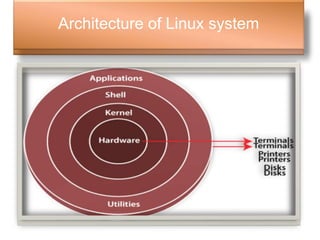
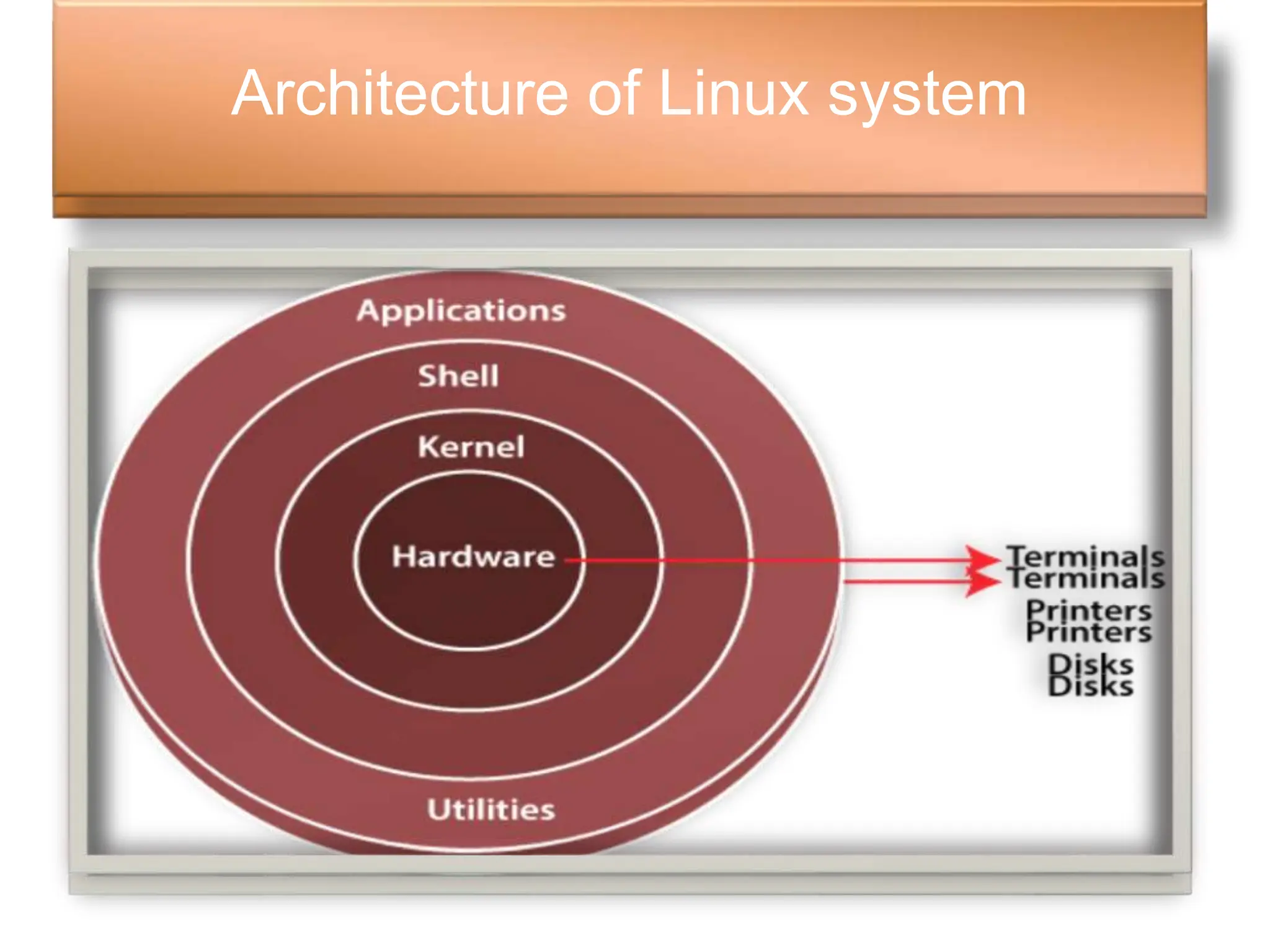
Architecture of Linux system
1. Kernel
The kernel is one of the core section of an operating
system. It is responsible for each of the major actions of
the Linux OS. This operating system contains distinct
types of modules and cooperates with underlying
hardware directly. The kernel facilitates required
abstraction for hiding details of low-level hardware or
application programs to the system.
• There are some of the important kernel types which
are mentioned below:
• Monolithic Kernel
• Micro kernels
• Exo kernels
• Hybrid kernels
2. System Libraries
THESE LIBRARIES CAN BE SPECIFIED
AS SOME SPECIAL FUNCTIONS.
THESE ARE APPLIED FOR
IMPLEMENTING THE OPERATING
SYSTEM'S FUNCTIONALITY AND DON'T
NEED CODE ACCESS RIGHTS OF THE
MODULES OF KERNEL.
THANK YOU
System Utility Programs
It is responsible for doing specialized level
and individual activities.
4. Hardware layer
Linux operating system contains a hardware
layer that consists of several peripheral
devices like CPU, HDD, and RAM.
Shell
It is an interface among the kernel and user. It can afford the
services of kernel. It can take commands through the user and
runs the functions of the kernel. The shell is available in distinct
types of OSes. These operating systems are categorized into two
different types, which are the graphical shells and command-line
shells.
The graphical line shells facilitate the graphical user interface, while
the command line shells facilitate the command line interface.
Thus, both of these shells implement operations. However, the
graphical user interface shells work slower as compared to the
command-line interface shells.
• There are a few types of these shells which are categorized as
follows:
• Korn shell
• Bourne shell
• C shell
• POSIX shell
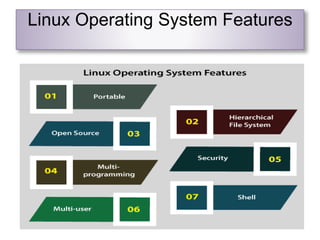
Linux Operating System Features
Portable
Linux OS can perform different types of
hardware and the kernel of Linux supports
the installation of any type of hardware
environment.
Open source
Linux operating system source code is
available freely and for enhancing the
capability of the Linux OS, several teams
are performing in collaboration.
Multiprogramming
Linux OS can be defined as a
multiprogramming system. It means more
than one application can be executed at
the same time.
Multi-user
Linux OS can also be defined as a multi-
user system. It means more than one user
can use the resources of the system such
as application programs,
memory, or RAM at the same time.
Hierarchical file system
Linux OS affords a typical file structure
where user files or system files are
arranged.
Security
Linux OS facilitates user security systems
with the help of various features of
authentication such as controlled access
to specific files, password protection, or
data encryption.
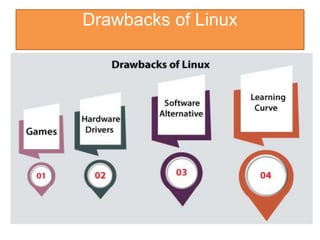
Drawbacks of Linux
Linux Operating System
Applications
Linux is a billion-dollar corporation
nowadays. Thousands of governments
and companies are using Linux operating
system across the world because of lower
money, time, licensing fee, and
affordability. Linux can be used within
several types of electronic devices. These
electronic devices are easily available for
users worldwide.
• Yamaha Motive Keyboard
• Volvo In-Car Navigation System
• TiVo Digital Video Recorder
• Sony Reader
• Sony Bravia Television
• One Laptop Per child XO2
• Motorola MotoRokr EM35 phone
• Lenovo IdeaPad S9
• HP Mini 1000
• Google Android Dev Phone 1
• Garmin Nuvi 860, 880, and 5000
• Dell Inspiron Mini 9 and 12

LINUX ppt.linux operating system and digram

  • 1.
    Architecture of Linuxsystem Architecture of Linux system
  • 2.
    1. Kernel The kernelis one of the core section of an operating system. It is responsible for each of the major actions of the Linux OS. This operating system contains distinct types of modules and cooperates with underlying hardware directly. The kernel facilitates required abstraction for hiding details of low-level hardware or application programs to the system. • There are some of the important kernel types which are mentioned below: • Monolithic Kernel • Micro kernels • Exo kernels • Hybrid kernels
  • 3.
    2. System Libraries THESELIBRARIES CAN BE SPECIFIED AS SOME SPECIAL FUNCTIONS. THESE ARE APPLIED FOR IMPLEMENTING THE OPERATING SYSTEM'S FUNCTIONALITY AND DON'T NEED CODE ACCESS RIGHTS OF THE MODULES OF KERNEL.
  • 4.
  • 5.
    System Utility Programs Itis responsible for doing specialized level and individual activities.
  • 6.
    4. Hardware layer Linuxoperating system contains a hardware layer that consists of several peripheral devices like CPU, HDD, and RAM.
  • 7.
    Shell It is aninterface among the kernel and user. It can afford the services of kernel. It can take commands through the user and runs the functions of the kernel. The shell is available in distinct types of OSes. These operating systems are categorized into two different types, which are the graphical shells and command-line shells. The graphical line shells facilitate the graphical user interface, while the command line shells facilitate the command line interface. Thus, both of these shells implement operations. However, the graphical user interface shells work slower as compared to the command-line interface shells. • There are a few types of these shells which are categorized as follows: • Korn shell • Bourne shell • C shell • POSIX shell
  • 8.
  • 9.
    Portable Linux OS canperform different types of hardware and the kernel of Linux supports the installation of any type of hardware environment.
  • 10.
    Open source Linux operatingsystem source code is available freely and for enhancing the capability of the Linux OS, several teams are performing in collaboration.
  • 11.
    Multiprogramming Linux OS canbe defined as a multiprogramming system. It means more than one application can be executed at the same time.
  • 12.
    Multi-user Linux OS canalso be defined as a multi- user system. It means more than one user can use the resources of the system such as application programs, memory, or RAM at the same time.
  • 13.
    Hierarchical file system LinuxOS affords a typical file structure where user files or system files are arranged.
  • 14.
    Security Linux OS facilitatesuser security systems with the help of various features of authentication such as controlled access to specific files, password protection, or data encryption.
  • 15.
  • 16.
    Linux Operating System Applications Linuxis a billion-dollar corporation nowadays. Thousands of governments and companies are using Linux operating system across the world because of lower money, time, licensing fee, and affordability. Linux can be used within several types of electronic devices. These electronic devices are easily available for users worldwide.
  • 17.
    • Yamaha MotiveKeyboard • Volvo In-Car Navigation System • TiVo Digital Video Recorder • Sony Reader • Sony Bravia Television • One Laptop Per child XO2 • Motorola MotoRokr EM35 phone • Lenovo IdeaPad S9 • HP Mini 1000 • Google Android Dev Phone 1 • Garmin Nuvi 860, 880, and 5000 • Dell Inspiron Mini 9 and 12

Editor's Notes

  • #2 The Linux operating system's architecture mainly contains some of the components: the Kernel, System Library, Hardware layer, System, and Shell utility.