LINUX
INTRODUCTION
Linux is an operating system (OS) that is free and open-source and is
based on Unix. Being used to run everything from servers and
supercomputers to smartphones and tablets, it is one of the most widely
used operating systems in the world. In mission-critical applications where
up time and data protection are crucial, Linux is frequently employed
because of its reliability, security, and flexibility.
HISTORY OF LINUX
Linus Torvalds began working on Linux in 1991 as a side project. The dearth
of free and open-source operating systems for personal computers irritated
Torvalds, who was a student at the University of Helsinki at the time. He
started developing his own operating system, which he termed Linux, and in
1991 he released the first iteration.
Linux quickly became the most widely used operating system for servers and
was well-liked by computer enthusiasts. Since its entry into the desktop
market in the early 2000 s, Linux has grown to be a competitive alternative
to Windows and mac OS.
HOW DOES LINUX WORK ?
Linux is an operating system that is based on Unix, making it a Unix-like
operating system. Early in the 1970 s, a team of Bell Labs researchers created
Unix. It has been used in a wide range of applications, including servers,
supercomputers, and embedded devices. Unix is a strong and adaptable
operating system.
In many aspects, Linux and Unix are comparable. The kernel, the essential
component of the operating system, is the foundation for both OSes. The kernel
controls the computer's hardware and software resources and offers
fundamental functions including process scheduling, memory management, and
file I/O.
Additionally, Linux includes a lot of features that Unix does not have. For
instance, because Linux is a free and open-source operating system, anyone can
use or alter the source code. Additionally, Linux is incredibly modular, making it
simple to alter and expand.
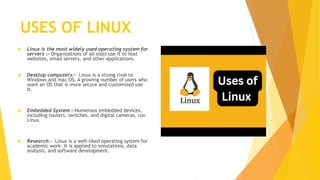
USES OF LINUX
 Linux is the most widely used operating system for
servers :- Organizations of all sizes use it to host
websites, email servers, and other applications.
 Desktop computers:- Linux is a strong rival to
Windows and mac OS. A growing number of users who
want an OS that is more secure and customized use
it.
 Embedded System :-Numerous embedded devices,
including routers, switches, and digital cameras, run
Linux.
 Research:- Linux is a well-liked operating system for
academic work. It is applied to simulations, data
analysis, and software development.
ADVANTAGES OF LINUX
Linux is an operating system that is free and open-source and
provides a number of benefits over other operating systems,
such as:
1. Free and open source :- Anyone can view and alter the source code of
Linux, which is accessible for free download and usage. Linux is a very
adaptable and adjustable operating system as a result.
2. Secure :- An extremely secure operating system is Linux. Compared to
Windows or mac OS, it is less vulnerable to viruses and malware. This is so
because Linux is an operating system similar to Unix that was created with
security in mind.
3. Stable :- An extremely stable operating system is Linux. It is well renowned
for being dependable and available. This is so because Linux is an operating
system similar to Unix, which is made to be dependable and stable.
CONCLUSION
In a wide range of applications, Linux is a strong and adaptable operating
system. It is secure, reliable, cost-effective, open-source, and
customization. Linux is a fantastic choice if you're seeking for a Windows or
mac OS substitute.

Linux operating system

  • 1.
  • 2.
    INTRODUCTION Linux is anoperating system (OS) that is free and open-source and is based on Unix. Being used to run everything from servers and supercomputers to smartphones and tablets, it is one of the most widely used operating systems in the world. In mission-critical applications where up time and data protection are crucial, Linux is frequently employed because of its reliability, security, and flexibility.
  • 3.
    HISTORY OF LINUX LinusTorvalds began working on Linux in 1991 as a side project. The dearth of free and open-source operating systems for personal computers irritated Torvalds, who was a student at the University of Helsinki at the time. He started developing his own operating system, which he termed Linux, and in 1991 he released the first iteration. Linux quickly became the most widely used operating system for servers and was well-liked by computer enthusiasts. Since its entry into the desktop market in the early 2000 s, Linux has grown to be a competitive alternative to Windows and mac OS.
  • 4.
    HOW DOES LINUXWORK ? Linux is an operating system that is based on Unix, making it a Unix-like operating system. Early in the 1970 s, a team of Bell Labs researchers created Unix. It has been used in a wide range of applications, including servers, supercomputers, and embedded devices. Unix is a strong and adaptable operating system. In many aspects, Linux and Unix are comparable. The kernel, the essential component of the operating system, is the foundation for both OSes. The kernel controls the computer's hardware and software resources and offers fundamental functions including process scheduling, memory management, and file I/O. Additionally, Linux includes a lot of features that Unix does not have. For instance, because Linux is a free and open-source operating system, anyone can use or alter the source code. Additionally, Linux is incredibly modular, making it simple to alter and expand.
  • 5.
    USES OF LINUX Linux is the most widely used operating system for servers :- Organizations of all sizes use it to host websites, email servers, and other applications.  Desktop computers:- Linux is a strong rival to Windows and mac OS. A growing number of users who want an OS that is more secure and customized use it.  Embedded System :-Numerous embedded devices, including routers, switches, and digital cameras, run Linux.  Research:- Linux is a well-liked operating system for academic work. It is applied to simulations, data analysis, and software development.
  • 6.
  • 7.
    Linux is anoperating system that is free and open-source and provides a number of benefits over other operating systems, such as: 1. Free and open source :- Anyone can view and alter the source code of Linux, which is accessible for free download and usage. Linux is a very adaptable and adjustable operating system as a result. 2. Secure :- An extremely secure operating system is Linux. Compared to Windows or mac OS, it is less vulnerable to viruses and malware. This is so because Linux is an operating system similar to Unix that was created with security in mind. 3. Stable :- An extremely stable operating system is Linux. It is well renowned for being dependable and available. This is so because Linux is an operating system similar to Unix, which is made to be dependable and stable.
  • 8.
    CONCLUSION In a widerange of applications, Linux is a strong and adaptable operating system. It is secure, reliable, cost-effective, open-source, and customization. Linux is a fantastic choice if you're seeking for a Windows or mac OS substitute.