Linux Commands Summary
Course Objective
 To introduce the Unix Operating System Concept.
 To introduce standard Unix commands.
 To introduce VI editor.
References
 Text Book Reference
 Brain W. Kernighan and Rob Pike, The UNIX Programming
Environment.
 A Practical Guide to Linux® Commands, Editors, and Shell
Programming - Mark Sobell's
 Web Reference
 Unix Tutorial For Beginners
 Introduction to Unix
 http://www.cis.uab.edu/cs344/spring2005/
What is Unix Operating System
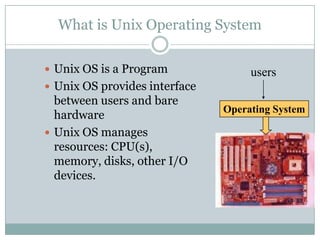
 Unix OS is a Program
 Unix OS provides interface
between users and bare
hardware
 Unix OS manages
resources: CPU(s),
memory, disks, other I/O
devices.
Operating System
users
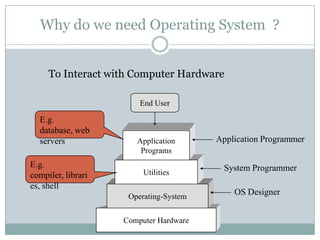
Why do we need Operating System ?
To Interact with Computer Hardware
End User
Computer Hardware
Operating-System
Utilities
Application
Programs
OS Designer
System Programmer
Application Programmer
E.g.
compiler, librari
es, shell
E.g.
database, web
servers
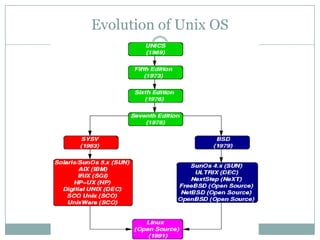
Evolution of Unix OS
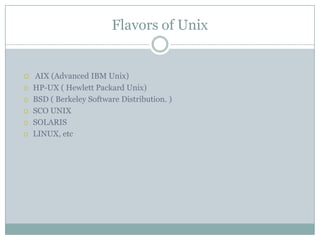
Flavors of Unix
 AIX (Advanced IBM Unix)
 HP-UX ( Hewlett Packard Unix)
 BSD ( Berkeley Software Distribution. )
 SCO UNIX
 SOLARIS
 LINUX, etc
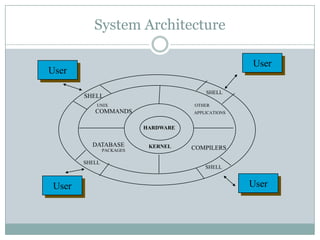
System Architecture
HARDWARE
KERNELDATABASE
UNIX
COMMANDS
COMPILERS
OTHER
APPLICATIONS
PACKAGES
SHELL
SHELL
SHELL
SHELL
User
UserUser
User
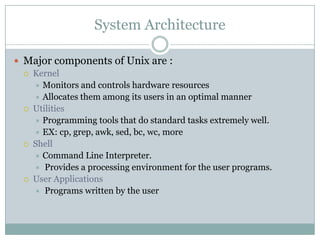
System Architecture
 Major components of Unix are :
 Kernel
 Monitors and controls hardware resources
 Allocates them among its users in an optimal manner
 Utilities
 Programming tools that do standard tasks extremely well.
 EX: cp, grep, awk, sed, bc, wc, more
 Shell
 Command Line Interpreter.
 Provides a processing environment for the user programs.
 User Applications
 Programs written by the user
Processing Environment
• User Program
– Set of instructions written by the user
• Process
– Instance of a program under execution
• Shell
– Provides a processing environment for the user programs
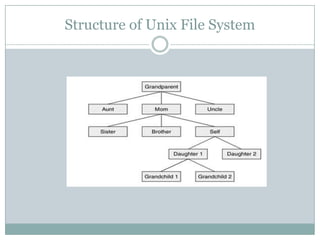
Structure of Unix File System
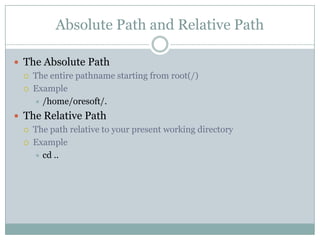
Absolute Path and Relative Path
 The Absolute Path
 The entire pathname starting from root(/)
 Example
 /home/oresoft/.
 The Relative Path
 The path relative to your present working directory
 Example
 cd ..
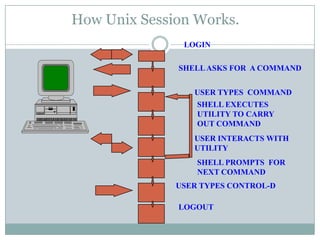
How Unix Session Works.
USER TYPES COMMAND
SHELL EXECUTES
UTILITY TO CARRY
OUT COMMAND
SHELLASKS FOR A COMMAND
USER INTERACTS WITH
UTILITY
SHELL PROMPTS FOR
NEXT COMMAND
USER TYPES CONTROL-D
LOGOUT
LOGIN
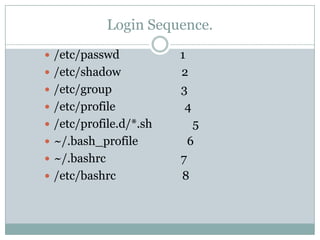
Login Sequence.
 /etc/passwd 1
 /etc/shadow 2
 /etc/group 3
 /etc/profile 4
 /etc/profile.d/*.sh 5
 ~/.bash_profile 6
 ~/.bashrc 7
 /etc/bashrc 8
Unix Command Structure
 Unix Command line structure
 command [options] [arguments]
Refer the following word Doc for Detail Command
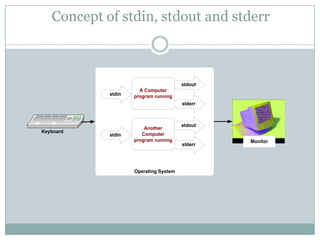
Concept of stdin, stdout and stderr
Operating System
Another
Computer
program running
stdout
stderr
stdin
Keyboard
A Computer
program running
stdout
stderr
stdin
Monitor
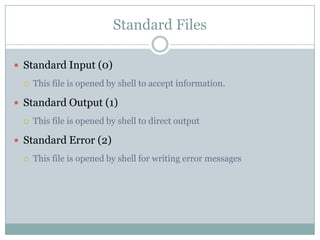
Standard Files
 Standard Input (0)
 This file is opened by shell to accept information.
 Standard Output (1)
 This file is opened by shell to direct output
 Standard Error (2)
 This file is opened by shell for writing error messages
Regular Expressions
What is it?
 String of ordinary and metacharacter which can be used to
match more than one type of pattern.
 Uses character set
 * , [], ^, $, {}, etc.
The Shell Metacharacters.
 See Demo at
/home/oresoft/Training/Linux/commands/shellChar
 * - Matches all filenames in current directory.
 ? - Matches a single character.
 [abc] - Matches a single character – either a, b or c.
 [!abc] - Matches a single character – which is not a, b or c.
 [a-c] – Matches a single character which is within the range of a and c.
 ^abc – Matches the pattern abc at the beginning of the line.
 abc$ - Matches the pattern abc at the end of the line.
Editor in Unix
 Need for editor in Unix
 Types of editor
 Line Editor
 ed : UC Berkeley
 ex : Powerful than ed, Bell Systems
 Full Screen Editor
 vi (stands for visual)
 vim – vi improved
 emacs (GNU)
The vi Editor.
 The important characteristic features are:
 Omnipresent
 Works on different Unix flavors
 Fast
 Various operations are very fast
 Powerful UNDO features
 Text in lines could be undone with very less effort
The vi Editor.
 The limitations are:
 Less user-friendly
 No graphical user interface
 Highly Case-sensitive
 Letter in small case has a different implementation in comparison
with the same letter in upper case
 Keystrokes could have more than one meaning
 A letter (of the same case) has different implementation across
different modes.
The vi Editor.
 Modes of working:
 Command Mode
 Keys are interpreted as commands
 Insert Mode
 Keys are interpreted as data
 Escape Mode
 Keys are interpreted for saving/exiting purposes
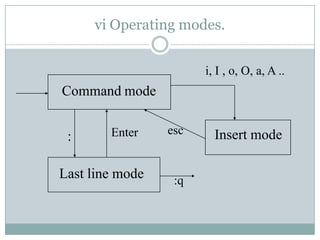
vi Operating modes.
Command mode
Insert mode
i, I , o, O, a, A ..
esc
Last line mode
Enter:
:q
Vi editor commands
 To move around
 h, j, k, l, ^D, ^U, G, 0, ^, $, w, b
 Inserting/Deleting text
 i, a, I, A, r, R, o, O, dd, dw, c$, D, x, X.
 Changing/Replacing text.
 cc, cw, c$, ~, J, u, . , yy, yw, p, P
 File manipulation.
 :w, :wq, ZZ, :w!, :q, :q! , :![command]
Searching a pattern
 /pattern
 Searches forward for first occurrence of a pattern.
 ?pattern
 Searches backward for first occurrence of a pattern.
 n
 Repeats the last search.
 N
 Repeats the last search command in opposite direction.
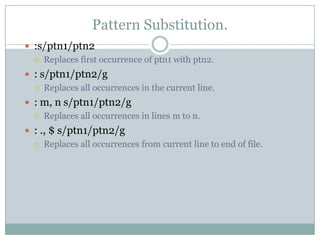
Pattern Substitution.
 :s/ptn1/ptn2
 Replaces first occurrence of ptn1 with ptn2.
 : s/ptn1/ptn2/g
 Replaces all occurrences in the current line.
 : m, n s/ptn1/ptn2/g
 Replaces all occurrences in lines m to n.
 : ., $ s/ptn1/ptn2/g
 Replaces all occurrences from current line to end of file.
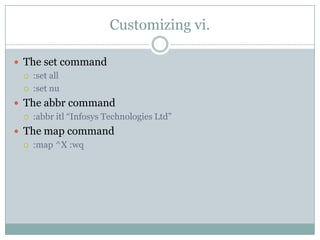
Customizing vi.
 The set command
 :set all
 :set nu
 The abbr command
 :abbr itl ―Infosys Technologies Ltd‖
 The map command
 :map ^X :wq
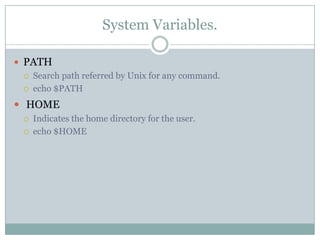
System Variables.
 PATH
 Search path referred by Unix for any command.
 echo $PATH
 HOME
 Indicates the home directory for the user.
 echo $HOME
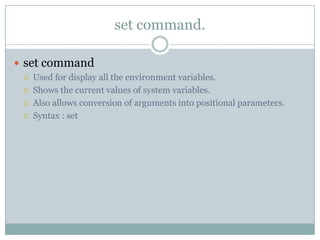
 set command
 Used for display all the environment variables.
 Shows the current values of system variables.
 Also allows conversion of arguments into positional parameters.
 Syntax : set
set command.
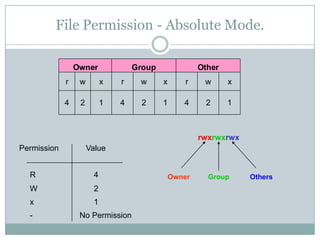
File Permission - Absolute Mode.
r w x r w x r w x
4 2 1 4 2 1 4 2 1
Owner Group Other
Group OthersOwner
rwxrwxrwx
Permission Value
R 4
W 2
x 1
- No Permission
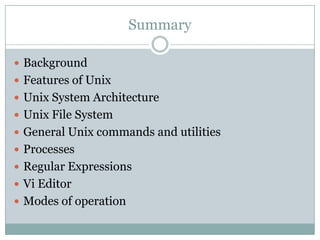
Summary
 Background
 Features of Unix
 Unix System Architecture
 Unix File System
 General Unix commands and utilities
 Processes
 Regular Expressions
 Vi Editor
 Modes of operation
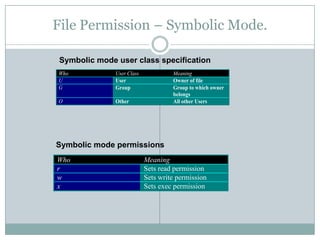
File Permission – Symbolic Mode.
Who User Class Meaning
U User Owner of file
G Group Group to which owner
belongs
O Other All other Users
Who Meaning
r Sets read permission
w Sets write permission
x Sets exec permission
Symbolic mode user class specification
Symbolic mode permissions
Examples of chmod
 Syntax.
chmod [0-7][0-7][0-7] filename (Absolute
Mode)
chmod [ugo][+-][rwx] filename (Symbolic
Mode)
$ chmod a=rw temp
$ ls -l temp-rw-rw-rw- 1 alex pubs 57 Jul 12 16:47 temp
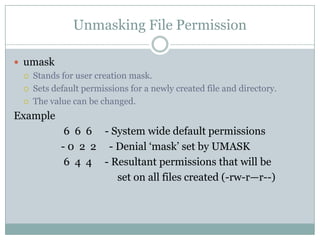
Unmasking File Permission
 umask
 Stands for user creation mask.
 Sets default permissions for a newly created file and directory.
 The value can be changed.
Example
6 6 6 - System wide default permissions
- 0 2 2 - Denial ‗mask‘ set by UMASK
6 4 4 - Resultant permissions that will be
set on all files created (-rw-r—r--)
Linux Command Suumary

Linux Command Suumary

  • 1.
  • 2.
    Course Objective  Tointroduce the Unix Operating System Concept.  To introduce standard Unix commands.  To introduce VI editor.
  • 3.
    References  Text BookReference  Brain W. Kernighan and Rob Pike, The UNIX Programming Environment.  A Practical Guide to Linux® Commands, Editors, and Shell Programming - Mark Sobell's  Web Reference  Unix Tutorial For Beginners  Introduction to Unix  http://www.cis.uab.edu/cs344/spring2005/
  • 4.
    What is UnixOperating System  Unix OS is a Program  Unix OS provides interface between users and bare hardware  Unix OS manages resources: CPU(s), memory, disks, other I/O devices. Operating System users
  • 5.
    Why do weneed Operating System ? To Interact with Computer Hardware End User Computer Hardware Operating-System Utilities Application Programs OS Designer System Programmer Application Programmer E.g. compiler, librari es, shell E.g. database, web servers
  • 6.
  • 7.
    Flavors of Unix AIX (Advanced IBM Unix)  HP-UX ( Hewlett Packard Unix)  BSD ( Berkeley Software Distribution. )  SCO UNIX  SOLARIS  LINUX, etc
  • 8.
  • 9.
    System Architecture  Majorcomponents of Unix are :  Kernel  Monitors and controls hardware resources  Allocates them among its users in an optimal manner  Utilities  Programming tools that do standard tasks extremely well.  EX: cp, grep, awk, sed, bc, wc, more  Shell  Command Line Interpreter.  Provides a processing environment for the user programs.  User Applications  Programs written by the user
  • 10.
    Processing Environment • UserProgram – Set of instructions written by the user • Process – Instance of a program under execution • Shell – Provides a processing environment for the user programs
  • 11.
    Structure of UnixFile System
  • 12.
    Absolute Path andRelative Path  The Absolute Path  The entire pathname starting from root(/)  Example  /home/oresoft/.  The Relative Path  The path relative to your present working directory  Example  cd ..
  • 13.
    How Unix SessionWorks. USER TYPES COMMAND SHELL EXECUTES UTILITY TO CARRY OUT COMMAND SHELLASKS FOR A COMMAND USER INTERACTS WITH UTILITY SHELL PROMPTS FOR NEXT COMMAND USER TYPES CONTROL-D LOGOUT LOGIN
  • 14.
    Login Sequence.  /etc/passwd1  /etc/shadow 2  /etc/group 3  /etc/profile 4  /etc/profile.d/*.sh 5  ~/.bash_profile 6  ~/.bashrc 7  /etc/bashrc 8
  • 15.
    Unix Command Structure Unix Command line structure  command [options] [arguments] Refer the following word Doc for Detail Command
  • 16.
    Concept of stdin,stdout and stderr Operating System Another Computer program running stdout stderr stdin Keyboard A Computer program running stdout stderr stdin Monitor
  • 17.
    Standard Files  StandardInput (0)  This file is opened by shell to accept information.  Standard Output (1)  This file is opened by shell to direct output  Standard Error (2)  This file is opened by shell for writing error messages
  • 18.
    Regular Expressions What isit?  String of ordinary and metacharacter which can be used to match more than one type of pattern.  Uses character set  * , [], ^, $, {}, etc.
  • 19.
    The Shell Metacharacters. See Demo at /home/oresoft/Training/Linux/commands/shellChar  * - Matches all filenames in current directory.  ? - Matches a single character.  [abc] - Matches a single character – either a, b or c.  [!abc] - Matches a single character – which is not a, b or c.  [a-c] – Matches a single character which is within the range of a and c.  ^abc – Matches the pattern abc at the beginning of the line.  abc$ - Matches the pattern abc at the end of the line.
  • 20.
    Editor in Unix Need for editor in Unix  Types of editor  Line Editor  ed : UC Berkeley  ex : Powerful than ed, Bell Systems  Full Screen Editor  vi (stands for visual)  vim – vi improved  emacs (GNU)
  • 21.
    The vi Editor. The important characteristic features are:  Omnipresent  Works on different Unix flavors  Fast  Various operations are very fast  Powerful UNDO features  Text in lines could be undone with very less effort
  • 22.
    The vi Editor. The limitations are:  Less user-friendly  No graphical user interface  Highly Case-sensitive  Letter in small case has a different implementation in comparison with the same letter in upper case  Keystrokes could have more than one meaning  A letter (of the same case) has different implementation across different modes.
  • 23.
    The vi Editor. Modes of working:  Command Mode  Keys are interpreted as commands  Insert Mode  Keys are interpreted as data  Escape Mode  Keys are interpreted for saving/exiting purposes
  • 24.
    vi Operating modes. Commandmode Insert mode i, I , o, O, a, A .. esc Last line mode Enter: :q
  • 25.
    Vi editor commands To move around  h, j, k, l, ^D, ^U, G, 0, ^, $, w, b  Inserting/Deleting text  i, a, I, A, r, R, o, O, dd, dw, c$, D, x, X.  Changing/Replacing text.  cc, cw, c$, ~, J, u, . , yy, yw, p, P  File manipulation.  :w, :wq, ZZ, :w!, :q, :q! , :![command]
  • 26.
    Searching a pattern /pattern  Searches forward for first occurrence of a pattern.  ?pattern  Searches backward for first occurrence of a pattern.  n  Repeats the last search.  N  Repeats the last search command in opposite direction.
  • 27.
    Pattern Substitution.  :s/ptn1/ptn2 Replaces first occurrence of ptn1 with ptn2.  : s/ptn1/ptn2/g  Replaces all occurrences in the current line.  : m, n s/ptn1/ptn2/g  Replaces all occurrences in lines m to n.  : ., $ s/ptn1/ptn2/g  Replaces all occurrences from current line to end of file.
  • 28.
    Customizing vi.  Theset command  :set all  :set nu  The abbr command  :abbr itl ―Infosys Technologies Ltd‖  The map command  :map ^X :wq
  • 29.
    System Variables.  PATH Search path referred by Unix for any command.  echo $PATH  HOME  Indicates the home directory for the user.  echo $HOME
  • 30.
     set command Used for display all the environment variables.  Shows the current values of system variables.  Also allows conversion of arguments into positional parameters.  Syntax : set set command.
  • 31.
    File Permission -Absolute Mode. r w x r w x r w x 4 2 1 4 2 1 4 2 1 Owner Group Other Group OthersOwner rwxrwxrwx Permission Value R 4 W 2 x 1 - No Permission
  • 32.
    Summary  Background  Featuresof Unix  Unix System Architecture  Unix File System  General Unix commands and utilities  Processes  Regular Expressions  Vi Editor  Modes of operation
  • 33.
    File Permission –Symbolic Mode. Who User Class Meaning U User Owner of file G Group Group to which owner belongs O Other All other Users Who Meaning r Sets read permission w Sets write permission x Sets exec permission Symbolic mode user class specification Symbolic mode permissions
  • 34.
    Examples of chmod Syntax. chmod [0-7][0-7][0-7] filename (Absolute Mode) chmod [ugo][+-][rwx] filename (Symbolic Mode) $ chmod a=rw temp $ ls -l temp-rw-rw-rw- 1 alex pubs 57 Jul 12 16:47 temp
  • 35.
    Unmasking File Permission umask  Stands for user creation mask.  Sets default permissions for a newly created file and directory.  The value can be changed. Example 6 6 6 - System wide default permissions - 0 2 2 - Denial ‗mask‘ set by UMASK 6 4 4 - Resultant permissions that will be set on all files created (-rw-r—r--)